mcp-observatory
Health Warn
- License — License: MIT
- Description — Repository has a description
- Active repo — Last push 0 days ago
- Low visibility — Only 5 GitHub stars
Code Warn
- fs module — File system access in .github/workflows/nightly-scan.template.yml
Permissions Pass
- Permissions — No dangerous permissions requested
No AI report is available for this listing yet.
Test, secure, and monitor MCP servers before agents depend on them.






The GitHub-native CI, SARIF, and security gate for MCP servers before agents depend on them.
Agents should not depend on tools nobody tests. MCP Observatory turns a local MCP check into release-gate evidence maintainers already understand: GitHub Actions, security findings, schema drift detection, PR reports, score badges, agent-accessible diagnostics, and GitHub Code Scanning SARIF.
Start with one server:
npx @kryptosai/mcp-observatory test npx -y my-mcp-server
Then convert the passing check into CI with Code Scanning:
npx @kryptosai/mcp-observatory setup-ci --all --command "npx -y my-mcp-server" --sarif
See the launch page, GitHub Code Scanning demo, and GitHub Code Scanning for MCP servers.
Two more fast paths:
Cloned this repo? Start here: CLONED_THIS.md. Want to contribute? Add one server to the MCP Target Registry or use the Agent Task Pack.
Add MCP CI in one command:
npx @kryptosai/mcp-observatory setup-ci --all --command "npx -y my-mcp-server"
Upload normalized MCP findings to GitHub Code Scanning when you want a security-native release gate:
npx @kryptosai/mcp-observatory setup-ci --all --command "npx -y my-mcp-server" --sarif
Add Observatory as an agent-accessible MCP server:
claude mcp add mcp-observatory -- npx -y @kryptosai/mcp-observatory serve
Building an autonomous agent, OpenClaw-style productivity machine, MCP gateway, or bot runtime? Start with the agent runtime quickstart, copy the OpenClaw MCP reliability agent template, or point your agent at llms.txt and AGENTS.md.
Or test a server immediately:
npx @kryptosai/mcp-observatory test npx -y @modelcontextprotocol/server-everything
Use it as a CLI, a GitHub Action, or an MCP server that lets your AI agent scan, test, record, replay, and verify other MCP servers autonomously.

Why MCP Observatory
MCP servers are becoming production dependencies. If agents rely on them, teams need a way to catch broken tools, unsafe schemas, schema drift, slow responses, and security footguns before those failures reach users.
Observatory gives maintainers and teams:
- One-command CI setup with
setup-ci --all - GitHub PR comments for compatibility, drift, and security findings
- GitHub Code Scanning SARIF for normalized MCP findings
- Health score badges for public trust signals
- Record/replay/verify workflows for regression testing
- MCP server mode so agents can inspect other MCP servers directly
- Production support path for hosted history, private repo reporting, certification, support, and fleet visibility
See the launch page, GitHub Code Scanning for MCP servers, Code Scanning demo, target gallery, target registry, target contribution guide, Agent Task Pack, setup-ci --doctor, MCP server security field guide, Safety Methodology, MCP Server Safety Index, June 2026 safety field report, reference evaluations, MCP lock files, public proof, campaign attribution, local metrics dashboard, and commercial support.
For Security And Platform Teams
MCP servers are becoming part of the AI software supply chain. Agents need reliable, testable, auditable tools before those tools become dependencies in mission-critical workflows.
MCP Observatory gives security and platform teams MCP server CI, schema drift detection, security findings, SARIF/HTML/Markdown reports, GitHub Code Scanning upload, and a path toward certification or fleet visibility. Local OSS use stays free; production, private repo, and fleet usage can move through a paid MCP Readiness Review.
Production Support
Local OSS use stays free under MIT. Teams running MCP in production can use the MCP Readiness Review for CI rollout, SARIF/Code Scanning setup, private repo review, recurring security reports, certification review, support, and fleet visibility. The default package starts at $2,500.
Run npx @kryptosai/mcp-observatory cloud, open a pilot request from the issue chooser, or see COMMERCIAL.md. Also see privacy and telemetry, campaign attribution, and terms for production use.
Quick Start
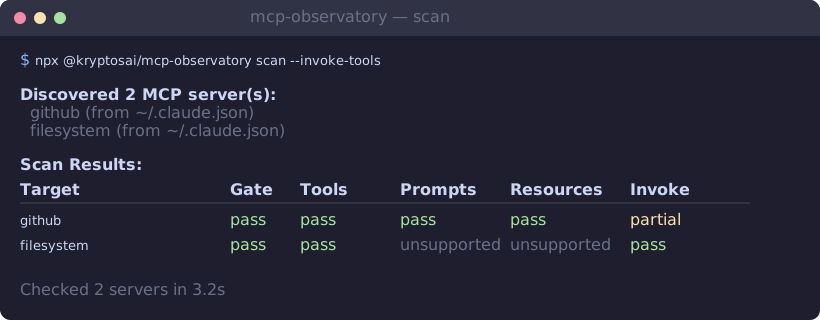
Scan every MCP server in your Claude config:
npx @kryptosai/mcp-observatory
Go deeper — also invoke safe tools to verify they actually run:
npx @kryptosai/mcp-observatory scan deep
Test a specific server:
npx @kryptosai/mcp-observatory test npx -y @modelcontextprotocol/server-everything
Add it to Claude Code as an MCP server:
claude mcp add mcp-observatory -- npx -y @kryptosai/mcp-observatory serve
Or add it manually to your config:
{
  "mcpServers": {
    "mcp-observatory": {
      "command": "npx",
      "args": ["-y", "@kryptosai/mcp-observatory", "serve"]
    }
  }
}
Commands
| Command | What it does |
|---|---|
scan |
Auto-discover servers from config files and check them all (default) |
scan deep |
Scan and also invoke safe tools to verify they execute |
test <cmd> / test --target <file> |
Test a specific server by command or target config |
record <cmd> |
Record a server session to a cassette file for offline replay |
replay <cassette> |
Replay a cassette offline — no live server needed |
verify <cassette> <cmd> |
Verify a live server still matches a recorded cassette |
diff <base> <head> |
Compare two run artifacts for regressions and schema drift |
watch <config> |
Watch a server for changes, alert on regressions |
suggest |
Detect your stack and recommend MCP servers from the registry |
serve |
Start as an MCP server for AI agents |
lock |
Snapshot MCP server schemas into a lock file |
lock verify |
Verify live servers match the lock file |
history |
Show health score trends for your MCP servers |
setup-ci / init-ci |
Create a GitHub Action and badge snippet for MCP compatibility/security checks |
setup-ci --sarif |
Generate a workflow that uploads normalized findings to GitHub Code Scanning |
setup-ci --doctor |
Inspect whether the repository has a complete CI adoption kit |
ci-report |
Generate CI report for GitHub issue creation |
enterprise-report |
Generate a static production/security report from run artifacts |
score <cmd> |
Score an MCP server's health (0-100) |
badge <cmd> |
Generate an SVG health score badge for README |
cloud |
Show hosted reporting, security review, and enterprise pilot options |
Run with no arguments for an interactive menu:
What It Does
Check capabilities — connects to a server and verifies tools, prompts, and resources respond correctly.
Invoke tools — goes beyond listing. Actually calls safe tools (no required params / readOnlyHint) and reports which ones work and which ones crash.
npx @kryptosai/mcp-observatory scan deep
Detect schema drift — diffs two runs and surfaces added/removed fields, type changes, and breaking parameter changes.
npx @kryptosai/mcp-observatory diff run-a.json run-b.json
Recommend servers — scans your project for languages, frameworks, databases, and cloud providers, then cross-references the MCP registry to suggest servers you're missing.
npx @kryptosai/mcp-observatory suggest
Or ask your agent "what MCP servers should I add?" when running in MCP server mode.
Security scanning — analyzes tool schemas for dangerous patterns: shell injection surfaces, broad filesystem access, missing auth, and credential leakage in responses.
npx @kryptosai/mcp-observatory test --security npx -y my-mcp-server
Record / replay / verify — capture a live session, replay it offline in CI, and verify nothing changed. Like VCR for MCP.
# Record a session
npx @kryptosai/mcp-observatory record npx -y @modelcontextprotocol/server-everything

# Replay offline (no server needed)
npx @kryptosai/mcp-observatory replay .mcp-observatory/cassettes/latest.cassette.json

# Verify the live server still matches
npx @kryptosai/mcp-observatory verify cassette.json npx -y @modelcontextprotocol/server-everything
Watch for regressions — re-runs checks on an interval and alerts when something changes.
npx @kryptosai/mcp-observatory watch target.json
Scan locations
When you run scan, it looks for MCP configs in:
~/.claude.json(Claude Code)~/Library/Application Support/Claude/claude_desktop_config.json(Claude Desktop, macOS)%APPDATA%/Claude/claude_desktop_config.json(Claude Desktop, Windows).claude.jsonand.mcp.json(current directory)
CI / GitHub Action
Add Observatory to your MCP server's CI pipeline:
npx @kryptosai/mcp-observatory setup-ci --all --command "npx -y my-mcp-server"
Check the adoption kit:
npx @kryptosai/mcp-observatory setup-ci --doctor
Or create the workflow manually:
# .github/workflows/observatory.yml
name: MCP Server Check
on: [pull_request]

permissions:
  contents: read

jobs:
  observatory:
    runs-on: ubuntu-latest
    steps:
      - uses: actions/checkout@v4
      - uses: KryptosAI/mcp-observatory/[email protected]
        with:
          command: npx -y my-mcp-server
          deep: true
          security: true
          comment-on-pr: false
          set-status: false
Action inputs:
| Input | Description | Default |
|---|---|---|
command |
Server command to test | (required if no target) |
target |
Path to target config JSON | |
targets |
Path to MCP config file for multi-server matrix scan | |
deep |
Also invoke safe tools | false |
security |
Run security analysis | false |
fail-on-regression |
Fail the action on issues | true |
fail-on-baseline-drift |
Fail the action when baseline verification detects drift | true |
comment-on-pr |
Post report as PR comment. Requires pull-requests: write. |
true |
set-status |
Set a commit status check (green/red) on the HEAD SHA. Requires statuses: write. |
true |
github-token |
Token for PR comments and commit statuses | ${{ github.token }} |
The action can comment on PRs and set commit statuses when the workflow grants write permissions. setup-ci generates read-only third-party-friendly workflows by default and lets maintainers opt into comments/statuses later. init-ci remains available as a backward-compatible alias. See action/README.md for all options.
Production teams can add hosted CI history, private-repo reporting, recurring security reports, certification review, support, and fleet visibility. Run npx @kryptosai/mcp-observatory cloud, see COMMERCIAL.md, or open a pilot request from the issue chooser.
Certified by MCP Observatory
MCP server maintainers can add a public compatibility/security signal to their README:
[](https://github.com/KryptosAI/mcp-observatory)
Or generate a score badge from a live check:
npx @kryptosai/mcp-observatory badge npx -y my-mcp-server --output docs/mcp-health.svg
See the certification distribution loop for the GitHub Action template, maintainer PR body, and badge rollout playbook.
Generate a pilot-ready production/security report from local run artifacts:
npx @kryptosai/mcp-observatory enterprise-report \
  --account "Your Company" \
  --format html \
  --output observatory-enterprise-report.html
For clearer internal account attribution in CI, set:
MCP_OBSERVATORY_ORG=your-company.com
MCP_OBSERVATORY_CONTACT=your-team-contact
Testing Feishu/Lark integrations? See the Feishu/Lark MCP guide.
Lock Files
$ npx @kryptosai/mcp-observatory lock              # Snapshot all server schemas
$ npx @kryptosai/mcp-observatory lock verify        # Verify no drift since last lock
Lock files are the package-lock for AI tools: commit the MCP contract, then make every tool, schema, prompt, or resource drift visible in CI. See MCP lock files.
Trend Tracking
$ npx @kryptosai/mcp-observatory history # Show health trends over time
Nightly Scans
$ npx @kryptosai/mcp-observatory ci-report # Generate regression report for CI
MCP Server Mode
No other testing tool is itself an MCP server. Add Observatory as a server and your AI agent can autonomously test, diagnose, and monitor your other MCP servers.
claude mcp add mcp-observatory -- npx -y @kryptosai/mcp-observatory serve
Your agent gets 10 tools:
| Tool | When to use it |
|---|---|
scan |
Check if all your configured MCP servers are healthy |
check_server |
Test a specific server before installing or after updating |
score_server |
Get a quick health score and grade for a server |
record |
Capture a baseline of a working server for future comparison |
replay |
Test against a recorded session — no live server needed |
verify |
Confirm a server update didn't break anything |
watch |
Check a server and see what changed since the last check |
diff_runs |
Find regressions between two check results |
get_last_run |
Retrieve previous check results for a server |
suggest_servers |
Discover MCP servers that match your project stack |
An AI tool that checks other AI tools. It is a tool testing tools that serve tools.
Security
The MCP server runs inside AI hosts where an LLM chooses which tools to call. To prevent prompt-injection attacks:
- Command allowlist: Only
npx,node,python,python3,uvx,docker,deno,bunare permitted as base executables. The CLI has no restrictions. - Path validation: File-reading tools are constrained to the runs/cassettes directories.
- No arbitrary execution: Use the CLI for unrestricted commands.
CLI vs MCP: Intentional Differences
| Feature | CLI | MCP Server | Why |
|---|---|---|---|
watch |
Polling loop | Single check + diff | Request/response doesn't support long-polling |
| Interactive menu | Arrow-key navigation | Not available | MCP has no interactive UI |
| Color output | --no-color flag |
Always plain text | MCP returns structured content |
report |
Renders saved artifacts | Not available | Agents read artifacts directly |
serve |
Starts MCP server | N/A | Is the MCP server |
run |
Reads target config files | Inline params | MCP tools accept params directly |
get_last_run |
Not available (use ls + diff) |
Available | Convenience for agents |
Compatibility
Works with any MCP server that uses standard transports:
| Transport | Examples | Adapter |
|---|---|---|
| stdio (most servers) | filesystem, memory, context7, brave-search, sentry, notion, stripe | local-process |
| HTTP/SSE (remote) | Cloudflare, Exa, Tavily | http |
| Docker | All @modelcontextprotocol/server-* images |
local-process via docker run -i |
Servers needing API keys work via env in the target config. Python servers work via uvx. See the full compatibility matrix for tested servers and known issues.
Target config files
For more control (env vars, metadata, custom timeout):
{
  "targetId": "filesystem-server",
  "adapter": "local-process",
  "command": "npx",
  "args": ["-y", "@modelcontextprotocol/server-filesystem", "."],
  "timeoutMs": 15000,
  "skipInvoke": false
}
npx @kryptosai/mcp-observatory run --target ./target.json
HTTP / SSE targets
{
  "targetId": "my-remote-server",
  "adapter": "http",
  "url": "https://mcp.example.com/mcp",
  "authToken": "${MCP_SERVER_TOKEN}",
  "headers": {
    "X-Api-Key": "$MCP_SERVER_API_KEY"
  },
  "timeoutMs": 15000
}
Target configs support ${VAR}, $VAR, and env:VAR references in authToken, headers, and local-process env values.
How It Compares
| Feature | Observatory | mcp-recorder | MCPBench | mcp-jest |
|---|---|---|---|---|
| Auto-discover servers | ✅ | — | — | — |
| Check capabilities | ✅ | — | ✅ | ✅ |
| Invoke tools | ✅ | — | — | ✅ |
| Schema drift detection | ✅ | — | — | — |
| Record / replay | ✅ | ✅ | — | — |
| Verify against cassette | ✅ | — | — | — |
| Response snapshot diffs | ✅ | — | — | — |
| Benchmarking / latency | — | — | ✅ | — |
| Jest integration | — | — | — | ✅ |
| MCP proxy mode | — | ✅ | — | — |
| Works as MCP server | ✅ | — | — | — |
Each tool has strengths. Observatory focuses on regression detection and CI-friendly workflows. mcp-recorder is great as a transparent proxy. MCPBench is the go-to for performance benchmarking. mcp-jest is ideal if you're already in a Jest workflow.
Prior Art
The record/replay/verify pattern is inspired by:
- VCR (Ruby) — pioneered cassette-based HTTP record/replay
- Polly.js (Netflix) — HTTP interaction recording for JavaScript
- mcp-recorder — MCP-specific traffic recording proxy
- MCPBench — MCP server benchmarking
- mcp-jest — Jest-style testing for MCP servers
Limitations
- Servers requiring interactive OAuth (e.g., Google Drive) need pre-authentication before Observatory can connect
- Custom WebSocket transports (e.g., BrowserTools MCP) are not supported
- A few servers time out or close before init — see known issues and compatibility
Contributing
See CONTRIBUTING.md for guidelines. The fastest way to contribute is to add a real passing target with a distinct capability shape, a clearer report surface, or a cleaner startup diagnosis.
If Observatory saved you a broken deploy, consider giving it a star. It helps others find the project.
Reviews (0)
Sign in to leave a review.
Leave a reviewNo results found