modelfit
Health Warn
- License — License: MIT
- Description — Repository has a description
- Active repo — Last push 0 days ago
- Low visibility — Only 6 GitHub stars
Code Fail
- rm -rf — Recursive force deletion command in bin/selftest.sh
- rm -rf — Recursive force deletion command in tests/design.test.sh
Permissions Pass
- Permissions — No dangerous permissions requested
No AI report is available for this listing yet.
Benchmark LLMs on your own codebase. Repo-specific probes, blind rubric-based judging, and correctness-first rankings.
ModelFit

Find the best LLM for your codebase—not someone else’s benchmark.
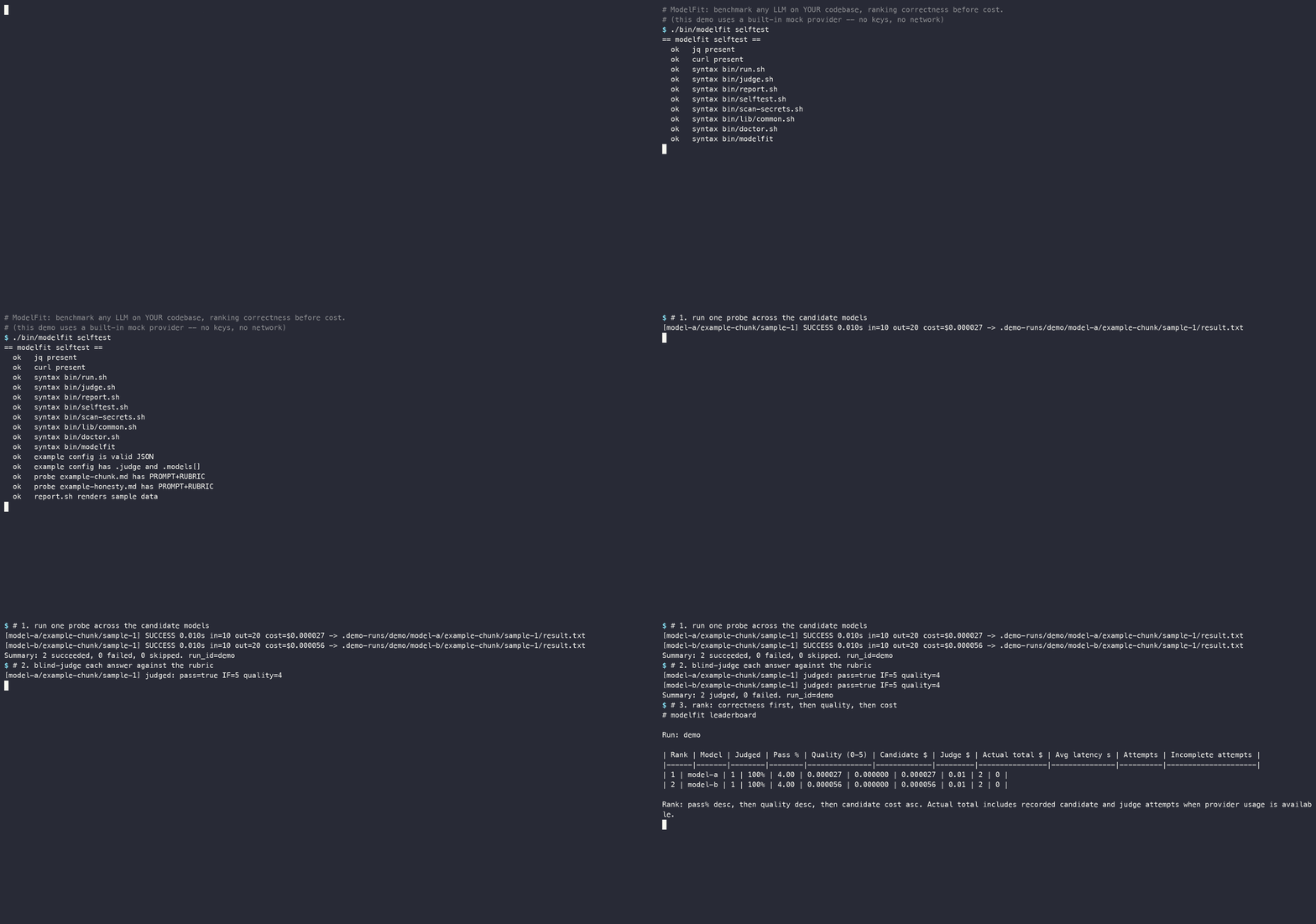
ModelFit runs repo-specific coding probes across candidate models, grades their answers blindly against explicit rubrics, and ranks correctness before cost and latency. Public benchmarks measure average code; ModelFit asks whether a cheaper or secondary model can handle your SwiftUI, your Drizzle migrations, your Cloudflare Worker, and your failure modes.
target repo ──▶ probes (PROMPT + RUBRIC) ──▶ run.sh ──▶ candidate answers
                                                              │
        attempts.csv + verdicts.csv ◀── judge.sh ◀────────────┘
                    │
                report.sh ──▶ coverage-aware leaderboard
Why it is different
- Your workflow, not a generic suite. Probes are generated from a target repo you name explicitly.
- Any compatible model. OpenAI-compatible
/chat/completionsand Anthropic-compatible/v1/messagesendpoints. - Blind rubric grading. The judge sees the task, rubric and answer, not the candidate model name.
- Correctness first. Cost and latency never rescue a correctness loss.
- Auditable runs. Every run gets an immutable run ID, per-sample outputs, attempt ledger and verdict ledger.
Security and data boundary
ModelFit is designed so secrets and run outputs are excluded from Git by default, but no local tool can guarantee you will never leak sensitive data.
config/models.jsonstores only the environment variable names that hold keys. The real keys live in your shell or.env, which is gitignored..env,config/models.json,runs/andresults.csvare ignored.bin/scan-secrets.shchecks tracked files for common secret-shaped strings before publishing.- Generated probes may contain proprietary code, customer data, credentials or personal data. Review probes before running them.
- Probe prompts are sent to each configured candidate provider. Task, rubric and candidate answer are sent to the judge provider.
Quickstart
git clone https://github.com/kwadwoadu/modelfit.git
cd modelfit
brew install jq shellcheck   # shellcheck optional, for local linting

./bin/selftest.sh            # zero API spend; includes mock-provider tests

cp config/models.example.json config/models.json   # edit models + judge
cp .env.example .env                                # paste keys; never commit
./bin/modelfit doctor --repo ../your-app
Generate probes with Claude Code from the ModelFit repo:
/modelfit --repo ../your-app
Then smoke-test one probe/model before the full suite:
./bin/modelfit run example-chunk fake-model-key --samples 1
./bin/modelfit judge example-chunk fake-model-key
./bin/modelfit report
Full run:
for p in probes/*.md; do
  n=$(basename "$p" .md)
  ./bin/modelfit run "$n" all --samples 1
  ./bin/modelfit judge "$n" all
done
./bin/modelfit report
If one model fails, the batch continues where possible but exits non-zero and the report shows incomplete coverage.
Add your workflow
- Agent-generated probes. Run
/modelfit --repo ../your-app. The command inspects the target repository, writes 6–10 probes intoprobes/, and records non-sensitive provenance. - Manual probes. Copy
probes/example-*.md: a# PROMPTsent to each model and a# RUBRICthe judge grades against.
A good probe has one decisive discriminator: the subtle thing a weaker model gets wrong.
Testing design elements
Probes carry a scoring: value in their frontmatter. Text probes use scoring: judge (the default). A design probe sets scoring: screenshot: the candidate returns a single self-contained HTML document, ModelFit renders it headlessly to a PNG, and the judge grades the rendered screenshot (layout, hierarchy, spacing, visible state) — not just the source text. See probes/example-design.md.
- Rendering requires a headless browser. Install Playwright (
npx playwright install chromium) or a Chromium/Chrome binary (chromium,google-chrome, ...). This is the only extra dependency and is used solely forscoring: screenshotprobes at run time; selftest and CI never need it. - Override the renderer with
MODELFIT_RENDER_CMD, a command template containing{IN}and{OUT}placeholders (e.g.MODELFIT_RENDER_CMD='wkhtmltoimage {IN} {OUT}'). - Viewport defaults to
1280x800; override withMODELFIT_RENDER_VIEWPORT=1440x900. - Screenshot samples write both
result.html(the source) andresult.png(the render). If rendering fails, the sample is markedrender_errorand counts as a failure so coverage stays honest. - Render a saved HTML file by hand with
./bin/modelfit render <html_in> <png_out>.
How scoring works
run.shsends each probe to candidates, strips markdown fences, retries empty/truncated replies up to the token ceiling, and records every attempt inruns/<run-id>/attempts.csv.judge.shsends task + rubric + untrusted candidate answer to the judge, validates strict JSON verdicts, and writesruns/<run-id>/verdicts.csv.report.shranks by pass percentage, quality and candidate cost, while showing judged count, attempts, incomplete attempts and actual recorded total cost. Add--by-taskfor a per-probe candidate-cost breakdown (which kinds of task are expensive on which model).- Candidate cost, judge cost and retry cost are tracked from provider token usage when available. Missing usage is
NA, not zero.
Limitations
- LLM judges are useful but not objective. Blind labels reduce model-identity bias; they do not remove style bias or prompt-injection risk.
- Judge-only probes do not execute candidate code. If compilation is decisive, add an executable gate in a future probe.
- Prices in
config/models.example.jsonare placeholders. Verify provider pricing before trusting cost comparisons. - One sample is not statistical confidence. Use
--samples Nwhen run-to-run variance matters. - Provider “compatibility” varies. Use
./bin/modelfit doctorand a smoke probe before a large run.
Layout
modelfit/
├─ bin/    modelfit run.sh judge.sh report.sh doctor.sh selftest.sh scan-secrets.sh
├─ bin/lib/common.sh
├─ config/ models.example.json
├─ probes/ example-honesty.md example-chunk.md
├─ prompts/ generate-probes.md judge-system.md
├─ tests/ mock-provider reliability tests
├─ .claude/commands/modelfit.md
├─ examples/ results.example.csv .env.example .gitignore LICENSE
MIT licensed. Built by Kwadwo Adu.
Reviews (0)
Sign in to leave a review.
Leave a reviewNo results found