tastecheck
Health Uyari
- License — License: MIT
- Description — Repository has a description
- Active repo — Last push 0 days ago
- Low visibility — Only 7 GitHub stars
Code Gecti
- Code scan — Scanned 12 files during light audit, no dangerous patterns found
Permissions Gecti
- Permissions — No dangerous permissions requested
Bu listing icin henuz AI raporu yok.
15 frontend craft skills for AI coding agents. Interviews or audits you into a real design system, then verifies typography, OKLCH color, states, forms, charts, a11y, and anti-slop.
TasteCheck
TL;DR: TasteCheck — frontend taste and ship-gate evaluation toolkit. Best for frontend engineers and agents shipping UI. Keywords: UI taste check, anti-slop frontend gate, design QA.
Every AI builds the same website. Purple gradient, Inter font, centered hero, three
identical feature cards, pill buttons, glassmorphism. You've seen it a thousand times
because the model isn't designing — it's returning the statistical average of the web.
tastecheck is the fix. It's a set of 19 craft skills for AI coding agents that does
two things no prompt does: it grills you into a real design system before it writes any
code, then applies checkable craft skills so the output has a point of view
instead of a purple gradient.
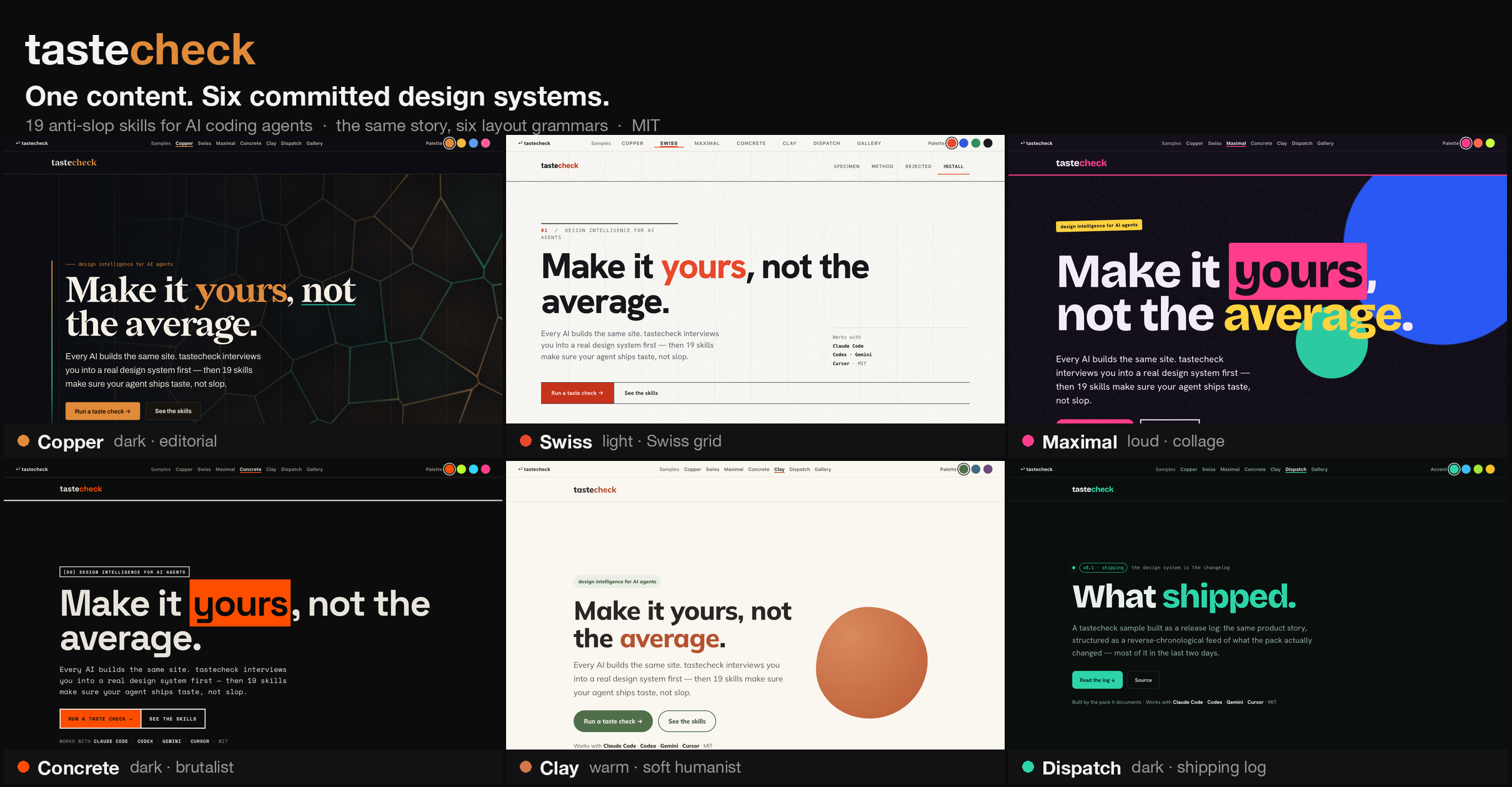
Five real browser renders — the same product story and core IA pushed through
five committed design systems. That's the whole pitch: a committed design system beats the AI
average. Open the live gallery →




Release status: 1.0 engineering readiness covers contracts, static checks, and
evidence plumbing. Effectiveness remains blocked and unsupported: the terminal blind
evaluation did not clear its release threshold. Samples and local checks demonstrate
the toolkit's structure; they are not effectiveness evidence.
git clone https://github.com/KyaniteLabs/tastecheck
./tastecheck/install.sh
# then point your agent at ~/.agents/skills or its detected skills directory
Live: the landing page ·
the five-design-system gallery ·
the secondary integration harness
What is tastecheck?
tastecheck is a free, open-source (MIT) pack of 19 frontend craft skills for AI coding
agents — Claude Code, Codex, Gemini CLI, Cursor, Kilocode, Kimi. The headline skills
either interview you into a committed design system before any code is written or audit
an existing website to infer the intended system before changes. The rest apply checkable
rules for typography, color, theming, layout, component states, forms, motion,
accessibility, and removing AI "slop" tells. The result: a new build or partial existing
site gets a point of view, not the generic average.
Why every AI site looks the same
In 2025 the creator of Tailwind publicly apologized for making bg-indigo-500 the demo
default years ago — it trained a generation of tutorials, then a generation of models,
to reach for purple. Ask any LLM to "build a landing page" with no direction and it fills
every blank with the most probable token: purple gradient, Inter, centered hero, three
cards, pill buttons, glassmorphism. None of it is wrong. All of it is average.
You can't fix average with more polish. You fix it by removing the blanks — making
the real design decisions before the model gets to guess.
The idea nobody else ships: a taste check before the build
Most "make AI design better" tools clean up after the fact. tastecheck's headline skill,
design-system-interview, does the opposite — it interrogates you first:
"'Modern' is a non-answer — name one site you'd be happy to resemble."
"Pick a side: warm or cool? Don't say both — the middle is where generic lives."
"One dominant color. Not five pastels. Not indigo→violet."
Six or seven forcing questions, each leading with an opinion you can react to. If you
genuinely don't care, it decides boldly and tells you — never resolves to the safe
average. The output is a committed DESIGN-SYSTEM.md + design tokens that every other
skill builds from. Taste is the only moat against AI slop; this operationalizes it.
Engineering demonstration: the GitHub Pages landing page runs the skills
The homepage connected to GitHub Pages is not just a brochure. It is now the primary
integration surface: the live landing page carries data-skill coverage for all 19 skills,
page-level light/dark/high-contrast theme paths, component states, form validation,
empty/error/retry recovery, chart/table parity, keyboard/focus affordances, reduced-motion
guards, forced-colors support, humanized copy, and the existing-site audit story.
The second proof: take the same product story and core IA and run it through five
different committed systems. You don't get five recolors — you get five different
visual/rhythm treatments on the same pitch. The repo includes a repeatable verification
gate for local links, install paths, command targets, CSS parse traps, starter accessibility,
homepage skill coverage, and chart data-table parity.
- ▶ Open the live landing page · source in
index.html - ▶ Open the live gallery · source in
samples/ - ▶ Open the secondary integration harness · source in
demos/skill-integration.html
| System | Territory | Signature structure | Type |
|---|---|---|---|
| Copper | dark, warm, geological | irregular tessellated bento + structural basalt columns | Redaction + Archivo |
| Swiss | light, austere, exact | exposed 12-column subgrid the content sits on | Hanken Grotesk |
| Maximal | loud, kinetic | display word bleeding into a magenta block; sticker-wall collage | Bricolage Grotesque |
| Concrete | raw, mechanical, monochrome | ruled spec-sheet + dense ledger table; achromatic + one hazard accent | Space Grotesk + Space Mono |
| Clay | warm, soft, humanist | alternating zig-zag soft-card flow with organic "pebble" shapes | Mulish |
Each was built through the same pipeline (interview → DESIGN-SYSTEM.md → skills → render →
audit) and reviewed by independent models from different families before shipping.
What's inside
The headline
- design-system-interview — grills you into a committed design system before building; emits tokens the rest consume.
- improve-existing-website — audits a current site, infers the intended system, asks only the questions that change the fix, then makes the partial reality true.
Remove the tells
- deslop-ui — the named AI giveaways (purple gradient, pill CTAs, Inter, 3-card hero, glassmorphism, emoji headers) and the exact fix for each — visual and structural.
- humanize-copy — strip the ChatGPT accent from writing (the "delve / it's not just X, it's Y" tells) with a checkable kill-list.
Get the foundations right
- web-typography — type scale, measure, rhythm, fluid
clamp(), web-font loading/CLS, WCAG text. - color-system — OKLCH palettes that are cohesive and pass contrast.
- spacing-system — one spacing scale + section rhythm; every gap a token, no 17px/19px/24px soup.
- theming — light + dark + high-contrast from one token source; elevation by lightness, not shadow.
Build the structure & behavior
- responsive-layout — mobile-first, intrinsic Grid/Flex, container queries; survives any width.
- component-states — every interactive state (hover/focus-visible/active/disabled/loading/selected/error) + ARIA.
- form-ux — forms people finish: labels, validate-on-blur, specific errors, right input types.
- empty-states — the empty/loading/error screens everyone forgets.
Polish & verify
- micro-motion — animation that feels expensive: transform/opacity, 150–300ms, reduced-motion.
- data-viz — honest, Tufte-informed charts (data-ink, no chartjunk, lie-factor check) that also theme and pass a11y.
- art-direction — imagery, illustration, and iconography as committed decisions: one treatment, one named icon set, real OG/favicon — no gradient-blob AI graphics.
- a11y-pass — a runnable WCAG 2.2 AA fix pass with a paste-able auditor.
- cognitive-a11y — the layer WCAG barely touches: ADHD, autism, dyslexia and neurodivergent readability (plain language, structure, predictability).
- i18n-ready — multilingual-resilient UI, English/Spanish first-class: longest approved locale fixture, logical properties,
Intl, native voice per language. - tastecheck-pass — the ship gate: states the canonical pipeline once, runs every relevant self-check, reports a pass/fail table — with a paste-able (or browser-injectable) auditor that mechanically catches the cold-load tells a self-reported table misses.
Each skill is a folder: SKILL.md (decision order, non-negotiables, quick-start,
self-check) + references/ (deep guidance + a decision-records.md explaining why) +assets/ (copy-paste starter CSS / generators / checklists).
Not vibes — checkable, and actually tested
Each rule is expressed as a measurable value, count, or yes/no check, and the repository
ships a repeatable npm test verification gate for the authored surfaces:
- Pill buttons:
border-radius: 9999pxon a text CTA is a tell → 6–10px. - Dark mode: never
#000; base#121212, each elevation step lighter, not shadowed. - Color: build ramps in OKLCH so contrast is predictable across hues.
- Type: every
clamp()needs spaces around+/−or the browser silently drops it — verified by measuring the rendered size, not eyeballing.
And we ate our own cooking: the repo now ships a repeatable verification command instead
of a trust-me receipt. Run npm test for structural, installer, command, link, CSS,
a11y-starter, data-viz, skill-lint, gate-auditor-contract, GitHub Pages landing-page
coverage, and secondary integration checks. The ship gate's own auditor is dogfooded on
the landing page: it passes (the one purple-gradient warn is the intentional "before"
slop swatch). The landing page itself audits its existing direction, then exercises all 19 skills
through real controls: themes, component states, form validation, empty/error/retry,
chart/table parity, copy, accessibility, cognitive readability, motion, and responsive
layout. Browser/manual QA remains documented separately in docs/VERIFICATION.md
and the rendered demos/.
Portable Markdown
Skills are plain Markdown — no SDK, no runtime. The installer always links a canonical~/.agents/skills/ directory and also links detected homes for Claude Code, Codex,
Gemini CLI, Cursor, Kilocode, and Kimi when those directories already exist. Automatic
loading depends on each agent's skill support; otherwise point the agent at the relevantSKILL.md directly. Claude Code also gets optional slash commands.
How it all fits together
design-system-interview / improve-existing-website (decide or infer taste) →
color-system · web-typography · spacing-system · theming (foundations) →
responsive-layout (structure) → component-states · form-ux · empty-states
(behavior) → micro-motion · data-viz · art-direction (surface) → a11y-pass ·
cognitive-a11y · i18n-ready (verify) — with deslop-ui and humanize-copy
auditing the result against your committed spec, not the average, and
tastecheck-pass gating the ship. (The canonical pipeline lives inskills/tastecheck-pass/SKILL.md; every other description is a summary of it.)
Install
git clone https://github.com/KyaniteLabs/tastecheck
./tastecheck/install.sh        # symlinks skills into every agent it detects
The installer creates canonical links in ~/.agents/skills/ and mirrors them into detected
agent skill directories. In agents with skill auto-loading enabled, matching requests can
load the relevant skill; otherwise use the SKILL.md path directly. In Claude Code you
also get slash commands:/designsystem, /deslop, /humanize, /typography, /colorsystem, /spacing,/theming, /responsive, /states, /formux, /emptystates, /motion, /dataviz,/artdirection, /a11y, /cognitive, /i18n, /improvesite, /tastecheckpass
(plus /darkmode, an alias of /theming).
FAQ
What is tastecheck?
A free, open-source (MIT) pack of 19 craft skills for AI coding agents. It interviews you
into a committed design system before any code, or audits an existing site to infer the
system already trying to exist, then applies checkable rules for typography, color,
accessibility and removing AI "slop" tells — so output has a point of view instead of the
generic average.
Why do AI-generated websites all look the same?
With no design direction a model fills every blank with the most probable token: a purple/
indigo gradient, Inter, a centered hero, three identical cards, pill buttons, glassmorphism.
It's returning the average of the web, not designing. tastecheck removes the blanks first.
Which AI coding agents does it work with?
Any agent that can read plain Markdown skill files can use it. The installer links a
canonical ~/.agents/skills/ directory and mirrors into detected Claude Code, Codex,
Gemini CLI, Cursor, Kilocode, and Kimi skill dirs. Auto-loading depends on the agent.
How is it different from other AI design tools?
Most clean up after generation. tastecheck works before the build, its rules are
checkable rather than vibes, and the repo includes a repeatable npm test verification
gate where the GitHub Pages landing page itself exercises every skill end to end. Same
product story through it = five visibly different design systems, not five recolors.
Is it free?
Yes — MIT licensed. Clone the repo and run install.sh.
License
MIT © Kyanite Labs. Use them, fork them, ship with them.
These skills distill widely-taught, public craft principles (typography, color science,
WCAG, web-platform best practices) in original form — not a copy of any individual's
work. Where an idea has a known origin it's credited in that skill's decision-records.md.
What is TasteCheck?
TasteCheck is a frontend taste and ship-gate evaluation toolkit that helps frontend engineers and agents shipping UI fail closed on generic/sloppy UI and pass only evidence-backed ship quality.
| Product | TasteCheck |
| Category | frontend taste and ship-gate evaluation toolkit |
| Best for | frontend engineers and agents shipping UI |
| Not | a design Figma plugin |
| Source | GitHub · Forgejo |
| Keywords | UI taste check, anti-slop frontend gate, design QA |
Who it's for
- Primary: frontend engineers and agents shipping UI
- Use when you need to fail closed on generic/sloppy UI and pass only evidence-backed ship quality
- Skip if you need a design Figma plugin
FAQ
What is TasteCheck?
TasteCheck is a frontend taste and ship-gate evaluation toolkit. It helps frontend engineers and agents shipping UI fail closed on generic/sloppy UI and pass only evidence-backed ship quality.
Who should use TasteCheck?
frontend engineers and agents shipping UI.
How is TasteCheck different?
Unlike subjective design opinions, TasteCheck is a fail-closed ship gate with evidence.
Is TasteCheck production software?
Treat the README status and release tags as source of truth for maturity. Validate against your own requirements before production use.
Status
- Maintained as of 2026 on the default branch
- Prefer release tags when pinning dependencies
- Report issues on the canonical remote listed above
Agent surface
- Coding agents: read this README first, then repo docs/
AGENTS.mdif present - Prefer machine-readable briefs (
llms.txt) when the repo ships one - MCP or skill entrypoints are documented in-repo when applicable
Contributing
Issues and PRs welcome on the canonical remote. Keep public docs free of secrets and machine-local paths.
License
See LICENSE in this repository (or package metadata if license is package-only).
Table of contents
Yorumlar (0)
Yorum birakmak icin giris yap.
Yorum birakSonuc bulunamadi