ai-film-skills
Health Gecti
- License — License: NOASSERTION
- Description — Repository has a description
- Active repo — Last push 0 days ago
- Community trust — 14 GitHub stars
Code Basarisiz
- eval() — Dynamic code execution via eval() in skills/local-ai-film/examples/scripts/consistency.py
Permissions Gecti
- Permissions — No dangerous permissions requested
Bu listing icin henuz AI raporu yok.
本地 AI 短片生产线 skill 套件 —— 一张 12GB 显卡跑通 LTX / Wan / MiniMax H3,含 1600+ 行踩坑经验与防同质化机制
ai-film-skills
A directing knowledge base for locally-generated AI short films — six Claude Skills about what to decide, not how to install things.
中文 · Gallery · Two kinds of skill · MiniMax H3 on 12 GB · Attribution
Install it and it works. Easiest path — paste this at Claude Code:
"Install this skill for me: https://github.com/L-Trunks/ai-film-skills — clone it and run install.sh"
Then say "make a short film." The skill itself is methodology and knowledge; it depends on no scripts, no models, no GPU.To run the reference implementations too, set three paths in
examples/scripts/config.py
and runpython doctor.pyfirst.
Watch first
Four films, all produced on one RTX 4070 Ti (12 GB). No cloud API in the generation path.
The clips below are silent GIFs. Full versions with sound:
▶ The Jailer · Mirror — Below the Clock Tower ·
Mirror — Rooftop · Nine Tails ·
Shan Hai
The Jailer — long-shot, episodic drama with dialogue
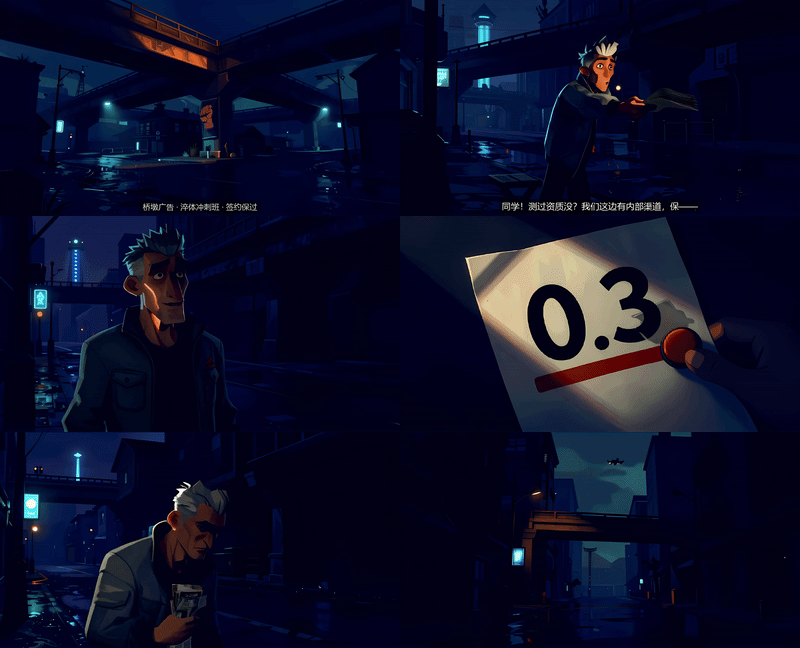
▶ 48-second clip, with sound — episodes 1–2, from 1'34" to 2'22".
Two episodes, 40 and 34 shots, 1'47" each. Native lip-synced dialogue from the model,
re-voiced in post. This is the first one where the audience checks your work: the same
character has to still be the same character forty shots later, and the lines have to line up.
It also overturned two of our own conclusions — that over-long prompts should be cut down,
and that audio: BGM throughout was unbreakable. Both are written up in the
gallery.
⚠️ Where this stops. We ran two more episodes and then called it: on a 12 GB card
this pipeline makes films, not series. At 736×416 and ~7 min per 5-second shot, 68 shots
is an overnight run for 1'45" of finished cut — and at 0.31 MP a face in a medium shot is
40–90 px, so 76% of character shots are forced to be close-ups. Episodic drama needs
mid-shots to play scenes. Neither limit is a craft problem and neither goes away by
picking a simpler art style — ours already was one. Everything below still holds on
cloud APIs or bigger cards; seedialogue-drama.mdfor the full
write-up.
Mirror — when the line above stops working, ship excerpts instead

▶ Below the Clock Tower, 33 seconds, with sound —
9 shots, 8 lines, two women in shot/reverse-shot.

▶ Rooftop, 14 seconds, with sound
Same card, same H3 setup. The only thing that changed is the deliverable: from "a film" to
"a few 30-second passages that hold up." All 58 segments were still generated (3 h 21 min,
zero failures) — they just stopped being the product and became the pool to pick from.
Three things this film taught:
- Excerpts are chosen by shot size, not by plot. Wide establishing shots and two-hander
full shots put faces too small to survive; over-the-shoulder and close-ups hold up.
A 30-second passage can contain zero wide shots — the information they would have carried
is cheaper to put in dialogue and sound than in a mushy establishing frame. - An excerpt is not a slice of the full film's timeline; it is re-edited from scratch.
Shot/reverse-shot that worked across the whole film has half its reverses outside the excerpt,
and what's left reads as "one still image moving its mouth." - The first pass was scrapped entirely, and the cause was not the art style — it was having
no character reference image. Pure text-to-image across 47 keyframes is 47 independent
draws. The second pass anchored on "hair silhouette + high-saturation iris + one hard marker
that cannot drift" and came out with zero costume bleed. Seechain-consistency.md.
⚠️ This film is also where knowledge/grid-review.md (the grid method) and pitfalls.md
item ⑲ (intermediate directories serving stale data) came from — we earned both the hard way.
Nine Tails — long-shot, chained: 58 segments joined into one film
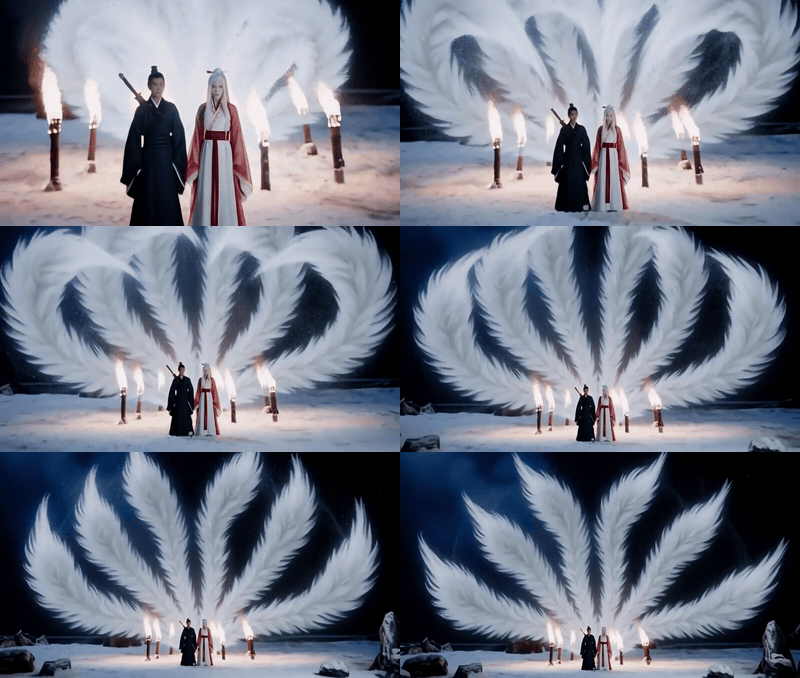
Tail frame becomes the next head frame, one character throughout. Narration and subtitles
added in post; one BGM track across the whole film.
57 generation runs / 5 GPU-hours, of which 17 were thrown away and redone.
Shan Hai — short-shot family, trailer
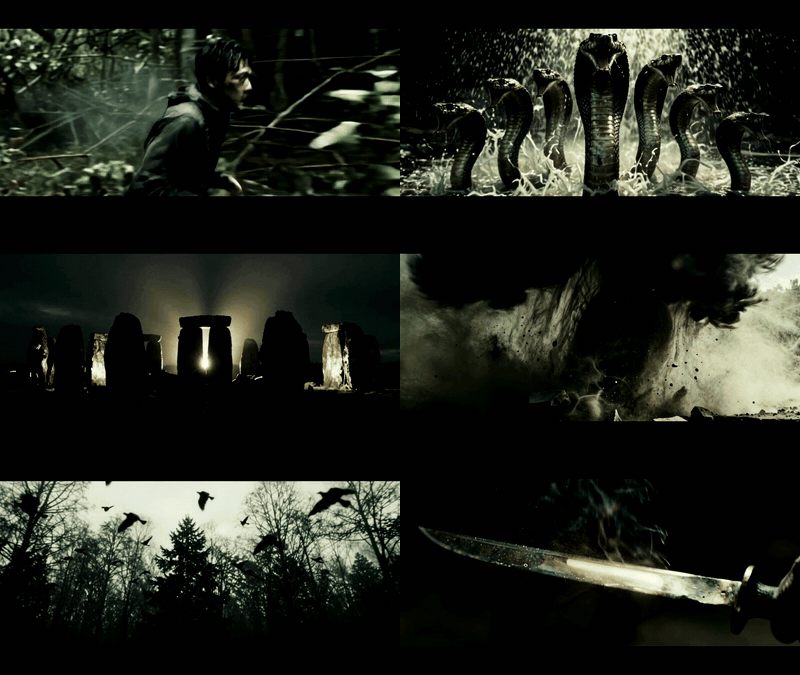
Not one mythical beast appears in full — only traces. That wasn't a style choice, it was
forced by the model: the creatures of the Classic of Mountains and Seas have no photographic
basis, so shooting them head-on always looks fake. Six shots out of thirty survived.
More stills and breakdowns in the gallery.
The three problems this solves
Making short films with AI, the things that actually block you are never the API calls:
① Every film comes out the same.
Once you write one structure that works, you'll unconsciously reuse it forever. This happened to us: four trailers (one Shan Hai plus three SCP pieces) compared shot by shot, and shot 25 in all four is "takes off the face covering, near-total darkness," while shot 36 in all four is "extreme wide, empty landscape." Writing "remember to vary it" in the docs does nothing — we wrote exactly that, and still collided.
② Nowhere to record what you learned the hard way.
"Glow compositing in YUV tints the whole film magenta." "Any prompt describing something absent that left a trace will make the model draw the absent thing." You can't search for this. You buy it with GPU time, and if you don't write it down you buy it again three months later.
③ Parameters welded to one model.
"2.04 seconds per shot is a hard limit" — true only for LTX-2.3. Change models and it's worthless, but nothing in the docs tells you which numbers are laws of physics and which are just properties of one machine.
The three answers
Anti-homogenization: orthogonal variables + a two-layer fingerprint
Before writing any shot, you fill in five orthogonal dimensions and must differ from recent films:
| Dimension | Values |
|---|---|
| Time structure | linear / reverse / loop / parallel cut / single-moment slices |
| POV | omniscient / follow one person / surveillance·instrument / object's view / absent |
| Tempo | steady / accelerate-to-burst / front-loaded / two breaths / fully static |
| Audio | BGM throughout / dialogue-driven / SFX-driven / ambient only / total silence / desynced |
| Ending | empty wide / return to first shot / hard cut to black / unresolved / mundane |
But checking that table alone will not catch real repetition. Those three SCP films could each have filled it differently and still come out shot-for-shot identical, because the repetition lives one level down — at section function → concrete shot design.
So the fingerprint records two layers and blocks at each:
vars       ≥3 dimensions collide  →  reselect (hard block)
structure  same as any of last 3  →  requires an explicit justification
signature  ≥2 fields collide      →  redesign (regardless of vars)
signature holds opening framing, ending framing, peak device, and climax pattern — the concrete choices. That third rule is the one that actually catches the SCP problem.
Edit structures are demoted from truth to one option among several, stamped with a usage record:
used_by: [Shan Hai, SCP-Breach, SCP-Archive, SCP-Field]
use_count: 4
Seeing use_count: 4 makes you pick something else. Far more effective than writing "please do not reuse."
Swapping models: profiles + self-calibration
Every model-dependent number moves out of the prose into a profile, and formulas take variables:
shot_count = (target_sec - transition) / (max_shot_sec - transition)
                                          ↑ a variable, no longer a hardcoded 2.0417
Only one profile in this repo has real data — ltx-2.3-q4-12g, which we measured. We do not ship numbers for Wan, HunyuanVideo, Kling or Jimeng, because we haven't run them; copying figures out of their docs would be fabrication, and getting caught fabricating costs more trust than the convenience is worth.
What you get instead is a blank template plus a five-step calibration to measure your own:
| To measure | How |
|---|---|
max_shot_sec |
Fix one keyframe, render at 2s/3.5s/5s, find where the subject drifts out, take the step before |
align_to |
Feed a non-divisible size and read the error, or read the VAE compression rate |
restart_each_shot |
Run two shots back to back; does the second OOM or slow down? |
text_sensitivity |
Put a signboard/menu in the subject, render 3×, count the garbled text |
motion_style |
Write "she slowly turns her head to the window" and see if it overshoots |
Pitfalls: their own document, quotable directly
knowledge/pitfalls.md is the real asset here. A few samples:
- Glow chains must run in RGB.
blend=screenis per-plane; in YUV it screens the U/V chroma planes too and tints everything magenta. Run the chain informat=gbrp, convert toyuv420pon the way out. - Absence cannot be prompted directly. Ask for "a chair cushion with the dent of someone who sat there" and you get a person sitting in the chair. Negations must be enumerated: "nobody in the chair, no body, no limbs, no clothing anywhere in frame."
- Keep text-bearing objects out of the subject. A negative prompt for "no watermark" will not stop text the subject itself implies. Signs, menus, labels, packaging, road signs — the fix is changing the subject, not adding negatives.
- The more dramatic, the faker. Volcanoes and calving glaciers sit in the model's overfit zone: the training data is all render art, so it always looks AI. Ordinary moments read as real.
- Face-consistency threshold is 0.28, not 0.5. Embedding cosine similarity between two images of the same AI-generated character is inherently lower than for photos of real people. Borrowing the real-photo threshold rejects every good image you have.
- Text in your prompt gets painted into the frame. Not just quoted dialogue. One segment failed three times running, rendering in turn: the narration line, the words "twenty-five or so" from a supporting-character description, and the stage direction "bowed slightly." Numerals are the highest risk, and appending "no text, no watermark" does nothing — all three versions had that line.
- Generic upscalers wreck small faces. Below ~110px face width, ESRGAN melts features together and grows crosshatch artifacts on skin; above 150px it's harmless. Fix it at generation time — an upscaler cannot invent detail that was never generated. Raising the generation resolution is the cheapest lever: 0.3 MP → 0.5 MP is a 1.30× linear scale, turning an 86px face into 112px, and you only need to raise it for the shots that need it. Faces under ~60px need a different framing, not a different parameter. Deciding per shot in post is the last-resort fallback, and what it buys you is "stops inventing," not "fixed."
- Face restoration is a liability for non-human characters. CodeFormer turned pale amber fox-spirit irises grey-blue;
fidelity=0.9didn't stop it. Its prior for "normal human face" is too strong. - Rebuild timestamps after concat. Without
setpts=N/FPS/TBthe encoder silently drops frames (6062 → 6013 measured), and the loss accumulates — audio drifts further out of sync the longer the film runs. - A simile gets rendered as a literal object. "A burn scar on his wrist, about the size of a
large coin" — and the wrist gets an actual coin-shaped thing on it. This is harder to catch than
a straynever X, because reading the sentence back, you don't feel like you mentioned a coin. - Intermediate directories silently serve stale data. The shape is always "A generates B,
downstream reads only B" — A gets updated, B never re-runs, nothing reports an error. Our post
chain had four of them (voice-over, upscale, lip-sync table, SFX table). The worst: two days of
voice work never reached the finished film, and I greenlit it twice — because I was measuring
A while the film was reading B. Two fixes: an mtime gate as the first statement of every
downstream script, and acceptance evidence must come from the finished artifact itself;
measuring an intermediate directory does not count. - When a composition instruction doesn't execute, it's a weight fight, not a wording problem.
Thirty words of instruction get diluted by three hundred words of style anchor and set
description, and the frame collapses back to the model's default. Two levers work: repeat the
instruction at both the head and the tail of the prompt, and write composition as something
physically incapable of holding anything else ("the top third is sky only, the bottom third is
ground only, he fits inside the band between them"). Piling on adjectives does not work.
Cutting the prompt down does work — but it buys obedience with picture quality, which is a bad
trade whenever the background is load-bearing.
Chained long-form (dozens of segments joined tail-to-head) has its own body of pitfalls inknowledge/chain-consistency.md: character drift needs periodic re-anchoring, the anchor prompt
must carry the full character description, empty shots must never be anchored, and the lead's
"white hair" bleeds onto everyone else in frame.
Films with dialogue add a whole second set — knowledge/dialogue-drama.md: a shared constants
layer for characters and sets, a give-up list of the six things the model cannot do (so you
stop burning rerolls on them), one single source of truth for every line of dialogue, and four
post-production bugs that only appear when several correct timelines are laid on top of each other.
Signing off shot by shot: the grid method (optional, off by default)
knowledge/grid-review.md. On a job that produces dozens of shots, the easiest mistake is
substituting "the batch runner didn't error and the files exist" for "is it any good" — we made
it three times in one day (final keyframes, candidate keyframes, video segments), and one batch
that passed every automated check turned out, on human review, to have six shots facing the wrong
way.
The method: build a grid driven by the shot table itself; a cell counts only once a human has
looked at the picture and signed it off. The signature is bound to a hash of the prompt (edit
the prompt and the signature expires — without this it degrades back into "does the file exist"
within two or three rounds), and nothing goes downstream until every cell is signed (once
upscaling / editing / mixing have run, changing one cell costs ten times as much).
⛔ It is off by default, and you have to ask first. Every sign-off round feeds a contact
sheet into the context as an image — dozens of images over one film, so token usage and context
pressure go up noticeably. It trades money for "every cell has actually been looked at," and
that trade is the user's call, not Claude's.
One rule for whoever is doing the signing: crop and zoom the cell you're unsure about before you
convict it — never rule on the thumbnail. We misread thumbnails twice (once mistaking a
character's back-of-head and bare shoulder for "a thigh"), and both times nearly went off to fix a
shot list that had nothing wrong with it.
Running unattended: turn "I can't tell" into a number
knowledge/auto-review.md. Overnight there is nobody to ask, and saving the doubtful shots for
morning means the GPU burned all night for nothing. So every "should this pass?" becomes something
computable: shot from behind → face count == 0; subject in the left third → keypoint bbox
centre x; wide shot showing the whole body → knee/ankle keypoint scores.
The part people skip is the one that matters: regression-test the checker against known-good
footage before you trust it, and look for false positives, not misses. An unvalidated checker
spends the night killing good frames by a wrong rule — worse than having no checker. Ours turned
up three classes of its own false positives (direction words read as positions; a ground-level
shot of shoes counted as "8 people"; the wrong person measured in an over-shoulder shot) — and,
as a free side-effect, four genuine defects in footage we had already shipped.
The six skills
One hub does the directing; five satellites each own a stage and can also be triggered on their own.
| Skill | Owns |
|---|---|
| local-ai-film ★ | The hub. Opening ritual (profile → variables → fingerprint), pitfalls, execution |
| emotion-to-camera-language | Translates "atmospheric" into light position / depth of field / camera position / subject state |
| lock-character-reference | Locking a character reference, and what to do when it won't stabilize |
| shot-breakdown | Filtering a batch of generations; when to stop rerolling |
| rhythm-density | Per-shot durations and density contrast |
| material-driven-storyboard | Reverse-engineering a storyboard when you lack the footage |
The opening flow:
1.  Pick a profile      → profiles/
2.  Roll the variables  → directing/variables.md
3.  Check fingerprints  → directing/fingerprint.md   ← collision means start over
4.  Pick/write skeleton → directing/structures/
5.  Compute shots/segs  → formula pulls from profile
6.  Write shots         → prompt-craft.md or shot-list-prompt.md
7.  Probe              → shot-breakdown
8.  Batch run          → examples/scripts/
8.5 Sign off shots     → knowledge/grid-review.md   ⛔ off by default, ask first
9.  Post               → knowledge/post-production.md
10. Review             → knowledge/pitfalls.md, item by item
                         unattended? → knowledge/auto-review.md
11. Write fingerprint  → films.jsonl                ← close the loop or it all stops working
Steps 1–3 gate step 6. Step 11 closes the loop — skip it and the whole mechanism silently dies.
If the film has dialogue, read knowledge/dialogue-drama.md before step 6 — the constants
layer, the give-up list and the single-source-of-truth rule for dialogue all have to be settled
before you write shots. Retrofitting them is a rewrite.
Three orthogonal forks
By model family (the profile's family field):
| short-shot | long-shot | |
|---|---|---|
| Examples | LTX, Wan | MiniMax H3 |
| One generation yields | one continuous shot, 2–5s | one segment of 1–3 shots, 5–15s |
| Hard cuts within a generation | impossible | works |
The two families' knowledge contradicts each other — action arcs, text-bearing objects, and
how to write relationships all flip between them. Know which family you're on before reading.
By production mode: one-off (atmospheric pieces, trailers) or chained (narrative films —
tail frame becomes the next head frame, one character throughout). Chaining works on both
families but requires reading chain-consistency.md.
By whether there's dialogue: silent films can dodge character consistency entirely (masks,
backlit silhouettes, one of ours is 17 shots with no face in any of them). A film with dialogue
can't dodge anything — the audience checks. That fork requires dialogue-drama.md and, on along-shot model with native audio, the episode-drama skeleton.
Usage
Step 1 — install the skills (you're done here)
Easiest path — paste this at Claude Code:
Install this skill for me: https://github.com/L-Trunks/ai-film-skills
Clone it and run install.sh
It will clone the repo, run the installer, and drop all six skills into ~/.claude/skills/.
Re-running is safe — an existing directory of the same name is backed up before it's replaced.
git clone https://github.com/L-Trunks/ai-film-skills
cd ai-film-skills
bash install.sh                # Windows: powershell -ExecutionPolicy Bypass -File install.ps1
Pass --project to install into the current project's .claude/skills/ instead of your home directory.
Or just copy them by hand:
cp -r skills/* ~/.claude/skills/
Then tell Claude Code "make a short film" or "batch-run some atmospheric videos."
That's it — the skill is fully usable at this point. It walks you through the opening
ritual, blocks homogenization via the fingerprint, picks the route that matches your model,
writes the shot list, and steers you around the several dozen pitfalls in knowledge/.
None of that needs scripts, models or a GPU — it works just as well if you generate
through a cloud API.
Using Codex or another agent?
They don't have Claude Code's skill auto-triggering, but these documents are plain Markdown
methodology — clone the repo, point your agent atskills/local-ai-film/SKILL.md, and it will
still walk you through the whole process. You just have to name the file each time.
Step 2 (optional) — calibrate your own profile
Follow the five steps in profiles/calibration.md — about 40 minutes locally
It works without this, but your shot counts and durations will be wrong, because the
formulas read max_shot_sec out of a profile, and the shipped one was measured on my machine.
Step 3 (optional) — run the reference scripts
examples/scripts/ is my machine's implementation. Everything machine-specific lives inconfig.py, so you never have to grep through the scripts:
# pick one
export AIFILM_COMFY=/path/to/ComfyUI          # 1. environment variables
export AIFILM_PY=/path/to/python
export AIFILM_ROOT=/path/to/output

cp config.py config_local.py                  # 2. a local override (already gitignored)
                                              # 3. or just edit config.py's defaults
Then check your setup:
python doctor.py
It verifies the ComfyUI directory, the interpreter, ffmpeg, the model files, whether ComfyUI
is actually running and whether you have enough VRAM — and for anything missing, tells you
which variable to change.
Two kinds of skill live here, in two different formats
This is deliberate, not an oversight:
| Distilled (RIA) | Hands-on | |
|---|---|---|
| Which | The five satellites | local-ai-film |
| Source | Methodology distilled from others' published work | Measured by us |
| Format | R / I / A1 / A2 / E / B | Assembly flow + knowledge + profiles |
| Trust | verified: secondhand |
verified: measured here + hardware stated |
Every number carries a verified field. "I measured this" and "I heard this" must stay distinguishable — that separation is what makes the rest of the repo trustworthy.
local-ai-film is deliberately not forced into the RIA format. It's firsthand experience with no source text to quote; applying the template would only manufacture a fake citation section.
Attribution
The five satellite skills distill methodology from several creators' public work. The R sections have been rewritten in our own words; original sources are listed in ATTRIBUTION.md.
License
Content is CC-BY-4.0. Code under skills/local-ai-film/examples/scripts/ is MIT.
Yorumlar (0)
Yorum birakmak icin giris yap.
Yorum birakSonuc bulunamadi