OCC
Health Uyari
- License — License: MIT
- Description — Repository has a description
- Active repo — Last push 0 days ago
- Low visibility — Only 5 GitHub stars
Code Gecti
- Code scan — Scanned 12 files during light audit, no dangerous patterns found
Permissions Gecti
- Permissions — No dangerous permissions requested
This is a YAML-first orchestrator for building multi-model LLM workflows. It allows developers to define complex AI pipelines with automatic parallel execution, zero-cost data fetching tools, and crash recovery, all without writing boilerplate code.
Security Assessment
Overall Risk: Medium. The tool acts as an orchestrator that natively makes network requests to various LLM APIs (such as Claude and OpenAI). Additionally, its documentation explicitly mentions the capability to execute bash commands and query databases as part of its zero-cost pre-tools. While the automated code scan (12 files) found no dangerous patterns or hardcoded secrets, the inherent nature of the tool requires it to handle sensitive data (API keys) and execute potentially harmful system commands. These capabilities necessitate strict sandboxing and proper environment variable management on the user's part.
Quality Assessment
The project appears to be highly active and professionally structured. It uses strict TypeScript, is MIT licensed, and its last commit was made today. The README features comprehensive documentation, benchmark claims, and badges indicating thousands of passing tests and Docker readiness. However, community trust is currently very low. It is an extremely new or niche project with only 5 GitHub stars, meaning it has not yet undergone widespread peer review or real-world community testing.
Verdict
Use with caution: the codebase appears clean and well-maintained, but the tool's deep system access and low community adoption require you to run it in a tightly controlled environment.
OCC (Orchestrator Chain Chimera) — YAML-first LLM orchestrator. Multi-model chains with auto-parallelism, 30 pre-tools at zero token cost, React canvas, MCP, REST API. 70% faster/cheaper than naive approaches.
OCC — Orchestrator Chain Chimera








Define chains, not code. Multi-model LLM workflows in YAML with automatic parallel execution, 30 pre-tools at zero token cost, and 6 LLM providers. Benchmarked: 70% faster and 70% cheaper than naive approaches on complex tasks.
steps:
  - id: market
    model: claude-haiku-4-5          # cheap for subtasks
    prompt: "Analyze the market for {input.topic}"
    output_var: market_data
  - id: risks
    model: claude-haiku-4-5
    prompt: "Identify risks for {input.topic}"
    output_var: risk_data
  - id: summary
    model: claude-sonnet-4-6         # smart for synthesis
    depends_on: [market, risks]      # runs after both complete
    prompt: "Executive summary:\n{market_data}\n{risk_data}"
    output_var: report
market and risks run in parallel. summary waits for both. No code needed.
Why OCC?
| Problem | Solution |
|---|---|
| LLM workflows require Python boilerplate | YAML chains — declarative, git-friendly, reviewable by non-devs |
| Data collection wastes LLM tokens | 30 pre-tools — fetch URLs, run bash, query DBs at 0 token cost |
| One model for everything is expensive | Model routing — Haiku for subtasks, Sonnet for synthesis = 80% cheaper |
| Sequential execution is slow | Auto-parallelism — DAG resolution runs independent steps simultaneously |
| Long workflows crash and lose progress | SQLite checkpoints — crash recovery resumes from last completed step |
| No TypeScript alternative to LangChain | TS native — npm install -g occ-orchestrator |
New to OCC? Read the Getting Started guide — first chain running in 5 minutes.
Table of Contents
- Quick Start · Getting Started · Architecture · FAQ
- Chain Format — step types, pre-tools, typed inputs
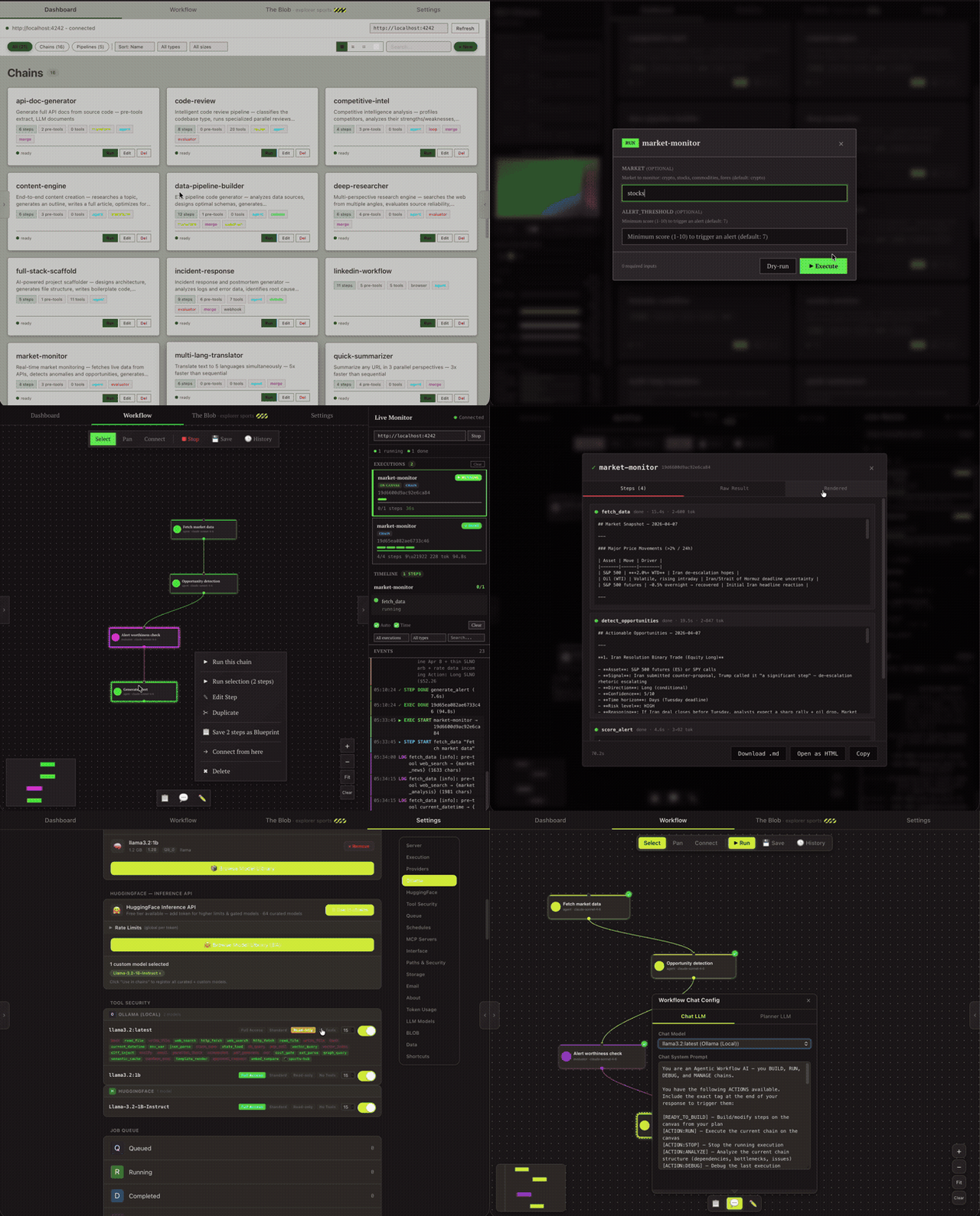
- Frontend (Chimera) — canvas, workflow chat, monitor
- Pipelines · BLOB Sessions · CLI
- REST API · Benchmarks
- Deployment · Security · Configuration
- Examples · Tests · Limitations · Contributing
Quick Start
Prerequisites
- Node.js 20+ · npm 9+
- Claude CLI — install and authenticate:
npm install -g @anthropic-ai/claude-code
claude   # opens browser to authenticate
On first launch, a Setup Check modal verifies all prerequisites and guides you through fixing any issues.
Install
# npm (recommended)
npm install -g occ-orchestrator

# From source
git clone https://github.com/lacausecrypto/OCC.git
cd OCC/mcp-server && npm install && npm run build
Run
# Start backend
cd mcp-server && npm run rest        # http://127.0.0.1:4242

# Start frontend (optional)
cd frontend-react && npm install && npm run dev   # http://localhost:5173

# Execute a chain
occ run deep-researcher -i topic="quantum computing"
Docker
cp .env.example .env   # set OCC_API_KEY
docker compose up      # non-root, cap_drop ALL, read-only FS
Chain Format
name: my-chain
description: "Research and summarize a topic"

inputs:
  - name: topic
    type: string
    placeholder: "e.g. quantum computing"

steps:
  - id: research
    model: claude-sonnet-4-6
    pre_tools:
      - type: web_search
        query: "{input.topic} latest news"
        inject_as: search_results
    prompt: |
      Research: {input.topic}
      Web results: {search_results}
    output_var: research

  - id: summarize
    depends_on: [research]
    prompt: "Summarize: {research}"
    output_var: summary

output: summary
Variables: {input.topic} (chain input) · {research} (step output) · {search_results} (pre-tool injection)
Steps without shared depends_on run in parallel automatically.
LLM Providers
| Provider | Access | Best For |
|---|---|---|
| Claude (CLI) | Subprocess | Default engine, full MCP tool access |
| OpenRouter | HTTP API | 200+ models (Llama, Gemini, Mistral...) |
| OpenAI | HTTP API | GPT-4o, o3-mini, o4-mini |
| Ollama | Local | Privacy, offline, zero cost |
| HuggingFace | HTTP API | Open-source models, free tier |
| Custom | OpenAI-compat | Groq, Together, any compatible endpoint |
All providers support tool use (Bash, Read, Write, Glob, Grep, WebSearch, WebFetch) via an OpenAI function calling agent loop.
Step Types (12)
| Type | Description |
|---|---|
| agent | LLM call (default) |
| router | Branch based on LLM classification |
| evaluator | Score output, trigger retries on failure |
| gate | Pause for human approval |
| transform | Data manipulation without LLM (json_extract, regex, template...) |
| loop | Iterate over items with parallel execution |
| merge | Combine parallel outputs (concatenate, llm_summarize, pick_best) |
| browser | Web automation via Playwright |
| subchain | Execute another chain as a step |
| debate | Multi-agent discussion with voting/consensus |
| webhook | HTTP callback with retry |
| image_gen | Generate images via DALL-E 3, FLUX, or Stability AI |
Pre-Tools (30)
Inject data before the LLM call — 0 tokens for data collection. All support {variable} interpolation, on_error, timeout_ms, retry, cache_ttl_minutes.
Data: http_fetch · web_search · mcp_call · db_query · parallel_fetch
Files: read_file · write_file · bash · diff_inject · ast_parse · ocr · screenshot · pdf_generate
State: state_load · state_save · vector_query · vector_index · semantic_cache · graph_query
Processing: json_parse · template_render · embed_compare · cost_gate · current_datetime
Notifications: notify (Slack/Discord/Telegram) · email (SMTP/SendGrid/Resend) · approval_request
System: env_var · sandbox_exec (Docker) · image_generate (DALL-E 3 / FLUX / SD3)
Typed Inputs (9 types)
inputs:
  - name: topic
    type: string
    min_length: 3
    examples: ["AI safety", "climate change"]
  - name: format
    type: enum
    enum: [markdown, openapi, jsdoc]
    default: markdown
  - name: depth
    type: number
    min: 1
    max: 10
  - name: verbose
    type: boolean
    default: "false"
  - name: banner
    type: image
    accepts: ["image/png", "image/jpeg"]
    max_file_size: 5242880
    optional: true
Types: string · number · boolean · enum · file · image · json · url · text
The frontend renders specialized widgets: dropdowns, toggles, file pickers with preview, range inputs, textareas with character counter.
Advanced Config
retry: { max: 3, delay_ms: 2000, backoff: 2 }
fallback_models: ["claude-opus-4-6"]
timeout_ms: 60000
cache: { enabled: true, ttl_minutes: 60 }
condition: '{type} == "frontend"'
output_schema: json
guardrails: [{ type: min_length, value: 500 }]
Frontend (Chimera)
Canvas Editor
- Visual DAG editor with drag, connect, and inline step editing
- Live SSE streaming per node with traffic light status dots
- Save chain (Ctrl+S), version history with diff + restore
- Blueprints — save and reuse step groups
Workflow Chat
- Conversational chain builder — describe what you want, AI creates nodes
- Agentic actions: run, stop, debug, analyze, dry-run, modify steps
- Multi-session per chain, configurable model per stage
- Markdown rendering, token tracking, persisted to localStorage
Monitor
- Real-time execution tracking with step timeline
- Gate approval panel — approve/reject from the UI
- Error messages inline, historical execution loading
Settings
- LLM provider management (add/remove/test)
- Ollama model marketplace — pull, delete, use in chains
- HuggingFace model browser — 118+ models, tier filters
- Setup Check — verify all prerequisites at any time
- Token usage charts, queue stats, server config
Pipelines
Orchestrate multiple chains:
name: full-security-review
chains:
  - id: static-analysis
    chain: security-audit
    inputs: { path: "{input.repo_path}" }
  - id: dependency-check
    chain: dependency-scanner
    inputs: { path: "{input.repo_path}" }
  - id: final-report
    chain: report-generator
    depends_on: [static-analysis, dependency-check]
    inputs: { audit: "{static-analysis}", deps: "{dependency-check}" }
output: final-report
BLOB Sessions
Autonomous exploratory AI canvas. Unlike chains (predefined), BLOB sessions grow organically from conversations. Three-stage pipeline: chat (Haiku) → plan (Sonnet) → execute (Sonnet with tools). Features: branching, knowledge graph auto-extraction, autonomous mode with budget guard.
CLI
17 commands:
occ validate ./chains                    # Lint all chains
occ dry-run deep-researcher -i topic=AI  # Execution plan + cost estimate (0 tokens)
occ run deep-researcher -i topic=AI      # Run + stream logs
occ run-pipeline research-to-content     # Run multi-chain pipeline
occ generate "Monitor BTC price"         # Natural language → chain YAML
occ list | status | logs | timeline | stats | queue | cancel | approve | reject
REST API
102 endpoints with Bearer auth, rate limiting, and SSE streaming.
Endpoint listChains: GET /chains · GET/POST/DELETE /chains/:name · GET /chains/:name/stats · versioning endpoints
Execution: POST /execute/:name · GET /executions · GET/DELETE /executions/:id · GET /executions/:id/stream (SSE) · GET /executions/:id/timeline · GET /executions/token-usage · resume/approve endpoints
Queue: GET /queue · job management · purge
Scheduling: CRUD on /schedules + toggle + manual run
Pipelines: CRUD + execute + versioning
Providers: CRUD + GET /providers/models + POST /providers/:id/test
BLOB: 17 endpoints (sessions, chat, plan, execute, branches, knowledge)
Ollama: status, models, pull (streaming), delete
HuggingFace: model search, info, test
System: /health · /config · /prerequisites · /events (SSE) · /mcp-servers · /generate-chain · /workflow-chat
Auth: Authorization: Bearer <key> — required when NODE_ENV=production.
Rate limiting: /execute/* 20/min · /generate-chain 5/min · /config 30/min.
Benchmarks
Real execution data from April 2026 — full methodology in BENCHMARKS.md.
Economy of Scale (10 steps, 4 waves, 3 runs each)
| Approach | Duration | Cost/run | Monthly (100/day) |
|---|---|---|---|
| Sequential, all Sonnet (naive) | 229s | $0.602 | $1,807 |
| Sequential, Haiku+Sonnet (smart) | 97s | $0.121 | $362 |
| OCC parallel, Haiku+Sonnet | 69s | $0.179 | $537 |
vs naive: 70% faster, 70% cheaper. Model routing alone: 80% cost reduction.
Overhead on Simple Tasks
+14% duration, same tokens, same cost. Worth it for 4+ step workflows.
Deployment
OCC is single-process, single-user. Not a multi-tenant SaaS.
Requirements: 1 vCPU, 1 GB RAM · Node.js 20+ · Claude CLI
Production env vars:
NODE_ENV=production
OCC_API_KEY=your-secret-key
OCC_ENCRYPTION_KEY=$(node -e "console.log(require('crypto').randomBytes(32).toString('hex'))")
REST_HOST=0.0.0.0                        # only behind reverse proxy
CORS_ORIGIN=https://yourdomain.com
See SECURITY.md for the full hardening checklist.
Examples
Chains (19)
| Chain | Steps | Parallel | Key Features |
|---|---|---|---|
deep-researcher |
6 | 3-way | web_search, evaluator, merge |
content-engine |
6 | partial | transform, guardrails |
competitive-intel |
4 | loop(3) | loop, merge |
code-review |
8 | 5-way | router, evaluator |
security-audit |
12 | 6-way | router, debate, webhook |
incident-response |
9 | parallel | debate, evaluator, webhook |
startup-pitch |
9 | 3-way | subchain, loop, debate |
market-monitor |
4 | partial | evaluator, conditional |
seo-analyzer |
9 | 3-way | browser, transform |
data-pipeline-builder |
12 | 3+2 | debate, subchain |
linkedin-workflow |
6 | 3-way | state_save, notify, web_search |
quick-summarizer |
4 | 3-way | http_fetch, merge |
repo-health-check |
6 | 5-way | bash pre-tools |
multi-lang-translator |
6 | 5-way | isolation |
api-doc-generator |
6 | 4-way | ast_parse |
full-stack-scaffold |
5 | seq | bash/write, retry, cache |
bench-complex |
10 | 4-wave | Haiku+Sonnet routing benchmark |
bench-claude |
4 | 3-way | provider comparison |
bench-ollama |
4 | 3-way | provider comparison |
Pipelines (5)
| Pipeline | Chains | Pattern |
|---|---|---|
research-to-content |
deep-researcher → content-engine | Sequential |
product-intelligence |
competitive-intel → market-monitor | Sequential |
full-security-review |
security-audit + code-review | Parallel |
startup-launch |
researcher → pitch → content | 3-stage |
repo-full-audit |
health + security + docs | 3-way parallel |
Tests
3243 tests across 111 files (59 backend + 52 frontend):
cd mcp-server && npm test       # 2344 backend tests
cd frontend-react && npm test   # 899 frontend tests
Backend: REST security, pre-tool execution (SSRF, SQL injection, path traversal, shell escaping), executor, gate manager, queue, storage, loader, linter, CLI, providers, blob, scheduler, MCP client, pipeline executor.
Frontend: components (RunModal, Settings, ExecResultModal, Sidebar, MonitorSidebar, Timeline, ApprovalPanel, LogViewer), stores (app, blob, shortcuts, workflowChat), utils (canvasToYaml, extractPalette), API client.
Limitations
- Single machine — no distributed execution. SQLite, not Redis.
- No multi-tenant — single API key, no per-user isolation.
- No built-in TLS — use nginx/Caddy as reverse proxy.
- Non-Claude models — tool use via agent loop, not native MCP.
- Bash pre-tool — can execute arbitrary commands. Review YAML before running untrusted chains.
Configuration
| Variable | Default | Description |
|---|---|---|
OCC_API_KEY |
— | Bearer auth key (required in prod) |
OCC_ENCRYPTION_KEY |
— | Provider API key encryption (required in prod) |
REST_PORT |
4242 |
HTTP port |
REST_HOST |
127.0.0.1 |
Bind address |
CORS_ORIGIN |
localhost | Allowed origin |
CLAUDE_CLI |
claude |
CLI binary path |
CLAUDE_TIMEOUT_MS |
1800000 |
Per-step timeout (30 min) |
MAX_CONCURRENT_EXECUTIONS |
5 |
Worker pool size |
EXECUTION_MAX_AGE_DAYS |
7 |
Auto-purge threshold |
LOG_LEVEL |
info |
debug / info / warn / error |
Contributing
Contributions welcome. Open an issue first.
- Fork → branch →
cd mcp-server && npm test→ PR - See CONTRIBUTING.md for code style and guidelines
License
MIT — see LICENSE
Yorumlar (0)
Yorum birakmak icin giris yap.
Yorum birakSonuc bulunamadi