QueryForge
Health Uyari
- No license — Repository has no license file
- Description — Repository has a description
- Active repo — Last push 0 days ago
- Community trust — 12 GitHub stars
Code Gecti
- Code scan — Scanned 12 files during light audit, no dangerous patterns found
Permissions Gecti
- Permissions — No dangerous permissions requested
Bu listing icin henuz AI raporu yok.
Governed AI analytics from natural language to auditable SQL, powered by a mandatory semantic layer, policy enforcement, and a visual Studio. 从自然语言到可审计 SQL 的受治理 AI 数据分析平台,内置强制语义层、SQL 策略治理与可视化工作台。
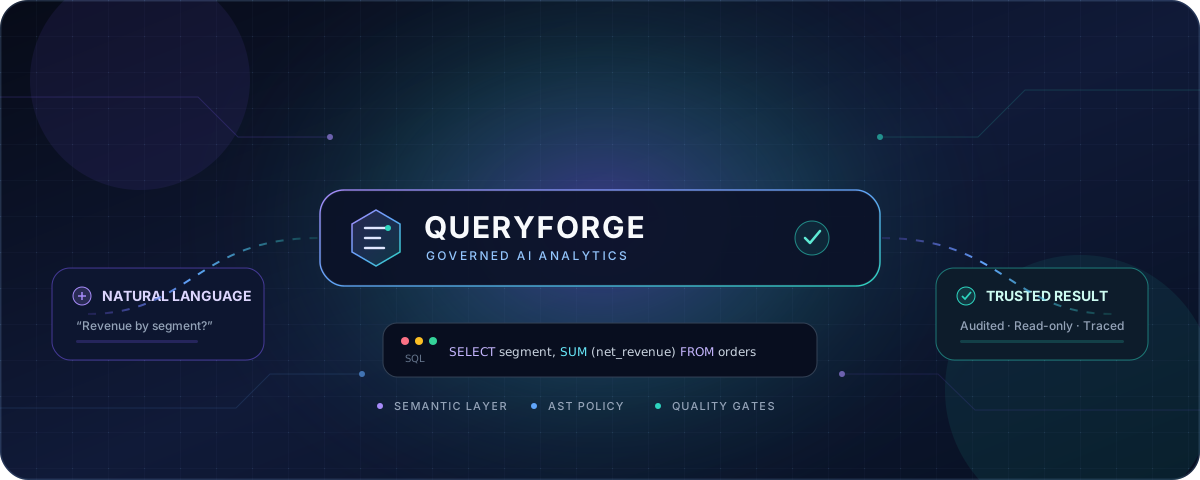
QueryForge
Governed AI analytics, from natural language to auditable SQL
Turn business questions into safe, traceable SQLite queries—with a semantic layer,
policy enforcement, bounded recovery, and production-friendly delivery interfaces.
简体中文 · Quick start · Architecture · Documentation





QueryForge is a local-first, domain-first AI data analytics platform built around
one principle:
generated SQL should be governed like application code, not trusted like prose.
Users create or select a data domain first—such as retail, finance, product, or
the bundled Anime Streaming sample—then onboard that domain's data, review its
semantic contract, and ask questions inside the same governance boundary.
QueryForge combines that workflow with natural-language-to-SQL, AST-level
security, read-only execution, multi-candidate selection, repair budgets, and
complete run artifacts.
QueryForge currently targets SQLite and controlled environments. It is a
portfolio-grade reference architecture, not a multi-tenant analytics service.
Product Tour
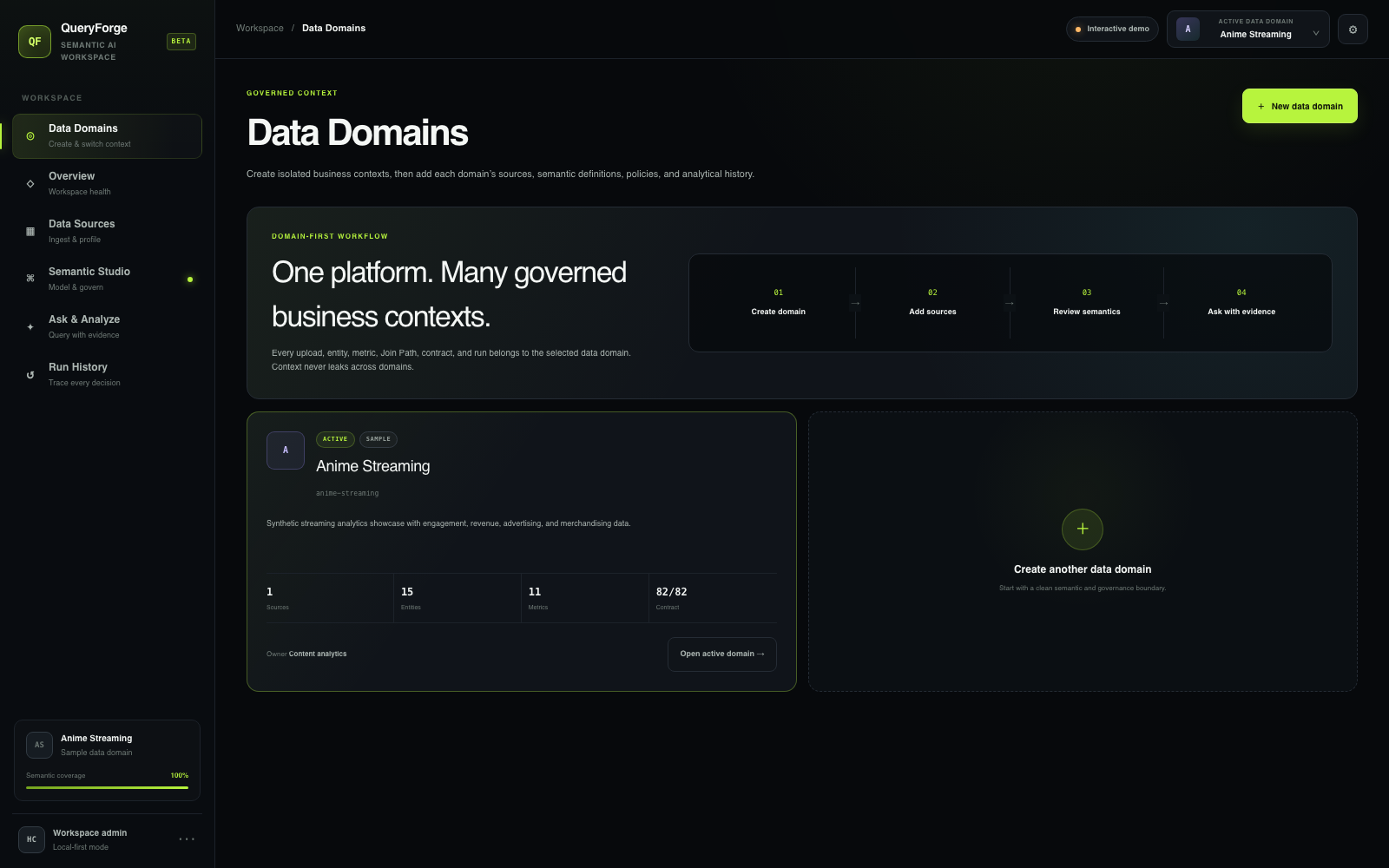 Data Domain Center — create or select a governed context before adding data or semantics.
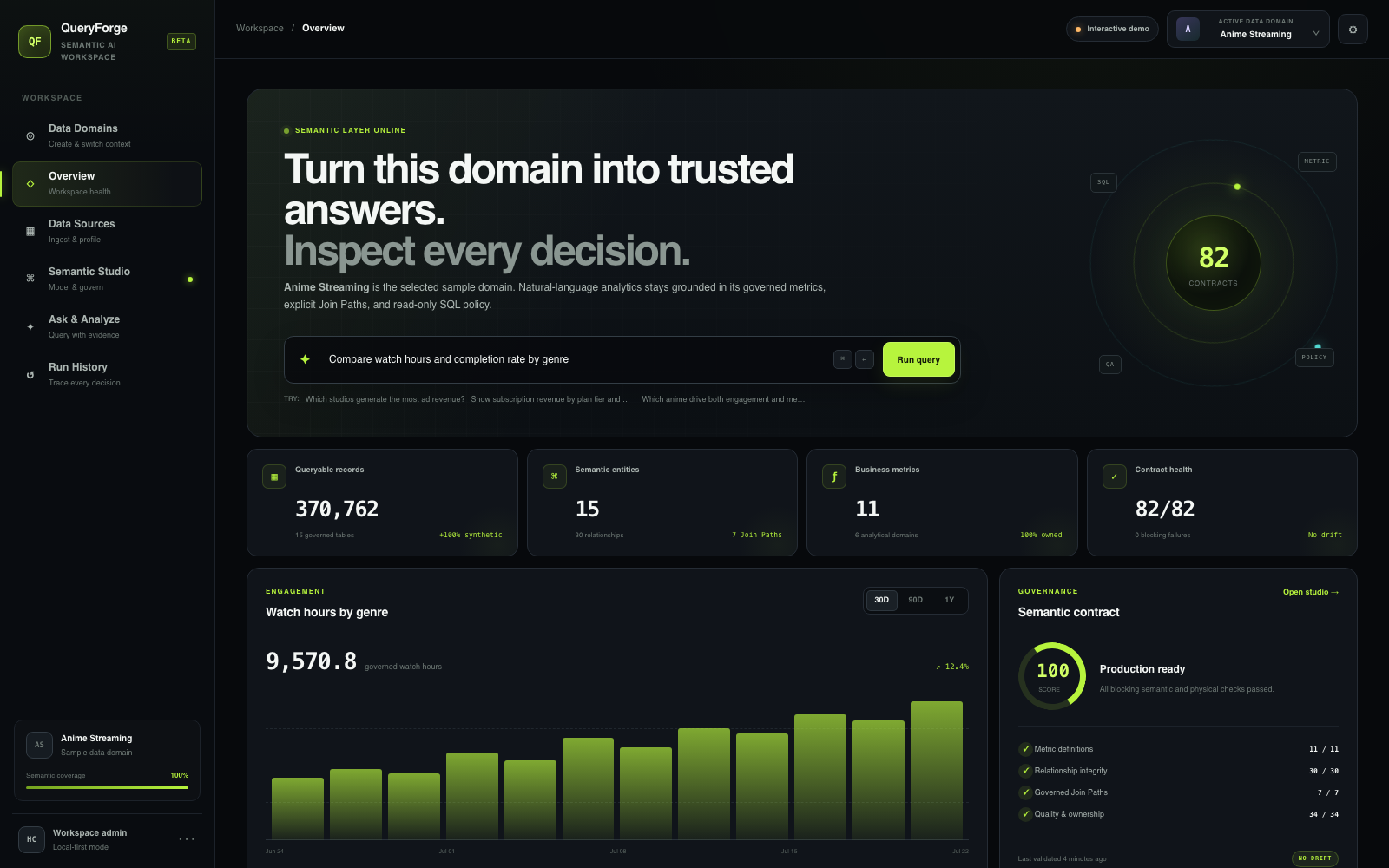 Domain overview — the Anime Streaming dataset is shown as one selected sample, not the platform identity.
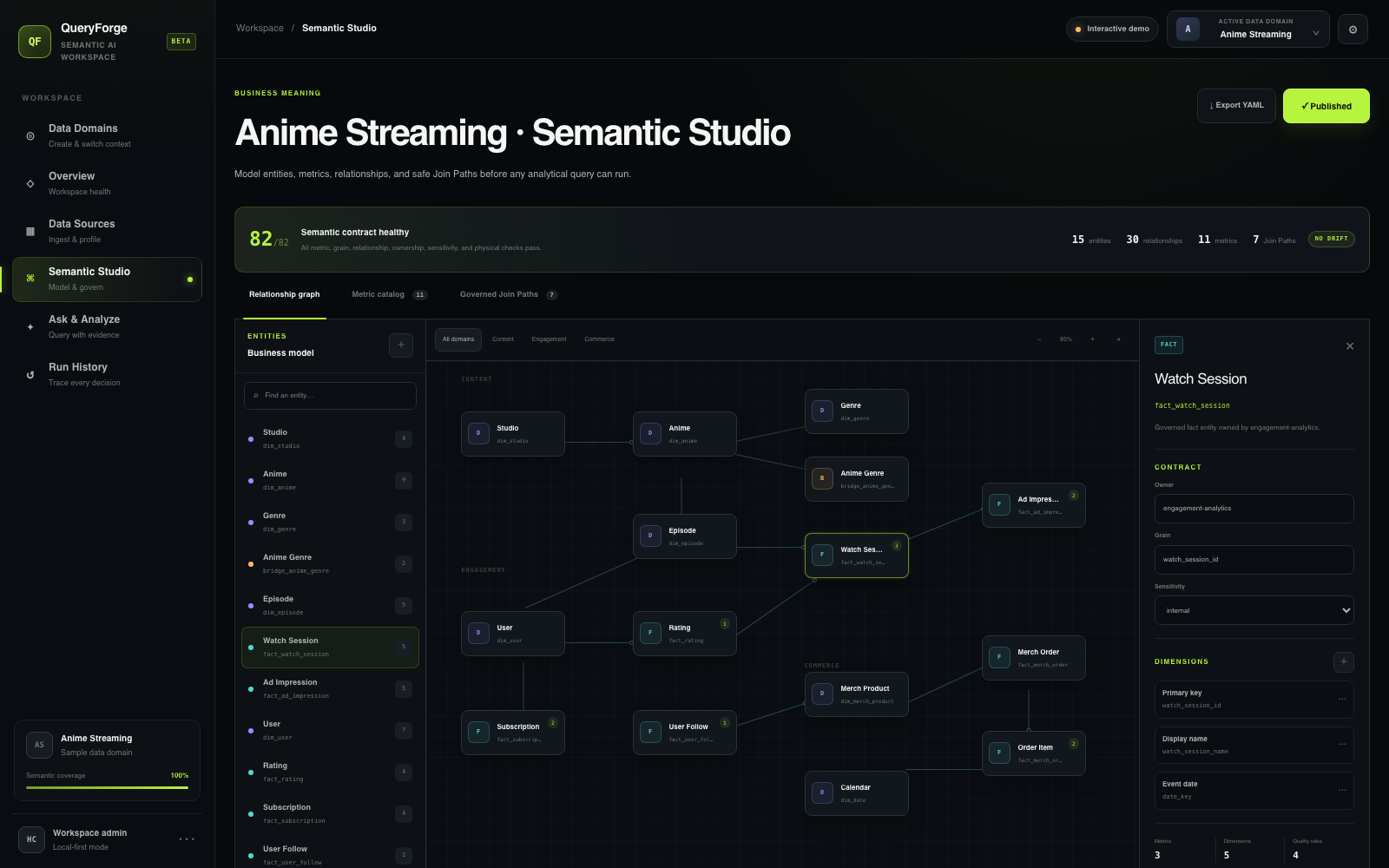
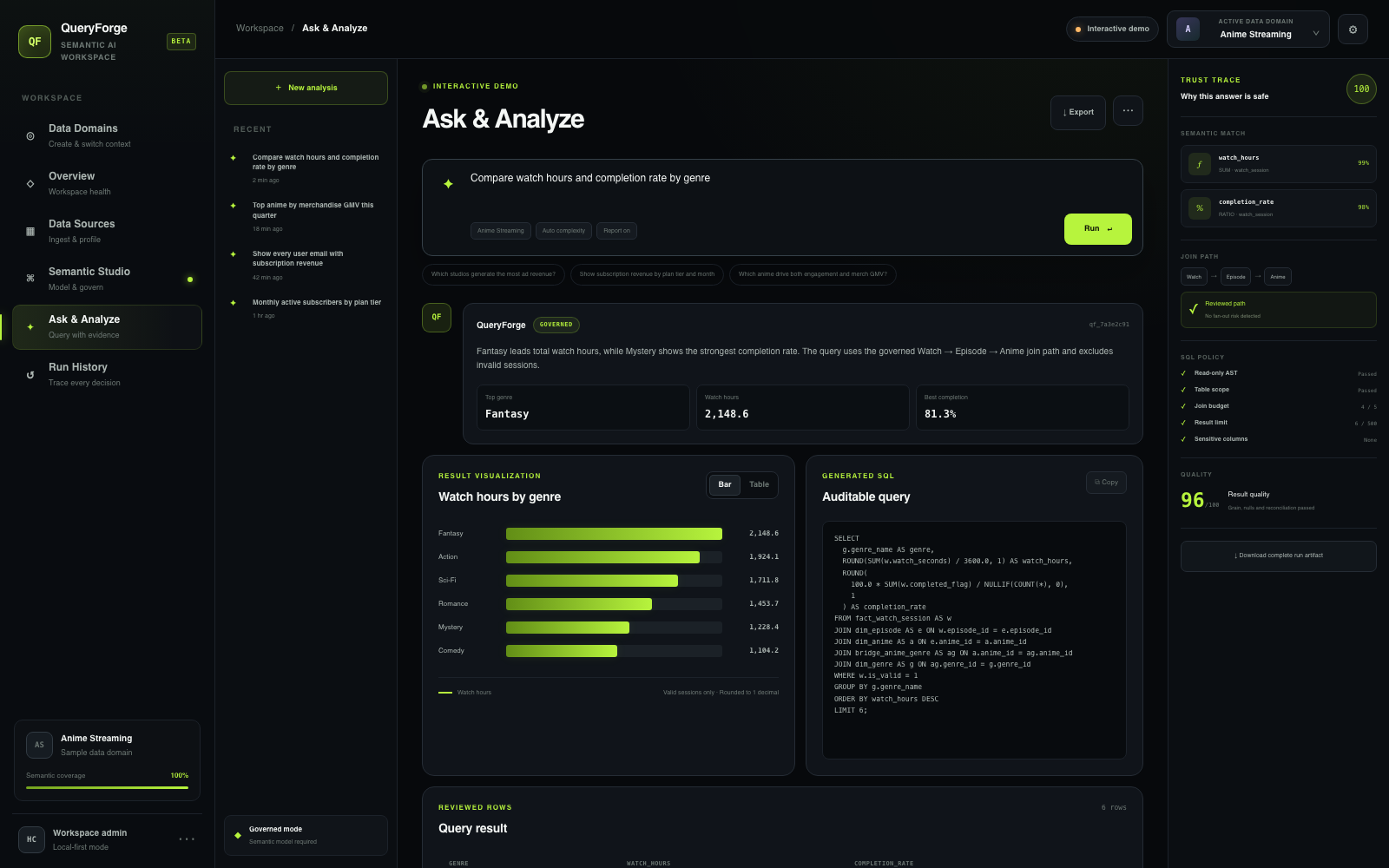
Semantic Studio · Governed analysis with auditable SQL and Trust Trace
Why QueryForge?
Most NL2SQL demos stop after a model emits a query. QueryForge covers the full
delivery loop:
| Need | QueryForge approach |
|---|---|
| Trust the generated SQL | Parse with SQLGlot and enforce a named policy before execution |
| Keep business meaning consistent | Define metrics, dimensions, grain, and join paths in YAML |
| Prevent context from leaking | Scope sources, semantic contracts, policies, and run history to a selected data domain |
| Recover from imperfect output | Reflect, repair, and retry within explicit budgets |
| Handle harder questions | Use bounded schema discovery and parallel SQL candidates |
| Trace what happened | Persist run state, policy decisions, quality evidence, and artifacts |
| Integrate with other tools | Expose CLI, REST/SSE, MCP, gateway, JSON, charts, and HTML reports |
| Start from raw data | Build governed SQLite assets from CSV, Parquet, and paginated JSON APIs |
Highlights
- Defense in depth — candidates are checked before execution and revalidated
at the database boundary. - Semantic contracts — YAML models describe business metrics, entities,
relationships, cardinality, ownership, SLA, sensitivity, and quality rules. - Adaptive workflow — simple questions stay fast; complex questions can
activate a bounded tool loop and concurrent candidate selection. - Read-only by default — normal analysis opens SQLite databases in read-only
mode and rejects write or administrative SQL. - Multiple delivery surfaces — use the same application service through the
CLI, REST/SSE, MCP, or a webhook gateway. - Reproducible evaluation — the repository includes offline acceptance checks
and a 120-case, three-domain NL2SQL gold set.
Quick Start
1. Install
Requirements: Python 3.11 or 3.12 and SQLite.
python3.11 -m venv .venv
source .venv/bin/activate
python -m pip install --upgrade pip
python -m pip install -e .
cp .env.example .env
2. Configure a model
Set one provider in .env. OpenAI-compatible, Claude, Gemini, Qwen, DeepSeek,
and GLM configurations are included.
LLM_PROVIDER=openai
OPENAI_API_KEY=your-api-key
OPENAI_MODEL=gpt-4.1-mini
Provider defaults and environment-variable mappings live in models.yml.
3. Run the bundled example
queryforge --prepare-sample-data

queryforge \
  --database sample_data/anime_streaming/anime_streaming.sqlite \
  --question "Which anime generated the most watch hours?"
Try a multi-hop semantic query:
queryforge \
  --database sample_data/anime_streaming/anime_streaming.sqlite \
  --semantic-model sample_data/anime_streaming/semantic_model.yml \
  --sql-policy sample_data/anime_streaming/sql_policy.yml \
  --question "Compare watch completion and merchandise GMV by anime genre"
Explore QueryForge Studio
The repository includes a complete visual workspace for creating and switching
data domains, onboarding domain-owned data, reviewing the required semantic
layer, asking governed questions, inspecting SQL and Trust Trace evidence, and
auditing domain-scoped run history.
# Terminal 1: QueryForge API
python -m pip install -e ".[api]"
queryforge --serve-api

# Terminal 2: QueryForge Studio
make web-install
make web-dev
Open http://localhost:3000. Start in Data Domains, select the bundled Anime
Streaming example or create a clean domain, then add data inside that domain. If
the Python API is offline, the sample-domain analysis remains explorable with a
deterministic demo response. See the Studio guide.
How It Works
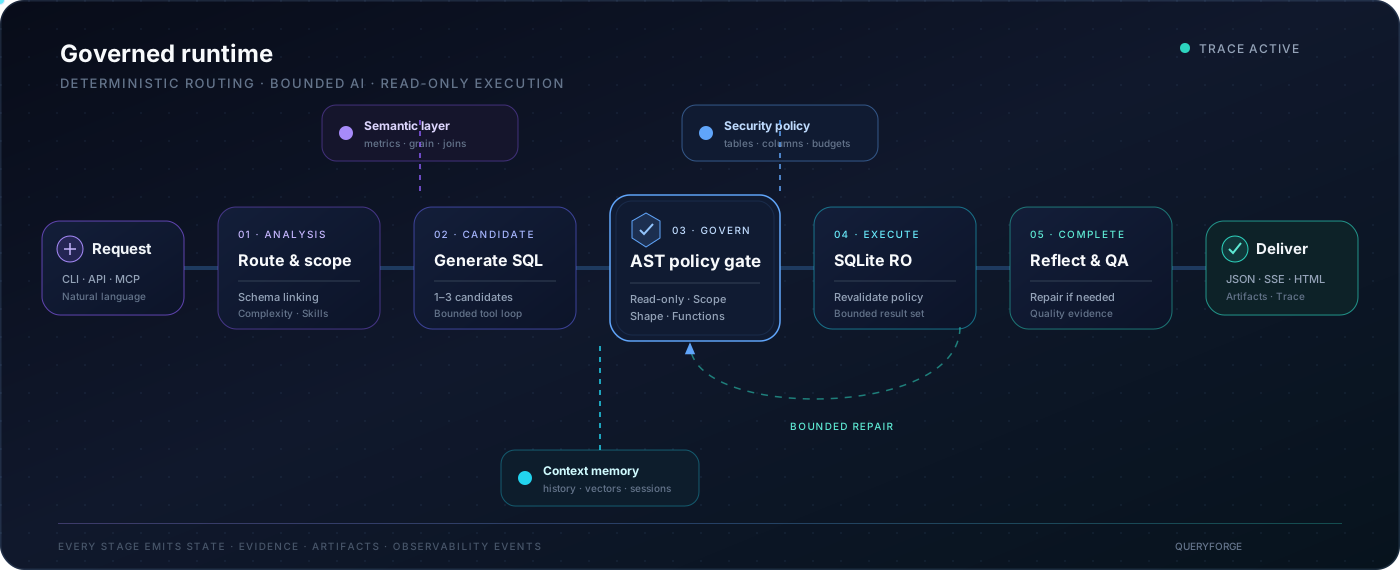
The public lifecycle stays intentionally small:
analysis → candidate → execution → completion → delivery
Role-specific agents operate inside those stages. A deterministic router chooses
the path; the model does not control the security boundary.
SQL Governance
Every generated query passes through an auditable pipeline:
SQL candidate
  → SQLite AST parse
  → single read-only statement
  → table and column scope
  → dangerous-function checks
  → recursive CTE and cross-join checks
  → table, join, and LIMIT budgets
  → governed preview
  → execution-boundary revalidation
A policy can be as small as:
version: 1
name: anime_streaming
allowed_tables:
  - fact_watch_session
  - dim_anime
require_limit: true
max_limit: 500
max_tables: 2
max_joins: 1
allow_cross_join: false
Policy denials return a structured SQL_SECURITY_ERROR before SQLite execution.
Semantic Layer
QueryForge's YAML semantic models give generated SQL business context that raw
schemas cannot provide:
metrics:
  - name: watch_hours
    description: Total valid viewing time in hours.
    entity: watch_session
    aggregation: sum
    expression: SUM(fact_watch_session.watch_seconds) / 3600.0
    default_filters:
      - fact_watch_session.is_valid = 1
    owner: audience-analytics
    sensitivity: internal
Models can declare entities, dimensions, metrics, grain, relationships, join
paths, fan-out constraints, operational metadata, and physical quality rules.
QueryForge requires a validated model by default; it auto-discovers a model beside
the database and rejects schema-only analysis unless the caller explicitly selects
the diagnostic escape hatch.
In Studio, semantic construction is domain-first and gated:
Create/select domain
  → upload domain-owned sources
  → profile physical schema
  → confirm entity identity and grain
  → define dimensions, measures, metrics, and time
  → review relationships, cardinality, and Join Paths
  → classify sensitivity, ownership, policy, and quality
  → validate 100% of blocking checks
  → publish data + semantics atomically
Technical names are treated as evidence, not business truth. A new domain starts
empty and never inherits the Anime sample's entities or metrics.
Build or incrementally refresh one:
python scripts/build_semantic_model.py \
  --database warehouse.sqlite \
  --output warehouse.semantic.yml \
  --owner data-platform
The generated report separates high-confidence physical evidence from definitions
that need business review. See Semantic layer authoring
and Semantic contracts.
The repository also includes a Monday-morning
semantic drift workflow that checks schema,
metrics, relationships, Join Paths, and data-quality contracts against a reviewed
baseline.
Bundled sample domain: Anime Streaming
Anime Streaming is one ready-to-run example data domain, not a product-wide
schema. The dataset is purpose-built for QueryForge and fully synthetic: 370,762
rows, 15 tables, 30 declared relationships, 7 governed Join Paths, and
11 business metrics across content, engagement, subscriptions, advertising,
community, and merchandise.
flowchart LR
  Studio[Studio] --> Anime[Anime]
  Genre[Genre] --- Bridge[Anime–Genre Bridge] --- Anime
  Anime --> Episode[Episode] --> Watch[Watch Session]
  User[User] --> Watch
  User --> Rating[Rating] --> Anime
  User --> Subscription[Subscription]
  Watch --> Ad[Ad Impression]
  User --> Order[Merch Order] --> Item[Order Item]
  Product[Merch Product] --> Item
  Anime --> Product
  User --> Follow[User Follow] --> User

  classDef dimension fill:#111827,stroke:#7c3aed,color:#f9fafb;
  classDef fact fill:#172554,stroke:#22d3ee,color:#f9fafb;
  class Anime,Studio,Genre,Episode,User,Product,Bridge dimension;
  class Watch,Rating,Subscription,Ad,Order,Item,Follow fact;
See the dataset contract, inspect the
semantic model, or regenerate
the database and optional CSV exports withpython sample/generate_anime_streaming.py.
Common Workflows
Preview a plan without executing SQL
queryforge \
  --plan-mode \
  --question "Compare monthly watch hours by subscription tier"
Enable the complex execution profile
queryforge \
  --complexity-mode complex \
  --parallel-candidates 3 \
  --question "Explain completion-rate changes by genre, device, and membership tier"
Stream progress or create a report
queryforge --stream --question "List the top ten anime by watch hours"
queryforge --report --question "Build a report for monthly engagement by genre"
Build a governed data asset
python -m pip install -e ".[assets]"

python scripts/scaffold_data_asset.py \
  --source events.csv \
  --output events.assets.yml \
  --owner engagement-analytics

# Review the semantic draft and set semantic_model.reviewed: true.
python scripts/build_data_assets.py \
  --config sample_data/data_assets/assets.yml \
  --publish-database .queryforge/demo/analytics.sqlite
Every uploaded asset must carry entity semantics. Data and semantics publish
atomically, so a failed metric, relationship, grain, or quality contract rolls the
whole upload back.
Start the REST API
python -m pip install -e ".[api]"
queryforge --serve-api --api-host 127.0.0.1 --api-port 8000
curl -X POST http://127.0.0.1:8000/ask \
  -H 'content-type: application/json' \
  -d '{
    "question": "List the ten anime with the highest completion rate",
    "database": "sample_data/anime_streaming/anime_streaming.sqlite"
  }'
Start the MCP server
python -m pip install -e ".[mcp]"
python -m queryforge.interfaces.mcp.server --transport stdio
Interfaces
| Surface | Entry point | Best for |
|---|---|---|
| Studio | make web-dev |
Data-domain management, visual onboarding, semantic authoring, and governed analysis |
| CLI | queryforge --question "..." |
Local exploration and engineering workflows |
| REST | POST /ask and POST /plan |
Application integration |
| SSE | POST /ask/stream |
Progress-aware clients |
| MCP | queryforge.interfaces.mcp.server |
IDEs and MCP-compatible assistants |
| Gateway | POST /gateway/webhook |
Stable user/channel session adapters |
| Artifacts | JSON, Vega-Lite, SVG, HTML | Review, sharing, and audit |
Project Structure
queryforge/
├── cli.py             # Installed CLI implementation
├── application/       # Transport-neutral service facade and resources
├── core/              # Configuration, schemas, and observability
├── data_assets/       # Ingestion, quality, lineage, and publication
├── domain/            # SQL policy, semantics, contracts, and skills
├── infrastructure/    # SQLite, model providers, storage, and tools
├── interfaces/        # CLI-adjacent API, MCP, and gateway adapters
├── orchestration/     # Router, role agents, lifecycle, and state
└── workflow/          # NL2SQL nodes, selection, repair, and reporting

evaluation/gold/       # Multi-domain NL2SQL evaluation cases
sample_data/           # Ready-to-run SQLite datasets and semantic models
web/                   # QueryForge Studio and hosted persistence adapters
scripts/               # Build, benchmark, evaluation, and acceptance tools
tests/                 # Unit, integration, boundary, and acceptance tests
docs/                  # Architecture and feature documentation
.github/               # CI, semantic drift audit, and contribution templates
Dependencies flow inward from interfaces and application code toward domain,
infrastructure, and core contracts.
Quality and Evaluation
Run the complete offline quality gate:
python scripts/run_acceptance.py --full
Or run the test suite directly:
python -m unittest discover -s tests -q
Live model evaluation reports execution success, semantic equivalence, policy
precision/recall, latency, estimated cost, and candidate-selection uplift:
python scripts/evaluate_sql.py \
  --cases evaluation/gold/nl2sql_multidomain.jsonl \
  --model-provider openai \
  --output .queryforge/evaluations/openai.json
CI runs the offline acceptance gate on Python 3.11 and 3.12.
Documentation
| Topic | Guide |
|---|---|
| Architecture | Agent team architecture |
| Configuration | Configuration reference |
| Studio | Visual workspace and semantic onboarding |
| REST API | API reference |
| MCP | MCP server |
| Semantic layer | Semantic contracts |
| Semantic authoring | Build, review, and require semantic models |
| Data assets | Data asset builds |
| Evaluation | NL2SQL evaluation |
| Reports | Report artifacts |
| Subject scoping | Subject tree |
| GitHub release | First-publish checklist |
| Documentation index | All guides |
Contributing and Security
The source tree is ready for GitHub review and CI. The repository owner still needs
to select and add a LICENSE before public release; no license has been assumed on
their behalf.
Scope and Security
QueryForge's guarantees apply to its configured SQLite execution boundary. The
project does not currently include:
- production authentication, authorization, tenant isolation, or rate limiting;
- durable distributed workflow recovery or token-level cancellation;
- PostgreSQL, MySQL, warehouse, lakehouse, or streaming-system adapters;
- provider-normalized billing or a trained-model lifecycle.
Keep REST and MCP transports inside a controlled environment. Do not commit
provider secrets, generated run state, or local databases containing sensitive data.
Network transports can be hardened without code changes:
QUERYFORGE_API_KEY— when set, REST/Gateway endpoints (except/health)
requireAuthorization: Bearer <key>orX-API-Key: <key>.DATABASE_ALLOWLIST/REPORT_ROOT_ALLOWLIST— comma-separated directories
that confine caller-supplieddatabase/semantic_model_path/sql_policy_path
and report output paths. Without them, network transports fall back to the
project root plus the default database directory.
POST /ask/stream delivers progress events followed by one terminalfinal_result event carrying the serialized answer (or an error); clients
that disconnect cancel the run cooperatively at the next node boundary.
Roadmap
- Database adapters beyond SQLite
- First-class authentication and tenant policy boundaries
- Durable workflow execution and cancellation
- Warehouse-catalog integrations
- Provider-independent usage and cost accounting
Contributions and design discussions are welcome after the repository license is selected.
Yorumlar (0)
Yorum birakmak icin giris yap.
Yorum birakSonuc bulunamadi