mnemonic-proxy
Health Uyari
- License — License: MIT
- Description — Repository has a description
- Active repo — Last push 0 days ago
- Low visibility — Only 5 GitHub stars
Code Gecti
- Code scan — Scanned 12 files during light audit, no dangerous patterns found
Permissions Gecti
- Permissions — No dangerous permissions requested
Bu listing icin henuz AI raporu yok.
Like Johnny, your local agent carries more than its head can hold — and keeps working for hours. Transparent proxy: verbatim archive, structured recall, segments, saved engine state.

Mnemonic Proxy
Like Johnny, your agent carries more than its head can hold — and keeps working for hours.




A transparent HTTP proxy that sits between a coding agent and a local model (llama.cpp's llama-server,
Strata, ds4-server, or any
OpenAI-compatible server). The agent keeps sending its whole,
unmodified history; the proxy decides what the model actually reads. Old material leaves the prompt but is never
summarized away: every message, tool call and output stays on disk, verbatim, and the model can pull any of it back.
It speaks OpenAI Chat Completions, Anthropic Messages and OpenAI Responses. Python ≥ 3.10, standard library only.
Developed and benchmarked primarily with Strata, by Niko1221 and contributors.
mnemonic-proxy is an independently maintained project that also supports llama-server, ds4-server and other
OpenAI-compatible backends; saved engine state depends on what the backend supports (see Engines).
Project page: https://lastreload.github.io/mnemonic-proxy/
One session, measured
A real coding session — a canvas tower-defense game built from scratch by a 35B-A3B MoE model on a single 12 GB
RTX 4070 Ti — with the proxy in between.
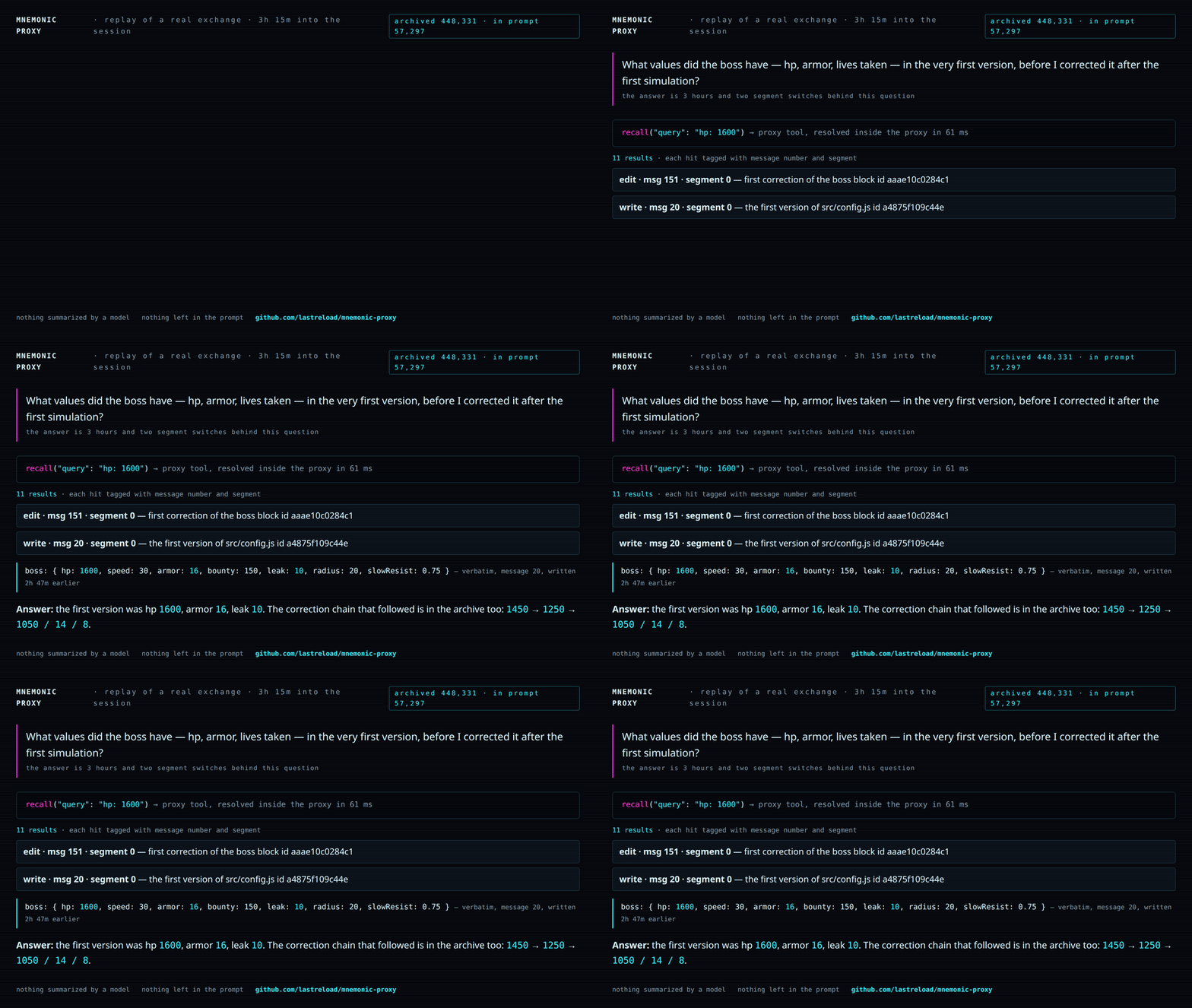
Replay of a real exchange (animated GIF; MP4).
Three hours and two segment switches into the session, one recall call — resolved inside the proxy in
61 ms — brings back the verbatim first version of the boss block, message 20. No model summarized anything.
| 448K | tokens of history archived and recallable |
| 105K | peak tokens actually in the prompt (window: 128K) |
| 3h15 | continuous agent work · 430 requests · 0 errors |
| 1.4 s | to resume a 110K-token conversation from disk (≈50 s re-reading it) |
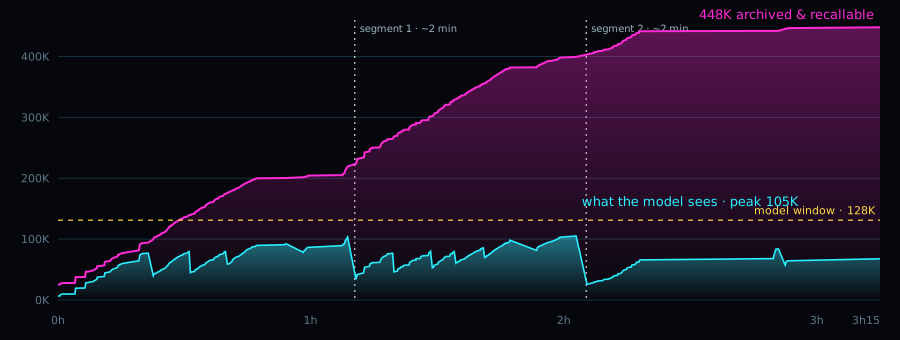
Magenta: the full history of the session. Cyan: what the model actually reads on each request. Dashed lines: the two
segment switches (≈2 minutes each, written handoff notes). Data from the proxy journal, 5 Oct 2026.
How it works
No summaries written by a model, no vector database required.
- Hide — mask, don't summarize. Old tool outputs and reasoning leave the prompt in stable blocks and become
one-line receipts with an id. The prefix stays byte-identical between blocks, so the engine's KV cache keeps
working. - Recall — structured, exact. A
recalltool searches the verbatim archive: first write of a file, its full
edit timeline, command → output, the reasoning behind an edit — every hit tagged with message number and segment.
The proxy runs these calls itself; the client never sees them, even when streaming. - Segment — handoff notes. When even the masked window fills up, the model writes its own notes, the segment is
sealed and a fresh one starts. Pinned lines (!!or📌) survive every switch; lines starting with🗑(or~)
mark a message as disposable once answered. - Save — engine state on disk. On engines that support it (llama-server, Strata with session files) the KV
state is saved to disk: resuming after a pause, a restart or another client takes 1–3 s instead of a full
re-read. - Archive — deduplicated cold storage. Old state files are rebuilt bit-for-bit from content-addressed zstd
blocks: −36% disk on our sessions, sha256-verified before every restore. - Lean — tools on demand. Agents ship tens of thousands of tokens of tool definitions. The proxy keeps the core
ones and loads the rest by name: 25.6K → 6.2K tokens on every request.
"In the courier business you don't read the payload. You carry it, and you give it back exactly as it was." — the
design rule. Hidden content is never paraphrased; it is either in the prompt or retrievable verbatim.
Recall, benchmarked
71 questions about past sessions, each with the known location of the evidence (including 8 with no answer in the
archive). Held-out split:
| keyword search | structured recall | |
|---|---|---|
| evidence found within 5 calls | 90% | 100% |
| tokens returned per question | 5,940 | 2,737 |
| "not in the archive" recognised | 1 / 4 | 4 / 4 |
The benchmark guided development, so read it as a regression suite, not an independent score. Its archives are real
private sessions and are not in this repository: bench/ runs against your own archives (bench/data/<name>.sqlite)
with questions written for them. Details: docs/dev-notes/RECALL-RESULT.md
(Italian).
Saved state, measured
Resuming a conversation instead of re-reading it:
| case | saved | re-read |
|---|---|---|
| Strata (session-files branch), 110K tokens, RTX 4070 Ti | 1.4 s | ≈50 s |
| Strata (session-files branch), 69K tokens, after restart | 2.9 s | 33 s |
| llama-server, 8.2K tokens, CPU, Qwen3-0.6B | 1.9 s | 28.6 s |
| llama-server.exe, native Windows (CI runner), 3.2K tokens, CPU, Qwen3-0.6B | 2.3 s | 35.7 s |
Times are for restoring the conversation's context; loading the model is separate.
Why saved state matters
A long agent conversation is expensive to rebuild: every token of it has to be processed again (prefill) before the
model can answer. Without saved state that cost is paid again each time the engine loses the conversation — after a
restart, when another client or conversation used the engine in between, and when the proxy returns to a sealed
segment. On a single 12 GB GPU that is close to a minute for 100K tokens; restoring the saved state takes a second or
two, and the state lives on disk, not in VRAM.
This is not specific to the proxy: any client that keeps long conversations on a local engine benefits.
llama-server already offers it through --slot-save-path. Strata has it since
v0.1.40 (PR #668),
opt-in with --slot-save-path. The Strata numbers on this page were measured on our session-files build
(0.1.38 + PR #668, 8d8f664), before the release; the proxy has not yet been re-measured on 0.1.40.
Claude Code and Codex, live on Strata
0.2.0 in front of Strata (Qwen3.8 Flash Next IQ3_XXS, RTX 4070 Ti 12 GB, 128K window), with the real clients:
| Claude Code 2.1.284 (Anthropic Messages) | Codex 0.160 (Responses) | |
|---|---|---|
| session | 1 h 41 min, 9 steps, 339 requests, 0 proxy errors | 3 steps, 20 requests |
| prompt tokens served from the engine cache | 92.6% of 11.36M | 93.9% of 351K |
| context | 328K virtual, at most 46K in the prompt; 14 segment switches | — |
recall |
22 calls | exact: 36 tests and 8/8 error messages, word for word |
Claude Code ran on a test config with low thresholds (window 64K, masking at 36K) so that segments would switch
within the session. Found live and fixed in 0.3.0: in 3 writes out of 140 the model copied the shortened form of an
old tool argument into a file (see What we have not proven). Report:
docs/dev-notes/LIVE020-RESULT.md (Italian).
Does the model recall on its own?
Recall only helps if the model uses it without being told. We built short scripted tasks where a value the model
needs at the end exists only in an old, masked tool output — not on disk, not reproducible — and the final request
never says "remember" or "earlier":
- A random output of a setup script (build id, p95, skipped migrations); re-running it gives different values;
- B a file read once, then deleted;
- C the old version of an overwritten config, no git, no backup;
- D an error from a test service that is then shut down;
- L a long session: the value appears in turn 0, followed by 12 heavy turns and several segment switches.
Qwen3.8 Flash Next IQ3_XXS on Strata 0.1.40, RTX 4070 Ti 12 GB, proxy 0.3.1 as released (no extra hints):
| client | episodes | right values | via recall the model chose to call |
|---|---|---|---|
| Claude Code 2.1.284 | A, B, C, D × 2 | 8 / 8 | 8 / 8 |
| Claude Code 2.1.284 | L: 127K virtual, 3 segment switches | 1 / 1 | yes |
| pi 0.87.1 | A, B, D | 3 / 3 | 3 / 3 |
| pi 0.87.1 | L: 231K virtual, 6 segment switches | 1 / 1 | yes (5 keyword searches) |
A control with the full history in the prompt (no masking) was right in every short episode. In the long one it
re-ran the setup script and wrote the new, wrong values — the proxy run did better. Each episode was checked to have
none of the true values in the final prompt; one file per configuration was also checked by hand.
Across 18 real sessions (pi, Claude Code, Codex) the need is rare: 5 spontaneous recalls against 108 after a question
about the past; 30 re-reads of a masked, unchanged file (≈37K tokens); 4 edits out of 505 failed because the model
misremembered a masked file. When a file can be re-read, the model re-reads it — which is right when it has changed.
Limits: one model, one run of each long session, scaled-down thresholds (32K window) for the long sessions; Cline
not measured (it cannot resume a session headless without a Cline account). Report:
docs/dev-notes/RECALL-NEED-RESULT.md
(Italian).
Long context on Strata, without the proxy
16 name=number facts scattered in a generated Italian story, question at the end, temperature 0, two seeds, from
16K to 122K tokens of prompt: 151/160 exact, 0 wrong — every miss is an omitted line, all at 64K and above.
Prefill stays at ~2.5K tok/s up to 122K, VRAM flat at 11.6 GB. Same report, section 4.
User reports
Numbers measured by users on their own hardware and shared with permission. Not reproduced by us.
| u/Swimming-Farmer7815 | |
|---|---|
| hardware | RTX 5060 Ti 16 GB, Xeon E5-2699 v3, 64 GB DDR4 ECC |
| engine / model | Strata, Swift-Qwen3.8-Flash-Next IQ3_XXS, 128K window |
| client | Cline, with its automatic context compaction disabled |
| session | 13 h; ~280K tokens of total history, ~77K in the last request |
| saved state | ~58K tokens restored in under 4 s (about 1 min 15 s to re-read at the measured prefill rate) |
recall |
8 calls, all 8 results used by the model |
The user reports no compaction pauses during the session. All 8 recalls happened in the last two minutes of the
session, when the user asked for a summary of the day: during normal work the model never called recall on its
own. In our tests with Claude Code and pi the model did call recall by itself when the value could not be re-read
from disk (Does the model recall on its own?); with Cline we could not test it.
Share your numbers. If you run the proxy on your own hardware, a report helps — especially with clients and models
we have not tested (Cline, OpenCode, other models). Useful: GPU/RAM, engine and model, client, session length (total
history and tokens in the last request), restore time, how many recall calls and whether the model made them on its
own. data/journal.jsonl holds most of it; check it before sharing, it contains your recall queries. Open an issue
with the user report template.
Requirements
- Engine window: at least 16K tokens (16384), 32K or more (32768) recommended. Below 16K the proxy refuses to
start, andmnemonic-proxy checkreports NOT READY, with the command to restart the engine (llama-server -c 32768,ds4-server --ctx 32768). Why: at 32K the recall trap of the ds4 runs (an error line removed from the
prompt, asked for later) was answered right with both ds4 builds; at 8K it passed once, after the 0.3.0 recall
fix, and failed before it. Small windows stay excluded until they are proven on more runs. Reports (Italian):
DS4-QWEN-COMPARE-RESULT.md,
RECALL-8K-030-RESULT.md. - Python ≥ 3.10 (
kv_archive: ≥ 3.14). An OpenAI-compatible engine; saved state needs llama-server with--slot-save-path, or Strata ≥ 0.1.40 with--slot-save-path(see Engines).
Quick start
Three levels. Each one stands on its own.
| what you see | needs | time | |
|---|---|---|---|
| T0 — see it work | archive, masking, exact recall, with a scripted fake model | Python ≥ 3.10 | 1 minute |
| T1 — real model on CPU | a real agent (pi) writing code through the proxy, masking, recall, resume after an engine restart | + cmake, a C++ compiler, Node.js ≥ 22.19, ~9 GB RAM (the engine at -c 32768), 3.5 GB disk |
~45 minutes |
| T2 — real use (GPU) | your own model and agent, long sessions | a GPU engine | — |
Commands are for Linux; see Platforms for macOS and Windows (native or WSL).
T0 — see it work (1 minute, no model)
python3 -m venv mnemonic-venv && . mnemonic-venv/bin/activate
pip install mnemonic-proxy
mnemonic-proxy demo
With uv, no venv to create: uvx mnemonic-proxy demo. The development version (themain branch, newer than the last PyPI release): pip install git+https://github.com/lastreload/mnemonic-proxy.
The demo starts the real proxy in a temporary folder, in front of a scripted fake model. An agent reads a longbuild.log that contains one build id; the session grows until the proxy hides the log; the demo prints what the
engine receives in its place (a one-line receipt); then the user asks for the build id, the model calls recall,
the proxy answers it internally and the archived text is compared byte for byte with the original. It ends withPASS (exit 0) or FAIL (exit 1).
It proves the proxy's own logic: archive, masking, recall. It does not prove anything about a real model, its tool
calling, or saved engine state — that is T1.
T1 — a real model on CPU
Tested end to end in a clean Ubuntu 24.04 container (see Tested combinations). A 4B model on
CPU is slow (seconds per answer) and limited: the point is to see every mechanism work, not to do real work.
0. Prerequisites (Ubuntu/Debian; other systems: Platforms):
sudo apt install git cmake build-essential python3-venv curl
and Node.js ≥ 22.19 for pi (https://nodejs.org/en/download, or your package manager).
1. Folder, proxy, example config.
mkdir mnemonic-trial && cd mnemonic-trial
git clone --depth 1 https://github.com/lastreload/mnemonic-proxy
python3 -m venv .venv && . .venv/bin/activate
pip install ./mnemonic-proxy
cp mnemonic-proxy/examples/config.llama-server-32k.json .
mkdir -p slots data
2. llama.cpp, the tested release (CPU build, ~2 minutes on 12 cores).
git clone --depth 1 --branch b11430 https://github.com/ggml-org/llama.cpp
cmake -S llama.cpp -B llama.cpp/build -DCMAKE_BUILD_TYPE=Release
cmake --build llama.cpp/build --config Release -j 8 --target llama-server
3. The model: Qwen3-4B-Instruct-2507, Q4_K_M (2.5 GB). Qwen publishes no GGUF for this model
(model card); this is the
Unsloth conversion, pinned to the tested revision:
mkdir -p models
curl -L -o models/Qwen3-4B-Instruct-2507-Q4_K_M.gguf \
  https://huggingface.co/unsloth/Qwen3-4B-Instruct-2507-GGUF/resolve/a06e946bb6b655725eafa393f4a9745d460374c9/Qwen3-4B-Instruct-2507-Q4_K_M.gguf
sha256sum models/Qwen3-4B-Instruct-2507-Q4_K_M.gguf
# 3605803b982cb64aead44f6c1b2ae36e3acdb41d8e46c8a94c6533bc4c67e597
4. The engine (terminal 1, inside mnemonic-trial):
llama.cpp/build/bin/llama-server -m models/Qwen3-4B-Instruct-2507-Q4_K_M.gguf \
  -c 32768 --parallel 1 --jinja --slot-save-path ./slots --port 8095
Wait for the line listening on http://127.0.0.1:8095 (about 2 s once the model file is cached; curl -s localhost:8095/health answers {"status":"ok"}). --slot-save-path ./slots is what makes saved state
possible, and it must be the same folder as slot_dir in the config (./slots). --jinja is already the default in
this build; it is written out because tool calling depends on it. -c 32768 is the recommended window (the minimum
is 16384, see Requirements); the example config starts masking at 14K tokens, so the proxy is at
work after a few long tool outputs.
5. Check, then start the proxy (terminal 2, inside mnemonic-trial, venv active: . .venv/bin/activate):
mnemonic-proxy check --live --upstream http://127.0.0.1:8095 --port 8096 --data ./data --config config.llama-server-32k.json
mnemonic-proxy --upstream http://127.0.0.1:8095 --port 8096 --data ./data --config config.llama-server-32k.json
check must end with READY (exit 0): engine recognised as llama.cpp, model loaded, window taken from n_ctx
(32768) with the thresholds scaled to it, saved state supported and configured, and — because of --live — one
real generation, one tool call, one save/restore whose file appeared in ./slots. Each failing line says how to fix
it; see also Troubleshooting. The proxy then prints[mnemonic-proxy] 127.0.0.1:8096 -> http://127.0.0.1:8095 (engine llama.cpp, saved state yes) ... window=32768.
6. pi, the coding agent (terminal 3). Install the tested version:
npm install -g --ignore-scripts @earendil-works/[email protected]
Create ~/.pi/agent/models.json (if it exists, add the mnemonic entry to its providers):
{
  "providers": {
    "mnemonic": {
      "baseUrl": "http://127.0.0.1:8096/v1",
      "api": "openai-completions",
      "apiKey": "local",
      "compat": { "supportsDeveloperRole": false, "supportsReasoningEffort": false },
      "models": [
        { "id": "local-model", "name": "local model via mnemonic-proxy", "reasoning": false,
          "contextWindow": 131072, "maxTokens": 2048 }
      ]
    }
  }
}
and ~/.pi/agent/settings.json (if it exists, add these three keys):
{
  "defaultProvider": "mnemonic",
  "defaultModel": "local-model",
  "compaction": { "enabled": false }
}
compaction.enabled: false matters: pi's own auto-compaction would summarise the history the proxy is managing.contextWindow is the virtual window the client sees (131072), not the engine's 32768: pi subtracts the prompt size
from it to choose max_tokens, and with the engine's real window it would ask for fewer and fewer tokens as the
history grows, down to 1. Fitting the history
into the engine's real window is the proxy's job. apiKey is a placeholder (the proxy does not check it); the model
id is any name, llama-server serves its loaded model.
7. The exercise. In terminal 3, a folder with a log whose one interesting line is buried in the middle:
mkdir -p ~/mnemonic-exercise && cd ~/mnemonic-exercise
python3 -c "for i in range(650): print('[%04d] compiling module_%03d.c ... ok (%d ms)' % (i, i, 80 + i * 7 % 61) if i != 397 else '[0397] build id: BUILD-7f3a9c-ORCHID-42')" > build.log
pi
Type these requests one at a time and wait for each answer (or non-interactively, same session:pi -p "<request 1>", then pi -c -p "<request 2>", …):
Run python3 -c "import uuid; print(uuid.uuid4())" and tell me the value.— abashtool call; pi repeats the
value.Run cat build.log and tell me whether every module compiled.— a long output (≈13K tokens; on CPU the 4B model
needs a few minutes to read it).Write primes.py with a function first_primes(n) that returns the first n prime numbers, and test_primes.py with three unittest tests. Run the tests.—writecalls, thenbash. The prompt is now past the masking threshold
(14K tokens with the 32K config): as soon as enough newer messages follow the log, the proxy hides it behind a
receipt (here during step 4). Nothing is printed; check withgrep -c '"event": "mask"' ~/mnemonic-trial/data/journal.jsonl(≥ 1).Add a function is_prime(n) to primes.py and a test for it in test_primes.py, then run the tests.What build id is written in build.log? Do not run commands and do not read files.— the log is no longer in the
prompt, only its receipt; the expected path is arecallcall answered by the proxy itself (pi never sees it):grep -c '"event": "recall"' ~/mnemonic-trial/data/journal.jsonl. Small models often skip it: see the results
below.
Wait one minute (the proxy saves the engine state after 60 s idle: "event": "autosave"), then restart the engine:
Ctrl+C in terminal 1, start it again with the same command, and ask Which files did you write in this session?.
The proxy restores the conversation from ./slots instead of re-reading it:grep '"event": "autorestore"' ~/mnemonic-trial/data/journal.jsonl shows the restored tokens and milliseconds.
What this proves and what it does not, for this model: see Tested combinations.
T2 — real use (GPU)
Use the engine and model you already have; the only requirements are an OpenAI-compatible endpoint and, for saved
state, an engine that can save its KV state to disk:
llama-server -m your-model.gguf -c 131072 --parallel 1 --jinja --slot-save-path /path/to/slots --port 8095
mnemonic-proxy check --upstream http://127.0.0.1:8095 --port 8096 --data ./data --config config.json
mnemonic-proxy --upstream http://127.0.0.1:8095 --port 8096 --data ./data --config config.json
with config.json = examples/config.llama-server.json and slot_dir = the same /path/to/slots (see
Configuration for the recommended fields). With an engine that has no saved state (vLLM, online
APIs) the proxy runs in base mode. The measurements at the top of this page (35B-A3B MoE, 128K window) come from
Strata (our session-files build, 0.1.38 + PR #668) on a 12 GB RTX 4070 Ti — see Engines; they say nothing about
other hardware.
The proxy recognises the engine at startup and turns off, with a warning, whatever the engine cannot do
(--engine auto|strata|llama.cpp|ds4|openai forces it). ctxproxy is kept as an alias of mnemonic-proxy.
Optional: --tokenizer (a Hugging Face tokenizer.json, or a Strata pack tokenizer/ folder; needspip install 'mnemonic-proxy[exact]') for exact token counts
instead of a chars/3.5 estimate; with llama-server, "engine_tokenize": true counts through its /tokenize. A
systemd user unit is in examples/mnemonic-proxy.service.
Disable the agent's own auto-compaction in every client below, otherwise two context managers fight over the same
history.
pi, Hermes, Continue, … (Chat Completions)
Point the client's OpenAI base URL at http://127.0.0.1:8096/v1. For pi, the two files of T1 step 6 (with your realcontextWindow/maxTokens). For other clients: their OpenAI-compatible provider setting, plus their own way to turn
off context compaction.
Claude Code (Anthropic Messages)
Checked against Claude Code 2.1.287; a 1 h 41 min session with 2.1.284 on Strata is measured
above. Claude Code may print unrecognized_model local-model: it works
anyway.
export ANTHROPIC_BASE_URL=http://127.0.0.1:8096      # no /v1
export ANTHROPIC_AUTH_TOKEN=local                    # any value; the proxy does not check it
export ANTHROPIC_MODEL=local-model                   # any name; the engine serves its loaded model
export ANTHROPIC_DEFAULT_HAIKU_MODEL=local-model     # background tasks (replaces ANTHROPIC_SMALL_FAST_MODEL)
export CLAUDE_CODE_DISABLE_NONESSENTIAL_TRAFFIC=1    # fewer side requests competing for the engine
export DISABLE_AUTO_COMPACT=1                        # turns off auto-compaction; /compact still works
claude
ANTHROPIC_SMALL_FAST_MODEL is still read by 2.1.287 (it takes precedence), but the documented name isANTHROPIC_DEFAULT_HAIKU_MODEL. DISABLE_COMPACT=1 would also turn off the manual /compact.POST /v1/messages (streaming and not) and POST /v1/messages/count_tokens are supported. Thinking blocks get a
local placeholder signature: a session started through the proxy cannot be continued on Anthropic's API.
Codex (OpenAI Responses)
Codex 0.160 speaks only the Responses API (wire_api = "chat" is rejected). In ~/.codex/config.toml (or a separateCODEX_HOME):
model = "local-model"
model_provider = "local"
model_context_window = 131072              # the proxy's window; Codex compacts relative to this
model_auto_compact_token_limit = 100000000 # compaction threshold far above any real session

[model_providers.local]
name = "local engine via mnemonic-proxy"
base_url = "http://127.0.0.1:8096/v1"
wire_api = "responses"
env_key = "LOCAL_API_KEY"          # export LOCAL_API_KEY=local (any value)
requires_openai_auth = false
supports_websockets = false
Codex 0.160 has no setting that turns auto-compaction off: model_auto_compact_token_limit only moves the
threshold. Set it far above any session, as above, so that in practice the proxy is the only context manager.
Codex's prompt_cache_key is used as the conversation key. Stateless only (store=false, noprevious_response_id), which is what Codex sends.
MCP recall server (Claude Code, Codex, Hermes)
The archive can also be searched from any MCP client, read-only (sqlite mode=ro; the proxy can keep writing). Three
tools: recall (same search as the proxy's tool), conversations, journal.
mnemonic-mcp --db ./data/archive.sqlite                 # stdio
mnemonic-mcp --db ./data/archive.sqlite --http 8133     # streamable HTTP on 127.0.0.1:8133/mcp
claude mcp add mnemonic -- mnemonic-mcp --db /path/to/data/archive.sqlite
codex mcp add mnemonic -- mnemonic-mcp --db /path/to/data/archive.sqlite
hermes mcp add mnemonic --command mnemonic-mcp --args --db /path/to/data/archive.sqlite
python3 -m ctxproxy.mcp_server is the same program. Hermes config.yaml equivalent:
mcp_servers:
  mnemonic:
    command: mnemonic-mcp
    args: [--db, /path/to/data/archive.sqlite]
    enabled: true
Dashboard (optional; needs the git clone; UI in Italian)
The dashboard is not part of the pip package: it runs from a clone of this repository, and its interface is in
Italian.
python3 mnemonic-proxy/dashboard/ctxdash.py --data ./data --strata http://127.0.0.1:8095 --proxy http://127.0.0.1:8096 --port 8097
Read-only, on 127.0.0.1:8097: engine status, physical vs. virtual context over time, masking/segment/recall events,
and the live physical prompt (with live_dump: true).
Proxy endpoints
Besides the client APIs (/v1/chat/completions, /v1/messages, /v1/responses), all other paths are passed to the
engine. The proxy's own:
| endpoint | what |
|---|---|
GET /health |
proxy + engine health: {"status": "ok" | "loading" | "engine_unreachable", "engine", "version", "upstream"}; HTTP 200 only when the engine is ready |
GET /v1/engine |
what was detected: kind, slot_save (saved state supported and on), n_ctx, model, notes. GET /v1/strata/engine is the same (0.1 name, kept) |
GET /v1/strata/conversations/<id> |
one conversation: archived messages, masks, segments |
GET /v1/strata/archive/<id> |
one archived block, verbatim |
GET /v1/strata/journal |
the last 200 journal events |
Tested combinations
0.3.0, engine -c 32768 (2026-10-06): T1 run as written above, on the CPU of a Ryzen 7 5700G (16 threads, no
GPU, llama-server at nice 19), in a fresh folder with its own HOME: llama.cpp b11430 CPU build, pi 1.0.3,
Node 24.14, Python 3.14, config.llama-server-32k.json. Requests sent with pi -p / pi -c -p, one at a time.
| model | check --live |
tool calls | masking | recall (step 5) | engine restart |
|---|---|---|---|---|---|
| Qwen3-4B-Instruct-2507 Q4_K_M (Unsloth) | READY (exit 0) | yes; steps 1–4 done, 4/4 tests pass | yes: 1 mask (the 13.4K-token log, prompt 17.3K → 4.0K) | no: answered "cannot determine" instead of calling recall |
autorestore 4112 tokens in 349 ms; next prompt 4157/4176 reused |
Times on this CPU: steps 2–4 took 7, 5 and 10 minutes (reading 13K tokens of log, then generating at a 16K prompt);
the whole exercise about 25 minutes. Memory: llama-server RSS 8.9 GB at -c 32768; one saved state of 4.1K tokens
is 600 MB in ./slots. A first run with a 150-line log (≈3K tokens, the 0.2.1 exercise) never reached
the masking threshold at 32K (largest prompt 10K): step 5 was answered right from the prompt, not tested. Hence the
650-line log above.
0.2.1, engine -c 8192 (windows below 16K are refused since 0.3.0): run literally as written in T1 at the time,
in a clean ubuntu:24.04 container (12 CPU cores, no GPU, user without sudo), llama.cpp b11430 CPU build, pi
1.0.3, Node 22.23.3, Python 3.12, the 8K example config of 0.2.1 (2026-10-06).
| model | check --live |
tool calls | masking | recall (step 5) | engine restart |
|---|---|---|---|---|---|
| Qwen3-4B-Instruct-2507 Q4_K_M (Unsloth) | READY | yes | yes: 5 masks, 4 segment switches | no: answered "cannot determine" instead of calling recall |
autorestore 2450 tokens in 42 ms; next prompt 2486/2505 reused |
| Qwen2.5-Coder-7B-Instruct Q4_K_M (Qwen) | READY with warnings (no tool call) | no: writes the call as JSON text, same straight to llama-server | — | — | autorestore 3698 tokens in 17 ms |
What T1 proves: the proxy in front of a real llama-server — window read from the engine, thresholds scaled to it,
masking under a real agent (and, at 8K, segment switches), state saved when idle and restored after an engine
restart without re-reading. What it does not prove: that a 4B model uses recall reliably (it did not, at 8K or at
32K), or that the agent always finishes the task — at 8K, in step 4 the 4B model looped on read/edit until the
timeout. Those depend on the model; use T2 for real work.
Found while testing, fixed in 0.2.1: with the extended recall tool (recall_struct, recall_multi) in the tool
list, Qwen3-4B made 0/6 tool calls (4–6/6 without): the example configs keep the short recall tool.
Troubleshooting
Start with mnemonic-proxy check (add --live to exercise the engine): every failing line says what to change.
| symptom | cause | fix |
|---|---|---|
check: port … is in use |
another proxy (or another program) on that port | stop it, or pass a different --port (and change the client's base URL) |
check: engine answers 503 / GET /health says loading |
llama-server is still loading the model | wait for listening on … in its log |
check: engine not reachable |
wrong --upstream, or the engine is not running |
start the engine; curl http://127.0.0.1:8095/health must answer |
proxy exits at startup: refusing to start, the context window is too small / check: context window … minimum is 16384 |
engine started with a window below 16K (-c 8192), or "window" below 16384 in the config |
restart the engine with -c 32768 (ds4-server: --ctx 32768); remove "window" from the config (it is read from the engine). See Requirements |
llama-server: failed to allocate / killed |
not enough memory for model + context | a smaller quantisation or a smaller model; the window can go down to 16384 (-c 16384), not below |
HTTP 400 exceeds the available context size |
the client asked for more than the window | proxy started with a config whose window is larger than the engine's -c? The proxy reads n_ctx from llama-server at startup: restart the proxy after changing -c |
| the model describes the command instead of calling a tool, or says it "cannot run commands" | chat template without tools, or a model weak at tool calling | llama-server with --jinja; check --live shows whether a tool call works; try a stronger model (see Tested combinations) |
check: saved state supported by the engine, disabled in the proxy |
config without slot_save |
use examples/config.llama-server.json |
check --live: the state file is not in slot_dir |
slot_dir ≠ llama-server --slot-save-path, or the engine runs on another host / in a container with another path |
the same folder, as seen from the proxy's host |
check: engine detected as openai |
llama-server too old, or another engine | saved state needs llama-server with --slot-save-path, or Strata ≥ 0.1.40 with --slot-save-path; everything else works |
| Strata has no saved state | Strata older than 0.1.40, or started without --slot-save-path |
update to Strata ≥ 0.1.40 and start it with --slot-save-path DIR |
| answers get shorter and shorter / summaries appear in the history | the client's own compaction is on as well | turn it off: pi "compaction": {"enabled": false}, Claude Code DISABLE_AUTO_COMPACT=1, Codex: threshold |
Codex: wire_api = "chat" rejected |
Codex ≥ 0.160 only speaks the Responses API | wire_api = "responses" |
kv_archive refused |
needs Python ≥ 3.14 (compression.zstd) |
Python 3.14, or leave kv_archive off (default) |
Platforms
Linux: the reference. Every tested combination below ran on Linux.
macOS: the proxy is plain Python and should work as on Linux (not yet tested). Build llama.cpp the same way
(Metal is on by default on Apple Silicon) or install it with Homebrew (brew install llama.cpp), then use the samellama-servercommand;sha256sumisshasum -a 256.Windows, native (since 0.3.2; tested on the
windows-latestCI runner, not yet on a desktop): Python ≥ 3.10
from python.org, the official llama.cpp Windows build (llama-b11430-bin-win-cpu-x64.zipor a GPU one). In
PowerShell:py -m venv mnemonic-venv; .\mnemonic-venv\Scripts\Activate.ps1 pip install mnemonic-proxy mnemonic-proxy demo mkdir slots llama-server.exe -m model.gguf -c 32768 --jinja --slot-save-path .\slots --port 8095 # in a second window mnemonic-proxy check --live --upstream http://127.0.0.1:8095 --data .\data --config config.llama-server.json mnemonic-proxy --upstream http://127.0.0.1:8095 --port 8096 --data .\data --config config.llama-server.jsonconfig.llama-server.jsonis inexamples\("slot_dir": "./slots": relative paths are resolved from the folder
you start the proxy in, so start the engine and the proxy from the same folder).examples\start-windows.batdoes the same in one double-click: it startsllama-server.exein its own window with--slot-save-path .\slots, waits for it, runscheck, then the proxy on
port 8096 (edit the four paths at the top:LLAMA,MODEL,CONFIG,VENV). What CI proves on Windows: unit
tests, demo on a cp1252 console,check --liveREADY, chat through the proxy,start-windows.bat, autosave and
autorestore after an engine restart (3.2K tokens restored in 95 ms; the turn takes 2.3 s instead of 35.7 s),kv_archiveround trip.
Not tested: real agents (pi, Claude Code, Codex) on Windows, GPU builds, the dashboard.sha256sumisGet-FileHash -Algorithm SHA256.Windows, WSL 2: follow the Linux commands inside WSL. Keep the engine, the proxy and the
slotsfolder all
inside WSL, so thatslot_dirand--slot-save-pathare the same path. Not yet tested.
Uninstall
pip uninstall mnemonic-proxy        # inside the venv you installed it in, or delete the venv
rm -rf ./data                       # the archive, the journal: your conversations in plaintext
rm -rf ./slots                      # saved engine state (large files), and kv-archive/ if you used kv_archive
./data and ./slots are separate on purpose: deleting the state files keeps the archive (recall still works, only
resuming without re-reading is lost); deleting ./data loses the archive and the conversations' state becomes
unreachable. Undo the client changes as well (pi models.json/settings.json, the Claude Code variables, the Codex
provider).
Engines
| client \ engine | Strata | llama-server | ds4-server | any OpenAI-compatible |
|---|---|---|---|---|
| Chat Completions (pi, Hermes, Continue…) | tested · full | tested on CPU · full | tested with pi (GLM 5.3, Qwen3.8) · engine keeps its own state | base (no saved state) |
| Claude Code (Anthropic Messages) | tested (1 h 41 min live session) | experimental | experimental | experimental |
| Codex (Responses) | tested (live, exact recall) | experimental | experimental | experimental |
| MCP recall server (Claude Code, Codex, Hermes) | tested read-only on a real archive |
"Tested": real client, real engine, measured; reports in docs/dev-notes/. "Experimental": tested end to end
against a mock engine and with short real client runs, not yet on long real sessions.
llama.cpp — start
llama-serverwith--slot-save-path DIRfor saved state (masking anchor, segment saved
before a switch, autosave/autorestore,kv_archive). The window comes from the server'sn_ctxunlesswindowis
set; with--parallel Nthe proxy pins one slot (slot_id, default 0). Without--slot-save-paththe proxy runs
in base mode.Strata — works in base mode on any version. Saved state: Strata ≥ 0.1.40
(PR #668, released in
v0.1.40), started with--slot-save-path DIR. Session files
must be trusted: the hashes detect corruption, not tampering. Our measurements are from the session-files build
(0.1.38 + PR #668,8d8f664); 0.1.40 has not been re-measured with the proxy yet.examples/config.example.jsonis the configuration used with session files;examples/config.official-strata.jsonthe one for Strata without--slot-save-path(or older than 0.1.40).Generic OpenAI-compatible (vLLM, online APIs, …) — base mode: masking, archive +
recall, segments with
handoff notes, 📌/🗑, streaming. No engine state, no saved files. Not tested on vLLM itself.ds4-server (antirez/ds4) — automatic detection, tool-call ids untouched, no
duplicate saving (ds4 has--kv-disk-dir). Tested with pi, see below.
ds4-server
ds4-server keeps its own state: with --kv-disk-dir DIR it checkpoints the KV cache to disk by text prefix and
resumes a conversation after a tool call by recognising the tool-call id (exact replay of the sampled call). So the
proxy does less than with other engines:
./ds4-server -m MODEL.gguf --ctx 65536 --port 8110 --kv-disk-dir ./kv
mnemonic-proxy --upstream http://127.0.0.1:8110 --port 8096 --data ./data --config examples/config.ds4.json
- Detection:
GET /v1/modelswithowned_by: "ds4.c"; the window is taken fromcontext_length(=--ctx).engine: "ds4"forces it. - The proxy does not save, restore or archive engine state (
slot_save,mask_anchor,autosave,kv_archive
are turned off): ds4 does it itself. mask_tool_argsis turned off: ds4 re-inserts the sampled call text by id, so shortened arguments would not
reach the model. Setds4_exact_tool_replay: falseonly if ds4-server runs with--disable-exact-dsml-tool-replay.- Tool-call ids pass through unchanged in all three protocols (the id the engine generated reaches the client and
comes back identical); internalrecallcalls keep the engine's id and are re-inserted identically next turn. - Old reasoning is masked as usual; the last turn with tool calls keeps its reasoning.
checkpoint_align_tokens(off by default): when set to ds4's checkpoint interval (by default 10240 tokens,--kv-cache-continued-interval-tokensrounded to--kv-cache-boundary-align-tokens), a masking block starts just
after a multiple of it, so fewer tokens are re-read after the last disk checkpoint. Needs an exact--tokenizer
to be meaningful. Not measured yet.- Not proven: long real sessions; Claude Code and Codex in front of ds4; parallel sessions (
--batched-session N)
— the proxy still serialises requests.
mnemonic-proxy is a separate tool, compatible with ds4-server and tested with it; it is not part of the ds4 project.
Measured with pi (4 tasks in one session on a 140-line server.log; the last one asks, without re-running
anything, for the request id and shard of the third error, whose output the proxy had already removed from the
prompt). Hardware: Ryzen AI Max+ 395 "Strix Halo", 128 GB unified memory, ROCm gfx1151.
| model, engine | window | tasks 1–3 | third error (rq-2290, shard 3) | recall |
time |
|---|---|---|---|---|---|
GLM 5.3 Flash Q2, ds4 0aaea5a, SSD streaming, MTP |
8K | ok | right, plus an invented timestamp | 5, by id + offset | 10 min 34 s |
| Qwen3.8 Flash Next Q2, ds4 local ROCm port | 8K | ok | not found; said so, invented nothing (0.2 recall budget: fixed in 0.3.0) | 5 | 6 min 05 s |
| Qwen3.8 Flash Next Q2, ds4 local ROCm port | 32K | ok | right (still in the prompt, no masking) | 0 | 3 min 30 s |
same, proxy 0.3.0, first prompt forcing a plain cat server.log |
8K | ok | right, exact line (no invented detail) | 1 (id + query) | 7 min 07 s |
The 8K rows were measured to stress recall; since 0.3.0 the proxy refuses windows below 16K (see
Requirements).
- GLM: after each
recallds4 read only the new tokens (614–634), never the whole prompt again: it resumes by
tool-call id. Prompt reading 24–29 tok/s, generation ~6 tok/s — enough to verify the mechanism, too slow for work. - Qwen3.8 at 8K: the model used
recallcorrectly (by id, then by offset), but 0.2's proxy cut the 2nd–4th results
to almost nothing (room< 0) and the third error, at character 6,183 of 9,282, never arrived. 0.3.0 fixes the
two causes (see the changelog). With 0.3.0 onerecallby id + query brought the line back (360 tokens). One
successful live run, with a stricter first prompt: in two runs with the original prompt the model rancat server.log | grep -c ERRORinstead, never saw the lines, and said so. - Qwen3.8 runs on a local ROCm port of ds4's Qwen path (not the ds4 release, which supports Qwen3.8 on Metal/CUDA
only); prompt reading ~81 tok/s and generation 16–19 tok/s at 1.6K–7.8K tokens without MTP.
Reports (Italian): DS4-GLM-RESULT.md,
DS4-QWEN-COMPARE-RESULT.md (also Qwen3.8 quality on ds4 vs Strata),
RECALL-8K-030-RESULT.md (the 0.3.0 run),
DS4-RESULT.md (the adapter).
GET /v1/strata/engine shows what was detected. Measurements: docs/dev-notes/ENGINES-RESULT.md (Italian).
Configuration
--config takes a JSON object with any field of ctxproxy.core.Config. Defaults below are the real ones in the
code. Most features are off by default so that 0.1 behaviour is unchanged; the last column is what we recommend
with an engine that has saved state (examples/config.example.json plus the options the benchmarks above support).
| field | default | meaning | recommended |
|---|---|---|---|
window |
131072 | physical context of the engine (llama-server: taken from n_ctx if unset) |
131072 |
mask_trigger / mask_target |
80000 / 40000 | start a masking block above trigger, mask oldest-first down to target | default |
min_batch_tokens |
16000 | a block runs only if it frees at least this much | default |
keep_recent_tokens / min_age_turns |
16000 / 2 | protected tail, never masked | default |
mask_reasoning / mask_tool_args |
false / false | also mask old reasoning / large old tool-call arguments | true / true |
mask_anchor, anchor_min_tokens |
false, 24000 | save/restore engine state at the masking frontier (saved state) | true, 24000 |
slot_dir |
"" | the engine's --slot-save-path folder, same host (anchor cleanup, autosave, kv_archive) |
set |
segments_enabled, tail_max, notes_max_tokens |
true, 24000, 8192 | segment switch with handoff notes | true, 24000, 12288 |
slot_save / seal_experimental |
false / false | save the old segment to disk before switching (saved state) | true / true |
response_floor |
0 | minimum response size assumed in the window check | 16384 |
inject_recall, max_recall_rounds, recall_max_tokens |
true, 4, 6000 | the recall tool |
default |
recall_tool_name / tools_tool_name |
"recall" / "tools" | names of the proxy's tools for new conversations | default |
prompt_language |
"en" | language of the texts the proxy writes into the prompt, for NEW conversations: "en" or "it"; stored per conversation at first use; conversations from before 0.3.1 stay Italian |
default |
recall_struct, recall_flex, recall_multi |
false, false, false | structured recall: file timelines, links, flexible words, several queries per call (the benchmark above) | true, true, true |
auto_recall / auto_recall_hint |
false / false | on each new user message, add relevant hidden pieces / only a one-line hint with ids | false / true |
tools_paging, tools_core |
false, read/bash/edit/write/grep/find/ls | tools on demand: only core tools + recall + tools in the prompt |
true |
typed_receipts, receipt_guard |
true, true | typed one-line receipts for hidden outputs; block write/edit/shell calls (pi, Claude Code, Codex names) that copy a receipt or the shortened form of an old argument | default |
pins_max_tokens |
8192 | cap of the carried-over 📌 block | default |
autosave, autosave_idle_s, autosave_keep, autosave_max_gb |
false, 180, 10, 25 | save engine state when the conversation is idle (saved state) | true, 180, 10, 25 |
autorestore, autorestore_min_gain |
true, 8192 | restore before forwarding when it saves at least this many tokens | default |
kv_archive, kv_archive_idle_s, kv_archive_min_age_s |
false, 600, 1800 | cold archive of state files (needs Python ≥ 3.14 for compression.zstd) |
true |
engine, slot_id, engine_tokenize |
"auto", 0, false | engine type, slot, token counting via the engine's /tokenize |
auto |
live_dump |
false | write data/live/last_request.json for the dashboard |
true |
A config for llama-server with saved state, as recommended above:
{
  "mask_reasoning": true, "mask_tool_args": true,
  "mask_anchor": true, "slot_dir": "/path/to/slots",
  "slot_save": true, "seal_experimental": true,
  "notes_max_tokens": 12288, "response_floor": 16384,
  "recall_struct": true, "recall_flex": true, "recall_multi": true, "auto_recall_hint": true,
  "tools_paging": true,
  "autosave": true
}
On a generic OpenAI engine drop the saved-state fields (mask_anchor, slot_dir, slot_save,seal_experimental, autosave, kv_archive); the proxy turns them off anyway, with a warning.
Tool names and older conversations
The proxy's own tools are called recall and tools (0.1 called them strata_recall and strata_tools). The tool
list is part of the prompt prefix, so conversations already in the archive from 0.1 keep the old names — renaming
them would force a full re-read and break saved state. New conversations get the new names. A call to the old names
is always resolved. If the client already declares a tool called recall (or tools), the client's tool is left
alone and the proxy uses history_recall (or load_tools) instead.
What we have not proven
- Engine windows below 16K: refused since 0.3.0. At 8K the recall trap passed once (Qwen3.8 on ds4, after the
0.3.0 fix) and failed in the runs before it; small windows stay excluded until they are proven on more runs. - Long-range quality is not free. Of six questions about the first hour of a 3-hour session, four were answered
exactly, two partially (one value missed, one timeline mixed up). None were invented. - The model does not attend to 448K tokens. It sees at most one window; the rest is recallable, not "in context".
- Segment switches cost ≈2 minutes of note-writing on a 12 GB GPU.
- Saved state on Strata: measured on our 0.1.38 + PR #668 build; the released Strata 0.1.40 (which includes it) has not
been re-measured with the proxy. - Claude Code and Codex are tested live only on Strata; on llama-server and ds4-server only against mock engines.
- Copied shortened arguments (found live with Claude Code: 3 writes out of 140 ended with the
…line of a masked
old argument, one caused a realNameError). Since 0.3.0 the proxy blocks a write/edit/shell call whose text
contains a line made only of…and answers the model with an error pointing torecall; tested on a mock
engine, not yet live. Still possible: a copy that drops the…line (only the first 160 characters of the old
argument) passes, and a real file whose content has a line made only of…is blocked. - Old reasoning is masked. On questions whose answer was only in the model's reasoning ("what had you estimated?"),
a replayed real session went from 3 exact + 1 partial out of 5 (reasoning kept) to 2 out of 5 (reasoning removed)
— and the model did not say it did not know: it took the final values from the files and presented them as the
original estimate. Questions about visible content: 7/7 either way. Measured without the proxy's recall loop. - Facts scattered in a long prompt: 0 wrong out of 160 on Strata, but 9 omissions, all from 64K up (two seeds).
- Recall search is lexical (FTS5 + structure), not semantic: a paraphrase with no shared words can miss.
- Unprompted recall is measured with Claude Code and pi on one model; with Cline a user saw recall only when asking
about the past, and we could not reproduce that setup. - One sequence: the proxy serialises requests and assumes it is the engine's only client; another client on the
same engine costs re-reads. - Numbers come from single runs on one machine and one kind of workload; treat them as indicative.
Security & privacy
- Everything stays local. The proxy talks only to the
--upstreamyou give it; no telemetry, no update checks,
no other network access. The dashboard and the MCP server bind to127.0.0.1and are read-only. - The archive is plaintext.
data/archive.sqliteholds everything the agent saw — file contents, command
outputs, reasoning — secrets included.data/journal.jsonlholds request metadata and recall queries;data/live/last_request.json(withlive_dump) the whole last prompt. Saved engine state files (slot_dir) andkv-archive/hold the conversation's tokens. - The proxy binds to
127.0.0.1by default and has no authentication; do not expose it (--host) on a shared
network. The MCP server's HTTP mode also binds to127.0.0.1. - Protect the folders:
chmod 700 ./data /path/to/slots. - There is no delete command yet. To forget a conversation, stop the proxy, then:
- find its id: the MCP
conversationstool, orsqlite3 data/archive.sqlite "SELECT conv, count(*) FROM archive GROUP BY conv"
(GET /v1/strata/conversations/<id>shows one conversation's stats); - delete its rows: in
sqlite3 data/archive.sqlite, for each tablearchive chains masks segments inserts anchors pins autosaves drops fileopsrunDELETE FROM <table> WHERE conv='<id>';, thenDELETE FROM kv WHERE k='tool_names:<id>';, drop the structured-recall index (rebuilt on demand):DROP TABLE IF EXISTS passages; DROP TABLE IF EXISTS passages_done; DROP TABLE IF EXISTS p_raw; DROP TABLE IF EXISTS p_norm;, and finallyINSERT INTO archive_fts(archive_fts) VALUES('rebuild'); VACUUM;; - delete its state files in
slot_dir:<id>-seg*-A.bin,<id>-seg*-anchor*.bin,<id>-seg*-auto-*.bin; - in
kv-archive/manifests/delete the matching.kvamanifests, thenpython3 -m ctxproxy.kvarchive --root /path/to/kv-archive gcto drop unreferenced blocks; - the journal is append-only: delete or filter
data/journal.jsonl(lines with"conv": "<id>").
- find its id: the MCP
Tests
python3 -m unittest discover -s tests -t .
Uses a fake OpenAI-compatible engine (tests/fake_engine.py, also runnable stand-alone withpython3 -m tests.fake_engine --port 18095). Optional groups are skipped unless their inputs are present: exact
counting (a tokenizer in ./tok or CTX_TOKDIR, plus tokenizers), Strata mock integration (STRATA_DIR, plusjinja2), and kv_archive (Python ≥ 3.14). tools/replay_dry.py and tools/replay_exact.py replay a pi session
through the context manager offline. tools/state_e2e.py --server PATH/llama-server --model M.gguf --work DIR
checks saved state end to end with a real llama-server on any OS (restart, restore from disk vs re-read, andkv_archive with --kv-archive). CI runs the unit tests on Linux and on native Windows.
Partly in Italian: code comments, the dashboard UI and the developer notes in docs/dev-notes/. Since 0.3.1 every
text the proxy writes into the model's prompt — receipts and placeholders of hidden content, the handoff-note
request, the segment and pinned-points blocks, automatic recall, recall results, guard and limit messages — is in
English for new conversations (prompt_language, default "en"). Conversations that already existed before 0.3.1
keep the Italian texts they were born with: those strings are part of their stable prompt prefix (archive, session
files, KV cache), so changing them would invalidate saved sessions. The language is stored per conversation at its
first request; the proxy recognizes its own markers in both languages in every conversation.
Credits & license
MIT — see LICENSE. Built by Maurizio Verde — LastReload.
Thanks to Niko1221 and the Strata contributors for the inference engine that
made our large-model measurements possible on a single 12 GB GPU; to the llama.cpp
contributors for llama-server and its slot save/restore API; and to the authors of pi for the coding agent used in our
experiments.
The name is a nod to William Gibson's courier, not affiliated with the story or the film.
@software{verde2026mnemonicproxy,
  author = {Verde, Maurizio},
  title  = {Mnemonic Proxy: long-running local coding agents with a verbatim archive},
  year   = {2026},
  url    = {https://github.com/lastreload/mnemonic-proxy}
}
Yorumlar (0)
Yorum birakmak icin giris yap.
Yorum birakSonuc bulunamadi