content
Health Gecti
- License — License: AGPL-3.0
- Description — Repository has a description
- Active repo — Last push 0 days ago
- Community trust — 10 GitHub stars
Code Gecti
- Code scan — Scanned 12 files during light audit, no dangerous patterns found
Permissions Gecti
- Permissions — No dangerous permissions requested
Bu listing icin henuz AI raporu yok.
Self-hosted engine that turns URLs, files and text into media, transcripts, summaries, translations and documents — HomeTube, Studio, MCP, CLI, SDK, REST API
Content
Turn URLs, files, and text into media, knowledge, and documents.
One self-hosted engine. HomeTube client for YouTube — Content Studio for everything else — HomeTube browser extension — MCP server — CLI — Typed SDK — REST API underneath them all





Quick start ·
HomeTube ·
Coming from HomeTube? ·
All the clients ·
Connect an agent ·
Read the docs
Content is a self-hosted engine that turns supported sources into media,
transcripts, summaries, translations, images, metadata, Markdown, PDF, and
more. The backend analyzes each source, determines what it can actually
produce, plans and runs the job, records its history, and delivers the results.
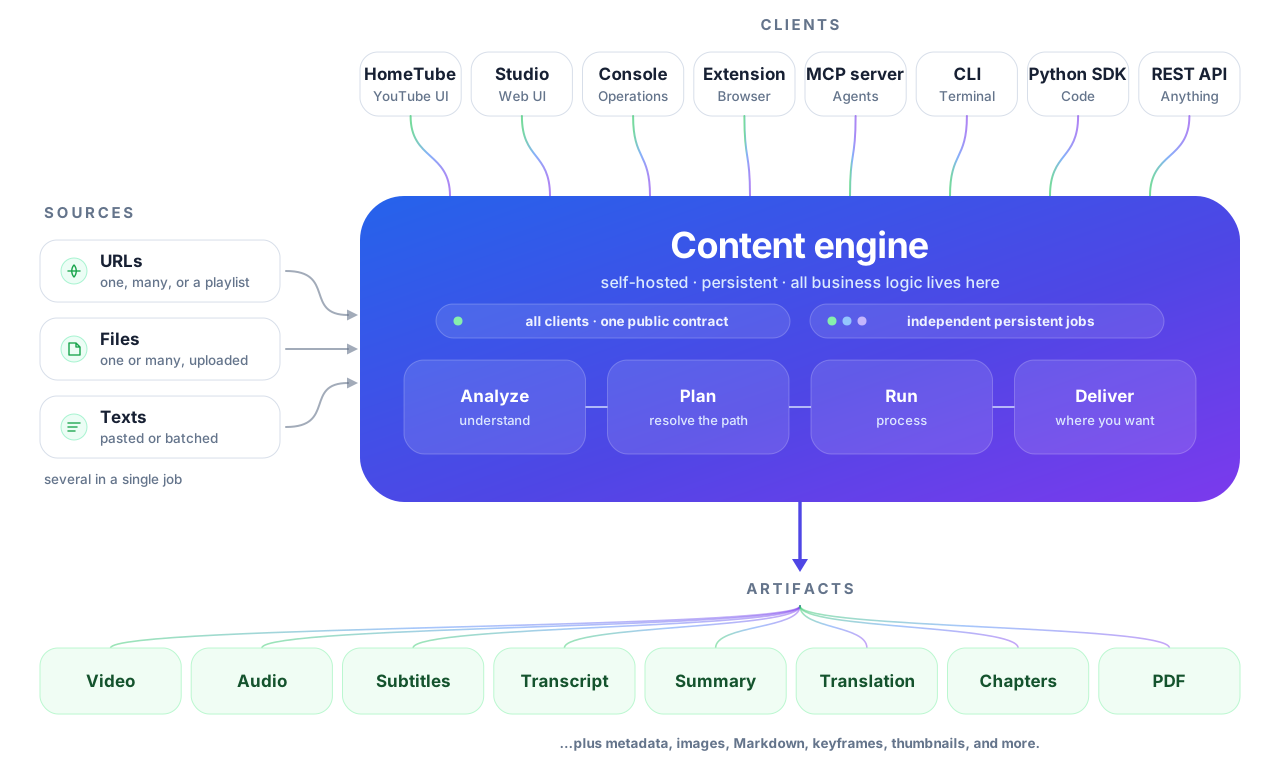
Everything else is a client of one public contract: HomeTube for the
focused YouTube experience, Content Studio for general workflows, a
Chromium extension for the tab you are already on, the content-mcp
server for agents, a CLI for terminals and cron, a typed Python SDK for
applications, the REST API for every other language, and Content
Console to watch the engine work. Pick one or several — none of them is a
layer the others have to pass through, and none of them holds business logic of
its own.
HomeTube is the quickest way to see what that means: paste a YouTube URL,
pick what you want out of it, and watch the files land in your library.

HomeTube in Content — paste a YouTube URL, choose what you want, follow the job into your library. More about HomeTube ↓
[!NOTE]
A proven workflow, now growing into a platform. The standalone
HomeTube container has passed
300,000 package downloads on GitHub Container Registry. It keeps running
and stays maintained — nothing breaks, and there is no deadline. Content is
where that work continues, and where its users are invited to move at their
own pace.The two are separate projects: standalone HomeTube has not been retrofitted to
run on Content. The HomeTube app in this repository is a new UI on the
Content engine, carrying the same workflow forward.
Coming from standalone HomeTube? ↓
Quick start
Docker Compose is the only runtime prerequisite. Install from the published
images — nothing to clone or build:
mkdir content && cd content
curl -fsSLO https://raw.githubusercontent.com/LatentNoise/content/main/deploy/docker-compose.yml
curl -fsSL -o .env https://raw.githubusercontent.com/LatentNoise/content/main/.env.example
docker compose up -d
The default .env starts the complete local stack:
| Service | Default URL | Purpose |
|---|---|---|
| Content Studio | http://localhost:8502 | General requests across URL, file, upload, and inline-text sources |
| HomeTube | http://localhost:8501 | Focused YouTube video and playlist workflow |
| Content Console | http://localhost:8503 | Health, configuration, storage, jobs, events, and logs |
| Content API | http://localhost:8010/docs | REST API, OpenAPI, and embedded worker |
Open Content Studio for the general workflow, or HomeTube if your
source is YouTube. You can also skip both web apps entirely and drive the same
engine from the MCP server, CLI, SDK, extension, or REST API.
Everything stays in the installation folder: ./data holds the database, jobs,
and artifacts; finished files are delivered to ./playground/output. SetCONTENT_DELIVERY_DIR_HOST in .env to point at your own NAS or media library
instead — its sub-folders then become the destination choices offered in the
clients.
Update later with:
docker compose pull && docker compose up -d
git clone https://github.com/LatentNoise/content.git
cd content
cp .env.example .env
docker compose up -d --build
The repository's docker-compose.yml adds local build: definitions beside
the same images. deploy/docker-compose.yml is
the build-free deployment file used above; a test keeps the two aligned.
One source, many artifacts
The same engine serves media and document workflows:
                             ┌─ My Conference.mp4
                             ├─ My Conference - audio.opus
YouTube URL ──→ Content ─────┼─ My Conference - subtitles - en.srt
                             ├─ My Conference - subtitles - fr.srt
                             ├─ My Conference - transcript.txt
                             ├─ My Conference - summary.md
                             └─ My Conference - summary.pdf

Web page / text / .md file ──→ Content ──┬─ Article.txt
                                         ├─ Article - summary.md
                                         ├─ Article - translation.md
                                         └─ Article.pdf
Each branch starts with a declarative request. You describe the results;
Content resolves what is possible, plans the work, runs the available tools,
and records where every artifact came from. No yt-dlp flags, ffmpeg pipelines,
transcription glue, or LLM orchestration in the client.
The clients
One engine, one contract, several independent front doors. Every client below
speaks the same GenerationRequest, sees the same resolved capabilities, and
produces the same artifacts — they differ in ergonomics, not in what they can
ask for. HomeTube is entirely optional; so is every other row.
| Client | Best for | Start here |
|---|---|---|
| HomeTube | The simplest YouTube video or playlist → library experience | Included in Docker Compose at :8501 |
| Content Studio | General capability-driven requests from URLs, uploads, server files, and inline text | Included in Docker Compose at :8502 |
| Chromium extension | Sending the current Chrome, Brave, Edge, or Vivaldi tab to Content | Download the release zip, unzip, Load unpacked |
| MCP server | Giving Claude, an IDE, or another MCP agent real artifacts instead of talk | uv tool install content-mcp |
| CLI | Terminals, scripts, cron jobs, and raw request files | uv tool install content-cli |
| Python SDK | Typed sync and async application integration | pip install content-sdk |
| REST API | Any language or integration that speaks HTTP | /api/v1, Swagger at :8010/docs |
| Content Console | Observing and operating the engine | Included in Docker Compose at :8503 |
HomeTube — YouTube, focused
http://localhost:8501 · README
Paste a URL, choose the media and related artifacts, and follow the job into
your library — the workflow demonstrated at the top of this page.
With HomeTube in Content, you can:
- download a video or playlist as video or audio, with quality, codec,
container, audio-language, and subtitle choices; - remove or mark sponsored segments with SponsorBlock, cut clips, use
server-side cookie credentials, and embed subtitles, chapters, thumbnails,
and metadata; - give every artifact a readable name and deliver it into a filesystem library
watched by Plex, Jellyfin, or Emby; - ask the same source for a transcript, summary, thumbnail, or metadata — not
just the downloaded media — when the required runners are available.
HomeTube is deliberately focused: it does not accept file, upload, or
inline-text sources, and it does not expose the broader document workflow or
PDF output. For those, use Content Studio, the API, CLI, or SDK. HomeTube is
a Content client, not a layer every Content user must pass through.
It has no settings of its own. It reads the engine's configuration, so what
changes HomeTube lives in the .env beside your docker-compose.yml: the
delivery library whose sub-folders become the destination choices
(CONTENT_DELIVERY_DIR_HOST), the languages pre-selected for audio and
subtitles (CONTENT_LANGUAGE_PRIMARY, CONTENT_LANGUAGES_SECONDARIES,CONTENT_VO_FIRST, CONTENT_LANGUAGE_PRIMARY_INCLUDED_IN_SUBTITLES), and the
server-side cookie file that unlocks age-restricted or members-only videos
(CONTENT_CREDENTIALS — HomeTube only ever shows its id; the file never leaves
the server). Nothing is ever pre-selected that the source does not offer, and
no default is final.
HomeTube's README documents each
variable and works the language rules through a concrete example — a Japanese
talk, a French speaker, and exactly what ends up pre-checked. The
full variable table
lists everything the engine accepts.
Coming from standalone HomeTube?
HomeTube — the standalone
Streamlit app — keeps running and stays maintained. Nothing breaks, and there
is no deadline. Content is where the work continues, so this is a move you make
when you are ready, not one you are forced into.
What comes across. The workflow you know: paste a URL, choose quality, codec,
container, audio languages and subtitles; remove or mark sponsored segments with
SponsorBlock; cut clips; unlock restricted videos with a server-side cookie file;
embed subtitles, chapters, thumbnails and metadata; and deliver readable file
names into a library watched by Plex, Jellyfin, or Emby. Playlists come across
too — each entry is analyzed and planned on its own, named per item, and
delivered as its own artifact.
What is new. The same source can also produce a transcript, a summary, a
translation, generated thumbnails, metadata, Markdown, or PDF. And the engine is
no longer reachable only from a web form: Studio, the Chromium extension, an MCP
agent, the CLI, the SDK, and plain HTTP all ask for the same things.
What has not made the trip yet. HomeTube's playlist synchronization — the
plan/apply diff that keeps a local folder in step with a playlist over time
(rename detection, archiving or deleting removed videos, relocation after a
naming or location change) — does not exist here. Content downloads a playlist;
it does not yet re-sync one. It is roadmapped as part of
M2. If playlist sync is your main use, keep standalone
HomeTube for that job.
One practical note. Both HomeTube apps default to port 8501. Change one of
them in your .env if you want to run the two side by side.
Content Studio — the whole contract, in a form
http://localhost:8502 · README
The general-purpose web app: several sources in one request, every output type
the engine can resolve, with their options, preferences, and constraints. The
form is capability-driven — it renders what /capabilities answers for
your source, so a capability the engine gains appears without a UI release, and
what cannot be produced is shown with the server's reason instead of silently
disappearing.

Content Studio — build general URL, file, upload and text requests
Studio takes a file two ways, and the distinction matters when the engine runs
on another machine:
- From this device — the bytes are sent to the engine and become an
uploadsource (ADR 0020).
Several files at once become several sources. Streamlit buffers the upload in
the UI container, so the ceiling here is deliberately lower than the API's
(200 MB by default, and the picker states the current value rather than
letting you discover it by failing). - On the server — a path the engine can already read, under a configured
allowed input root. With this Compose setup that root is./playground/input.
For genuinely large files, skip the browser: the SDK streams from disk withclient.upload_file(path).
Chromium extension — the tab you are already on
Send the page you are watching to your engine without opening a UI. Manifest
V3, Chromium only (Chrome, Brave, Edge, Vivaldi, Opera, Arc…), no build step —
what the browser loads is exactly the files in the zip:
- download
content-browser-extension-chromium-v<version>.zipfrom the latest
release and unzip it (Chromium loads a folder, not a zip); - open
chrome://extensions, turn on Developer mode, Load unpacked,
select the folder; - open a video and click the extension.
It normalizes the tab's URL (youtu.be, Shorts, and embeds become the
canonical watch URL; a list= on a watch URL means that video, not the
playlist), asks the engine what the source can produce and offers only that,
prefills the name with the naming engine's own proposal, offers the library's
existing folders plus new folder…, then follows the job and shows where each
file landed. Every network call happens in the service worker — the engine
sends no CORS headers by default, and that is what lets the extension work
against a stock instance with nothing to configure
(ADR 0016).

Browser extension — send the current tab to Content, from the tab itself
The popup's footer always names the engine it is talking to, so "where is this
sending my video?" is answered on screen. Its README also carries an honest
path-by-path verification table — what has actually been driven in a
browser, and what has not.
MCP server — for agents and IDEs
Content gives an MCP-compatible agent a controlled way to turn URLs into real
artifacts, not just talk about them. The official content-mcp server
exposes intention-level tools — not one per endpoint — to:
- analyze a URL and discover what it can produce;
- request one or several outputs and choose a library destination;
- monitor the job, cancel it, and report actionable failures;
- find the artifacts and their delivered paths;
- read small text artifacts inline while keeping large media out of the model
context.
The agent never needs shell access, yt-dlp syntax, or backend internals.
Nothing to install. uvx fetches the server on first use and caches it, so
the client owns the whole lifecycle (updating stays explicit — uvx --refresh,
or pin [email protected]):
# Claude Code
claude mcp add content \
  --env CONTENT_API_URL=http://localhost:8010 \
  -- uvx content-mcp
For Claude Desktop, Cursor, and other MCP clients using the standard JSON
shape:
{
  "mcpServers": {
    "content": {
      "command": "uvx",
      "args": ["content-mcp"],
      "env": { "CONTENT_API_URL": "http://localhost:8010" }
    }
  }
}
Prefer a pinned executable on your PATH — for an offline machine, or to control
when the version changes? Install it and name it directly
("command": "content-mcp", or -- content-mcp for Claude Code):
uv tool install content-mcp # or: pipx install content-mcp
Then ask naturally:
Analyze this lecture, save its audio into
Talks, create a transcript and a
structured summary if the available runners allow it, and tell me where
every artifact landed.
The normal tool journey isget_config → analyze_source → generate → get_job → get_artifact. Downloads to
the agent's own machine are bounded by a single variable
(CONTENT_MCP_DOWNLOAD_DIR, ~/Downloads/Content by default): a destination
pointing outside it is refused, not clamped — widening that is the operator's
decision, not something a prompt can talk the server into.
What it can and cannot do, briefly — the
MCP guide has the full three
tables, and each row there was driven over stdio against a running engine
rather than inferred:
| Works | URLs and playlists · local files (uploaded to the engine, so a laptop can drive a NAS) · PDFs, read for their text layer · video, audio, subtitles, transcripts, summaries, translations, chapters, thumbnails, metadata, Markdown, PDF · delivery into your library · cookie-authenticated sources |
| Does not | no live progress (get_job is a poll) · no .docx/.epub/.odt/.rtf, no OCR for scans · no transcoding · no playlist sync · nothing deletes anything · the API has no authentication |
| Needs a runner | Summaries, translations and derived chapters want a local Ollama or a cloud key; transcripts want subtitles, or the optional Whisper runner. The engine reports these as unavailable up front rather than failing halfway |
| By design | stdio, not an HTTP endpoint — the server runs where you do, which is what lets an agent hand it ~/Documents/report.pdf and have the bytes uploaded to an engine on your NAS. It also means no open port on a system that has no authentication. For a client that cannot spawn a process — Open WebUI, hosted UIs — mcpo bridges it today |
| Coming | Retrying only what failed · playlist sync · retention · more document readers |
CLI — terminals, scripts, and cron
uv tool install content-cli
export CONTENT_API_URL=http://nas.local:8010

content analyze "https://www.youtube.com/watch?v=…"
content video "https://…" --height 1080 --subs en,fr --watch
content audio "https://…" --format opus --playlist --watch
content submit request.json --watch          # a raw GenerationRequest, or -
content jobs ; content job <id> ; content artifacts <id>
content download <artifact_id> -o out.mkv
--watch follows the job's event stream rather than re-asking for its
status, and the exit code carries the outcome so a script can chain on it
(ADR 0021):0 succeeded, 2 partially succeeded, 1 failed or cancelled. 2 is
deliberately distinct — a playlist that yielded five videos of six is not a
failure, but a script that treats it as a success will quietly move on with
missing files.
Python SDK — typed, sync and async
The one official API client: the CLI, the MCP server, and the web apps all
speak through it, so the engine's rules are never duplicated. Python 3.11+,httpx and pydantic only.
from content_sdk import ContentClient, outputs

with ContentClient("http://localhost:8010") as client:
    analysis = client.analyze(outputs.url_source("https://www.youtube.com/watch?v=…"))
    job = client.generate(analysis.id, [outputs.audio_output()])
    job.wait()
    for artifact in job.artifacts:
        print(artifact.display_filename, artifact.delivered_path)
AsyncContentClient mirrors the whole surface. Analyses are addressable, so
every call accepts either an analysis_id or inline sources
(ADR 0014);client.upload_file(path) streams a local file to the engine and hands back a
ready-to-use source; and every non-2xx becomes a typed exception carrying the
stable error codes (NotFound, Gone, ValidationError).
REST API — every other language
Public contract · Swagger at http://localhost:8010/docs
/api/v1 is the contract every client above is built on, and it is stable
enough to build a ninth client against: requests describe desired outputs
rather than technical operations, error codes are machine identifiers that do
not change (only their human messages do), and "valid but not implemented" is
a different, explicit answer from "invalid". Reserved fields are refused
rather than silently ignored. The V1 API has no built-in authentication —
see deployment and security.
Content Console — observe and pilot the engine
http://localhost:8503 · README
The operations console: strictly observability and control, and deliberately
not a way to create downloads (that is Studio and HomeTube).

Content Console — observe and control the engine
- Overview — version, cache, concurrency, analysis TTL, a live jobs pulse,
the installed runners with their availability, storage paths. - Environment — every
CONTENT_*variable with its effective value,
whether it was set or fell back to a default, and a one-line description.
Secrets are never shown — only their presence and length. - Jobs — a filterable list plus full detail: steps, the submitted
GenerationRequest, artifacts with their provenance, ordered events,
per-step logs, cancel and retry, with an opt-in 5-second auto-refresh that
polls only while jobs are in flight. - Storage & cache, and a contract & API tab with the schemas, Swagger,
ReDoc, and a raw API tester.
What Content can produce
Content resolves availability for each analyzed resource and installed runner.
Clients show what can actually be produced instead of presenting a static list
and failing halfway through a job.
| Output | Typical inputs and behavior |
|---|---|
| Video | Media URLs and local media files; stream selection, remux, fast or frame-accurate cutting, and SponsorBlock handling |
| Audio | Media URLs as source audio, Opus, MP3, or M4A; local files keep their native audio stream |
| Subtitles | Manual or automatic tracks selected by language |
| Transcript | Existing subtitles, or audio with the optional Whisper runner |
| Summary | Transcript or readable text through a local or opt-in cloud LLM |
| Translation | Subtitles or transcripts through an LLM; subtitle timings stay aligned |
| Chapters | Chapters declared by the source, or chapters derived from a transcript through an LLM |
| Thumbnail and keyframes | Published artwork or frames extracted from video |
| Metadata | Normalized, provider-independent resource information |
| Markdown and plain text | Readable web pages, text and Markdown files, PDFs (their text layer), and inline text |
| Readable sources or outputs such as summaries, transcripts, and translations |
Media acquisition works with YouTube and the
sites supported by yt-dlp.
Playlists can produce artifacts for each member in a single traceable job.
Finished files can be delivered directly into any mounted filesystem library,
including folders watched by Plex, Jellyfin, or Emby.
Local and optional AI runners
Content has no mandatory cloud dependency. AI-backed outputs activate when a
compatible runner is available:
- Summaries, translations, and derived chapters: connect a local
Ollama instance, or explicitly configure an Anthropic
or OpenAI API key. Cloud runners can be excluded per request. - Transcription from audio: set
CONTENT_INSTALL_STT=trueand rebuild to
install the local Whisper runner. Transcripts from existing subtitles do not
need it.
Unavailable optional runners do not make Content unhealthy. The affected
capability is reported as unavailable, and an impossible request is refused
before the job starts. See
deployment and configuration for the full
inventory.
Why build on Content?
- Declare intent, not tooling. Requests describe outputs; yt-dlp, ffmpeg,
Whisper, LLMs, and PDF renderers remain replaceable implementation details. - Self-hosted and local-first. Run it on a workstation, NAS, or homelab.
There is no account, telemetry, or mandatory cloud service. - One public contract. Studio, HomeTube, MCP, the CLI, SDK, extension, and
REST API converge on the same domain instead of drifting into parallel
feature sets. - Human files, not pipeline debris. The engine names every artifact and can
place it directly in the library you already use. - Observable work. Jobs expose states, ordered events, progress, logs,
artifacts, provenance, cancellation, and retry. - Honest capabilities. “Valid but unsupported,” “unavailable on this
source,” and “broken” are different answers, reported before or during the
correct stage.
How it works
The public request describes desired outputs. It does not prescribe technical
operations:
Sources → Analysis → Capabilities → Execution plan → Job → Artifacts
Content Backend (REST /api/v1)   ← domain, planning, execution, persistence
        │
   Content Python SDK            ← official Python API client
    │        │        │
   CLI      MCP     Web apps     ← thin clients of the public contract

   Browser extension             ← JavaScript client of /api/v1
The engine analyzes source facts, resolves feasible capabilities against the
installed implementations, builds a deterministic execution plan, and runs it
as an observable job. The database is the source of truth; yt-dlp, ffmpeg,
transcription, LLM, and PDF implementations stay behind dedicated boundaries.
The domain keeps user intent (GenerationRequest), resolved strategy
(ExecutionPlan), execution (Job), and concrete results (Artifact)
separate. For the full design, see the
architecture overview,
public contract, domain model, and
architecture decisions.
Deployment and security
Content targets single-host Linux/macOS deployments on amd64 or arm64. Docker
Compose runs the API and embedded worker together, with the web apps as
separate API clients. SQLite and artifact storage persist locally; no Redis,
Celery, Kubernetes, or cloud infrastructure is required.
The commented .env.example covers UI selection, image
versions, ports, storage and delivery, language preferences, server-side
cookie credentials, optional LLM/STT runners, CORS, and notifications. No
release check makes an outbound request unless you configure one.
The V1 API has no built-in authentication: anyone who can reach it can submit
jobs, upload files and read every artifact. Keep it on a trusted network, or put
an authenticating reverse proxy in front of any externally reachable instance —
and do not publish the port. What an attacker who reaches the API can and cannot
do is written out in docs/operations/threat-model.md.
See deployment for configuration, health
checks, data layout, authenticated sources, and production guidance, and
ADR 0024
for why that is the V1 answer.
Development
The repository is a monorepo containing the backend, web applications, CLI,
MCP server, Chromium extension, and Python SDK. The root Makefile is the main
entry point:
make install       # create the development environment and install packages
make validate      # formatting, linting, and hermetic tests: the official gate
make test-ui       # hermetic Streamlit application tests
make validate-all  # official gate plus UI and opt-in external-tool tests
The main test suite does not require the Internet. Read the
repository architecture and
validation guide before changing the code.
Releases follow the release runbook.
Documentation
docs/README.md is the complete documentation map. Useful
starting points:
- Product vision
- Public contract and domain model
- Architecture and
invariants - Storage and artifact delivery
- Deployment and operations
Licence
Content is free and open-source software licensed under
AGPL-3.0-or-later. You may run, study, modify, and redistribute
it, including commercially, under the terms of the licence.
The AGPL contains source-sharing requirements for certain modified,
network-accessible versions. See COMMERCIAL.md for the
project's factual licensing summary; no separate commercial offering is
currently available.
Governance
Content is developed and maintained by Yann Orieult under a single-maintainer
model. Bug reports, ideas, and design feedback are welcome through issues. Code
contributions are not accepted—unsolicited pull requests are closed without
review; forking is the intended path for independent changes. See
CONTRIBUTING.md and GOVERNANCE.md.
Report security issues privately as described in SECURITY.md.
© 2026 Yann Orieult.
Yorumlar (0)
Yorum birakmak icin giris yap.
Yorum birakSonuc bulunamadi