ai-code-review-triage
Health Gecti
- License — License: MIT
- Description — Repository has a description
- Active repo — Last push 0 days ago
- Community trust — 87 GitHub stars
Code Gecti
- Code scan — Scanned 2 files during light audit, no dangerous patterns found
Permissions Gecti
- Permissions — No dangerous permissions requested
Bu listing icin henuz AI raporu yok.
Claude Code skill for reviewing AI-written PRs: catch bugs, align context, own the sign-off.
AI Code Review Triage
AI writes code faster than you can read it. Stop reading harder and review differently.
English · 简体中文
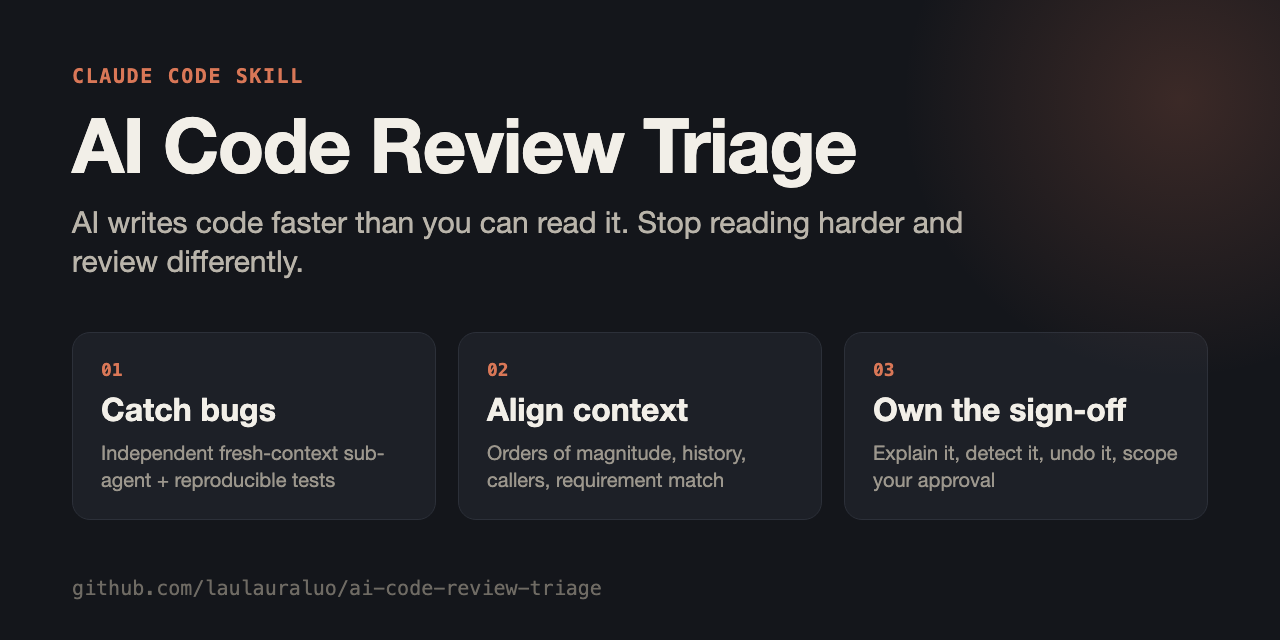
A Claude Code skill that reviews AI-generated pull requests by splitting "reading the code" into three separate jobs.



The problem
Agent-written PRs pile up faster than anyone can review them line by line. Reading harder doesn't help much either: the code is tidy on the surface, so the real problems hide well enough to survive a careful read. "Just merge and roll back if it breaks" works technically, but a human still answers for the incident.
The idea
"Reviewing code" has always bundled three different jobs. That worked when code arrived slowly. At agent speed, each job needs its own process:
flowchart LR
    PR([AI-written PR]) --> T{Step 0<br/>Triage<br/>risk tier}
    T --> B["**1 · Catch bugs**<br/>fresh-context sub-agent<br/>+ tests / repro"]
    B --> C["**2 · Align context**<br/>orders of magnitude<br/>history & neighbors<br/>requirement match"]
    C --> S["**3 · Own the sign-off**<br/>explain · detect · undo<br/>scoped approval"]
    S --> R([Review report])
| Job | Question | Who does it best |
|---|---|---|
| Catch bugs | Is the code wrong? | Machines, with an independent second pass |
| Align context | Is this the right change for this product, today? | A human, checking angles the diff can't show |
| Own the sign-off | Will I put my name on this? | The approver, with an explicit scope |
Low-risk PRs only run Step 1. High-risk PRs (production behavior, data, security, money) run all three.
What it catches that line-by-line review misses
A PR changes
SESSION_TIMEOUT = 30to30000and drops one line of unit conversion. Tests pass. The code is clean. A line-by-line reader approves it in 30 seconds.
- Step 1 has a fresh-context sub-agent add a boundary test. Result: sessions now expire after 30 seconds.
- Step 2 checks history and callers. The same change was reverted once before, the mobile client hard-codes the old value, and the request was only for "remember me" users while the diff changes everyone.
- Step 3 blocks the approval. Nobody can explain what the PR actually does.
Full run: examples/session-timeout-walkthrough.md
A second runnable example follows a pagination change from 100 to 1000 rows per request: a capped API returns 100 rows, and the exporter silently stops with 150 of 250 rows missing. See the pagination walkthrough for the contract check, reproduction, and recovery scope. Both walkthroughs use invented scenarios.
Install
As a plugin (inside Claude Code):
/plugin marketplace add laulauraluo/ai-code-review-triage
/plugin install ai-code-review-triage@ai-code-review-triage
As a standalone skill:
git clone https://github.com/laulauraluo/ai-code-review-triage.git
cp -r ai-code-review-triage/skills/ai-code-review-triage ~/.claude/skills/
Usage
Ask Claude Code something like:
- "Review this AI-generated PR before I merge it."
- "Can this diff be merged? Claude wrote it."
- "I'm about to approve #123. What should I verify first?"
The skill triggers on its own and returns a report (illustrative example):
## Extend session lifetime for "remember me" · Risk: High

### 1. Bugs (independent fresh-context review)
- [CONFIRMED] auth/session.py:3 — unit conversion dropped; sessions expire after 30 s. Repro: test_session_expires_after_timeout

### 2. Context
- Magnitudes: SESSION_TIMEOUT 30 → 30000 (comment says min, code treats as ms) — suspicious
- History / neighbors: reverted once before (a1b2c3d); mobile/src/config.ts hard-codes 30 min
- Requirement match: asked for remember-me users only; diff changes everyone

### 3. Sign-off
- Detection: login-rate and 401-rate alerts · Rollback: config revert
- Recommendation: request changes
- Verification scope: verified units and callers; did not load-test
Review questions and limitations
- How do I review AI-generated code before merging?
- Why can passing tests miss incomplete exports?
- Can this review Codex, Copilot, or Cursor output?
- Does it replace scanners or human review?
The installation targets Claude Code. The workflow can review code from other agents; native integration with those tools is not provided.
Repository layout
.claude-plugin/
  plugin.json          # plugin manifest
  marketplace.json     # lets /plugin marketplace add this repo
skills/
  ai-code-review-triage/
    SKILL.md           # the skill itself
examples/
  session-timeout-walkthrough.md   # timeout units and requirement scope
  pagination-limit-walkthrough.md # API contract mismatch, runnable repro
Works well with
This skill organizes the review and decides what has to be true before you approve. It doesn't replace specialized checkers. Run them inside Step 1:
- correctness-focused review (e.g. Claude Code's built-in
/code-review) - security / performance checklists
- over-engineering reviews
Acknowledgments
The three-job framing was inspired by a public talk on reviewing AI-written code.
License
If this caught a bad merge for you, a ⭐ helps other reviewers find it.
Yorumlar (0)
Yorum birakmak icin giris yap.
Yorum birakSonuc bulunamadi