iphone-use
Health Warn
- License — License: MIT
- Description — Repository has a description
- Active repo — Last push 0 days ago
- Low visibility — Only 5 GitHub stars
Code Fail
- rm -rf — Recursive force deletion command in install.sh
- rm -rf — Recursive force deletion command in scripts/make-app.sh
- rm -rf — Recursive force deletion command in scripts/sign.sh
Permissions Pass
- Permissions — No dangerous permissions requested
No AI report is available for this listing yet.
Computer-use, but for the iPhone — AI agents (and your browser) see and drive a real phone over macOS iPhone Mirroring. Low-latency WebRTC video, near-native touch, HTTP API + MCP. Rust, self-hosted.
iphone-use
Computer-use, but for the iPhone — let AI agents (and your browser) see and drive a real phone.




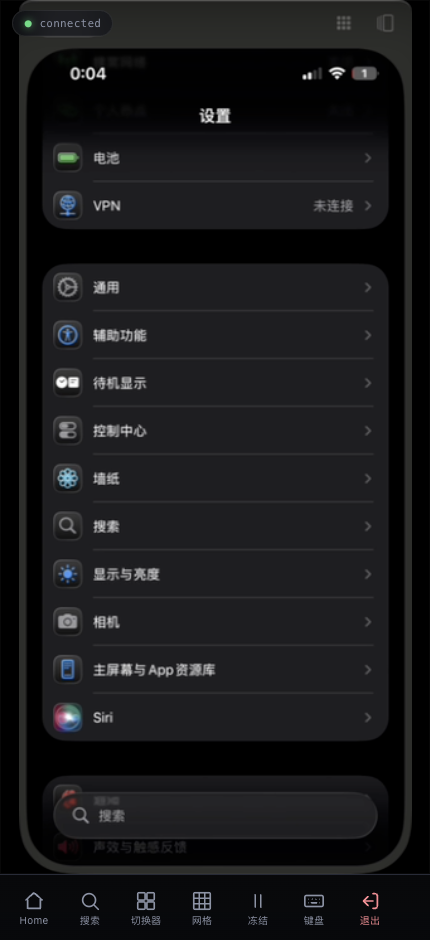
Remote-control your iPhone from any web browser — over macOS iPhone Mirroring,
with low-latency WebRTC video and near-native touch. A Rust daemon captures the Mirroring
window with ScreenCaptureKit, hardware-encodes it to H.264 with VideoToolbox,
and streams it to iPhone Safari (or any browser) over WebRTC — injecting taps, swipes,
scrolls, and text back as continuous system events. AI agents, scripts, and bots can drive
the same phone through a simple HTTP API.
Think Chrome Remote Desktop, but for your iPhone — running entirely on your own Mac, no
third-party cloud.
Features
- 📱 Control an iPhone from a browser — live screen with tap / swipe / scroll / type, on iPhone Safari or any desktop browser.
- ⚡ Low latency — hardware H.264 (VideoToolbox) over WebRTC, not screenshot polling.
- 🤚 Near-native touch — real scroll-wheel scrolling, keycode text input, Home / Spotlight / App-Switcher shortcuts.
- 🤖 Agent-ready — an HTTP API (
/agent/input,/agent/screenshot) lets AI agents and scripts see and drive the phone. - 🌐 LAN or remote — same Wi-Fi over your local network, or from anywhere via a Cloudflare tunnel + TURN.
- 🔒 Self-hosted & authenticated — password login; runs on your own machine, your screen never leaves your control.
v2 — a full WebRTC + hardware-codec + continuous-input rebuild of the original
v1 screenshot-polling server. The input + video vertical (video, tap, scroll,
text, shortcuts, LAN WebRTC) is validated on real hardware.
Architecture
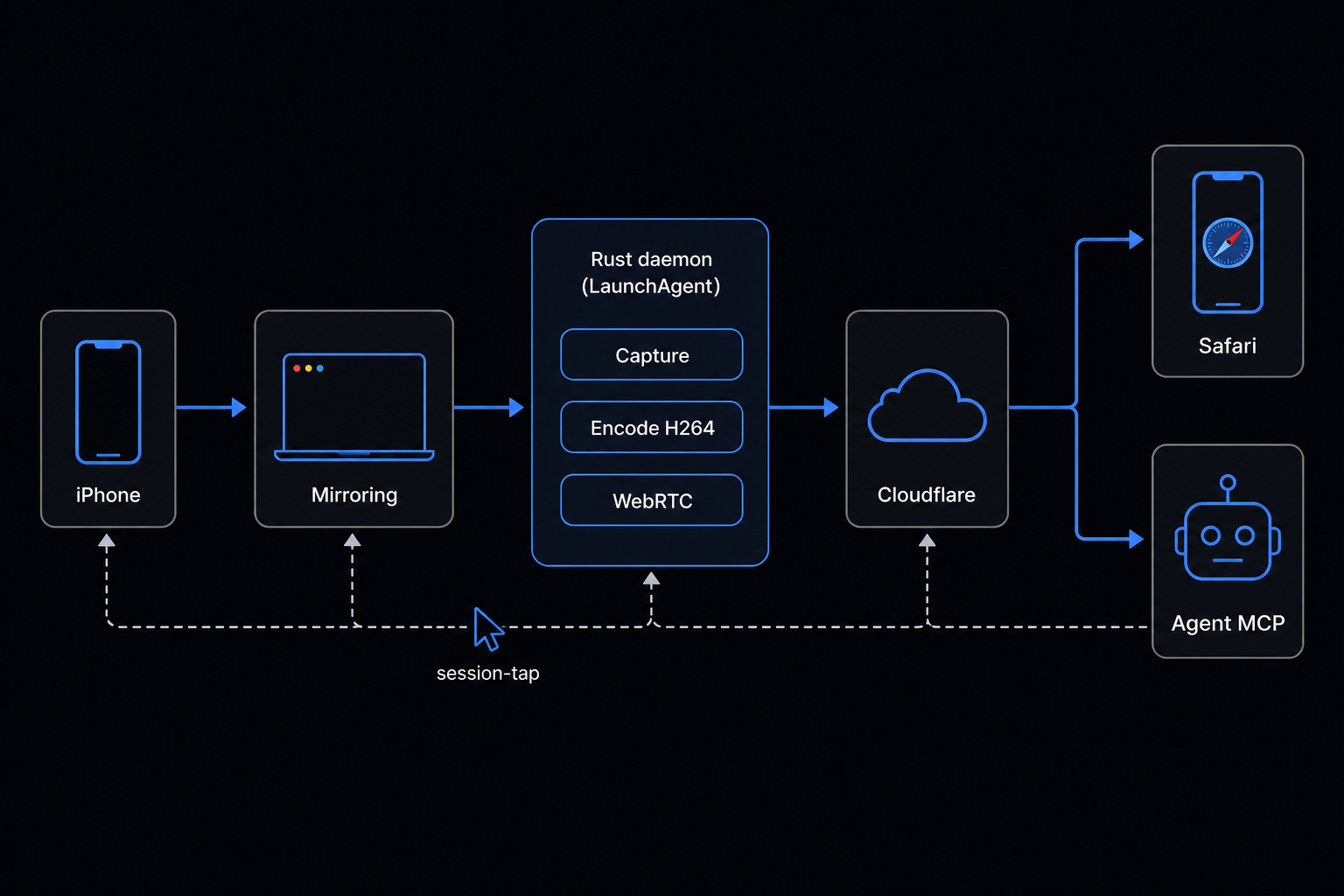
A Rust daemon captures the macOS iPhone Mirroring window with ScreenCaptureKit,
hardware-encodes it to H.264 with VideoToolbox, and streams it over WebRTC
(webrtc-rs, axum for HTTP/WS signaling). The same capture/input core serves two
front-ends: a human client (iPhone Safari — live video + continuous touch) and an
agent client (an HTTP control API; see Agent API). Touch is injected
back as continuous CGEvents through the system HID event tap. STUN handles most NAT;
optional Cloudflare TURN relays the rest.
Key input findings baked into the daemon (all hardware-validated):
- Scroll is a wheel event. iPhone Mirroring reads a mouse-drag as a long-press /
icon-reorder and never scrolls — a finger swipe must map toCGEventscroll-wheel. - Text is keycodes, not Unicode. Mirroring forwards virtual keycodes (and a real
Shift key), not theCGEventUnicode payload. CJK caveat: typing sends US keycodes;
if the phone keyboard is a Chinese (Pinyin) IME, digits become candidate-selectors
(a1b2c3→啊不c3) — switch the phone to the English ABC keyboard for literal text.
Real CJK input needs the on-phone IME and is out of scope for now. - HID taps need the Mirroring window frontmost — the daemon re-asserts focus only
when another app steals it.
Deployment — a GUI-session LaunchAgent
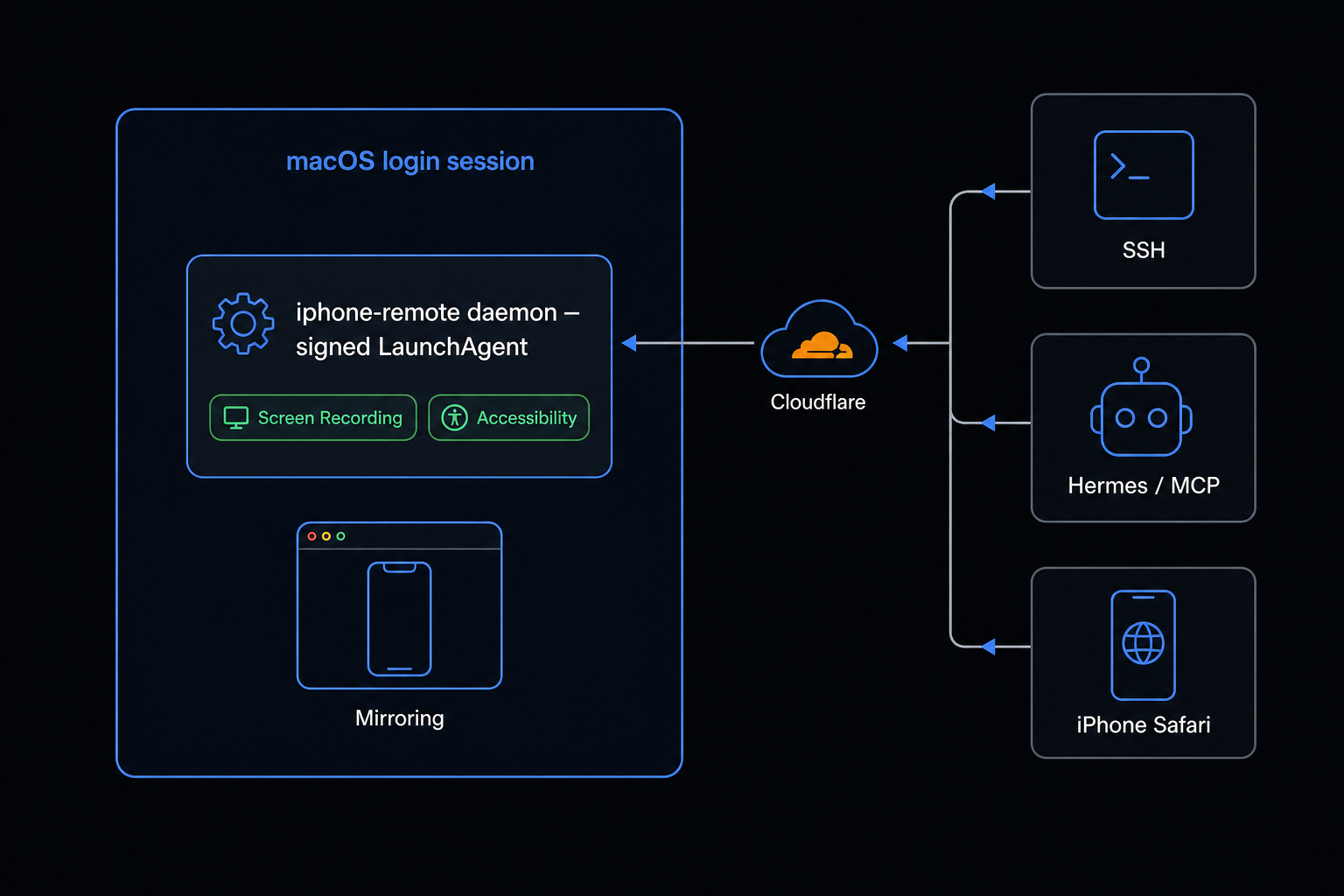
ScreenCaptureKit (Screen Recording) and input injection (Accessibility) require TCC
grants tied to a signed identity in the login session — an SSH-spawned binary is
denied. So the daemon runs as a codesigned LaunchAgent in the desktop session,
granted once; SSH shells, agents, and the iPhone Safari controller all connect to it.
Control lease — one cursor, one controller
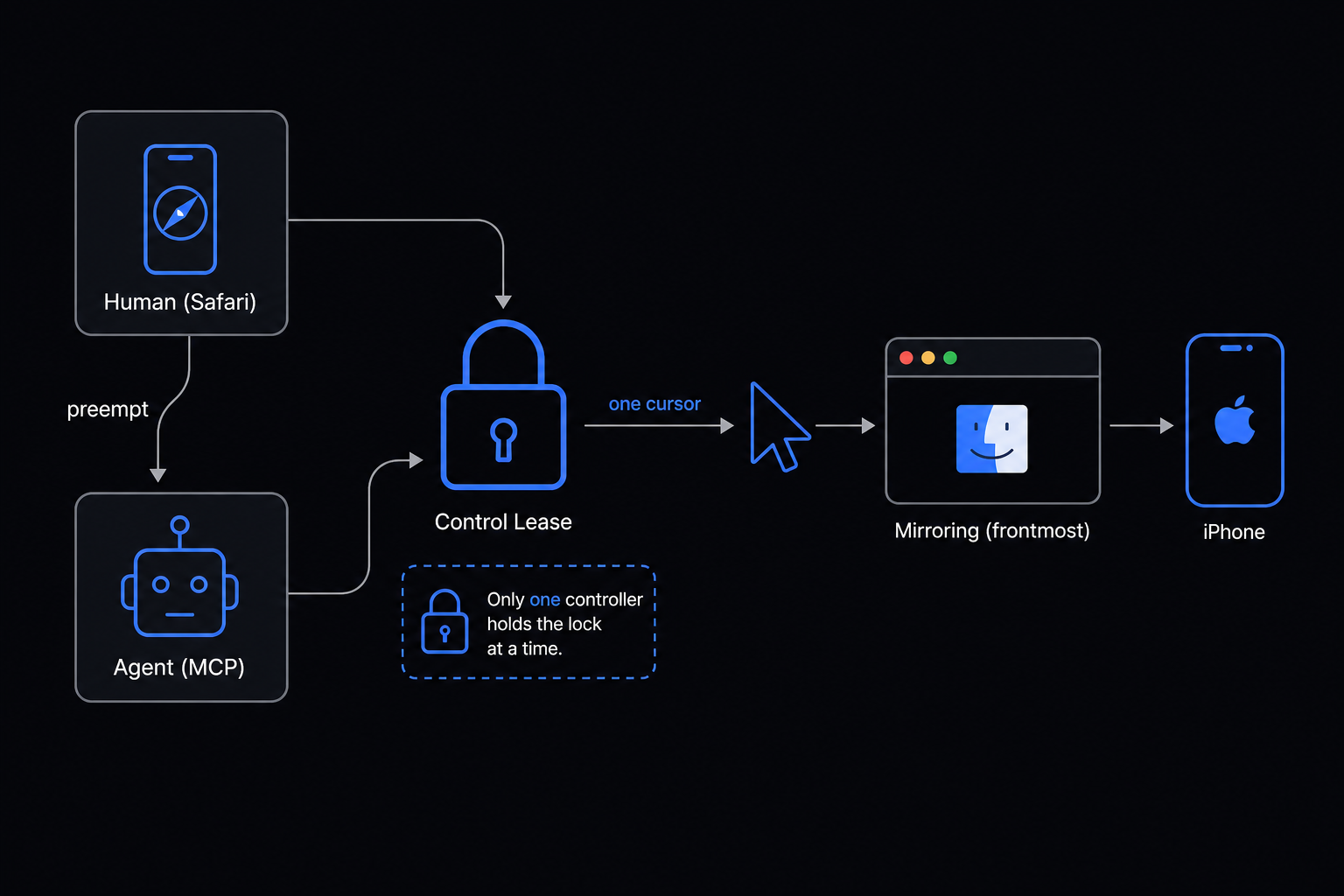
HID-tap input drives the host Mac's one real cursor with the Mirroring window
frontmost. A mandatory control lease grants that single cursor to one controller at a
time (human or agent); the most recent actor holds control. Without the lease, human and
agent would corrupt each other's gestures fighting over the same cursor. Viewers (WebRTC
video consumers not sending input) are unaffected: last-connected-wins for input, but all
viewers keep their video stream.
Requirements
- macOS 15 Sequoia or later (iPhone Mirroring's requirement) with iPhone
Mirroring set up and signed in. Validated on macOS 15 Sequoia / 26 Tahoe;
see the Roadmap for macOS 27 support. - Rust toolchain (to build) —
cargo. - Zero external runtime dependencies — all input (tap, scroll, text, key,
shortcuts) is injected via nativeCGEventdirectly, and screenshots use the
built-inscreencaptureCLI. No third-party binary (cua-driveror otherwise)
is required at runtime. - (optional) a Cloudflare TURN key for cross-network (cellular / remote) access.
Install
Build, bundle into a signed .app, and register the LaunchAgent:
cargo build --release --bin iphone-remote
./scripts/make-app.sh                 # → ./iPhoneRemote.app
./install.sh ./iPhoneRemote.app       # signs, installs, writes the LaunchAgent
install.sh binds 0.0.0.0, generates a password (or uses $PHONE_REMOTE_PASSWORD),
opens the Screen Recording + Accessibility panes to grant once, and prints the iPhone
connect URL. On the iPhone (same Wi-Fi) open http://<mac-lan-ip>:8787/phone and
enter the password.
Pre-built binaries are published from CI on every version tag — see the
Releases page. To cut the first release: trigger the smoke-test via
Actions → workflow_dispatch, then git tag v0.1.0 && git push origin v0.1.0.install.sh self-signs the app locally with codesign -s -; Gatekeeper will prompt
unless the binary is notarized (optional secrets: APPLE_SIGNING_CERTIFICATE /APPLE_SIGNING_CERTIFICATE_PASSWORD / APPLE_SIGN_IDENTITY; notarization:APPLE_ID / APPLE_ID_PASSWORD / APPLE_TEAM_ID). Unsigned is the default path.
Run without installing (dev)
PHONE_REMOTE_HOST=0.0.0.0 PHONE_REMOTE_PASSWORD=secret \
  ./target/release/iphone-remote serve
Configuration (environment)
| Variable | Default | Purpose |
|---|---|---|
PHONE_REMOTE_HOST |
127.0.0.1 |
Listen address (0.0.0.0 for LAN). |
PHONE_REMOTE_PORT |
8787 |
Listen port. |
PHONE_REMOTE_PASSWORD |
(none) | Shared password (cookie login + agent bearer fallback). |
PHONE_REMOTE_AGENT_TOKEN |
(none) | Dedicated agent bearer token. When set, the agent API accepts only this token (the password is no longer valid as a bearer); unset = password doubles as the bearer (legacy). |
PHONE_REMOTE_CF_TURN_KEY_ID / _API_TOKEN |
— | Cloudflare TURN key → ephemeral relay creds for cross-network. |
PHONE_REMOTE_TURN_URLS / _USERNAME / _CREDENTIAL |
— | Static TURN server (alternative to Cloudflare). |
Agent API
Agents drive the phone by connecting in to the running daemon (never by spawning their
own input process — macOS makes a spawned child's events untrusted). Bearer auth:Authorization: Bearer <token> where token is PHONE_REMOTE_AGENT_TOKEN when set,
otherwise PHONE_REMOTE_PASSWORD (legacy fallback).
| Method | Path | Purpose |
|---|---|---|
GET |
/agent/status |
Auth / health probe. |
POST |
/agent/input |
One control message: tap / scroll / text / key / shortcut (normalized [0,1] coords). |
GET |
/agent/screenshot |
Current phone screen as PNG. |
Full reference: docs/agent-api.html.
HOST=http://<mac-lan-ip>:8787; AUTH="Authorization: Bearer $PW"
curl -s -H "$AUTH" "$HOST/agent/screenshot" -o screen.png
curl -s -H "$AUTH" -X POST "$HOST/agent/input" -d '{"type":"shortcut","name":"home"}'
curl -s -H "$AUTH" -X POST "$HOST/agent/input" -d '{"type":"tap","x":0.5,"y":0.3}'
MCP server
iphone-remote-mcp is an MCP stdio server (crates/mcp) that
bridges MCP clients — Claude Desktop, Claude Code — to the daemon's agent API. Seven
tools: phone_status, screenshot, tap, scroll, type, key, shortcut. Two
env vars: PHONE_REMOTE_URL (default http://127.0.0.1:8787) and PHONE_REMOTE_TOKEN
(optional; maps to PHONE_REMOTE_AGENT_TOKEN on the daemon side).
Add to your claude_desktop_config.json (or Claude Code MCP config):
{
  "mcpServers": {
    "iphone-remote": {
      "command": "/path/to/iphone-remote-mcp",
      "env": {
        "PHONE_REMOTE_URL": "http://127.0.0.1:8787",
        "PHONE_REMOTE_TOKEN": "<your-agent-token>"
      }
    }
  }
}
See crates/mcp/README.md for full tool schemas and build
instructions.
Security notes
This tool exposes live phone control over the network. Treat the URL and password like
sensitive credentials.
- A password is mandatory when binding to the LAN (
install.shenforces it). - HTTPS for remote access is terminated by a Cloudflare tunnel (the daemon serves plain
HTTP and readsX-Forwarded-Proto); the session cookie isHttpOnly+SameSite=Lax. - Don't leave payment apps, private chats, or 2FA screens open while exposing access.
- Stop / unload the LaunchAgent when not in use.
Roadmap
Shipped and hardware-validated on macOS 15 Sequoia / 26 Tahoe: WebRTC video, tap,
scroll, keycode text, shortcuts, frontmost-robust input, the agent HTTP API, and the
LaunchAgent install. Next:
- macOS 27 "Golden Gate" support. macOS 27 makes the iPhone Mirroring window
resizable with variable aspect ratios (and can render an iPad layout) — it's no
longer portrait-locked. Make window selection aspect-independent (rank by on-screen +
area, not shape), re-validate capture + input on the 27 beta, and add the new
Control Center shortcut. Goal: one build that runs on macOS 15 / 26 / 27. - MCP server wrapping the agent API, so MCP clients (Claude, etc.) get
tap/type/scroll/screenshotas native tools. - Cross-network validation of the Cloudflare dynamic TURN path with a real key
(the minting + refresh code already ships; needs an end-to-end run off-LAN). - Release binaries in CI + a one-line
curl … install.sh | shinstall. - A short demo (GIF / video) of an AI agent driving the phone through the API.
Issues and PRs welcome.
Layout
crates/core— capture, encode, coordinate/geometry, input injection, control lease.crates/server— theiphone-remotedaemon: HTTP/WS, WebRTC, signaling, agent API, TURN.web/index.html— the iPhone Safari client (WebRTC viewer + touch).install.sh,scripts/make-app.sh,deploy/— packaging + LaunchAgent.docs/— design spec, runbooks, agent API reference, research notes.
License
Reviews (0)
Sign in to leave a review.
Leave a reviewNo results found