global-law
Health Gecti
- License — License: NOASSERTION
- Description — Repository has a description
- Active repo — Last push 0 days ago
- Community trust — 1730 GitHub stars
Code Gecti
- Code scan — Scanned 12 files during light audit, no dangerous patterns found
Permissions Gecti
- Permissions — No dangerous permissions requested
Bu listing icin henuz AI raporu yok.
Git for Global Law: the law of every country as one git history, each country's record a submodule, every commit one law taking effect
Git for Global Law
The world's law in one git history. Every word traced to the law that wrote it for any country and any date.
An expansion of the same for the US Code, #1 on Hacker News (28/10/26).
Semantic, searchable law on a global scale.
https://github.com/user-attachments/assets/f24f3411-24d9-416a-8c45-9cebc817c64e
Free to use: CC0. Fork it, build on it, ship it in a product: no permission or credit needed. The law text
sits in each country's repository, under that repository's own terms.
The law of many jurisdictions as one git history. Each jurisdiction's law is its own repository, where every commit
is one law taking effect, written by that law. This repository arranges those repositories by jurisdiction and
interleaves their histories in the order the changes took force, so a single commit here is the state of all of them on
one day.
global-law/
├── manifest.json            every corpus: path, source repo, coverage, which trailer holds the in-force date
├── jurisdiction.json        the world, and its children: 193 UN members, other territories with their own ISO code, and the EU
├── germany/                 Germany (ISO code DE in its jurisdiction.json)
│   ├── SOURCES.md           where German law can be read, with what each source offers
│   └── bund/                federal law
│       └── acts/            submodule: the Grundgesetz since 1949 (grundgesetz/), every other federal act since 2019
├── estonia/                 Estonia
│   └── national/acts/       submodule: Estonia's law history, from its corpus.json
├── france/                  France: jurisdiction.json and SOURCES.md, no history yet
└── …                        every other country, the same way
Each country's law lives in its own repository, lexifina/<country>-law, which says where it belongs here in acorpus.json at its root. A country whose repository still holds only its sources (no law yet) has a folder with itsjurisdiction.json and SOURCES.md, and no submodule: only real law is pinned. Laws adopted but not yet in force stay
on each corpus's future branch; main here holds only what is in force by the build date.
Corpora differ widely in reach. Some hold a country's whole statute book (Czechia, Spain, Switzerland, Georgia, Malta);
others hold a few acts, or a sample: the US corpus is nine titles of the United States Code, and the UK corpus is the
special educational needs law. manifest.json gives each corpus's coverage, and history says how its past is known:in-force (dated official versions), replayed (rebuilt by applying each amending act; its verification says which
dates were checked) or current-only (today's text only).
Using it from an AI model (MCP)
tools/mcp_server.py is a Model Context Protocol server for this tree. It lets Claude or any other MCP client ask the
law what it said on a date, and every answer states where its record starts and ends. It uses only Python 3.9+ and
git, runs on your machine over stdio, reads the repository and changes nothing. It makes no network calls.
You can download one country's law instead of the whole tree, which is several GB. The clone itself is the shared
index of every country, about 650 MB; Romania then adds about 60 MB:
git clone https://github.com/lexifina/global-law && cd global-law
python3 tools/countries.py add romania      # git downloads Romania's history only
claude      # or open the folder in Cursor, VS Code or Codex: the server starts on its own
For every country, clone with --recurse-submodules instead. The server serves the countries in your clone and, when
asked about another, names the command that adds it. MCP.md has the details.
The clone carries the setup for Claude Code (.mcp.json), Cursor (.cursor/mcp.json), VS Code (.vscode/mcp.json)
and Codex (.codex/config.toml, once you trust the project), and an AGENTS.md that tells agents to use the server.
Each starts tools/mcp.sh through git, which finds Python 3.9 or newer as python3, python or py, so the same
files work on macOS, Linux and Windows. For a client elsewhere (Claude Desktop and the like), add this to its MCP
settings:
{ "mcpServers": { "global-law": { "command": "git", "args": ["-C", "/path/to/global-law", "-c", "alias.global-law-mcp=!sh tools/mcp.sh", "global-law-mcp"] } } }
Then ask in plain words, for example:
- "What did 11 U.S.C. §1182(1) say on 1 May 2022, and which law last changed it?"
- "A case was commenced on 2022-05-01 under §1182. Which text applies, period by period?"
- "Is the text of s. 42 Children and Families Act 2014 that the Court of Appeal applied in 2020 still in force?"
- "Which provisions rely on 11 U.S.C. §1182, and which judgments does the record hold for it?"
- "Check every citation in this brief against the law in force today."
It has 18 read-only tools, three prompts and a resource template. The tools cover finding a provision, reading it on a
date, who wrote each word, comparing dates, a provision's history, the laws between two dates, searching the text and
the change notes, when words entered or left the law, what else a change affects, checking precedent, resolving the
citations in a brief, and which text applies to a case. Old paths with ISO country codes (us/federal/usc/..., de)
are still read. MCP.md has the full tool list, the protocol versions, the security measures and how it compares with
other law MCP servers. The tests are python -m unittest tests.test_mcp.
How it is built
- The first commit, dated 1 January 1970, holds the jurisdiction tree and the list of corpora, and no law.
- Every later commit moves exactly one corpus to its next commit. Its author is the law, as in the corpus, and its
trailers name the corpus, the corpus commit, the law and the in-force date. - The order is the in-force date, keeping each corpus's own order.
- The last commit adds this README, the tools and the tests.
- The build is deterministic. When a corpus is rebuilt, for example after a correction, this repository is rebuilt from
scratch and force-pushed.
Dates
Git cannot store dates before 1970, so changes to the Grundgesetz that took effect earlier carry 1970 commit dates, one
second apart, in the right order. The In-force trailer is authoritative and the tools use it, solaw.py show 1956-03-19 … works.
What it does not show
- Each corpus covers only what its README says. A file missing on a date can mean the provision was not yet in force or
that the corpus does not reach that far back. - A later law that reaches back to earlier dates (retroactive application) is recorded in the corpus's commit messages
but does not change the text shown on those earlier dates. git blameworks by line, so a line changed in part is credited to the last law that touched it.law.py words
credits each word instead, by comparing each version with the one before; text rewritten in place is credited to
the law that rewrote it, even where a few of its words are the same as before.
Visualisation suite
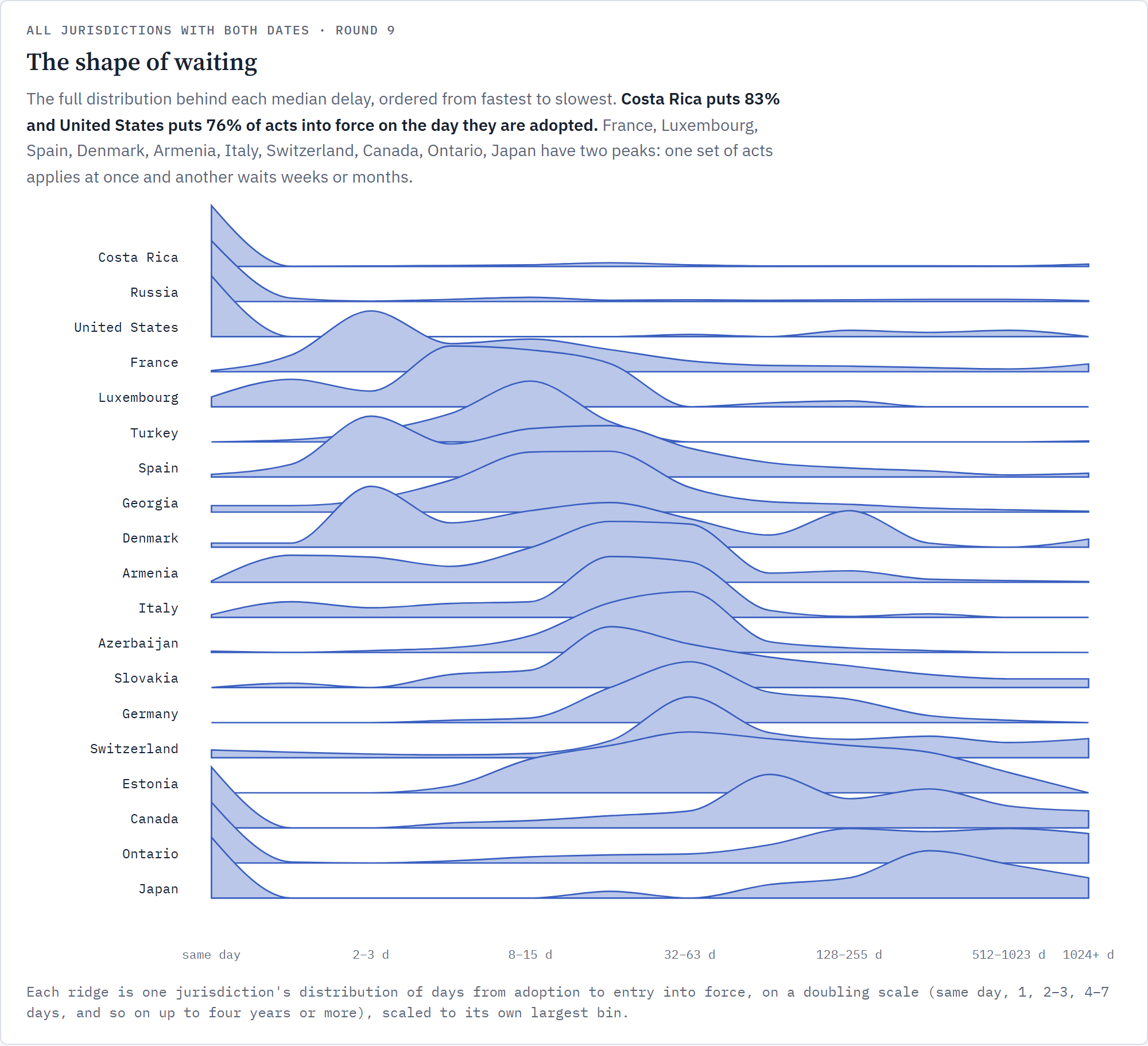
See all global law cohort visualisations and bridges here
Reading it
git clone https://github.com/lexifina/global-law && cd global-law
git submodule update --init          # every country; or python3 tools/countries.py add <country> for some

python tools/law.py world 2022-05-01                       what every corpus looked like that day
python tools/law.py show 2022-05-01 united-states/federal/usc/title-11/1182.md
python tools/law.py blame 2022-07-01 united-states/federal/usc/title-11/1182.md
python tools/law.py words 2022-07-01 united-states/federal/usc/title-11/1182.md
python tools/law.py diff 2022-05-01 2022-07-01 united-states/federal/usc/title-11/1182.md
python tools/law.py laws 1990-01-01 1990-12-31 germany
Dates must be written YYYY-MM-DD. When a date falls before a record starts or after it ends, the tools say so on
stderr, because each country's record covers a different period (see record_to in manifest.json).
Plain git works too, with care:
git log --first-parentis a world chronology of laws taking effect.git grep --recurse-submodules <term> <commit>searches all the law in force at that moment, in every country.git diff --submodule=diff <commit> <commit>shows every change in every country between two moments.Inside a corpus,
git blamenames the law that wrote each line, andgit log -p --word-diff -- <file>shows each
law's change word by word, which matters where a line is a whole paragraph. Blame and log do not cross from here
into a corpus: run them in the corpus folder, or uselaw.py.To look around an older moment, use a separate worktree, not
git checkouthere:git worktree add ../then <commit> && cd ../then && git submodule update --init. Checking out an old commit here
leaves the folders of corpora that did not exist yet, and the tools, which live in the last commit, disappear.Git cannot store dates before 1970, so
git log --before=1960-01-01gives a wrong answer without saying so. The
tools read theIn-forcetrailer instead.Each corpus's own tags are copied here under its path, for example
germany/bund/acts/gg/36.After a corpus is rebuilt (its maintainers force-push), run
git submodule update --initand, inside that corpus,git fetch --force --tags: a plain fetch keeps old tags with the same names.The most amended provisions of a corpus: inside its folder,
git log --format= --name-only | sort | uniq -c | sort -rn | head.
Tests
python -m unittest discover -s tests -v
The 48 tests check the jurisdiction tree and the timeline, known readings in each country, and that the answers here
agree with each corpus read with its own tools. REPRODUCE.md lists them, with the exact build and a hash-for-hash
rebuild check.
How it was made
tools/build.py builds this repository from the published corpus repositories, deterministically. REPRODUCE.md
records the command, the software, the commits pinned, the decisions made by hand and what an AI model did and did
not do.
Videos
https://github.com/user-attachments/assets/6020acb1-53f3-4b65-94a4-fe132b867358
https://github.com/user-attachments/assets/3e3076d7-cfb4-4e0a-8552-2926a630fc8e
License
This repository is CC0. The law text is in each country's repository, under that repository's own terms.
Yorumlar (0)
Yorum birakmak icin giris yap.
Yorum birakSonuc bulunamadi