desk
Health Warn
- License — License: MIT
- Description — Repository has a description
- Active repo — Last push 0 days ago
- Low visibility — Only 6 GitHub stars
Code Fail
- rm -rf — Recursive force deletion command in packaging/macos/build-app.sh
- rm -rf — Recursive force deletion command in packaging/windows/build.sh
Permissions Pass
- Permissions — No dangerous permissions requested
No AI report is available for this listing yet.
A Kanban board where every card is a Claude Code session.
desk
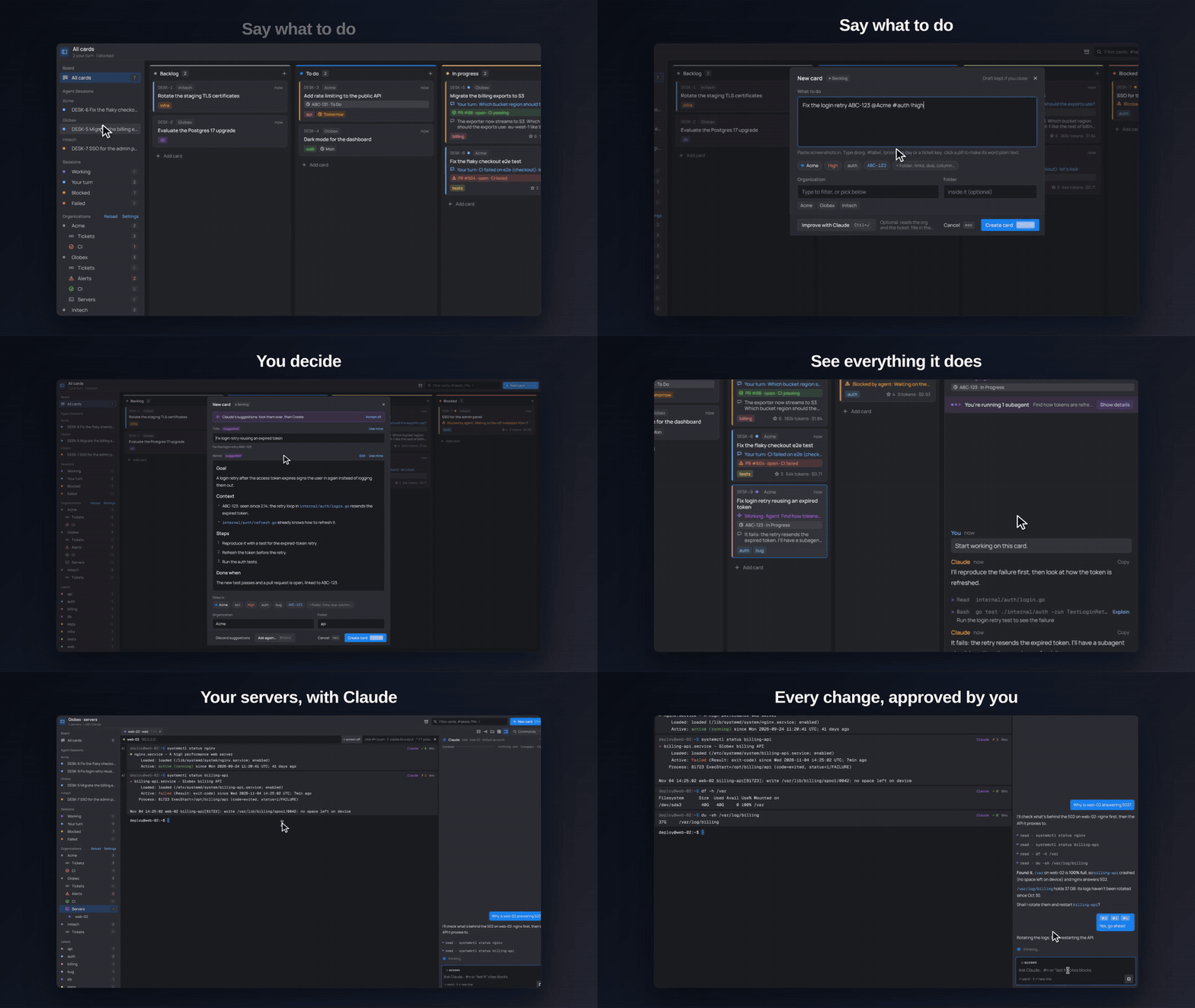
A Kanban board where every card is a Claude Code session.
Say what to do; Claude works on it in the right organization, under its own account, and asks you when it needs you.
Pull requests, tickets, CI, alerts and the org's servers sit next to the work. desk demo shows it all with nothing to set up.
▶ The 85-second demo, narrated · 📖 Documentation





Features · Install · Getting started ·
Guide · Keys · Development
Features
| 🗂️ Board of sessions | Backlog, To do, In progress, Blocked, Review, Done. Sessions move their own card: a message sends it to In progress, Claude reporting blocked to Blocked, done to Review. Only you move a card to Done. |
| 🏢 Organizations | Each org is a folder with its own desk.toml: its accounts, its Claude profile (sandboxed with bwrap on Linux, CLAUDE_CONFIG_DIR on macOS and Windows), its skills, its agents. |
| ✨ Prompt optimization | A new card's request is worked out by Haiku in the org's folder into a real brief: context, steps, acceptance criteria, labels, links and the skills to use. |
| 🔗 Live links | GitHub, GitLab and Bitbucket PRs/MRs and Jira issues on each card, with their state and CI. Tickets follow their card's column. |
| 🎫 My tickets, CI, alerts | Per org: tickets assigned to you, failing pipelines, and Nagios alerts. One click turns any of them into a card. |
| 🖥️ Infra workspace | Live SSH panes of the org's servers, from a plain OpenSSH config (or imported from Ásbrú), shared with an infrastructure Claude that asks before every change. |
| 💬 Rich conversation | Markdown with highlighted code, diffs of every edit, explained shell commands, subagents and background shells, permission prompts and interviews inline. |
| 🧑💻 Full TUI too | Any card opens in the real Claude Code TUI, inside desk, on the same session. |
| 🧭 Workspace | Each card's editor view: its projects' files in an editor beside a second Claude that reads them with you (never writes), answers the card's Claude, and opens any diff from the chat on the change. |
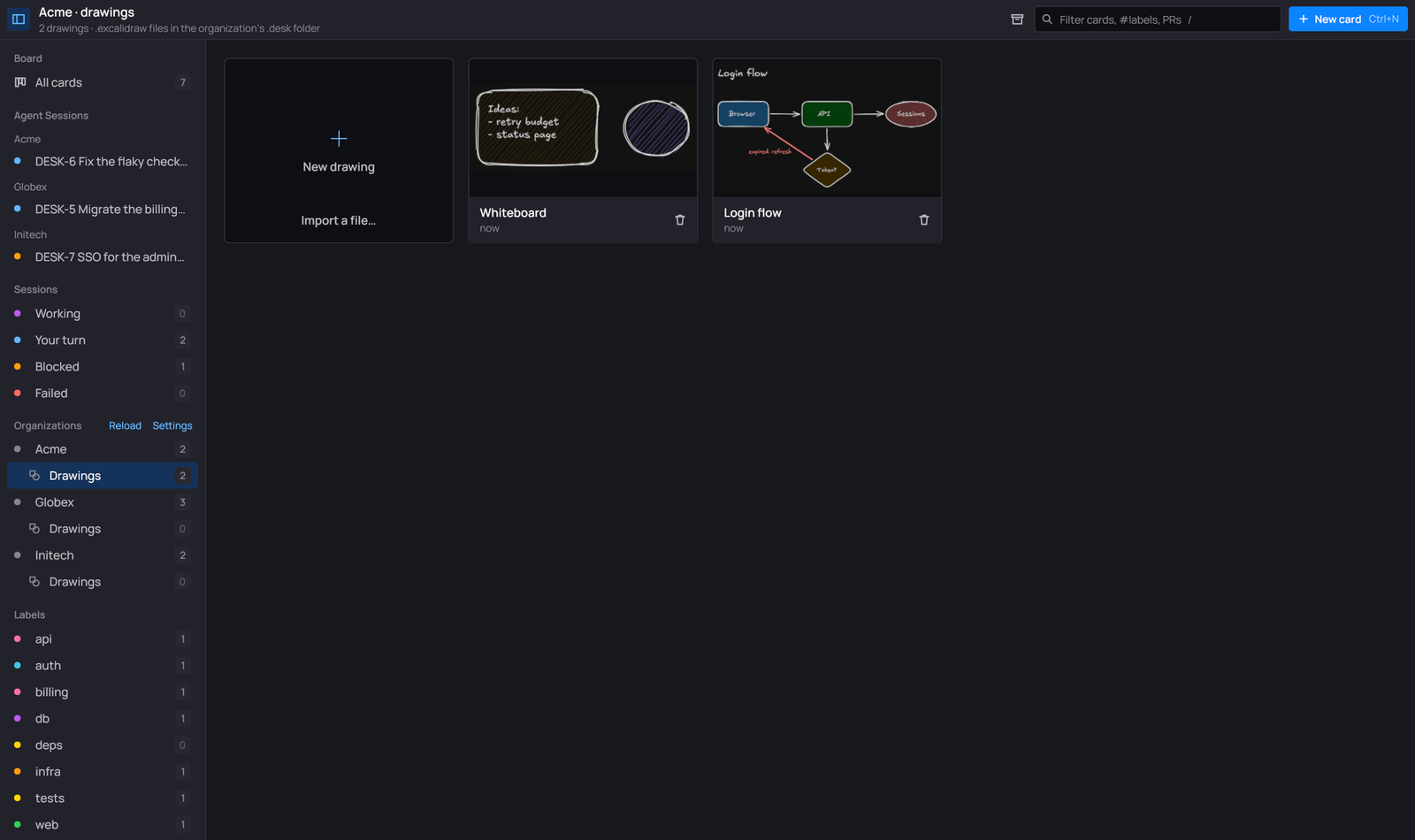
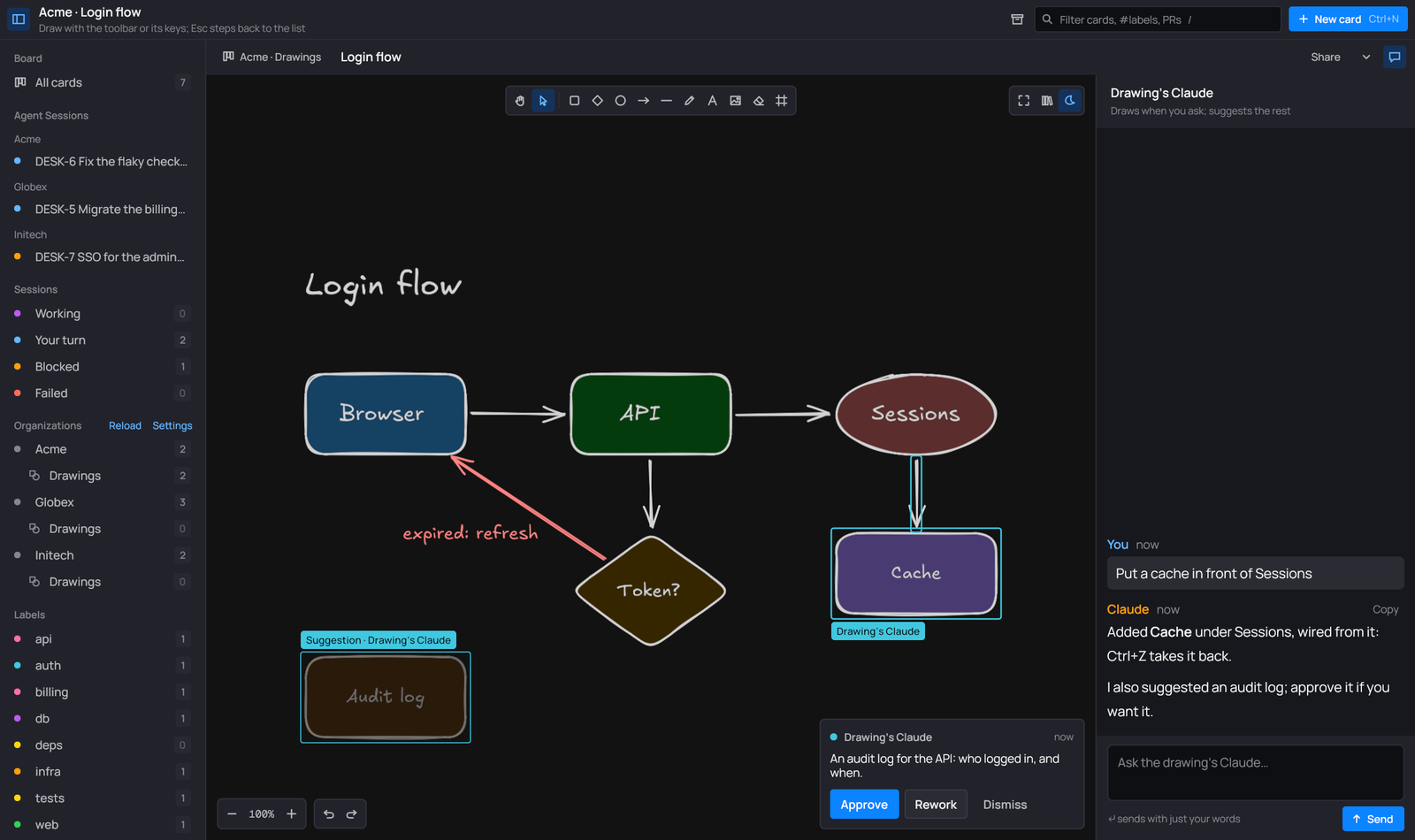
| ✏️ Drawings | Excalidraw diagrams per organization and per card, in desk's own editor. Every Claude can read and draw in them: edits show live and undo, and what you didn't ask for comes as a suggestion to approve. |
| 🔐 Vaults | Tokens from Bitwarden/Vaultwarden, Passbolt, env vars or a command. Unlocked keys stay in memory only. |
| 🪶 No CLIs needed | Every provider and vault is spoken to in Go. No gh, glab, bw or wl-paste. |
Screenshots
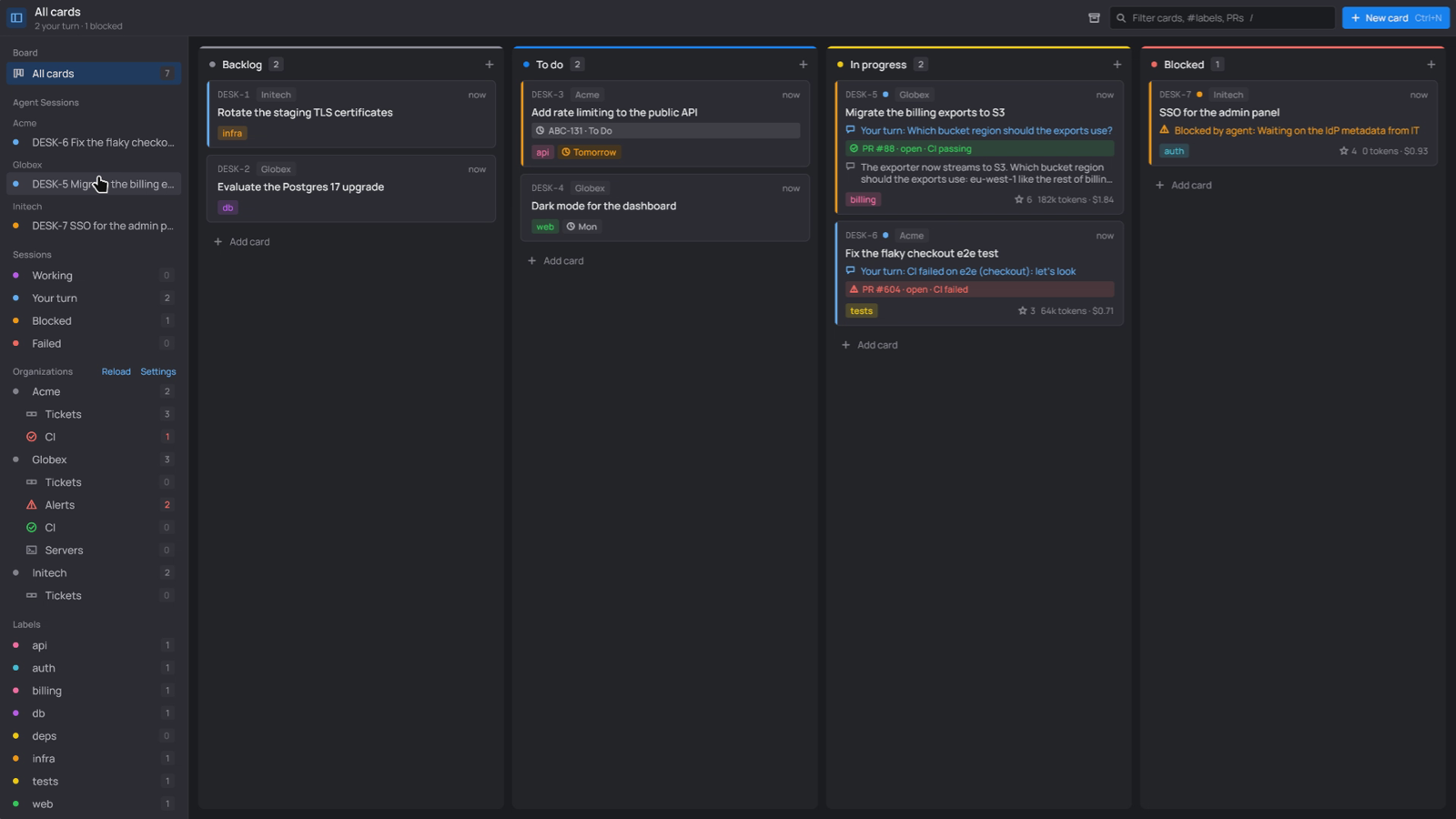
Taken from desk demo: the organizations, tickets and servers are made up.
 |
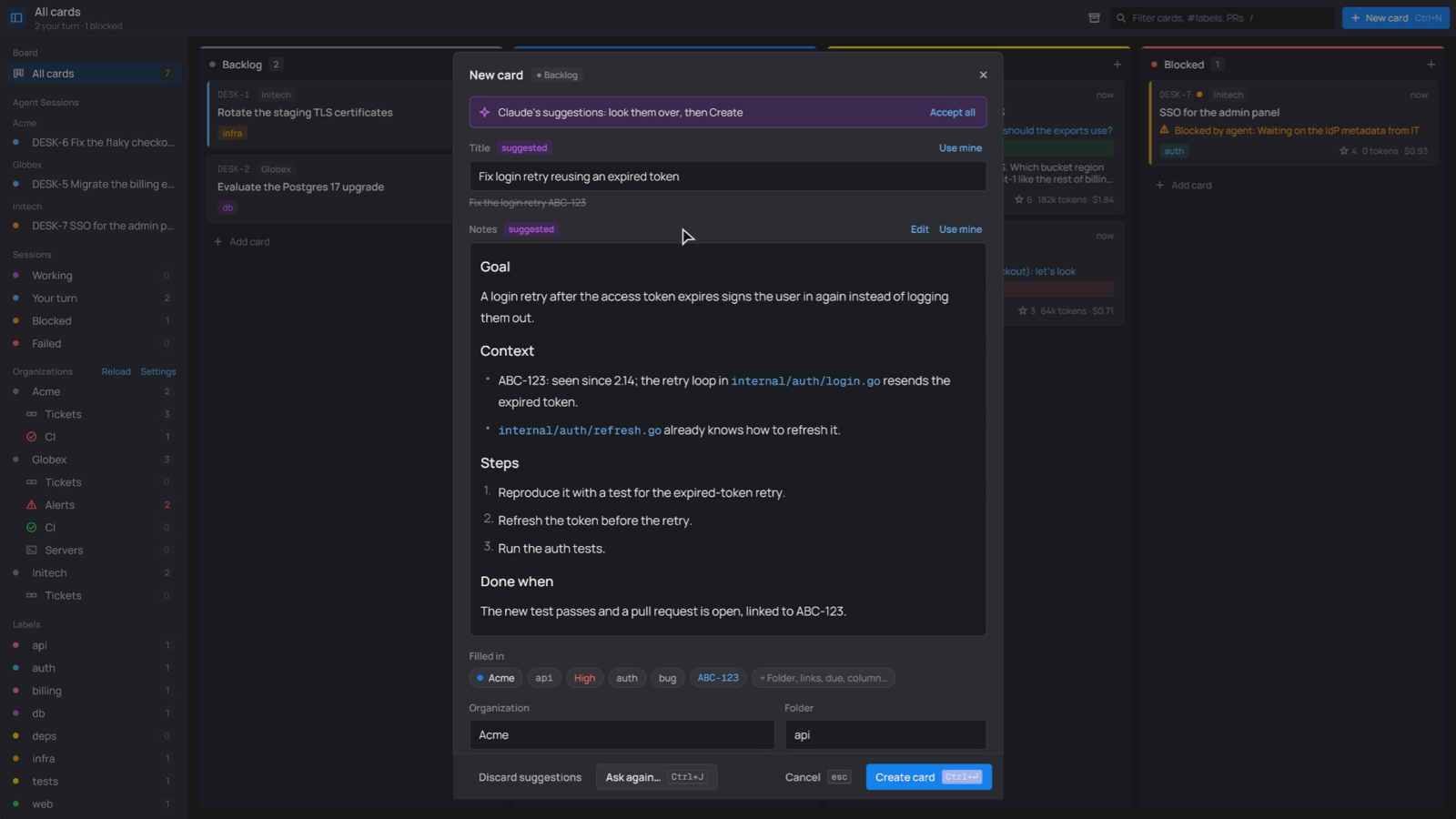 |
| The board. Every card is a session; Agent Sessions groups them by organization. | Improve with Claude. A one-line request becomes a brief: goal, context, steps, done when. |
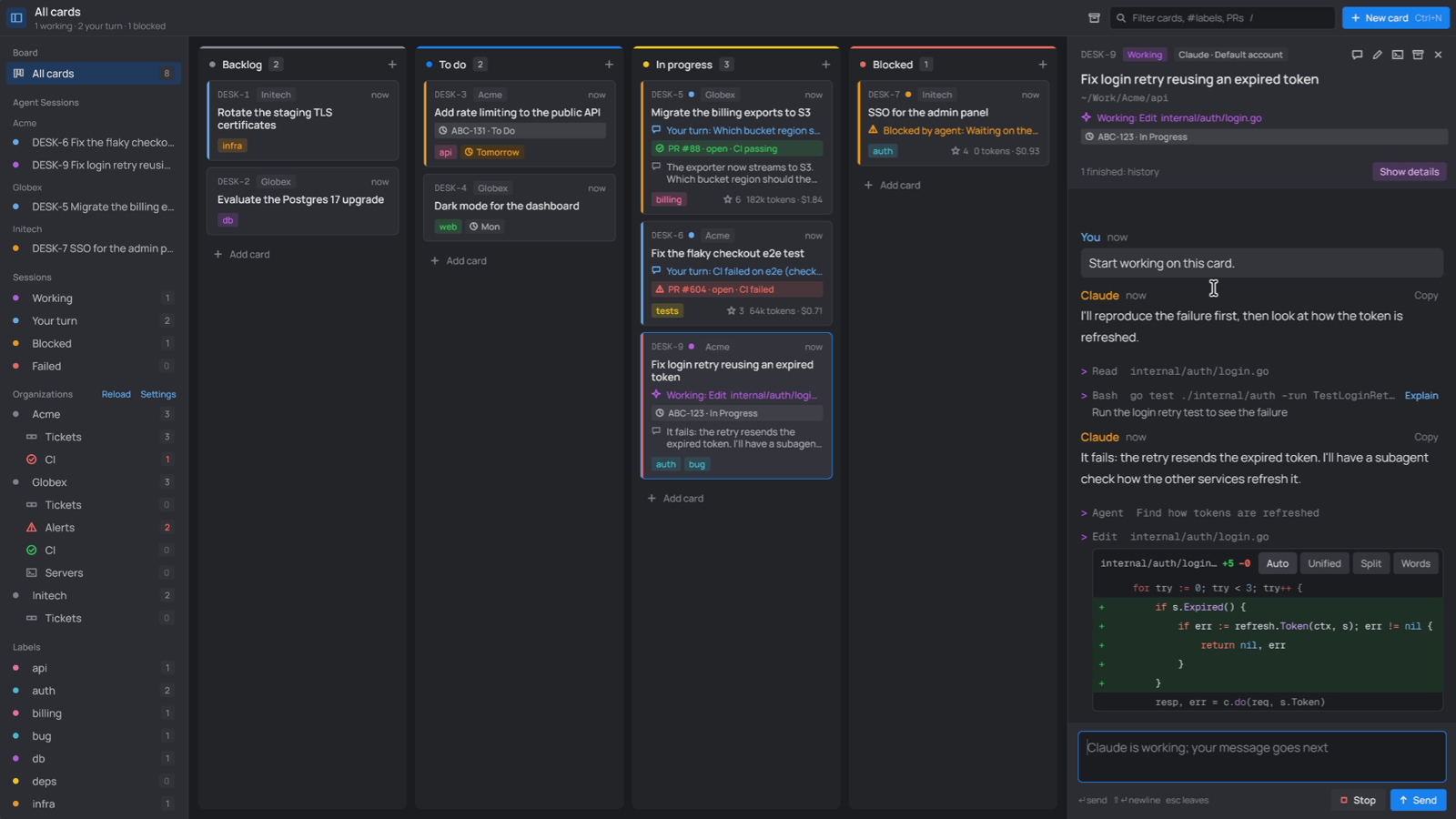 |
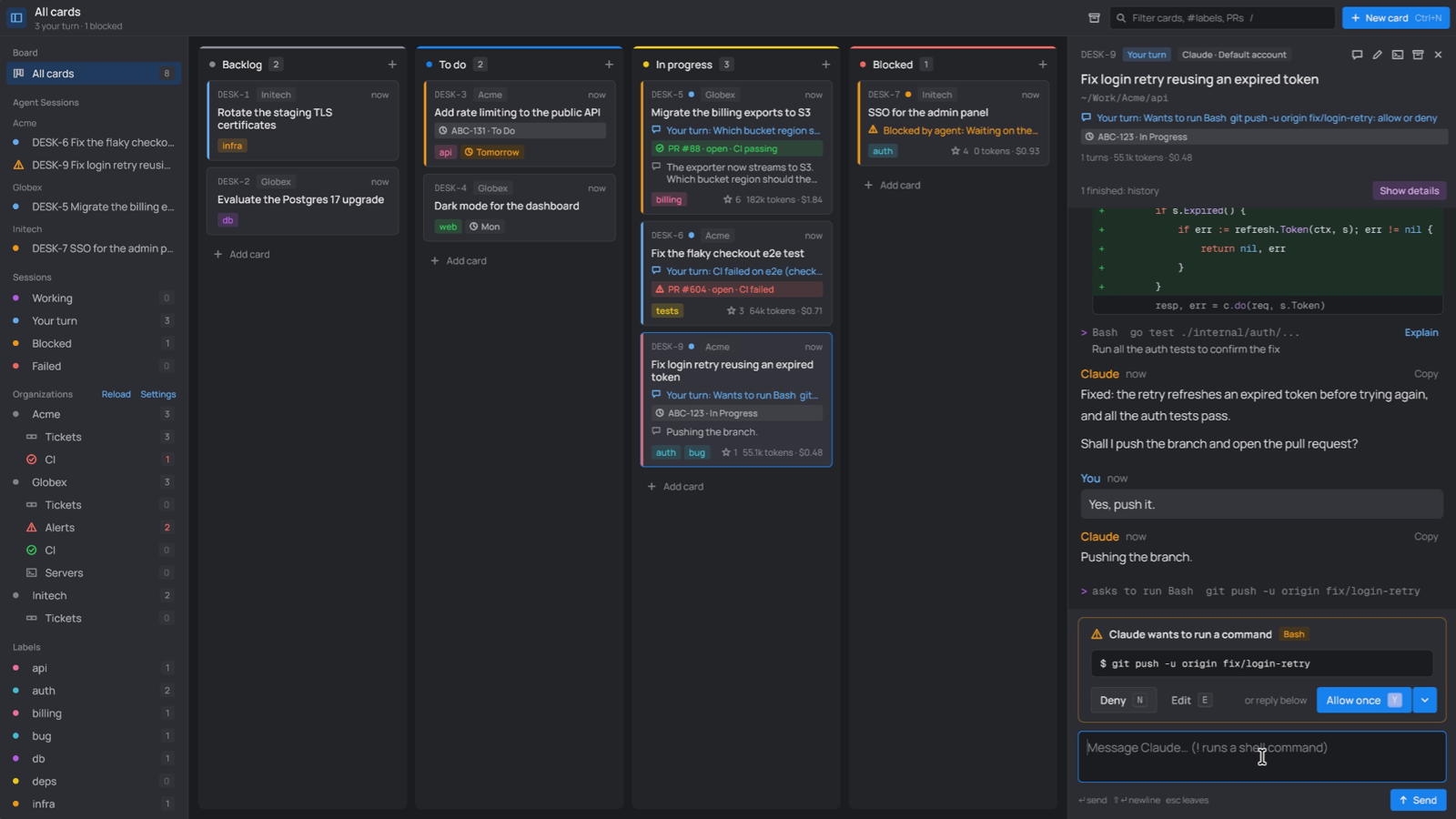 |
| The session. Commands in plain words, subagents, every edit as a diff. | Your turn. Permission prompts and answers right in the conversation. |
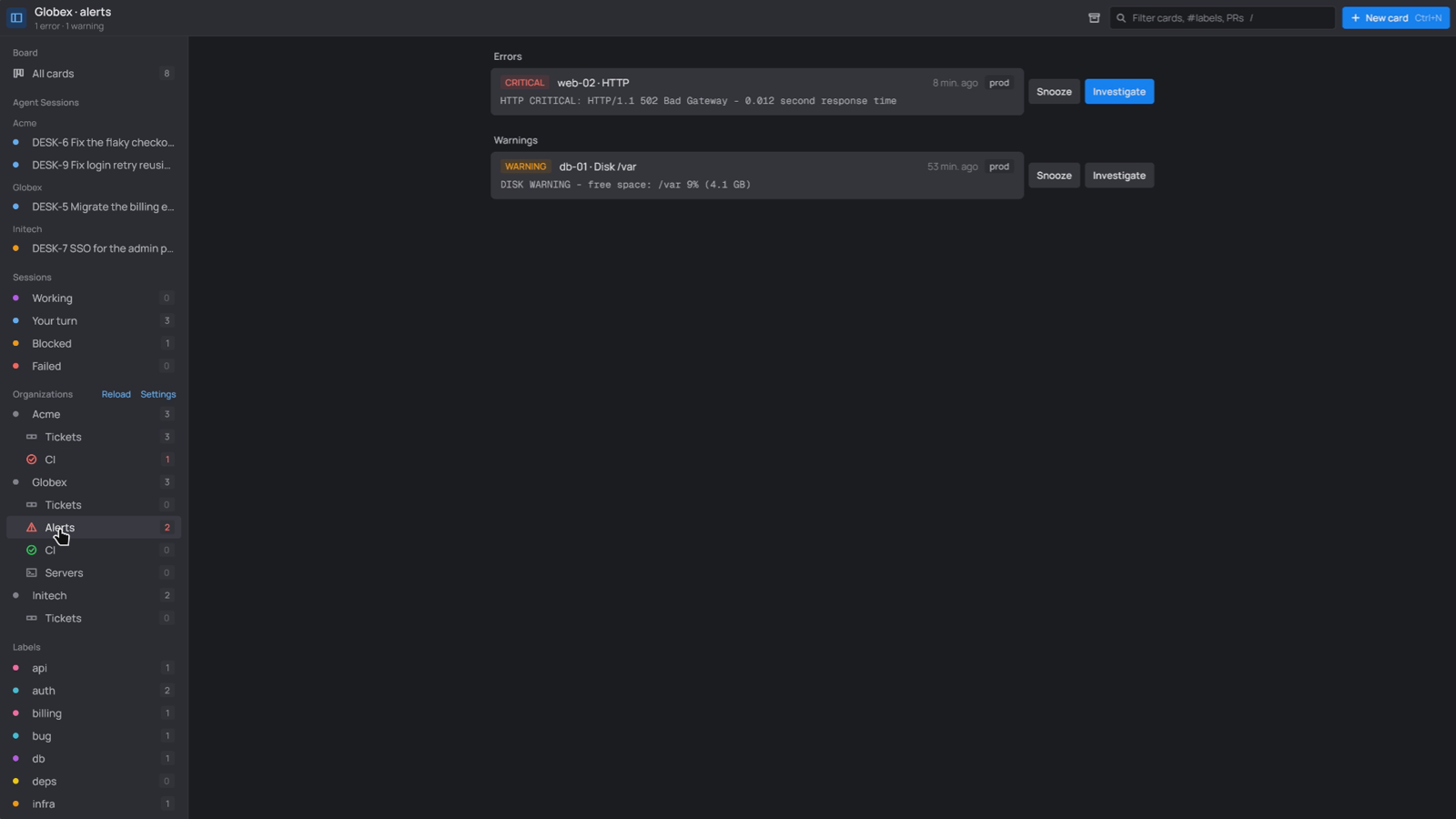 |
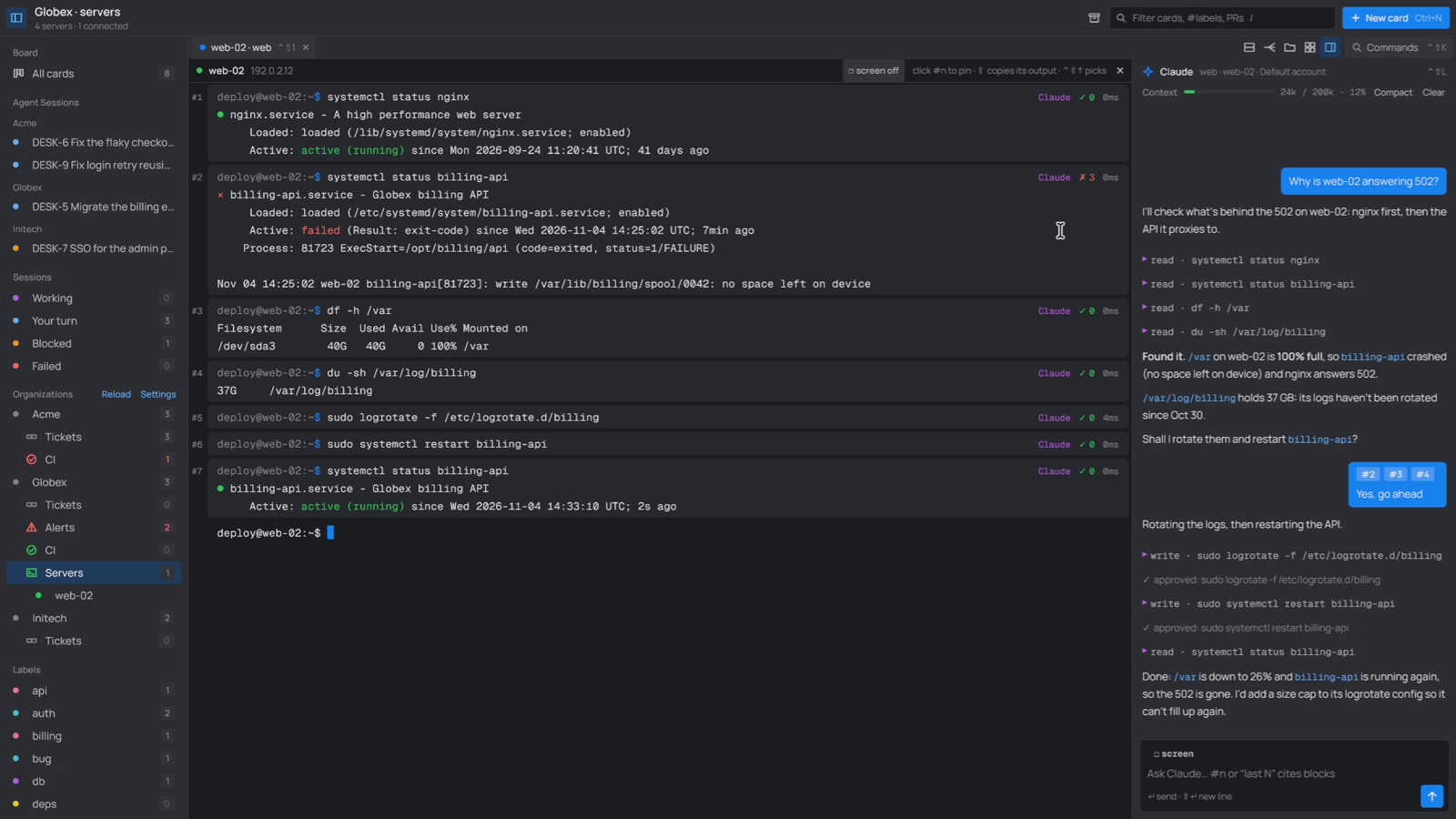 |
| Alerts. Each organization's Nagios alerts, next to the work. | Servers. SSH panes shared with an infra Claude that asks before every change. |
 |
 |
Drawings. Excalidraw diagrams for each organization and card, as .excalidraw files. |
Claude in drawings. It draws when you ask and suggests the rest; every edit undoes. |
Install
desk runs on Linux under Wayland (Hyprland, Sway, KDE, GNOME…; X11 is on the
roadmap), on macOS 12+ (Apple silicon and Intel) and on Windows 10/11 (x64).
It needs Claude Code (claude) on PATH, or where its native installer puts it (~/.local/bin, on Windows %USERPROFILE%\.local\bin\claude.exe).
Optional on Linux: bwrap (bubblewrap) for
per-organization Claude profiles (macOS and Windows hand the profile to Claude Code asCLAUDE_CONFIG_DIR instead). The infra workspace speaks SSH itself (no ssh program needed).
[!WARNING]
macOS and Windows are new and not fully tested. desk is developed on Linux.
- Windows was tested under Wine on Linux, not on a real Windows machine: the test suite
passes there, but some of it (PowerShell, console resizing, sockets) can't run under Wine.
The window was seen running under Proton (Steam's Wine, drawing through DXVK), until the
mouse moves over it: Proton's pointer input is incomplete and Gio, the UI toolkit, stops on
it. Plain Wine can't open the window at all. Real Windows has both.- macOS was tested in a QEMU macOS VM without a GPU: it builds and the test suite passes,
but desk's window needs Metal, so the GUI has never been seen running. It should work on a
real Mac.If something breaks on either, please open an issue.
Windows
Download desk-<version>-windows-amd64.msi from the latest release
and run it: a wizard installs desk for you alone (%LOCALAPPDATA%\Apps\desk, no administrator
rights) or, under Advanced, for everyone (Program Files\desk), adds it to PATH (sessions
run desk peer), puts desk in the Start Menu and on the desktop, and can launch it when it's done;
a newer MSI replaces the old install. Or take the portabledesk-<version>-windows-amd64.zip and run desk.exe from anywhere. Neither is code-signed (see
Roadmap), so SmartScreen warns the first time: More info → Run anyway.
Terminals run on ConPTY; local shells are pwsh, else Windows PowerShell. Data lives where it does
on Linux, under %USERPROFILE% (.config\desk, .local\share\desk). Linux-only on Windows: the
infra workspace's virtual camera. From Linux, packaging/windows/build.sh cross-builds both files.
macOS
Download desk-<version>-macos.zip from the latest release
(one universal desk.app), unzip it into Applications. It isn't signed with an Apple Developer ID
(see Roadmap), so open it the first time with right-click → Open, or clear the quarantine flag:
xattr -dr com.apple.quarantine /Applications/desk.app
From source, with Go and the Xcode command line tools: packaging/macos/build-app.sh buildsdist/desk.app. Run the app rather than a bare binary: macOS only shows an app bundle's
notifications. Data lives where it does on Linux (~/.config/desk, ~/.local/share/desk).
Linux-only on macOS: the infra workspace's virtual camera (PipeWire / v4l2loopback).
Nix
nix run github:lfdominguez/desk
Or add it to a flake:
inputs.desk.url = "github:lfdominguez/desk";
# …
environment.systemPackages = [ inputs.desk.packages.${pkgs.system}.default ];
AppImage
Download desk-<version>-x86_64.AppImage from the latest release:
chmod +x desk-*-x86_64.AppImage
./desk-*-x86_64.AppImage
Debian / Ubuntu
sudo apt install ./desk_<version>_amd64.deb
Arch Linux (AUR)
yay -S desk-kanban # or paru, or: git clone https://aur.archlinux.org/desk-kanban.git && cd desk-kanban && makepkg -si
It builds the tagged release from source and installs desk. The AUR's desk is another program
(a shell workspace manager), so the two conflict. Claude Code itself is the AUR's claude-code.
From source
Go (the version in go.mod), cgo, and the Wayland, xkbcommon, EGL and PipeWire headers:
CGO_CFLAGS_ALLOW=-fno-strict-overflow go build -tags nox11 -o desk ./cmd/desk
Getting started
- Lay out your work as organizations. By default desk looks in
$DESK_ROOT(~/Work), two
levels down: every subfolder is an organization (~/Work/Acme,~/Work/Globex…). Change the
folders and depth in Settings → General, along with the languages cards are written in and
Claude speaks with you in (English unless you change them; each new card can pick its own). - Optionally give an org a Claude account. A profile in
~/Secure/Claudes/<Org>/makes that
org's sessions run under it, sandboxed with bwrap (on macOS and Windows, withCLAUDE_CONFIG_DIRat it).
Others use your own login. - Optionally connect its accounts in Settings (or by hand in
<Org>/.desk/desk.toml, see
Links and organizations). - Ctrl+N for a new card: say what to do, pick the organization, Improve with Claude,
Create card. The card starts working right away.
Just looking? desk demo opens a made-up board (Acme, Globex, Initech) whose Claude sessions,
tickets, CI, alerts and Globex's servers (with their infra Claude) are scripted: no accounts, no
SSH, nothing of yours read or written.
Everything is saved as you go: the board in ~/.local/share/desk/board.json, conversations in~/.local/share/desk/chats/<card>.jsonl, settings in ~/.config/desk/settings.toml.
Guide
The board
- Sidebar views: all cards; sessions by status (working, your turn, blocked, failed, review); each
organization and label in use; links (waiting on review, ready to merge, changes requested, open
tickets); due (overdue, this week); the Done archive. Each shows its count. - Header: the view in words, e.g. "2 working · 4 blocked · 1 overdue".
- Cards: key (
DESK-12), status dot, organization, age; title; the status line with its
reason ("Blocked by agent: waiting for PR #609"); link chips with their live state ("PR #609 ·
approved — merge", "ABC-1317 · In Review"); the last message; labels, due date, and the
session's turns, tokens and cost. - Review and Done: a card Claude finishes waits in Review ("Ready for review") until you
move it to Done; nothing else does. No view shows the Done column; Done cards show in
Done archive with the archived ones: in sections by date or organization, filtered by chips
(Done, Archived, organizations, top labels) and the search, a click previews a card beside the
list (notes, numbers, last messages; Open session, Restore or Archive, Delete), and checkboxes act on
many at once with one undo. The box in the toolbar archives every Done card. - My tickets: under each organization with a Jira, GitHub or GitLab account, Tickets lists
the open issues assigned to you there, by project. Click one to open its card, or to make one
linked to it. - CI: under each organization whose cards link pull or merge requests or commits, CI lists
their GitHub Actions runs and GitLab pipelines; failed and running ones show their jobs. A PR or
MR chip says its CI too ("approved — merge · CI failed" turns red). - Alerts: under each organization with one or more
[[nagios]], Alerts lists hosts down
or unreachable and services in warning or critical, errors first. Its count is the ones nobody
acknowledged. desk reads Nagios Core's JSON CGI (statusjson.cgi, which XI serves too) with
basic or digest auth, and falls back to a Nagios 3'sstatus.cgipages. An alert's
Investigate makes it a card whose Claude has the infra Claude check the servers;
Snooze (1 hour … 1 week, or your own2h30m) hides it until then. - Card tools: every card's Claude has desk's read-only tools (
mcp__desk__*):alerts,tickets,link,ciandci_log, through the org's accounts. They add to the org's own
workflow tools; Claude falls back to them when one of the workflow's fails.add_projectandask_workspacereach the card's workspace. - Right-click a card for its menu: open its session, its full window or a window of its own, its terminal, its workspace, turn its
Remote Control on or off, edit it, copy its key, move it to another column, archive it. - Desktop notifications when a card turns to your turn, blocked, failed or ready for review, unless you're
looking at it.
Prompt optimization
The new-card dialog asks only What to do (as it comes, over as many lines as you like), the
organization, and Improve with Claude (Ctrl+J). The latest Haiku runs as Claude Code in the organization's
folder under its account, reading its CLAUDE.md files and code and changing nothing, and fills the
dialog as it streams: a title, the request worked out into the session's first message (context
found, steps, acceptance criteria, open questions), labels (the board's reused), priority, folder,
links and due date. It sees the skills, plugins, subagents and MCP tools that account's sessions
have, and has the session start with the ones that fit (a ticket → /team-tools:work-ticket ABC-510). Tickets and PRs the request names are read first. The brief it follows isinternal/claude/optimizer.md.
Look it over, edit anything, then Create; Ask again… reruns it on what the dialog
holds now. What you wrote is kept: Use mine or Discard suggestions goes back to it.
- Screenshots: Ctrl+V of an image saves it beside the board and puts
in the
notes; the session reads it. desk reads images from the compositor itself (the Wayland
data-control protocol: Hyprland, Sway, other wlroots compositors, KDE), on macOS from the
pasteboard (⌘V), on Windows from the clipboard (a PNG or a screenshot's bitmap), nothing to
install. - Tickets: when the organization has somewhere to create them (its first
[[jira]]project,
else a[[github]]account'srepo), the Ticket switch has the card's Claude create its
ticket before any work, assigned to you, with the Markdown description converted to Atlassian's
format by go-adf.
Sessions
Click a card (or Enter) to open its panel: the conversation, its links, and a box to message
Claude. Claude runs in <Org>/<folder> with --permission-mode auto, the organization's own
folder added with --add-dir so its .claude/skills load. Every Claude view names the account it
runs under.
- Status lines: Claude sets the card's state by ending a reply with
DESK-STATUS: blocked — <reason>orDESK-STATUS: done, and attaches links withDESK-LINK: <url>(desk hides those
lines). Done puts the card in Review, once nothing (subagent, background shell) is left running. - Questions and permissions: Claude's interviews (AskUserQuestion) and tool permissions show
as a box at the end of the conversation; the card goes to "your turn" meanwhile. - Shell commands: a message starting with
!runs it yourself withbash(PowerShell on
Windows) in the card's folder, no Claude, no approval. Its output streams into the conversation, and when it ends
Claude gets the command, output, exit code and time and carries on by itself. - Agent Sessions: every card with a session is listed in the sidebar. Its full window shows
the context meter and the account's plan limits (the 5-hour session, the week, a model's week). - A session in its own window (the header's pop-out, the menu's Open in new window or
Ctrl+Shift+O): just that card's session, its own message box and keyboard, while the board
stays in the main window; closing it puts the session back, and it comes back when desk starts. - Subagents and background shells: a bar under the header says what runs; Show details
opens a rail with each one (model, task, tools, tokens, time) and their history. A held subagent
says why: Waiting on <its shell>, Running <tool> over 30 s, No activity after 2
minutes. - The canvas: a card's full window draws its process as a node graph (Canvas | Conversation):
the card, its tickets and the workspace Claude feed the session, the session hands work to its
subagents and shells, its pull requests go to their CI and on to Done; each Claude shows where
it is and what it's on. Pan, zoom, and click a node to open it. - File changes: every Edit shows as a diff (unified, split or word diff, picked per block),
over the code's highlighting. A Write shows its size. - Shell commands, explained: Claude describes every command it runs in plain words;
Explain has Haiku take it apart flag by flag. - Terminals: T opens the card's session in the full Claude Code TUI inside desk (desk
lets go of the chat's process first). It keeps running while you look at the board.
Remote in its header (or R in the card menu) restarts it with Claude Code's Remote
Control, to go on from claude.ai/code or the Claude app: the link and QR code show in the
terminal. The chat's own process can't serve it (Claude Code offers it only in the TUI). - The workspace: the header's
</>(or the card menu's W) opens the card's projects
(its folder, plus the ones its Claude adds withadd_project, with an Undo toast) in a tree,
files in tabs of a code editor (highlighting, line numbers, undo, Ctrl+S saves, reloads
when Claude edits an open file), and a workspace Claude that only reads: what you have open,
selected or the change you're viewing goes with your message, it suggests changes as diffs, and
the card's Claude can ask it things (ask_workspace). A diff's</>opens the file on that
change, marked in the gutter. - Artifacts the session publishes are listed under the card's links.
- Selecting text: drag or double-click, copied as you let go; Claude's replies select with
formatting kept, and Copy takes a whole reply as Markdown. The keyboard stays in the message
box meanwhile.
Drawings
Each organization has Drawings under its name in the sidebar, and each card its own (the
panel header's shapes icon): .excalidraw files in <Org>/.desk/drawings/, which excalidraw.com
opens too. A drawing opens in desk's editor, with Excalidraw's tools, keys and style panel
(rectangles, diamonds, ellipses, arrows that stay attached, lines, free hand, text, eraser), hand-drawn
or clean, light or dark; frames and groups; images from a file or the clipboard; the
organization's library (library.excalidrawlib); and copy and paste that goes both ways with
excalidraw.com.
- Its Claude: a chat beside the canvas with a Claude of the drawing's own, which reads the
organization's files and draws only through desk's drawing tools. What you select goes with
your message. - Every Claude draws: card sessions, the infra Claude and each drawing's Claude get
drawings,drawing_read(a picture and the element list),drawing_editanddrawing_suggest; the workspace Claude only reads and suggests. An edit shows live, outlined
and named as that Claude's, and Ctrl+Z takes it back. - Suggestions: a change nobody asked for floats over the drawing as a ghost, with Approve,
Rework (your comment goes back to that Claude) and Dismiss. - Export, import, share: PNG, SVG or
.excalidrawthrough the save dialog; Import a file…
takes an.excalidraw(a new drawing) or an.excalidrawlib(into the library); Share has
the drawing's Claude publish it as a claude.ai artifact, and keeps the link.
Links and organizations
Add links in the card's sheet (E): GitHub PRs and issues, Bitbucket PRs, GitLab MRs, Jira issues,
or bare Jira keys. Their state refreshes every 3 minutes through the organization's own accounts in<Org>/.desk/desk.toml: any number of each kind. Edit them in Settings or by hand (the dialog keeps
keys it doesn't show, but not the file's comments). Reload looks for organizations again and
rechecks every link. desk keeps everything of its own in an org's .desk/ (Claude Code's.claude/ and CLAUDE.md stay where they are); a desk.toml or ssh_config still at the org's
root from an older desk moves there by itself, and relative paths in them still start from the
org's folder.
A folder inside an organization can be one of its own: give it a desk.toml (e.g.~/Work/Acme/billing). It is named after the folder, or by a top-level org = "Billing", and its
sessions run under the outer org's Claude account.
Tickets follow their card: when a card moves column, its tickets you're assigned move to
match. A Jira issue takes the transition to the column's status category (Blocked: a status named
blocked; Review counts as in progress), a GitHub issue closes in Done and reopens out of it. Pull
and merge requests are left alone. At start and every 3 minutes, tickets that drifted are brought back in line.
desk only asks a provider through an account: a link whose organization has no account (with a
token) for its host and owner shows no GitHub account (or GitLab, Bitbucket) and is never
fetched, and its CI stays out of the CI view. Anonymous API calls would see no private repos and
run out fast (GitHub allows 60 an hour per address).
A token comes from a password vault item (vault + item, optionally field), an environment
variable (token_env) or a command (token_cmd). Vaults are Bitwarden, Vaultwarden and
Passbolt; desk asks for the master password the first time a link needs it and keeps it in memory
until it closes.
desk.toml
agent = "planner"               # optional: the Claude Code agent new cards' sessions run as
agents = "meta/.claude/agents"  # where its agent files are, from this folder (default .claude/agents)

[[vault]]
name = "me"
kind = "bitwarden"              # Bitwarden or Vaultwarden
url = "https://vault.example.com"   # default https://vault.bitwarden.com
email = "[email protected]"
client_id = "user.1b2c…"        # optional: the account's API key, which skips 2FA
client_secret = { token_env = "BW_CLIENT_SECRET" }

[[vault]]
name = "globex"
kind = "passbolt"
config_file = "~/.config/passbolt/globex.toml"  # go-passbolt-cli's: server, key, passphrase, TOTP token

[[vault]]                       # or without a CLI config
name = "acme"
kind = "passbolt"
url = "https://passbolt.acme.com"
key_file = "~/.config/passbolt/acme.asc"   # your armored private key
# password = { token_env = "PASSBOLT_PASSPHRASE" }  # else desk asks

[[github]]                      # REST API; needs a token, like every account here
owners = ["globex-org"]
# repo = "globex-org/api"       # where cards create their issues (Ticket switch)
vault = "globex"
item = "GitHub token"

[[jira]]
url = "https://globex.atlassian.net"
email = "[email protected]"
projects = ["ABC"]              # bare keys like ABC-12 link here; cards create their tickets in the first
# issue_type = "Story"          # what they're created as; default Task, else the first non-subtask
# sync = false                  # cards' column moves don't transition these issues
token_env = "JIRA_GLOBEX_TOKEN"
[jira.status]                   # optional: the status a column moves issues to, by name
Review = "In Review"            # cards waiting on your review put their issues there

[[bitbucket]]
workspace = "team"
user = "me"                     # app password; without user, token is a bearer token
token_cmd = "pass bitbucket/team"

[[gitlab]]
url = "https://gitlab.com"
groups = ["globex"]
token_env = "GITLAB_TOKEN"

[[nagios]]                      # as many as the org has: each one's alerts in its Alerts view
name = "prod"                   # what its alerts say they come from (default: its host)
url = "https://mon.globex.com/nagios"   # its web root, where cgi-bin/ is
user = "me"                     # the CGIs' login; the password is the token
vault = "globex"
item = "Nagios prod"

[servers]                       # optional: the org's servers file (below), from the org's folder
file = "infra/ssh_config"       # default .desk/ssh_config
Servers
Under each organization with a servers file, Servers opens its infra workspace: session tabs,
live SSH panes with numbered command blocks, and the org's infrastructure Claude beside them,
which runs commands in those panes and waits for your approve / always / edit / deny on every
change ([approvals] in desk.toml). Ctrl+Shift+K is its palette: runbooks, files, forwards,
notes, reports, the health check, the audit log, recordings, sharing, broadcast.
A card of such an org hands server work to it with desk peer; the card shows ⇄ <org> infra,
and the infra Claude's questions and results come into the card's conversation. Each card gets an
infra session of its own (tab <org> · DESK-12, its own Claude), so two tickets' server work
never mixes; its panes are the servers that one ticket needs. It can also write
to a card unasked or put follow-up work in To do. Claude Code users outside desk get the same
through the bundled plugin (plugin/).
An organization's servers are one real OpenSSH config, <Org>/.desk/ssh_config (or [servers] file).
desk connects with its own SSH client (Go, no ssh program), reading that file the wayssh -F <that file> <alias> would, so the same command works from any terminal. Panes, the files
split (SFTP, or sh/tar on servers without it), the changes tool and port forwards share one
connection per server; questions (passwords, passphrases, yes/no) go to desk's ask box, a#@ password from the vault first (read only once the server asks for a password). A pane that opens a new connection shows each of its steps
with its time (name lookup, connect, vault, key exchange, host key, each auth method, the shell),
so a slow connect says where the time went. Not supported: GSSAPI/Kerberos, host-based auth, PKCS#11 smart
cards, FIDO keys outside an agent, X11 forwarding, compression; the pane says so. desk's own data
are comment lines OpenSSH ignores, #@ key value:
ssh_config
# Before any "#@ group" or Host: the file's defaults.
#@ vault acme
#@ password "{user}@{host}"

# A section of the tree until the next "#@ group" ("/" nests); its #@ lines
# are the group's defaults (eu/web also takes eu's).
#@ group eu/web
#@ tags web, nginx
Host web1
    HostName 10.0.0.1
    User deploy
    # this host's own: host > group > parent groups > file
    #@ password "web1 root" password
    #@ wol 52:54:00:12:34:56 10.0.0.255:9
    #@ desc the public proxy
    # its name in Nagios (default: the alias and HostName)
    #@ nagios web1.example.com
    #@ pin
Host bastion
    # usable (ProxyJump), not listed
    #@ hidden
Host lab-pi
    # the password itself, no vault: your call (keep the file chmod 600)
    #@ password-raw "s3cret"

# Your own defaults last: ssh keeps the first value it finds.
Match all
    Include ~/.ssh/config
- Comments go on their own lines (
#@ desc a # bkeepsa # b). password ITEM [FIELD]fills{host},{user}and{group}in ITEM and takes it fromvault;password-rawis the password itself. The nearest level with either one wins.- A changed host key (a reinstalled server, rotated keys) stops the connection. The pane's box
then shows the key the server sent next to the one inknown_hosts, by fingerprint. Accept
new key (A) drops that line, saves the key shown and reconnects; it does nothing if the line
no longer holds that key for that host. - Old algorithms: a server offering only ones modern SSH turns off gets Fix algorithms (F),
which writesKexAlgorithms +…(orHostKeyAlgorithms,Ciphers,MACs) into its Host block. - Includes resolving inside the org folder count; ones outside it (like
~/.ssh/config) are
read when connecting but never listed, so your personal hosts never show as the org's servers. - Relative paths (
IdentityFile,UserKnownHostsFile,Include…) are from the folder of
the file that holds them, not desk's working directory (nor~/.ssh/forInclude, asssh -F
would take them). - Dynamic inventory:
#@ hosts-cmd PATHruns at start and on reload and keeps what it prints
(ssh_config text orname user@host:portlines) in<Org>/.desk/servers-dynamic.conf
(on Windows it runs throughcmd /C: a.bat,.cmdor.exe). - Every tab of the org works in
<Org>/.desk/infra/: its Claude's cwd, withrunbooks/and itsCLAUDE.md(an older<Org>/Infra-Claude/moves there once). The servers file is the only
source of servers: the oldInfra-Claude/<group>/folders are no longer read.
Import from Ásbrú
Coming from Ásbrú Connection Manager? An organization's settings page
has Import from Ásbrú under its accounts: pick one of Ásbrú's top-level groups (the one that is
this organization's), or all of it, and its SSH connections are added to the org's servers file,
which is made if it has none. From a shell, the same is:
desk servers import-asbru -org ~/Work/Acme -group Prod   # add Prod's hosts to Acme's servers file
desk servers import-asbru > ssh_config                   # or just print the file
It reads ~/.config/asbru/asbru.yml (or $ASBRU_CFG; give another file, such as an export, as the
last argument). Ásbrú writes that file when it closes cleanly, so close it before importing: while it runs, desk
refuses its file and says so (an export is read anyway).
- Groups become
#@ grouppaths, relative to the group you picked. - For each host it brings the address, user (the key's user for a key login), port and key.
- Jump hosts become hidden
Hostblocks behindProxyJump, and a SOCKS proxy aProxyCommand. - The descriptions become
#@ desc. - Its ssh options (
-X,-A,-C,-o Key=Value,-L/-R/-Dforwards,-p,-i,-l,-J)
become their config keywords. Anything else stays as a comment in the host's block. - Algorithms desk's SSH client doesn't know (as OpenSSH 10, it has no
ssh-dss) are left out ofHostKeyAlgorithms,KexAlgorithms,Ciphers… with a comment, since one unknown name makes it
refuse the whole file.-lists stay as they are. - Passwords stay behind: an ssh_config can't hold them. Point
#@ passwordat your vault instead. - Connections that aren't SSH (RDP, VNC, Telnet…) are skipped, and so are hosts written with Ásbrú's
variables (<GV:…>,<ENV:…>). The toast and the shell say which ones. - A host the file already has (same address and port, under its name or the one it would get) is left
as it is, so importing again only adds the new ones. A name the file gives another host gets the
host's group in front (acme-tracker), even when you import one group at a time.
Keys
| Do | How |
|---|---|
| Add a card | Ctrl+N, New card, or a column's + |
| Open a card's session | click it, or Enter on the selected card |
| Edit its fields | E |
| Its terminal | T |
| Move a card | drag it, or Ctrl+arrows |
| Select | arrows |
| Search | / or Ctrl+F: key, title, notes, org, links, #labels (fzf syntax) |
| Improve the request | Ctrl+J in the new-card dialog |
| Undo an archive or delete | Ctrl+Z |
| In the Done archive | ↑/↓ preview, Space check, Ctrl+A check all, Enter session, Delete, Esc uncheck |
| Back out | Esc: the dialog, the search, a field, the panel, then the selection |
| Text size | Ctrl+= bigger, Ctrl+- smaller, Ctrl+0 back to 100%: the terminals and the session panel, anywhere |
| A new line in a message box | Shift+Enter or Alt+Enter (Enter sends) |
| Change a shortcut | Settings → Keyboard shortcuts, or Keyboard shortcuts in the palette (Ctrl+K) |
Board keys work on the board only, not while you type in a field or in a dialog. A terminal takes
every key, Esc included, for Claude Code, except the text size's. A drawing has Excalidraw's keys
(tool letters and digits, Ctrl+C/X/V, Ctrl+G, Ctrl+D…): see the docs' Keys page.
Every key with a modifier has Ctrl or Alt in it (⌘ on macOS): Shift alone types (Shift+2 is @ on
many layouts). These are the defaults; what you change is kept in settings.toml under [keys]
and the buttons show it.
Development
CONTRIBUTING.md says how to report bugs and send pull requests;
SECURITY.md, how to report a vulnerability privately.
nix develop                     # Go, cgo and the Wayland headers; or install them yourself
go test ./...                   # the dev shell sets -tags nox11
go run ./cmd/qa cover           # every package's coverage against its floor
go run ./cmd/qa mutate -file internal/ui/smart.go ./internal/ui   # mutation testing
Releases are dated, not semver (desk is an app, not a library): 2026.11.03, and another
the same day 2026.11.03.1, .2… Pushing such a tag builds the .deb and the AppImage and
publishes them; desk --version and the Settings say which one runs (a build between releases saysdev-<commit>). Every push to main also replaces thenightly pre-release with that
commit's .deb and AppImage.
git tag 2026.11.03 && git push origin 2026.11.03
Point XDG_DATA_HOME and DESK_ROOT at scratch directories when running checks, never at your
real board. For screenshots and videos, desk demo runs in a fresh temp folder (board, settings,
organizations and HOME all inside it) with every provider faked, in a window titled desk demo. CLAUDE.md has the package map and the conventions (it's written for
Claude Code, which builds most of desk, but reads fine for people).
Vendored dependencies
desk's terminals (card sessions and SSH panes) run on charmbracelet'sx/vt emulator andultraviolet cell buffer. Their released versions
copy every cell of the screen on each scrolled line, and drop the bottom of the screen when a pane
shrinks. A busy pane (a build log, journalctl -f) then costs seconds of CPU, and resizing a split
hides the prompt. Until upstream releases fixes, third_party/ holds both modules
as published, with only the changes below, wired in by the replace block in go.mod. Their MIT
licenses are kept.
| Module | Function | Before | After | Measured | Upstream |
|---|---|---|---|---|---|
| ultraviolet | Buffer.InsertLineArea / DeleteLineArea |
every cell of every line below is copied: O(width × height) per scrolled line | full-width areas rotate the row slices: O(height) pointer moves | one line on a 200×1000 buffer: 2.0 ms → 3 µs; seq 1 300000 through a pane: 7.0 s → 1.0 s (80 cols), 15.2 s → 1.8 s (200 cols) |
not fixed: issue #214, open PR #215 |
| x/vt | Scrollback.Push |
a full scrollback drops its oldest line with slices.Delete, shifting all 10,000 lines |
drops it by reslicing | one line into a full scrollback: 5.3 µs → 1.9 µs | not fixed: open PR #888 (a ring buffer) |
| x/vt | Emulator.Resize |
a shorter main screen cuts its bottom rows, where the prompt is | the top rows scroll into the scrollback first, as xterm does | behaviour fix | not fixed: issue #1013, open PR #1019 |
Each copy goes away once upstream releases its fix. third_party/README.md
has the versions copied.
Roadmap
Planned, not there yet:
- X11. Gio, the UI toolkit, can draw on X11, but desk builds with
-tags nox11, and pasting
images reads the Wayland clipboard itself (internal/clip). - Apple signing and Homebrew. macOS support is done (see Install), but the release's
desk.appis only ad-hoc signed: signing it with a Developer ID and notarizing it needs an Apple
Developer account, which the developer doesn't have and doesn't plan to get for now. The release
workflow already has the signing steps, ready for when an account exists. No Homebrew cask yet
either. The virtual camera stays Linux-only (PipeWire / v4l2loopback). - Windows code signing, winget and Scoop. Windows support is done (see Install), but
desk.exeand the MSI aren't Authenticode-signed, so SmartScreen warns: signing needs a code
signing certificate, which the developer doesn't have and doesn't plan to get for now. The
release workflow already has the signing steps (WINDOWS_CERT_PFX), ready for when one exists.
No winget or Scoop package yet either.
Acknowledgements
- Gio for the GUI, charmbracelet's
x/vtandultravioletfor the terminals (patched copies inthird_party/),
goldmark and chroma
for the conversation, gvcode for the workspace's editor,
fzf's matching algorithm for every
search box, go-adf and
go-passbolt. - Drawings follow Excalidraw's file format and look:
their hand-drawn strokes are a Go port of rough.js
(MIT), and their outlines of perfect-freehand's idea. - Fonts: Manrope,
Geist Mono and
Excalifont, under the SIL Open Font License; the
file icons are Seti UI's font and colors, as VS Code
ships them, under the MIT License.
License
MIT © Luis Felipe Domínguez Vega
Reviews (0)
Sign in to leave a review.
Leave a reviewNo results found