predictive-maintenance-mcp
Health Pass
- License — License: NOASSERTION
- Description — Repository has a description
- Active repo — Last push 0 days ago
- Community trust — 23 GitHub stars
Code Pass
- Code scan — Scanned 12 files during light audit, no dangerous patterns found
Permissions Pass
- Permissions — No dangerous permissions requested
No AI report is available for this listing yet.
AI-Powered Predictive Maintenance & Fault Diagnosis through Model Context Protocol. An open-source framework for integrating Large Language Models with predictive maintenance and fault diagnosis workflows.
Predictive Maintenance MCP Server


Give any AI assistant the ability to analyze vibration data, detect machinery faults, and generate professional diagnostic reports — through natural conversation.
An open-source MCP server and Claude Code plugin that turns LLMs into condition monitoring assistants. Engineers describe what they need in plain language; the AI calls the right analysis tools and delivers results. It's designed to support and accelerate expert decision-making, not replace it — the engineer stays in control.
Quick Start
pip install predictive-maintenance-mcp
Add to your Claude Desktop config (%APPDATA%\Claude\claude_desktop_config.json on Windows, ~/Library/Application Support/Claude/claude_desktop_config.json on macOS):
{
  "mcpServers": {
    "predictive-maintenance": {
      "command": "predictive-maintenance-mcp"
    }
  }
}
Restart Claude Desktop. You're ready — try: "Load real_train/OuterRaceFault_1.csv and check if the bearing is healthy."
More options: install from source · VS Code setup · Docker / HTTPS deployment · use with local LLMs (Ollama)
What Can It Do?
Upload a vibration signal → get a professional diagnosis through conversation.
| You say | The AI does |
|---|---|
| "Is this bearing healthy?" | Loads the signal, runs spectral analysis, checks for fault patterns, classifies severity |
| "Generate a full diagnostic report" | Produces an interactive HTML report with charts, fault markers, and severity assessment |
| "Extract specs from test_pump_manual.pdf and diagnose the signal" | Reads the equipment manual, looks up the bearing model, calculates expected fault frequencies, matches them against the signal |
| "Train an anomaly detector on my healthy baselines, then flag anomalies" | Trains a machine learning model on normal data, scores new signals, highlights outliers |
The AI doesn't guess — it calls 48 specialized analysis tools running locally on your machine. Your data never leaves your infrastructure.
See the full tool list (48 endpoints)Signal Acquisition (6 tools + 2 resources)
| Endpoint | Type | Description |
|---|---|---|
load_signal |
Tool | Load vibration file (CSV, WAV, MAT, NPY, Parquet) |
list_signals |
Tool | Browse available signal files with metadata |
list_stored_signals |
Tool | List cached signals in memory |
get_signal_info |
Tool | Signal metadata (sampling rate, duration, stats) |
generate_test_signal |
Tool | Create synthetic signals for testing |
clear_signal / clear_all_signals |
Tool | Cache management |
signal://list |
Resource | Browse all signal files |
signal://read/{filename} |
Resource | Read signal metadata |
Spectral & Statistical Analysis (7 tools)
| Tool | Description |
|---|---|
analyze_fft |
Frequency spectrum with automatic peak detection |
analyze_envelope |
Envelope analysis for bearing fault detection |
analyze_statistics |
Time-domain features (RMS, kurtosis, crest factor) |
compute_power_spectral_density |
Power spectral density (Welch method) |
compute_spectrogram_stft |
Time-frequency spectrogram |
extract_features_from_signal |
17+ statistical and spectral features |
plot_signal / plot_spectrum / plot_envelope |
Visualization tools |
Diagnostics & Health Assessment (14 tools)
| Tool | Description |
|---|---|
calculate_bearing_characteristic_frequencies |
Compute expected fault frequencies from bearing geometry |
check_bearing_fault_peak_tool |
Detect peaks at fault frequencies |
check_bearing_faults_direct |
Multi-fault detection (inner/outer/ball/cage) |
diagnose_bearing |
Guided bearing diagnostic workflow |
search_bearing_catalog |
Look up bearing specs by model number |
lookup_bearing_and_compute_tool |
Catalog lookup + frequency calculation |
diagnose_gear |
Evidence-based gear fault detection |
evaluate_iso_20816 |
Vibration severity assessment (4 severity zones) |
assess_vibration_severity |
Health classification |
train_anomaly_model |
Train novelty detection on healthy baselines |
predict_anomalies |
Score new signals for anomalies |
search_documentation |
Semantic search over equipment manuals |
read_manual_excerpt / extract_manual_specs |
Extract specs from PDFs |
list_machine_manuals |
Browse available documentation |
Reporting (8 tools)
| Tool | Description |
|---|---|
generate_fft_report |
Interactive frequency analysis report |
generate_envelope_report |
Envelope analysis with fault markers |
generate_iso_report |
Severity zone visualization |
generate_diagnostic_report_docx |
Structured Word document report |
generate_pca_visualization_report |
2D/3D anomaly projection |
generate_feature_comparison_report |
Cross-signal feature comparison |
list_html_reports / get_report_info |
Report management |
Guided Workflows (4 prompts + 4 resources)
| Prompt | Description |
|---|---|
diagnose_bearing_prompt |
Complete bearing fault diagnostic decision tree |
diagnose_gear_prompt |
Gear fault detection workflow |
quick_diagnostic_report_prompt |
Fast health screening |
analyze_anomalies_prompt |
ML-based anomaly detection tutorial |
Claude Code Plugin
The project includes a plugin for Claude Code with domain-specific skills that activate automatically during conversation. Install it and Claude gains guided diagnostic workflows, autonomous agents, and quick commands.
/plugin marketplace add LGDiMaggio/predictive-maintenance-mcp
/plugin install predictive-maintenance@predictive-maintenance-marketplace
Skills (7) — activate automatically based on context
| Skill | What it does |
|---|---|
| bearing-diagnosis | Walks through a complete bearing fault diagnostic workflow |
| gear-diagnosis | Gear fault detection via spectral pattern analysis |
| quick-screening | 30-second vibration health check |
| report-generation | Professional HTML and Word report generation |
| anomaly-detection | Train and run ML-based anomaly detection models |
| signal-management | Load, inspect, and manage vibration signals |
| documentation-search | Search equipment manuals and bearing catalogs |
Agents (2) — run autonomously for complex tasks
| Agent | What it does |
|---|---|
| diagnostic-pipeline | End-to-end: load signal → spectral analysis → fault detection → severity assessment → report |
| signal-explorer | Explore and compare multiple signals, find outliers, characterize patterns |
Commands (3) — quick entry points
| Command | Example |
|---|---|
/pm-diagnose |
/pm-diagnose bearing_signal.csv — full fault diagnosis |
/pm-screen |
/pm-screen bearing_signal.csv — quick health check |
/pm-report |
/pm-report bearing_signal.csv full — generate all reports |
Reports
All analysis tools generate interactive HTML reports you can open in any browser — pan, zoom, hover for details. Also supports structured Word (.docx) exports.
Report examples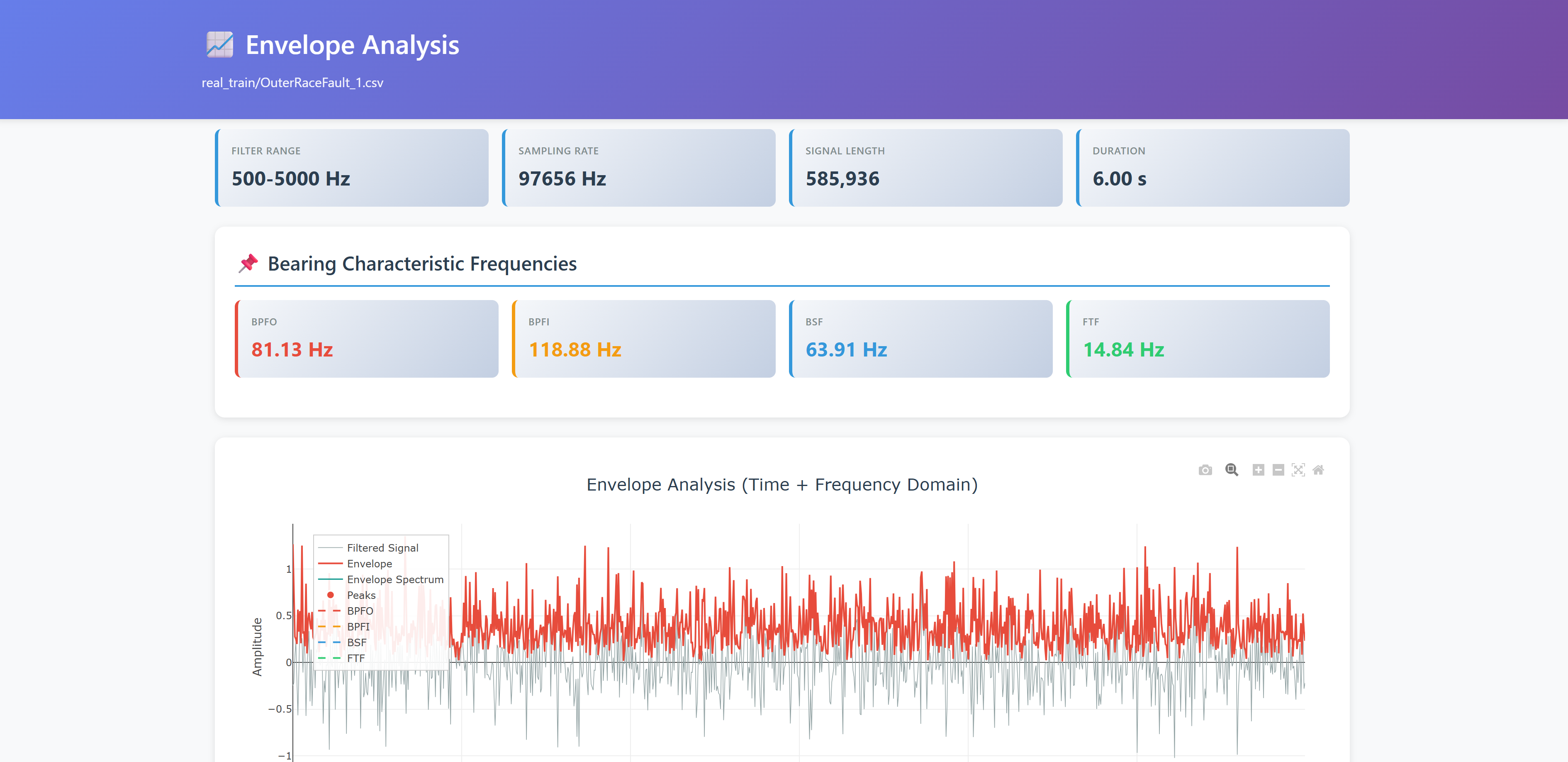
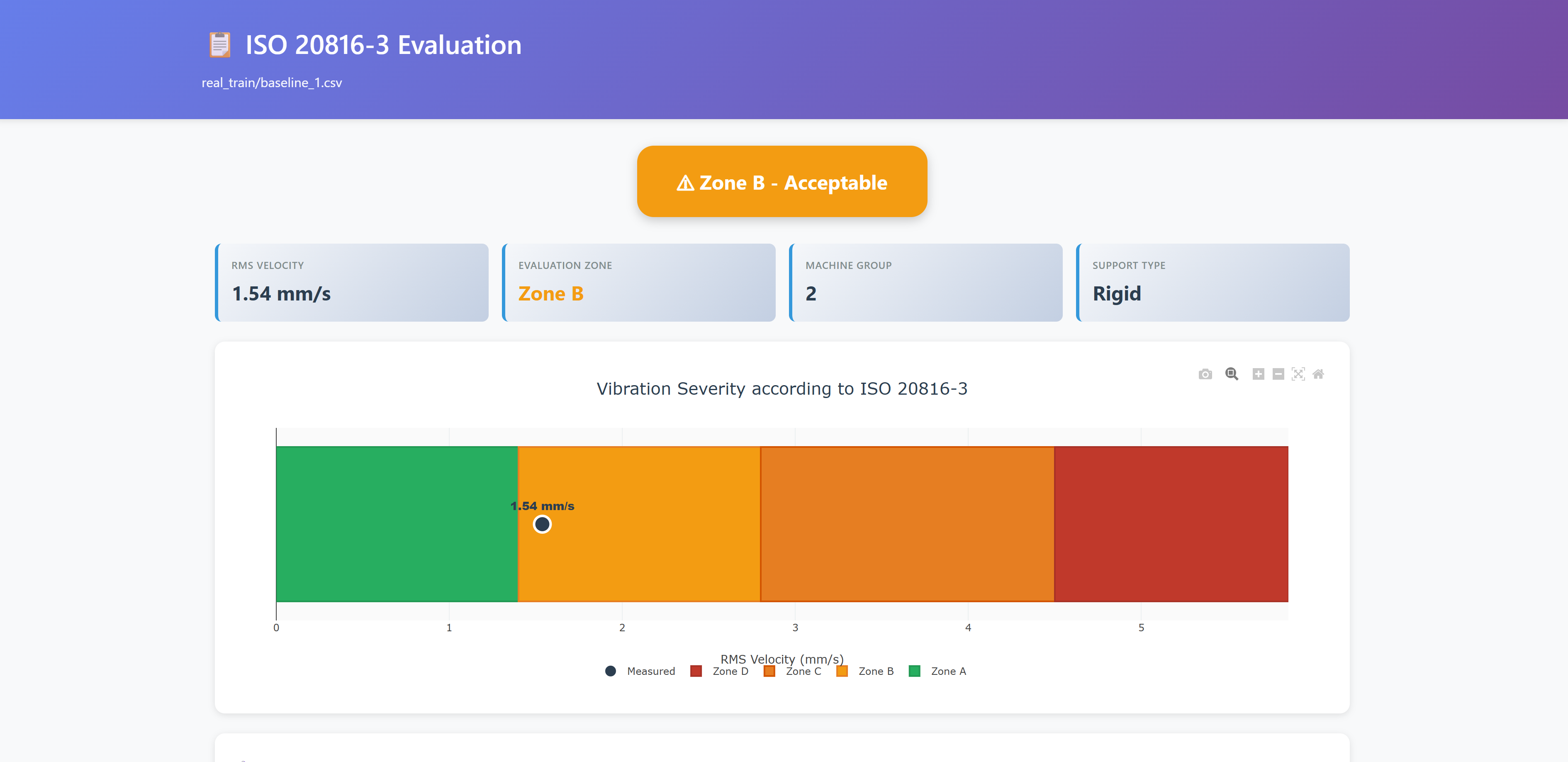
| Report Type | What it shows |
|---|---|
| Frequency spectrum | Peak detection, harmonic markers |
| Envelope analysis | Bearing fault frequency matching |
| Severity assessment | Vibration health zones (ISO 20816-3) |
| Word document | Full diagnostic narrative with embedded charts |
| PCA visualization | Multi-signal anomaly clustering |
| Feature comparison | Side-by-side signal feature analysis |
Sample Data Included
The project ships with 20 real bearing vibration signals from production machinery tests — ready to use out of the box.
- Training set: 2 healthy baselines + 12 fault signals (inner race, outer race)
- Test set: 1 healthy baseline + 5 fault signals
Try: "Load real_train/OuterRaceFault_1.csv and diagnose the bearing fault."
Full dataset documentation: data/README.md
Architecture
          YOU (natural language)
               │
               v
     LLM (Claude, GPT, Ollama...)
     understands intent, selects tools
               │
               v  ── Model Context Protocol ──
    ┌──────────────────────────────┐
    │    Predictive Maintenance    │
    │         MCP Server           │
    │                              │
    │  Signal Analysis    Reports  │
    │  Fault Detection    ML       │
    │  Severity Rating    RAG Docs │
    └──────────────────────────────┘
               │
               v
       YOUR DATA (stays local)
    signals · manuals · models
The codebase follows a modular architecture organized around the ISO 13374 Six-Block Diagnostic standard — signal acquisition, processing, diagnostics, prognostics, and decision support as separate sub-packages.
Detailed module structuresrc/predictive_maintenance_mcp/
├── mcp_tools/ # MCP endpoint registration (48 endpoints)
│ ├── acquisition_tools.py # Signal loading & management
│ ├── analysis_tools.py # Spectral & statistical analysis
│ ├── diagnostics_tools.py # Fault detection, ML, document search
│ ├── report_tools.py # HTML/DOCX report generation
│ ├── prompts.py # Guided diagnostic workflows
│ └── _utils.py # Shared utilities
├── signal_acquisition/ # Multi-format loaders (CSV, MAT, WAV, NPY, Parquet)
├── signal_processing/ # Spectral analysis & feature extraction
├── diagnostics/ # Bearing/gear analysis, ISO standards
├── decision_support/ # Evidence-based diagnosis pipeline
├── prognostics/ # Trend analysis & RUL estimation
├── rag.py # Document indexing & search (FAISS/TF-IDF)
├── models.py # Pydantic data models
├── server.py # FastMCP server entry point
└── config.py # Configuration management
Standards implemented: ISO 13374 (diagnostic architecture), ISO 20816-3 (vibration severity classification), MIMOSA OSA-CBM (condition-based maintenance framework).
Key design choices:
- Privacy-first — raw vibration data never leaves your machine; only computed results flow to the LLM
- LLM-agnostic — works with Claude, ChatGPT, Microsoft Copilot Studio, or any MCP-compatible client. Use Ollama for fully air-gapped deployments
- Modular — use only the tools you need, extend with your own
Documentation
| Guide | For |
|---|---|
| Quickstart for Engineers | Get results fast, no coding required |
| Quickstart for Developers | Understand MCP, extend the server |
| Plugin README | Claude Code plugin installation and usage |
| HTTPS Deployment | Docker + HTTPS for enterprise environments |
| Ollama Guide | Use with local LLMs (fully air-gapped) |
| Architecture | ISO 13374 block mapping and module design |
| Examples | Complete diagnostic workflows |
| Installation | Detailed setup and troubleshooting |
| Contributing | How to contribute (all skill levels welcome) |
| Changelog | Version history |
Testing
86% test coverage across Windows, macOS, and Linux (Python 3.11 & 3.12).
pytest                                  # run all tests
pytest --cov=src --cov-report=html      # with coverage report
20+ test files covering signal analysis, fault detection, severity assessment, ML models, report generation, RAG search, and real bearing fault data validation.
Roadmap
- 48 MCP endpoints with modular architecture
- Claude Code plugin (7 skills, 2 agents, 3 commands)
- 86% test coverage, CI/CD on 3 platforms
- Docker + SSE/HTTP transport for enterprise deployment
- Semantic document search (FAISS + TF-IDF)
- Customizable severity thresholds
- Multi-signal trending and historical comparison
- Remaining useful life (RUL) estimation models
- Real-time streaming (MQTT/Kafka)
- Fleet dashboard for multi-asset monitoring
- CMMS integration (SAP, Maximo, Infor)
Ideas? Open a discussion or create an issue.
Related
claude-stwinbox-diagnostics — Extends this project by connecting a physical edge sensor (STEVAL-STWINBX1) to Claude via MCP, with Claude Skills for guided condition monitoring. Same analysis engine, real hardware, operator-friendly reports.
Contributing
Contributions welcome from everyone — not just programmers. Domain experts, technical writers, and testers are equally valued. See CONTRIBUTING.md for paths tailored to your background.
Quick start: browse Issues for good first issue or help wanted labels.
Citation
@software{dimaggio_predictive_maintenance_mcp_2025,
  title   = {Predictive Maintenance MCP Server},
  author  = {Di Maggio, Luigi Gianpio},
  year    = {2025},
  version = {0.7.1},
  url     = {https://github.com/LGDiMaggio/predictive-maintenance-mcp},
  doi     = {10.5281/zenodo.17611542}
}
License
MIT — see LICENSE. Sample data is CC BY-NC-SA 4.0 (non-commercial); for commercial use, replace with your own machinery data.
Acknowledgments
FastMCP framework · Model Context Protocol by Anthropic · Sample data from MathWorks · Core development assisted by Claude
An open-source AI assistant for predictive maintenance — built to support reliability engineers and the developer community.
Reviews (0)
Sign in to leave a review.
Leave a reviewNo results found