spec-driven-workflow
Health Gecti
- License — License: Apache-2.0
- Description — Repository has a description
- Active repo — Last push 0 days ago
- Community trust — 75 GitHub stars
Code Gecti
- Code scan — Scanned 12 files during light audit, no dangerous patterns found
Permissions Gecti
- Permissions — No dangerous permissions requested
This tool provides a set of structured Markdown prompts designed to guide AI coding assistants through a predictable, spec-driven software development workflow. It acts as a playbook to help developers define, plan, execute, and validate code.
Security Assessment
The overall risk is Low. The tool consists entirely of Markdown prompt files and does not contain executable code. It does not access sensitive data, make network requests, execute shell commands, or contain hardcoded secrets. A light code audit of 12 files confirmed no dangerous patterns.
Quality Assessment
The project is in excellent health. It is actively maintained (last pushed 0 days ago) and has accumulated 75 GitHub stars, indicating a good level of community trust. It is properly licensed under the permissive Apache-2.0 license and comes with clear descriptions and documentation.
Verdict
Safe to use.
Lightweight markdown-based workflow for collaborating with AI coding assistants using spec-driven development methodology
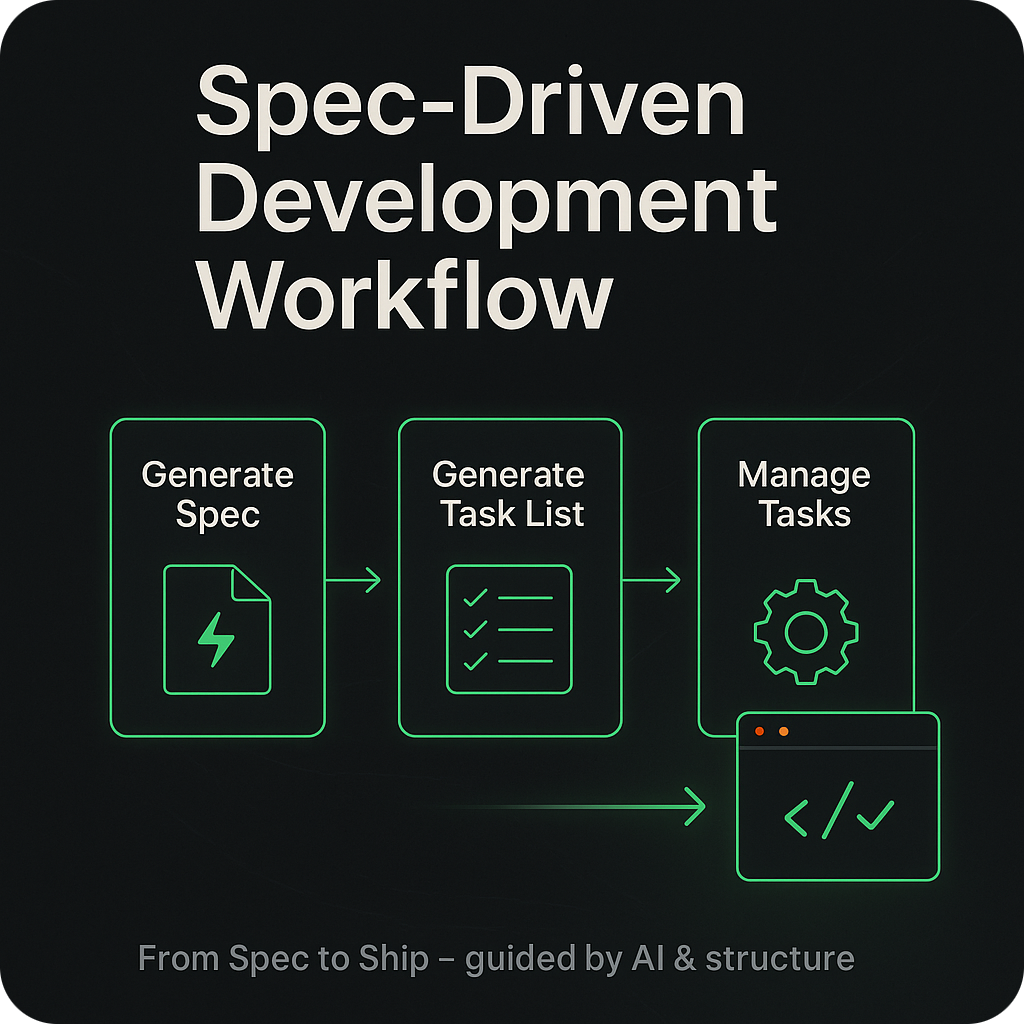
🧭 Spec-Driven Development Workflow
Build predictable software with a repeatable AI-guided workflow.
Spec-driven development prompts for collaborating with AI agents to deliver reliable outcomes.



Overview
This repository provides structured prompts (Markdown files) that guide AI assistants through a complete software development workflow:
- Define intent: generate a reviewed spec with clear demo criteria
- Plan: break work into demoable tasks and subtasks, then run a planning audit gate
- Execute: implement with checkpoints and proof artifacts
- Validate: verify implementation against the spec with evidence
Think of these prompts as reusable playbooks that keep AI agents focused and consistent across long conversations.
Table of Contents
- TLDR / Quickstart
- Details for the 4-step workflow
- Artifacts and directory layout
- Documentation
- Context verification markers
- Security best practices
- Contributing
- References
- License
TLDR / Quickstart
Installation options
Option A: Install as Slash Commands (Recommended)
Install these prompts as native /slash-commands in your AI assistant (Cursor, Windsurf, Claude Code, etc.) using the slash-command-manager utility:
Prerequisite: uvx comes from uv. Install uv first if you don’t already have it:
- (Mac):
brew install uv - (Windows):
winget install astral-sh.uv
Install SDD w/ Bash (Mac)
uvx --from git+https://github.com/liatrio-labs/slash-command-manager \
  slash-man generate \
  --github-repo liatrio-labs/spec-driven-workflow \
  --github-branch main \
  --github-path prompts/
Install SDD w/ PowerShell (Windows)
uvx --from git+https://github.com/liatrio-labs/slash-command-manager `
  slash-man generate `
  --github-repo liatrio-labs/spec-driven-workflow `
  --github-branch main `
  --github-path prompts/
What this command does:
uvxruns a Python tool without installing it globally (likenpxfor Python)- Fetches the
slash-command-managertool from GitHub - Auto-detects your installed AI assistants from the list of supported tools
- Downloads the prompt files for each supported tool from the
prompts/directory - Installs them as slash commands for each supported tool
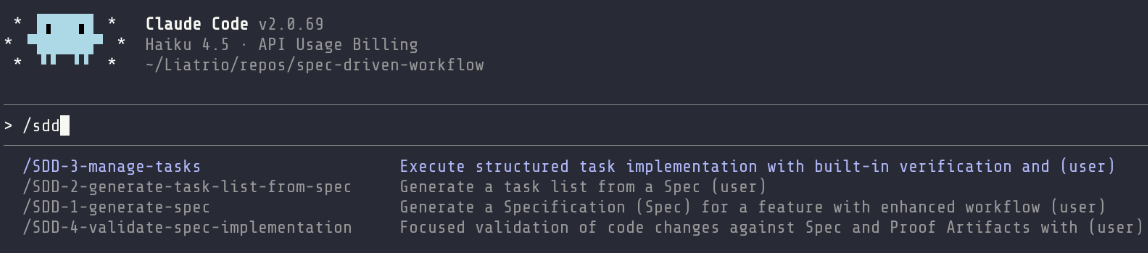
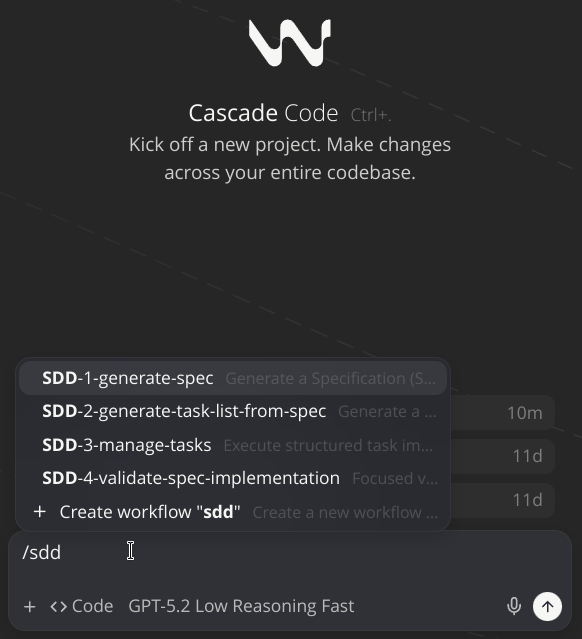
Result: you can now type /SDD-1-generate-spec in your AI assistant to start the workflow.
Where to use the slash commands: in AI chat UIs (e.g., Windsurf, Claude Code) type / in the chat input. Some AI assistants require being in "Agent" or "Code" mode for slash commands to appear.
Option B: Manual Copy-Paste (No Installation)
Copy the contents of a prompt file directly from prompts/ and paste it into your AI chat. The AI will follow the structured instructions in the prompt.
Quick "try it" flow
- Run
/SDD-1-generate-specand describe the feature you want. If the AI determines material clarification is needed, answer the generated questions file before continuing. - Next, use
/SDD-2-generate-task-list-from-specpointing it at the generated spec; complete task generation, baseline planning commit, planning audit, and user-approved remediation if needed. - Then execute
/SDD-3-manage-tasksto implement tasks one at a time (creating proof artifacts before commits) after the SDD-2 audit required gates pass. - Finally, apply
/SDD-4-validate-spec-implementationto verify the implementation against the spec.
Details for the 4-step workflow
Each step uses a different prompt file and produces specific artifacts in docs/specs/.
Generate a spec (
prompts/SDD-1-generate-spec.md)- What it does: checks scope, researches current best practices for relevant technologies, determines whether clarification is needed, optionally creates a questions file for material ambiguities with recommended answers and justification notes, and writes a junior-friendly spec with demo criteria
- Output:
docs/specs/[NN]-spec-[feature-name]/[NN]-spec-[feature-name].mdand, when needed,docs/specs/[NN]-spec-[feature-name]/[NN]-questions-[N]-[feature-name].md - Why: aligns humans + AI on what to build before any code changes
Generate a task list (
prompts/SDD-2-generate-task-list-from-spec.md)- What it does: converts the spec into parent tasks (demoable units) + detailed subtasks, creates a baseline planning commit, runs a planning audit gate, and requires user-approved remediation before implementation handoff
- Output:
docs/specs/[NN]-spec-[feature-name]/[NN]-tasks-[feature-name].mdanddocs/specs/[NN]-spec-[feature-name]/[NN]-audit-[feature-name].md - Why: catches planning defects early and improves downstream validation readiness
Manage tasks (implementation loop) (
prompts/SDD-3-manage-tasks.md)- What it does: guides execution with checkpoints, verification checklists, and proof artifacts created before each commit
- Output:
docs/specs/[NN]-spec-[feature-name]/[NN]-proofs/[NN]-task-[TT]-proofs.md - Why: keeps work single-threaded, demoable, and evidence-driven
Validate implementation (
prompts/SDD-4-validate-spec-implementation.md)- What it does: validates implementation vs spec using proof artifacts, applies validation gates, produces a coverage matrix
- Output: validation report (markdown) showing verified/missing items
- Why: confirms completeness before shipping
SHIP IT 🚢💨
Highlights
- Prompt-first workflow: Use curated prompts to go from idea → spec → task list → implementation-ready backlog.
- Planning quality gate: SDD-2 includes a mandatory audit with human-approved remediation before implementation starts.
- Predictable delivery: Every step emphasizes demoable slices, proof artifacts, and collaboration with junior developers in mind.
- No dependencies required: The prompts are plain Markdown files that work with any AI assistant.
- Context verification: Built-in emoji markers (SDD1️⃣-SDD4️⃣) detect when AI responses follow critical instructions, helping identify context rot issues early.
Why Spec-Driven Development?
Spec-Driven Development (SDD) keeps AI collaborators and human developers aligned around a shared source of truth. This repository provides a lightweight, prompt-centric workflow that turns an idea into a reviewed specification, an actionable plan, and a disciplined execution loop. By centering on markdown artifacts instead of tooling, the workflow travels with you—across projects, models, and collaboration environments.
Guiding Principles
- Clarify intent before delivery: The spec prompt requires a clarification sufficiency check so material ambiguities are resolved before planning, while minor uncertainty can remain explicit in the spec.
- Ground plans in current guidance: The spec prompt combines repository pattern discovery with current external best-practice research for material technologies, then asks follow-up questions when those signals still leave meaningful choices open.
- Ship demoable slices: Every stage pushes toward thin, end-to-end increments with clear demo criteria and proof artifacts.
- Make work transparent: Tasks live in versioned markdown files so stakeholders can review, comment, and adjust scope anytime.
- Progress one slice at a time: The management prompt enforces single-threaded execution to reduce churn and unfinished work-in-progress.
- Stay automation ready: While SDD works with plain Markdown, the prompts are structured for MCP, IDE agents, or other AI integrations.
Artifacts and directory layout
Each prompt writes Markdown outputs into docs/specs/[NN]-spec-[feature-name]/ (where [NN] is a zero-padded 2-digit number: 01, 02, 03, etc.), giving you a lightweight backlog that is easy to review, share, and implement.
- Specs:
docs/specs/[NN]-spec-[feature-name]/[NN]-spec-[feature-name].md - Questions files (when needed):
docs/specs/[NN]-spec-[feature-name]/[NN]-questions-[N]-[feature-name].md - Task lists:
docs/specs/[NN]-spec-[feature-name]/[NN]-tasks-[feature-name].md - Audit reports:
docs/specs/[NN]-spec-[feature-name]/[NN]-audit-[feature-name].md - Proof artifacts:
docs/specs/[NN]-spec-[feature-name]/[NN]-proofs/[NN]-task-[TT]-proofs.md - Validation reports:
docs/specs/[NN]-spec-[feature-name]/[NN]-validation-[feature-name].md
Example directory structure:
[NN]-questions-[N]-[feature-name].md is optional and appears only when the spec prompt determines a clarification round is required.
docs/specs
└── 01-spec-feature-name
    ├── 01-proofs
    │   ├── 01-task-01-proofs.md
    │   ├── 01-task-02-proofs.md
    │   ├── 01-task-03-proofs.md
    │   └── 01-task-04-proofs.md
    ├── 01-questions-1-feature-name.md
    ├── 01-audit-feature-name.md
    ├── 01-spec-feature-name.md
    ├── 01-tasks-feature-name.md
    └── 01-validation-feature-name.md
Documentation
For comprehensive documentation, examples, and detailed guides, visit the SDD Playbook:
- SDD Playbook — Complete overview and workflow guide
- Comparison — How SDD compares to other structured development tools
- Developer Experience — Real-world usage examples and patterns
- Common Questions — FAQ and troubleshooting
- Video Overview — Visual walkthrough of the workflow
- Reference Materials — Additional resources and examples
To preview the playbook locally with hot reload, run:
uvx livereload --port 8012 docs/
Then open http://localhost:8012.
Getting help
- Start here: Common Questions
- Ask/Report: open a GitHub Issue in this repo with details about your environment + prompt/tooling
Context verification markers
Each prompt includes a context verification marker (SDD1️⃣ for spec generation, SDD2️⃣ for task breakdown, SDD3️⃣ for task management, SDD4️⃣ for validation) that appears at the start of AI responses. These markers help detect context rot—a phenomenon where AI performance degrades as input context length increases, even when tasks remain simple.
Why this matters: Context rot doesn't announce itself with errors. It creeps in silently, causing models to lose track of critical instructions. When you see the marker at the start of each response, it's an indicator that the AI is probably following the prompt's instructions. If the marker disappears, it's an immediate signal that context instructions may have been lost.
What to expect: You'll see responses like SDD1️⃣ I'll help you generate a specification... or SDD3️⃣ Let me start implementing task 1.0.... This is normal and indicates the verification system is working. For more details, see the research documentation.
Security Best Practices
Protecting Sensitive Data in Proof Artifacts
Proof artifacts are committed to your repository and may be publicly visible. Never commit real credentials or sensitive data. Follow these guidelines:
- Replace credentials with placeholders: Use
[YOUR_API_KEY_HERE],[REDACTED], orexample-key-123instead of real API keys, tokens, or passwords - Use example values: When demonstrating configuration, use dummy or example data instead of production values
- Sanitize command output: Review CLI output and logs for accidentally captured credentials before committing
- Consider pre-commit hooks: Tools like gitleaks, truffleHog, or talisman can automatically scan for secrets before commits
The SDD workflow prompts include built-in reminders about security, but ultimate responsibility lies with the developer to review artifacts before committing or pushing to remotes.
Contributing
See CONTRIBUTING.md. Please review CODE_OF_CONDUCT.md.
References
| Reference | Description | Link |
|---|---|---|
| AI Dev Tasks | Foundational example of an SDD workflow expressed entirely in Markdown. | snarktank/ai-dev-tasks |
| Slash Command Manager | Utility for installing prompts as slash commands in AI assistants. | liatrio-labs/slash-command-manager |
| MCP | Standard protocol for AI agent interoperability. | modelcontextprotocol.io |
License
This project is licensed under the Apache License, Version 2.0. See the LICENSE file for details.
Yorumlar (0)
Yorum birakmak icin giris yap.
Yorum birakSonuc bulunamadi