speckit-superpowers-bridge
Health Gecti
- License — License: MIT
- Description — Repository has a description
- Active repo — Last push 0 days ago
- Community trust — 14 GitHub stars
Code Gecti
- Code scan — Scanned 12 files during light audit, no dangerous patterns found
Permissions Gecti
- Permissions — No dangerous permissions requested
Bu listing icin henuz AI raporu yok.
Spec Kit writes WHAT. Superpowers enforces HOW. Thin handoff bridge for Codex and Claude Code.
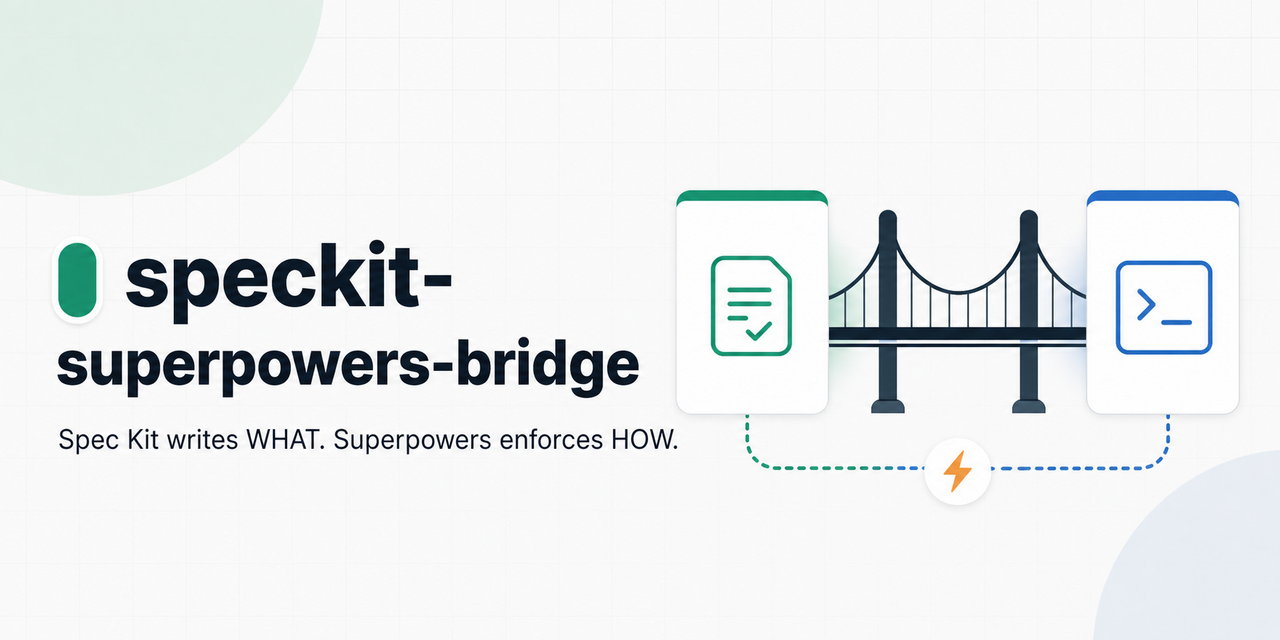
Spec Kit writes WHAT. Superpowers enforces HOW. This bridge only carries the handoff.





speckit-superpowers-bridge
中文版:README.zh-CN.md
speckit-superpowers-bridge is the handoff layer between Spec Kit design artifacts and Superpowers implementation discipline. Spec Kit stays the source of truth for design (constitution → spec → plan → tasks). Superpowers executes implementation with TDD, verification, and review, invoked explicitly at named lifecycle phases. Codex and Claude Code share the same repo-local protocol.
No daemon. No service. No database. No second workflow engine. No custom discipline beyond native Superpowers.
The design intent is documented in the Spec Kit vs Superpowers comparison article — this extension is the minimal wiring that lets the two tools cooperate.
At a glance
| If you want... | The bridge gives you... |
|---|---|
| Spec Kit artifacts to remain canonical | Spec Kit keeps owning spec.md, plan.md, and tasks.md. |
| Superpowers discipline without replanning | tasks.md is handed to native Superpowers execution, verification, review, and branch-finishing skills. |
| Codex and Claude Code to cooperate | A shared .specify/superpowers-handoff.json contract with identical bridge skills for both agents. |
| Windows and Linux coverage | One ZIP ships bash and Windows PowerShell flavors, with release gates for both. |
| Marketplace-friendly confidence | bridge-status --readiness, package validation, deterministic release ZIPs, and published SHA evidence. |
| Minimal operational footprint | 3 commands, 5 hooks, 6 small state scripts per shell flavor, and no runtime service. |
Install the current stable release:
specify extension add speckit-superpowers-bridge \
  --from https://github.com/lihan3238/speckit-superpowers-bridge/releases/latest/download/speckit-superpowers-bridge.zip
Why speckit-superpowers-bridge
Spec Kit is excellent at producing durable design artifacts (constitution, spec, plan, tasks, checklists, analysis), but its bundled speckit.implement is a one-shot LLM run with no TDD, no subagent fan-out, no structured review.
Superpowers is excellent at execution discipline (TDD, systematic debugging, subagent-driven development, verification, code review, finishing a development branch), but it natively expects to drive design through its own brainstorming and writing-plans skills, not from a Spec Kit tasks.md.
The bridge is the thinnest possible glue that lets the two cooperate without either side colonizing the other's role: a single superpowers-handoff.json state file, five hardcoded guard rules, six small scripts per shell flavor, and one orchestrator skill that invokes native Superpowers in order against the Spec Kit tasks.md. No runtime matrix, no audit loop, no implementation validation pass, no command-parity subsystem, no custom DSL — just the smallest contract that makes the cycle work.
Quick Start
specify init my-project --integration claude   # or --integration codex
cd my-project
specify extension add speckit-superpowers-bridge \
  --from https://github.com/lihan3238/speckit-superpowers-bridge/releases/latest/download/speckit-superpowers-bridge.zip
What this does, in 7 steps:
specify initbootstraps a Spec Kit project with your chosen agent integration.specify extension add ... /releases/latest/download/...installs the bridge from the stable-alias URL (always resolves to the latest released bridge — never goes stale on subsequent releases).- Spec Kit registers the bridge's 3 commands and 5 hooks in
.specify/extensions.yml. - Bridge writes its boundary guard at
.specify/extensions/speckit-superpowers-bridge/scripts/. - Drive a feature:
/speckit-specify→/speckit-clarify→/speckit-plan→/speckit-tasks. - The
after_taskshook fires automatically — bridge writes.specify/superpowers-handoff.jsonwith statusexecuting. /speckit-superpowers-bridge(Claude Code) or$speckit-superpowers-bridge(Codex) drives nativesuperpowers:executing-plansagainsttasks.md, then verification + code review + branch finishing. Handoff transitions tocomplete.
[!TIP]
Have only a vague idea? Runsuperpowers:brainstormingbefore/speckit-specify. The bridge guard allows it in the pre-spec window — the resulting design doc atdocs/superpowers/specs/<date>-<topic>-design.mdcan be referenced in your/speckit-specifydescription so the LLM picks it up as context. See feature 010-prespec-brainstorming for the documented lifecycle decision.
1.0.x Readiness and Support
v1.0.0 is a stable protocol release: no new workflow engine, no daemon, no service, no database, and no replacement for native Spec Kit or Superpowers behavior. The release adds stricter package/readiness checks and evidence for the supported platforms and agents.
v1.0.1 is a documentation and development-checkout cleanup patch on the same protocol surface.
v1.0.2 is a discoverability and launch-asset patch: README hero image, social cards, marketplace wording, and small contributor-doc fixes; runtime bridge behavior is unchanged.
| Target | Status | Evidence |
|---|---|---|
| Linux bash | Verified | Full bash smoke suite plus release-artifact sandbox cycle. |
| Windows PowerShell 5.1+ | Verified | Native PowerShell smoke plus release-artifact sandbox cycle. Set PYTHONUTF8=1 if an older Windows Spec Kit CLI renders Rich symbols through a GBK console. |
| Codex | Verified | Bounded sandbox run with codex-cli 0.137.0. |
| Claude Code | Verified | Bounded sandbox run with Claude Code 2.1.162. |
Run the lightweight readiness check after install:
bash .specify/extensions/speckit-superpowers-bridge/scripts/bash/bridge-status.sh --readiness --actor codex
bash .specify/extensions/speckit-superpowers-bridge/scripts/bash/bridge-status.sh --readiness --json --actor codex
.\.specify\extensions\speckit-superpowers-bridge\scripts\powershell\bridge-status.ps1 -Readiness -Actor claude
.\.specify\extensions\speckit-superpowers-bridge\scripts\powershell\bridge-status.ps1 -Readiness -Json -Actor claude
The readiness report is read-only. It checks script flavor, required tools, command namespace, package files, current bridge state, verified agent metadata, and the next recommended action.
Demo: user flow

Positioning
How the bridge differs from doing nothing, doing only one side, or using a peer hybrid:
| Owns design | Owns implementation | Cross-agent | Bridge-style overhead | |
|---|---|---|---|---|
Just speckit.implement |
Spec Kit | Spec Kit (one-shot LLM run) | partial (agent-aware via Spec Kit) | none |
| Just Superpowers (no Spec Kit) | Superpowers (brainstorming + writing-plans) |
Superpowers (TDD + subagents) | yes (Claude Code + Codex via OS-level skills) | none |
| Superspec | Spec-first workflow | Plugin-managed implementation flow | varies by agent | higher — useful doctor/status ideas, but 1.0.0 install failures showed catalog id / namespace drift risk |
| SuperB | Superpowers-centered planning | Superpowers-centered implementation | yes | higher — richer orchestration, but more lifecycle ownership than this bridge wants |
| Comet (rpamis/comet, OpenSpec + Superpowers) | OpenSpec change/spec | Superpowers via Comet's state machine | yes (multi-platform npm installer) | medium — Comet has its own .yaml + guard scripts |
| speckit-superpowers-bridge (this) | Spec Kit (vendor-owned) | Superpowers (vendor-owned) | yes (Codex + Claude Code, identical contract) | extremely thin — 1 guard script, 1 handoff JSON, 0 new state machinery |
The bridge's brand is compatible with upstream growth + extremely lightweight. Every release is graded against the constitution's Principle VI Native-First gate: does upstream already do this? Is upstream the right place to fix this? If either answer is "yes", the bridge does NOT add the feature.
Workflow diagram
                  ┌───────────────────── Spec Kit phase ─────────────────────┐
  user ─► /speckit-constitution ─► /speckit-specify ─► /speckit-clarify ─►
          /speckit-plan ─► /speckit-tasks
                                                       │
                                                       │ after_tasks hook
                                                       ▼
                          ┌──────── speckit-superpowers-bridge ─────────┐
                          │  handoff (writes superpowers-handoff.json)  │
                          │  guard (5 hardcoded boundary rules)         │
                          │  execute (orchestrates native skills)       │
                          └──────────────────┬──────────────────────────┘
                                             │
                  ┌────────── Superpowers phase (explicit invocations) ───────┐
                  ▼                                                            ▼
       superpowers:executing-plans                   superpowers:verification-before-completion
       superpowers:test-driven-development           superpowers:requesting-code-review
       superpowers:systematic-debugging              superpowers:finishing-a-development-branch
                                             │
                                             │ handoff transitions logged
                                             ▼
                                   .specify/bridge-events.jsonl
Spec Kit must be installed first. The extension is listed in the official Spec Kit community catalog for discovery and review.
Official listing: docs/community/extensions.md (accepted via issue #2581 and PR #2586).
The community catalog is discovery-only by default, so the normal install command uses the stable latest-release ZIP.
Pure Codex
specify init my-project --integration codex
cd my-project
specify extension add speckit-superpowers-bridge --from https://github.com/lihan3238/speckit-superpowers-bridge/releases/latest/download/speckit-superpowers-bridge.zip
No Claude Code dependency. The bridge runs entirely through Codex's $speckit-* invocation surface.
Pure Claude Code
specify init my-project --integration claude
cd my-project
specify extension add speckit-superpowers-bridge --from https://github.com/lihan3238/speckit-superpowers-bridge/releases/latest/download/speckit-superpowers-bridge.zip
No Codex dependency. The bridge runs through Claude Code's /speckit-* slash commands.
Both (cross-agent handoff)
specify init my-project --integration claude         # or --integration codex
cd my-project
specify integration install codex                     # or 'claude' if you started with codex
specify extension add speckit-superpowers-bridge --from https://github.com/lihan3238/speckit-superpowers-bridge/releases/latest/download/speckit-superpowers-bridge.zip
Both .agents/skills/ (Codex) and .claude/skills/ (Claude Code) receive the bridge skill peer files. You can design in one agent and implement in another by simply switching tabs.
Local development usage (for working on this bridge repo itself):
This source checkout already contains the bridge extension at.specify/extensions/speckit-superpowers-bridge/, and.specify/extensions.yml registers that local source as the installed
extension. Use the normal $speckit-* / /speckit-* commands from this repo;
do not install the published ZIP into the same checkout unless you
intentionally want to replace the local extension tree with release contents.
If a fresh specify init --here ... --force regenerated local install state and
the bridge needs to be re-registered, install from a temporary copy outside the
target extension directory:
tmp="$(mktemp -d)"
cp -a ./.specify/extensions/speckit-superpowers-bridge "$tmp"/
specify extension add --dev "$tmp/speckit-superpowers-bridge"
Do not pass ./.specify/extensions/speckit-superpowers-bridge directly as the--dev source from this source checkout. Spec Kit installs to that same target
path, so source and destination would be identical.
PowerShell equivalent:
$tmp = New-Item -ItemType Directory -Path ([System.IO.Path]::Combine([System.IO.Path]::GetTempPath(), [System.Guid]::NewGuid().ToString()))
Copy-Item .\.specify\extensions\speckit-superpowers-bridge $tmp.FullName -Recurse
specify extension add --dev (Join-Path $tmp.FullName "speckit-superpowers-bridge")
Use the published ZIP only in a separate consumer project or in the sibling
release-verification sandbox ../test_specify_superpower.
Version-pinned install (for reproducible installs of a specific release):
specify extension add speckit-superpowers-bridge --from https://github.com/lihan3238/speckit-superpowers-bridge/releases/download/v1.0.2/speckit-superpowers-bridge-v1.0.2.zip
Windows users need PowerShell 5.1+ (preinstalled on supported Windows releases). Linux and macOS users run the same extension ZIP through the bash flavor and need:
bash >= 4.0jq >= 1.6
Install examples:
sudo apt install bash jq      # Ubuntu / Debian
brew install bash jq          # macOS
sudo dnf install bash jq      # Fedora
Contributors who run the repository smoke tests on any OS use the WSL bash suite (bash tests/run-all.sh, post-009 cleanup). End users do not need PowerShell Core (pwsh) for normal bridge execution.
1. /speckit-constitution            (one time per project)
2. /speckit-specify "add OAuth2 sign-in"
3. /speckit-clarify                 (the bridge asks 2–5 targeted Qs)
4. /speckit-plan                    (writes plan.md + research.md + data-model.md + contracts/)
5. /speckit-tasks                   (writes tasks.md)
                       │
                       │ after_tasks hook fires → handoff JSON written; status=executing
                       ▼
6. /speckit-superpowers-bridge      (Claude Code)  or  $speckit-superpowers-bridge  (Codex)
       │
       │ bridge SKILL.md loads; native Superpowers skills run in order:
       │   • superpowers:executing-plans drives the per-task loop
       │   • superpowers:test-driven-development per code-modifying task
       │   • superpowers:verification-before-completion at phase boundary
       │   • superpowers:requesting-code-review then :finishing-a-development-branch at end
       ▼
7. handoff → complete; next /speckit-specify auto-archives the previous one

Not every change needs the full Spec Kit → bridge → Superpowers workflow. You decide the route:
| Change type | Recommended route |
|---|---|
| Typo fix, single-line bug, tiny refactor | Invoke Superpowers directly. Skip /speckit-specify. |
| New feature, multi-file refactor, anything requiring design decisions | Full flow: /speckit-specify → /speckit-clarify → /speckit-plan → /speckit-tasks → /speckit-superpowers-bridge. |
| Investigation or spike with unknown scope | Start with Superpowers brainstorming; promote to the full flow if a spec emerges. See feature 010-prespec-brainstorming. |
The bridge no longer recommends this routing automatically (the previous recommend-route command was removed in 0.3.0). You make the call. The guard still enforces boundary rules either way — it does not block direct Superpowers use when there is no active Spec Kit handoff.
| Command (Claude Code) | Command (Codex) | Purpose |
|---|---|---|
/speckit-superpowers-bridge |
$speckit-superpowers-bridge |
Run Spec Kit tasks.md through Superpowers via the bridge protocol |
/speckit-speckit-superpowers-bridge-handoff |
$speckit-speckit-superpowers-bridge-handoff |
Create or update the Superpowers handoff state |
/speckit-speckit-superpowers-bridge-guard |
$speckit-speckit-superpowers-bridge-guard |
Check whether a requested command is allowed under the current handoff state |
bash .specify/extensions/speckit-superpowers-bridge/scripts/bash/bridge-status.sh (or .ps1 on Windows) |
same | (v0.7.0+) Print current bridge state + Drift: + Next: recommendation in under a second. Read-only. --json for machine output. In v1.0.0, add --readiness / -Readiness for install health. |
Fresh marketplace installs generate $speckit-superpowers-bridge / /speckit-superpowers-bridge from the execute command alias. The canonical fallback remains $speckit-speckit-superpowers-bridge-execute / /speckit-speckit-superpowers-bridge-execute. Handoff and guard intentionally keep their canonical long names because they are advanced/internal commands.
If you see .agents/skills/speckit-speckit-superpowers-bridge-* or .claude/skills/speckit-speckit-superpowers-bridge-*, that is normal: Spec Kit generated those skills from extension commands. The source repository also contains short local bridge skill mirrors under .agents/skills/speckit-superpowers-bridge/ and .claude/skills/speckit-superpowers-bridge/; do not expect those development mirrors to be copied directly from the extension ZIP.
The 6 meta-commands that existed in v0.2.x (audit, validate, parity, recommend-route, submission-checklist, cleanup-audit) were removed in 0.3.0. They duplicated discipline that native Superpowers already provides, or codified custom features beyond the thin-bridge scope. See CHANGELOG.md.
The bridge reads two layers of configuration in priority order: explicit script arguments > environment variables.
Actor resolution: when a bridge script needs to know which agent invoked it (-Actor), it resolves in this order:
- Explicit
-Actor <codex|claude|unknown>argument. SPECKIT_BRIDGE_ACTORenvironment variable.- Literal
"unknown".
Per-agent bridge SKILL.md files hardcode -Actor / --actor to their own agent — so in normal dialog use, you never need to set the env var. The chain matters for CI or manual script invocation.
See AGENTS.md for the master cross-agent protocol; CLAUDE.md for Claude-specific supplements.
| Symptom | Likely cause | Fix |
|---|---|---|
handoff stuck in executing |
Previous bridge run was interrupted before transitioning to complete or blocked |
Inspect superpowers-handoff.json; if work is genuinely done, run update-handoff.ps1 -Status complete or update-handoff.sh --status complete; if abandoned, set blocked with a reason |
missing per-agent peer skill |
One agent's .X/skills/<id> exists but the other agent's does not |
Mirror the SKILL.md from the agent that has it; or remove the orphan |
only long speckit-speckit-superpowers-bridge-* skills appear |
Installed v0.4.0-rc.1 or an older package before the execute alias existed |
Upgrade with the latest-release ZIP command above; the short execute alias is $speckit-superpowers-bridge / /speckit-superpowers-bridge |
specify extension info throws UnicodeEncodeError on Windows |
Legacy GBK console cannot render Rich's bullet character | Run chcp 65001 or set PowerShell output to UTF-8. This is a Spec Kit CLI display issue, not a bridge install failure |
| guard denies an unexpected action | One of the 5 hardcoded rules in guard-command.ps1 is firing |
Read the deny reason printed by the guard; the rule set is small and inspectable |
| handoff JSON from an older install has v3 fields | Pre-0.3.0 handoff with autonomous_mode / resume_context / archive_history |
No action needed. The 0.3.0+ bridge reads these tolerantly and silently drops them on the next write. |
Maintenance and versioning[!WARNING]
WSL users: do NOT setgit config --global http.proxy. Use the per-call env-var pattern fromAGENTS.md(https_proxy=http://10.77.0.11:10808 git push ...). A global proxy config bakes the address into git config and breaks on every machine where that proxy is unreachable. The bridge's release runbook and smoke suite assume the env-var-per-call pattern.
This release (v1.0.2) is verified against:
- Spec Kit
0.9.3on Linux bash; Windows sandbox also passed the bridge runtime floor with Spec Kit CLI0.8.10 - Superpowers
5.1.0 - Codex CLI
0.137.0 - Claude Code
2.1.162
Verified metadata is captured in .specify/extensions/speckit-superpowers-bridge/verified-versions.json — a project-owned additive schema refreshed once per bridge release. v1.0.2 records bridge, upstream tool, platform, and real-agent rows; missing or blocked rows are not advertised as verified.
When upstream tools ship a new release that breaks the bridge, we either patch the bridge scripts or pin the documented compatible versions in CHANGELOG.md.
Spec Kit 0.9.x moved coding-agent context updates into the bundled agent-context extension. The bridge runtime does not depend on that extension, so requires.speckit_version stays at >=0.8.10; this repository tracks agent-context only to keep its own Spec Kit project bootstrap current.
Architecture in 60 seconds[!NOTE]
From v0.6.0 onward, the marketplacedownload_urlis decoupled from the version. It permanently points athttps://github.com/lihan3238/speckit-superpowers-bridge/releases/latest/download/speckit-superpowers-bridge.zipand resolves via GitHub's/releases/latest/alias. Future bridge releases never editdownload_url; onlyversionis bumped inmarketplace/catalog-entry.json. This removes a recurring per-release edit class and a drift surface — one of the smallest possible Principle-VI wins.
Adapted with attribution from the Spec Kit vs Superpowers comparison article (truongpx396, dev.to).
- Spec Kit owns WHAT. Constitution, spec, clarify, plan, tasks, checklists, analysis. These are durable design artifacts under
.specify/andspecs/. - Superpowers owns HOW. TDD, debugging, executing-plans, requesting-code-review, verification-before-completion, finishing-a-development-branch. These are implementation discipline skills invoked at lifecycle phases.
- The bridge orchestrates native skills and does not provide custom discipline. It contributes only: generated extension command skills, six small scripts in PowerShell and bash flavors (
update-handoff,guard-command,auto-archive-handoff,bridge-state,bridge-status,common-actor-resolution), and 5 hardcoded boundary rules. No runtime matrix, no audit loop, no implementation validation pass, no command-parity subsystem.
Contributing and License
MIT — see LICENSE.
This extension was developed using AI coding assistants (Claude Code for design + planning; Codex for implementation passes; Claude Code for the v0.3.0 trim and the v0.6.0 polish) per the AI-disclosure requirement in Spec Kit CONTRIBUTING.md. Every artifact passes human review before commit. Smoke tests under tests/ (bash flavor as of 009) exercise the handoff schema, the 5 hardcoded guard rules, the bridge-state output, and cross-agent skill parity.
Issues and discussion: https://github.com/lihan3238/speckit-superpowers-bridge/issues
Yorumlar (0)
Yorum birakmak icin giris yap.
Yorum birakSonuc bulunamadi