second-brain
Health Uyari
- License — License: MIT
- Description — Repository has a description
- Active repo — Last push 0 days ago
- Low visibility — Only 5 GitHub stars
Code Gecti
- Code scan — Scanned 12 files during light audit, no dangerous patterns found
Permissions Gecti
- Permissions — No dangerous permissions requested
Bu listing icin henuz AI raporu yok.
Build a second brain every AI can share: your content in Oracle AI Database 26ai — semantic search with in-database embeddings, a self-compiling wiki, four kinds of agent memory, and an MCP server that plugs it into Claude, ChatGPT, and any MCP client. Runs on the free local container or Always Free cloud.
Second Brain
One private place for everything you've made and thought — your posts, videos, notes, and AI
chats — unified in a single Oracle database: searchable by meaning, synthesized into a living
wiki, reachable from any AI assistant, and yours alone.
Everything you make and learn scatters across apps that each remember a little and forget the rest.
This is the fix: a second brain — one home for your content and thinking that you can search
by meaning, that compiles itself into a synthesized knowledge layer, that keeps your private
data private, and that you can reach from Claude, ChatGPT, or your phone. On top of it a
research agent answers grounded in your own work and gets sharper the more you use it.
Your content, its embeddings, and the agent's memory all live in one engine — the LLM is pluggable
(this build uses Claude); the database does the heavy lifting.
This repo is meant to be followed step by step. Everything runs locally and headless —
no Docker Desktop, no cloud account required. (Lifting it to Oracle Cloud is an optional
later step.)
New here? Take the hands-on workshop → docs/TUTORIAL.md — Part I is the
core labs (set up → see it work → your content); Part II is modular labs you pick for your use
case (research base, team knowledge, creator brain, personal wiki). The sections below are the
reference version.
🔒 Using your real data, or putting it online? Read SECURITY.md first —
redaction, secrets handling, least-privilege DB users, and OAuth + an email allowlist for the
hosted MCP.
What you'll build
Collect  →  Store  →  Search  →  Converse
(yt-dlp)    (Oracle    (in-DB     (Claude research
            Duality)   vectors)    agent + memory)
- Collect — pull your content (this guide uses a public YouTube channel via
yt-dlp). - Store — normalize it into Oracle using a JSON Relational Duality model.
- Search — semantic search over your content with in-database embeddings (the model
runs inside Oracle; your content never leaves it). - Converse — a Claude agent that researches over your content and writes each run to an
agent-memory table, so it improves over time.
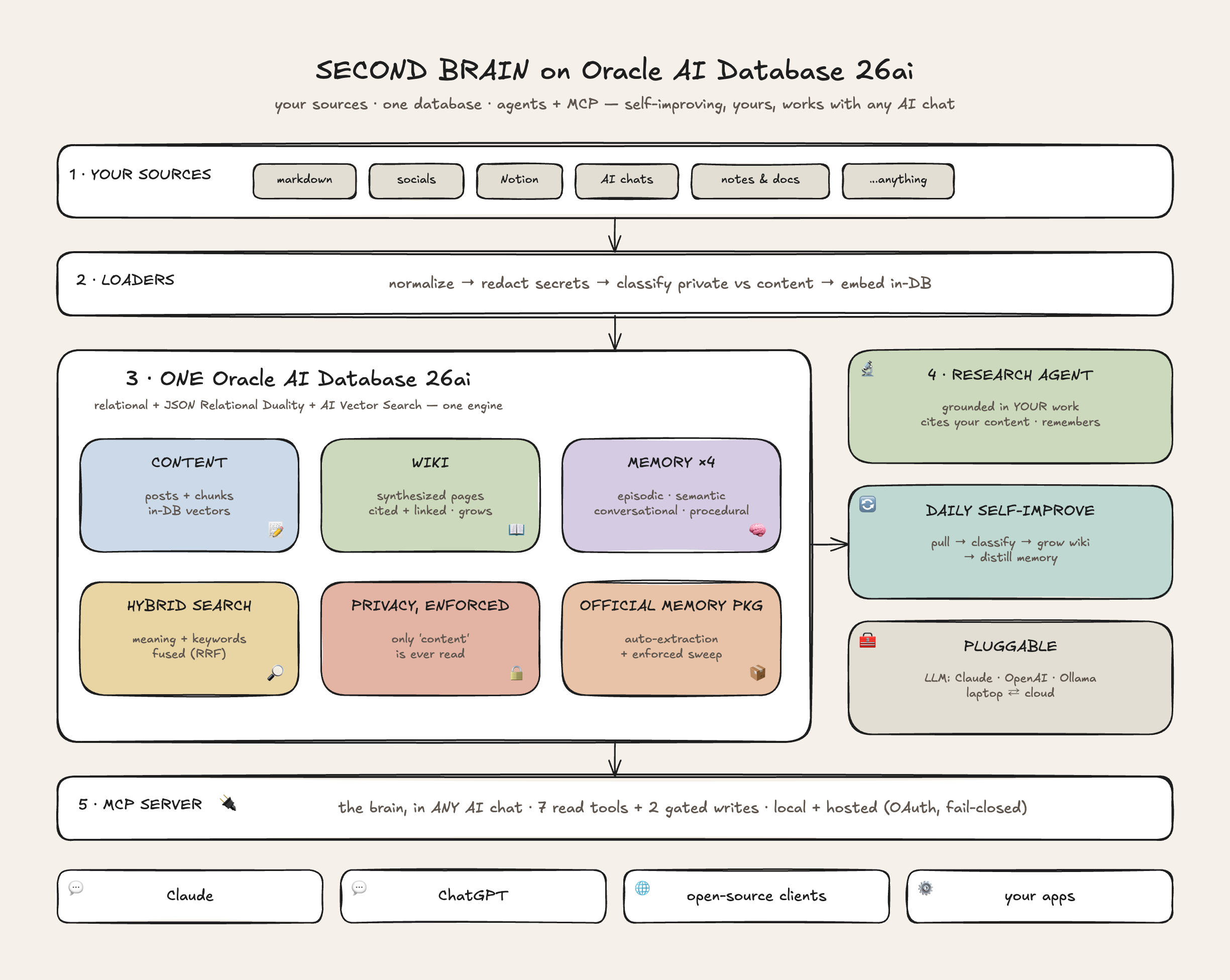
The full picture — every layer, the four memory types, the self-improving loop, the privacy scope,
and the MCP surface — on one page:
New to the concepts (embeddings, duality, agent memory, the agent loop)? The
TUTORIAL teaches each one as you build it, and
docs/ARCHITECTURE.md shows how the pieces fit. To go deeper on agent memory,
Oracle has two great resources: the free Oracle × DeepLearning.AI "Agent Memory" course
and the Oracle AI Developer Hub
(workshops + notebooks from RAG to memory-augmented agents — start with its
Agent Memory Workshop).
Why Oracle
One database holds your content, its embeddings, and the agent's memory — so a single query
can retrieve across all of it. Two features make it a strong fit here: JSON Relational
Duality lets a post be one clean JSON document to your app and normalized, joinable
relational data underneath (bidirectional, no ORM, no syncing two copies); and in-database
embeddings generate the vectors inside the engine, so your content never leaves it. AI
Vector Search ties it together for semantic retrieval.
And the free path is unusually generous: locally, the 26ai container is free; in the cloud,
the Always Free tier includes two Autonomous AI Databases (1 OCPU + 20 GB each — this
whole build fits in one), an Arm VM that can host the MCP server, 200 GB of block storage, and
10 TB/month of outbound transfer — permanently, not a 12-month trial.
Already keep a markdown vault? This build keeps markdown at its core — your vault stays
the portable, canonical layer, read in place. The database adds what files alone can't: semantic search with the
embeddings and the model in one indexed engine, privacy as an enforcedvisibilityconstraint
on every read path (not a folder convention), wiki citations as foreign keys that stay consistent,
and agent memory that consolidates transactionally while the MCP server, sync job, and agents
read and write concurrently. Markdown where it shines (authoring, portability); a database where
the work is (retrieval, relationships, memory, governance).
Step 0 — Prerequisites
- macOS (this guide is Apple Silicon /
arm64; on Intel, drop theplatform:line inoracle/docker-compose.yml). - Homebrew, and — only for the final "Converse" step — an LLM: an
Anthropic API key (default), an OpenAI key, or a free local model via Ollama
(LLM_PROVIDERinoracle/.env— search itself needs no key at all).
Step 1 — Quickstart: stand up the database (~15 min)
# 1. Container engine (headless — no Docker Desktop)
brew install colima docker docker-compose
colima start --cpu 4 --memory 8 --disk 60

# 2. Python env (3.12 — newer versions may lack wheels for oracledb/onnx)
brew install [email protected]
python3.12 -m venv .venv
./.venv/bin/pip install -r oracle/agent/requirements.txt yt-dlp

# 3. Config (the CHANGE_ME_* placeholders work for the local sandbox; set your own for anything real)
cp oracle/.env.example oracle/.env

# 4. Start Oracle AI Database 26ai (Free container image) locally
docker-compose -f oracle/docker-compose.yml up -d

# 5. Download the in-DB embedding model, then bootstrap the database
#    (waits for healthy, applies schema, loads the ONNX model)
./oracle/download-model.sh
./oracle/bootstrap.sh
That gives you a live Oracle 26ai with the content schema, the Duality view, theagent_memory table, and the MINILM embedding model loaded. Verify:
./.venv/bin/python -c "import sys; sys.path.insert(0,'oracle/agent'); import db; \
  print(db.connect().cursor().execute(\"select count(*) from user_objects\").fetchone())"
Step 2 — Collect + search your content
# Collect: pull a public channel's metadata (any public channel works — swap in yours later)
mkdir -p exports/youtube
./.venv/bin/yt-dlp --skip-download --dump-json --playlist-items 1-7 \
  "https://www.youtube.com/@oracledevs/videos" > exports/youtube/videos.jsonl
./.venv/bin/python scripts/youtube.py

# Search: semantic search over what you just loaded (no API key needed)
./.venv/bin/python scripts/search.py "protecting data in the cloud"
Swap in any channel, or ingest other platforms via their data exports — see
docs/EXPORT_GUIDE.md. Every platform lands in the same posts
model, so the pipeline is the same.
Step 3 — Converse: the research agent (needs an LLM)
# oracle/.env:  ANTHROPIC_API_KEY=sk-ant-...   (this demo agent is the Claude build)
cd oracle/agent && ../../.venv/bin/python demo_research.py
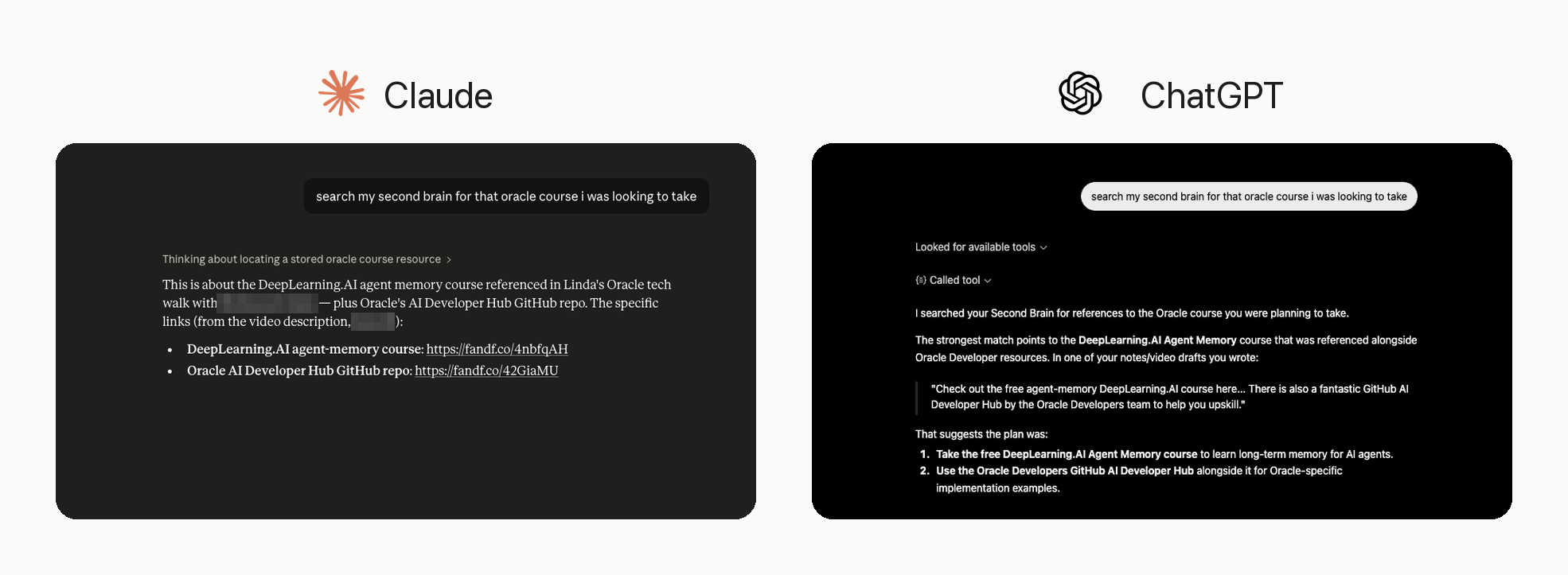
# No Claude key? You lose nothing: the same "research my brain" move runs in any MCP
# client (Step 4), and every other LLM step swaps engines freely — LLM_PROVIDER=openai
# or LLM_PROVIDER=ollama (free + local) in oracle/.env.
The agent searches your content, answers grounded in it (citing your videos), and records
each research run to agent_memory.
The agent needs an engine — I run Claude here. But the brain underneath doesn't care what you
point at it: search needs no LLM at all (the embeddings live in the database), and everything
that does — the wiki, memory, the classifiers — runs on Claude, OpenAI, or a fully-local model
via Ollama, one line of config (LLM_PROVIDER). Agents are apps built on the brain, and each
app picks its own engine: this research agent I built Claude-first because I wanted its
server-side web search — build yours on whatever you like. The same "research my brain" move
also runs inside ChatGPT, over MCP, where whatever model you're chatting with executes the
playbooks. The engine is swappable. Your brain stays put.
Step 4 — Beyond the quickstart: make it a real second brain
Once the basics work, this scales into a real second brain — the full path is in
docs/TUTORIAL.md:
- Bring all your content — Instagram, LinkedIn, ChatGPT/Claude exports, Notion, all into the
samepostsmodel (docs/EXPORT_GUIDE.md). For video, pull transcripts
so what you said is searchable, not just the caption. - Keep private data private — a
visibilityscope +classify_private.pykeep financials and
private items out of search and the self-improving loop (SECURITY.md). - Keep it current —
sync.py(pull → wiki refresh → consolidate) on a daily schedule. - Use it everywhere — host the MCP (OAuth + allowlist) and reach your brain from claude.ai,
ChatGPT, and your phone (docs/HOSTED_MCP.md).
Step 5 — Take it to the cloud (optional)
Everything above runs free on your laptop. The same code runs on an Always Free Autonomous AI
Database so the brain is always-on, backed up, and reachable from anywhere:
- Move the database — wallet + load the same ONNX model + one copy script (ships
content-scope only by default): docs/CLOUD_MIGRATION.md. - Host the MCP server — one small container (the guide deploys to Fly.io) with OAuth + an
email allowlist, so claude.ai, ChatGPT, and your phone can reach it:
docs/HOSTED_MCP.md.
How it all connects
The data flow, in one breath: loaders normalize any source into posts (embeddings are
generated in-database on insert, long content is chunked into passages). The wiki compiler
reads those posts and writes synthesized topic pages whose citations are foreign keys back to
them. Agents answer from posts + wiki and write what they learn to agent_memory;
consolidation distills those runs into durable semantic_memory facts. The MCP server
serves all of it to any AI client, and its write tools (ingest_note, save_chat) flow new
knowledge back in. Every read path filters visibility = 'content', so private items are out of
search AND out of the self-improving loop.
How it runs day to day
Once your content is in, one scheduled job keeps every derived layer current, in an order that
can never leak or go stale:
sync.py:  pick up new chat-export zips (ingest_exports.py watches your downloads folder)
          → pull API sources (Instagram, Notion) → Claude Code sessions (local, automatic)
          → classify private vs content (safety net re-runs after fresh imports)
          → refresh + GROW the wiki → consolidate memory
          → OAMP privacy sweep (auto-added on the package backend)
Run it by hand anytime (./.venv/bin/python scripts/sync.py) or schedule it daily — the
TUTORIAL ships a ready macOS LaunchAgent plist. For chats there is also
real-time capture: say "save this chat to my brain" in any connected client and the save_chat
tool stores it on the spot, no export needed.
How it improves itself
"Self-improving" here means two specific mechanisms — and, deliberately, not a third:
- The knowledge self-organizes. The wiki doesn't just refresh pages whose sources changed —
it proposes new pages when enough content clusters around a topic no page covers yet. On the
default backend the package extracts durable memories from every exchange as it happens, and
nightly consolidation distills raw agent runs (agent_memory) into global facts
(semantic_memory) — recall reads both. Nobody asks for any of it; the daily sync keeps it fed. - The agents compound experience. Every run follows recall → act → verify → record: an
agent recalls consolidated facts before acting, does the work, fact-checks its answer against
the run's own evidence, and records the outcome. Tonight's
runs become tomorrow's recalled facts — the research agent literally stops re-deriving things
it worked out last month. The more you use it, the better it answers. - Nothing self-modifies. No agent rewrites its own code or prompts, and no model decides what
runs when — scheduling and routing stay deterministic (a smallsync.pyand cron-style
timers). The behavior improves because the memory it stands on grows, which means every
improvement is inspectable with plain SQL:SELECT * FROM semantic_memory ORDER BY created_at.
How the rules work: three tiers
Every rule in this system lives at one of three depths — and knowing which tier a rule
belongs in is most of security design:
- Instructions (a model reads them, and might not follow them): AGENTS.md
briefing coding agents, the MCP server's tool-routing instructions, prompt rules like
"never memorize financials." Useful, cheap — and proven imperfect: our eval suite
caught the memory extractor partially ignoring exactly that instruction. - Constraints (no model in the loop; can't be ignored): the
visibilityfilter the
database applies to every read, auth that fails closed,MCP_READONLYnever
registering write tools, loaders that skip deal-data rows, embeddings computed inside
the INSERT itself — and the checked-in.claude/settings.jsonhook that blocks any
coding agent from editing a.envfile (Claude Code asks you to approve it once). - Watchdogs (deterministic checks that run later): the daily privacy sweep that
deletes what the extractor was told not to keep, the classify tripwire after chat
re-imports, the weekly eval delta, the monthly memory-hygiene review.
The design rule this repo follows: instructions filter, constraints enforce, watchdogs
verify. When a rule matters, don't leave it at tier 1 — push it down a tier.
Loop engineering: keeping the loops honest
Everything in "how it runs day to day" is a loop — a scheduled job that works without
you watching: the sync pulls new content, the wiki recompiles, memory consolidates
overnight. That's the value and the risk, because automation fails quietly: a token
expires and a source just stops loading; a job breaks and nothing announces it; an LLM
step spends money nobody counts. (Each of those happened here.) So every loop is built
to stay accountable: it ships with an eval or a report you actually read, its LLM calls
land in a spend ledger, its failures escalate through a database heartbeat you can check
from your phone, and it has a registry row before it's allowed to exist — no row, no run.
The full playbook — the watchdog recipe, restore drills, boundary tiers, and the evals
that catch silent quality regressions — is in
docs/LOOP_ENGINEERING.md.
Repo layout
| Folder | What lives there |
|---|---|
oracle/ |
The database: docker-compose, schema (Duality + 4 memory types + wiki), setup SQL |
oracle/agent/ |
The agents (db, content, memory, research_agent, idea_agent, wiki…) + the MCP server (stdio and hosted) |
scripts/ |
Source loaders (YouTube, Notion, Instagram, LinkedIn, ChatGPT/Claude, Obsidian, Drive…) + the pipeline (sync, classify_private, consolidate) + ops tools |
tests/ |
Regression suite (test_brain.py) + quality evals with golden sets |
web/ |
Read-only web UI (graph, wiki, memory views) served by the hosted MCP |
deploy/ |
Hosted-MCP container (Dockerfile; fly.toml lives at repo root) |
sources/ |
Your canonical content as Markdown + frontmatter — the source of truth |
docs/ |
TUTORIAL (start here) · ARCHITECTURE · EXPORT_GUIDE · CLOUD_MIGRATION · HOSTED_MCP · WEB_UI · LOOP_ENGINEERING · BLOG |
File-first sources are canonical markdown on disk — sources/ for collected content (YouTube),
or your own vault read in place — and the database's view of them is rebuildable. API loaders
(Notion, Drive, socials, chat exports) write to the database directly and can re-pull anytime;
Autonomous auto-backup covers the rest.
What's included
Collect → Store → Search → Converse — self-improving research agent over your content
Many sources, one model — YouTube (+ transcripts), Notion, Instagram (API or
export — captions + reel transcripts), LinkedIn, ChatGPT/Claude exports — all into onepoststable (scripts/)Four agent-memory types, two ways — episodic, semantic, conversational,
procedural. The default is Oracle's official
AI Agent Memory package
(oracleagentmemory— maintained + benchmarked, auto-extraction, hybrid retrieval, the
privacy guard as custom extraction instructions plus a structural deny-list sweep that
enforces it, and global consolidated facts merged into recall;oamp_memory.py).MEMORY_BACKEND=customswitches to the learning track: the same layer hand-built as
tables you can read with SQL (how Oracle's DeepLearning.AI course teaches it) — and the
fully-local path, auto-selected when you configure Ollama. Episodic + procedural are
this build's extensions of the core on both (+ a
LangGraph example, +tests/eval_oamp.py— 7 probes to run
on every package upgrade)Knowledge wiki layer — LLM-compiled, self-improving topic pages (
wiki.py) + a Duality
view; the strongest relational + JSON + vector showcaseHybrid search — vector + keyword (Reciprocal Rank Fusion)
Content series (your own) — group posts into a named
series(a tutorial series, an
interview show, book notes, a weekly update…) via a NotionSerieslabel orclassify_series.py;
surfaced by aby_seriestool + flagged in search — define whatever series fit your contentPrivate by scope — a
visibilityflag keeps financials/private items out of search and
the self-improving loop;classify_private.pytags private + off-topic items on ingestSelf-improving sync —
sync.py(pull → wiki refresh → consolidate) on a daily schedule,
so the derived layers never go staleIdea & repurposing agent — grounded next-content suggestions (
idea_agent.py)MCP server, everywhere — local (stdio) + hosted (HTTP + WorkOS OAuth + allowlist),
reachable from claude.ai, ChatGPT, and your phone; read tools annotated read-only, the write
tool gated (MCP_READONLY) — see docs/HOSTED_MCP.md.
(This build uses the custom, portable, Python route — full control, works with the local
container, portable to any database. Oracle's fully-managed
Autonomous AI Database MCP Server
— zero-ops + DB-identity governance, built into Autonomous AI Database — is the official
managed alternative when your brain lives there.)Agents over MCP: the playbook pattern — conversational agents ship as MCP prompts
(research_brief,interview_prep,caption_pack,weekly_review): parameterized playbooks
the client model executes with the read tools, so your agents run on whatever AI you're
chatting with — swap the client, keep the agents. Scheduled agents stay cron jobs; see
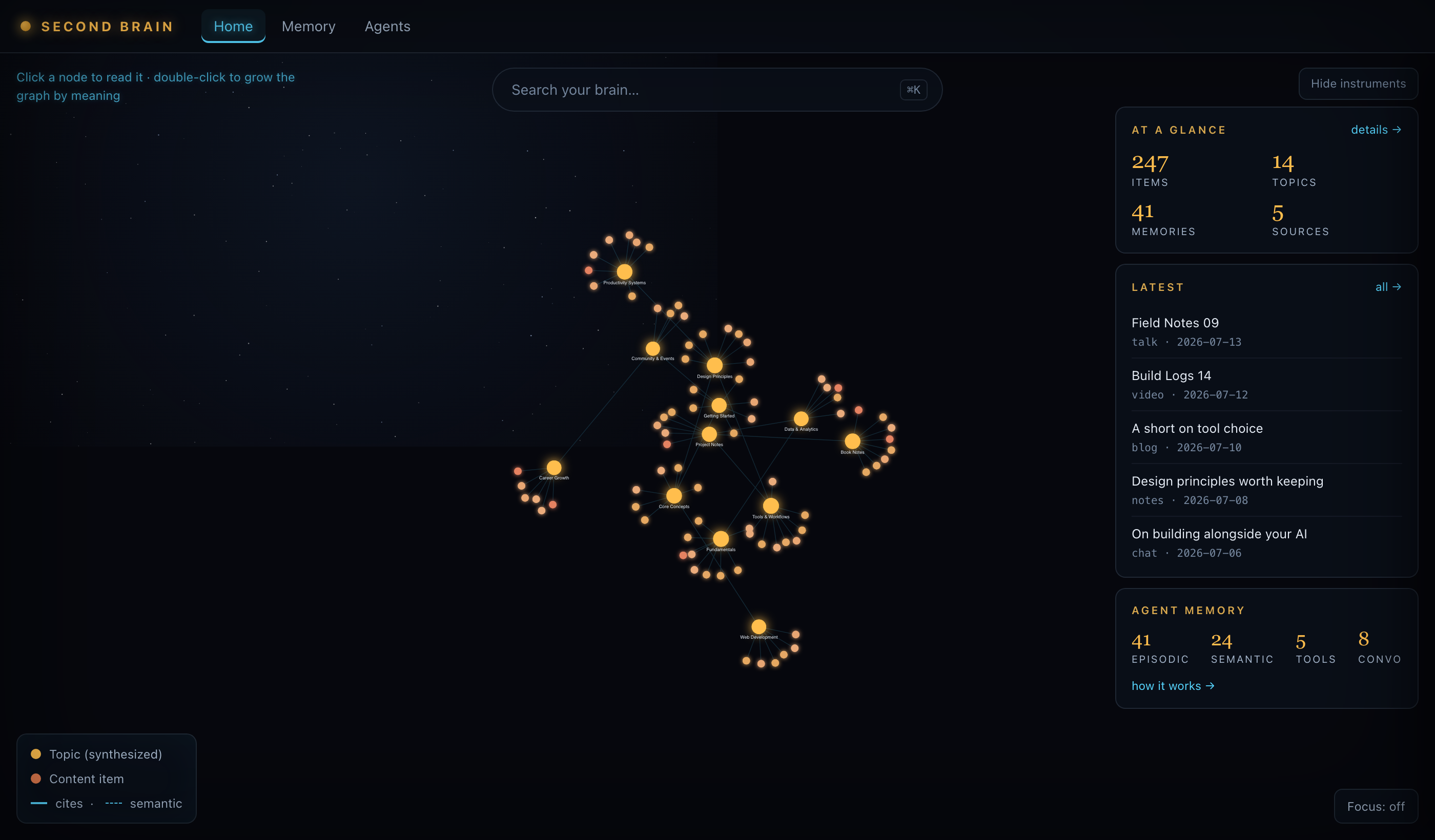
"Exposing agents over MCP".Web UI — a read-only view of the brain. Home puts the knowledge graph center stage
with instruments floating over it: a semantic search command bar (⌘K), an at-a-glance
widget (counts + source health, with a full overview one click away), the latest items,
and the agent-memory pulse. Two deeper pages: Memory (the four memory kinds + how
they work) and Agents (a registry that auto-lists everything you've built on top).
Served by the same hosted app, token-gated and off by default (docs/WEB_UI.md).
Your install starts empty and fills as you load your content:Day one — a fresh install:
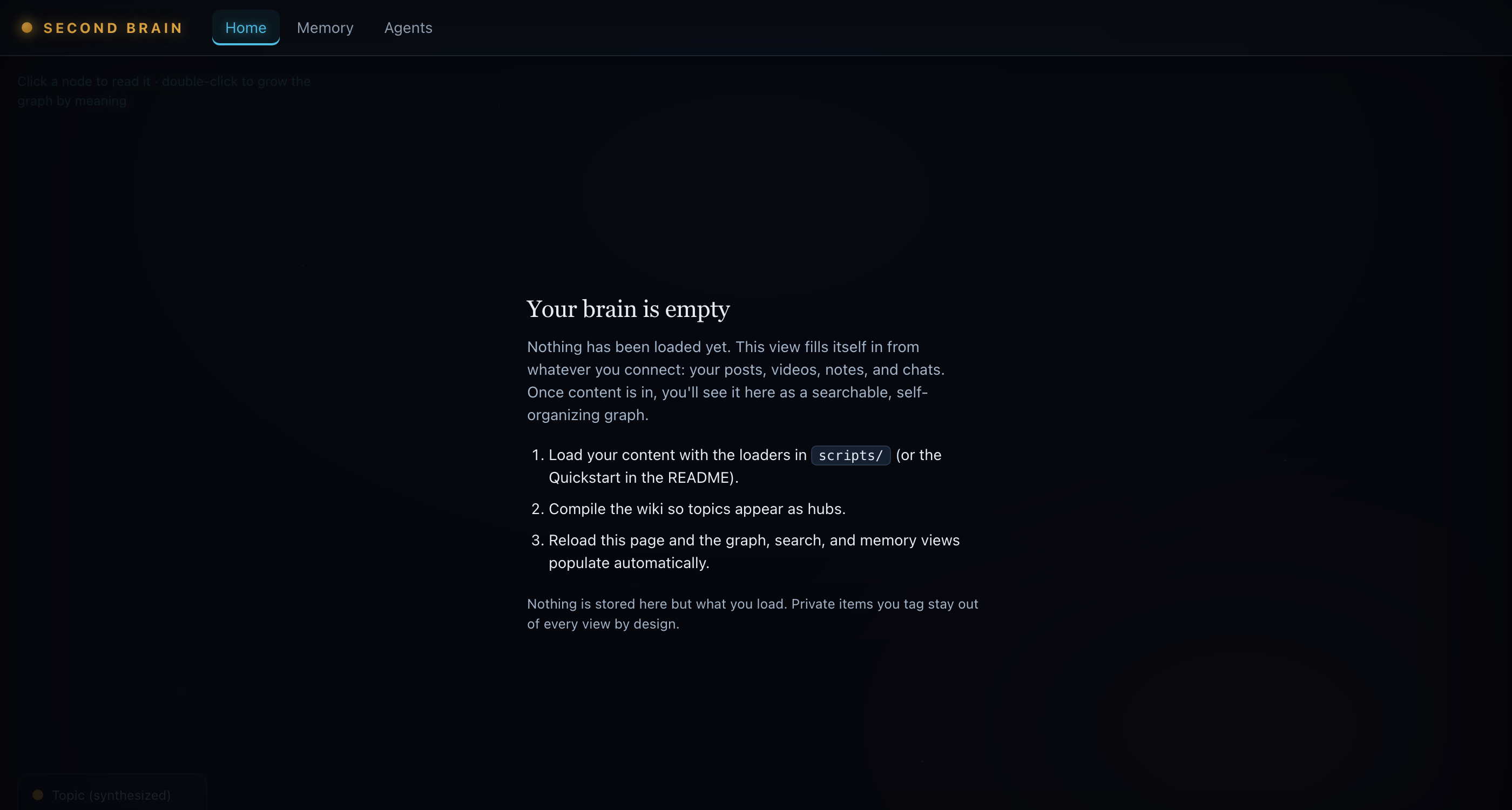
…and once your content is in (a populated brain, generic sample data shown):
Cloud — lift to Oracle Autonomous AI Database (docs/CLOUD_MIGRATION.md)
Maintenance —
lint_wiki.py(review candidates) +review.py(leaked-secret scan)
Roadmap: live Instagram performance metrics via API sync.
Make it yours (safely)
Forking this into your second brain is the point — these six steps keep yours private while
you do:
- Change every demo password (
oracle/.env) — the defaults are public in this repo.
For real credentials, go one better: move them into the OS keychain, so.envholdskeychain:<item>pointers instead of plaintext values —./.venv/bin/python scripts/migrate_env_to_keychain.py --applydoes it safely
(backs up, verifies each secret reads back, never prints a value). See
SECURITY.md. - Decide your private categories first, then ingest — adapt
classify_private.py's rubric to
your private material (don't publish what those categories are), and run it after every import. - Your own auth, before hosting — your own WorkOS allowlist (
ALLOWED_SUBS) or bearer token.
The server refuses to start unconfigured, so there's no accidental open door. (The web UI has
its own gate — off by default, and enabling it without a token also refuses to boot:
docs/WEB_UI.md.) - Never commit
.env, the cloud wallet,exports/, orsources/— already gitignored; keep
it that way, and runscripts/review.pybefore sharing anything derived from your data. - Customize the personal bits — your sources, your
serieslabels, your wiki topics. The code
is generic; everything "you" lives in env vars and your data. - Personal agents go in a private companion repo — make the gitignored
private/dir its own
private git repo for agents that encode your workflow (they can import the public engine
directly). Publish patterns; keep personalization private.
Build yours with your AI (three prompts)
My sources aren't your sources, and my questions aren't your questions. So don't copy this
repo. Give it to your AI as a reference and have it build YOUR version. These three prompts
do exactly that, in order. Your coding agent gets its own briefing too:
AGENTS.md gives Claude Code, Cursor, or any coding agent the house rules:
the privacy constraints to keep, and the tests and evals that gate every change. Pointing
your coding tool at this repo is the intended path.
1. The Architect Prompt (plan first, no code):
I want to build my own second brain: a private, searchable home for everything I create and
think. Use this repo as a REFERENCE, not a template:
https://github.com/LindaHaviv/second-brain. Read its README, AGENTS.md, and
docs/ARCHITECTURE.md first.Before you write any code, interview me:
- What do I create, and where does it live? (platforms, notes apps, docs, chats)
- What are the 5 real questions I'd actually ask my second brain?
- What must stay private vs. what could ever be shared? Are any of my 5 questions
about the private stuff? (If so, plan a local-only scope for them.)Then propose MY architecture: which parts of the reference apply to me, which don't, and what
I need that it doesn't have. Plan only. Don't build anything yet.
2. The First-Source Prompt (build small, prove it):
From the plan we agreed on, build ONE source end-to-end: ingest → store → search → answer one
of my 5 real questions with it. Nothing else. Rules: secrets go in environment variables or a
keychain, never in chat or code; private data stays on my machine; show me the answer to my
real question before we call it done.Only after I've asked it something and gotten a real answer do we add source #2.
Pick a first source you actually care about. Your YouTube channel is a great one, and it's
the same path the Quickstart already proved with sample data: scripts/youtube.py works on
any public channel, no API key needed, so swapping in your own channel is one command. Live
in your notes app instead? Any folder of markdown works: point scripts/obsidian.py +OBSIDIAN_VAULT at it, and a visibility: frontmatter key is the privacy switch.
3. The Hand-Off Prompt (the rest of the build has a guide,
docs/TUTORIAL.md; this prompt puts your AI on it):
My single-source brain works. From here, walk docs/TUTORIAL.md with me. Its labs are
the build-out: my other sources, the privacy scope, the wiki, the daily sync, and MCP
into the AI I use every day. Two rules: one lab at a time, and show me PROOF before we
move on (a real answer, a compiled page, a heartbeat, not just "done"). Set up my private
scope BEFORE we load real volume. The finish line: my brain answering one of my 5 real
questions inside the AI I actually use.
When that happens, it stopped being a demo and became your brain.
For later: once your brain starts drafting things you'll publish, split the roles.
Writer in one AI, verifier in another, claims checked against your brain before anything
ships under your name. It's the same recall → act → verify → record rule your agents
already live by.
Notes
- LLM-agnostic where it counts — the pipeline swaps engines with one line of config
(LLM_PROVIDER: Claude, OpenAI, or local Ollama; see Step 3); the database is the constant. - Local-first, cloud-optional — runs entirely on your machine; your data stays put — and the
cloud copy script ships only the content scope by default. - Oracle AI Database Free in Docker is the same engine as the cloud — features used here
(AI Vector Search, JSON Relational Duality, in-DB ONNX embeddings) work in both.
Yorumlar (0)
Yorum birakmak icin giris yap.
Yorum birakSonuc bulunamadi