linggen
Health Uyari
- License — License: Apache-2.0
- Description — Repository has a description
- Active repo — Last push 0 days ago
- Low visibility — Only 8 GitHub stars
Code Gecti
- Code scan — Scanned 12 files during light audit, no dangerous patterns found
Permissions Gecti
- Permissions — No dangerous permissions requested
Bu listing icin henuz AI raporu yok.
Local-first AI agent runtime for macOS — any model on your own machine, skills as files, your phone as a peer over WebRTC.

Linggen
Local-first AI apps on your own machine.
A personal CFO that reads your bank statements without uploading them, a Mac
health doctor, a music DJ — full apps on one open runtime, with a
general-purpose assistant built in.



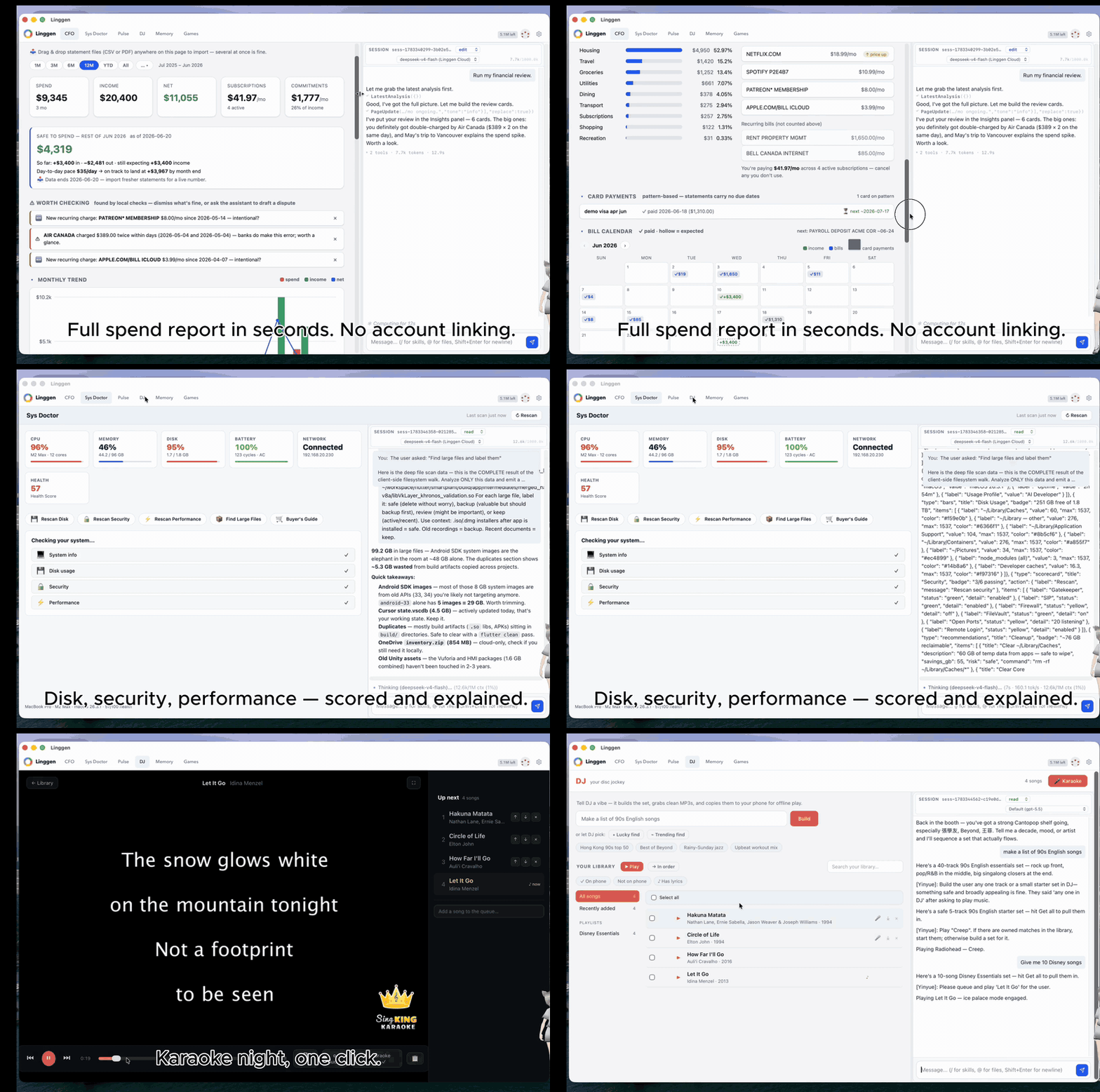
CFO catches a $389 double charge (statements never leave your Mac) · Apple Shifu scores your Mac's health · DJ runs karaoke night. Full demo →
Install
The Mac app — launcher with all apps below, menubar companion included:
curl -fsSL https://linggen.dev/install-app.sh | bash
Engine only — CLI + web UI, macOS and Linux:
curl -fsSL https://linggen.dev/install.sh | bash
ling
Opens the web UI at http://localhost:9527.
The apps
- CFO — a personal CFO that never uploads your money data. Drop in bank/card CSV or PDF exports: deterministic local code parses them into a spend report — monthly trends, subscriptions, commitments, transfer detection, duplicate-charge checks. The AI layer only explains and reviews, and account numbers are stripped before it sees even the redacted totals. 60-second demo.
- Apple Shifu — AI health analyst for your Mac: disk, security, performance, dormant apps, buyer's guide. Recommends; never acts on its own.
- DJ — tell it a vibe and it curates a set, builds your local music library with clean tags, syncs tracks to your phone, and does karaoke with synced, translated lyrics.
- Pulse — GTM brain for solo founders. Reads your configured trends and feeds, then drafts on-voice posts and replies for X and Reddit.
- Games — Chinese Chess and Gomoku where the model actually plays you, plus Snake, Pong, and Tetris.
- Memory — cross-agent semantic memory via
ling-mem: the same store reachable from Linggen, Claude Code, or Codex. - Model sharing — open a room and let friends use your models over P2P WebRTC. No keys for the consumer, no cloud middleman; the owner controls budget and tools.
Skills, agents, missions — all files. New apps are a folder away. Browse community skills at github.com/linggen/skills.
What is Linggen?
Architecturally, Linggen is the root system for AI agents. The core
runtime manages agent processes, communication, and execution; everything
else (skills, agents, missions) grows on top as files. An "AI app" in
Linggen is a skill, an agent, or a mission — markdown + scripts, not code
plugins. The runtime gives every app a process, syscalls (built-in tools),
a filesystem (memory), permissions, and a network surface (P2P rooms).
Apps drop into a folder and run.
OS analogy
| OS | Linggen |
|---|---|
| Process | Agentic loop — one running agent |
| Interrupt | User message queue — checked each iteration |
| Thread / Fork | Subagent delegation — concurrent child execution |
| Syscall | Tool call — built-in tools are the kernel API |
| Dynamic library | Skill — loaded at runtime, no code changes |
| Cron job | Mission — scheduled agent / app / script |
| Driver | Model provider — Ollama, Claude, GPT, Gemini, Bedrock |
| Filesystem | Memory store — core markdown + LanceDB RAG via ling-mem |
| Process privilege | Permission modes (chat / read / edit / admin) + path scoping |
| Network share | Rooms — share models with peers over P2P WebRTC |
Full table and design principles in doc/product-spec.md;
vision and roadmap in doc/insight.md.
Yinyue — your desktop companion
A VRM avatar and conversational companion built into the runtime — the face the
agents wear. She reads the room (whether you're typing, reading, or away), voices
the moments that matter in her own words, and gives the agents a way to talk to
each other and to you.
- She heralds your agents. When one is blocked waiting on you, fails, or
finishes a background job, Yinyue says so — and stays quiet on the routine. - Relay an answer. When an agent is parked on a question or a permission,
just tell Yinyue "approve" — she carries your word back and it unblocks. agent_chat. Agents message each other. Ask Yinyue to have Ling introduce
itself and the message lands in your chat ([Yinyue]: …) and Ling replies;
tell Ling to make Yinyue dance and she dances. A loop-break keeps you in the loop.- She's present. Gestures and moods (
Express), occasional unprompted
remarks, a local voice with lip-sync.
She's an ordinary Linggen session on the yinyue agent — swap her model, edit
her persona, or build another companion the same way. Seedoc/yinyue-companion-spec.md.
Add an app
Drop a markdown file in ~/.linggen/ — available immediately, no restart:
---
# ~/.linggen/agents/reviewer.md
name: reviewer
description: Code review specialist.
tools: ["Read", "Glob", "Grep"]
model: claude-sonnet-5
---

You review code for bugs, style issues, and security vulnerabilities.
Skills (~/.linggen/skills/<name>/SKILL.md) and missions (cron-scheduled
agent / app / script) follow the same drop-in pattern. Skills use the open
Agent Skills standard and work in Claude Code
and Codex too.
Where Linggen sits
- Local-first. Runtime, data, and inference (when you pick local models) live on your machine. Cloud is opt-in via your own API keys.
- Model-agnostic. Any model — Ollama, Claude, GPT, Gemini, DeepSeek, Groq, OpenRouter. Routing policies (
local-first,cloud-first, custom) decide which model handles each request. - App platform, not a single product. Coding is one app among many.
- P2P, not centralized. Remote access and model sharing flow over WebRTC data channels.
linggen.devacts as a signaling relay; it does not see chat content. - Skills as the contract. Apps follow the open Agent Skills standard.
Remote access
Sign in from the app (or ling account login). Signing in links this machine
automatically — there is no separate step.
Then open linggen.dev/app from any browser. P2P-encrypted tunnel back to
your machine; no VPN, no port forwarding.
Use Linggen from other agents (MCP)
The daemon is an MCP server at http://127.0.0.1:9527/mcp — 22 tools in
four groups: memory_* (durable cross-host memory on the ling-mem store),browser_* (drive one visible tab in your own Chrome, per-site permission
prompts), x_* (structured reads of your logged-in X session), andagent_run (hand a task to a local Linggen agent and get its answer back).
On Claude Code / Codex, install the linggen plugin — it bundles the
per-turn memory recall hook and installs both binaries on first session
start:
claude plugin marketplace add linggen/linggen-memory
claude plugin install linggen@linggen-memory
Any other MCP client just points at the endpoint. Details indoc/mcp-spec.md.
Documentation
- Design docs — architecture, specs, internals
- Product spec — system definition + design principles
- Insight — vision, roadmap, problems Linggen solves
- Skill spec — how to write skills
- Full docs — guides and reference
License
Apache 2.0 — engine and bundled skills. Branded apps shipped from linggen-releases ship under their own terms.
Yorumlar (0)
Yorum birakmak icin giris yap.
Yorum birakSonuc bulunamadi