OpenTag
Health Uyari
- License — License: NOASSERTION
- Description — Repository has a description
- Active repo — Last push 0 days ago
- Low visibility — Only 5 GitHub stars
Code Basarisiz
- network request — Outbound network request in package-lock.json
- spawnSync — Synchronous process spawning in scripts/smoke-v01.mjs
- process.env — Environment variable access in scripts/smoke-v01.mjs
- process.env — Environment variable access in src/admin/AdminServer.js
Permissions Gecti
- Permissions — No dangerous permissions requested
Bu listing icin henuz AI raporu yok.
Open-source, channel-native agent gateway for Slack. Route team threads to Claude Code, Codex, OpenCode, Docker, HTTP agents, and custom CLIs with policy, approvals, memory, audit logs, and artifacts.
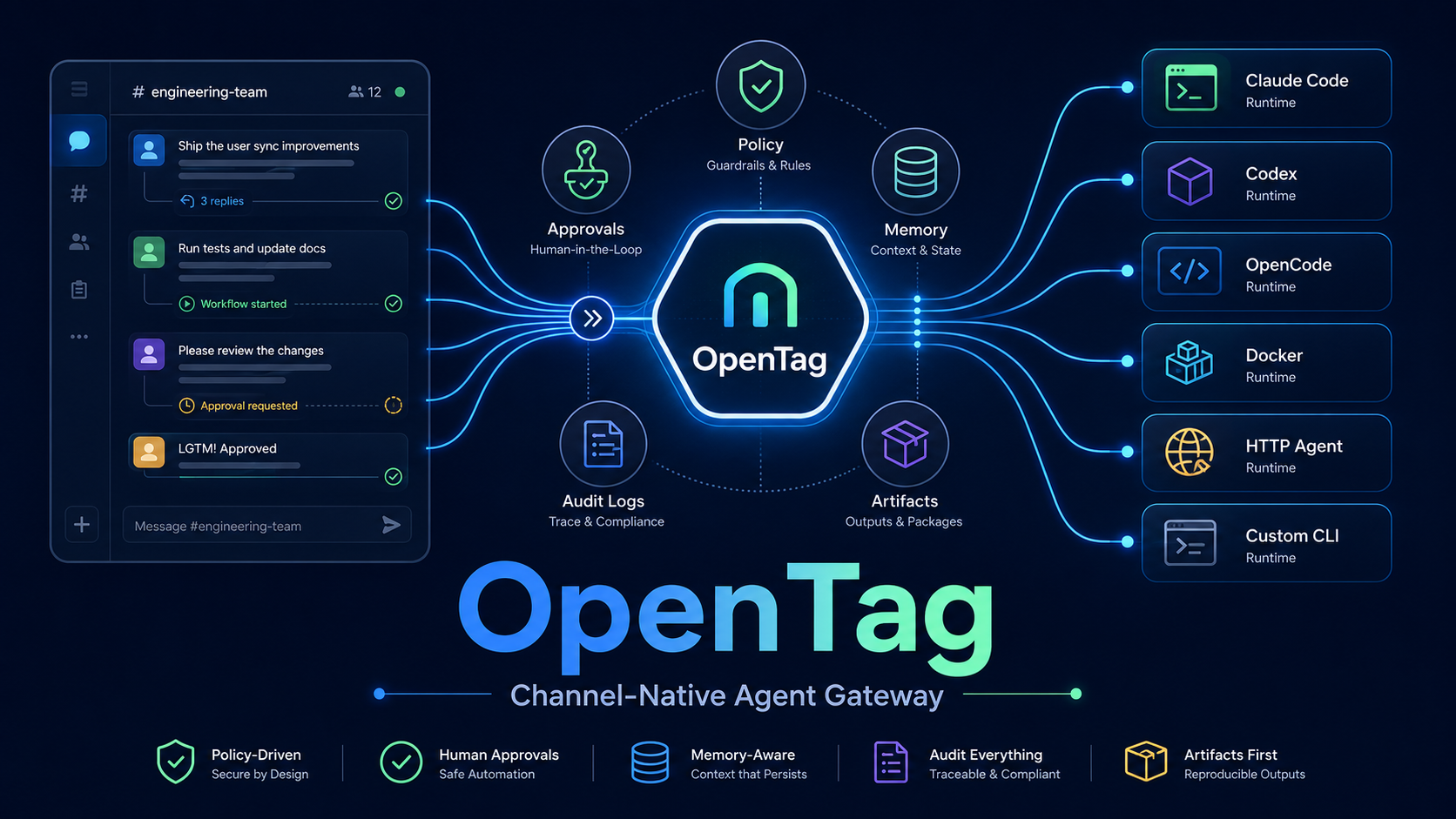
OpenTag
An open-source, channel-native agent gateway for teams.
English · 简体中文 · User Guide · Security
OpenTag brings AI agents into the place where team work already happens: Slack channels and threads.
Instead of running an agent from one person's terminal and pasting results back into chat, a team can mention @OpenTag, discuss the task in the same thread, approve risky actions when needed, and keep the outcome visible to everyone who has access to that channel.
What You Can Do
- Ask an agent to investigate a bug from a Slack thread.
- Let teammates add context before or during the agent run.
- Route work to different agent backends such as Codex, Claude Code, OpenCode, Docker-based agents, HTTP agents, or custom CLIs.
- Use channel-level rules so different projects can have different permissions, memories, and default agents.
- Require approvals before write actions or risky operations.
- Keep a record of sessions, decisions, outputs, and generated artifacts.
OpenTag is designed for team workflows where context, permission, and accountability matter.
How It Feels In Slack
@OpenTag summarize why this deployment failed

@OpenTag check this thread and draft the fix plan

/runtime codex-readonly explain the current project structure

/opentag sessions
/opentag approvals
/opentag status <session_id>
The agent replies in the same Slack thread, so the work stays connected to the original discussion.
Why OpenTag
Most AI coding and automation tools are built around a single local operator. OpenTag is built around shared channels.
- Shared by default: the conversation, context, and result stay in the team thread.
- Channel-aware: each channel can have its own project, instructions, memory, permissions, and default runtime.
- Agent-flexible: use the agent runtime that fits the task instead of locking the team into one backend.
- Approval-ready: sensitive actions can pause for human review.
- Auditable: sessions, messages, approvals, outputs, and artifacts can be reviewed later.
Quick Start
OpenTag requires Node.js >=20.11.0.
npm install
npm run smoke
Try OpenTag locally without Slack:
npm run start:console
Start the Slack gateway with the example configuration:
cp examples/env.example .env
set -a
source .env
set +a
npm run doctor
npm start
For Slack setup, start with:
What Is Included
- Slack gateway for mentions, thread replies, DMs, slash commands, and approvals.
- Local console mode for trying OpenTag without Slack.
- Runtime options for mock runs, Codex, Claude Code, OpenCode, Docker, HTTP agents, and generic CLI agents.
- Channel configuration for default runtime, allowed runtimes, allowed users, approvers, instructions, memory, and workspace roots.
- Local storage for sessions, messages, approvals, runs, audit records, and artifacts.
- Admin and integration surfaces for teams that want to build deeper workflows.
User Guide
docs/user-guide/README.md- guide indexdocs/user-guide/01-install.md- install and Slack setupdocs/user-guide/02-use-in-slack.md- day-to-day Slack usagedocs/user-guide/03-projects-and-runtimes.md- projects and runtime choicesdocs/user-guide/04-admin-and-safety.md- approvals, safety, and operationsdocs/user-guide/05-troubleshooting.md- common issuesdocs/user-guide/06-faq.md- FAQ
For implementation details, see docs/developer-guide.md.
Safety Model
OpenTag is meant to make agent work visible and controllable in a team setting.
- Secrets should be supplied through environment variables, not committed to the repository.
- Channels can limit who can use OpenTag and which runtimes are allowed.
- Write-capable or risky actions can require approval.
- Workspaces and filesystem roots can be restricted by configuration.
- Runs, approvals, artifacts, and audit records are kept for review.
See SECURITY.md for security reporting and project security guidance.
Current Status
OpenTag is an MVP for Slack-first team agent workflows. It is suitable for local trials, internal team experiments, and runtime integration work.
It is not yet a hosted production SaaS. Planned improvements include Slack OAuth installation, stronger multi-instance storage, a web admin UI, hardened sandboxing, and more channel integrations.
License
Apache-2.0. See LICENSE.
Yorumlar (0)
Yorum birakmak icin giris yap.
Yorum birakSonuc bulunamadi