kimi-plugin-cc
Health Uyari
- License — License: Apache-2.0
- Description — Repository has a description
- Active repo — Last push 0 days ago
- Low visibility — Only 5 GitHub stars
Code Basarisiz
- os.homedir — User home directory access in dist/commands/review-gate.js
Permissions Gecti
- Permissions — No dangerous permissions requested
Bu listing icin henuz AI raporu yok.
Claude Code plugin that delegates read-only review, adversarial review, free-form ask, and write-capable rescue work to the local Kimi CLI. Includes an opt-in stop-time review gate.
kimi-plugin-cc
Use Kimi as Claude Code's second reviewer, independent thinker, and delegated worker — without building your own multi-agent stack.
This is a Claude Code plugin that connects to Kimi CLI's Wire mode — an experimental streaming protocol that gives full programmatic access to a Kimi agent session. Claude can ask Kimi for a structured code review, delegate a bug hunt, or have Kimi double-check its own work before stopping — all through slash commands, with persistent job state and session resume.
- Independent model, independent perspective. Kimi reasons differently from Claude. A second opinion from a different model catches things self-review misses.
- No orchestration layer required. No ACP, no cloud broker, no shared API keys. The plugin talks directly to a locally-installed
kimiCLI over stdio. - Full agent capabilities. Kimi can read files, write code, run shell commands, and resume where it left off — all bounded by a companion-side approval allowlist that the plugin enforces.
Try it in 60 seconds
/plugin marketplace add linxule/kimi-plugin-cc
/plugin install kimi@kimi-marketplace
/kimi:setup
/kimi:review "review my current diff"
Kimi reads your working-tree diff and returns structured findings:
{
  "summary": "One high-confidence issue in the auth middleware.",
  "verdict": "concern",
  "findings": [
    {
      "severity": "high",
      "confidence": "high",
      "title": "JWT expiry not checked before token refresh",
      "file": "src/middleware/auth.ts",
      "start_line": 42,
      "end_line": 47,
      "body": "The refresh handler calls getNewToken() without first checking whether the current token has actually expired...",
      "suggested_fix": "Add an expiry check before the refresh call."
    }
  ]
}
Claude reads these findings and can act on them directly. To go further:
/kimi:rescue "fix the top review finding"
Kimi opens the file, writes the fix, runs the relevant tests, and reports back. The session persists — if you restart Claude Code, /kimi:rescue --resume picks up where it left off.
When to use what
| Command | What it does | Kimi can write? | Session persists? |
|---|---|---|---|
/kimi:ask |
Free-form Q&A — "explain this module"; supports --background / --wait like rescue |
No | Fresh by default, -r to resume |
/kimi:review |
Structured code review of your diff | No | Fresh each time |
/kimi:challenge |
Adversarial review with a custom focus | No | Fresh each time |
/kimi:rescue |
Delegate real work — bug hunts, refactors, fixes | Yes (allowlisted) | Persists + resumable |
| Review gate | Kimi checks Claude's work before stopping | No | Per-stop-event |
The plugin ships four Claude Code subagents that the main thread can dispatch proactively via the Agent tool: kimi-rescue (write-capable delegation), plus kimi-review, kimi-challenge, and kimi-ask (read-only forwarders to the matching companion surfaces). Each agent's description is Kimi's own statement of what it's good for — Claude matches the moment and dispatches; no prescriptive skill manual in between.
How it works
The architecture is modeled after OpenAI's codex-plugin-cc. Both follow the same pattern: thin plugin shell, rich local runtime, one process per job.
  /kimi:review "check the auth flow"
       │
       └─ companion.sh → node dist/companion.js
               │
               ├─ spawns: kimi --wire --session <uuid> --agent-file review.yaml
               ├─ streams JSON-RPC events over stdio (Wire protocol)
               ├─ turn capture: buffers ContentParts after last ToolResult
               ├─ approval dispatcher: auto-approves reads, allowlists writes
               ├─ persists job + event log to SQLite (node:sqlite, zero native deps)
               └─ returns structured result to Claude
Wire-first transport. The plugin implements a full Wire client in TypeScript — JSON-RPC over stdio with start, initialize, prompt, approval dispatch, turn capture, and close-based exit semantics. Each command mode runs a custom Kimi agent profile (--agent-file) that controls which tools Kimi has access to. This is one of the first third-party consumers of Kimi CLI's Wire protocol.
Job lifecycle. Every job gets a client-assigned UUID, a SQLite record (created before the Wire connection opens), and a full event log. Jobs go through running → completed/failed/cancelled. Use /kimi:status, /kimi:result, /kimi:cancel, /kimi:replay to manage them.
Rescue approval policy. When Kimi has write access (rescue mode), every file edit and shell command goes through the approval allowlist: symlink-aware path containment, .git/ exclusion, a curated set of read-only check tools, and explicit rejection of package-manager run <script> (opaque scripts are a supply-chain risk). The allowlist is the security boundary — not the system prompt.
Zero native dependencies. The runtime uses Node 22.5's built-in node:sqlite — no better-sqlite3, no node-gyp, no compilation step. dist/ is precompiled and committed, so installed plugins work immediately with just node on PATH.
132 tests, drift gate. The test suite covers the Wire client, approval allowlist, command handlers, job lifecycle, session-title integration, and more. bun run check rebuilds dist/ and fails if the rebuild produces uncommitted changes — forgotten rebuilds can't ship.
kimi web integration
Every plugin session appears in kimi web with a human-readable title. The plugin calls PATCH /api/sessions/{id} on the local kimi web server after session creation, setting titles like Kimi Task: review my current diff (read-only) or Kimi Task: fix the auth bug [write] (rescue).
This means you get a unified view of all Kimi work — terminal sessions and plugin-delegated sessions side by side, searchable by the Kimi Task prefix.
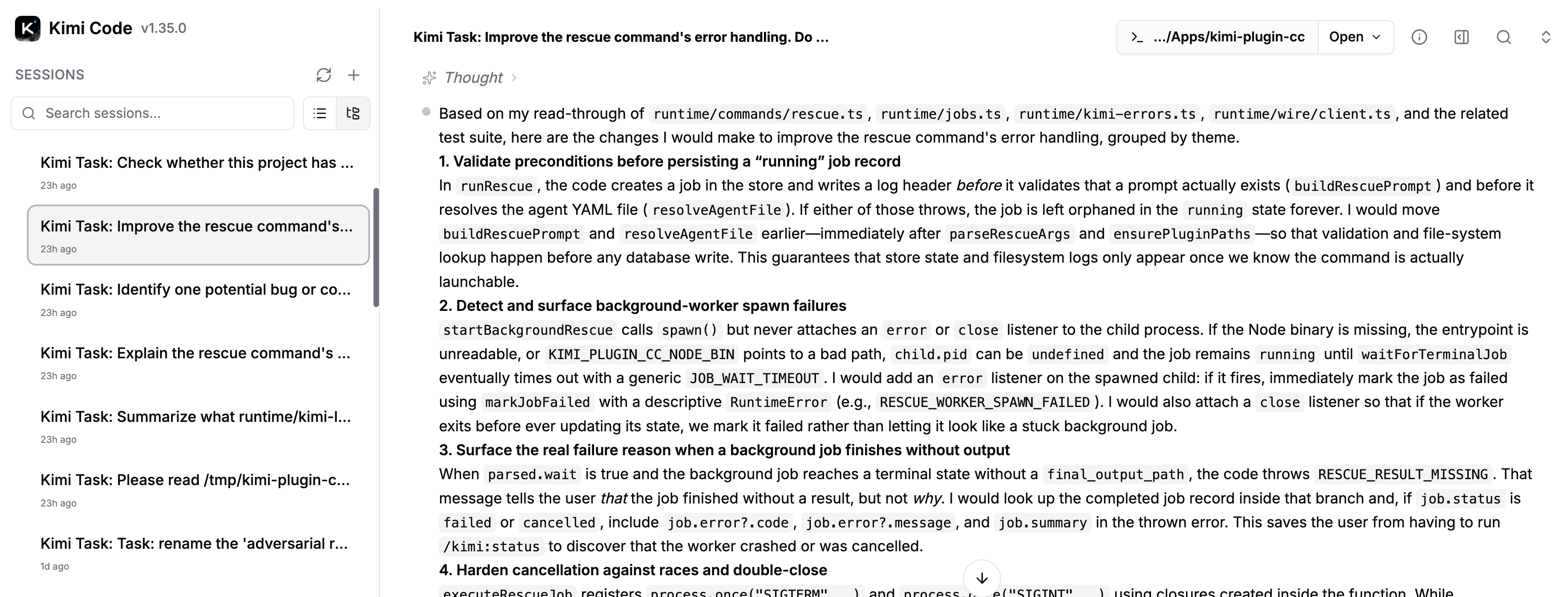
Plugin-created sessions in kimi web — each titled with the task prompt, browsable alongside regular terminal sessions.
Note for Kimi CLI maintainers: The plugin would benefit from a native
--session-title TEXTflag onkimi --wireso titles can be set in-band during session creation, eliminating the PATCH workaround. See the session-title runtime and kimi-web client for the current integration.
Install
Via the Claude Code marketplace (recommended)
/plugin marketplace add linxule/kimi-plugin-cc
/plugin install kimi@kimi-marketplace
/kimi:setup
From a local clone
git clone https://github.com/linxule/kimi-plugin-cc ~/kimi-plugin-cc
claude --plugin-dir ~/kimi-plugin-cc
Then run /kimi:setup to verify the local kimi CLI is reachable and authenticated.
Prerequisites
- Kimi CLI on
PATH— requires--wire,--session, and--agent-filesupport (recent versions). SetKIMI_PLUGIN_CC_KIMI_BINto override. - Node >= 22.5 — for built-in
node:sqlite. SetKIMI_PLUGIN_CC_NODE_BINto override. - bun — only for contributor tooling. Not required at runtime.
Development
bun run check    # rebuild dist/, typecheck, run 132 tests, drift gate
bun test <path>  # run a single test file
See CONTRIBUTING.md for the full contributor workflow.
How this was built
This plugin was built through the same multi-model collaboration it enables — Claude, Kimi, and Codex working together at every stage from design through pre-public audit.
Acknowledgments
- Kimi (Moonshot AI) — the reasoning model this plugin delegates to, and a design/review collaborator throughout development
- Codex (OpenAI) — architecture consults, parallel implementation, and independent pre-ship reviews via the codex-plugin-cc companion plugin
- Claude Code (Anthropic) — the host environment, primary development agent, and the platform this plugin extends
License
Yorumlar (0)
Yorum birakmak icin giris yap.
Yorum birakSonuc bulunamadi