Fuse
Health Gecti
- License — License: Apache-2.0
- Description — Repository has a description
- Active repo — Last push 0 days ago
- Community trust — 13 GitHub stars
Code Basarisiz
- rm -rf — Recursive force deletion command in .github/workflows/ci.yml
- fs module — File system access in assets/fuse-benchmarks-chart.py
Permissions Gecti
- Permissions — No dangerous permissions requested
Bu listing icin henuz AI raporu yok.
MCP server for .NET: typecheck AI agent edits against the compiler, resolve DI and route wiring from Roslyn, scope PRs to the files that matter.




Fuse
Fuse is a local .NET tool with a persistent semantic index, typed-graph wiring
resolution, reduced task-scoped source, and pre-write compiler verification for
coding agents. It indexes a solution through MSBuild and Roslyn, stores the result
in .fuse/fuse.db, and reuses it across agent turns instead of rediscovering the
same structure through repeated file reads and text searches.
From a .NET project directory:
dotnet tool install -g Fuse
fuse mcp install --rules
Reload your MCP client, then ask:
Resolve IOrderService to its implementation, then check the proposed OrderService.cs edit
with fuse_check before writing it.
When the MCP server starts, its shared local daemon begins warming .fuse/fuse.db in
the background. A cold read waits for a bounded syntax-first pass and reports when the
semantic graph is still upgrading. Run fuse index when you want a synchronous full
index before connecting the agent. fuse mcp install --rules also adds .fuse/ to.gitignore at project scope.
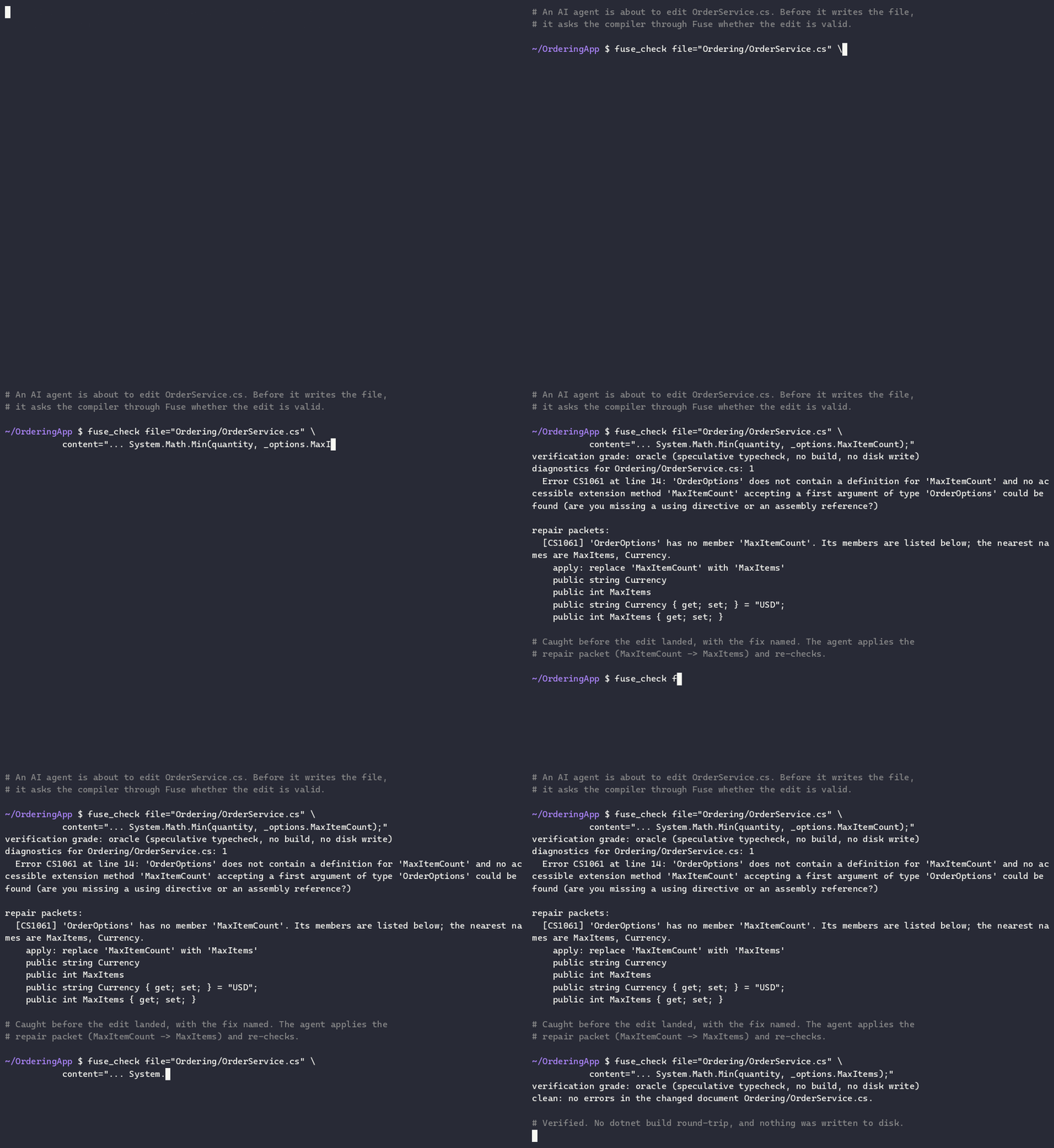
Analysis runs locally and can work offline. Fuse walks a typed graph of DI registrations,
handlers, routes, and callers, emits reduced source for a selected scope, and lets a coding
agent typecheck proposed single-file content before writing it. No model is required. The
optional update check can contact NuGet, and build-grade operations can use the package
feeds configured for the repository.
Persistent Discovery and Reduced Context
Coding agents can inspect a repository through file reads, grep, and regex. On a large
solution, those operations can rediscover the same symbols, references, registrations, and
project structure across several turns. Fuse performs that discovery through MSBuild and
Roslyn, persists the result, and incrementally re-indexes files as they change.
When a project loads semantically, the graph records DI registrations, request handlers,
routes, options bindings, and call edges. When it does not, Fuse falls back to syntax-level
indexing for that project and reports the mode.
- Resolve wiring.
fuse_findtraces a service, request, route, or configuration
section to the code that handles it. Text search findsIOrderService; Fuse follows the
registration to the implementation that runs. - Pack branch context.
fuse_reviewseeds on the git diff and returns related callers,
handlers, and tests with provenance. On 69 recorded pull requests the median response was
1,026 tokens at 93.4 percent precision (review.json). - Return less source.
fuse_contextreduces the selected files under a token budget
and records why each file was included. Across four recorded repositories, skeleton
reduction removed 38 to 44 percent of tokens while retaining every measured public and
protected type name (reduce.json). - Read warm. On the recorded NodaTime run (semantic tier, 14,760 symbols), exact
symbol lookup took 1.8 ms at the median, task localization 15.7 ms, and review planning
106.3 ms (performance.json; timings are environment-dependent).

Compiler Checks and Change Verification
fuse_checkchecks the proposed content of one file and returns compiler diagnostics
without changing the working tree. Oracle grade reuses compiler state captured from the
real build. Build grade runs a scopeddotnet buildfor the owning project when captured
state is unavailable. Supported API-shape errors can include a repair packet; in the
recorded run, the top suggestion repaired 20 of 20 near-miss member and type errors
(diagbench.json).- Before changing a public method,
fuse_impactfinds callers, implementations, and
referencing types. Given a package id and two versions, it returns the break set for
that NuGet upgrade. - When a signature must change,
fuse_refactorstages the refactor as a diff and
returns it only when the compiler reports no new diagnostic. - After an edit,
fuse_testselects and runs the test types that reach the changed
symbol instead of starting with the whole suite.
Every answer names how it was produced. Fuse calls this the verification grade:
oracle grade checks against the compilation captured from the real build, build grade
runs a scoped dotnet build, and when neither compiler path can answer, Fuse abstains
and names the missing prerequisite instead of guessing.
What the Recorded Results Cover
Every result below comes from tests/benchmarks/results and has a reproduction command
on the benchmarks page.
- Across 1,000 compiler-labeled edits in the recorded OrderingApp test app (500 breaking,
500 neutral),fuse_checkreported zero broken edits as clean and rejected zero valid
edits (checkgate.json). - In the same app, Fuse matched all 24 expected .NET wiring links with no extra matches
(semantics.json). - Across 69 real pull requests, branch review retained every git-changed file by
construction at 93.4 percent precision with a median size of 1,026 tokens (review.json). - In the reduced-scope agent-loop run, the Fuse arm's edits passed the project's own
tests on the first attempt in 89 percent of scored rollouts versus 82 percent for
native tools, with overlapping confidence intervals. The Fuse arm declared success on a
failing edit 8 times versus 9 for native. Build and test calls were essentially equal at
3.1 versus 3.2 (loop.json). - Across four recorded repositories, skeleton reduction removed 38 to 44 percent of
tokens while keeping every public and protected type name and 96.3 to 99.4 percent of
method names (reduce.json).
The opt-in resident workspace answered repeated fuse_check calls in 31.2 ms at the
median on the recorded NodaTime run (resident-latency.json). That path is faster than a
full build for speculative checks; it does not replace normal builds or tests before merge.
These measurements have defined limits. Read the
full methods and results before comparing
tools or applying the figures to another repository.
Local and Write-Safe
Fuse reads source, compiler state, git metadata, and its local .fuse/fuse.db index.
Read, check, impact, refactor, and review operations do not write the working tree.fuse_workspace with action=apply is the one explicit tree-write path, and it is a dry
run unless write=true.
Compiler-backed wiring analysis is .NET-only. Other languages receive syntax-level search
and reduction.
Related Code-Intelligence Tools
Repository indexes, code graphs, and language-server tools already exist.
CodeGraphContext provides a local
multi-language graph, Serena exposes
language-server-backed symbol tools, and Sourcegraph
covers multi-repository search and code intelligence. Fuse concentrates on local .NET work
through MSBuild and Roslyn: framework wiring, reduced scoped context, compiler-backed
proposed-file checks, change impact, and covering-test selection. It can run alongside the
index or search built into a coding client.
The peer comparison
records a bounded, dated experiment and its sampling limits. It is not a general ranking of
code-intelligence tools.
Start Here
Apache 2.0. Copyright (c) 2026 Litenova Solutions. See LICENSE and
NOTICE.
Yorumlar (0)
Yorum birakmak icin giris yap.
Yorum birakSonuc bulunamadi