modlens
Health Pass
- License — License: MIT
- Description — Repository has a description
- Active repo — Last push 0 days ago
- Community trust — 597 GitHub stars
Code Fail
- eval() — Dynamic code execution via eval() in evals/run.mjs
- spawnSync — Synchronous process spawning in evals/run.mjs
Permissions Pass
- Permissions — No dangerous permissions requested
No AI report is available for this listing yet.
CLI toolkit for AI agents — converts images into structured JSON evidence (OCR, layout, semantics), bridging the vision gap for text-only LLMs.
ModLens
Give a text-only model sight, and just paste the image.
简体中文 · Troubleshooting · Configuration · Output contract · Security · ModSearch (web)





DeepSeek and GLM have no vision capability and cannot read images. ModLens is a plug-in vision engine that gives a text-only model sight. ModLens reads images pasted straight into the chat, no saving to a file and passing a path first.
Talk to us
Issues are welcome any time: open one. And come find me on X: @liustack. What you built with it, which harness you are on, what should come next. New releases land there first, and a proper community space is on the way.
Highlights
Paste an image and it reads it. No saving to a file and passing a path first.
- Zero-config start. Reuses what Claude Code, Codex, OpenCode, or Pi already have set up: the multimodal models on your machine go straight to work. Nothing at all? Antigravity CLI is a free no-key channel, and a free Gemini key brings a read down to 5-10 seconds.
- Evidence, not imagination. Full transcription, reading-order layout regions, entity and relation lists. The model quotes specifics.
- Install once, use everywhere. Verified on real machines in Claude Code, Codex, Pi, and OpenCode.
Installation
Step 1, hand it to your AI. Send it this line:
Install and configure the modlens skill following https://github.com/liustack/modlens/blob/main/INSTALL.md, then run the health check and tell me the result.
The install starts by checking what your machine already has. An existing login in Claude Code, Codex, OpenCode, or Pi can be enough: modlens asks before reusing any of them, and the health check tells you where things stand.
Step 2, only if the health check comes back empty, set up a free engine. The recommended choice is a free Gemini API key (about three minutes at Google AI Studio, no credit card), which also makes every read 5-10 seconds. A free OpenAI-compatible key from another platform works too. To avoid any sign-up, install Antigravity CLI instead, then sign in:
curl -fsSL https://antigravity.google/cli/install.sh | bash
agy                                                           # sign in, then exit
The install also inventories vision reachable through your other local harness CLIs (Codex, OpenCode, Pi) and asks, per harness, whether modlens may reuse it. Granted logins join the engine pool as equals, and every reused read is labeled with whose quota it spent.
Usage
Once installed, just chat. Paste an image or drop a path, ask anything, and the skill triggers on its own: the image goes to a vision engine and the answer comes back grounded in what it read.
See it work
Unedited runs, all driving a text-only DeepSeek-V4-Flash.
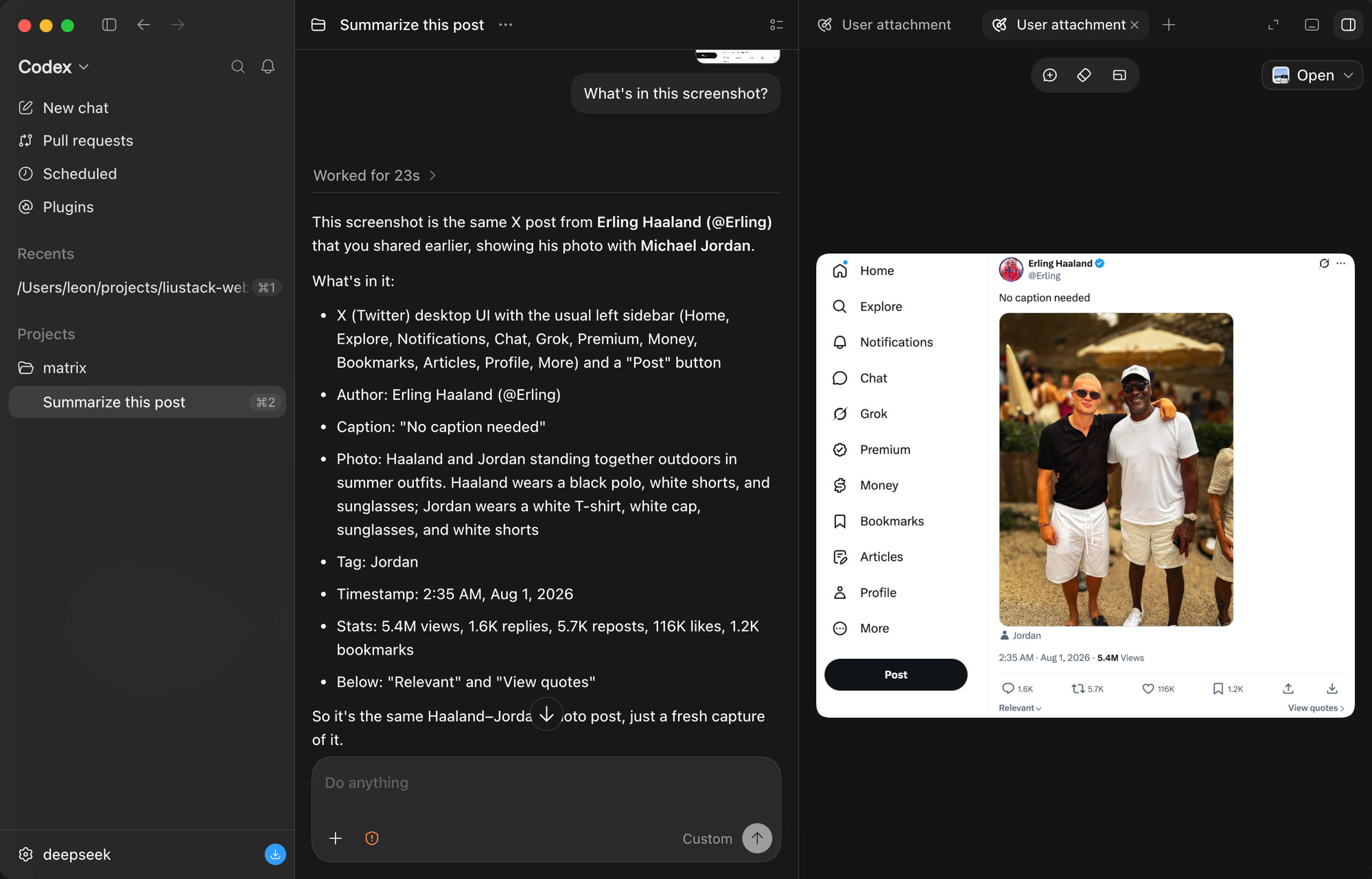
A tweet screenshot in the Codex desktop app. It reads the author, the caption, the photo itself (down to what both people are wearing), the timestamp, and every engagement number: 5.4M views, 1.6K replies, 5.7K reposts, 116K likes.
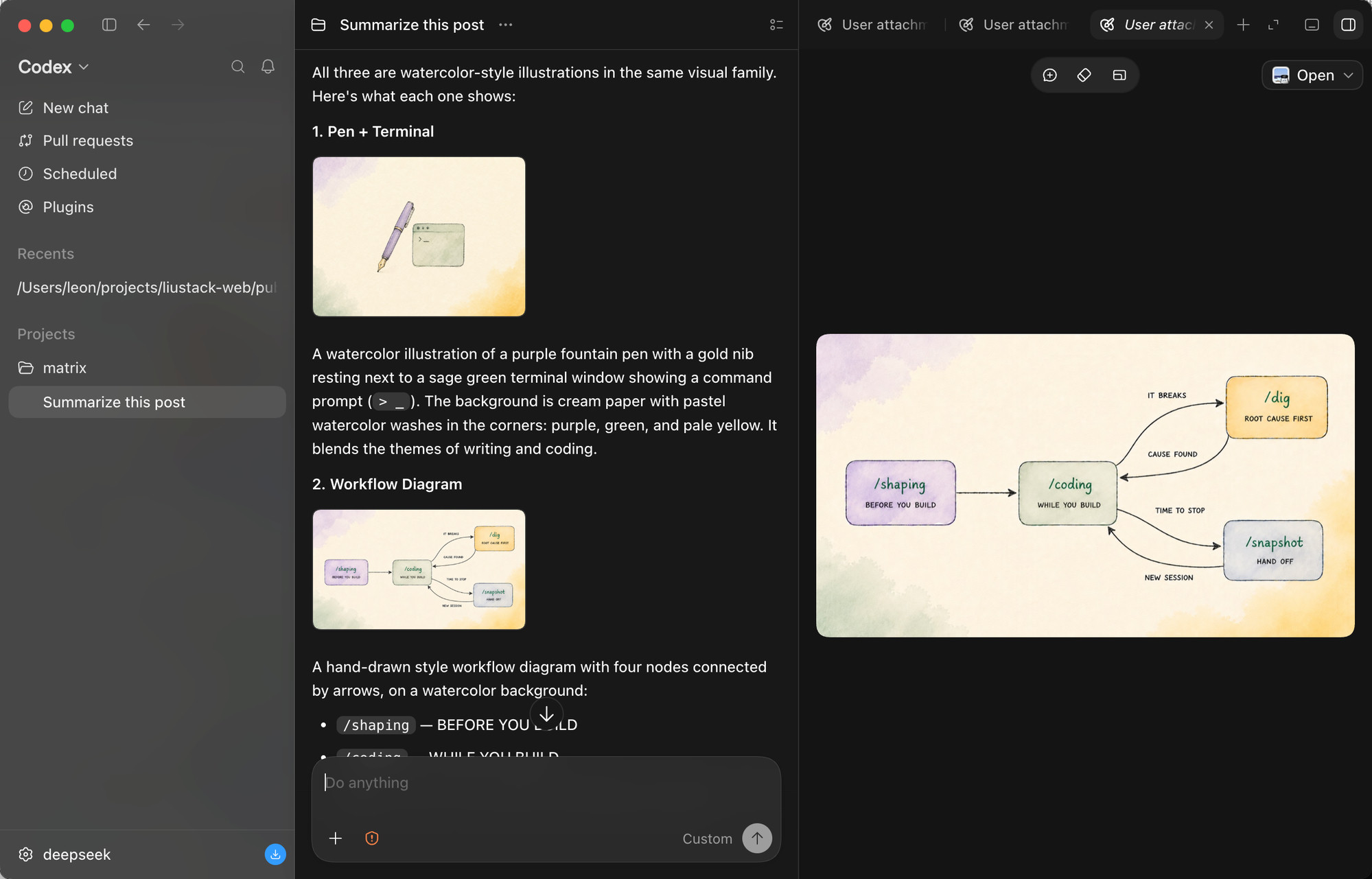
Three images pasted at once. The model reads them one by one, spots that they belong to one visual family, and describes each illustration's content and style.
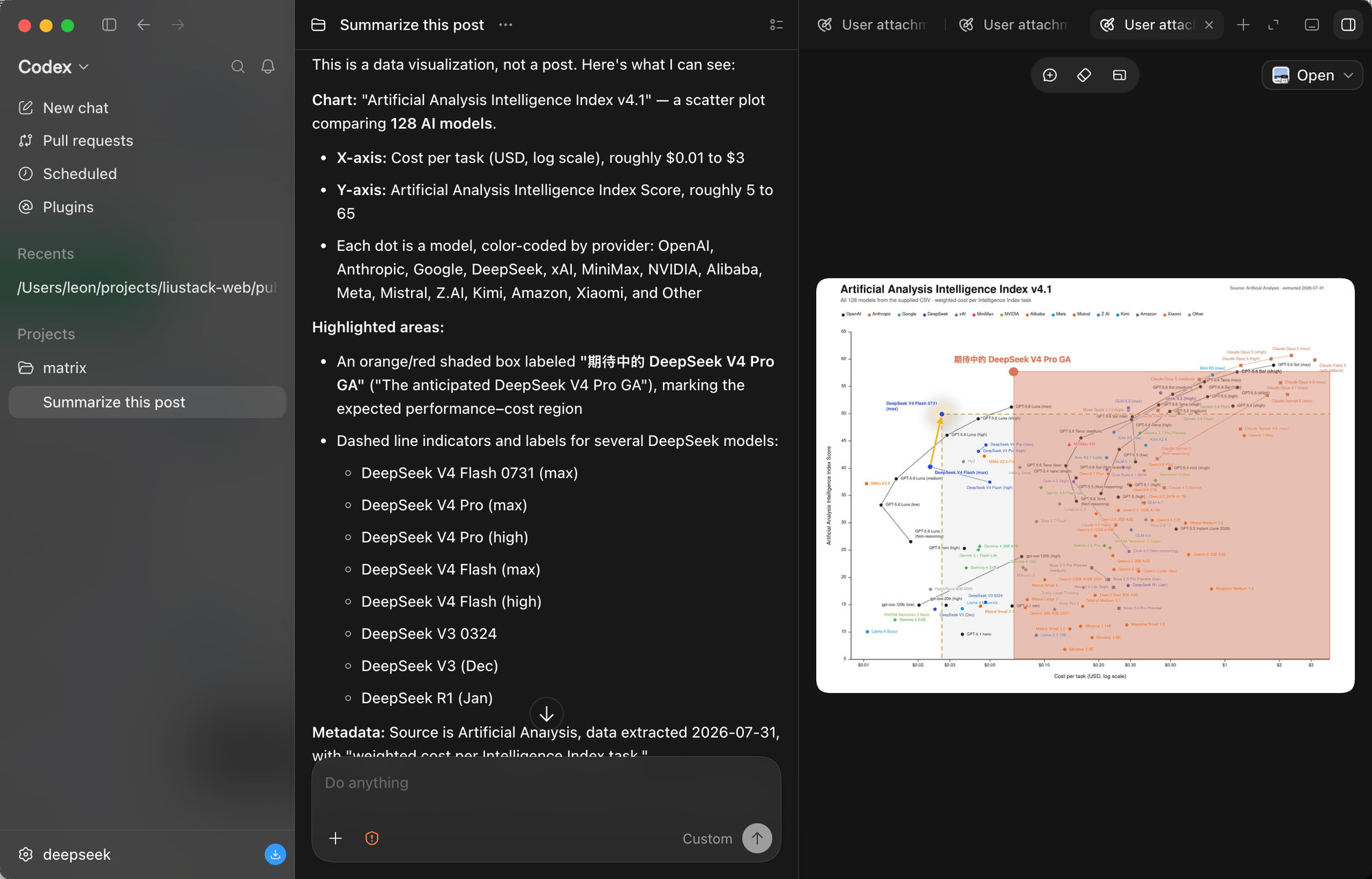
The stress test: a scatter plot comparing 128 AI models. It reads both axes, the log scale, the per-provider color coding, the highlighted region, and every DeepSeek model called out with dashed markers. Dense charts are where vision bridges most often fail.
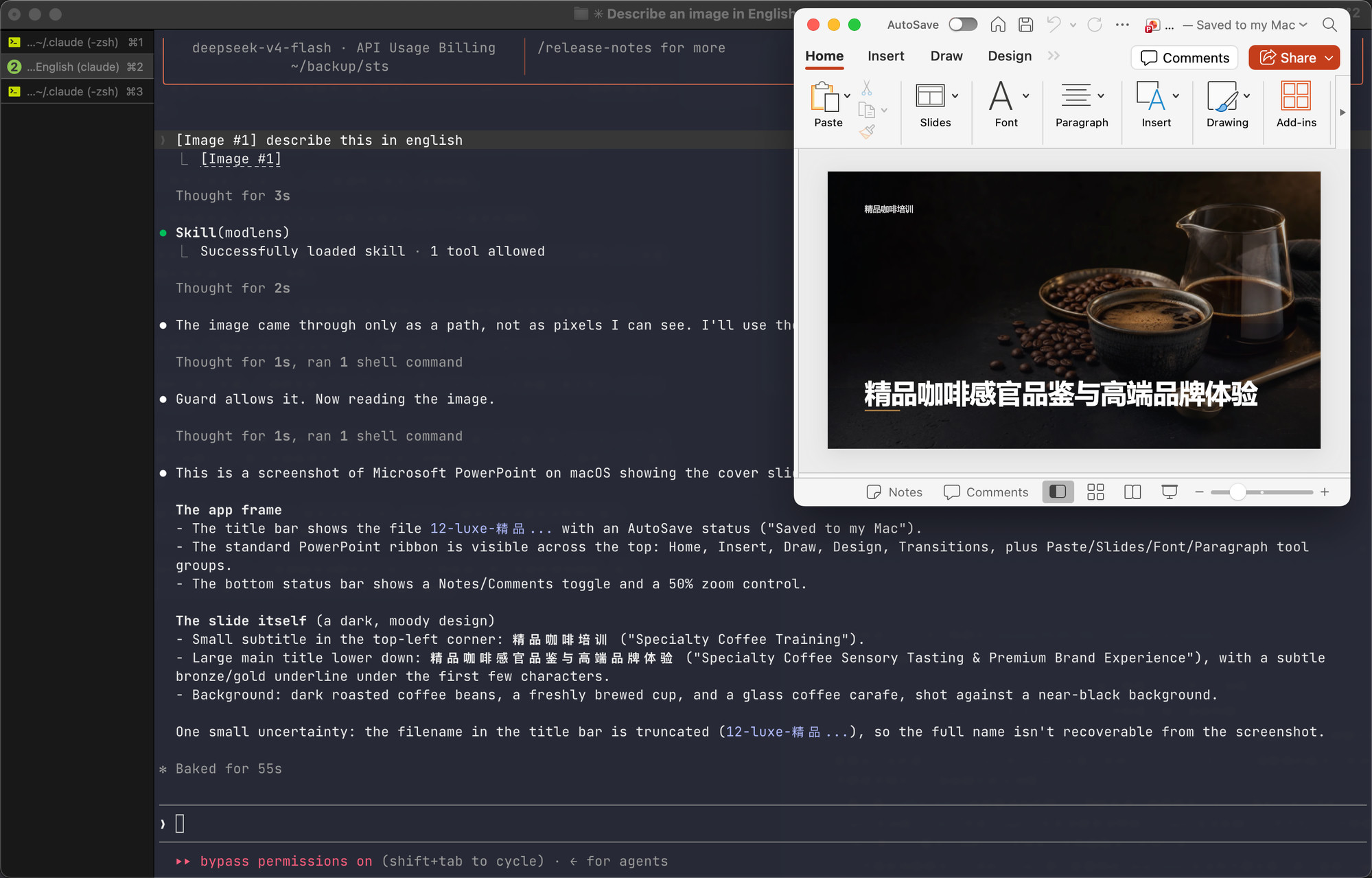
And the paste path, end to end, in a Claude Code terminal on DeepSeek. The pasted image arrives as a path rather than pixels, the skill triggers on its own, the guard confirms the model truly has no vision, and the slide's full content comes back: titles, layout, background, plus an honestly stated uncertainty about the truncated filename.
Documentation
| Doc | Read it when |
|---|---|
| Install guide | Installing the skill step by step (written for an agent) |
| CLI manual | The CLI the skill drives: flags, config, doctor |
| Troubleshooting | A command failed and the message needs decoding |
| Configuration | Setting a key, switching providers, fixing config |
| Output contract | Parsing the JSON or building on it |
| Harness setup | Wiring it into Codex, Claude Code, Pi, or OpenCode |
| Security | File permissions, image content as untrusted input |
| CHANGELOG | Finding what changed in a version |
Contributing
ModLens does not accept pull requests. The project is maintained by a single author who reviews every line, which is a deliberate choice for reliability. Two effective ways to contribute:
- Open an issue. Bugs, suggestions, confusing errors, unclear docs. Issues are read and shape what gets built next.
- Fork it. Under MIT your copy is fully yours to modify and publish.
Shameless plug
This project runs on LIUSTACK Skills: shaping before you build, coding while you build, dig when it breaks, snapshot when you hand off. Lighter than Superpowers, and stronger.
npx -y skills add liustack/liustack -g
⭐ If it helps, star ModLens and liustack. Stars are how the next developer finds them.
Star History
Disclaimer
Provided as-is under the MIT License below. The author makes no warranty and gives no endorsement for any particular use, commercial use included. Your use of upstream engines (Antigravity CLI, the Gemini, OpenAI, and Anthropic APIs, and any OpenAI-compatible endpoint) is governed by their own terms and quotas, which you are responsible for.
License
MIT
Reviews (0)
Sign in to leave a review.
Leave a reviewNo results found