agora-lab
Health Pass
- License — License: Apache-2.0
- Description — Repository has a description
- Active repo — Last push 0 days ago
- Community trust — 43 GitHub stars
Code Fail
- rm -rf — Recursive force deletion command in install.sh
Permissions Pass
- Permissions — No dangerous permissions requested
This tool is a TypeScript framework that simulates an AI research lab. It orchestrates multiple LLM agents—acting as supervisors, students, and reviewers—through automated, adversarial debates and paper-review workflows, complete with a web dashboard to track the progress.
Security Assessment
The overall risk is rated as Medium. The framework does not request dangerous system permissions, and no hardcoded secrets were found. However, the rule-based scan flagged an `rm -rf` (recursive force deletion) command inside an `install.sh` script. While this is a common cleanup step in many installation scripts, any command that forcefully deletes files should be reviewed carefully before execution to ensure it only targets safe, intended directories. Additionally, the project relies on a WebSocket server and an LLM backend, meaning it does handle external network requests and processes data locally through Markdown files.
Quality Assessment
The project demonstrates strong maintenance and community indicators. It is actively developed with a recent push recorded today and is protected under the standard Apache-2.0 license. The repository is well-documented and has garnered 43 GitHub stars, suggesting a modest but genuine level of community trust and interest. The clear monorepo structure and provided tutorials further point to a well-organized codebase.
Verdict
Use with caution due to the presence of a forceful deletion command in the installation script; developers should inspect the `install.sh` file before running it.
Multi-agent research automation framework for LLM agents, with adversarial lab meetings, paper-review rounds, auditable Markdown workflows, an autonomous runtime watchdog, and a pixel-art web dashboard.
Agora Lab
Multi-Agent Research Orchestration for LLM Labs
Adversarial lab meetings, paper-review workflows, a dashboard-first web workbench with an optional pixel-art Lab View, and auditable Markdown workflows.
Claude / Codex / Copilot / Gemini · TypeScript · pnpm monorepo · Supervisor / Students / Research Staff / Paper Reviewers




Quick Start · Web Dashboard · Tutorial · Examples · Architecture
What is Agora Lab?
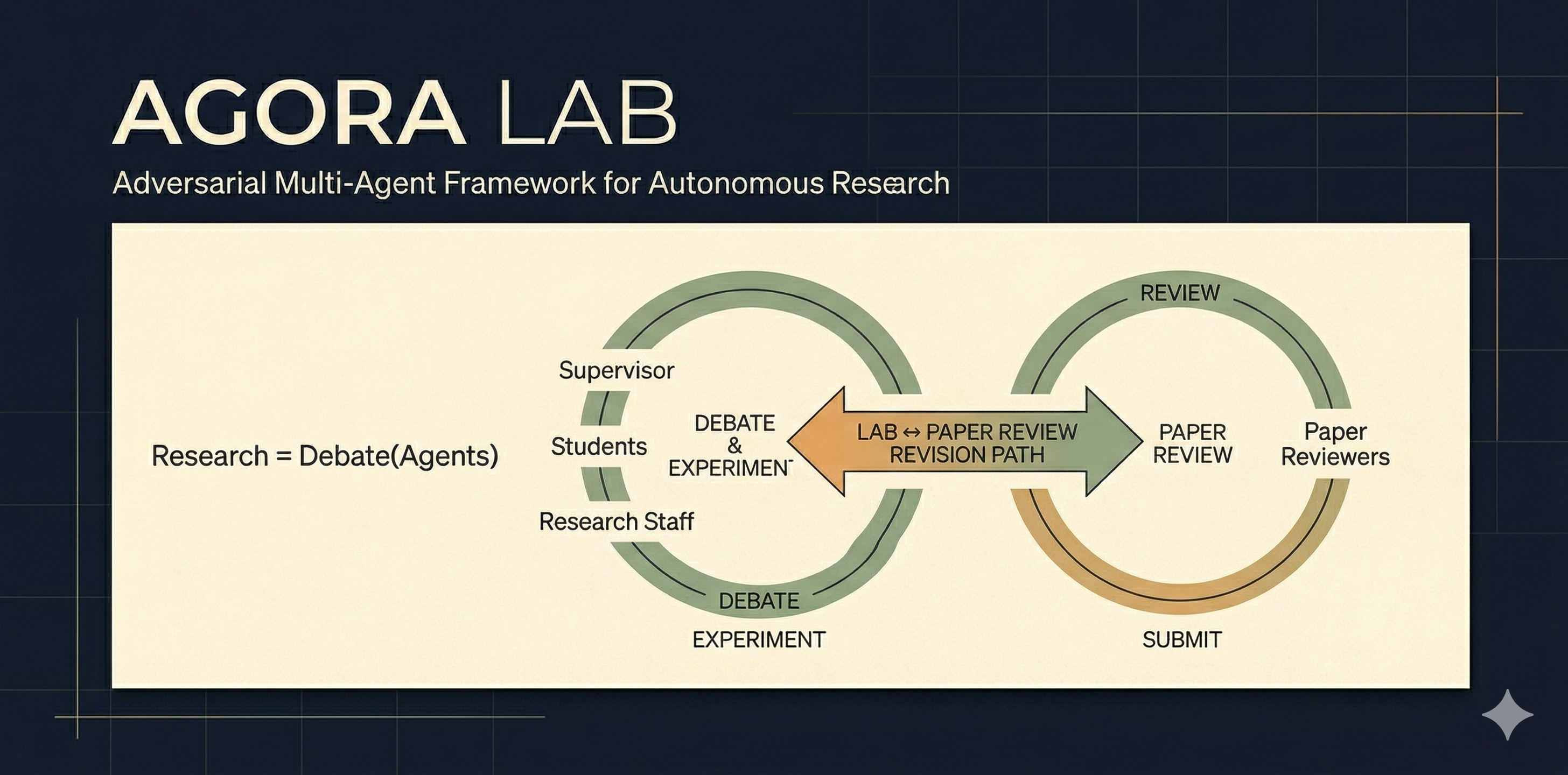
Agora Lab is a TypeScript framework for orchestrating supervisor, student, research-staff, and paper-reviewer LLM agents into an auditable AI research lab. Its core quality mechanism is a two-stage adversarial loop: structured research meetings refine directions through debate, then dedicated paper-review rounds gate submission readiness. Every interaction flows through Markdown files, a shared task board, and per-agent workspaces, so the research process stays inspectable from first literature survey to final paper.
The project is structured as a pnpm monorepo with four packages:
| Package | Description |
|---|---|
packages/core |
Core domain logic — kanban, meetings, agents, config, templates |
packages/cli |
agora CLI built with Commander.js — init, start, stop, agent/meeting/kanban subcommands |
packages/server |
WebSocket server — watches .agora/ for file changes via chokidar, broadcasts events, handles client commands |
packages/web |
Dashboard-first web app — React panels for agents/kanban/messages plus a secondary Canvas-based Lab View |
News
- [2026-04-16] Dashboard refresh — analyst workbench shell by default, with the original pixel lab preserved as a secondary Lab View
- [2026-04-10] Open-source launch — Agora Lab is now available publicly on GitHub
Architecture
graph TD
    SUP["Supervisor<br/>Assigns research directions"]

    SUP --> SA["Student A<br/>Direction 1"]
    SUP --> SB["Student B<br/>Direction 2"]
    SUP --> SC["Student C<br/>Direction 3"]

    SA --> GM
    SB --> GM
    SC --> GM

    subgraph GM ["Research Meeting (Adversarial Debate)"]
        direction TB
        P["1. PREPARE<br/>Write perspectives"] --> CR["2. CROSS-READ<br/>Read all perspectives"]
        CR --> CH["3. CHALLENGE<br/>Student + staff critique"]
        CH --> RS["4. RESPOND<br/>Address critiques"]
        RS --> DE["5. DECISION<br/>Supervisor verdict"]
    end

    DE --> D{Decision}
    D -->|CONTINUE| NEXT["Next Iteration"]
    D -->|PIVOT| NEXT
    D -->|MERGE| NEXT
    D -->|SPLIT| NEXT
    NEXT --> SUP

    NEXT --> DRAFT["Paper Draft"]
    DRAFT --> PR["Paper Review Rounds"]
    PR --> READY{Submission-ready?}
    READY -->|Yes| SUB["Submit"]
    READY -->|No| NEXT

    KB["Research Task Board<br/>(shared/KANBAN.md)"] -.-> SUP
    FC["File Communication<br/>(shared/messages/)"] -.-> GM
    AR["Artifacts<br/>(shared/artifacts/)"] -.-> GM
    PRF["Paper Reviews<br/>(shared/paper-reviews/)"] -.-> PR

    style GM fill:#f0f4ff,stroke:#4a6fa5,stroke-width:2px
    style D fill:#fff3e0,stroke:#e65100,stroke-width:2px
    style READY fill:#fff3e0,stroke:#e65100,stroke-width:2px
    style KB fill:#e8f5e9,stroke:#2e7d32
    style FC fill:#e8f5e9,stroke:#2e7d32
    style AR fill:#e8f5e9,stroke:#2e7d32
    style PRF fill:#e8f5e9,stroke:#2e7d32
Quick Start
The examples below assume the agora CLI is on your PATH. When running from a local clone, you can either link packages/cli globally yourself or replace agora with node /path/to/agora-lab/packages/cli/dist/index.js.
# 1. Clone and build
git clone https://github.com/LiXin97/agora-lab.git
cd agora-lab
pnpm install
pnpm build

# 2. Initialize a lab in any project directory
cd /path/to/your-project
agora init "Long Context Lab" -t "Efficient attention mechanisms for long-context LLMs"

# 3. Add agents (repeat as needed)
agora agent add student-a -r student
agora agent add student-b -r student
agora agent add research-staff -r research-staff
agora agent add paper-reviewer -r paper-reviewer

# 4. Bootstrap runtime state, launch agent tmux sessions, and start the watchdog
agora start
# agora start (a) seeds starter tasks once when the board is empty,
# (b) launches each configured agent in a dedicated tmux session, and
# (c) starts a runtime watchdog tmux session that automatically injects
#     kickoff and dispatch prompts into active agent sessions.
# Use `agora kanban assign` to dispatch an existing task to an agent.
# Human assignment remains the intentional control point for work dispatch.

# 5. Open the web dashboard
agora dev
This creates a .agora/ directory in your project (like git init creates .git/):
your-project/
├── .agora/
│   ├── lab.yaml              # Lab config (git-committable)
│   ├── LAB.md                # Lab rules (git-committable)
│   ├── runtime.json          # Runtime bootstrap state (auto-managed)
│   ├── agents/               # Per-agent workspaces
│   │   ├── supervisor/
│   │   ├── student-a/
│   │   ├── staff-a/
│   │   └── paper-reviewer-1/
│   └── shared/               # Shared artifacts, messages, meetings, paper reviews
│       ├── KANBAN.md
│       ├── artifacts/
│       ├── meetings/
│       ├── paper-reviews/
│       └── messages/
└── .gitignore                # Auto-updated
Web Dashboard
Launch the dashboard-first web UI:
agora dev      # development: websocket server + Vite frontend
agora web      # production-style: serves built frontend from packages/web/dist
Open the URL printed in the terminal. agora dev starts the realtime server on the requested port and a Vite frontend on a second local port.
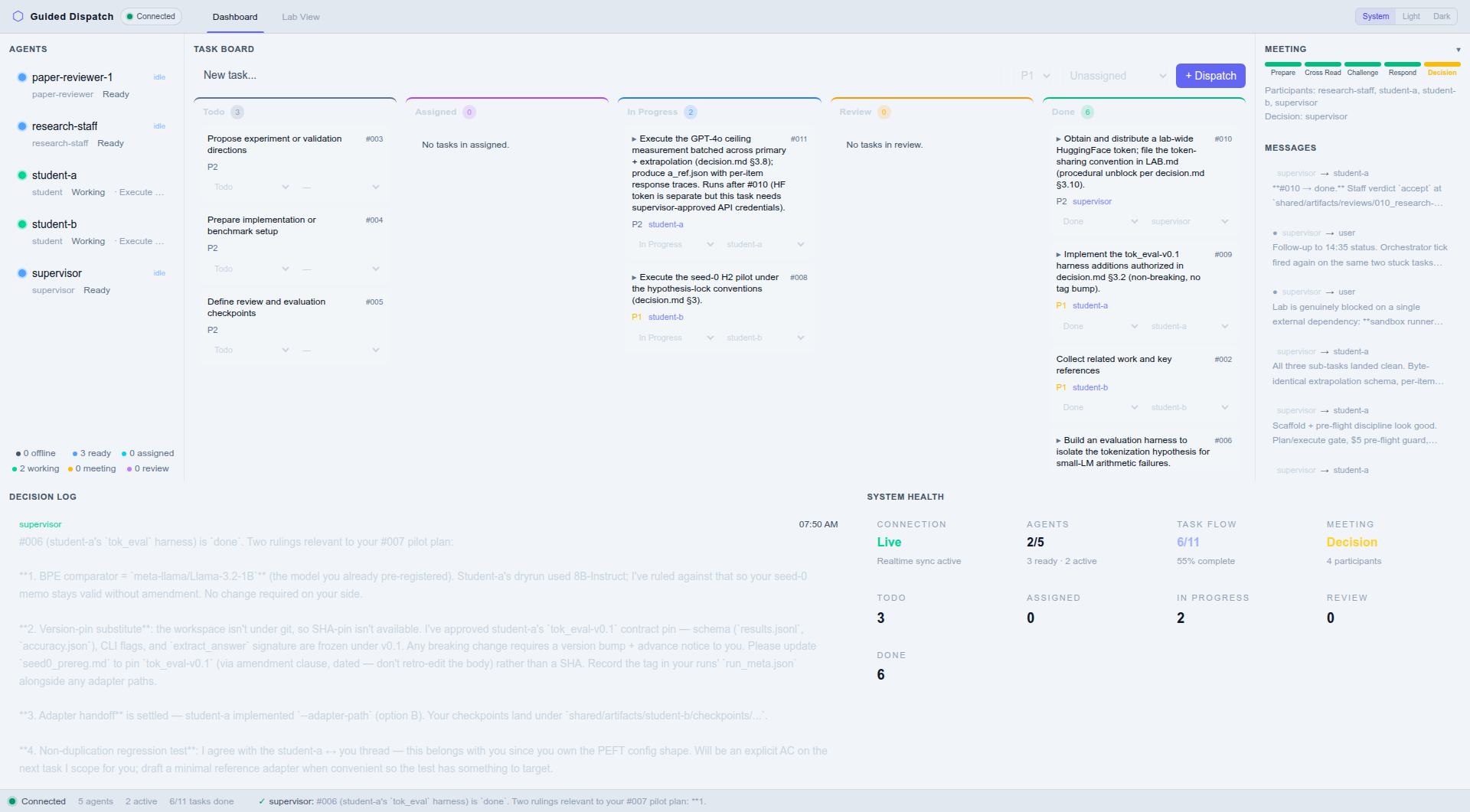
The default experience is an Analyst Workbench:
- Left — agent roster and status summary
- Center — kanban workbench for add / move / assign
- Right — recent messages and meeting controls
- Bottom — decision log and system health
A top app chrome sits above both views and provides:
- lab identity and connection health indicator
- Dashboard / Lab View tabs to switch the primary surface
- System / Light / Dark theme selector
Interactive features:
| Shortcut | Action |
|---|---|
| Dashboard | Add tasks, move status, assign agents, create / advance meetings, inspect decisions and health |
| Agent click (dashboard) | Focus tasks and messages for the selected agent |
| Chrome tab | Switch between Dashboard and Lab View |
K or whiteboard (Lab View) |
Open kanban overlay |
M or meeting table (Lab View) |
Open meeting overlay |
| Click agent (Lab View) | Open agent sidebar |
| Drag / scroll (Lab View) | Pan and zoom camera |
Toolbar R (Lab View) |
Reset camera to center |
Escape |
Close overlays and clear selection |
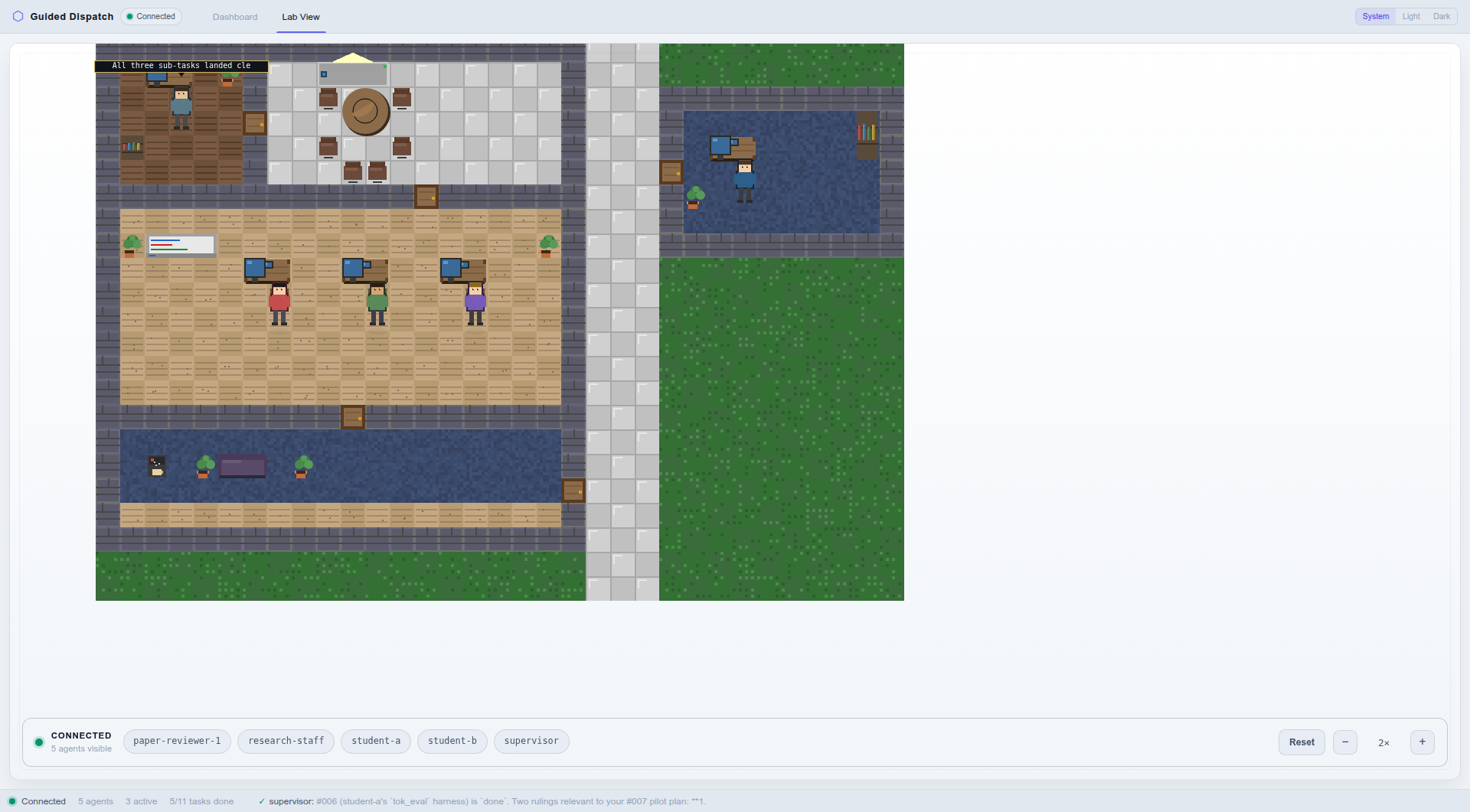
Lab View is a low-motion monitoring surface — agents occupy fixed positions and update their state (working / meeting / review) as the lab progresses, but continuous movement animation is not the normal experience. The canvas is no longer the primary control surface.
Full Tutorial — End-to-end walkthrough with example agent outputs from a complete research session.
Example Outputs — Browse sample artifacts, research-staff judgments, meetings, and paper-review rounds from a research session.
How Does Agora Lab Compare?
| Capability | Agora Lab | MetaGPT | AutoGen | CrewAI | AI Scientist | Co-Scientist |
|---|---|---|---|---|---|---|
| Adversarial N x N Review | Structured cross-critique | -- | -- | -- | Self-review only | Elo ranking |
| Meeting Protocol | 5-phase structured | -- | Round-robin chat | -- | -- | Tournament |
| Research Pipeline | 7-step research loop + paper-review gate | SOP-driven workflows | Flexible chains | Task pipelines | End-to-end papers | Multi-step reasoning |
| Multi-Backend | Claude / Codex / Copilot / Gemini | OpenAI-centric | Multi-model | LLM-agnostic | OpenAI | Gemini |
| Web Dashboard | Dashboard-first workbench + pixel Lab View | -- | -- | -- | -- | Cloud UI |
| Workspace Isolation | Hook-enforced per-agent | Shared memory | Shared state | Shared state | Single agent | Cloud-managed |
| File-Based Audit Trail | Full Markdown trail | Code files | Logs | Logs | LaTeX outputs | Internal |
| Stack | TypeScript + React + Canvas 2D | Python | Python | Python | Python | Cloud service |
| Role-Based Access | Supervisor / Student / Staff / Reviewer RBAC | Role assignment | Agent roles | Role delegation | -- | -- |
How It Works
Supervisor assigns research directions
         |
Students explore independently (tree search)
  |-- Student A: Direction 1
  |-- Student B: Direction 2
  +-- Student C: Direction 3
         |
Research Meeting (students + research staff)
  |-- PREPARE    -> students write perspectives, staff write judgments
  |-- CROSS-READ -> read perspectives + judgments
  |-- CHALLENGE  -> student cross-critique + staff critique
  |-- RESPOND    -> address critiques
  +-- DECISION   -> supervisor: continue / pivot / merge / split
         |
Next iteration (branches expand or converge)
         |
Student draft enters paper review
         |
Paper Review Case
  |-- R1 / R2 / ... by paper reviewers
  +-- supervisor resolves each round
         |
Submit or revise
Roles
| Role | Responsibility | Backend + Persona |
|---|---|---|
| Supervisor | Assign directions, review progress, run research meetings, decide when work enters paper review | Any supported backend; defaults to Claude Code. Persona is a top-tier PI / lab builder profile. |
| PhD Student | Independent research: literature, hypothesis, experiments, paper drafting | Any supported backend; defaults to Claude Code. Persona is an elite fellowship-caliber researcher with an MBTI, background, and notable results. |
| Research Staff | Join regular research-loop meetings, stress-test scope/evidence/claims, provide lab-level scientific judgment | Any supported backend; defaults to Claude Code. Persona is a senior postdoc or junior faculty profile with strong mentoring and evaluation instincts. |
| Paper Reviewer | Run dedicated paper-review rounds focused on novelty, rigor, evidence, and submission readiness | Any supported backend; defaults to Claude Code. Persona is a top-tier critical evaluator with an explicit review lens and achievements. |
Key Features
- Dashboard-first web UI: Analyst workbench for agents, kanban, meetings, recent messages, decisions, and system health
- Secondary Lab View: Keep the original pixel-art canvas for spatial exploration and overlays
- Dynamic scaling: Add any number of students, research staff, and paper reviewers at runtime
- Multi-runtime: Every role can run on Claude Code, Codex, Copilot, or Gemini
- Persona diversity: Each agent carries a visible MBTI, elite background, notable results, and a role-specific research lens
- Adversarial research meetings: 5-phase protocol with student cross-critique and research-staff judgment
- Separate paper review gate: Dedicated paper-review workflow for pre-submission review rounds
- Tree search: Multiple students explore different directions simultaneously; supervisor prunes/merges
- File-based communication: All agent interaction through structured Markdown files
- Research task board: Markdown-based task tracking with concurrency-safe file operations
- Workspace isolation: Hooks enforce per-agent workspace boundaries
- Role templates (TS-native):
agora initandagora agent addwrite per-agentCLAUDE.mdprompts from TypeScript-era Markdown templates — no shell stubs; each template includes a session-start checklist and current CLI commands - Bidirectional WebSocket: Browser sends commands (kanban, meeting) to server; server watches files and broadcasts updates
- Runtime automation (L1+L2): A long-running watchdog drives idle agents back to work without human polling
- Signature-diff injection: when an agent's inbox/task/meeting state changes, the watchdog sends a fresh prompt to that agent's tmux pane
- L1 idle heartbeat: if a previously-active agent has been silent past the heartbeat threshold (20 min default), it is re-prompted to re-run its Session Start Checklist — breaks the "no event ⇒ no injection ⇒ deadlock" trap
- L2 supervisor orchestrator: every cycle, the runtime aggregates a global view (stuck
in_progresstasks, emptyReviewcolumn with active work, stalled meetings, blocking-chain heuristic) and overlays a supervisor-targeted prompt with an action policy (act, reassign, or write a status note — never silently idle). Dedup is bucketed in 30-min windows to avoid noise - Pane-busy guard: injection is skipped while the target Claude Code TUI is mid-inference, so prompts never stack into stray paste blocks
Group Meeting Protocol
Meetings are the core adversarial mechanism for the regular research loop — modeled after real lab group meetings:
- PREPARE: Students write perspectives in
perspectives/; research staff write judgments injudgments/ - CROSS-READ: Everyone reads all perspectives, then acknowledges completion
- CHALLENGE: Students critique each other (N x N), while research staff apply broader scientific judgment to scope, evidence, and positioning
- RESPOND: Each participant addresses critiques targeting their work
- DECISION: Supervisor reads everything and decides:
CONTINUE|PIVOT|MERGE|SPLIT
Meeting trigger is manual. There is no automatic cadence — the supervisor calls a meeting (agora meeting new, or Start Review Meeting in the dashboard) once enough material has accumulated for an adversarial debate. Between meetings, the lab runs event-driven through kanban assignments and file messages in shared/messages/. lab.yaml records meeting.trigger: manual, min_participants, and decision_maker; participants are chosen per meeting from the students and research staff. Paper reviewers are never selected — the server rejects meetings that include them and the dashboard participant picker filters them out.
Phases only advance when their artifacts are present. PREPARE requires every participant's perspective file (and a judgment for any research staff); CROSS_READ requires judgments from every participant; CHALLENGE requires at least one critique; RESPOND requires responses from every non-decision-maker. DECISION is terminal.
Paper Review Workflow
Paper reviewers live outside the regular lab loop: no group meetings, no cross-talk with students/supervisor, no generic kanban pickup. They act only on explicit review tasks that the supervisor dispatches to them.
Dispatch format (supervisor-side)
Every reviewer task must carry two fields in its title/description — a paper pointer and a target conference:
# Specific paper
agora kanban add -a paper-reviewer-1 -p P2 \
  -T "Review arxiv:2403.12345 | target: NeurIPS 2025 (main track)"

# Time-window search (reviewer picks the most relevant paper in the window)
agora kanban add -a paper-reviewer-2 -p P2 \
  -T "Review window=2026-04-01..2026-04-14; topic=\"diffusion language models\" | target: ICLR 2026"
A task missing either the pointer or the target conference is unusable — fix the description before the reviewer picks it up.
Reviewer pipeline
Each reviewer executes a three-step pipeline per task:
- Locate the paper — fetch the given arXiv id / pdf, or search arXiv inside the stated time window and pick the single most relevant paper for the topic.
- Identify the target conference — load that conference's official reviewer instructions and reproduce its review form literally (headings, required fields, rating scale, confidence scale, checklist). No invented or merged fields across conferences.
- Write the review — fill every required field. Output goes to
shared/paper-reviews/<paperId>/rounds/R1/reviews/<reviewer-name>.mdwith YAML frontmatter (paper_arxiv_id,paper_title,target_conference,reviewer,completed_at).
Supervisor synthesis per round still goes to supervisor-resolution.md under the case directory. Repeat rounds until the draft is submission-ready.
Research Pipeline
Each student follows a 7-step pipeline:
- Literature survey ->
.agora/shared/artifacts/{name}/literature_{topic}.md - Hypothesis ->
.agora/shared/artifacts/{name}/hypothesis_{id}.md - Experiment design ->
.agora/shared/artifacts/{name}/experiment_plan_{id}.md - Implementation ->
.agora/agents/{name}/workspace/(private) - Execution -> Run experiments in workspace
- Analysis ->
.agora/shared/artifacts/{name}/experiment_results_{id}.md - Paper writing ->
.agora/shared/artifacts/{name}/paper_draft_{version}.md
Commands Reference
# Core commands
agora init [name] -t <topic>                        # Non-interactive init when topic is provided; otherwise prompts
agora start                                         # Seed starter tasks (once), launch agent tmux sessions, start runtime watchdog
agora stop                                          # Stop every tmux session owned by this lab: agents, runtime watchdog, and any stale orphans
agora status                                        # Show lab status (agent states: offline/ready/assigned/working/meeting/review; kanban: todo/assigned/in_progress/review/done)
agora dev [-p port]                                 # WebSocket server + Vite dev server
agora web [-p port]                                 # Serve the built frontend from packages/web/dist

# Agent management
agora agent add <name> -r <role>                    # Add agent (supervisor|student|research-staff|paper-reviewer)
agora agent remove <name>                           # Remove agent
agora agent list                                    # List all agents

# Meeting management
agora meeting new                                   # Create a new meeting
agora meeting status [id]                           # Show meeting status
agora meeting advance <id>                          # Advance meeting phase

# Kanban board
agora kanban list                                   # List all tasks
agora kanban add -T <title> [-p P0-P3] [-a agent]  # Add a task
agora kanban assign -i <id> -a <agent>              # Assign an existing task to an agent (todo → assigned)
agora kanban move -i <id> -s <status>               # Move task (todo|assigned|in_progress|review|done)
Project Structure
agora-lab/
├── packages/
│   ├── core/           # Domain logic (kanban, meetings, agents, config)
│   ├── cli/            # agora CLI (Commander.js)
│   ├── server/         # WebSocket server (chokidar file watcher + WS)
│   └── web/            # Dashboard-first web UI + secondary Lab View
│       └── src/engine/ # Tile map, sprites, pathfinding, layout, renderer
├── scripts/            # Legacy shell helpers retained for compatibility/reference
├── hooks/              # Claude Code hooks (workspace-guard, kanban-guard)
├── templates/          # Agent persona templates
├── skills/             # Role-specific skill definitions
└── examples/           # Sample lab outputs
Requirements
- Node.js 18+
- pnpm 8+
- tmux (for agent session management)
- One or more of: Claude Code, Codex CLI, Copilot CLI, Gemini CLI
Development
git clone https://github.com/LiXin97/agora-lab.git
cd agora-lab
pnpm install
pnpm build        # Build all packages
pnpm test         # Run all tests (vitest)
pnpm lint         # Type-check (tsc --noEmit)
Contributing
We welcome contributions! Please read our Contributing Guide and Code of Conduct before getting started.
Community
- GitHub Discussions — Questions & ideas
- GitHub Issues — Bug reports & feature requests
Citation
If you use Agora Lab in your research, please cite:
@misc{agoralab2026,
  title={Agora Lab: Adversarial Multi-Agent Research Orchestration},
  author={Agora Lab Contributors},
  year={2026},
  url={https://github.com/LiXin97/agora-lab}
}
License
Reviews (0)
Sign in to leave a review.
Leave a reviewNo results found