blitzdenk
Health Warn
- License — License: MIT
- Description — Repository has a description
- Active repo — Last push 0 days ago
- Low visibility — Only 8 GitHub stars
Code Pass
- Code scan — Scanned 6 files during light audit, no dangerous patterns found
Permissions Pass
- Permissions — No dangerous permissions requested
No AI report is available for this listing yet.
Coding and research harness in pure Zig. Programmable in Lua
Blitzdenk
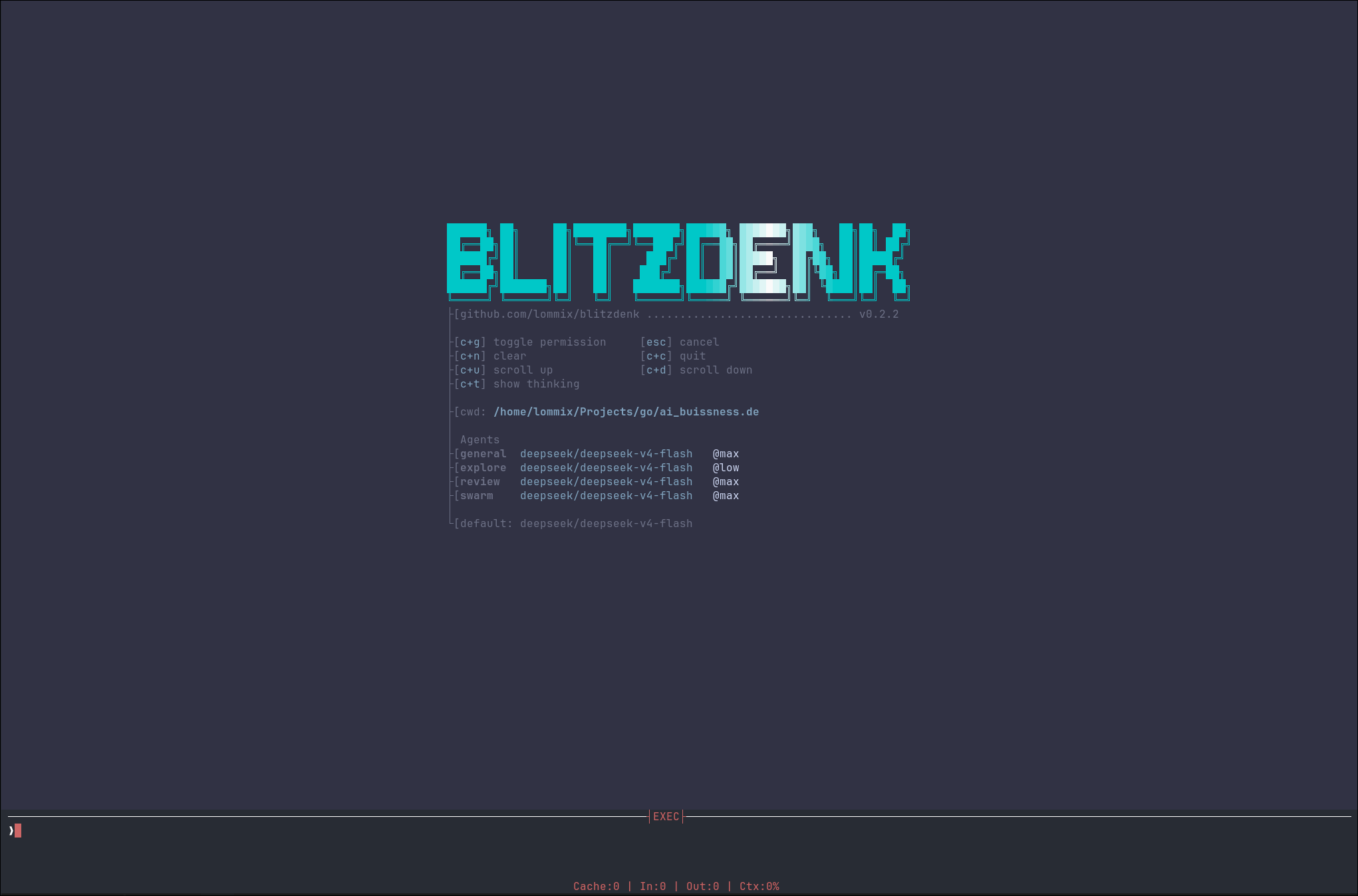
Coding and research harness for posix systems. No dependencies, just Zig and vendored Lua.
Configure, override and extend in Lua. Single binary, no supply chain, bare metal.
Core features and patterns
- All IO goes through GNU core utils (ls, tee, cat, etc.)
- Optional SSH layer: Since IO is core utils, slapping SSH in front is free.
- Small: 5MB native binary, less than 200MB ram usage.
- MCP, LSP and Skill support.
- Multi-provider: Any OpenAI or Anthropic chat/response schema supported, including local AI.
- LuaApi: Code your own tools, system prompts, modes, commands and loops.
Install
You can download the pre compiled binaries from the release page or build it yourself:
zig build --release=small
cp zig-out/bin/blitz ~/.local/bin/blitz
Minimal configuration
Open the blitz.lua configuration at ~/.config/blitzdenk/blitz.lua
Setup at least on provider. The key_envar is not the API key! It's the environment var holding your key.
local anthropic = blitz.add_provider({
	type = "anthropic",
	url = "https://api.anthropic.com/v1/",
	key_envar = "CLAUDE_API_KEY",
	max_tokens = 32000,
	temperature = 1,
})

local llama = blitz.add_provider({
	type = "openai",
	url = "http://127.0.0.1:8118",
	key_envar = "",
	max_tokens = 32000,
})

local novita = blitz.add_provider({
	type = "openai",
	url = "https://api.novita.ai/openai/v1",
	key_envar = "NOVITA_API_KEY",
	temperature = 1,
	max_tokens = 32000,
})

local openrouter = blitz.add_provider({
	type = "openai",
	url = "https://openrouter.ai/api/v1",
	key_envar = "OPENROUTER_API_KEY",
	temperature = 1,
	max_tokens = 32000,
})

local xai = blitz.add_provider({
	type = "response",
	url = "https://api.x.ai/v1",
	key_envar = "XAI_API_KEY",
	temperature = 1,
	max_tokens = 32000,
})

local openai = blitz.add_provider({
	type = "response",
	url = "https://api.openai.com/v1",
	key_envar = "OPENAI_API_KEY",
	max_tokens = 32000,
})
Then set a default model to use, or specify which agent should use which model
blitz.set_model("gpt-5.4-mini", openai)
blitz.set_model_agent(blitz.AGENT_GENERAL, "deepseek/deepseek-v4-pro", "max", novita)
Documentation
checkout the github pages 'getting started' and examples
or take a look at my configuration.
Contribution
No issue no merge. Open source, restricted contribution. Simple bug fixes are welcome.
Note
I am too poor to afford the good stuff. So this harness is hardened using cheap/dumb models, mostly deepseek flash and local.
The idea: If the dumb model can do it, a smart one will exceed expectation.
Reviews (0)
Sign in to leave a review.
Leave a reviewNo results found