AskMyDocs
Health Uyari
- License — License: MIT
- Description — Repository has a description
- Active repo — Last push 0 days ago
- Low visibility — Only 5 GitHub stars
Code Gecti
- Code scan — Scanned 12 files during light audit, no dangerous patterns found
Permissions Gecti
- Permissions — No dangerous permissions requested
Bu listing icin henuz AI raporu yok.
AI Hub & Intelligent Agentic Platform for the Enterprise - self-hostable AI hub for enterprise knowledge.
AskMyDocs — AI Hub & Intelligent Agentic Platform for the Enterprise
Enterprise RAG + Knowledge Graph + Agentic Tool Use, self-hostable, MIT licensed.
AskMyDocs is a self-hostable AI hub for enterprise knowledge. It fuses
hybrid retrieval-augmented generation (pgvector + FTS + reranker), a
typed canonical knowledge graph with human-gated promotion, a streaming
chat surface on the Vercel AI SDK, and a full admin operations cockpit
into a single Laravel platform. It is the open-source, on-prem alternative
to Glean / Notion AI / ChatGPT Enterprise — without the per-seat lock-in.















Ask your docs. Get grounded answers. See the sources. Run agentic tools.
CHATBOT UI/UX
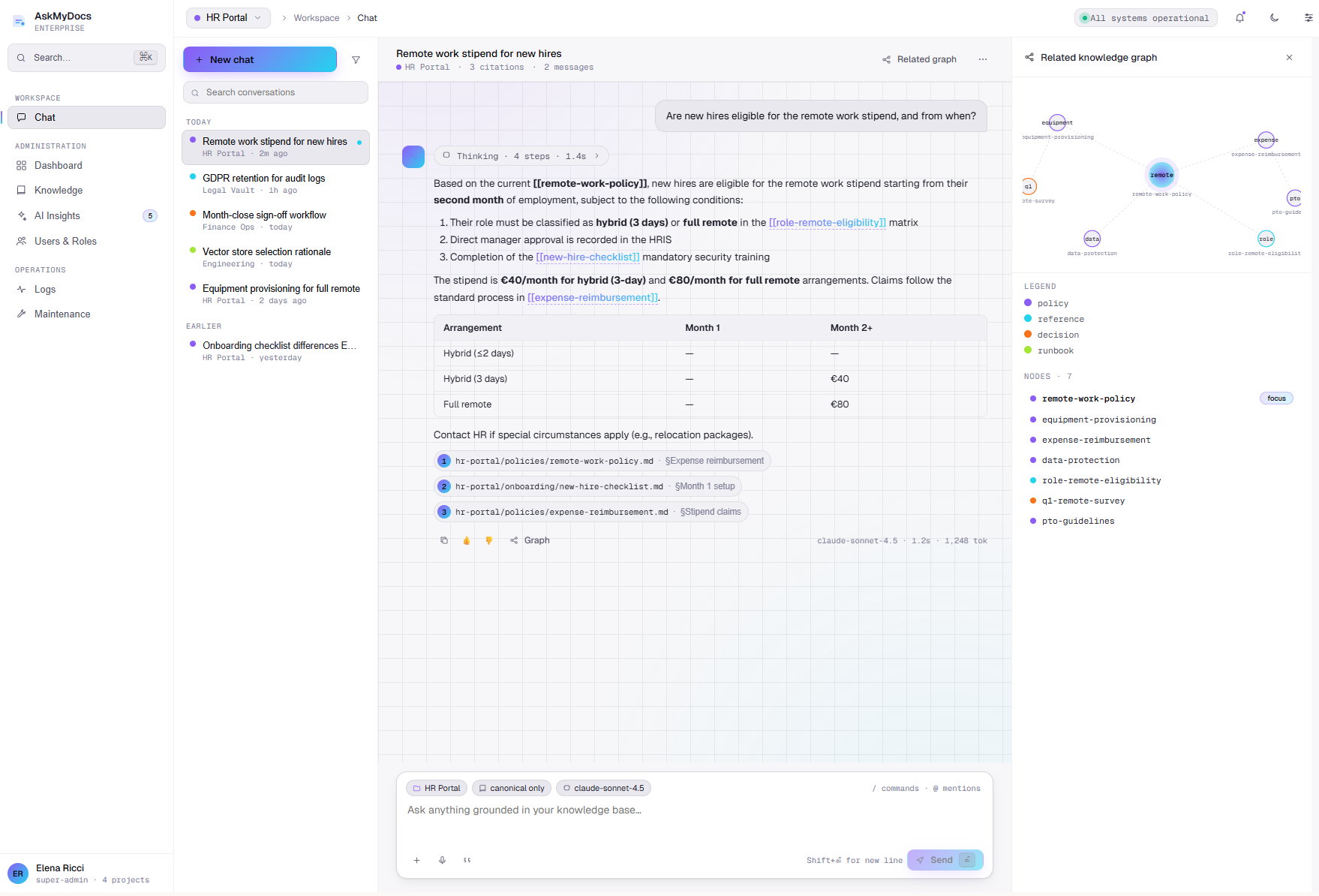
DASHBOARD UI/UX
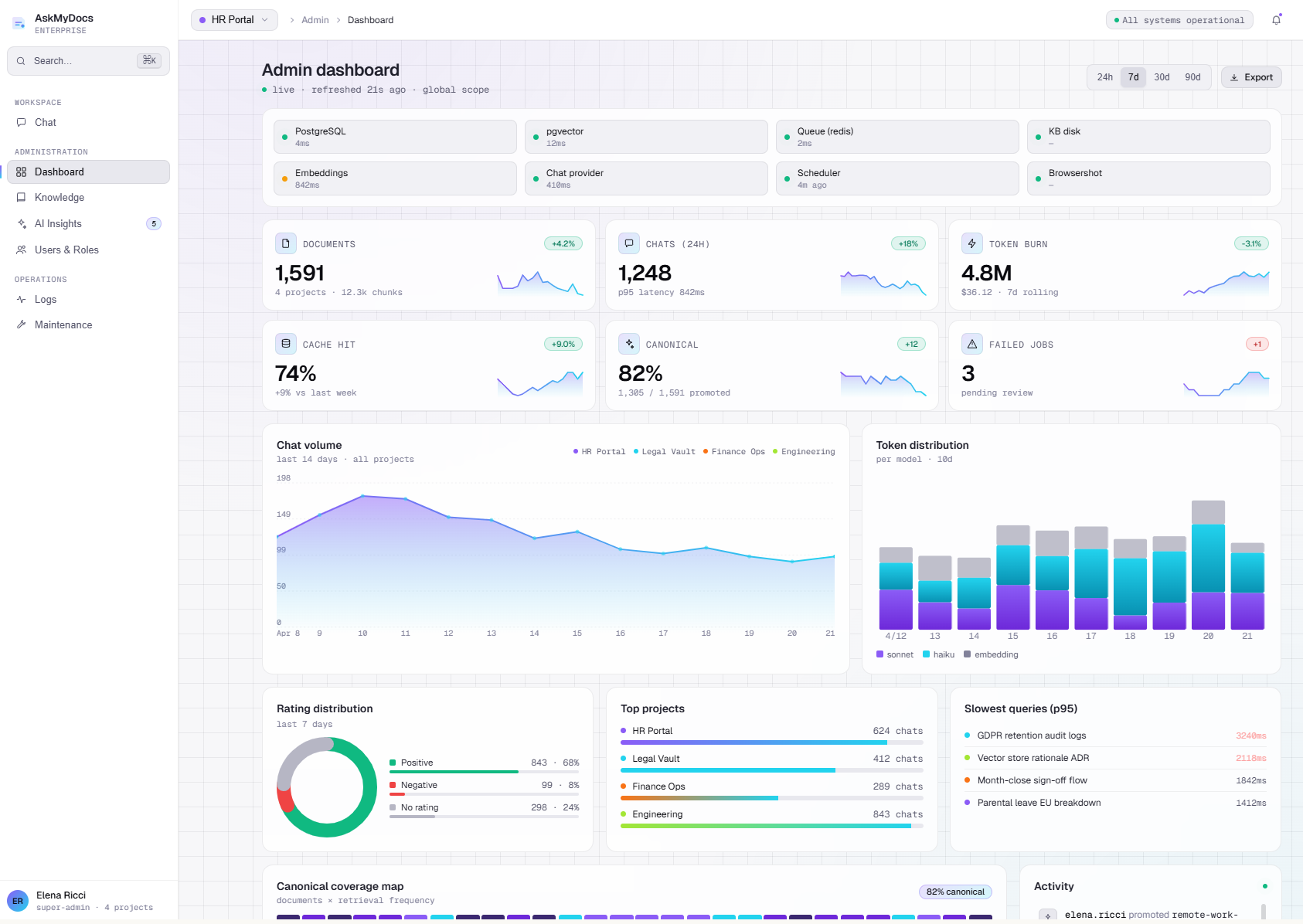
Table of Contents
- What it is
- Why AskMyDocs — the 6 moats
- ✨ Universal Connectors
- ✨ Modern Chat Surface (Vercel AI SDK UI)
- ✨ KITT — Knowledge Interface Tour Toolkit
- ✨ Institutional Memory — anti-repetition retrieval over a living knowledge graph
- ✨ Auto-Wiki — self-compiling agentic knowledge tier
- Features by area
- Quick start (5 minutes)
- Architecture
- Roadmap
- Documentation
- Screenshots gallery
- Sister packages
- Contributing
- License
- Changelog
What it is
What. AskMyDocs is an AI hub for enterprise knowledge built on
Laravel 13 + PostgreSQL + pgvector. It ingests markdown, text, PDF and
DOCX documents into a typed canonical knowledge graph, answers
questions over them with streaming RAG, exposes the same knowledge as
MCP tools for any agentic client (Claude Desktop, Claude Code,
Cursor, custom agents), and ships a full React admin SPA — KPI
dashboard, canonical KB explorer with inline editor and graph viewer,
log viewer (five tabs), whitelisted Artisan maintenance runner, daily
AI-insights panel, and a self-compiling Auto-Wiki admin (health /
indices / explorer with promote-auto→human / per-project settings,
v8.12) — all behind Spatie role-based access control with audit trails
on every destructive mutation.
Why. Most "RAG over docs" tools treat your KB as a pile of
interchangeable chunks. They re-discover the answer from zero on every
query, never persist what your team has already decided, and
re-propose options that were explicitly dismissed three quarters ago.
SaaS competitors (Glean, ChatGPT Enterprise, Notion AI) either lock
you into per-seat contracts and proprietary data residency, or charge
~$500K/year for the on-prem option. AskMyDocs is MIT-licensed,
self-hostable, EU-sovereign-feasible, and ships a typed canonical layer
with human-gated promotion that no public competitor offers.
For whom. Enterprise teams ingesting their architectural decisions
/ runbooks / standards / incidents / domain concepts into a navigable
KB; operators of regulated-industry RAG (GDPR, AI Act) needing
field-level PII redaction at every persistence boundary; engineering
orgs that want LLMs to stop re-proposing rejected approaches; Italian
software companies filing under documentazione_idonea Patent Box;
and anyone allergic to vendor lock-in.
📖 Official Documentation
The full documentation — quickstart, guides, integrations, architecture deep-dives,
and API/CLI reference — lives at:
→ doc.askmydocs.padosoft.com
This README is the above-the-fold pitch; the documentation site is the
authoritative, argued, diagrammed reference.
Why AskMyDocs — the 6 moats
These differentiators come from the public competitor audit atdocs/v4-platform/AUDIT-2026-05-11-competitor-comparison.md
(Section 3, "Where AskMyDocs is genuinely AHEAD") plus the v8.11 Auto-Wiki
cycle. They are the moats no other public RAG platform — open-source or SaaS —
currently ships.
| ★ | Moat | One-line |
|---|---|---|
| ★ | Human-gated canonical promotion pipeline (ADR 0003) | Three-stage API (/suggest → /candidates → /promote) holds the LLM at "draft"; only humans (git push → GH Action) and operators (kb:promote CLI) commit canonical storage. Immutable kb_canonical_audit trail. No public competitor splits "AI proposes" from "human writes" this way. |
| ★ | Retrieval-time knowledge graph + rejected-approach injection | GraphExpander walks kb_edges 1-hop at every query and folds neighbours into the SearchResult. RejectedApproachInjector vector-correlates the query against rejected-approach canonical docs and surfaces them under a ⚠ marker so the LLM stops re-proposing dismissed options. ChatGPT Enterprise / Glean / Vectara do not do this. |
| ★ | PII redaction at 11 persistence boundaries (default-OFF, granular per touch-point) | padosoft/laravel-pii-redactor v1.2 wired at 11 touch-points across observers, middleware, Monolog processor, failed-job listener, Flow payload redactor, insights inspector. EU-GDPR-grade field-level redaction inside the app boundary — not just data-residency. Every knob default-OFF so v3 / v4.0 hosts see byte-identical behaviour until they opt in. |
| ★ | MIT-licensed, self-hostable, on-prem feasible (no $500K/yr vendor contract) | Vectara is the only competitor that ships on-prem ($500K/yr public list). Glean / Notion AI / ChatGPT Enterprise / M365 Copilot are SaaS-only. AskMyDocs runs on any Laravel + PostgreSQL + pgvector host with zero vendor lock-in; the entire sister-package stack is MIT and independently reusable. |
| ★ | Eval-harness CI gate + nightly LLM-as-judge + adversarial cohorts | padosoft/eval-harness v1.2 RAG regression gate on every PR (4 datasets / 1 baseline + 3 adversarial / 7 metrics including custom CitationGroundednessMetric + CosineGroundednessMetric); eval:nightly Artisan cron at 05:30 UTC with three-fence cost guard, regression detection vs prior baseline, Log::alert + sidecar on regression; adversarial-lane nightly opt-in shipped in v4.4. Out-of-the-box eval surface nobody else publicly ships. |
| ★ | Self-compiling Auto-Wiki tier behind an anti-hallucination firewall (v8.11) | A second-class auto tier the system builds itself — on ingest the LLM enriches frontmatter (tags / summary / cross-refs / evidence-tier), materialises a navigable graph, synthesizes new domain-concept pages, indexes + lints them, agentically navigates (multi-hop BFS), and cross-model-reviews its own output — yet the reranker firewall always ranks human-accepted > auto > raw, so machine knowledge never silently becomes authoritative. Every layer is reversible, audited, tenant-scoped, default-ON-but-degradable, and exposed PHP + HTTP API + MCP. No public RAG platform ships a self-maintaining knowledge tier behind a human-vouched firewall. |
Plus: a closed-loop KB Lifecycle Intelligence suite (v8.7 → v8.11)
Beyond the moats, the v8.7–v8.11 cycles shipped a closed governance loop most
RAG tools simply don't have — the exact capabilities the
2026 Affine KB Buyer's Guide
tells buyers to demand:
- Content-gap analytics — every question the KB couldn't answer (sync and streaming
refusals) is ranked under Admin → Content Gaps so editors write the missing article next.
The guide names this in three separate sections; few competitors expose it at all. - Obsolescence intelligence on every change and delete — the AI deep-analysis flags which
other docs a change (or deletion) makes stale or dangling, suggest-only, human-gated. - Synonym expansion + per-query multilingual FTS — the guide literally lists "Synonym
Expansion: does the AI connect industry terms?" (shipped v8.7) and multilingual consistency
(shipped v8.8). - Review cadence + archival, not deletion — automated stale-review reminders + the Cloud
Time Machine (browse / diff / restore any version) — the guide's "Review Cadence and Archival
Policy" governance section, shipped. - Graph-native navigation — a chat-side Related panel walks the knowledge graph straight
from a grounded answer. - Self-compiling Auto-Wiki (v8.11) — ingest auto-enriches frontmatter + materialises graph
edges, synthesizes recurring-concept pages, maintains per-tenant index hubs, lints wiki health,
agentically navigates multi-hop, cross-model-reviews auto pages, applies change/delete
suggestions, and self-maintains on a daily schedule — all behind the human > auto > raw
firewall. See the dedicated section below. - Engagement & Intelligence Suite (v8.15) — a proactive, multi-channel digest (newly
created / promoted docs · stale review queue · top unanswered questions · KB-health trend ·
"your attention needed"; modified-doc activity shows in the headline metrics) delivered to
email + Discord + Slack + Teams + an in-app feed with
an opt-in AI narrative on a dedicated free model; an admin engagement dashboard (contributor
leaderboard / coverage / answer-rate / decision-debt trend) and a personal My KB dashboard
(your score / rank / impact / review queue); and opt-in gamification (config-driven badges
over real contribution metrics, default-OFF). Built to surpass Stack Overflow for Teams /
Zendesk / Notion on packaging + delivery breadth; every capability tri-surface (PHP + API +
MCP). See the doc-site.
✨ Universal Connectors
Plug AskMyDocs into Google Drive, Notion, OneDrive, Evernote, Fabric, Confluence, and Jira with OAuth in one click — every document chunked and cited correctly per source.
Most "RAG over docs" tools either expect a pile of pre-flattened
markdown or ship a single brittle "Google Drive sync" feature. AskMyDocs
v4.5 ships a real connector framework + seven native connectors
- per-source chunkers so every external knowledge corpus lands in
the canonical KB with its provenance, native IDs, ACL hints, and
status preserved — and gets chunked the way that source actually wants
to be chunked.
- 7 native connectors live in v4.5 —
google-drive(OAuth2 + delta-query),notion(OAuth2 + block paginator),evernote(OAuth +.enexbulk import),fabric(API-key, OAuth pending upstream),onedrive(Microsoft Graph delta-query — supportstext/markdown/text/plain/application/pdf; Office formats.docx/.xlsx/.pptxingestion deferred),confluence(Atlassian OAuth 2.0 3LO;cloud_idpersisted in tenant-scopedconnector_credentials.extra_json.cloud_id, optionally reused by a Jira install in the same tenant/workspace),jira(Atlassian OAuth 2.0 3LO + ADF-to-markdown + injection-safe JQL builder). - Per-source chunkers —
NotionBlockChunker/ConfluencePageChunker/OfficeDocChunker/AtomicNoteChunker/JiraIssueChunker/PdfPageChunkerdispatched viaPipelineRegistry::resolveChunker()(R23 FQCN-validated +supports()mutex-checked at boot). - Rich frontmatter capture — every connector populates document-level metadata (
connector,external_id,external_url, native timestamps) plus chunk-level metadata (source_type,search_tags(top-level in chunk metadata),recency_bucket, ACL hint, status, preamble-path). DrivesKbSearchServicefacets +RerankerLayer-4 signals (tag overlap + recency + status-active + preamble-match). - Admin OAuth flow at
/app/admin/connectors— React SPA + Spatie super-admin gate + signed OAuth callback + per-installationconnector_installations+connector_credentialsrows + scheduler-driven incremental sync viaApp\Jobs\ConnectorSyncJob. - Opt-in live-test recording infrastructure —
tests/Live/Connectors/skeleton + per-provider env-var guard +docs/v4-platform/RUNBOOK-live-fixture-recording.mdjunior-proof setup guide. CI runs onlyUnit+Feature; operators refresh fixtures explicitly when provider APIs drift.
How it compares
| Capability | AskMyDocs v4.5 | Glean | Notion AI | ChatGPT Enterprise | M365 Copilot | Mendable | Vectara |
|---|---|---|---|---|---|---|---|
| Self-hostable + connector framework | ✅ MIT | ❌ SaaS | ❌ SaaS | ❌ SaaS | ❌ SaaS | ❌ SaaS | ❌ $500K/yr |
| Native Google Drive | ✅ | ✅ | ❌ | ✅ | ❌ | partial | ❌ |
| Native Notion | ✅ | ✅ | ✅ | ✅ | ❌ | partial | ❌ |
| Native OneDrive | ✅ | ✅ | ❌ | ❌ | ✅ | ❌ | ❌ |
| Native Evernote | ✅ | ❌ | ❌ | ❌ | ❌ | ❌ | ❌ |
| Native Confluence | ✅ | ✅ | ❌ | ❌ | partial | partial | ❌ |
| Native Jira | ✅ | ✅ | ❌ | ❌ | ❌ | partial | ❌ |
| Source-aware chunking framework | ✅ | private | ❌ | ❌ | ❌ | partial | partial |
| Plugin/package extensibility | ✅ (v4.6 packages) | ❌ | ❌ | ❌ | ❌ | ❌ | ❌ |
Try it. Read docs/connectors/README.md
for the developer guide (10-method ConnectorInterface contract +
auto-discovery + framework reuse pattern), then log in as a
super-admin and navigate to /app/admin/connectors to install the first
connector.
✨ Modern Chat Surface (Vercel AI SDK UI)
Stop / regenerate / branch / inline-edit / token-cost meter — the chat surface every modern AI app should have, with full streaming citations and suggested follow-ups.
The chat UX gap against Claude Desktop / ChatGPT Plus / Vercel
reference apps is what 90% of first-time users notice and 0% of
self-hostable RAG OSS ships. v4.5 closes that gap on all seven Tier 1
affordances plus the first Tier 2 win (suggested follow-ups), built on
top of the v4.0 Vercel AI SDK v6 UIMessageChunk streaming foundation.
- 7 Tier 1 features — stop-streaming button (
AbortController-backed), regenerate-last-assistant, branch-from-message endpoint (forks the conversation tree), inline-edit user message, token+cost meter (BEconfig('ai.cost_rates')), enhanced per-message provider+model+timestamp badge, copy-code-block. - Suggested follow-up pills —
SuggestedFollowupGeneratorderives three follow-up prompts from the assistant's last reply; renders as clickable pill chips under the message; submits via the streaming endpoint when clicked. - Full Vercel AI SDK v6 message-parts integration —
MessageStreamControlleremits canonicalstart/text-start/text-delta/text-end/source-url/data/finishframes over SSE;useChatStream()exposesdata-state="idle|loading|ready|empty|error"for deterministic Playwright waits (SDKsubmittedandstreamingstatuses both map toloadingviamapStatusToDataState()— seefrontend/src/features/chat/map-status-to-data-state.test.ts). - Canvas-ready architecture (artifact panel deferred to v5.x) — Tier 2 stretch (tool-result rendering, streaming source-document parts, conversation export, image attachments, artifact panel) is deliberately deferred to a v5.x milestone so it can be designed alongside the MCP client tool-result surface and share one storage contract. See ADR 0008 D4.
- Zero-config for OpenAI / Anthropic / Gemini / OpenRouter / Regolo — OpenAI, Anthropic, Gemini, and OpenRouter are called via raw
Http::(no SDK); Regolo is wired through thepadosoft/laravel-ai-regoloSDK adapter onlaravel/ai.AiManager::chatStream()synthesises a single-chunk SSE for providers without native streaming via theFallbackStreamingtrait.
Try it. Open /app/chat in the React SPA. Start a long answer
and hit Stop; click Regenerate; hover the assistant message and pick
Branch (a new conversation forks from that point); pick a follow-up
pill chip to chain into the next prompt; hover any code block for the
Copy button.
✨ KITT — Knowledge Interface Tour Toolkit
KITT (Knowledge Interface Tour Toolkit) is a one-<script> embeddable, page-aware, agentic AI assistant for any website — it answers grounded questions with citations, reads the page, and (when allowed) drives it: clicks, types, navigates, submits, and calls your backend tools.
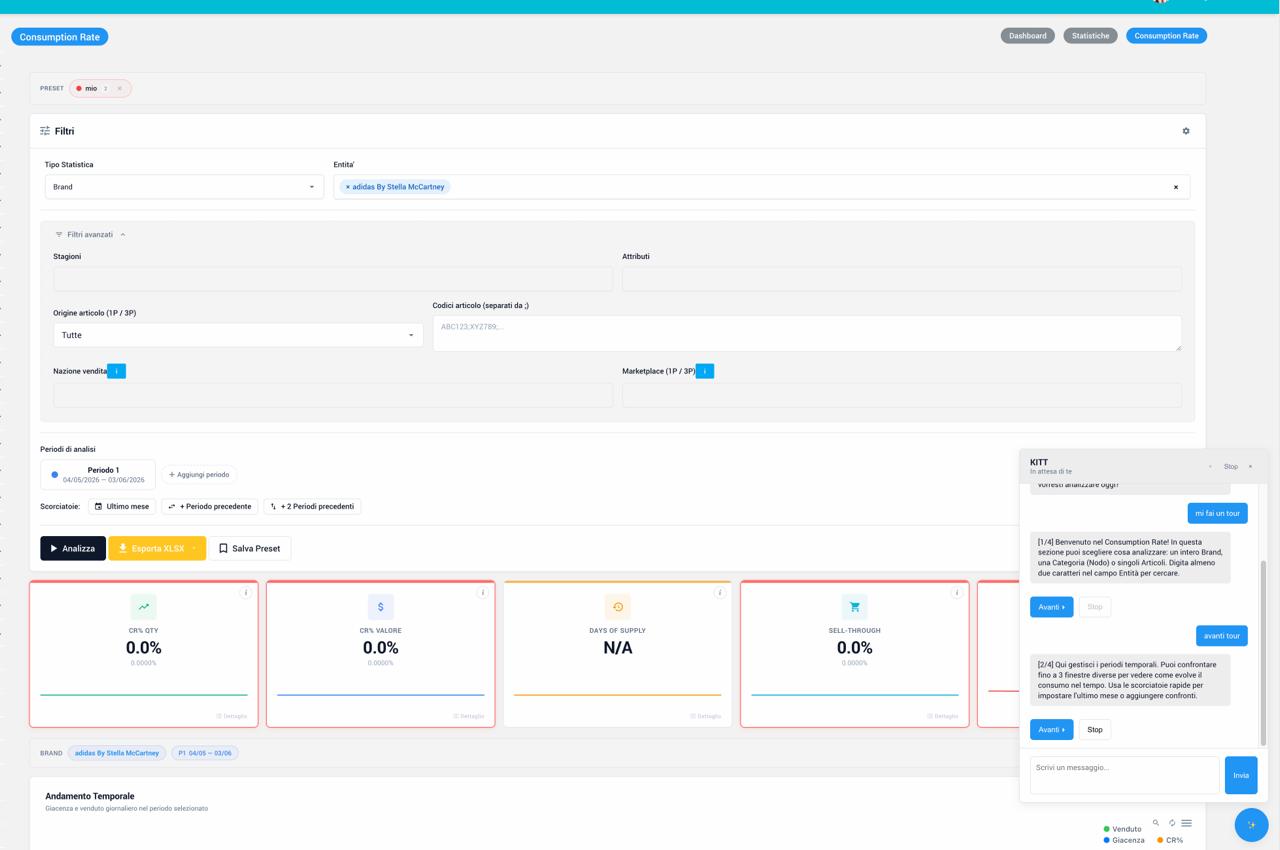
Most "chat widget" products are a stateless text box bolted to a generic
LLM. KITT is the embeddable surface of the same AskMyDocs retrieval
stack — grounded, cited, tenant-isolated — plus a bounded ReAct loop
that perceives and acts on the host page. A customer pastes a snippet; the
widget captures a structured snapshot of the current page (regions, fields,
actions, messages, outline) and reasons about what's actually on screen.
- Embed in one snippet —
<script>window.AskMyDocsWidget = { key: 'pk_…', apiBase: '…' }</script>+ the async loader. Two layouts: a floatinghelperlauncher or aninlinemounted block. Theme, title, skill all configurable viawindow.AskMyDocsWidgetordata-*attrs. - Grounded + cited, never a generic bot — the widget runs the first-party
KbSearchService+ reranker + refusal gate, scoped to the key's tenant + project. The browser never names a tenant — tenant/project are resolved server-side from the key (R30); cross-key/cross-tenant session access is404(anti-IDOR). - Agentic by design — the LLM emits tool calls executed in the page DOM (
click/type/select/navigate_to/submit_form/wait_for+ ~15 more), or server-side via/exec-tool(search_knowledge_base), in a bounded loop with per-session step + consecutive-error caps. Skills (JSON manifests underresources/widget/skills/*) declare which tools, what auto-annotation rules, and the run policies. - Host-Tools Protocol (HTP) — your app can expose its own tools to the agent ("create order", "set rate"), double-gated (per key and per skill) and off by default. The page is annotated with stable, verb-based
data-kitt-*attributes (region/field/action/message/locale/skip);data-kitt-sensitiveandtype=password/hiddenvalues are force-nulled server-side so secrets never reach the LLM or the step log. - Secure embedding — exact-match
Originallowlist (browser mode) orsk_secret (server-to-server); single-use, origin-bound session tokens consumed atomically under a lock (R21, hashed at rest, rate-limit checked before burn); snapshot byte + count caps;javascript:/data:/protocol-relative navigation blocked on both server and client; PII masked on every persisted step (Italian VAT masking is checksum-validated so non-PII codes stay readable). - Full admin surface —
/app/admin/widget(super-admin): create / rotate / revoke keys, manage allowed origins + theme, toggle host-tools, copy the ready-made embed snippet, and replay every session step (PII-masked).
Try it. As super-admin, open /app/admin/widget, create a key (set aproject_key + your site's origin), copy the Embed code snippet into
your page, and reload. Locally, set WIDGET_DEMO_ENABLED=true and open/widget-demo for a self-contained annotated demo page (add ?mode=inline
for the inline layout). Full developer guide:docs/kitt/INTEGRATION.md.
Security & embedding. KITT is a cross-origin embeddable and an
agentic (page-driving) surface, so before embedding it on anything beyond a
public, low-sensitivity page, read the
Security & threat model
section of the integration guide — it documents exactly what is enforced and
why (tenant isolation, exact-match origin allowlist, no-credential CORS, no
host-page XSS, credential-field and navigation guards), the residual/inherent
risks of a public embeddable agent (public-key abuse, prompt-injection-driven
actions, data egress to the LLM), and the best practices the operator and
the host site must follow to mitigate them — includingdata-kitt-skipto
keep sensitive page regions out of the snapshot.
✨ Institutional Memory — anti-repetition retrieval over a living knowledge graph
Your KB doesn't just store documents — it remembers what your team decided,
refuses to let the LLM re-propose approaches you already rejected, and keeps that
memory current by itself.
Commodity RAG treats your corpus as interchangeable chunks: it re-discovers the
answer from zero on every query, never persists what was already decided, and
happily re-suggests an option your team dismissed three quarters ago. AskMyDocs
ships a typed canonical layer (decisions / runbooks / standards / incidents /
integrations / domain-concepts / rejected-approaches) over a lightweight
knowledge graph — and wires both straight into retrieval, so the memory is
not a passive archive but an active participant in every answer.
How your searches benefit — on every query, automatically:
- Graph-expanded recall —
GraphExpanderwalkskb_edgesone hop out from
each canonical seed hit and folds the connected decisions / runbooks / concepts
into the result set, so the answer carries the surrounding context a bare vector
match would miss (config-gated; a clean no-op for tenants with no canonical docs). - Anti-repetition firewall —
RejectedApproachInjectorvector-correlates the
query against yourrejected-approachdocs and surfaces the dismissed options
under a ⚠ marker in the prompt, so the model stops re-proposing exactly what your
team already ruled out. This is the single most-requested behaviour commodity RAG
cannot give you, because it has nowhere to store a rejection. - Evidence-aware weighting — every retrieved chunk carries its evidence tier
(guideline > peer_reviewed > official > … > unverified); the prompt flags
low-confidence claims so an answer never leans on a blog post as if it were a
ratified standard. - Trust-ranked fusion — the reranker fuses vector + keyword + heading signals
and always ranks human-accepted>auto> raw, so machine-written
knowledge can enrich an answer but never silently outranks a human-vouched
decision.
How the memory self-updates and maintains itself — the part that keeps it
from rotting (the self-compiling engine detailed in the
Auto-Wiki section below):
- On ingest, an LLM compiler enriches each document's frontmatter (tags /
summary / cross-references) and materialises those cross-references into real
graph edges + nodes — so a freshly-landed doc becomes navigable immediately,
with zero manual linking. - Recurring concepts that appear across many documents are synthesized into
brand-newdomain-conceptpages, grounded only in the docs that mention them —
the KB grows its own connective tissue instead of waiting for someone to write it. - A daily maintenance sweep rebuilds the per-tenant index hubs, lints the graph
(dangling / orphan / stale cross-references, with safe auto-fix), and backfills
enrichment — so "knowledge improves over time" rather than decaying. - An independent, cross-model review-LLM audits every auto-generated page for
grounding, novelty and contradictions before it is trusted — and the entire
self-maintaining tier sits behind the human > auto > raw firewall, fully
reversible and audited.
Every layer is tenant-scoped (R30), written to the immutable kb_canonical_audit
trail, and config-gated (default-degradable, R43) — and, per R44, exposed across
PHP + HTTP API + MCP. No public RAG platform — open-source or SaaS — ships
institutional memory that both feeds retrieval and maintains itself behind a
human-vouched firewall.
Try it. Promote a decision doc and a rejected-approach doc (git push → GH
Action, or the kb:promote CLI), then ask the chat a question near the rejected
option: the ⚠ rejected-approaches block appears inside the grounded answer, and the
chat-side Related panel walks the graph straight from the decision you just
promoted.
✨ Auto-Wiki — self-compiling agentic knowledge tier (v8.11)
Inspired by Andrej Karpathy's LLM-Wiki pattern (raw → wiki → schema layers;
ingest / query / lint ops) and AutoSci (concept pages + graph edges, entity
index, BFS exploration, cross-model review), AskMyDocs compiles its own wiki
on top of every ingested corpus — and keeps it healthy over time — without ever
weakening the human-vouched authoritative tier.
The cornerstone is a second-class auto tier (knowledge_documents.generation_source ∈ {human, auto}):
AI-compiled knowledge is real, searchable and navigable, but an
anti-hallucination reranker firewall always ranks human-accepted > auto > raw,
and an admin can promote auto → human. Every layer is reversible, audited tokb_canonical_audit, tenant-scoped (R30), and config-gated (default-ON but
cleanly degradable to today's behaviour, R43).
Shipped incrementally across v8.11.0 → v8.11.10 (each its own tagged release):
| Phase | Capability |
|---|---|
| Foundations (v8.11.0) | The auto tier discriminator + reranker firewall + layered AutoWikiGate + dedicated AI-model override + source-retention config + ADR 0014. |
| Compiler (v8.11.1) | After ingest, the LLM auto-enriches frontmatter — tags / summary / aliases / cross-references (allow-listed to real neighbours, anti-hallucination) → frontmatter_json._autowiki. |
| Evidence-tier (v8.11.2) | An evidence-strength axis (guideline > peer_reviewed > official > … > unverified) derived in the same call + surfaced in the RAG prompt to flag low-confidence claims (AutoSci #67). |
| Graph canonicalization (v8.11.3) | Cross-references become real kb_edges + kb_nodes — the auto tier becomes navigable; every auto doc gets a stable auto--namespaced slug. |
| Concept synthesis (v8.11.4) | Recurring concepts across a project become new domain-concept pages, grounded in the docs that mention them (AutoSci /prefill dedup). |
| Indices + log (v8.11.5) | Per-project roll-ups + a per-tenant index hub (the agentic map) + the auto-wiki operation log. |
| Lint / health (v8.11.6) | Deterministic checks — dangling / orphan / stale-cross-ref / missing-index — with safe auto-fix. |
| Agentic navigation (v8.11.7) | Multi-hop, cycle-safe BFS over the graph, anchor-driven from the index — the "navigate the wiki" primitive beyond 1-hop expansion. |
| Cross-model review (v8.11.8) | An independent review-LLM audits each auto page for grounding / novelty / contradictions before it's trusted. |
| Apply engine (v8.11.9) | Change/delete suggestions become concrete, audited, reversible mutations (add cross-ref / deprecate impacted) — manual + opt-in auto-apply (default-OFF). |
| Scheduled maintenance (v8.11.10) | A daily sweep that rebuilds indices, lints, and backfills enrichment so "knowledge improves over time". |
Tri-surface everywhere (R44): every capability is exposed and consumable via
PHP (Artisan commands: kb:evidence-tier, kb:wiki-link,kb:synthesize-concepts, kb:wiki-index, kb:wiki-lint, kb:wiki-navigate,kb:wiki-review, kb:apply-suggestion, kb:wiki-maintain, kb:wiki-promote),
HTTP API (RBAC-gated admin endpoints under /api/admin/kb/*), and MCP
(the enterprise-kb server grew from 14 → 28 tools, incl.KbWikiNavigateTool as the primary agentic surface, KbWikiPromoteTool for
promote/discard, and the v8.15 engagement trio KbEngagementSummaryTool /KbDigestPreviewTool / KbUserBadgesTool) — all thin layers over one shared
core service per capability.
Admin Wiki UI (v8.12.0): a full web surface on the whole engine — Wiki
Health (lint + safe auto-fix), Wiki Indices (hub + per-project roll-ups +
operation log + rebuild), Wiki Explorer (browse by tier, promote auto→human,
discard), Doc Insights → Apply (turn change/delete suggestions into audited
reversible mutations), Auto-Wiki Settings (per-project auto-build gate), and
tier-badged chat citations (auto vs human-vouched) — every screen real-data
Playwright-covered (R13).
Database
DB_CONNECTION=pgsql
DB_HOST=127.0.0.1
DB_PORT=5432
DB_DATABASE=askmydocs
DB_USERNAME=postgres
DB_PASSWORD=secret
AI Provider
The system supports five providers. OpenAI, Anthropic, Gemini, and OpenRouter are called via raw Http::, which keeps auth, retries, timeouts, and response parsing under our control. Regolo is the exception: it is wired through the padosoft/laravel-ai-regolo SDK adapter (built on Laravel\Ai), so chat + embeddings reuse its OpenAI-compatible client.
Config file: config/ai.php
Defaults
# Chat provider. Supported: openai, anthropic, gemini, openrouter, regolo
AI_PROVIDER=openrouter

# Embeddings provider. Must support embeddings (openai, gemini, regolo, openrouter).
# Anthropic does NOT offer embeddings. OpenRouter exposes OpenAI-compatible
# /v1/embeddings (since Oct 2025) routing openai/text-embedding-3-small (default)
# and qwen/qwen3-embedding-4b. Leave empty to let AiManager reuse AI_PROVIDER
# when the default chat provider supports embeddings; otherwise it falls back
# to the first embeddings-capable provider with a configured API key in this order:
# openai → openrouter → regolo → gemini. The 1536-dim defaults (openai +
# openrouter) come first so the stock KB_EMBEDDINGS_DIMENSIONS=1536 pgvector
# schema stays consistent under auto-selection — regolo (4096) and gemini
# (768) require a pgvector resize in lock-step, set AI_EMBEDDINGS_PROVIDER
# explicitly to opt in.
AI_EMBEDDINGS_PROVIDER=openai
OpenAI
AI_PROVIDER=openai
OPENAI_API_KEY=sk-...
OPENAI_CHAT_MODEL=gpt-4o
OPENAI_EMBEDDINGS_MODEL=text-embedding-3-small
OPENAI_TEMPERATURE=0.2
OPENAI_MAX_TOKENS=4096
OPENAI_TIMEOUT=120
Anthropic (Claude)
Anthropic has no embeddings endpoint, so pair it with any embeddings-capable provider — OpenAI, OpenRouter, Regolo, or Gemini. If AI_EMBEDDINGS_PROVIDER is left empty, AiManager auto-selects the first one with a configured API key in this order: openai → openrouter → regolo → gemini. The 1536-dim defaults (OpenAI's text-embedding-3-small + OpenRouter routing the same model) come first so a deployment with the stock KB_EMBEDDINGS_DIMENSIONS=1536 pgvector schema stays consistent under auto-selection; Regolo (4096) and Gemini (768) require a vector(N) resize and a matching KB_EMBEDDINGS_DIMENSIONS change before use, so set AI_EMBEDDINGS_PROVIDER=regolo|gemini explicitly when you've migrated.
AI_PROVIDER=anthropic
AI_EMBEDDINGS_PROVIDER=openai

ANTHROPIC_API_KEY=sk-ant-...
ANTHROPIC_CHAT_MODEL=claude-sonnet-4-20250514
OPENAI_API_KEY=sk-...
Google Gemini
Gemini supports both chat and embeddings. text-embedding-004 is 768-dim, so switching embedding providers requires updating KB_EMBEDDINGS_DIMENSIONS and re-indexing.
AI_PROVIDER=gemini
GEMINI_API_KEY=AIza...
GEMINI_CHAT_MODEL=gemini-2.0-flash
GEMINI_EMBEDDINGS_MODEL=text-embedding-004
OpenRouter (multi-model gateway) — default
OpenRouter proxies hundreds of models. Since Oct 2025 it also exposes an
OpenAI-compatible /v1/embeddings endpoint, so it can serve both chat
and embeddings from the same gateway. Default embedding model isopenai/text-embedding-3-small (1536 dims — matches the defaultKB_EMBEDDINGS_DIMENSIONS, no re-index needed). Alternativeqwen/qwen3-embedding-4b (2560 dims) requires resizing the pgvector
column on knowledge_chunks.embedding + embedding_cache.embedding
and re-indexing. Pair with a separate provider if you prefer.
AI_PROVIDER=openrouter
AI_EMBEDDINGS_PROVIDER=openrouter

OPENROUTER_API_KEY=sk-or-...
OPENROUTER_CHAT_MODEL=openai/gpt-4o-mini
OPENROUTER_EMBEDDINGS_MODEL=openai/text-embedding-3-small
OPENROUTER_APP_NAME="AskMyDocs"
OPENROUTER_SITE_URL=https://kb.example.com
Regolo.ai (by Seeweb)
EU-based, GDPR-compliant, OpenAI-compatible REST API. Supports chat, streaming, embeddings, and reranking via the padosoft/laravel-ai-regolo extension on top of the official laravel/ai SDK. Get keys at dashboard.regolo.ai and see docs.regolo.ai for the full model catalogue.
AI_PROVIDER=regolo
AI_EMBEDDINGS_PROVIDER=regolo

REGOLO_API_KEY=...
REGOLO_BASE_URL=https://api.regolo.ai/v1

# Chat models — `cheapest` / `smartest` aliases pick the right model for
# cost-vs-quality shortcuts (see `Lab::Cheapest` / `Lab::Smartest` in laravel/ai).
REGOLO_CHAT_MODEL=Llama-3.3-70B-Instruct
REGOLO_CHAT_MODEL_CHEAPEST=Llama-3.1-8B-Instruct
REGOLO_CHAT_MODEL_SMARTEST=Llama-3.3-70B-Instruct

# Embeddings — set KB_EMBEDDINGS_DIMENSIONS to the same value below.
REGOLO_EMBEDDINGS_MODEL=Qwen3-Embedding-8B
REGOLO_EMBEDDINGS_DIMENSIONS=4096

# Reranker — used when KB_RERANKING_ENABLED=true.
REGOLO_RERANKING_MODEL=jina-reranker-v2

# Transport + per-call defaults. `REGOLO_MAX_TOKENS` / `REGOLO_TEMPERATURE`
# are the provider-level fallbacks; per-call `$options['max_tokens']` /
# `$options['temperature']` (e.g. `ConversationController::generateTitle`
# capping titles at 60 tokens) take precedence.
REGOLO_TIMEOUT=120
REGOLO_MAX_TOKENS=4096
REGOLO_TEMPERATURE=0.2
Embedding dimension gotcha
If you change the embeddings provider/model (e.g. from OpenAI 1536-dim to Gemini 768-dim):
- Update
KB_EMBEDDINGS_DIMENSIONSin.env - Create a new migration that resizes the
embeddingvector(N)column onknowledge_chunksandembedding_cache - Flush the cache so stale-dimension vectors don't pollute retrieval — call
app(\App\Services\Kb\EmbeddingCacheService::class)->flush()(or scope by retired provider with->flush('openai')) from a tinker session.kb:prune-embedding-cache --days=Nonly evicts rows older than N days and returns early whenN <= 0, so it is not a full-flush substitute. - Re-index all documents
Storage (Laravel disks)
KB markdown files are read through a Laravel filesystem disk, so the ingestion pipeline is storage-agnostic: local for dev, S3 for production, MinIO for on-prem — no code change needed.
Config file: config/filesystems.php. The dedicated kb disk defaults to storage/app/kb:
# Disk used by kb:ingest and DocumentIngestor (see config/filesystems.php)
KB_FILESYSTEM_DISK=kb
KB_DISK_DRIVER=local
# KB_DISK_ROOT=/absolute/path/to/markdown/root

# Optional path prefix prepended to every ingested path
KB_PATH_PREFIX=
Switching to S3
Install the Flysystem S3 adapter once:
composer require league/flysystem-aws-s3-v3 "^3.0"
Then switch the disk driver and fill the AWS credentials:
KB_FILESYSTEM_DISK=s3

AWS_ACCESS_KEY_ID=...
AWS_SECRET_ACCESS_KEY=...
AWS_DEFAULT_REGION=eu-west-1
AWS_BUCKET=askmydocs-kb
AWS_URL=
AWS_ENDPOINT=              # set for MinIO / R2 / Wasabi
AWS_USE_PATH_STYLE_ENDPOINT=false
Ingesting a document
# Reads storage/app/kb/docs/setup.md (local disk)
php artisan kb:ingest docs/setup.md --project=erp-core --title="Installation Guide"

# Override the disk ad-hoc
php artisan kb:ingest docs/setup.md --project=erp-core --disk=s3
Chat Logging
Chat logging is off by default. Enable it to get structured analytics about every Q&A turn.
Config file: config/chat-log.php
CHAT_LOG_ENABLED=true
CHAT_LOG_DRIVER=database
CHAT_LOG_DB_CONNECTION=      # optional: dedicated DB connection
CHAT_LOG_RETENTION_DAYS=90   # scheduler rotates rows older than N days
Fields persisted per interaction
| Field | Description |
|---|---|
session_id |
Session UUID (from X-Session-Id header or auto-generated) |
user_id |
Authenticated user id (nullable) |
question |
User question |
answer |
Assistant response |
project_key |
Project key used as RAG filter |
ai_provider |
openai / anthropic / gemini / openrouter / regolo |
ai_model |
Specific model used |
chunks_count |
Number of retrieved context chunks |
sources |
Source document paths that contributed context |
prompt_tokens / completion_tokens / total_tokens |
Token usage |
latency_ms |
End-to-end latency |
client_ip / user_agent |
Client metadata |
extra |
JSON for custom fields (e.g. few_shot_count) |
Logging is wrapped in try/catch — a driver failure never breaks the user response.
Knowledge Base
Config file: config/kb.php
KB_EMBEDDINGS_DIMENSIONS=1536
KB_MIN_SIMILARITY=0.30
KB_DEFAULT_LIMIT=8

# Chunking
KB_CHUNK_TARGET_TOKENS=512
KB_CHUNK_HARD_CAP_TOKENS=1024
KB_CHUNK_OVERLAP_TOKENS=64

# Embedding cache
KB_EMBEDDING_CACHE_ENABLED=true
KB_EMBEDDING_CACHE_RETENTION_DAYS=30
GET /api/kb/documents/search (v3.0+)
Document title/path autocomplete used by the chat composer's @mention popover (T2.7/T2.8). Sanctum-protected.
Query params:
q— search string (2-120 chars, escaped forLIKEwildcards via\+ESCAPE '\\'clause per R19; literal_and%in the query do NOT act as wildcards)project_keys[]— optional tenant scope (zero or more)
Response: { "data": [{ "id", "project_key", "title", "source_path", "source_type", "canonical_type" }] }
Up to 20 results per request. Archived documents are excluded.
Saved filter presets (v3.0+)
Authenticated users can save / load / delete personal filter combinations via RESTful /api/chat-filter-presets (consumed by the FE FilterBar dropdown — UI work in a follow-up FE PR).
GET /api/chat-filter-presets— list the user's presets (alphabetical by name).POST /api/chat-filter-presets— create. Required body:{ "name": "…", "filters": { … } }. Per-user uniqueness enforced onname(422 on duplicate within the same account). Different users may pick the same display name independently.GET /api/chat-filter-presets/{id}— show one. Returns404for IDs owned by a different user (deliberate — the API does not leak the existence of other users' presets).PUT /api/chat-filter-presets/{id}— update name + filters; same404semantics for non-owned rows.DELETE /api/chat-filter-presets/{id}— delete;204on success,404for non-owned rows.
The filters JSON column carries a serialised RetrievalFilters payload — the same shape the chat controller's KbChatRequest::toFilters() consumes. Round-trip is lossless: load preset → POST to /api/kb/chat produces identical retrieval scope as if the user had re-selected every filter manually.
Chat filters (v3.0+)
POST /api/kb/chat accepts an optional filters object that narrows the retrieval scope BEFORE reranking + graph expansion + rejected-approach injection — filters change the candidate population, not the post-hoc ranking. Every dimension is optional.
{
  "question": "What is our cache invalidation policy?",
  "filters": {
    "project_keys": ["hr-portal", "engineering"],
    "tag_slugs": ["policy", "security"],
    "source_types": ["markdown", "pdf"],
    "canonical_types": ["decision", "runbook"],
    "connector_types": ["local", "google-drive"],
    "doc_ids": [42, 99],
    "folder_globs": ["hr/policies/**"],
    "date_from": "2026-01-01",
    "date_to": "2026-12-31",
    "languages": ["it", "en"]
  }
}
Field semantics:
project_keys— multi-tenant scope; takes precedence over the legacyproject_keyfield when both are sent.tag_slugs— match documents tagged with ANY listed slug (T2.3 join, ships in a follow-up).source_types— one ofmarkdown,text,pdf,docx(validated againstApp\Support\Kb\SourceTypeso adding a new type extends the validator automatically).canonical_types— one of theApp\Support\Canonical\CanonicalTypeenum values currently stored onknowledge_documents.canonical_type:decision,module-kb,runbook,standard,incident,integration,domain-concept,rejected-approach,project-index. The validator is built fromCanonicalType::cases()so adding a new case auto-extends the accepted set.connector_types— connector identifier strings (for examplelocal,google-drive,onedrive,notion,asana,imap). Accepted in v3.0 but currently a no-op in retrieval until theconnector_typecolumn is added in v3.1.doc_ids— explicit document-id allowlist (used by the@mentionUI in the chat composer, T2.7).folder_globs— path globs againstsource_path.*matches a single segment (does NOT cross/),**matches across segments (e.g.hr/policies/**matcheshr/policies/leave.mdANDhr/policies/inner/leave.md),?matches a single char (not/). Applied PHP-side after the SQL pre-filter viaApp\Support\KbPath::matchesAnyGlob(PostgreSQL has no native fnmatch and**doesn't translate to LIKE cleanly).date_from/date_to— ISO 8601 date range againstindexed_at.date_tomust be after-or-equal todate_from.languages— ISO 639-1 codes (normalized to lowercase during DTO construction; the validator enforcessize:2).
Pre-T2.2 callers using the legacy {question, project_key} payload keep working unchanged — internally project_key is wrapped into filters.project_keys = [project_key]. The response meta.filters_selected echoes the count of user-selected filter dimensions for the FE composer to render "5 filters selected".
Multi-format ingest (v3.0+)
kb:ingest-folder now picks up .md, .markdown, .txt, .pdf, and .docx files automatically (default --pattern is the union of every supported extension). Operators who want pre-T1.8 markdown-only behavior pass --pattern=md,markdown explicitly.
The POST /api/kb/ingest endpoint accepts an optional mime_type field per document (defaults to text/markdown for back-compat). Binary formats (application/pdf, application/vnd.openxmlformats-officedocument.wordprocessingml.document) require documents.*.content to be base64-encoded; the controller decodes-or-422 before writing to disk. Text MIMEs (text/markdown, text/x-markdown, text/plain) keep accepting raw content. Unsupported MIME types return 422 with an actionable error naming the supported set.
The App\Support\Kb\SourceType enum is a typed helper for the markdown/text/pdf/docx domain — SourceType::fromMime() and SourceType::fromExtension() are the canonical conversions used by the API controller and the folder walker. The actual ingest routing is config-driven via config/kb-pipeline.php (converters / chunkers / mime_to_source_type); adding a new format requires updating BOTH config/kb-pipeline.php AND SourceType::fromMime() / fromExtension() / toMime() / supportedMimes() so the API/CLI surfaces stay consistent with what the registry resolves.
Extending the Ingestion Pipeline
AskMyDocs v3.0 introduces a pluggable ingestion pipeline driven by config/kb-pipeline.php. To add support for a new file format:
- Implement
App\Services\Kb\Contracts\ConverterInterface— convert raw bytes to aConvertedDocument(markdown + extraction metadata). Every converter MUST populateextractionMeta['filename'] = basename($doc->sourcePath)so the chunker can attribute chunks back to their source file. - Implement
App\Services\Kb\Contracts\ChunkerInterface— or reuseMarkdownChunkerif your converter outputs markdown (the default for prose formats). - Register in
config/kb-pipeline.phpunderconvertersandchunkers. - Map the MIME type in
mime_to_source_typeso the pipeline can route to the right chunker.
Built-in converters (v3.0):
MarkdownPassthroughConverter—text/markdown,text/x-markdownTextPassthroughConverter—text/plain(wraps prose in a# {basename}header so MarkdownChunker can section it)PdfConverter—application/pdf(smalot/pdfparser primary; falls back topdftotextfrom Poppler when smalot rejects the file)DocxConverter—application/vnd.openxmlformats-officedocument.wordprocessingml.document(parses the.docxpackage viaphpoffice/phpword; mapsHeading{N}paragraph styles to#{×N+1}markdown headings nested under the basename H1; tables become markdown pipe-tables. Embedded images are NOT extracted in v3.0 — planned for v3.1 with the vision-LLM pipeline.)
PDF support: smalot/pdfparser is a hard require (pure PHP, no system deps). For more robust extraction on complex PDFs (multi-column layouts, certain XFA forms, mixed encodings), install poppler-utils on the host (apt install poppler-utils on Debian/Ubuntu, brew install poppler on macOS) — the PdfConverter automatically falls back to the pdftotext binary when smalot raises an exception. extractionMeta.extraction_strategy records which strategy was used per document so you can audit the rate of fallbacks in production.
Built-in chunkers (v3.0):
PdfPageChunker— handlespdfsource-type. Slices on the## Page Nheading boundaries emitted byPdfConverter; emits one chunk per non-empty page withheading_path = "Page N"so citations like "see page N of foo.pdf" map 1:1 to a single chunk row. Pages exceedingKB_CHUNK_HARD_CAP_TOKENSare split intra-page on\n\nparagraph boundaries; all pieces of the same page share the sameheading_pathso page-level citations still resolve cleanly.MarkdownChunker— handlesmarkdown,md,text,docxsource types (any source whose converter outputs markdown). Usessection_awaremode: emits one chunk per ATX heading section withheading_pathas a>-joined breadcrumb of H1-H3 ancestors. Falls back toparagraph_split(one chunk per blank-line-separated block) for documents without headings.
The chunker registry is order-significant — PdfPageChunker is listed FIRST in config/kb-pipeline.php's chunkers so the first-match-wins resolution prefers it for pdf over the markdown fallback.
The polymorphic entry point is DocumentIngestor::ingest(string $projectKey, SourceDocument $source, string $title, array $extraMetadata = []). The pre-v3 ingestMarkdown(...) is now a thin facade that synthesises a text/markdown SourceDocument and delegates to ingest() — IngestDocumentJob and the GitHub Action keep working unchanged.
Multi-tenant deployment (v4.0)
The v4.0 cycle adds a per-request tenant context that scopes every Eloquent query against tenant-aware tables (R30/R31). Existing v3.x deployments are backward-compatible — every row gets tenant_id = 'default' and the resolver returns 'default' unless explicitly configured otherwise.
The plumbing
| Piece | Path | Responsibility |
|---|---|---|
TenantContext |
app/Support/TenantContext.php |
Request-scoped singleton; holds the active tenant_id for the duration of one HTTP request or one CLI command |
ResolveTenant middleware |
app/Http/Middleware/ResolveTenant.php |
Reads the tenant from the configured resolver and sets TenantContext; runs at the top of the global middleware stack so every controller / job dispatched from the request inherits the context |
BelongsToTenant trait |
app/Models/Concerns/BelongsToTenant.php |
Auto-fills tenant_id on creating events from TenantContext::current(); provides forTenant($id) query scope |
--tenant=X CLI option |
every domain Artisan command | CLI commands (kb:ingest-folder, kb:rebuild-graph, kb:promote, insights:compute) accept the option and set the context before running |
Configuration (.env)
# Single-tenant deployment (v3.x backward compatible — DEFAULT)
TENANT_DEFAULT=default
TENANT_RESOLVER=default          # always returns 'default'

# Multi-tenant by HTTP header (suitable for B2B SaaS with API gateway routing)
TENANT_RESOLVER=header
TENANT_HEADER_NAME=X-Tenant-ID

# Multi-tenant by domain (suitable for subdomain-per-customer deployments)
TENANT_RESOLVER=domain
TENANT_DOMAIN_PATTERN='([^.]+)\\.example\\.com'   # captures tenant slug

# Multi-tenant by authenticated user (suitable for shared-host SaaS)
TENANT_RESOLVER=auth
TENANT_USER_COLUMN=tenant_id     # column on the User model that holds the tenant
What's tenant-scoped (and what isn't)
The 20 tenant-aware models (enumerated in tests/Architecture/TenantIdMandatoryTest::TENANT_AWARE_MODELS — KnowledgeDocument, KnowledgeChunk, ChatLog, Conversation, Message, KbNode, KbEdge, KbCanonicalAudit, ProjectMembership, KbTag, KnowledgeDocumentAcl, AdminCommandAudit, AdminCommandNonce, AdminInsightsSnapshot, ChatFilterPreset, ChatLogProvenance, TabularReview, TabularCell, Workflow, HiddenWorkflow) all carry tenant_id and use the BelongsToTenant trait. The architecture test gates new models on every CI run so this list stays in lock-step with the migrations. The composite FKs on kb_edges are project-scoped ((project_key, node_uid) — intra-project referential integrity); cross-tenant isolation is enforced at the application layer via the R30 forTenant() scope (BelongsToTenant auto-stamps on write but adds no global read scope), not by the FK — project_key is shared across tenants.
embedding_cache is intentionally NOT tenant-aware — the cache is a cross-tenant reuse layer keyed by the composite UNIQUE (text_hash, provider, model) (v4.0.1, widened from text_hash alone so multiple provider/model embeddings of the same text coexist without forcing a flush). Sharing embeddings across tenants is a deliberate cost optimisation; TenantIdMandatoryTest documents the exclusion.
The 6 v4 cycle rules guard the boundary
| Rule | What it enforces |
|---|---|
| R30 | Every Eloquent query against a tenant-aware table MUST be scoped to the active tenant via forTenant() or explicit where('tenant_id', $ctx->current()) — cross-tenant leak is a GDPR catastrophe |
| R31 | Every tenant-aware model MUST use BelongsToTenant; and list 'tenant_id' in $fillable; tests/Architecture/TenantIdMandatoryTest.php enumerates the model list and gates new entries on every CI run |
| R36 | Mandatory Copilot review + CI green loop on every PR — caught the v4 PR #98 regression where embedding_cache was wrongly tagged tenant-scoped |
| R37 | feature/vX.Y integration branch + once-per-major merge to main — preserves stable consumers from in-flight major work |
| R38 | Heavy work (migrate:fresh, big seeders) belongs in CLI workflow steps, not behind php artisan serve — keeps E2E reliable |
| R39 | Tag vX.Y.0-rcN at every Wn weekly milestone closure pinned to the exact closure SHA — gives auditors and downstream consumers serialised milestone visibility |
Features by area
Six grouped feature tables. Every entry is verifiable against the
codebase (see CLAUDE.md section 3 for the component map,
the per-cycle STATUS docs under docs/v4-platform/,
and the ADR set under docs/adr/).
Retrieval & Knowledge
| Feature | Description | Since |
|---|---|---|
| Hybrid retrieval (pgvector + FTS + reranker) | Vector top-K (pgvector cosine) fused with full-text top-K (PostgreSQL to_tsvector GIN index) via Reciprocal Rank Fusion; Reranker runs 0.55·vec + 0.25·kw + 0.05·heading on top of 3× over-retrieval |
v1.0 |
| Multi-format ingestion pipeline | markdown, text, PDF (smalot/pdfparser + Poppler fallback), DOCX (phpoffice/phpword) — all converge on DocumentIngestor::ingest(SourceDocument) via the PipelineRegistry (R23: FQCN validated at boot, supports() mutex-checked) |
v3.0 |
| Canonical knowledge graph (9 node types / 10 edge types) | kb_nodes + kb_edges with decision / runbook / standard / incident / integration / domain-concept / module-kb / rejected-approach / project-index nodes and depends_on / uses / implements / related_to / supersedes / invalidated_by / decision_for / documented_by / affects / owned_by edges. Tenant-scoped composite FKs make cross-tenant edges structurally impossible |
v3.0 |
CanonicalParser (9 canonical types / 6 statuses) |
YAML frontmatter parser via symfony/yaml; validates type, status, slug, retrieval_priority in [0, 100]. Invalid frontmatter degrades gracefully to non-canonical (R4) |
v3.0 |
GraphExpander 1-hop graph expansion at retrieval |
Walks kb_edges from canonical seed docs at retrieval time, returns best chunk per neighbour; config-gated via KB_GRAPH_EXPANSION_ENABLED=true (default); degrades to no-op when no canonical docs exist |
v3.0 |
RejectedApproachInjector anti-repetition memory |
Vector-correlates the query against rejected-approach canonical docs above KB_REJECTED_MIN_SIMILARITY (default 0.45); top-N (default 3) injected into the prompt under ⚠ REJECTED APPROACHES; the LLM sees dismissed options before answering |
v3.0 |
Promotion pipeline (suggest / candidates / promote) |
Three-stage human-gated API (ADR 0003): /suggest extracts candidates via LLM (writes nothing), /candidates validates a draft (writes nothing), /promote writes markdown + dispatches IngestDocumentJob (HTTP 202). Only humans and kb:promote CLI commit canonical storage |
v3.0 |
| Idempotent SHA-256 ingestion | Composite UNIQUE on (project_key, source_path, version_hash); re-pushing identical bytes is a no-op; a new version archives the prior; $tries=3 with backoff [10, 30, 60] on IngestDocumentJob |
v1.0 |
MarkdownChunker section-aware fence-safe FSM |
Custom line-based fence-aware state machine: emits one chunk per ATX heading section with heading_path breadcrumb (H1>H2>H3); fences (```, ~~~) suppress heading detection inside code blocks; falls back to paragraph_split on docs without headings |
v3.0 |
PdfPageChunker page-aware PDF chunking |
Slices on the ## Page N boundaries emitted by PdfConverter; emits one chunk per non-empty page with heading_path = "Page N" for page-precise citations; intra-page split on \n\n when over KB_CHUNK_HARD_CAP_TOKENS |
v3.0 |
| Embedding cache (cross-tenant by design) | DB-backed LRU cache keyed on SHA-256(text) UNIQUE; eliminates redundant API calls on re-ingestion and repeated queries; EmbeddingCacheService::flush($provider) on provider/model change. Conditional approval gate via KB_EMBEDDING_CACHE_APPROVAL_THRESHOLD (default 5000) on v4.2+ |
v1.0 |
| Soft delete + retention sweep | SoftDeletes on KnowledgeDocument; hidden from every read path by default; kb:prune-deleted (03:30 daily) hard-deletes after KB_SOFT_DELETE_RETENTION_DAYS (default 30); cascades kb_nodes + kb_edges on final hard delete; immutable kb_canonical_audit row survives |
v3.0 |
MCP server enterprise-kb (28 tools) |
5 retrieval + 5 canonical/promotion tools (v3.0), 4 propose-only canonical tools (v7), 11 Auto-Wiki tools (v8.11–v8.12: set-evidence-tier / rebuild-wiki-links / synthesize-concepts / build-wiki-index / wiki-hub / wiki-lint / wiki-navigate / wiki-review / apply-suggestion / wiki-maintain / wiki-promote), and 3 Engagement tools (v8.15: engagement-summary / digest-preview / user-badges) exposed for Claude Desktop / Claude Code / any MCP-compatible agent. Every host capability is reachable via MCP (R44 tri-surface) | v3.0 · v8.11 · v8.12 · v8.15 |
| Enterprise chat filters (10 dimensions) | RetrievalFilters DTO with project_keys / tag_slugs / source_types / canonical_types / connector_types / doc_ids / folder_globs / date_from / date_to / languages. Per-user saved presets with 404-not-403 cross-user isolation; @mention doc pinning via cursor-context detection |
v3.0 |
| Reranker canonical boost + status penalty | Reranker applies priority × 0.003 canonical boost and superseded −0.4 / deprecated −0.4 / archived −0.6 status penalties on top of the vector/keyword/heading fusion; non-canonical chunks get zero adjustment (legacy behaviour preserved) |
v3.0 |
| Source-aware chunkers + rich frontmatter capture | PipelineRegistry::resolveChunker($sourceType) dispatches per source (R23 FQCN-validated + supports() mutex-checked at boot) to: NotionBlockChunker / ConfluencePageChunker / OfficeDocChunker / AtomicNoteChunker / JiraIssueChunker / PdfPageChunker / MarkdownChunker. Document-level metadata carries connector + external_id + external_url + native timestamps; chunk-level metadata carries source_type + search_tags (top-level) + recency_bucket + ACL hint + status + preamble-path |
v4.5 |
Reranker Layer-4 signals (tag overlap, recency, status-active, preamble) |
Four additive Layer-4 deltas: tag_overlap_weight=0.05 + preamble_match_weight=0.05 + recency_weight=0.02 + status_active_weight=0.02, on top of the base 0.55·vec + 0.25·kw + 0.05·heading. Max score ~1.44 (documented in code); base 4 signals still sum to 1.0 |
v4.5 |
KbSearchService facets (source + tag) |
searchWithContext() accepts optional facets param; emits facets[source] + facets[tag] counts; backed by 2 new GIN-on-jsonb indexes (source_type + search_tags) plus 1 B-tree expression index on metadata->>'recency_bucket' on knowledge_chunks, all PostgreSQL-only (SQLite is a no-op) |
v4.5 |
| Synonym Expansion (industry jargon ↔ plain language) | Per-(tenant, project) synonym groups managed under Admin → Synonyms (kb_synonyms). SynonymExpander bidirectionally expands a query — mentioning any group member also searches every other member — enriching the query embedding (all drivers) and OR-expanding the FTS tsquery (PostgreSQL, injection-safe). Connects internal acronyms / product codenames the base embedding model has never seen. Toggle via KB_SYNONYM_EXPANSION_ENABLED (default on; no-op without groups) + KB_SYNONYM_CACHE_TTL_SECONDS (default 300) |
v8.7 |
| AI deep-analysis on document change + delete (Doc Insights) | When a document is ingested, modified, or deleted, an async job asks the LLM — given the changed doc + its closest semantic neighbours — to (a) suggest how to strengthen it, (b) surface its cross-references, and (c) flag which OTHER docs the change makes obsolete / in need of revision. On a delete (v8.8) a pre-delete snapshot drives an obsolescence-impact pass: which remaining docs now have a dangling reference. Results land in kb_doc_analyses (trigger ∈ ingested|modified|deleted), notify reviewers, and render under Admin → Doc Insights (/app/admin/kb/insights). Suggest-only — never mutates a doc (ADR 0003). Cost-gated: default ON for canonical docs, opt-in for non-canonical; v8.8 adds a per-(tenant, project) override (Admin → Analysis Gate, kb_analysis_settings) so an operator can turn the analysis on/off per project independently of the change / canonical-split / on-delete knobs; master switch KB_CHANGE_ANALYSIS_ENABLED |
v8.7 · v8.8 |
| Per-query multilingual FTS | QueryLanguageDetector detects each query's language and stems with the matching PostgreSQL FTS dictionary (italian / english / …) instead of a single fixed one — a dependency-free, deterministic stopword heuristic that returns a dictionary ONLY on a confident, language-specific signal and otherwise falls back to the configured default (R14 — never silently stems with the wrong dictionary). Default OFF (KB_FTS_LANGUAGE_DETECTION); supported set via KB_FTS_SUPPORTED_LANGUAGES |
v8.8 |
| Content-gap analytics (Content Gaps) | Every refused chat turn — the deterministic grounding gate and the LLM self-refusal sentinel, across the sync and streaming chat paths — increments a per-(tenant, project, normalized query, reason) rollup in kb_search_failures (atomic, never breaks the chat path). Admin → Content Gaps (/app/admin/kb/content-gaps, API /api/admin/kb/content-gaps) ranks the most-asked unanswered questions so editors know what to write next, with a reason filter (options derived from the DB) and a one-click resolve to dismiss a gap once an article covers it. Toggle via KB_CONTENT_GAPS_ENABLED (default on) |
v8.8 |
| Cloud Time Machine (version timeline + diff + restore) | Every re-ingest already retains the prior knowledge_documents row + its chunks (status archived); the Time Machine surfaces that history under Admin → Time Machine (/app/admin/kb/time-machine/{id}). GET .../versions lists the version timeline for a (tenant, project, source_path) family; .../versions/diff?from=&to= returns an in-house LCS line diff (App\Support\MarkdownDiff) of the reconstructed content; POST .../restore-version re-activates an archived version (transactional status-flip + canonical-identity transfer + kb_canonical_audit row) — no re-embedding, reuses retained chunks. kb:prune-archived-versions (daily) caps retained archived versions per family at KB_KEEP_ARCHIVED_VERSIONS (default 10); the live + soft-deleted rows are never pruned |
v8.7 |
| Tabular Review (spreadsheet-style document extraction) | tabular_reviews + tabular_cells tables; TabularReviewExtractor runs ONE multi-column LLM call per document (cost O(documents) not O(documents × columns)); 17 format types (Mike's 9 + 8 AskMyDocs-new including the LLM-free json_path shortcut leveraging v4.5/W5.5 source-aware metadata); R14 loud refusal with red flag + reasoning on no-evidence / LLM error / JSON parse failure; DB-level upsert keyed on the composite UNIQUE (tenant_id, review_id, document_id, column_index) prevents duplicate rows under concurrent generate/regenerate. Admin SPA at /app/admin/tabular-reviews (list / show / create + grid view with flag-tinted cells + a per-cell flag glyph and inline reasoning text, plus an aria-label combining summary + flag + reasoning so AT users get the same context as sighted users — R15); SSE streaming variant POST /api/admin/tabular-reviews/{id}/generate-stream is wired end-to-end on the BE and emits per-cell event: cell frames, but the v4.7 GA SPA still calls the synchronous /generate endpoint — the progressive-paint FE consumer ships in v4.7.x alongside the Glide Data Grid migration (ADR 0010 D1) |
v4.7 GA |
| Workflows (reusable prompt templates + AI-suggested catalogue) | workflows + workflow_shares + hidden_workflows tables; WorkflowService enforces ownership / share / hide semantics with per-user scope; WorkflowSuggester analyzes the tenant's KB (MetadataPatternAnalyzer detects recurring practices / projects / column patterns) and proposes up to 5 assistant + tabular workflow drafts via the LLM. 15 system-shipped templates (legal review / GDPR DPIA / DPA review / commercial agreement triage / privacy policy audit / vendor due diligence / employment policy review / regulatory mapping / risk register / litigation timeline / NDA review / IP-licensing review / consent record audit / processor-list extraction / contract-clause comparison). Admin SPA at /app/admin/workflows with Mine / Shared / System scope tabs + AI-suggest gallery + create dialog (assistant type only in GA; tabular create UI deferred to v4.7.x — tabular workflows ARE accepted by the JSON API and via the AI-suggest gallery's save-this path); email-based share model scales to invitees not yet on the platform |
v4.7 GA |
Auto-Wiki — self-compiling auto tier |
A second-class AI-compiled knowledge tier (generation_source ∈ {human, auto}) the system builds + maintains itself: ingest-time frontmatter enrichment (AutoWikiCompiler) + evidence-tier derivation + graph materialisation (AutoWikiGraphLinker, auto--namespaced slugs) + concept-page synthesis (ConceptSynthesizer) + per-tenant index hub (WikiIndexBuilder, kb_wiki_indices) + wiki lint (WikiLinter) + multi-hop agentic navigation (WikiNavigator) + cross-model review (AutoWikiReviewer) + change/delete apply engine (SuggestionApplier, kb_doc_analysis_applications) + daily self-maintenance (WikiMaintainer, kb:wiki-maintain) + promote/discard (WikiExplorerService, kb:wiki-promote). The reranker firewall keeps human-accepted > auto > raw so machine knowledge never silently becomes authoritative; every layer reversible + audited + tenant-scoped + config-gated (R43) + tri-surface PHP/API/MCP (R44). Full admin UI (v8.12): Wiki Health / Indices / Explorer / Doc-Insights Apply / Auto-Wiki Settings + tier-badged chat citations. See the dedicated section |
v8.11 · v8.12 |
Chat & Conversation
| Feature | Description | Since |
|---|---|---|
| Vercel AI SDK v6 streaming | MessageStreamController emits SDK v6 UIMessageChunk frames (start / text-start / text-delta / text-end / source-url / data / finish) over SSE; first-token latency dropped from ~2.8 s synchronous to ~400 ms streaming on the Lighthouse baseline |
v4.0 |
useChatStream() React hook |
mapStatusToDataState() adapter exposes data-state="idle|loading|ready|empty|error" for deterministic Playwright waits (SDK submitted and streaming statuses both collapse to loading per the R11 comment in MessageThread.tsx); unit-tested in frontend/src/features/chat/map-status-to-data-state.test.ts |
v4.0 |
| Citations panel | Every assistant reply ships the source documents (document_id, title, source_path, slug, project_key, headings, chunks_used); persisted on messages.metadata.citations; survives conversation reload |
v1.0 |
| Chat-side Related graph panel | A lazy, collapsible panel under each grounded answer shows the 1-hop knowledge-graph neighbours of the cited canonical docs (both directions — dependencies AND docs that depend on the cited one), so a user can navigate the graph straight from an answer. Backed by GET /api/kb/related (RelatedGraphService walks kb_edges, tenant + project scoped, config-gated by KB_GRAPH_EXPANSION_ENABLED, no-op without a canonical graph). ACL-safe — a neighbour the user can't access shows its slug but never its title |
v8.8 |
| Conversation history | conversations + messages tables (user-scoped); inline rename, delete with confirmation, AI-generated title after first turn, full multi-turn history sent to provider on every request |
v1.0 |
| Anonymous (non-persisted) chat | KB_ANONYMOUS_CHAT_ENABLED (default OFF). "New anonymous chat" opens /app/chat/anonymous, which posts the stateless POST /api/kb/chat with anonymous:true: no conversations / messages row (in-memory only, lost on refresh) and minimal-or-no chat_logs per CHAT_LOG_ANONYMOUS_LEVEL (minimal keeps by-norm provider / model / token / latency / chunks / project fields under a fresh per-request session id and strips question / answer / sources / user_id / client_ip / user_agent; none writes nothing). PII is force-masked (non-persistent) before retrieval / LLM / log / content-gap, so the turn is more redacted than a normal stateless turn — every other guard (tenant, RBAC, AI-Act, R26 refusal) still applies. Off → BE 422 + a clean SPA disabled landing via GET /api/kb/chat/anonymous-config (R43 both-states; a probe error is surfaced, not shown as the off-state — R14) |
v8.8.3 |
| Composite confidence score (0–100) | ConfidenceCalculator: 0.40·mean_top_k_sim + 0.20·threshold_margin + 0.20·chunk_diversity + 0.20·citation_density; renders as high / moderate / low / refused tier in the ConfidenceBadge |
v3.0 |
| Refusal handling | Two refusal paths: deterministic no_relevant_context short-circuit (Mockery shouldNotReceive('chat') per R26 proves no LLM call) and llm_self_refusal via exact-match-after-trim __NO_GROUNDED_ANSWER__ sentinel. RefusalNotice uses role="status" not alert (R24) |
v3.0 |
@mention doc pinning |
Type @docname in the composer → /api/kb/documents/search autocomplete → MentionPopover with cursor-context detection → pinned doc_id forces inclusion in retrieval even when scored below the similarity floor |
v3.0 |
| Filter chips + saved presets | Persistent FilterBar with per-dimension removable FilterChips; tabbed FilterPickerPopover (Project / Type / Tag / Folder / Date / Language); per-user saved presets at RESTful /api/chat-filter-presets (lossless round-trip) |
v3.0 |
| Speech-to-text (Web Speech API) | Browser-native mic input via webkitSpeechRecognition; zero external service, zero cost; defaults to it-IT (configurable). Chrome / Edge / Safari supported |
v1.0 |
| Few-shot learning loop | Thumbs up/down rating on every assistant message; FewShotService retrieves last 3 positively-rated Q&As per user/project and injects as "Examples of Well-Rated Answers" in the system prompt |
v1.0 |
| Smart visual artifacts | ~~~chart JSON blocks render as Chart.js bar/line/pie/doughnut; ~~~actions JSON renders as copy/download buttons; every code block ships a "Copy" button |
v1.0 |
| Multi-provider AI federation | OpenAI / Anthropic / Gemini / OpenRouter via raw Http:: calls (no SDK); Regolo via the padosoft/laravel-ai-regolo SDK adapter on laravel/ai; AiManager::chat() + chatStream() + embeddings(); per-provider streaming where supported (all 5 native or via FallbackStreaming trait); chat and embeddings providers configured separately |
v1.0 |
| Stateless JSON chat API | POST /api/kb/chat synchronous endpoint kept as backward-compat fallback alongside the v4 SSE streaming path; same hybrid retrieval pipeline + refusal short-circuit + confidence score serve both |
v1.0 |
| Stop / regenerate / branch / inline-edit affordances | Vercel AI SDK UI Tier 1 closure: stop-streaming via AbortController; regenerate-last-assistant; branch-from-message endpoint (forks the conversation tree); inline-edit user message; copy-code-block. All wired on MessageStreamController + the useChatStream() hook |
v4.5 |
| Per-message provider/model/cost metadata | Enhanced badge below every assistant message shows provider, model, started_at, prompt + completion tokens, and derived USD cost when config('ai.cost_rates') is populated (keyed by provider → model → {input, output}); cost is omitted (not zero) when rates are missing. Public lookup at GET /api/chat/cost-rates with 1-hour CDN cache |
v4.5 |
| Suggested follow-up pills | SuggestedFollowupGenerator derives three follow-up prompts from the assistant's last reply via AiManager::chat(); renders as clickable pill chips above the composer; clicking submits via the streaming endpoint. Best-effort — provider error / parse failure / empty response returns [] and the row is not rendered. Triggered once on onFinish per assistant turn at POST /conversations/{id}/suggested-followups |
v4.5 |
Security & Compliance
| Feature | Description | Since |
|---|---|---|
| Evidence & Risk Review firewall | padosoft/laravel-evidence-risk-review v1.1 wired tri-surface (PHP command + MCP tools + HTTP API + native FE admin at /app/admin/evidence-risk-review): a budget-bounded sweep labels source evidence tiers and scores per-claim risk verdicts (keep / soften / flag / remove) into a tenant-scoped review log. Host TenantResolver binding forces R30 isolation (a client tenant filter cannot widen scope); opt-in via EVIDENCE_RISK_REVIEW_ADMIN_ENABLED + optional LLM pass over AiManager via EVIDENCE_RISK_REVIEW_LLM_ENABLED (both default-OFF, R43) |
v8.13 |
| PII redaction at 11 persistence boundaries | padosoft/laravel-pii-redactor v1.2 wired at: (1) chat-message middleware, (2) embedding-cache pre-redact, (3) AI-insights snippet sanitiser, (4) operator detokenize endpoint, (5) Monolog log channel processor, (6) failed-jobs sanitiser via JobFailed listener with deterministic UUID match, (7) Conversation+Message saving observers, (8) ChatLog::creating observer, (9) AdminCommandAudit::creating observer, (10) AdminInsightsSnapshot::creating observer (6 JSON columns), (11) Flow CurrentPayloadRedactorProvider contract binding (covers run input + step results + audit + webhook outbox + approvals in one wire). All 5 v4.3 env knobs default OFF |
v4.3 |
| Multi-tenant isolation (R30 + R31) | 20 tenant-aware models carry tenant_id (enumerated in tests/Architecture/TenantIdMandatoryTest::TENANT_AWARE_MODELS); BelongsToTenant trait auto-fills from TenantContext on creating; composite tenant-scoped FK on kb_edges makes cross-tenant edges structurally impossible; architecture test TenantIdMandatoryTest gates new models |
v4.0 |
ResolveTenant middleware + 4 resolvers |
Header (X-Tenant-ID), domain regex, authenticated user column, or 'default' (v3 backward compat); per-request singleton; queue workers re-bind tenant via try/finally restore |
v4.0 |
| Spatie RBAC (5 roles) | super-admin / admin / editor / viewer / dpo (DPO added in v4.2 for PII admin); permission matrix grouped by dotted-prefix domain; gates wired at controller + route + middleware layer |
v3.0 |
| Sanctum stateful SPA + Bearer tokens | Two transports feed the same guard: cookie-based SPA (/sanctum/csrf-cookie + X-XSRF-TOKEN) and personal access tokens for API clients / MCP / GitHub Action; AuthenticateForSse middleware emits JSON 401 (not HTML redirect) on streaming endpoints |
v3.0 |
| Immutable audit trail | kb_canonical_audit records every promote/update/deprecate/hard-delete (no updated_at, no FK to docs — survives hard deletes for forensic access); admin_command_audit stamps every destructive maintenance run with started/completed/failed timestamps + output/error capture |
v3.0 |
| DB-backed single-use confirm tokens for destructive commands | AdminCommandNonce table; signed confirm_token issued at preview, consumed inside DB::transaction with lockForUpdate() + update() in the same closure (R21 atomic invariant); composite UNIQUE on (token_hash, consumed_at) |
v3.0 |
| 6-gate Artisan whitelist runner | CommandRunnerService enforces: (1) whitelist lookup in config('admin.allowed_commands'), (2) args_schema validation, (3) confirm_token + single-use nonce, (4) Spatie permission gate (commands.run admin / commands.destructive super-admin), (5) audit-before-execute, (6) per-user throttle:10,1 rate limit |
v3.0 |
| 2FA stub | TwoFactorController skeleton behind AUTH_2FA_ENABLED=false for future TOTP rollout |
v3.0 |
| Operator detokenize endpoint | POST /api/admin/logs/chat/{id}/detokenize round-trips a tokenised chat-log row back to original PII text; 422 when strategy ≠ tokenise; 403 when caller lacks kb.pii_redactor.detokenize_permission (default pii.detokenize); every 200/403 writes admin_command_audit row |
v4.1 |
| GDPR-aware soft delete + retention | KB_SOFT_DELETE_ENABLED=true (default); KB_SOFT_DELETE_RETENTION_DAYS (default 30); kb:prune-deleted (03:30 daily) hard-deletes file on disk + chunks + audit-trails the deprecation |
v3.0 |
| CSRF + CORS hardening | SANCTUM_STATEFUL_DOMAINS + CORS_ALLOWED_ORIGINS; wildcard * forbidden because supports_credentials=true; whitelist-driven origin parsing with whitespace-safe CSV (R19) |
v3.0 |
Admin & Operations
| Feature | Description | Since |
|---|---|---|
Admin SPA shell (/app/admin/*) |
React 18+ (React 19 since v4.3) + TypeScript + Vite + TanStack Router/Query + shadcn/ui; dark-first glassmorphism; code-split routes (~400 KB initial gzipped); RBAC-gated via Spatie; sidebar visibility enforced server-side. Since v8.8.2 a single unified, grouped + collapsible sidebar (nav-config.ts SSOT — 28 sections in 5 groups as of v8.12, the Knowledge group having gained the four Auto-Wiki admin screens) replaces the old primary-rail + secondary-AdminShell-rail double menu, and every admin surface now renders center-only with no nested second admin shell (cross-mounted sister-package admins drop their own sidebar/header into an in-content tab strip; the Flow surface launches its cockpit in a new tab) — so the host's unified rail is the only menu on any /app/admin/* page |
v3.0 · v8.8.2 |
| Dashboard KPIs + health | 6 KPIs (docs / chunks / chats / p95 latency / cache hit rate / canonical coverage) + 6 health probes (db / pgvector / queue / kb-disk / embeddings / chat) + 3 code-split recharts cards (chat volume area, token burn stacked, rating donut) + top projects + activity feed; 30s Cache::remember layer keyed by kind+project+days |
v3.0 |
| Users + Roles + Memberships | Filterable users table with soft-delete + restore; 3-tab edit drawer (Details / Roles / Memberships with scope_allowlist JSON editor); Spatie-backed role CRUD with grouped permission matrix; project_memberships rows scope canonical visibility per project |
v3.0 |
| KB Explorer (tree + 5 right-panel tabs) | Memory-safe chunkById(100) tree walker with canonical-aware modes (canonical | raw | all, with_trashed=0|1); right-panel tabs Preview (remark-rendered + frontmatter pills) / Meta (canonical grid + AI tags) / Source (CodeMirror 6 editor with PATCH /raw → validate → write → audit → re-ingest) / Graph (1-hop tenant-scoped subgraph, SVG radial, ≤ 50 nodes) / History (paginated kb_canonical_audit) |
v3.0 |
| PDF export (Browsershot + Dompdf fallback) | PdfRenderer interface with BrowsershotPdfRenderer primary (full CSS / fonts / charts) and DompdfPdfRenderer fallback (no headless Chromium dependency); A4 print-optimised; renderer chosen at controller level (R23 registry mutex) |
v3.0 |
| Log viewer (5 tabs) | Five deep-linkable tabs (?tab=chat|audit|app|activity|failed): chat logs with model/project/rating filters; canonical audit trail with event-type/actor filters; reverse-seek SplFileObject-powered application log tailer (whitelist regex, 2000-line cap, optional live polling via ?live=1); Spatie activity log; failed-jobs read-only table |
v3.0 |
| Maintenance command runner | Three-step React wizard (Preview → Confirm with type-in for destructive → Run → Result); whitelist + args_schema + confirm_token + Spatie gates + audit + throttle (see Security row); scheduler widget reports next run of every queued command | v3.0 |
| AI insights panel | Daily insights:compute (05:00 UTC) writes one row to admin_insights_snapshots; six widget cards (Promotion Suggestions / Orphan Docs / Suggested Tags / Coverage Gaps / Stale Docs / Quality Report) read from JSON columns; O(1) DB read, zero LLM calls per page load |
v3.0 |
| Per-user notification feed (bell + panel + API) | Top-bar <NotificationBell /> polls /api/notifications/unread-count every 30s (R11 data-state + aria-busy); /app/admin/notifications full panel with unread|read|dismissed|all tabs, BE-derived event-type filter (R18 — GET /api/notifications/event-types), pagination, per-row mark-read/dismiss, bulk mark-all-read scoped to the active filter; HMAC-signed one-click email unsubscribe; channels (in_app, email) ship as part of v8.0/W1.3, joined by W2.1 external channels discord + slack + teams + generic webhook (all default-OFF — opt in by setting the corresponding NOTIFICATIONS_DISCORD_URL / NOTIFICATIONS_SLACK_URL / NOTIFICATIONS_TEAMS_URL / NOTIFICATIONS_WEBHOOK_URL env var; the generic webhook channel additionally signs every request with X-AskMyDocs-Signature: sha256=<hmac> when NOTIFICATIONS_WEBHOOK_SECRET is set). External-channel sends route through the queueable SendExternalNotificationJob with [5, 30, 120]s backoff (R14 — terminal failure recorded on the row's channel_dispatch_log); 4xx responses (except 429) are surfaced as failed immediately without retry. Per-user notification_preferences matrix wired in v8.0/W2; daily notifications:prune 04:10 retains rows for NOTIFICATIONS_RETENTION_DAYS (default 90, set 0 to disable) — see env block below. R21 atomic mark-read + dismiss (whereNull('read_at')->update(...) + COALESCE); R30 cross-tenant isolation enforced on every endpoint including mutations; presenter strips forensic channel_dispatch_log + tenant_id + user_id from the FE feed. |
v8.0 |
| Stale-doc review + weekly digest (KB lifecycle) | kb:stale-review-sweep (daily) fires a kb_doc_stale_review notification for any document untouched longer than KB_HEALTH_STALE_REVIEW_MONTHS (default 6, set 0 to disable) — time-based, every doc type, ACL-scoped to eligible reviewers, idempotent per content version via a metadata.stale_review_notified_at marker. notifications:digest-weekly (Monday) aggregates the week's notification_events per tenant into a notification_digests row and emails each email-opted-in user their OWN roundup (WeeklyDigestMail), stamping sent_at + recipients_count — so a user can keep noisy per-event email OFF and still get the Monday digest. Both slots are env-tunable (SCHEDULE_KB_STALE_REVIEW_SWEEP_* / SCHEDULE_NOTIFICATIONS_DIGEST_WEEKLY_*). |
v8.7 |
| Cross-mounted admin SPAs (3 packages) | padosoft/laravel-pii-redactor-admin v1.0.2 at /admin/pii-redactor (cross-mount since v4.4/W2) + padosoft/laravel-flow-admin v1.0.0 at /admin/flows + padosoft/eval-harness-ui v1.0.0 at /admin/eval-harness non-prod-only (cross-mount since v4.4/W3, 3 fail-closed fences preserved). Since v8.8.2 each package admin mounts center-only with no nested chrome (the host unified rail is the only menu): the PII and Eval trees cross-mount their React panels directly; the Flow surface renders a native host panel (KPI probe of /admin/flows/api/live + section cards) that links out to the full Flow cockpit in a new tab (target="_blank") — so no Blade+Alpine page is ever nested inside the host chrome. This new-tab launcher supersedes ADR 0005's "flow-admin stays iframe-mounted" assumption (the cockpit itself remains Blade+Alpine; only the host-side mounting changed) |
v4.2 · v8.8.2 |
| Laravel scheduler (14+ entries) | kb:prune-embedding-cache 03:10 / chat-log:prune 03:20 / kb:prune-deleted 03:30 / kb:rebuild-graph 03:40 / queue:prune-failed 04:00 / notifications:prune 04:10 (v8.0/W1.5, default 90d retention via NOTIFICATIONS_RETENTION_DAYS; set 0 to disable) / admin-audit:prune 04:30 / kb:prune-orphan-files 04:40 / kb:wiki-maintain 04:40 (v8.11/P9 — Auto-Wiki sweep: rebuild indices + lint + backfill enrichment) / admin-nonces:prune 04:50 / insights:compute 05:00 / eval:nightly 05:30 (v4.3+, default OFF) / kb:stale-review-sweep 03:55 + notifications:digest-weekly Mon 07:00 (v8.7/W2); all onOneServer()->withoutOverlapping(). v8.0/W2.4 — every slot's cron + enabled flag is now env-tunable via the 24 SCHEDULE_*_CRON / SCHEDULE_*_ENABLED knobs (see .env.example Tier-1 scheduler section); defaults preserve the overnight rotation above byte-for-byte. The GET /api/admin/commands/scheduler-status widget surfaces the effective cron times after env overrides. |
v3.0 |
| Sidebar gating + R29 testid hierarchy | Sidebar entries always rendered, visibility enforced server-side via per-route fences (RequireRole + middleware can: + env abort(404)); every actionable element uses feature-resource-{id}-{action[-substep]} testid convention for Playwright stability |
v3.0 |
Connector admin SPA (/app/admin/connectors) |
React DataTable with per-connector install/uninstall flow; OAuth callback handler at /app/admin/connectors/$key/callback; per-installation connector_installations + connector_credentials rows (encrypted via OAuthCredentialVault); scheduler-driven ConnectorSyncJob; Spatie manageConnectors super-admin gate at controller + route layer |
v4.5 |
Widget admin SPA (/app/admin/widget) |
Manage the KITT embeddable widget: key CRUD + rotate (pk_/sk_ returned once) + revoke, allowed-origins editor, theme designer (validated + sanitised), per-key host_tools_enabled toggle, copy-ready embed snippet, and a read-only sessions browser with PII-masked step replay. Key management is manageWidgetKeys (super-admin); session inspection is viewWidgetSessions (admin + super-admin); everything tenant-scoped. Sessions + steps pruned by widget:prune-sessions (daily, WIDGET_SESSION_RETENTION_DAYS default 90) which also prunes expired session tokens |
v8.10 |
Integrations & Extensibility
| Feature | Description | Since |
|---|---|---|
| MCP server (inward, 10 tools) | enterprise-kb server at /mcp/kb exposes the KB to Claude Desktop / Claude Code / any MCP-compatible agent (5 retrieval + 5 canonical/promote tools); auth:sanctum + throttle:api |
v3.0 |
GitHub composite action ingest-to-askmydocs (v2) |
Reusable action with diff-mode (every push: git diff --diff-filter=AMR ingest + D+R delete batches via DELETE /api/kb/documents) and full-sync mode; canonical-folder aware; max 100 docs / batch; --rawfile for ARG_MAX safety (R5) |
v3.0 |
| 9 registered Flow definitions (saga / compensation) | kb.ingest (5-step) / kb.canonical-index (3-step) / kb.promote (4-step approval-gated, first use of approval-gate primitive) / kb.delete (4-step) / kb.prune-deleted / kb.prune-embedding-cache (conditional approval gate) / kb.prune-chat-logs / kb.rebuild-graph / kb.ingest-folder (3-step fan-out). Reverse-order compensation chains; persisted to flow_runs + flow_steps + flow_audit + flow_approvals + flow_webhook_outbox |
v4.2 |
| Multi-AI-provider abstraction | OpenAI / Anthropic / Gemini / OpenRouter via raw Http:: (no SDK); Regolo via the padosoft/laravel-ai-regolo SDK adapter on laravel/ai; FallbackStreaming trait synthesises single-chunk SSE for providers without native streaming |
v1.0 |
| Pluggable ingestion pipeline | 3 contracts (ConverterInterface / ChunkerInterface / EnricherInterface); PipelineRegistry with FQCN-validated-at-boot + supports() mutex (R23); add a new format = implement 3 interfaces + register in config/kb-pipeline.php |
v3.0 |
| Pluggable chat-log driver | ChatLogDriverInterface; database driver shipped; BigQuery / CloudWatch are extension points via ChatLogManager::resolveDriver() |
v1.0 |
Sister padosoft/* package stack |
laravel-ai-regolo v1.0 (Regolo provider for laravel/ai) + laravel-pii-redactor v1.2 (PII detection with EU country packs: Italy + Germany + Spain) + laravel-pii-redactor-admin v1.0.2 + laravel-flow v1.0 (saga engine + approval gates + webhook outbox + replay) + laravel-flow-admin v1.0.0 + eval-harness v1.2 (golden datasets + 7 metrics + cohorts + adversarial + LLM-as-judge) + eval-harness-ui v1.0.0 — every package MIT, every architecture test enforces standalone-agnostic invariants (zero refs to KnowledgeDocument / kb_* tables / lopadova/askmydocs in src/) |
v4.2 |
| External Patent Box dossier tool | padosoft/laravel-patent-box-tracker v0.1 generates audit-grade Italian Patent Box dossiers; deliberately NOT in AskMyDocs composer.json — operators install it in a separate Laravel project (R37 standalone-agnostic) and consume tools/patent-box/2026.yml from this repo. Commercialista-validated 2026-05-02 |
v4.0 |
| Connector framework + 7 native connectors | Plugin/package architecture (ConnectorInterface 10-method contract + BaseConnector + OAuthCredentialVault + ConnectorRegistry with R23 FQCN-validated discovery via config/connectors.php::built_in OR composer.json::extra.askmydocs.connectors). 7 native connectors: google-drive + notion + evernote + fabric + onedrive + confluence + jira (all inline for v4.5; extracted to padosoft/askmydocs-connector-* packages in v4.6 per ADR 0008 D1) |
v4.5 |
| MCP client framework | AskMyDocs as MCP CLIENT (outward direction) — tenant-scoped McpServerRegistry + McpToolCallingService orchestrates multi-turn tool-calling loops (max 3 iterations, configurable); McpToolAuthorizer gates per-user/per-server/per-tool access; v7.0/W6.3.B retired the v5.0 Node sidecar and now drives JSON-RPC directly over native HTTP / SSE / stdio transports via padosoft/askmydocs-mcp-pack; McpHandshakeService persists initialize+tools/list under mcp_servers.handshake_response_json; immutable audit trail in mcp_tool_call_audit (with transport_error status when the upstream connection is unreachable but not timing out); admin API for server CRUD + handshake + tool-list management; AI_AGENTIC_ENABLED master switch; OpenAI + OpenRouter providers wire tool schemas automatically |
v5.0 |
| MCP admin web panel (optional companion) | Standalone Laravel package padosoft/askmydocs-mcp-pack-admin ships a React SPA that cross-mounts under /admin/mcp-pack and surfaces every MCP-side capability above through 12 routes (Dashboard, Servers list + new-server wizard, per-server detail with 7 tabs, Tools matrix + try-it, Resources tree, Prompts playground, Audit log + drilldown, Circuit breakers, OpenAPI explorer, Settings, Help). v1.1.0 (shipped 2026-05-18) drives the full live padosoft/askmydocs-mcp-pack v1.5+ REST surface end-to-end — 22 typed endpoints, 23 TanStack Query hooks across read+write paths, R21 two-call confirm-token protocol on tool invoke / audit replay / breaker reset, SSE live-feed consumer, 154 Vitest specs covering every binding. Composer-discoverable, RBAC-gated, dark+light themed — see Optional: mount the MCP admin web panel |
v7.0 |
| KITT embeddable agentic widget | A one-<script> embeddable, page-aware, agentic chat widget served at /widget/askmydocs-widget.js and driven by /api/widget/* (gated by the widget.key middleware — public pk_ + Origin allowlist, sk_ secret for server-to-server, or single-use origin-bound wt_ session tokens consumed atomically per R21). Runs the first-party retrieval stack (grounded + cited, tenant/project resolved server-side from the key — R30) inside a bounded ReAct loop: the widget captures a structured page snapshot and the LLM emits tool calls run in the page DOM (~20 FE verbs: click/type/select/navigate_to/submit_form/wait_for/…) or server-side via /exec-tool (search_knowledge_base). Skills are JSON manifests (resources/widget/skills/*) declaring tools_enabled + auto_annotation_rules + default_policies; the Host-Tools Protocol lets a host app expose its own tools, double-gated per key (host_tools_enabled) and per skill. Pages annotate with stable verb-based data-kitt-* attributes; data-kitt-sensitive/password/hidden values are force-nulled server-side. Tool schemas are sent only to providers in config('widget.tool_calling_providers') (default openai,openrouter,fake); otherwise it degrades to plain grounded chat. See docs/kitt/INTEGRATION.md |
v8.10 |
Quality & Observability
| Feature | Description | Since |
|---|---|---|
| RAG regression CI gate | .github/workflows/rag-regression.yml triggers on every PR touching app/Services/Kb/** / app/Ai/** / app/Eval/** / tests/Eval/golden/** / composer.lock. Drives the golden Q&A set through the LIVE KbSearchService + GraphExpander + RejectedApproachInjector + AiManager::chat() against the seeded DemoSeeder corpus; fails the build on regression; 14-day artifact retention |
v4.2 |
| 4 eval datasets × per-lane metric stacks | 1 baseline (42 samples, 4 metrics: contains + cosine-embedding + custom CosineGroundednessMetric + custom CitationGroundednessMetric) + 3 adversarial cohorts (12 samples each: out-of-corpus refusal / contradicting claims / rejected-approach trigger — 3 metrics: contains + refusal-quality + CitationGroundednessMetric). Cohorts: source_type × canonical_type × language × query_complexity |
v4.2 |
| Custom RAG-specific metrics | CosineGroundednessMetric (cosine of answer-vs-cited-chunk-text — catches "fluent answer that doesn't track its own citations") and CitationGroundednessMetric (every expected source_path must appear; phantom citations cap score at 0.5; refusal-with-citations drops to 0) |
v4.2 |
eval:nightly cron with LLM-as-judge |
Default-OFF via EVAL_NIGHTLY_ENABLED; three-fence cost guard (enable flag + EVAL_NIGHTLY_LIVE provider-key check + key presence check inside the command); R26 defense-in-depth test pre-seeds both flags + asserts Http::assertNothingSent(); persisted <date>.json + <date>.md artefacts; regression detection vs prior baseline; Log::alert() + <date>.alert.json sidecar on regression > EVAL_NIGHTLY_REGRESSION_THRESHOLD (default 0.05); auto-prunes beyond EVAL_NIGHTLY_RETENTION_DAYS (default 90); 3 ops flags (--dry-run / --status / --prune-only). ADR 0006 |
v4.3 |
| Adversarial nightly opt-in | 2 env knobs (EVAL_NIGHTLY_ADVERSARIAL / EVAL_NIGHTLY_ADVERSARIAL_DATASETS) default OFF; runs the 3 adversarial datasets after baseline SUCCESS using the nightly batch profile; advisory-only summary sidecar; baseline-gates-adversarial alerting policy. ADR 0007 |
v4.4 |
| Regression-detection self-test | RegressionDetectionTest proves the gate ACTUALLY catches regressions: runs the metric stack against a canonical SUT (asserts green report) then against a hallucinating SUT (asserts citation-groundedness-strict mean AND macro_f1 drop, strict > comparison per R16) |
v4.2 |
| Playwright E2E suite | Real Postgres + pgvector in CI; deterministic via data-state + data-testid contract (R11); happy-path + failure-injection per feature (R12); real data only — page.route() reserved for external boundaries (R13) gated by scripts/verify-e2e-real-data.sh |
v3.0 |
| Test inventory | ~1695 PHPUnit tests across PHP 8.3 / 8.4 / 8.5 + 408 Vitest react scenarios + 18 Vitest legacy + 39 Playwright spec files + RAG regression workflow — all green as of v5.0.0 GA | v5.0 |
| Opt-in live-test recording infrastructure | tests/Live/Connectors/ skeleton + LiveConnectorTestCase per-provider env-var guard: each test gates on CONNECTOR_<PROVIDER>_LIVE=1 (e.g. CONNECTOR_NOTION_LIVE=1) and needs the provider credential vars (e.g. CONNECTOR_NOTION_TOKEN, CONNECTOR_CONFLUENCE_TOKEN+CONNECTOR_CONFLUENCE_CLOUD_ID); fixture recording is enabled via CONNECTOR_RECORD_FIXTURES=1. Default CI runs Unit + Feature only (zero provider cost). Manual workflow .github/workflows/live-recording-nightly.yml available via workflow_dispatch. Junior-proof per-provider setup in docs/v4-platform/RUNBOOK-live-fixture-recording.md |
v4.5 |
| Structured chat logging | DB driver (extensible to BigQuery / CloudWatch); session_id / user_id / question / answer / project_key / ai_provider / ai_model / chunks_count / sources / prompt_tokens / completion_tokens / total_tokens / latency_ms / client_ip / user_agent / extra columns; try/catch — never propagates failures |
v1.0 |
| 40 codified review rules (R1–R43; R33–R35 reserved) | Distilled from live Copilot findings — R14–R21 alone from ~110 findings catalogued at PR #16 across PRs #16–#31 (docs/enhancement-plan/COPILOT-FINDINGS.md), with earlier and later rules appended over the project's PRs; mirrored in CLAUDE.md + .github/copilot-instructions.md + per-rule .claude/skills/<rule>/; auto-loaded by Claude Code when trigger conditions match; pre-push agent at .claude/agents/copilot-review-anticipator.md. The set grows over time — started at v3.0 (R1–R29); R42/R43 were added in v8.8.1/v8.8.2 |
v3.0 · v8.8.2 |
| ADR set (ADR 0001 → 0010) | Architectural decisions records: 0001 ingestion path, 0002 storage agnostic, 0003 human-gated promotion, 0004 v4.2 sister-package integration, 0005 React 19 host bump + iframe→cross-mount deferral, 0006 nightly eval cron, 0007 adversarial nightly opt-in, 0008 v4.5 universal connectors + source-aware ingestion + modern chat surface, 0009 v4.6 connector package extraction, 0010 v4.7 tabular review + workflows architecture | v3.0 |
Retrieval-quality benchmark (kb:benchmark) |
A 5-doc labelled corpus (markdown + PDF + DOCX, graph-linked + rejected-approach) under resources/benchmark/ + 14 gold queries scored on nDCG@k / MRR / precision@k / citation-precision / graph-recall / rejected-recall / refusal-accuracy via RetrievalQualityMetrics. --stub runs anywhere (SQLite + PHP-cosine, no key); LIVE uses real embeddings + pgvector. Dated JSON+MD scorecards in storage/app/kb-benchmark/. The deterministic RetrievalPipelineScenarioTest runs the FULL pipeline (ingest → per-type chunk → embed → graph → search → citations → refusal) in CI with no mocks — closing the gap that let search bugs ship green |
v8.2 |
Running the retrieval-quality benchmark
The benchmark measures the real quality of search / vector / rerank /
citations / graph / rejected-injection / refusal end-to-end, and produces a
dated scorecard you can re-run after any retrieval change (or at a milestone
close) to catch regressions.
1. Deterministic (no key, runs anywhere — CI-safe):
php artisan kb:benchmark --stub
# SQLite + PHP-cosine + a deterministic embedder. Exercises the full pipeline
# wiring + lexical ranking. (Also runs as a PHPUnit feature test:
# vendor/bin/phpunit tests/Feature/Benchmark/)
2. LIVE (real embeddings + LLM — true semantic quality):
# a) Postgres + pgvector. A throwaway durable container (host port 5433,
#    leaves your local PostgreSQL untouched):
docker run -d --name askmydocs-pgvector --restart unless-stopped \
  -e POSTGRES_DB=askmydocs -e POSTGRES_USER=postgres -e POSTGRES_PASSWORD=aaaa \
  -p 5433:5432 -v askmydocs-pgvector-data:/var/lib/postgresql/data \
  pgvector/pgvector:pg16
# later just: docker start askmydocs-pgvector  /  docker stop askmydocs-pgvector

# b) Point the app at it + an embeddings provider, then migrate + run:
DB_PORT=5433 php artisan migrate --force
DB_PORT=5433 php artisan kb:benchmark        # uses AI_EMBEDDINGS_PROVIDER (e.g. openrouter)
.env for LIVE: AI_EMBEDDINGS_PROVIDER=openrouter (or openai) with the
key set — Anthropic has no embeddings API, so it can drive chat
(AI_PROVIDER) but not the vector side. text-embedding-3-small is 1536-dim
= the stock pgvector column (no migration).
3. Answer faithfulness (real LLM answers — v8.3):
# Adds answer-faithfulness to the scorecard: per answerable query it
# generates the REAL chat answer (same kb_rag prompt the app uses) and
# scores cosine(answer, grounding-text) — catching a fluent answer that
# drifts from its own grounding.
DB_PORT=5433 php artisan kb:benchmark --with-answers
--with-answers makes LIVE chat and embeddings calls (even under--stub, which only stubs the retrieval ranking) — it needs a configured
chat + embeddings provider; the command warns early if the chat provider has
no key. Faithfulness embeddings bypass embedding_cache so a benchmark never
mutates production cache state.
Reading the scorecard. The command prints a per-query table + an
aggregate block and writes storage/app/kb-benchmark/<timestamp>.{json,md}.
Enterprise pass thresholds (gate with --gate, exit non-zero on miss):nDCG@5 ≥ 0.80, MRR ≥ 0.85, citation-precision ≥ 0.90,refusal-accuracy ≥ 0.95 (tunable via kb.benchmark.*). When--with-answers ran, an answer-faithful. line is added.
Validating faithfulness with the eval-harness (live LLM-as-judge). The
benchmark scores faithfulness with embedding cosine; for an independent
judge-graded read, the eval:nightly cron runs the golden Q&A
(tests/Eval/golden/) through the real RAG pipeline and thepadosoft/eval-harness LLM-as-judge + groundedness metrics. To run it LIVE
against a real model (otherwise it uses a deterministic fake):
# Point the judge + embeddings metrics at any OpenAI-compatible endpoint
# (OpenRouter shown) and flip the three live gates:
EVAL_LIVE_AI=1 EVAL_NIGHTLY_ENABLED=true EVAL_NIGHTLY_LIVE=true \
EVAL_HARNESS_JUDGE_ENDPOINT=https://openrouter.ai/api/v1/chat/completions \
EVAL_HARNESS_JUDGE_MODEL=openai/gpt-4o-mini EVAL_HARNESS_JUDGE_API_KEY=$OPENROUTER_API_KEY \
EVAL_HARNESS_EMBEDDINGS_ENDPOINT=https://openrouter.ai/api/v1/embeddings \
EVAL_HARNESS_EMBEDDINGS_MODEL=openai/text-embedding-3-small \
EVAL_HARNESS_EMBEDDINGS_API_KEY=$OPENROUTER_API_KEY \
DB_PORT=5433 php artisan eval:nightly
# Reports land in storage/app/eval-harness/nightly/<date>.{json,md}.
A live run on the seeded corpus scores citation-groundedness ≈ 0.98 and
cosine-groundedness ≈ 0.62 (p95 1.0) — the answers track their citations.
(The contains metric reads ~0 by design: it is a verbatim-substring check,
and a real LLM paraphrases rather than echoing the gold string — that is what
the cosine + judge metrics exist to measure.)
Seeing compliance + PII live in your own runs. The data-mutating
observability features (chat logging + PII redaction) ship default-OFF for
production safety; the AI Act disclosure header (X-AI-Disclosure, Art. 50)
and token-level explainability are on by default (they add no data
mutation). To watch the opt-in ones fire locally, flip the relevant flags in.env (mask strategy needs no salt):CHAT_LOG_ENABLED=true, KB_PII_REDACTOR_ENABLED=true +KB_PII_REDACT_PERSIST=true + KB_PII_REDACT_ANSWERS=true +PII_REDACTOR_ENABLED=true + PII_REDACTOR_STRATEGY=mask. The consolidatedKbChatFullStackComplianceTest proves one
chat turn fires grounded citations + the disclosure header + a chat_logs row
- PII answer-redaction together.
Milestone ritual. Run php artisan kb:benchmark --stub (deterministic)
at the close of any retrieval-touching milestone, and the LIVE run before
shipping a retrieval change — if a knob (rerank weights,KB_RERANK_NORMALIZE_SCORES, kb.refusal.*, kb.mentions.mode,kb.diversification.*) moves the scorecard, you'll see it.
Canonical Knowledge Compilation
AskMyDocs's signature differentiator: every retrieved chunk passes through a
typed canonical knowledge graph with human-gated promotion. The LLM
proposes; only humans (or operators via kb:promote) commit canonical storage.
The three-stage promotion API is the architectural boundary between "AI
drafting" and "knowledge canon":
| Stage | Route | Effect |
|---|---|---|
| Suggest | POST /api/kb/promotion/suggest |
LLM extracts candidate artefacts from a transcript via PromotionSuggestService. Writes nothing. |
| Validate | POST /api/kb/promotion/candidates |
Validates a markdown draft against CanonicalParser (9 canonical types / 6 statuses / YAML frontmatter). Returns {valid, errors}. Writes nothing. |
| Promote | POST /api/kb/promotion/promote |
CanonicalWriter writes markdown to KB disk + dispatches IngestDocumentJob. HTTP 202. Only this stage commits canonical storage. |
Claude skills + the suggest / candidates endpoints stop at the validation
boundary. Only humans (via git push → GitHub Action → ingest) and operators
(via kb:promote CLI) commit canonical storage. Every promotion writes an
immutable kb_canonical_audit row — promotion is forever traceable.
See ADR 0003 for the architectural decision rationale + the
Retrieval & Knowledge features table above for the surrounding canonical
infrastructure (typed parser, knowledge graph, rejected-approach injection).
Quick start (5 minutes)
Prerequisites
- PHP
>= 8.3 - Composer
2.x - PostgreSQL
>= 15with the pgvector extension - Node.js
>= 20(Vite SPA build) - npm (bundled with Node)
Fastest PostgreSQL + pgvector setup:
docker run -d --name askmydocs-pg \
    -e POSTGRES_USER=askmydocs \
    -e POSTGRES_PASSWORD=askmydocs \
    -e POSTGRES_DB=askmydocs \
    -p 5432:5432 \
    pgvector/pgvector:pg16
Clone → working SPA
# 1. Clone + install
git clone https://github.com/lopadova/AskMyDocs.git
cd AskMyDocs
composer install
npm ci && npm run build

# 2. Configure
cp .env.example .env
php artisan key:generate
# Edit .env: DB_*, AI_PROVIDER, OPENROUTER_API_KEY (or OPENAI_API_KEY)

# 3. Migrate + seed
php artisan migrate
php artisan db:seed --class=RbacSeeder      # 5 roles + permission matrix
php artisan db:seed --class=DemoSeeder      # 3 demo accounts + canonical KB

# 4. Run
php artisan serve
Open http://localhost:8000 and log in as [email protected] /password (DemoSeeder creates the account with the super-admin role).
The SPA redirects to /app/chat; click Dashboard in the sidebar
to land on /app/admin.
Full configuration reference
Every environment variable is documented inline in.env.example. Sister-package configs live inconfig/ai.php, config/kb.php,config/kb-pipeline.php,config/chat-log.php,config/admin.php,config/laravel-flow.php,config/eval-harness.php.
Optional: mount the MCP admin web panel
The MCP client framework (v5.0+) is exposed through the parent host
admin under /app/admin/mcp-tools with a server-list page and chat-time
tool-call UI. For a richer single-pane-of-glass view dedicated to the
MCP fleet (12 routes — fleet table, three-step new-server wizard,
seven-tab per-server detail, tools matrix + try-it, three-pane resource
tree, prompt playground, audit drilldown, circuit-breaker grid,
OpenAPI explorer, settings + tour), install the standalone companion
package:
composer require padosoft/askmydocs-mcp-pack-admin:^1.1
# Service provider auto-discovers via composer.json::extra.laravel.providers
# Pre-built SPA bundle ships inside vendor/padosoft/askmydocs-mcp-pack-admin/public/vendor/mcp-pack-admin/
# Publish the assets so Laravel can serve them at /vendor/mcp-pack-admin/:
php artisan vendor:publish --tag=mcp-pack-admin-assets --force
# Optionally override the mount prefix (default: /admin/mcp-pack)
php artisan vendor:publish --tag=mcp-pack-admin-config
Then sign in as a super-admin and openhttp://localhost:8000/admin/mcp-pack.
Status note (v1.1.0 GA — shipped 2026-05-18): the panel drives
the full livepadosoft/askmydocs-mcp-packv1.5+ REST surface
end-to-end: 22 typed endpoints, 23 TanStack Query hooks across
read+write paths, R21 two-call confirm-token protocol on tool
invoke / audit replay / breaker reset, SSE live-feed consumer
replacing the prototype simulator. 154 Vitest specs cover every
endpoint binding with loading / error / empty / ready states +
R21 happy + failure paths + ValidationError surfacing + SSE
consumer behaviour via MSW handlers shaped to the real wire
schema. AskMyDocs v7.1+ requirespadosoft/askmydocs-mcp-pack:^1.5
(auto-resolved by composer) so all 22 admin endpoints answer the
SPA out of the box.
Enabling AI Act compliance features (junior-proof)
The v6.0 GA wires AskMyDocs as the first Laravel platform AI-Act-ready
out of the box — the 9 baseline compliance modules (Disclosure, DSAR,
Risk Register, Bias Monitoring, Human Review Tracker, Incident, Consent,
Cybersecurity, Attestation) ship configured and active. The v6.1 catch-up
adds four additional capabilities that default OFF so existing
installs see no behavioural change. Turn them on in this order — each
section is independently optional.
1. Pluggable bias-metric registry (v1.2 — already active)
Three reference metrics ship and auto-register:
AI_ACT_BIAS_DEFAULT_METRIC=demographic_parity   # alternatives: equalized_odds | calibration
AI_ACT_BIAS_DISPARITY_THRESHOLD=0.05            # drift alert threshold (0..1)
Switch the active metric on the chat path:
app(\Padosoft\AiActCompliance\BiasMonitoring\Services\BiasMonitorService::class)
    ->capture([
        'metric_name' => 'equalized_odds',
        'cohort_dimension' => 'language',
        // ... domain payload
    ]);
Verification one-liner:
php artisan tinker --execute='dump(app(Padosoft\AiActCompliance\BiasMonitoring\Services\MetricRegistry::class)->has("equalized_odds"))'
# expect: true
2. Cohort-drift real-time alerting cascade (v1.3 — opt-in)
AI_ACT_ALERTING_ENABLED=true
AI_ACT_ALERT_THROTTLE_MINUTES=60
AI_ACT_ALERT_CB_FAILURES=5
AI_ACT_ALERT_CB_COOLDOWN=30
# Optional click-through link for the DPO email body:
AI_ACT_ALERT_EVIDENCE_URL_TEMPLATE="${APP_URL}/admin/ai-act-compliance/bias?tenant={tenant_id}&metric={metric_name}"
Seed at least one channel route (Slack / Discord / email):
\Padosoft\AiActCompliance\Alerting\Models\AlertRoute::query()->create([
    'tenant_id' => null,                                                  // null = platform-global
    'channel' => 'slack',
    'webhook_url' => 'https://hooks.slack.com/services/T0/B0/xyz',        // auto-encrypted at rest
    'enabled' => true,
]);
\Padosoft\AiActCompliance\Alerting\Models\AlertRoute::query()->create([
    'tenant_id' => null,
    'channel' => 'email',
    'email' => '[email protected]',
    'enabled' => true,
]);
Make sure queue.default is NOT sync for production deployments
(otherwise alerts fire on the request thread). database is fine for
small installs; redis for prod-grade.
3. EU AI Act regulatory-feed auto-flagger (v1.4 — opt-in)
AI_ACT_REGULATORY_FEED_ENABLED=true
AI_ACT_REGULATORY_FEED_URL=https://eur-lex.europa.eu/EN/legal-content/summaries/AI-act.xml
AI_ACT_REGULATORY_FEED_MAX_ENTRIES=50
AI_ACT_REGULATORY_FEED_TIMEOUT=15
bootstrap/app.php schedules ai-act:regulatory-poll daily at 04:10
once the env flag is on. Trigger it on demand:
php artisan ai-act:regulatory-poll
# expect output: "Regulatory poll complete: ingested=N skipped=M failures=0"
DPO operators triage the resulting rows on/admin/ai-act-compliance/regulatory (companion admin SPA cross-mount).
4. DPO multi-org tenant management (v1.5 — opt-in)
No env vars — driven entirely via the tenants table. Create a tenant:
php artisan tinker --execute='
\Padosoft\AiActCompliance\MultiTenancy\Models\Tenant::query()->create([
    "slug" => "acme",
    "name" => "Acme Inc.",
    "subscription_tier" => "enterprise",
    "dpo_email" => "[email protected]",
    "config_overrides_json" => ["bias.disparity_threshold" => 0.02],
]);
'
Send a request with the tenant header:
curl -H "X-Tenant-Id: acme" http://localhost:8000/api/admin/ai-act-compliance/tenants/acme
# expect: {"data":{"tenant":{"slug":"acme",...},"kpis":{...}}}
AskMyDocs's ResolveTenant middleware propagates the host tenant id
into the sister-package context via App\Compliance\TenantContextBridge
automatically — every call to TenantConfigResolver::resolve() returns
the per-tenant override when it exists, the host config otherwise.
Verification: an unknown slug returns 404, suspended → 423 Locked,
archived → 410 Gone (per the package's ai-act.tenant-context
middleware).
Reference
- Full
.env.examplesection: search for# AI Act compliance v1.2 → v1.5. - Backend package: https://github.com/padosoft/laravel-ai-act-compliance (READMEs §4-§6 "killer modules")
- Admin SPA package: https://github.com/padosoft/laravel-ai-act-compliance-admin (11 screens)
- Host-side end-to-end tests live in
tests/Feature/AiAct/— open them for working code samples of every flow.
Architecture
The v5.x platform routes every request through ResolveTenant
middleware that populates the TenantContext singleton, so every
Eloquent query that follows is tenant-scoped (R30 / R31). The chat
surface ships two interchangeable transports — the v3 synchronous
JSON path on KbChatController (backward-compat fallback) and the v4
SSE streaming path on MessageStreamController (default for the React
SPA, emits SDK v6 UIMessageChunk frames). Both converge on the same
hybrid retrieval pipeline (vector + FTS + reranker + canonical graph
expansion + rejected-approach injection). When AI_AGENTIC_ENABLED=true,McpToolCallingService intercepts after the first provider response and
runs a multi-turn tool-calling loop (max AI_MCP_TOOL_CALL_MAX_ITERATIONS
iterations) — invoking registered MCP servers via native JSON-RPC
transports (HTTP / SSE / stdio) provided by padosoft/askmydocs-mcp-pack
and accumulating results before returning the final answer. (v5.0
shipped this via a separate Node sidecar process; v7.0/W6.3.B retired
the sidecar and moved every call onto the host PHP process.)
┌─────────────────────────────────────────────────────────────────────────────┐
│                Client (React SPA / API / MCP / GitHub Action)               │
│                                                                             │
│   v4 streaming           v3 JSON              ingest                        │
│   POST /conversations/   POST /api/kb/chat    POST /api/kb/ingest           │
│        {id}/messages/    (legacy fallback)    (Sanctum, batch ≤ 100)        │
│        stream (SSE)                                                         │
└──────────────────────────────┬──────────────────────────────────────────────┘
                               ▼
┌──────────────────────────────────────────────────────────────────────────────┐
│  ResolveTenant middleware → TenantContext singleton (R30/R31)                │
│  AuthenticateForSse middleware (JSON 401 on streaming endpoints)             │
│  RedactChatPii middleware (v4.1 W4.1 — default-OFF, narrow scope)            │
└──────────────────────────────┬──────────────────────────────────────────────┘
                               ▼
┌──────────────────────────────────────────────────────────────────────────────┐
│  Chat orchestrators                                                          │
│  ┌──────────────────────────────┐   ┌──────────────────────────────────┐     │
│  │ KbChatController (v3 sync)   │   │ MessageStreamController (v4 SSE) │     │
│  │ • Refusal short-circuit R26  │   │ • Refusal short-circuit R26      │     │
│  │ • KbSearchService            │   │ • KbSearchService                │     │
│  │ • AiManager::chat()          │   │ • AiManager::chatStream()        │     │
│  │ • McpToolCallingService       │   │ • McpToolCallingService (v5)     │     │
│  │   (v5, if AI_AGENTIC_ENABLED) │   │   multi-turn tool loop →        │     │
│  │ → { answer, citations,       │   │   native JSON-RPC transport      │     │
│  │     refusal_reason,          │   │   (v7 — HTTP / SSE / stdio,      │     │
│  │                              │   │    no Node sidecar)              │     │
│  │                              │   │ → UIMessageChunk frames          │     │
│  │     confidence, meta,        │   │   (start/text-delta/source-url/  │     │
│  │     tool_calls }             │   │    data-confidence/data-refusal/ │     │
│  │                              │   │    finish)                       │     │
│  └──────────────────────────────┘   └──────────────────────────────────┘     │
│           │                                   │                              │
│           └─────────────────┬─────────────────┘                              │
│                             ▼                                                │
│  ChatLogManager::log() — try/catch; never propagates failures                │
└──────────────────────────────┬──────────────────────────────────────────────┘
        ┌──────────────────────┼──────────────────────────┐
        ▼                      ▼                          ▼
┌───────────────────┐  ┌───────────────────┐  ┌──────────────────────────────┐
│ KbSearchService   │  │ AI Providers      │  │ Persistence (Postgres)       │
│ • Embed query     │  │ via raw Http::    │  │                              │
│ • pgvector top-K  │  │                   │  │ • knowledge_documents +      │
│ • FTS GIN top-K   │  │ • OpenAI          │  │   knowledge_chunks (FK       │
│ • RRF + reranker  │  │ • Anthropic       │  │   CASCADE)                   │
│   0.6v + 0.3k +   │  │ • Gemini          │  │ • embedding_cache (cross-    │
│   0.1h            │  │ • OpenRouter      │  │   tenant on text_hash)       │
│ • Canonical boost │  │ • Regolo (via     │  │ • kb_nodes / kb_edges /      │
│ • Status penalty  │  │   laravel-ai-     │  │   kb_canonical_audit         │
│ • GraphExpander   │  │   regolo)         │  │ • chat_logs / conversations  │
│   1-hop kb_edges  │  │                   │  │   / messages                 │
│ • RejectedApproach│  │                   │  │ • admin_command_audit /      │
│   Injector        │  │                   │  │   admin_command_nonces /     │
│ → SearchResult    │  │                   │  │   admin_insights_snapshots   │
│   { primary,      │  │                   │  │ • flow_runs / flow_steps /   │
│     expanded,     │  │                   │  │   flow_audit / approvals /   │
│     rejected,     │  │                   │  │   webhook_outbox             │
│     meta }        │  │                   │  │ • pii_token_maps (v4.1)      │
└───────────────────┘  └───────────────────┘  │ • mcp_servers /              │
                                               │   mcp_tool_call_audit (v5.0) │
                                               └──────────────────────────────┘
Ingestion has two entrypoints (CLI kb:ingest-folder + HTTPPOST /api/kb/ingest) that converge on a single execution path:IngestDocumentJob → DocumentIngestor::ingest(SourceDocument) →PipelineRegistry-resolved Converter+Chunker+Enricher chain →
idempotent SHA-256 upsert on (project_key, source_path, version_hash). When canonical YAML frontmatter is detected,CanonicalParser validates it and CanonicalIndexerJob populateskb_nodes + kb_edges after commit.
Promotion (ADR 0003) is human-gated: /suggest extracts
candidates from a transcript, /candidates validates a draft,/promote writes the markdown and dispatches ingestion. Only humans
(git push → GH Action) and operators (kb:promote CLI) commit
canonical storage.
Auto-Wiki (v8.11, ADR 0014) layers a second-class auto tier on top of the
same persistence + graph. After ingest, AutoWikiCompilerJob → AutoWikiCompiler
enriches frontmatter_json._autowiki; AutoWikiGraphLinker materialises the
inferred kb_edges; ConceptSynthesizer writes new domain-concept pages
through the same DocumentIngestor::ingestMarkdown() path; WikiIndexBuilder
maintains kb_wiki_indices (per-project roll-ups + per-tenant hub);WikiLinter, WikiNavigator (multi-hop BFS), and AutoWikiReviewer
(cross-model audit) operate over the graph; SuggestionApplier turns
change/delete analyses into reversible mutations recorded inkb_doc_analysis_applications; WikiExplorerService lists pages by tier and
promotes auto→human / discards them; and the daily kb:wiki-maintain sweep
(WikiMaintainer) keeps it all fresh. The reranker firewall
(kb.canonical.auto_tier_penalty) keeps human-accepted > auto > raw at
retrieval time, so the auto tier never silently outranks vouched knowledge.
Every capability is also exposed via the enterprise-kb MCP server (25
tools) and RBAC-gated HTTP endpoints under /api/admin/kb/*, and — since
v8.12 — administered from the SPA (Wiki Health / Indices / Explorer /
Doc-Insights Apply / Auto-Wiki Settings + tier-badged chat citations).
For the full component map see CLAUDE.md section 3.
Roadmap
| Major | Status | Theme |
|---|---|---|
| v4.0 | ✅ shipped 2026-05-02 | Enterprise platform foundation — multi-tenant + Vercel AI SDK streaming + canonical KB graph + admin shell + 5 sister packages on Packagist |
| v4.1 | ✅ shipped 2026-05-03 | PII redactor v1.1 integrated at 4 chat / embedding / insights / detokenize touch-points (default-OFF) |
| v4.2 | ✅ shipped 2026-05-10 | Sister-package integration GA — laravel-flow v1.0 (9 Flow definitions) + eval-harness v1.2 RAG regression CI gate + 3 admin SPAs cross-mounted |
| v4.3 | ✅ shipped 2026-05-10 | Host-side hardening — PII at 11 persistence touch-points + React 19 host bump + eval:nightly LLM-as-judge cron (ADR 0005 + ADR 0006) |
| v4.4 | ✅ shipped 2026-05-11 | Tailwind v4 host migration + iframe→cross-mount of pii-redactor-admin + eval-harness-ui + adversarial nightly opt-in (ADR 0007) |
| v4.5 | ✅ shipped 2026-05-12 | Universal Connectors (Google Drive / Notion / Evernote / Fabric / OneDrive / Confluence / Jira) + admin OAuth SPA + source-aware ingestion (per-source chunker dispatch + Reranker Layer-4 + facets) + Vercel AI SDK UI Tier 1 + partial Tier 2 (suggested follow-ups). Stretch Tier 2 (tool-result render / streaming source parts / export / image attachments / artifact panel) deferred to v5.0 per ADR 0008 D4 |
| v4.6 | ✅ shipped 2026-05-12 | Connector package extraction — 7 inline connectors lifted to 8 standalone padosoft/askmydocs-connector-* packages (-base v1.1.1 + -notion v1.0.1 + -google-drive v1.0.1 + -evernote + -fabric + -onedrive + -confluence + -jira all v1.0.0) + HostIngestionBridge (binds ConnectorIngestionContract) + composer-extra auto-discovery + chunkers stay in host (ADR 0009) |
| v4.7 | ✅ shipped 2026-05-12 | Tabular Review + Workflows + AI-suggest — admin SPA list/show/create + SSE streaming extractor + workflow list / create / AI-suggest gallery + KB-sample-driven AI suggester + ~115 tests across PHPUnit / Vitest / Playwright. Workflow edit + share modal + use-as-template + Glide Data Grid migration deferred to v4.7.x per ADR 0010 |
| v5.0 | ✅ shipped 2026-05-13 | Agentic platform — MCP client framework: McpToolCallingService multi-turn orchestration + McpServerRegistry per-tenant + McpToolAuthorizer RBAC + McpClientBridge Node sidecar + immutable mcp_tool_call_audit trail + admin CRUD API + AI_AGENTIC_ENABLED master switch; OpenAI + OpenRouter tool-schema auto-wiring; +147 PHPUnit + 1 Playwright spec |
| v6.0 | ✅ shipped 2026-05-14 | AI Act compliance bundle — padosoft/laravel-ai-act-compliance v1.1.0 (9 modules: Disclosure / RiskRegister / DSAR / BiasMonitoring / HumanReviewTracker / Incident / Consent / Cybersecurity / ComplianceAttestation) + padosoft/laravel-ai-act-compliance-admin v1.1.0 (8 pixel-ported screens from Claude Design handoff) + AskMyDocs host depth: TokenLevelExplainability decorator over streamReply() writing into chat_log_provenance, RagRefusalQualityMetric implements CohortParityMetric, ProvenanceChain::forChatLog() joining chunks + documents (withTrashed) — ADR 0011 |
| v6.1 | ✅ shipped 2026-05-15 | AI Act compliance v1.2 → v1.5 catch-up wave — bumps padosoft/laravel-ai-act-compliance + -admin pins from ^1.1.3 to ^1.5.0 (skipping v1.2 → v1.5 in one hop). Layered capabilities arrive via the package upgrade: pluggable CohortParityMetric registry (DemographicParity / EqualizedOdds / Calibration), cohort-drift real-time alerting cascade (Slack → Discord → always-CC email with throttle + circuit breaker + severity-escalation bypass), EU AI Act regulatory-feed auto-flagger (RSS + Atom, XXE-safe), DPO multi-org tenant registry + per-tenant config overrides + cross-tenant overview. The companion admin SPA (already cross-mounted under /admin/ai-act-compliance/ from v6.0) automatically surfaces three new screens (/alerts, /regulatory, /tenants) once the pin is bumped — no AskMyDocs-side route / middleware changes required. 1729/1729 PHPUnit on the bumped pin. |
| v6.1.1 | ✅ shipped 2026-05-15 | AI Act compliance host wiring — bootstrap/app.php registers ai-act.tenant-context middleware alias + scheduled ai-act:regulatory-poll daily 04:10 (env-gated); new App\Compliance\TenantContextBridge propagates host tenant id → package Tenant model; 18 new host-side end-to-end tests under tests/Feature/AiAct/ (4 AlertingCascadeFlowTest + 2 BiasMetricRegistryHostFlowTest + 4 RegulatoryFeedFlowTest + 8 TenantContextHostFlowTest) prove every default-OFF v1.3 / v1.4 / v1.5 feature works when the opt-in flag is flipped; new .env.example AI Act section + junior-proof setup tutorial in README |
| v7.0/W1.A | ✅ shipped 2026-05-15 | MCP client framework extraction — padosoft/askmydocs-mcp-pack v1.0.1 published on Packagist (6 contracts + multi-turn tool-calling orchestrator + stdio/HTTP transports + hash-only audit + RBAC hooks + 42 tests across 7 PHP × Laravel CI cells). Standalone, zero AskMyDocs dependencies; v5.0's inline app/Mcp/Client/* not yet replaced — the host integration is intentionally deferred until the package roadmap closes |
| v7.0/W2 | ✅ shipped 2026-05-15 | mcp-pack v1.1.0 — SSE transport (SseJsonRpcTransport) for remote HTTP+SSE gateways, JSON-RPC resources/* + prompts/* methods so the orchestrator can read from upstream resource catalogs and pre-prompt templates |
| v7.0/W3 | ✅ shipped 2026-05-15 | mcp-pack v1.2.0 — first-class server-side. The same package exposes a Laravel app AS an MCP server (stdio long-lived process via artisan command + HTTP+SSE route + JSON-RPC handler routing initialize / tools/list / tools/call to host-supplied tool catalog). Auth + RBAC integration with host gates |
| v7.0/W4 | ✅ shipped 2026-05-15 | mcp-pack v1.3.0 — production-hardening. Per-tool circuit breaker (open / half-open / closed states tracked in cache with TTL recovery) + adaptive retry budget (token-bucket per server per minute, exponential backoff on failure). Decorator over ToolInvoker; new config keys + telemetry events |
| v7.0/W5 | ✅ shipped 2026-05-15 | mcp-pack v1.4.0 — admin backend surface. Package registers REST routes under a configurable prefix (default /api/admin/mcp-pack): server CRUD, handshake action, tool catalog, paginated audit log, circuit-breaker state. Middleware-driven auth (host wires Sanctum / RBAC). OpenAPI 3.1 spec + Postman collection ship with the package. NO React/Vue code — this is the backend the standalone -admin SPA consumes in the post-v7.0 cycle |
| v7.0/W6 | ✅ shipped 2026-05-16 | Host integration over padosoft/askmydocs-mcp-pack v1.4 — closed across five sub-waves: PR #174 composer require, PR #175 mcp_tool_call_audit input_hash/actor coexistence + bulk CASE-WHEN backfill, PR #176 host adapters (McpServerAdapter / EloquentMcpServerRegistry / McpToolAuthorizerAdapter / HostBridge) bound via AppServiceProvider::boot() + status ENUM→varchar(32) + user_id/result_hash NULLABLE + mcp_server_name added, PR #177 Node sidecar fully retired (entire mcp-client/ TypeScript project deleted, ToolInvoker + McpHandshakeService rewritten to drive McpClient::forServer() natively, /api/mcp/credentials decrypted-secret callback removed), PR #179 final sidecar-artefact retirement (/api/mcp/internal-auth probe + MCP_INTERNAL_AUTH_TOKEN env + mcp.internal_auth_token config + McpInternalAuthController all gone). DSAR coverage on actor-written rows, SPA contract aligned (server_id filter + page/per_page + meta.* pagination), StatusPill widened with transport_error. Inline orchestrator (McpToolCallingService + host registry + custom authorizer) keeps its surface — it already runs on native transports (PR #177 rewrote the invoker) and the consolidation is a refactor that's deferred to a post-v7.0 cycle (no capability gain, just translation-adapter work). See docs/v4-platform/STATUS-2026-05-16-v7-w6.md for the full closure status. |
| v7.1 | ✅ shipped 2026-05-18 | mcp-pack v1.4→v1.5 + mcp-pack-admin v1.0→v1.1 live wire-up cycle. mcp-pack v1.5.0 ships the full 22-endpoint admin REST surface (+16 over v1.4) with BC-safe sub-interface extensions (McpHostBridgeIdentityContract + McpServerMutableRegistryContract), R21-atomic confirm-token protocol with host-owned mint/consume, OpenAPI 3.1 spec, 325 PHPUnit tests; mcp-pack-admin v1.1.0 wires the React SPA against the live surface end-to-end (23 hooks across read+write paths, R21 two-call with second-leg expired-token guard, SSE live-feed consumer, 154 Vitest specs); AskMyDocs host bumps padosoft/askmydocs-mcp-pack from ^1.4 to ^1.5 — zero breakage (1750 PHPUnit tests green: 613 Unit + 1137 Feature). 8 R36 iters across the cycle (mcp-pack v1.5: 4 PRs, mcp-pack-admin v1.1: 4 PRs). Full real-backend Playwright suite parked for v1.1.x patch (docs/W5-E2E-REWRITE.md). |
| v8.0 | ✅ shipped 2026-05-21 | Killer-features cycle closed (W1..W8). W1-W7 features shipped as planned (notifications core + channels/preferences, why-not-cited + counterfactual, decision-debt heatmap, living collections foundation+semantic, MCP-as-KB-debugger). W8 Compliance Differential Pack v1 closed via PRs #217..#221: compliance_reports schema, report generator (delta + audit aggregate + tamper-evident hash), PDF/JSON export, /app/admin/compliance/reports SPA + verify endpoint, and tenant opt-in quarterly digest cron compliance:digest-quarterly. RC sequence completed (v8.0.0-rc1..v8.0.0-rc4), then GA. Plan: docs/v4-platform/PLAN-v8.0-killer-features.md. ADRs: 0012..0018. |
| v8.0.1 | ✅ shipped 2026-05-22 | Deep-review hotfix (PR #223 — 12 R36 iterations). Six findings from a post-merge comparative review of v8.0.0-rc1..rc3: F1 HIGH project-membership gate on KbChunkFeedbackController (IDOR-class cross-project feedback), F2 HIGH atomic upsert replacing updateOrCreate race, F3 retrieval correctness on KbSearchService::fullTextSearch (filter DTO now applied to hybrid FTS branch), F4 R31 gate entry for KbChunkFeedback, F5 per-user server-side chat preferences (users.chat_preferences JSON + GET/PATCH /api/me/chat-preferences), F6 CHANGELOG doc/code drift on payload_hash. |
| v8.0.2 | ✅ shipped 2026-05-22 | Cross-release deep-review hotfix (PR #224 — 9 R36 iterations). Four cross-release findings against tags v5.0.0 → v7.1.0: B HIGH AI Act middleware (ai.disclosure + optional ai.consent:*) mounted on the SPA's real chat path POST /conversations/{id}/messages + /messages/stream (was only on /api/kb/chat), C DSAR exporter + deleter now iterate every tenant the user has membership OR data in (data-derived sweep across project_memberships + conversations + chat_logs + connector_installations + mcp_tool_call_audit + kb_canonical_audit), atomic outer transaction on the deleter + new _dsar_meta envelope, D ResolveTenant now report()s + Log::warning()s bridge failures instead of swallowing silently, E verify-e2e-real-data.sh no longer allowlists /api/admin/ai-act-compliance/. New App\Compliance\UserTenantResolver is single source of truth for tenant enumeration + actor sets. Adopt v8.0.2 over v8.0.0 / v8.0.1 — F1 and B are both pre-adoption blockers. |
| v8.1.0 | ✅ shipped 2026-05-26 | Retrieval-quality minor release (focused review on result extraction + citations/mentions + rerank; PRs #227..#231). P0.1 — fixed a production-broken anti-hallucination refusal gate: the controllers read chunk scores via object syntax on array-shaped data ($c->vector_score → null → 0), so the gate was non-functional on /api/kb/chat + the sync conversation path (only the stream path was patched), and the suite stayed green because every chat test mocked (object) chunks production never emits (R13/R16). New shape-agnostic RetrievalGrounding gate (grounds on rerank_score OR the vector floor). P0.2 — unified all three chat channels onto one ChatRetrievalService (one searchWithContext path, one grounding gate, one origin-aware citation builder; grouped by document_id). P0.3 — @mention is now a recall-safe rerank boost (kb.mentions.mode=boost) instead of a hard WHERE id IN filter; FE mention-min aligned to the BE min:2. P1 — evidence-grade citations (chunks[] with chunk_id/evidence_hash/heading/score/snippet, R27 additive), doc-cap diversification (kb.diversification.max_chunks_per_doc=3), and a ConfidenceCalculator diversity fix (read nested document.id, was always ~1/n). P2 — stream/sync citation parity via source-url providerMetadata, mention-search relevance ranking (title-exact > prefix > contains > path), and an IR-metrics core (RetrievalQualityMetrics: nDCG@k / MRR / precision@k). +21 tests. Follow-up: rerank scale-calibration (findings #7/#9) deferred to validate against a labelled benchmark using the new metrics. |
| v8.2.0 | ✅ shipped 2026-05-26 | Retrieval-quality benchmark + live-validated calibration (PRs #233..#236). A reproducible, repeatable quality gate: a 5-doc labelled corpus (markdown + PDF + DOCX, graph-linked + rejected-approach) + 14 gold queries scored on nDCG@k / MRR / precision@k / citation-precision / graph-recall / rejected-recall / refusal-accuracy by RetrievalQualityMetrics, via the kb:benchmark runner (--stub no-key + LIVE). The whole RAG pipeline is now testable end-to-end with NO mocks — KbSearchService gained a driver-aware PHP-cosine fallback so vector search runs on SQLite in CI (pgsql keeps native pgvector), closing the structural gap that let the v8.1 P0.1 search bug ship green; the deterministic RetrievalPipelineScenarioTest exercises ingest → per-type chunk → embed → graph → search → citations → refusal. Rerank scale-calibration (findings #7/#9) implemented (KB_RERANK_NORMALIZE_SCORES) and validated on the LIVE benchmark (real OpenRouter embeddings + pgvector) which drove a measured calibration of three defaults (KB_CANONICAL_PRIORITY_WEIGHT 0.003→0.001, normalize on, KB_REJECTED_MIN_SIMILARITY 0.45→0.40): scorecard nDCG 0.855→0.997, MRR 0.833→1.000, citation/refusal/graph/rejected all 1.000 — PASSED. The live run also caught a real strict_types RRF bug invisible to the mocked suite. README "Running the retrieval-quality benchmark" + milestone ritual + manual CI workflow. +30 tests. |
| v8.0.3 | ✅ shipped 2026-05-26 | Multi-tenant isolation + security deep-review hotfix (PR #226). Four audits: the 31-finding review (26 confirmed — 5 CRITICAL incl. C1 X-Tenant-Id header now gated by a post-auth AuthorizeTenantHeader + tenant.cross-access permission, C2-C5 {document}/{membership}/{report} bindings + LogViewer + ComplianceReport + KbTree scoped; 5 false positives), 7 bonus leaks caught by the new TenantReadScopeTest; Audit #3 all 10 MCP tools + AiInsightsService (+ per-tenant insights:compute & (tenant_id,snapshot_date) unique) + ProvenanceChain + Conversation binding; Audit #4 embedding-cache batch crash, filter max:N caps, compliance promoted-delta via the audit event. Plus the HY093 root-cause (ESCAPE '\\' → ~ across all LIKE sites, the deterministic Postgres E2E blocker) + the lockForUpdate()->count() Postgres FOR-UPDATE crash. New guards: TenantReadScopeTest (all 33 BelongsToTenant models, scans Http/Services/Mcp/Console/Compliance) + NoBackslashLikeEscapeTest. Behavioural change: tenant switching via header is super-admin-only. Feature-completeness backlog in docs/ENTERPRISE-COMPLETENESS-ROADMAP.md (R1-R29). Adopt v8.0.3 — C1-C5 are cross-tenant data-exposure blockers. |
| v8.3.0 | ✅ shipped 2026-05-27 | Full-stack live verification. WS-A — kb:benchmark --with-answers scores answer-faithfulness = cosine(real chat answer, the grounding text the LLM saw) via AiManager (no cache pollution), mirroring the kb_rag per-bucket rendering; live-validated 0.68 with every retrieval metric still at ceiling (also caught + fixed a real OpenRouter temperature string→400 bug, hardened with is_numeric() guards on every numeric provider env). WS-C — the eval:nightly LLM-as-judge path validated LIVE against OpenRouter (real judge + embeddings): citation-groundedness 0.976, cosine-groundedness 0.621 (p95 1.0). WS-B — consolidated KbChatFullStackComplianceTest proving one chat turn fires grounded citations + AI-Act disclosure header + chat_logs row + PII answer-redaction together; README documents the --with-answers + live eval-harness commands + the local feature-flag recipe. +2 PHPUnit tests across the cycle — WS-A --with-answers + WS-B full-stack smoke (2058→2060). |
| v8.4.0 | ✅ shipped 2026-05-27 | Security + correctness hardening. RBAC access-control matrix (AdminAuthorizationMatrixTest, R32 + skill): one data-driven gate over 21 admin endpoints × 5 roles + guest — its first run caught a real unauthenticated-access vulnerability where the padosoft/laravel-ai-act-compliance package mounted api/admin/ai-act-compliance/* (DSAR / incidents / bias / risk-register / consent / attestations / tenants) with middleware: ['api'] (NO auth), unfixed because the host never published a config to override it; closed via config/ai-act-compliance.php gating with auth:sanctum + tenant.authorize + ai-act.tenant-context + can:viewAiActCompliance. Per-role Playwright role-access.spec.ts + dpo/editor demo users. Chat streaming crash fixes: the SSE source-url frame emitted providerMetadata as a flat map (SDK requires Record<string,Record<…>>) and the finish frame carried a usage key the SDK rejects — both aborted the entire stream in the browser; fixed + an exhaustive stream-contract.test.ts now validates every BE frame against the real @ai-sdk uiMessageChunkSchema. Repo default CACHE_STORE database→file (no cache table migration shipped). +4 PHPUnit (2060→2063) + 13 Vitest. |
| v8.5.0 | ✅ shipped 2026-05-27 | Definitive browser streaming E2E (PR #242). The v8.4 chat crashes (source-url providerMetadata shape + finish.usage) shipped because the streaming E2E were all test.skip and the unskipped chat specs stubbed the AI boundary — so the real /messages/stream SSE through the real @ai-sdk transport (the only layer that validates each UIMessageChunk against the SDK zod schema, where those crashes fired) had zero browser coverage. New chat-stream-browser.spec.ts drives a real grounded turn and a real refusal turn end-to-end (R13: nothing stubbed) — asserting the citation chip renders (source-url parses), the thread reaches ready (finish parses), RefusalNotice renders on empty retrieval, and no SDK "Type validation failed" pageerror fires. Determinism without a live LLM: a new offline FakeProvider (canned answer + constant embedding vector, hard-gated to testing/local by AiManager::resolveFakeProvider()) + E2eStreamSeeder ingesting one doc through the real DocumentIngestor so it is vector-searchable (DemoSeeder chunks have NULL embeddings). +3 PHPUnit (2063→2066). |
| v8.6.0 | ✅ shipped 2026-05-27 | Live chat actions (PR #243). Wired up chat surfaces that looked interactive but did nothing: cited sources now navigate to the cited KB document detail (/app/admin/kb?doc=<id>, admin-gated via the auth-store role so viewer/editor chips stay hover-only instead of dead-ending on a 403; null-document_id citations aren't openable; the admin/kb route gained a validateSearch so the deep-link survives navigation); the conversation title auto-generates from the transcript on first turn-settle (the existing BE generateTitle, called once per thread) and the header shows it via a new ConversationTitle with an inline rename pencil (ChatGPT-style, PATCH /conversations/{id}); feedback thumbs (already wired) got real E2E coverage. New app-smoke.spec.ts walks every admin-accessible screen asserting zero uncaught exceptions. +9 Vitest + 2 E2E specs (chat-actions incl. an R13 rename-500 injection, app-smoke). |
| v8.7.0 | ✅ shipped 2026-06-02 | KB Lifecycle Intelligence cycle (W1–W6, PRs #244..#247). W1 Synonym Expansion — per-(tenant, project) synonym groups (kb_synonyms) bidirectionally expand queries (embedding text + injection-safe FTS tsquery) so in-house jargon connects to plain language. W2 Weekly digest + stale-review — notifications:digest-weekly (closes the dead notification_digests scaffold, R6) emails each user their own weekly roundup; kb:stale-review-sweep flags docs untouched beyond KB_HEALTH_STALE_REVIEW_MONTHS via a new kb_doc_stale_review event (R21-atomic, slug-version-idempotent). W3–W4 AI deep-analysis on change (flagship) — an async, cost-gated AnalyzeDocumentChangeJob asks the LLM, on every ingest/modify, to suggest enhancements, surface cross-references, and flag which OTHER docs the change makes obsolete; results land in kb_doc_analyses, notify reviewers, and render under Admin → Doc Insights. Suggest-only (ADR 0003); default ON for canonical docs, opt-in otherwise. W5 Cloud Time Machine — version timeline + in-house LCS diff (App\Support\MarkdownDiff) + atomic restore (status-flip + canonical-identity transfer + audit) + kb:prune-archived-versions retention, under Admin → Time Machine. Every sub-PR ran the R40 local-critic + R36 cloud Copilot loops to 0 must-fix; rc1..rc4 tagged per Wn (R39). |
| v8.8.0 | ✅ shipped 2026-06-03 | KB Lifecycle Intelligence — Plus cycle (W1–W7, PRs #250..#255). W1 stabilized the test suite (rule R41: roll the DB back BEFORE Mockery::close() — 38 fragile teardowns reordered so an unmet mock can't cascade an "active transaction" failure) + a line-by-line Affine buyer's-guide gap audit. W2 delete-trigger deep-analysis — deleting a doc now runs an obsolescence-impact pass (pre-delete snapshot → which remaining docs have a dangling reference; trigger='deleted'). W3 per-(tenant, project) analysis gate — kb_analysis_settings + ChangeAnalysisGate (config → tenant * → project, each NULL inherits) + Admin → Analysis Gate. W4 content-gap analytics — every refused turn (sync + streaming) increments kb_search_failures; Admin → Content Gaps ranks the unanswered questions to write next. W5 per-query multilingual FTS — detect the query language, stem with the matching PostgreSQL dictionary, fall back on an inconclusive signal (R14). W6 chat-side Related graph panel — 1-hop kb_edges neighbours of an answer's cited canonical docs, ACL-safe. +74 PHPUnit (2141→2215) + 14 Vitest (536→550). Every sub-PR ran the R40 local-critic + R36 cloud Copilot loops to 0 must-fix. |
| v8.8.1 | ✅ shipped 2026-06-04 (v8.8.3 GA · PR #258) | Live-verification patch. Driving a REAL browser against live pgvector + a real OpenRouter key (not mocks) surfaced 4 bugs the mocked suites missed: (1) chat citation project_key must be read from the chunk, not the unselected document relation — the W6 chat Related panel was dead in production; (2) the primary sidebar dead-ended on Coming in Phase… placeholders while the real Dashboard / Knowledge / AI-Insights / Users / Maintenance views sat under /app/admin/* (e2e navigated there directly, so never caught it) → repointed + redirects + placeholder components deleted; (3) the sidebar role label was hardcoded from a seed constant → now reads the real auth-store role (least-privilege fallback); (4) the AI Act page had an infinite iframe recursion (a v6.0 redirect placeholder looped the iframe back into the host SPA) → replaced with a native panel on the real /api/admin/ai-act-compliance/* endpoints. Adds a gated tests/Live/Rag end-to-end suite (real pgvector + AI, LIVE_RAG=1, throwaway tenant, full teardown). New rule R42 — on a transient external-API failure (429 / 5xx / stream-idle-timeout / no-connection) never stop: wait ~60 s and retry in a loop. |
| v8.8.2 | ✅ shipped 2026-06-04 (v8.8.3 GA · PR #260) | Unified admin navigation + center-only sister mounts. Removes the confusing "double menu": the primary sidebar and a near-identical secondary AdminShell rail are merged into ONE grouped, collapsible sidebar driven by a single nav-config.ts source of truth (23 sections, 5 groups); AdminShell is reduced to a content-only wrapper. Each sister-package admin now mounts center-only — no second sidebar / nested chrome: Flows → a native host landing (live KPIs) + the full cockpit via target=_blank (no iframe); PII Redactor + Eval Harness cross-mounts drop their own sidebar/header into an in-content tab strip; Eval additionally probes its data API and shows a clean "unavailable" landing when it isn't wired (safe with the flag ON or OFF). New rule R43 — a boolean feature flag is tested in BOTH states (OFF and ON), never just enabled; the OFF path must degrade cleanly (404 / disabled / unavailable), never a 500. 9-round Copilot R36 loop to 0 must-fix; the whole admin surface re-verified live (1 nav, 0 nested chrome, every backing API healthy). |
| v8.8.3 | ✅ shipped 2026-06-04 (PR #262) | Anonymous chat. A "New anonymous chat" button opens a self-contained /app/chat/anonymous view that posts the stateless POST /api/kb/chat with anonymous:true: the turn is never persisted (no conversations / messages row — in-memory only, lost on refresh) and chat_logs are written minimally or not at all per CHAT_LOG_ANONYMOUS_LEVEL (minimal keeps only the by-norm operational fields — provider / model / token counts / latency / chunks / project — under a fresh per-request session id and strips question / answer / sources / user_id / client_ip / user_agent; none writes no row). PII is force-redacted with a non-persistent mask strategy BEFORE retrieval / LLM / minimal-log / content-gap, so an anonymous turn is more redacted than a normal stateless turn — never a bypass — and every other guard still applies (tenant isolation, RBAC, AI-Act disclosure/consent, the no_relevant_context refusal short-circuit R26, and the content-gap rollup records the redacted query). Feature-flagged KB_ANONYMOUS_CHAT_ENABLED (default OFF, R43 both-states): when off the BE rejects an anonymous:true turn with 422 and the SPA renders a clean disabled landing via the GET /api/kb/chat/anonymous-config probe — a probe failure surfaces as an error, not a silent off-state (R14). +13 PHPUnit (7 anon controller + existing chat suite) + 6 Vitest + 2 Playwright (R13 real-data; KB_ANONYMOUS_CHAT_ENABLED=true in the E2E web-server). The R40 local critic caught the R14 probe-error bug + an R30 test-scoping nit before the first push. |
| v8.10 | ✅ shipped 2026-06-12 | KITT embeddable agentic widget. A one-<script> embeddable, page-aware, agentic chat widget (loader at /widget/askmydocs-widget.js, API under /api/widget/* behind the widget.key middleware). Runs the first-party grounded+cited retrieval stack (tenant/project resolved server-side from the key — R30) inside a bounded ReAct loop: captures a structured page snapshot, executes ~20 FE DOM tools (click/type/select/navigate_to/submit_form/…) and BE tools (/exec-tool → search_knowledge_base); JSON skill manifests (tools_enabled + auto_annotation_rules + default_policies); a double-gated Host-Tools Protocol (per key + per skill); data-kitt-* page annotation with server-side sensitive-value nulling. Three auth modes (public pk_ + Origin allowlist / sk_ server-to-server / single-use origin-bound wt_ session tokens, R21-atomic); 4 tables (widget_keys / widget_sessions / widget_session_steps / widget_session_tokens); admin SPA at /app/admin/widget (key CRUD/rotate/revoke + origins + theme + host-tools toggle + embed snippet + PII-masked session replay); widget:prune-sessions retention. See docs/kitt/INTEGRATION.md. |
| v8.10.1 | ✅ shipped 2026-06-12 (PR #268) | KITT security hardening + threat-model docs. A focused security pass on the embeddable widget. Docs: docs/kitt/INTEGRATION.md gains a full Security & threat model (enforced controls + why — tenant isolation, exact-match origin allowlist, no-credential CORS, no host-page XSS, credential-field + navigation guards — plus the residual/inherent risks of a public embeddable agent and best practices for the operator and the host site, incl. data-kitt-skip as the data-egress control), linked from the README KITT section. Hardening: the FE executor type() guard, which only refused password/hidden, now shares snapshot.ts::isSensitiveInput() so it also refuses autocomplete cc-* / current-password / new-password — the agent can neither read nor fill a credential/payment field via prompt injection. Pentest-as-fixed-tests: WidgetSecurityTest (origin allowlist exact-match vs look-alike/suffix/subdomain/scheme-downgrade/port/userinfo origins, empty-allowlist-denies-all, secret_hash never in /setup, anti-IDOR + cross-tenant session containment → 404) + snapshot.security.test.ts (data-kitt-skip excludes fields/actions/headings; sensitive values auto-nulled) + extended executor.security.test.ts. R40 local critic caught the executor-guard gap; +11 PHPUnit + 7 Vitest. |
| v8.11.0 | ✅ shipped 2026-06-13 | Auto-Wiki foundations (Karpathy LLM-Wiki + AutoSci-inspired; cycle start). Introduces a second-class auto tier for AI-compiled knowledge: a new knowledge_documents.generation_source ∈ {human, auto} discriminator + an anti-hallucination reranker firewall (kb.canonical.auto_tier_penalty) so a human-accepted doc on the same topic always outranks an auto-compiled one (auto still outranks raw), threaded through KbSearchService/GraphExpander/Reranker. Adds the layered AutoWikiGate (config → tenant * → project via kb_analysis_settings, default-ON, R43 both-states), a dedicated AI model override for the upcoming auto-compile + agentic-retrieval LLM calls (KB_AUTOWIKI_AI_PROVIDER/_MODEL, KB_AGENTIC_AI_PROVIDER/_MODEL — empty falls back to the default chat provider), a source-retention policy (full_copy/markdown_only/reference_only + a markdown_path artifact column so the converted markdown is no longer only lossily re-derivable from chunks), and ADR 0014 (extends ADR 0003 — the human tier keeps its human gate; the auto tier is reversible + audited + promotable auto→human). Foundation for the compiler (next), lint+index, agentic retrieval, and the apply engine. +10 PHPUnit. |
| v8.11.1 | ✅ shipped 2026-06-13 | Auto-Wiki Compiler (Karpathy LLM-Wiki "ingest"). After a document is ingested, the async AutoWikiCompilerJob (dispatched by IngestDocumentJob, gated by AutoWikiGate, version-idempotent) runs the AutoWikiCompiler service which asks the LLM to auto-enrich its frontmatter — topical tags, a tight summary, aliases, and cross_references (slug + why + edge_type) to its closest existing neighbours — and merges them into frontmatter_json._autowiki, marking the doc generation_source='auto'. Firewall: it NEVER touches a human-curated canonical doc (the authoritative tier keeps its gate); audited to kb_canonical_audit (actor system:autowiki). Uses the dedicated model override (KB_AUTOWIKI_AI_PROVIDER/_MODEL) when set, else the default chat provider. Default-ON, R43 both-states. +12 PHPUnit. |
| v8.11.2 | ✅ shipped 2026-06-13 | Evidence-tier (core; AutoSci #67 — the evidence-strength axis a community reviewer flagged as missing). A new EvidenceTier taxonomy (guideline > peer_reviewed > official > preprint > news > blog > search_hint > unverified) records what kind of external evidence a doc's claims rest on, on a nullable knowledge_documents.evidence_tier column. The Auto-Wiki Compiler derives it in the same enrichment LLM call (one extra field — cheap piggyback) and the RAG prompt surfaces it (a per-chunk Evidence: line + a weighting rule so the model flags low-confidence blog/search_hint/unverified claims). Exposed tri-surface (R44) over one EvidenceTierService core: the kb:evidence-tier Artisan command (PHP), GET /api/admin/kb/evidence-tiers + PATCH …/documents/{id}/evidence-tier (HTTP, RBAC-gated, R32 matrix), and the KbSetEvidenceTierTool MCP tool — a human-set tier is an audited override that the firewall trusts over the LLM's guess. The general risk-sweep/review-log engine stays OUT of core → sister packages padosoft/laravel-evidence-risk-review (+ -admin). +15 PHPUnit. |
| v8.11.3 | ✅ shipped 2026-06-13 | Graph canonicalization (AutoSci edges — the auto tier becomes navigable). After a doc is enriched, the new AutoWikiGraphLinker materialises its allow-listed _autowiki.cross_references into real kb_edges (provenance='inferred', typed + weighted via EdgeType) and the kb_nodes they connect (missing targets become dangling nodes) — so the LLM-discovered links join the same graph the canonical layer walks. Enterprise scope: every auto doc participates — a doc with no slug is given a stable, collision-safe, per-project slug (auto--namespaced slugified title, suffixed on collision; never squats on the human canonical slug namespace) so the whole corpus is navigable, not just the canonical-shaped subset. It replaces only its own inferred edges (human frontmatter/wikilink edges are left intact), is tenant-scoped (R30), audited (graph_rebuild, system:autowiki), and idempotent. Exposed tri-surface (R44) over one AutoWikiGraphLinker core: kb:wiki-link (PHP), POST /api/admin/kb/documents/{id}/wiki-link (HTTP, RBAC-gated), KbRebuildWikiLinksTool (MCP, roster 15→16). Gated by KB_AUTOWIKI_GRAPH_ENABLED (default-ON, R43 both-states; OFF = enrichment only). +18 PHPUnit. |
| v8.11.4 | ✅ shipped 2026-06-14 | Concept-page synthesis (Karpathy concept pages / AutoSci concept pages + entity index). A project sweep finds recurring concepts — the topical tags P1 derived, appearing across ≥ KB_AUTOWIKI_CONCEPTS_MIN_FREQUENCY docs — that don't yet have their own page, and the new ConceptSynthesizer asks the LLM to synthesize a concise domain-concept page grounded only in the docs that mention each concept. The page is written to the KB disk as canonical markdown (frontmatter generation_source: auto) and ingested through the one execution path (DocumentIngestor::ingestMarkdown) — so it gets chunks, embeddings, and graph nodes/edges (from its related: frontmatter) like any doc, but lands in the second-class auto tier. Ingest now honours an explicit generation_source: auto canonical frontmatter key (default human, unchanged for human docs). AutoSci /prefill dedup: a concept is skipped if a doc already owns its slug (human {concept} or auto-{concept}). Explicit trigger only (never per-ingest), capped per run, best-effort per concept, tenant-scoped (R30), audited. Exposed tri-surface (R44) over one ConceptSynthesizer core: kb:synthesize-concepts {project} (PHP), POST /api/admin/kb/concepts/synthesize (HTTP, RBAC-gated), KbSynthesizeConceptsTool (MCP, roster 16→17). Gated by KB_AUTOWIKI_CONCEPTS_ENABLED (default-ON, R43 both-states; OFF = clean no-op). +13 PHPUnit. |
| v8.11.5 | ✅ shipped 2026-06-14 | Wiki indices + operation log (Karpathy index.md hub + AutoSci anchor map). The new WikiIndexBuilder materialises two index artifacts into a new kb_wiki_indices table (deterministic — no LLM, no disk write; a pure, rebuildable projection of the corpus): a per-(tenant,project) roll-up (page counts by type, concept count, auto/human split, recently-changed + a rendered markdown TOC) and a per-tenant hub (project_key='*' — the map across all the tenant's projects that the agentic retrieval will anchor on in P6). The operation log is a read over the immutable, append-only kb_canonical_audit filtered to the system:autowiki actor (no separate log table — audit already is the append-only log). Exposed tri-surface (R44) over one WikiIndexBuilder core: kb:wiki-index (PHP), POST /api/admin/kb/wiki-index (rebuild) + GET /api/admin/kb/wiki-index (hub) + GET /api/admin/kb/wiki-operations (log) (HTTP, RBAC-gated), and KbBuildWikiIndexTool + KbWikiHubTool (MCP, roster 17→19). Tenant-scoped (R30/R31 — new table joins the two completeness lists). +12 PHPUnit. |
| v8.11.6 | ✅ shipped 2026-06-14 | Wiki lint / health (Karpathy "lint"). The new WikiLinter runs deterministic structural checks over a project's graph + docs — dangling nodes (wikilinked targets with no owning doc), orphan pages (real nodes with no incoming and no outgoing edges), stale cross-references (edges pointing at deprecated / superseded / archived / soft-deleted docs), and a missing index (project has pages but no kb_wiki_indices row) — reported grouped with counts + a healthy flag. fix() applies only safe auto-fixes (prunes leftover dangling nodes nothing references anymore; the rest is reported for human/AI follow-up), audited. Semantic contradiction detection is deferred to P7 (the LLM-comparison phase) so the linter stays deterministic, fast, and free. Exposed tri-surface (R44) over one WikiLinter core: kb:wiki-lint {--project=} {--fix} (PHP), GET /api/admin/kb/wiki-lint + POST /api/admin/kb/wiki-lint/fix (HTTP, RBAC-gated, R32 matrix), and KbWikiLintTool (MCP, roster 19→20). Tenant-scoped (R30). +13 PHPUnit. |
| v8.11.7 | ✅ shipped 2026-06-14 | Agentic graph-navigation retrieval (Karpathy "query" / AutoSci BFS + anchor-driven discovery). The new WikiNavigator is a multi-hop, budget-bounded, cycle-safe BFS over kb_edges — the "navigate the wiki" primitive beyond the legacy 1-hop GraphExpander. Two modes: BFS from explicit seed slugs, or anchor-driven discovery that first reads the per-project index (P4) to pick the most relevant anchors (central/recently-changed pages) then BFS-expands from them — giving the walk a map instead of expanding blindly. Returns reached pages with hop distance, the edge type that reached each, resolved title/type, and an exists flag (dangling targets are still valid nav nodes). Read-only, deterministic, tenant-scoped (R30). Exposed tri-surface (R44) over one WikiNavigator core — the MCP KbWikiNavigateTool is the primary agentic surface (an agent can explore related knowledge beyond a single vector hit), plus kb:wiki-navigate {project} {--seeds=} {--depth=} (PHP) and POST /api/admin/kb/wiki-navigate (HTTP, RBAC-gated). Roster 20→21; depth bounded 1–5 (KB_GRAPH_EXPANSION_DEPTH, default 2). Additive + safe: the chat retrieval hot path is unchanged — wiring the navigator into chat + the benchmark-gated default-ON flip is a deliberate follow-up. +12 PHPUnit. |
| v8.11.8 | ✅ shipped 2026-06-14 | Cross-model review / novelty gate (AutoSci cross-model review + novelty; folds in the contradiction detection deferred from P5). The new AutoWikiReviewer has an independent review-LLM audit an auto-tier page before it's trusted — checking grounding (claims supported by the page, not hallucinated), cross-reference validity, novelty (novel / overlap / duplicate vs the nearest existing pages), and contradictions (neighbours whose claims conflict — filtered to real neighbour slugs, anti-hallucination) — producing a verdict (approved / flagged) persisted to frontmatter_json._autowiki.review + audited (system:autowiki-review). Cross-model by design: a dedicated review-model override (KB_AUTOWIKI_REVIEW_AI_PROVIDER/_MODEL) — point it at a different model than the compiler for true cross-model diversity (empty → default chat). Firewall: only auto-tier docs are machine-reviewed; explicit trigger only (never per-ingest). Exposed tri-surface (R44) over one AutoWikiReviewer core: kb:wiki-review {document} (PHP), POST /api/admin/kb/documents/{id}/wiki-review (HTTP, RBAC-gated), KbWikiReviewTool (MCP, roster 21→22). Gated by KB_AUTOWIKI_REVIEW_ENABLED (default-ON, R43). Tenant-scoped (R30). +11 PHPUnit. |
| v8.11.9 | ✅ shipped 2026-06-14 | Apply engine (change/delete suggestions → concrete mutations). The new SuggestionApplier turns a kb_doc_analyses suggestion into an audited, reversible mutation: a cross_reference suggestion adds an inferred edge from the analyzed doc to a suggested neighbour; an impacted suggestion marks an impacted doc deprecated. Every application is validated against the analysis (you can only apply a suggestion the analysis actually produced — no arbitrary mutation), recorded in a new kb_doc_analysis_applications table (before/after for reversibility) and kb_canonical_audit. Firewall (ADR 0003): a human-curated accepted canonical doc is never mutated by an auto apply; a manual apply is an explicit human action and may. Opt-in auto-apply (KB_CHANGE_AUTOAPPLY_ENABLED, default-OFF, R43): when on, the analysis job routes the safe subset (cross-refs from an auto-tier doc) through the applier. Exposed tri-surface (R44) over one SuggestionApplier core: kb:apply-suggestion {analysis} {type} {target} (PHP), POST /api/admin/kb/analyses/{id}/apply (HTTP, RBAC-gated), KbApplySuggestionTool (MCP, roster 22→23). New kb_doc_analysis_applications table joins both tenant-completeness lists (R31). Tenant-scoped (R30). +12 PHPUnit. |
| v8.11.10 | ✅ shipped 2026-06-14 | Scheduled wiki maintenance (Karpathy lint cadence / AutoSci scheduled discovery — "knowledge improves over time"). The new WikiMaintainer is a periodic sweep that orchestrates the earlier phases over each (tenant, project): rebuild the indices (P4), lint wiki health (P5, optionally fix), and backfill enrichment — dispatch AutoWikiCompilerJob for un-enriched docs (no _autowiki block yet), bounded per run (KB_AUTOWIKI_MAINTENANCE_BACKFILL_LIMIT, default 25) — so the corpus converges toward full enrichment over time. Pure orchestration (every effect flows through the already-reviewed P1/P4/P5 services + their firewalls/audits). Registered as the daily kb_wiki_maintain Tier-1 scheduler slot (config-driven cron + kill-switch, default 04:40). Exposed tri-surface (R44) over one WikiMaintainer core: kb:wiki-maintain {--project=} {--fix} {--backfill=} (PHP + the cron entry), POST /api/admin/kb/wiki-maintain (HTTP, RBAC-gated), KbWikiMaintainTool (MCP, roster 23→24). Tenant-scoped (R30). +9 PHPUnit. |
| v8.12.0 | ✅ shipped 2026-06-15 | Auto-Wiki admin UI (P10 — epic close) — the full web surface on the P1–P9 engine, shipped as 7 real-data-tested sub-PRs (#282..#288). Wiki Health (/app/admin/kb/wiki-health — lint findings + safe auto-fix), Wiki Indices (hub + per-project roll-ups + operation log + one-click rebuild), Wiki Explorer (browse typed pages by provenance tier, promote auto→human, discard auto — a new tri-surface WikiExplorerService capability: kb:wiki-promote + GET /api/admin/kb/wiki-pages + POST …/documents/{id}/wiki-{promote,discard} + KbWikiPromoteTool, MCP roster 24→25), Doc Insights → Apply (turn cross-reference / impacted suggestions into audited reversible mutations over the P8 engine, with a 200-refusal surfaced distinctly from a transport error per R14), Auto-Wiki Settings (/app/admin/kb/autowiki-settings — per-(tenant,project) auto-build gate over AutoWikiGate, tri-state Inherit/On/Off, R43 both-states), and tier-badged chat citations (every citation carries generation_source; auto pages get an auto badge, R27 additive). Every screen has Vitest + real-data Playwright (R13) + an AdminAuthorizationMatrix row for each new endpoint (R32). |
| v8.13.0 | ✅ shipped 2026-06-15 | Evidence & Risk Review integration (P11) — the general risk-sweep / review-log engine deferred OUT of core at v8.11.2 lands as the standalone padosoft/laravel-evidence-risk-review (core, v1.1) + -admin (v1.0) sister packages, wired tri-surface (R44) into AskMyDocs over one shared core service: the package's Artisan command + MCP tools auto-register (PHP + MCP), the HTTP API mounts at /api/admin/evidence-risk-review/* (secured: tenant.resolve + auth:sanctum + tenant.authorize + can:viewEvidenceRiskReview, R32 matrix-locked), and a native FE admin at /app/admin/evidence-risk-review (Reviews log + detail / Profiles / Taxonomy / Try) cross-mounts against that API — the same convention as every sister admin (the -admin React bundle is composer-required but dont-discovered). R30: a host TenantResolver binds the review log to the active tenant — a review is stamped on write and the read paths are forced to that tenant (a client tenant filter cannot widen it). R43 both-states: the whole admin surface is opt-in via EVIDENCE_RISK_REVIEW_ADMIN_ENABLED (default-OFF — routes unregistered → clean 404 + a clean FE "unavailable" landing, never a 500); the optional LLM semantic pass over AiManager is a second default-OFF flag (EVIDENCE_RISK_REVIEW_LLM_ENABLED). +7 integration PHPUnit (tenant isolation E2E + LLM adapter + R43 on/off) + 3 Vitest + real-data Playwright (R13). |
| v8.15.0 | ✅ shipped 2026-06-17 | Engagement & Intelligence Suite (W1–W5) — the layer that turns the KB into a living system, surpassing Stack Overflow for Teams / Zendesk / Notion on packaging + delivery breadth. W1 an append-only contribution log (kb_contribution_events, written from the existing ingest/promote/citation paths — never a new write path) + EngagementMetricsService (SQL-aggregated, R3) + daily engagement:compute snapshot (kb_engagement_snapshots). W2 multi-channel rich digest — DigestComposer → DigestRendererRegistry (R23 mutex) → email (magazine HTML) / Discord embed / Slack Block Kit / Teams Adaptive Card, with an opt-in AiDigestNarrator on a dedicated free OpenRouter model (KB_DIGEST_AI_MODEL=meta-llama/llama-3.3-70b-instruct:free, default-ON, degrades to deterministic copy R14/R43); `digest:send {--frequency=weekly |
| Future | ⏳ planned for v8.x or v9.0 | Auto-Wiki follow-ups: navigator→chat wiring + benchmark-gated default-ON, source-retention wiring (save the converted markdown artifact). SSO / SCIM enterprise auth + content export/portability — surfaced by the v8.8 Affine gap audit; #1 Semantic Time Travel + #8 v2 (answer drift replay) — parked from v8.0 |
For the strategic reasoning behind v4.5+ seedocs/v4-platform/AUDIT-2026-05-11-competitor-comparison.md
(competitor gap analysis, top 5 highest-leverage gaps) anddocs/v4-platform/AUDIT-2026-05-11-vercel-ai-sdk-ui-coverage.md
(Vercel AI SDK UI coverage gap analysis, Tier 1/2/3 backlog).
Documentation
| Document | What it covers |
|---|---|
CLAUDE.md |
Authoritative project brief — what AskMyDocs is, critical components, schemas, flows, 40 codified review rules (R1–R43; R33–R35 reserved), branching strategy (R37), Copilot review loop (R36) |
docs/adr/ |
Architectural decision records — 0001 ingestion path / 0002 storage agnostic / 0003 human-gated promotion / 0004 v4.2 sister-package integration / 0005 React 19 host bump / 0006 nightly eval cron / 0007 adversarial nightly opt-in / 0008 v4.5 universal connectors + source-aware ingestion + modern chat surface / 0009 v4.6 connector package extraction / 0010 v4.7 tabular review + workflows |
docs/v4-platform/STATUS-* |
Per-cycle weekly status docs (v4.0 W1–W8 / v4.1 W4.1 / v4.2 W1–W5 / v4.3 W1–W4 / v4.4 W1–W4 / v4.5 W1–W8 / v4.6 W4 / v4.7 W1–W3) — what shipped, test count delta, RC tag SHAs |
docs/v4-platform/ROADMAP-v4-v5-v6.md |
Multi-major roadmap — v4.5 → v4.6 → v4.7 → v5.0 → v6.0 with Wn breakdowns, acceptance gates, and locked-in decision dates |
docs/connectors/README.md |
Connector framework developer guide — 10-method ConnectorInterface contract + composer-package auto-discovery + helper traits + the four channels available to a new connector author |
docs/kitt/INTEGRATION.md |
KITT embeddable widget developer guide — embed snippet + config, the 3 auth modes, the full /api/widget/* API, skills + tools, data-kitt-* page annotation, the Host-Tools Protocol, admin SPA, tables, env vars, security model + troubleshooting |
docs/v4-platform/RUNBOOK-live-fixture-recording.md |
Junior-proof per-provider runbook for recording fresh fixtures — exact dev-console URLs, sidebar paths, button labels, scopes, env vars produced, verification one-liner with expected output |
docs/v4-platform/INTEGRATION-ROADMAP-sister-packages.md |
Per-sister-package integration timeline + status: regolo / pii-redactor / flow / eval-harness + the 3 admin SPAs + patent-box-tracker (external) |
docs/v4-platform/AUDIT-2026-05-11-competitor-comparison.md |
Competitor audit vs Glean / Notion AI / ChatGPT Enterprise / M365 Copilot / Mendable / Vectara — feature parity matrix + 5 moats + top 5 v4.5+ gaps |
docs/v4-platform/AUDIT-2026-05-11-vercel-ai-sdk-ui-coverage.md |
Vercel AI SDK v6 UI coverage audit — what AskMyDocs already implements vs Vercel reference / Claude / ChatGPT; Tier 1/2/3 v4.5 backlog |
docs/v4-platform/FEATURE-CATALOG-*.md |
Per-sister-package feature catalogs (laravel-flow / eval-harness / pii-redactor / flow-admin / eval-harness-admin) |
CHANGELOG.md |
Full per-release changelog (v1.0 → v4.7.0 GA) — every milestone, every RC tag, every test count delta |
Screenshots gallery
The chat surface and admin shell, page by page.
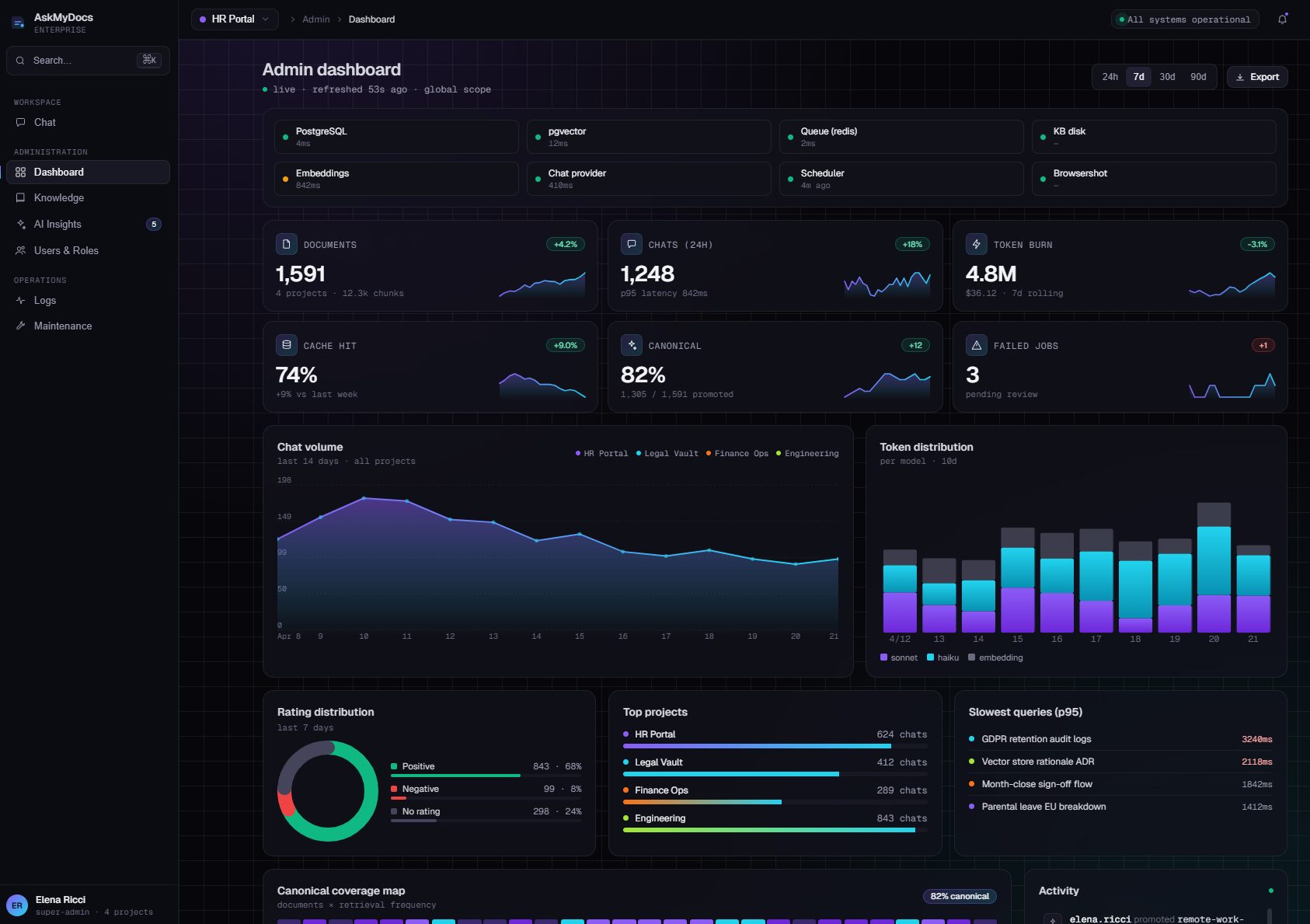
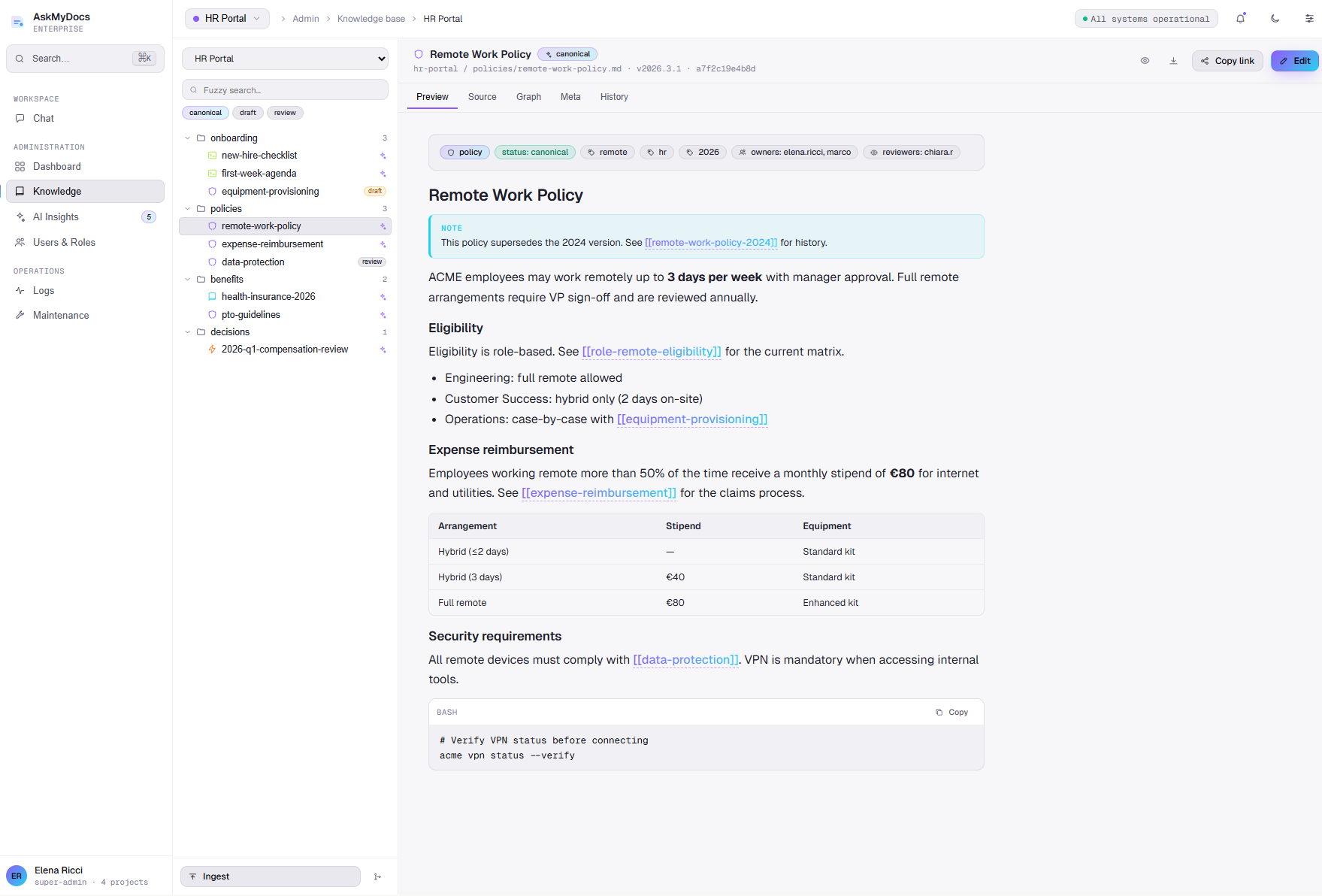
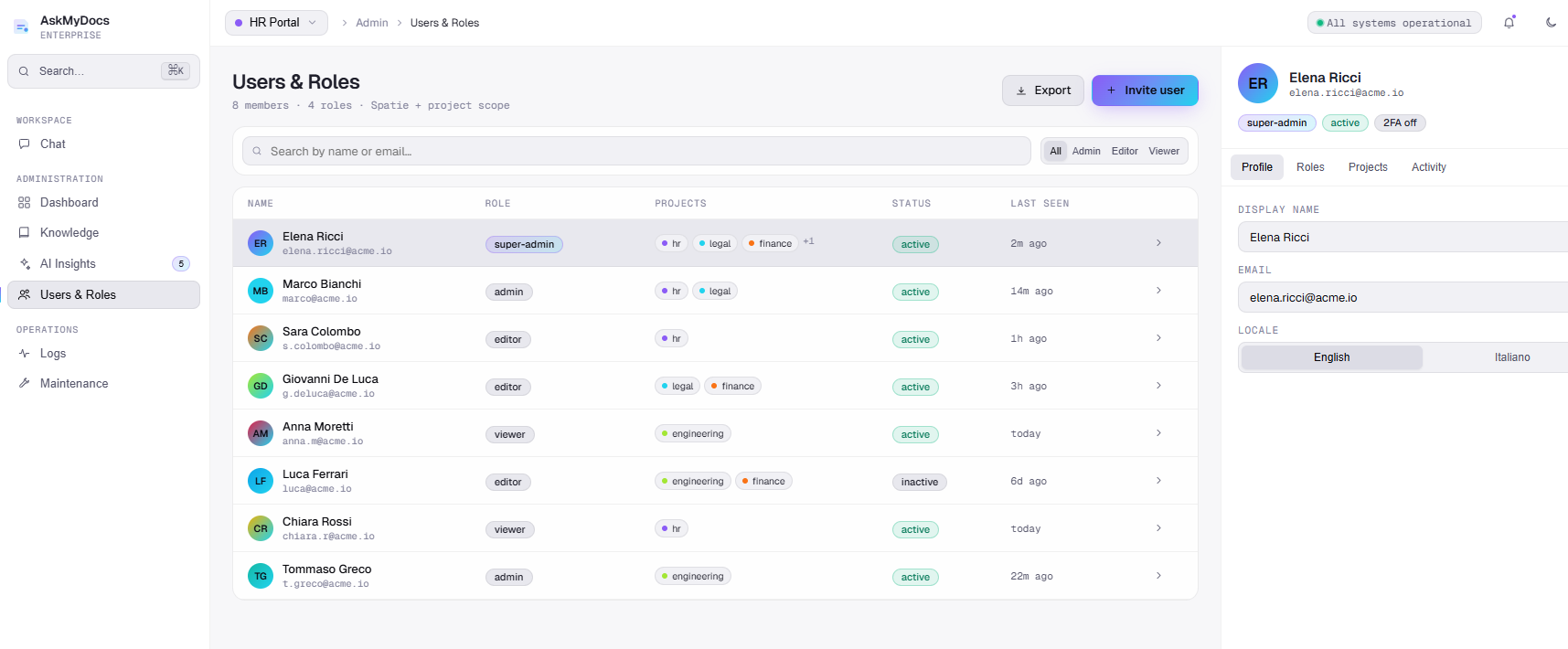
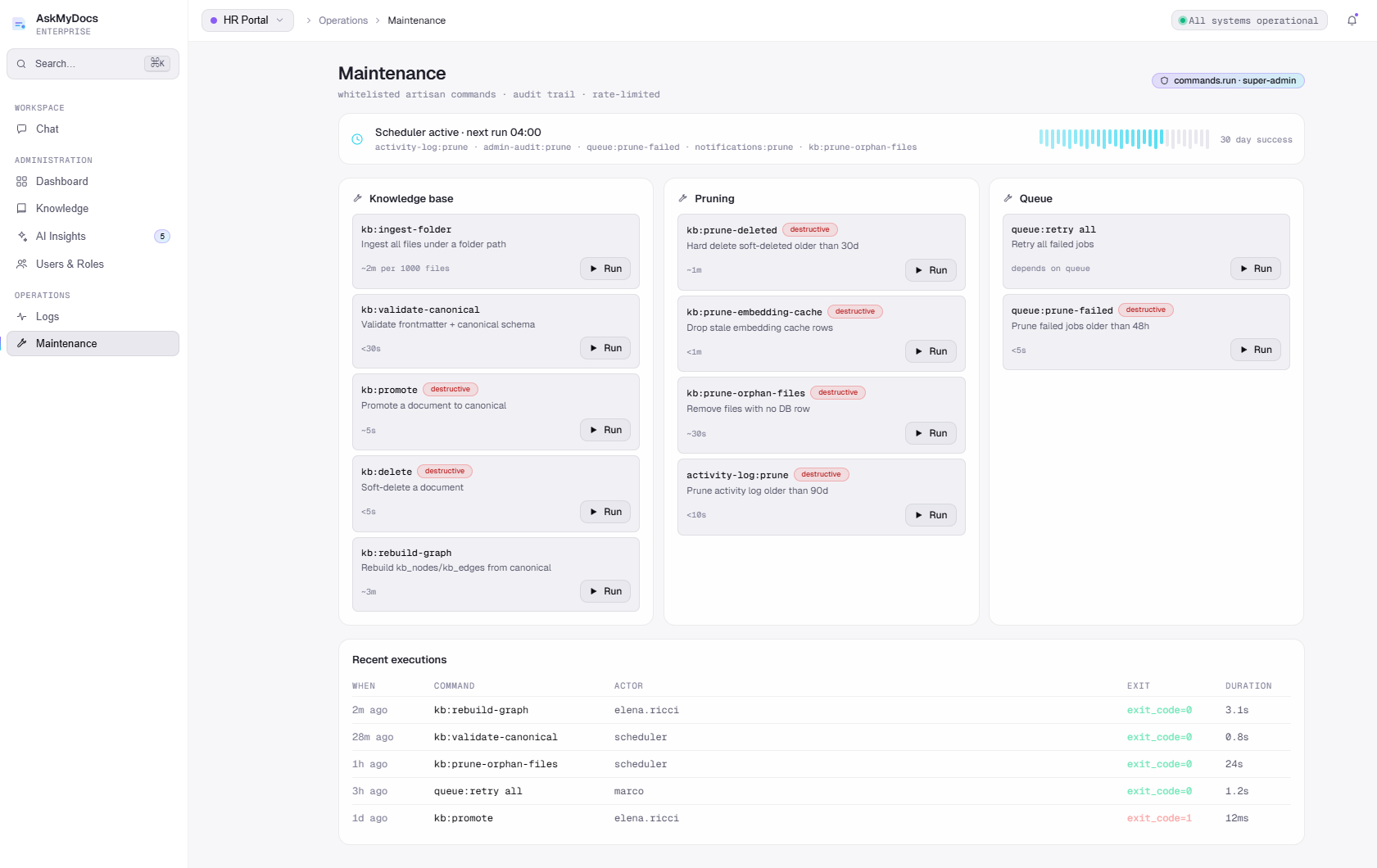
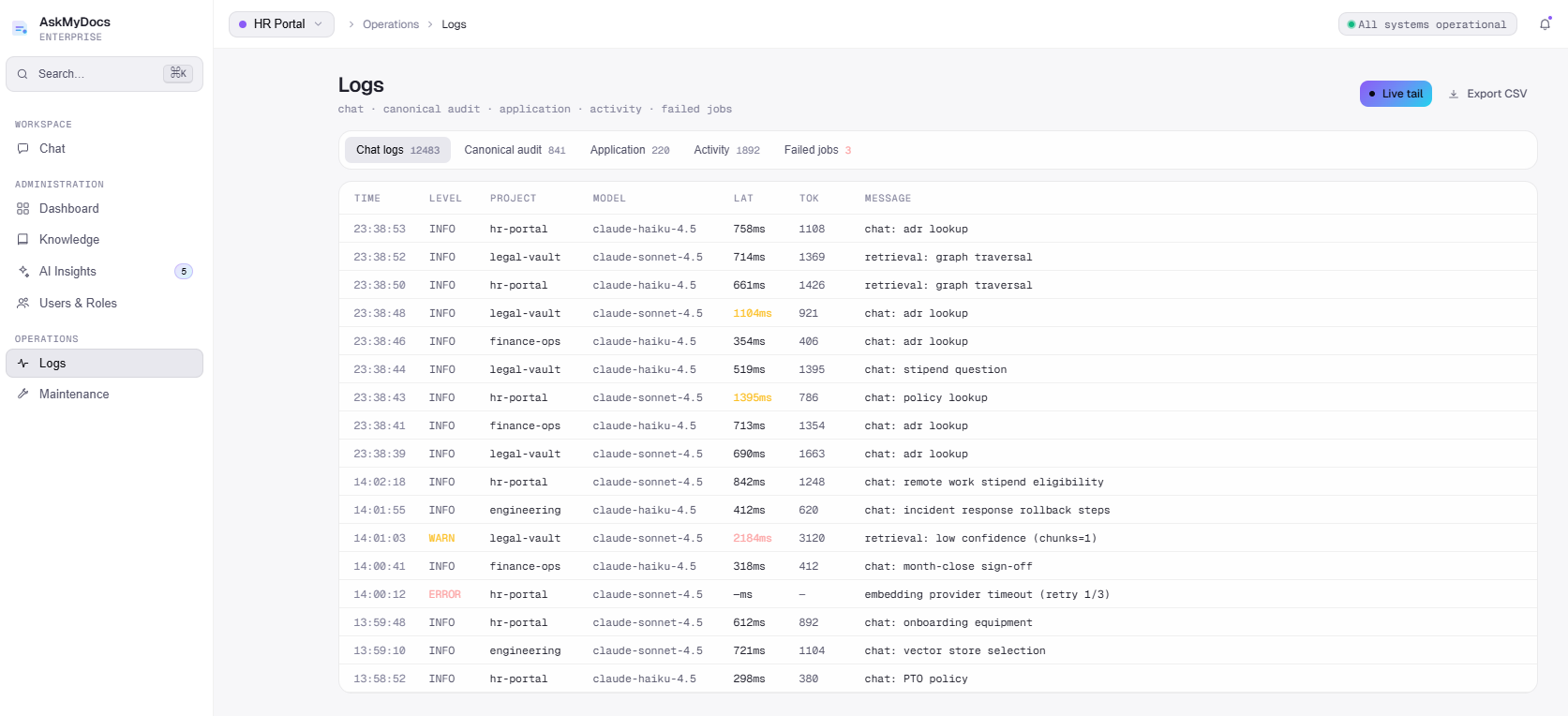
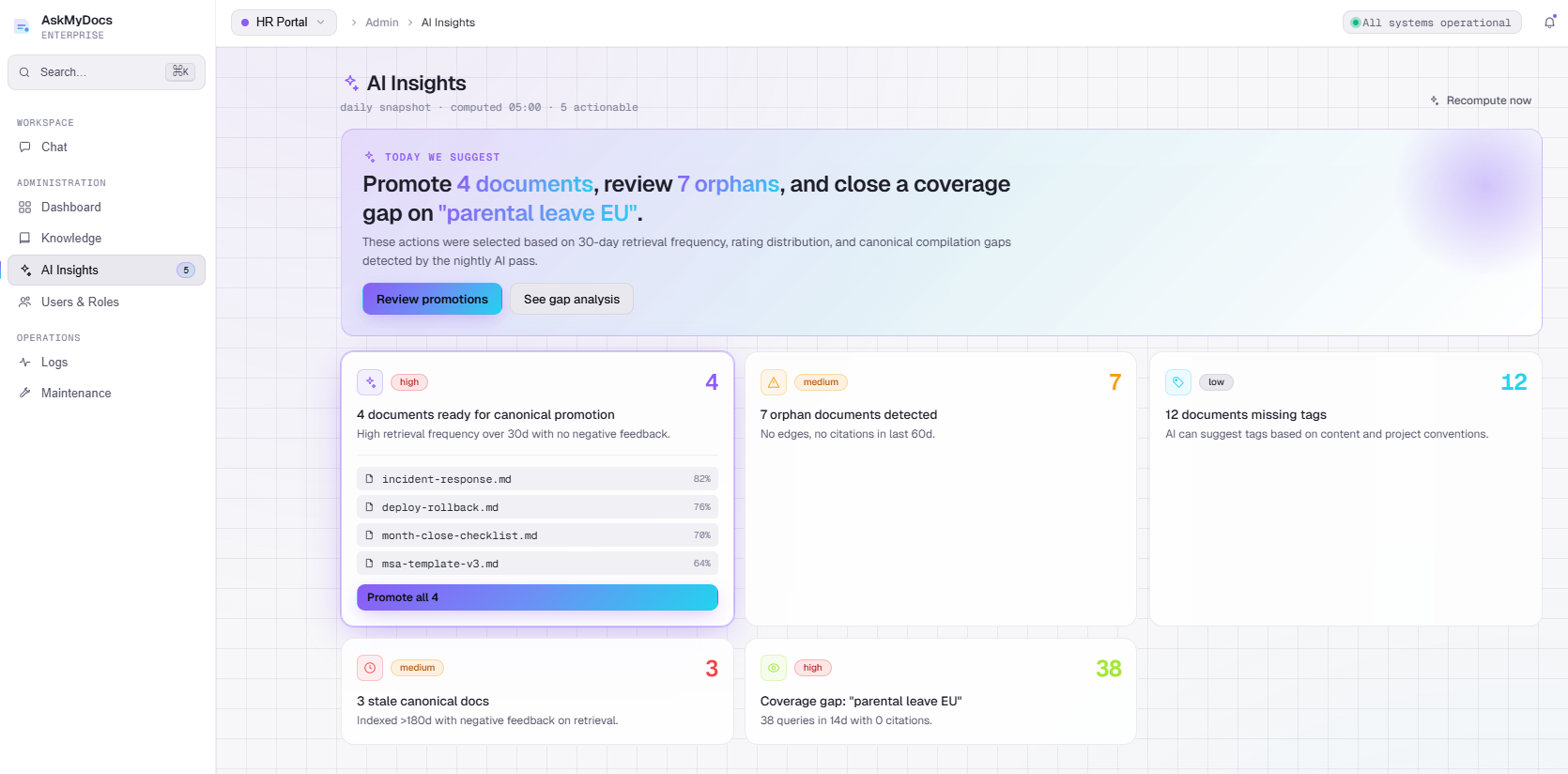
KITT embeddable agentic widget (on a host page)
Admin pages in detail.
Dashboard (/app/admin)
Users + Roles (/app/admin/users + /app/admin/roles)


KB Explorer (/app/admin/kb)


Logs (/app/admin/logs)

Maintenance (/app/admin/maintenance)


AI Insights (/app/admin/insights)
Dark mode and auth pages

Sister packages
Several padosoft/* MIT Composer packages ship alongside AskMyDocs. Every
package carries architecture tests enforcing standalone-agnostic
invariants — zero references to KnowledgeDocument, KbSearchService,kb_* tables, or lopadova/askmydocs in src/. composer require <package> on a fresh empty Laravel app produces a working in-process
feature.
| Package | Role | AskMyDocs integration | Repo |
|---|---|---|---|
padosoft/laravel-ai-regolo v1.0 |
Regolo provider for laravel/ai (EU-based OpenAI-compatible REST) |
✅ wired since v4.0 W2 — RegoloProvider delegates to the SDK |
github |
padosoft/laravel-pii-redactor v1.2 |
PII detection + redaction with EU country packs (Italy + Germany + Spain), 6 checksum-validated detectors, 4 strategies, dual NER drivers | ✅ wired at 11 persistence touch-points since v4.3 W1 (was 4 in v4.1) | github |
padosoft/laravel-pii-redactor-admin v1.0.2 |
7-screen admin SPA for PII operator workflows | ✅ cross-mounted at /admin/pii-redactor since v4.4 W2 (iframe in v4.2/W4) |
github |
padosoft/laravel-flow v1.0 |
In-process saga / compensation engine + approval gates + webhook outbox + replay lineage | ✅ wired since v4.2 W2 — 9 Flow definitions registered | github |
padosoft/laravel-flow-admin v1.0.0 |
Blade + Alpine cockpit SPA — runs / approvals / webhook outbox / definitions | ✅ at /admin/flows. Since v8.8.2 the host shows a native center-only panel (KPI probe of /admin/flows/api/live + section cards) that launches the full Blade+Alpine cockpit in a new tab (target="_blank") — so the cockpit is never nested inside the host chrome. This supersedes ADR 0005's "flow-admin stays iframe-mounted" assumption; what remains true from ADR 0005 is that the cockpit itself stays Blade+Alpine, not React |
github |
padosoft/eval-harness v1.2 |
RAG / LLM evaluation framework — golden datasets, 7 metrics, cohorts, adversarial lane, LLM-as-judge regression detection | ✅ wired since v4.2 W3 (CI gate) + v4.3 W3 (nightly cron) + v4.4 W4 (adversarial opt-in) | github |
padosoft/eval-harness-ui v1.0.0 |
8-page React + Vite admin SPA — read-only, non-prod-only | ✅ cross-mounted at /admin/eval-harness since v4.4 W3 (iframe in v4.2/W4); 3 fail-closed fences preserved |
github |
padosoft/laravel-patent-box-tracker v0.1 |
Italian Patent Box dossier auto-generator | ❌ external by design — operators install in a separate Laravel project; AskMyDocs ships tools/patent-box/2026.yml as input |
github |
Connectors (8 packages, v4.6 extraction) — padosoft/askmydocs-connector-base v1.1.1 + -google-drive v1.0.1 + -notion v1.0.1 + -evernote v1.0.0 + -fabric v1.0.0 + -onedrive v1.0.0 + -confluence v1.0.0 + -jira v1.0.0 |
Framework primitives + 7 standalone external-source connectors (OAuth2 + sync + source-aware markdown rendering) — each composer require-able; auto-discovered via composer.json::extra.askmydocs.connectors; talk to AskMyDocs through the ConnectorIngestionContract IoC bridge |
✅ wired since v4.6 W4 — HostIngestionBridge implements the contract (dispatch / path resolve / PII redact / audit / soft-delete by remote-id); inline app/Connectors/BuiltIn/ from v4.5 fully replaced |
base · google-drive · notion · evernote · fabric · onedrive · confluence · jira |
padosoft/askmydocs-mcp-pack v1.5.0 |
Framework-agnostic MCP (Model Context Protocol) plumbing for Laravel — 6 contracts + multi-turn tool-calling orchestrator + stdio/HTTP transports + hash-only audit + RBAC hooks + full admin REST surface (22 endpoints): me/tenants/api-keys, server CRUD + handshake + tools/resources/prompts, R21-atomic tool invoke / audit replay / breaker reset, SSE events, OpenAPI 3.1 spec; standalone, zero AskMyDocs dependencies; 325 PHPUnit tests across 7 CI cells (PHP 8.3 × Laravel 11/12/13, PHP 8.4 × Laravel 11/12/13, PHP 8.5 × Laravel 13 only) | ✅ shipped 2026-05-18 (v1.5.0) — full cycle v1.0→v1.5 closed: v1.0 contracts, v1.1 transports + SSE, v1.2 server-side, v1.3 circuit breaker + retry, v1.4 admin REST minimal (6 endpoints), v1.5 admin REST complete (22 endpoints with sub-interface BC-safe extensions: McpHostBridgeIdentityContract + McpServerMutableRegistryContract). AskMyDocs v7.1+ pins ^1.5 |
github |
padosoft/askmydocs-mcp-pack-admin v1.1.0 |
Standalone React SPA companion — 12 routes covering server CRUD, handshake, tool catalog, paginated audit log, circuit-breaker dashboard, three-pane resources browser, prompt playground, OpenAPI explorer, settings + tour. Cross-mounts under /admin/mcp-pack exactly like pii-redactor-admin / flow-admin / eval-harness-ui |
✅ live wire-up GA 2026-05-18 (v1.1.0) — every page surface drives real padosoft/askmydocs-mcp-pack v1.5+ endpoints via TanStack Query: 22 typed endpoints + 19 hand-written types mirroring v1.5 OpenAPI, 13 read hooks + 10 mutation hooks, R21 two-call confirm-token protocol with second-leg expired-token guard on useInvokeTool / useReplayAudit / useResetBreaker, SSE live-feed consumer replacing prototype simulator, <DataState> shared wrapper enforcing R14+R11+R15 invariants. 154 Vitest specs across 22 test files covering loading / error / empty / ready states + R21 happy + failure + ValidationError + SSE behaviour via MSW handlers shaped to the real wire schema. Full real-backend Playwright rewrite tracked for v1.1.x; v1.1.0 ships with a smoke spec only |
github |
padosoft/laravel-evidence-risk-review v1.1 + -admin v1.0 |
Answer-grounding risk firewall: a budget-bounded deterministic + optional-LLM sweep that labels evidence tiers, scores per-claim risk verdicts (keep / soften / flag / remove), and appends a tenant-scoped review log; domain risk profiles + a pluggable check registry; tenancy-agnostic via a TenantResolver contract |
✅ wired tri-surface since v8.13 P11 — core PHP command + MCP tools auto-register; HTTP API at /api/admin/evidence-risk-review/* (host-secured + tenant-scoped); native FE admin at /app/admin/evidence-risk-review cross-mounts the core API (the -admin React bundle is composer-required but dont-discovered). Opt-in (EVIDENCE_RISK_REVIEW_ADMIN_ENABLED, default-OFF, R43) |
core · admin |
padosoft/laravel-ai-act-compliance + -admin |
EU AI Act compliance pack: DSAR, pluggable bias-metric registry (DemographicParity / EqualizedOdds / Calibration), risk register, FRIA (Art. 27), human-review tracker, incident state machine, consent + disclosure middleware, cybersecurity middleware stack, Article 30 attestation PDF, cohort-drift real-time alerting cascade (Slack → Discord → always-CC email; throttle + circuit breaker + severity-escalation bypass), EU AI Act regulatory-feed auto-flagger (RSS + Atom, XXE-safe), DPO multi-org tenant registry + per-tenant config overrides + cross-tenant overview; companion admin SPA cross-mounts under /admin/ai-act-compliance (host cross-mount infrastructure shipped in v6.0; v6.1 brings 3 additional screens via the package upgrade) with 12 fully-featured screens (Overview / DSAR / Consent / Risks / FRIA / Incidents / Bias / DPO / Settings / Alerts / Regulatory / Tenants) |
v1.5.0 — Packagist ✅ | v6.0–v6.1 |
See docs/v4-platform/INTEGRATION-ROADMAP-sister-packages.md
for the per-package timeline and locked composer constraints.
Contributing
Contributions welcome. Workflow:
- Fork the repository
- Create a feature branch (
feature/v4.x/<sub-task>for v4.x work — R37) - Commit with conventional-style messages
- Push + open a PR with
--reviewer copilot-pull-request-reviewer(R36) - Wait for Copilot review + CI green; iterate until 0 outstanding must-fix
- Merge when both gates pass
Guidelines:
- PSR-12 for PHP; ESLint + Prettier for TS/React
- Add or update tests for any meaningful change (PHPUnit + Vitest + Playwright as appropriate)
- Keep PRs focused — one feature or fix per PR
- Update the relevant CLAUDE.md / docs / CHANGELOG when user-facing behaviour changes
- English for code, comments, and commit messages
- Honour the 40 codified review rules (R1–R43; R33–R35 reserved) — see
CLAUDE.mdsection 7
Report issues via GitHub Issues with reproduction
steps, expected vs actual behaviour, and Laravel / PHP / provider
versions.
License
This project is open-source under the MIT License.
You are free to use, modify, and distribute it for any purpose,
including commercial use.
Changelog
v8.15.0 — Engagement & Intelligence Suite. The layer that turns a knowledge
base from a passive store into a living system — proactive digests, contributor
analytics, dashboards and opt-in gamification — designed to surpass Stack Overflow
for Teams / Zendesk / Notion on packaging and delivery breadth. It rests on one
append-only primitive: the contribution event (kb_contribution_events),
written from the existing ingest / promotion / citation paths (never a new write
path, so the log stays a rebuildable projection). EngagementMetricsService
aggregates those events in SQL (R3) into contributor stats, leaderboards,
coverage %, answer rate and trends; a daily engagement:compute snapshot
(kb_engagement_snapshots) makes dashboards and digests read O(1).
The digest is a composition, not a query: DigestComposer assembles typed
sections (newly created/promoted docs · stale review queue · top unanswered ·
health trend · "your attention needed"; modified-doc activity shows in the
headline metrics rather than as a per-doc list) and a DigestRendererRegistry
(R23 boot-validated mutex) renders one card per channel — a magazine-grade HTML
email plus Discord embed / Slack Block Kit / Teams Adaptive Card, reusing the
existing notification channel adapters for transport, plus an in-app feed
(engagement_digest_feed). An opt-in AiDigestNarrator adds a "what changed &
why it matters" summary on a dedicated free OpenRouter model
(KB_DIGEST_AI_MODEL, default meta-llama/llama-3.3-70b-instruct:free) so it
never competes with the primary chat model and costs ≈$0, degrading to
deterministic copy when off or unreachable (R14/R43). digest:send {--frequency=weekly|monthly} {--tenant=} {--channel=} {--dry-run} {--preview}
drives it; per-user digest_preferences (frequency + per-section toggles) and a
monthly executive roll-up complete the delivery matrix.
Two dashboards read the same metrics so the numbers always agree: a personal
My KB dashboard at /app/me (your score, rank, authored docs, citation impact,
review queue) and an admin engagement panel (leaderboard / coverage / answer-rate /
decision-debt trend), both on the existing KpiCard/ChartCard/recharts
primitives. Finally, opt-in gamification awards a config-driven badge catalog
over all-time engagement metrics (kb_user_badges, gamification:recompute) —KB_GAMIFICATION_ENABLED default-OFF, tested in both states (R43); when off the
badges section is absent, not an empty box.
Every capability is tri-surface (R44) over one shared core: Artisan command +
HTTP endpoint + MCP tool (KbEngagementSummaryTool / KbDigestPreviewTool /KbUserBadgesTool; MCP roster 25→28). Five new tenant-aware tables join both
completeness lists (R30/R31). Deep doc-site pages ship for the suite, digests,
dashboards and gamification (R45).
v8.13.0 — Evidence & Risk Review integration (P11). The general
risk-sweep / review-log engine that v8.11.2 deliberately kept OUT of core lands
as the standalone padosoft/laravel-evidence-risk-review (core, v1.1) +-admin (v1.0) sister packages and is wired tri-surface (R44) into AskMyDocs
over one shared core service. The core package's Artisan command + MCP tools
auto-register (PHP + MCP). The HTTP API mounts at/api/admin/evidence-risk-review/*, host-secured with the same admin stack as
the rest of /api/admin/* (tenant.resolve + auth:sanctum +tenant.authorize + can:viewEvidenceRiskReview) and locked by the R32
authorization matrix. A native FE admin at /app/admin/evidence-risk-review
(Reviews log + detail drill-down / Profiles / Taxonomy / Try-a-review)
cross-mounts that API — the same convention as PII Redactor / Flow / Eval Harness
/ AI Act; the separate -admin React bundle is composer-required butdont-discovered. R30: a host TenantResolver binds the review log to the
active tenant — every review is stamped on write and the read paths are forced
to that tenant, so a client-supplied tenant filter can never widen the scope.
R43 both-states: the whole admin surface is opt-in viaEVIDENCE_RISK_REVIEW_ADMIN_ENABLED (default-OFF → the package routes never
register, the FE shows a clean "unavailable" landing, and there is never a 500);
the optional LLM semantic pass over the host AiManager is a second default-OFF
flag (EVIDENCE_RISK_REVIEW_LLM_ENABLED). Coverage: +7 integration PHPUnit
(cross-tenant isolation E2E + LLM-adapter mapping + R43 on/off via MockeryshouldNotReceive/shouldReceive, R26) + the flag-OFF clean-404 test, +3 Vitest
(pending / ready / unavailable), and a real-data Playwright happy path + a marked
R13 failure injection. Full suite green (2736 PHPUnit).
v8.12.0 — Auto-Wiki admin UI (P10 — epic close). The web surface on the
P1–P9 engine, shipped as seven real-data-tested sub-PRs (#282..#288): Wiki
Health (lint + safe auto-fix), Wiki Indices (hub + per-project roll-ups +
operation log + rebuild), Wiki Explorer (browse by provenance tier +
promote auto→human + discard — a new tri-surface WikiExplorerService
capability: kb:wiki-promote + GET /api/admin/kb/wiki-pages +POST …/documents/{id}/wiki-{promote,discard} + KbWikiPromoteTool, lifting theenterprise-kb MCP roster 24 → 25 tools), Doc Insights → Apply (the P8
apply engine surfaced per-suggestion, a 200-refusal rendered distinctly from a
transport error per R14), Auto-Wiki Settings (per-(tenant,project) auto-build
gate over AutoWikiGate, tri-state Inherit/On/Off, R43 both-states), and
tier-badged chat citations (every citation carries generation_source; auto
pages get an auto badge, R27 additive). Every screen ships Vitest + real-data
Playwright (R13), and every new endpoint joins the AdminAuthorizationMatrix
(R32). This closes the Auto-Wiki epic (P0–P10): a default-ON, tenant-safe,
reversible, fully-audited self-compiling knowledge tier behind the
anti-hallucination firewall, exposed PHP + HTTP API + MCP and now fully
administrable from the SPA. Every sub-PR went through an independent
code-reviewer pass + green CI before merge.
v8.11.2 → v8.11.10 — Auto-Wiki cycle complete (the self-compiling agentic
knowledge tier). Nine incremental releases finished the Auto-Wiki engine on top
of the v8.11.0/v8.11.1 foundations, each merged + tagged + released on its own:
v8.11.2 evidence-tier (an evidence-strength axis the compiler derives + the
RAG prompt weights, AutoSci #67), v8.11.3 graph canonicalization (auto
cross-refs → real kb_edges/kb_nodes, every auto doc gets an auto--namespaced
slug so the whole corpus is navigable), v8.11.4 concept-page synthesis (newdomain-concept pages for recurring concepts, ingested via the one execution
path; ingest now honours a generation_source: auto frontmatter key),
v8.11.5 wiki indices + operation log (per-project roll-ups + a per-tenant
index hub in kb_wiki_indices), v8.11.6 wiki lint/health (dangling / orphan
/ stale-cross-ref / missing-index + safe auto-fix), v8.11.7 agentic
graph-navigation (multi-hop cycle-safe BFS, anchor-driven from the index —WikiNavigator, the primary agentic surface), v8.11.8 cross-model review /
novelty gate (an independent review-LLM audits grounding / novelty /
contradictions before an auto page is trusted), v8.11.9 apply engine
(change/delete suggestions → audited, reversible mutations; manual + opt-in
auto-apply default-OFF), and v8.11.10 scheduled maintenance (a daily sweep
that rebuilds indices, lints, and backfills enrichment). Throughout, the
anti-hallucination firewall holds (human-accepted > auto > raw), every
capability is tri-surface (R44) — PHP command + HTTP API + MCP tool over one
shared core — and the enterprise-kb MCP server grew 14 → 24 tools. The
remaining phase is the admin Wiki Explorer / Health / Indices / Apply /
Settings SPA (v8.12.0). ~115 PHPUnit across the cycle; every sub-PR went through
an independent code-reviewer pass + green CI before merge.
v8.11.1 — Auto-Wiki Compiler is the first functional increment of the
Auto-Wiki cycle: it actually auto-builds wiki metadata on ingest. After a
document is persisted, IngestDocumentJob dispatches the asyncAutoWikiCompilerJob (gated by AutoWikiGate; version-idempotent so an
unchanged doc is never re-compiled) which asks the LLM — reading the document
plus its closest existing neighbours — to derive topical tags, a tight
summary, aliases, and cross-references (each with a slug + why +edge_type), merged into frontmatter_json._autowiki with the doc markedgeneration_source='auto'. The firewall holds: a human-curated canonical
document is never auto-edited (the authoritative tier keeps its human gate, ADR
0014), and every auto write is audited to kb_canonical_audit (actorsystem:autowiki). The LLM call honours the dedicated model override
(KB_AUTOWIKI_AI_PROVIDER/_MODEL, empty → default chat). Default-ON
(KB_AUTOWIKI_ENABLED, R43 both-states — off ⇒ no enrichment, behaviour
unchanged). +12 PHPUnit (compiler enrichment / human-curated skip / model-override
/ empty-doc; job version-idempotency + gate composition).
v8.11.0 — Auto-Wiki foundations opens the Auto-Wiki / Agentic Knowledge
Compilation cycle (a Karpathy LLM-Wiki + AutoSci-inspired knowledge layer). It
lays the substrate for auto-compiling the typed canonical wiki on ingest
while preserving the platform's anti-hallucination moat. New: a second-classauto tier (knowledge_documents.generation_source ∈ {human, auto},
default human) for AI-compiled content; an anti-hallucination reranker
firewall (kb.canonical.auto_tier_penalty, default 0.02) so a human-accepted
doc on the same topic always outranks an auto-compiled one — and an auto doc
still outranks raw — wired through KbSearchService / GraphExpander /Reranker; the layered AutoWikiGate (config → tenant * → project viakb_analysis_settings, default-ON, R43 both-states); a dedicated AI model
override for the upcoming auto-compile + agentic-retrieval LLM calls
(KB_AUTOWIKI_AI_PROVIDER/_MODEL, KB_AGENTIC_AI_PROVIDER/_MODEL — empty
falls back to the default chat provider, so you can point auto-compilation at a
cheaper/smarter model than interactive chat); the schema + config foundation for a source-retention policy
(KB_SOURCE_RETENTION = full_copy | markdown_only | reference_only, global
- per-connector) plus a
markdown_pathartifact column — the ingest wiring that
acts on the mode and writes the markdown artifact lands with the compiler in a
later v8.11.x release;
and ADR 0014, which extends (does not revoke) ADR 0003 — the human tier
keeps its human-gated promotion, while theautotier is reversible, audited,
and promotableauto → human. This is the foundation release of the cycle; theAutoWikiCompiler(frontmatter enrichment + concept-page synthesis), wiki
lint + per-tenant index hub, agentic graph-navigation retrieval, the apply
engine, and the admin Wiki surfaces ship as the subsequent releases. +10 PHPUnit.
v8.10.1 — KITT security hardening + threat-model docs is a focused
security patch on the embeddable widget. It adds a full Security & threat
model to docs/kitt/INTEGRATION.md — what is
enforced and why (server-side tenant isolation, exact-match origin allowlist,
no-credential CORS, no host-page XSS, credential-field and navigation guards),
the residual/inherent risks of a public embeddable + agentic surface
(public-key abuse from a forged-origin script, prompt-injection-driven actions,
data egress to the LLM), and the best practices the AskMyDocs operator and the
host site must follow to mitigate them — including data-kitt-skip as the
host's data-egress control (keep sensitive page regions out of the snapshot);
the README KITT section links to it. It also hardens the widget executor:type() previously refused only password/hidden, and now sharessnapshot.ts::isSensitiveInput() so it equally refuses autocompletecc-* / current-password / new-password — the agent can neither read nor
fill a credential/payment field via prompt injection. Finally it turns the
pentest scenarios into fixed regression tests (local + CI):WidgetSecurityTest (exact-match origin allowlist vs look-alike / suffix /
subdomain / scheme-downgrade / port / userinfo origins; empty-allowlist
denies-all; secret_hash never serialized in /setup; anti-IDOR and
cross-tenant session containment → 404), snapshot.security.test.ts
(data-kitt-skip excludes fields / actions / headings, sensitive values
auto-nulled), and an extended executor.security.test.ts. The R40 local critic
caught the executor-guard gap pre-push. +11 PHPUnit + 7 Vitest.
v8.10.0 — KITT Embeddable Agentic Widget ships a one-<script>
embeddable, page-aware, agentic chat widget. A customer pastes a snippet
(window.AskMyDocsWidget = { key: 'pk_…', apiBase: '…' } + the async loader
at /widget/askmydocs-widget.js) and gets the first-party retrieval stack
— grounded, cited, tenant/project resolved server-side from the key (R30) —
inside a bounded ReAct loop: the widget captures a structured snapshot of
the host page (regions / fields / actions / messages / outline) and the LLM
emits tool calls run in the page DOM (~20 FE verbs — click / type /select / navigate_to / submit_form / wait_for / …) or server-side via/exec-tool (search_knowledge_base). Behaviour is governed by JSON skill
manifests (resources/widget/skills/*: tools_enabled + auto_annotation_rules
default_policies) and a double-gated Host-Tools Protocol (per keyhost_tools_enabledand per skill) that lets a host app expose its own
tools; pages annotate with stable verb-baseddata-kitt-*attributes, anddata-kitt-sensitive/password/hiddenvalues are force-nulled
server-side so secrets never reach the LLM or the step log. Security: three
auth modes (publicpk_+ exact-matchOriginallowlist,sk_secret for
server-to-server, single-use origin-boundwt_session tokens consumed
atomically under a lock per R21 + hashed at rest + rate-limit checked before
burn); cross-key / cross-tenant session access is404(anti-IDOR); snapshot
byte + count caps;javascript:/data:/ protocol-relative navigation
blocked on both server and client; PII masked on every persisted step (Italian
VAT masking checksum-validated so non-PII codes stay readable). 4 tables
(widget_keys/widget_sessions/widget_session_steps/widget_session_tokens), a super-admin admin SPA at/app/admin/widget
(key CRUD / rotate / revoke + allowed-origins + theme designer + host-tools
toggle + copy-ready embed snippet + PII-masked session replay), and awidget:prune-sessionsretention sweep. Developer guide:docs/kitt/INTEGRATION.md; local demo at/widget-demo(WIDGET_DEMO_ENABLED=true).
v8.9.0 — Tenant & Project Isolation Hardening is a security-review
release: a deep audit of every content-surfacing path (chat answer, search,
JSON API, MCP tools, admin GUI) confirmed tenant isolation is absolute —
a user in one tenant can never see, retrieve, or have cited any document,
chunk, citation or graph node from another tenant — and fixed the handful of
residual gaps it surfaced: the SPA chat routes (POST /conversations/{id}/messages
- the SSE variant) now carry
tenant.authorize(closing anX-Tenant-Id
cross-tenant retrieval hole), the MCP read-by-id tools (KbReadDocumentTool/KbReadChunkTool) are tenant-scoped, the admin Users CRUD enforces a
role-assignment privilege ceiling (anadmincan no longer grantsuper-admin), an admin-insights IDOR is closed, and the legacy Blade chat
sanitises Markdown through DOMPurify. It also introduces opt-in per-project
isolation (KB_PROJECT_ISOLATION_ENABLED, default OFF — no behaviour
change for existing deployments): when ON, the "see all projects" capability
moves from the blanketkb.read.anyto a dedicatedkb.read.all_projects
permission (admin/super-admin), and every other user is constrained to their
assignedproject_membershipsset (1..N projects), enforced uniformly across
chat, search, autocomplete and the admin KB surface so cross-project content
never appears in answers or citations. The admin Users → Project memberships
editor now derives its project picker from the live tenant project list. Both
flag states are covered by tests (R43).
See CHANGELOG.md for detailed release notes from
v1.0 through v8.8.3. v8.8.3 is the KB Lifecycle Intelligence — Plus
cycle plus three follow-on releases: v8.8.0 added the delete-trigger
deep-analysis, a per-(tenant, project) analysis gate, content-gap analytics,
per-query multilingual FTS, and the chat-side Related graph panel; v8.8.1
was a live-verification patch (real browser + live pgvector/OpenRouter caught
four bugs the mocked suites missed, incl. the dead chat Related panel and an
AI-Act iframe recursion → native panel); v8.8.2 unified the admin navigation
into one grouped sidebar and made every sister-package admin mount center-only
(no nested chrome); and v8.8.3 adds anonymous chat — a non-persisted,
authenticated chat that force-redacts PII (non-persistent mask) before
retrieval/LLM/log, writes only a minimal-or-no chat-log, and is feature-flagged
default-OFF (KB_ANONYMOUS_CHAT_ENABLED, both states defined per R43).
v8.7.0 is the KB Lifecycle Intelligence cycle:
Synonym Expansion (per-tenant jargon ↔ plain-language query expansion),
a weekly notification digest + a settings-tunable stale-document
review sweep, the flagship AI deep-analysis on document change (an async
LLM pass that, on every ingest/modify, suggests enhancements, surfaces
cross-references, and flags which other docs the change makes obsolete —
surfaced under Admin → Doc Insights, suggest-only per ADR 0003), and the
Cloud Time Machine (version timeline + diff + atomic restore + retention
prune under Admin → Time Machine). v8.6.0 makes the chat's dead clickable actions live:
cited sources now navigate to the KB document (admin-gated), the conversation
title auto-generates after the first turn and is inline-renamable via a pencil
(ChatGPT-style), and a new boot/navigation smoke test asserts every main screen
mounts with zero uncaught exceptions. v8.5.0 ships the definitive browser streaming E2E:chat-stream-browser.spec.ts drives a real grounded turn and a real
refusal turn through the real /messages/stream SSE + the real @ai-sdk
transport (the layer where the v8.4 wire-format crashes fired) with nothing
stubbed — backed by an offline FakeProvider (hard-gated to testing/local)
and an E2eStreamSeeder that makes one doc genuinely vector-searchable.
v8.4.0 is a security + correctness hardening release:
an RBAC access-control matrix (R32) that caught a real unauthenticated AI-Act
API vulnerability on its first run, two chat-stream wire-format crash fixes
(source-url + finish) with an exhaustive SDK-schema contract guard, and theCACHE_STORE default fix. v8.3.0 adds full-stack live verification:kb:benchmark --with-answers scores real-LLM answer-faithfulness
(cosine of the answer vs the grounding the LLM saw), the eval:nightly
LLM-as-judge path is validated LIVE against a real model
(citation-groundedness ≈ 0.98), and a consolidated full-stack test proves
grounded citations + AI-Act disclosure + chat logging + PII answer-redaction
all fire on one chat turn. v8.2.0 shipped a reproducible retrieval-quality
benchmark (kb:benchmark) + made the full RAG pipeline testable
end-to-end with no mocks (SQLite PHP-cosine fallback), and a
live-validated calibration (real embeddings + pgvector) that took the
scorecard to nDCG 0.997 / MRR 1.000 / citation 1.000 / refusal 1.000.
v8.1.0 was the retrieval-quality minor before it (refusal-gate fix +
3-channel unification + @mention boost + evidence citations + IR metrics).
Yorumlar (0)
Yorum birakmak icin giris yap.
Yorum birakSonuc bulunamadi