awesome-proactive-agent
Health Warn
- No license — Repository has no license file
- Description — Repository has a description
- Active repo — Last push 0 days ago
- Low visibility — Only 5 GitHub stars
Code Warn
- Code scan incomplete — No supported source files were scanned during light audit
Permissions Pass
- Permissions — No dangerous permissions requested
No AI report is available for this listing yet.
A curated list of papers, benchmarks, project pages, and code for proactive agents.
Awesome Proactive Agents
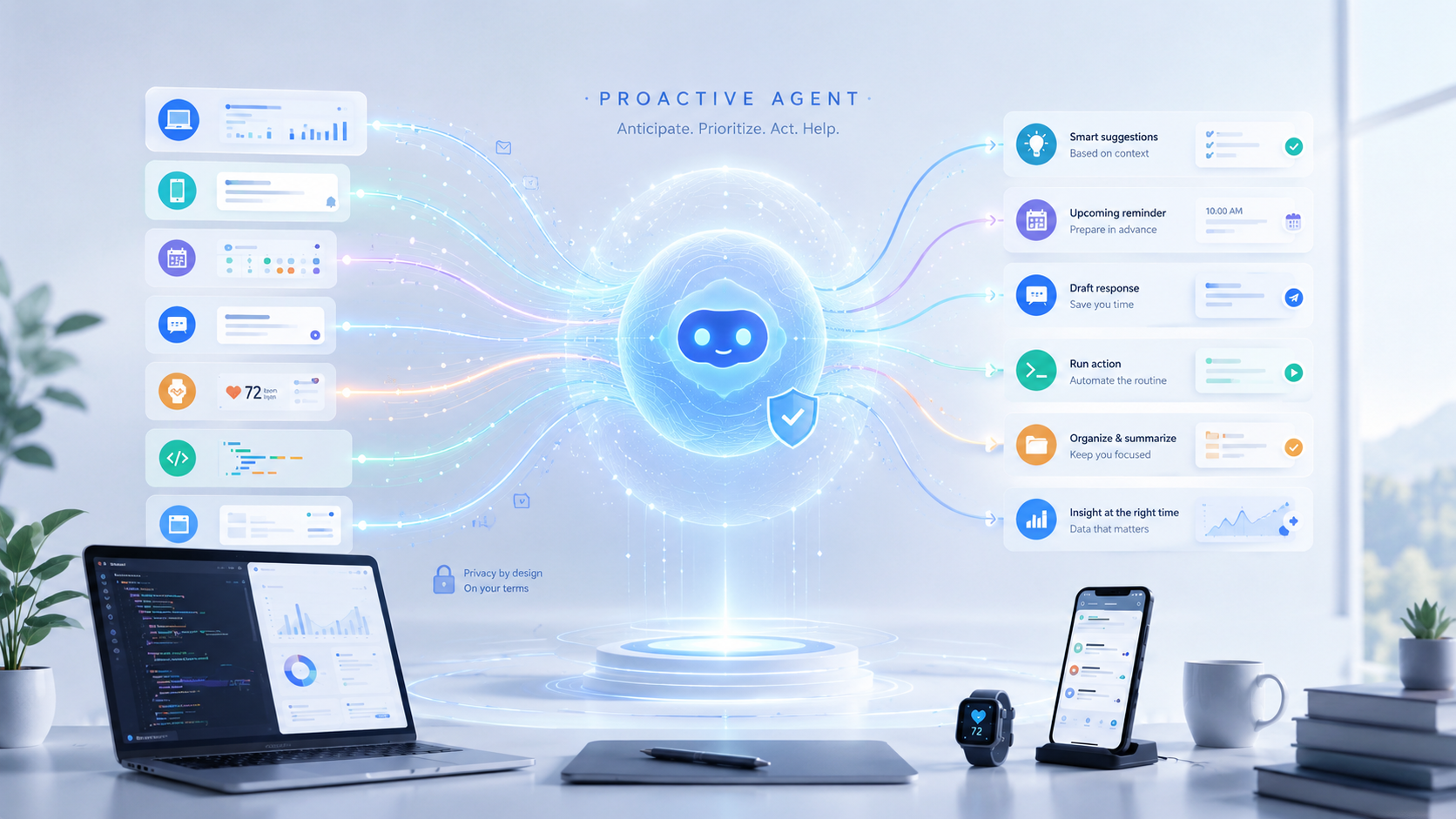




A curated research map for proactive agents: AI systems that infer latent user needs, decide when to intervene, ask for missing context or consent, and initiate useful assistance before a complete explicit command.
If this list is useful, a ⭐ helps others find it.
Contents
Scope
This list prioritizes papers where proactivity is a central research target. The list is broader than computer-use agents: it includes proactive dialogue, planning, recommendation, wearable assistance, GUI/mobile/OS agents, programming assistants, personalization, memory, benchmarks, optimization, and human factors.
Typical inclusion signals:
- The agent predicts latent intent or missing context before a complete user instruction.
- The agent decides when to ask, suggest, remind, intervene, execute, or stay silent.
- The paper evaluates proactive behavior, intervention timing, user control, consent, interruption cost, or personalization.
- The benchmark or dataset makes proactivity the primary task rather than a side effect of general tool use.
Resource labels:
- Paper: arXiv, ACL Anthology, DOI, OpenReview, ACM, Springer, or official proceedings page.
- Website: project page, conference page, lab page, or documentation.
- Code / Dataset: GitHub, released code, released benchmark, or released dataset.
- Notes: short English decision card with why the paper matters, proactivity signal, evaluation setup, limitations, and use cases.
Must Read
Selected starting points for understanding the field.
| Date | Paper | Why read it first | Resources |
|---|---|---|---|
| 2024-04 | Towards Human-centered Proactive Conversational Agents | Establishes the human-centered dimensions of proactive agents: intelligence, adaptivity, and civility. |   |
| 2024-10 | Proactive Agent | Canonical shift from reactive LLM agents to active assistance over event streams; introduces ProactiveBench. |     |
| 2024-10 | Need Help? | Strong user-study reference for proactive IDE assistance and intervention timing. |  |
| 2025-05 | ContextAgent | Extends proactive agents to open-world sensory contexts and tool calling. |    |
| 2026-02 | ProAgentBench | Real workflow logs reveal why synthetic proactive data can overestimate performance. |   |
| 2026-04 | KnowU-Bench | Closest benchmark to proactive, personalized, consent-aware mobile assistants. |    |
| 2026-05 | π-Bench | Sharp long-horizon benchmark for hidden-intent resolution in personal assistant workflows. |    |
Papers
Foundations, Surveys and Human Factors
| Date | Title | Venue / Source | Tags | Resources |
|---|---|---|---|---|
| 2024-04 | Towards Human-centered Proactive Conversational Agents | SIGIR 2024 | Definition · Human Factors · Dialogue |
|
| 2024-10 | Redefining Proactivity for Information Seeking Dialogue | SICON 2024 | Definition · Dialogue · Intent Inference |
 |
| 2025-01 | When AI-Based Agents Are Proactive: Implications for Competence and System Satisfaction in Human-AI Collaboration | BISE 2026 | Human Factors · Intervention Timing · Trust |
 |
| 2025-02 | Assistance or Disruption? Exploring and Evaluating the Design and Trade-offs of Proactive AI Programming Support | CHI 2025 | Human Factors · Intervention Timing · IDE |
  |
| 2025-03 | Proactive Conversational AI: A Comprehensive Survey of Advancements and Opportunities | ACM TOIS 2025 | Survey · Definition · Dialogue |
 |
| 2026-01 | Developer Interaction Patterns with Proactive AI: A Five-Day Field Study | arXiv 2601 | Human Factors · Real-world Data · IDE |
 |
| 2026-02 | From Fragmentation to Integration: Exploring the Design Space of AI Agents for Human-as-the-Unit Privacy Management | arXiv 2602 | Safety & Consent · Privacy · Human Factors |
 |
| 2026-02 | Exploring The Impact of Proactive Generative AI Agent Roles in Time-Sensitive Collaborative Problem-Solving Tasks | arXiv 2602 | Human Factors · Collaboration · Intervention Timing |
 |
Proactive Interaction and Planning
| Date | Title | Venue / Source | Tags | Resources |
|---|---|---|---|---|
| 2024-03 | ProMISe: A Proactive Multi-turn Dialogue Dataset for Information-seeking Intent Resolution | Findings of EACL 2024 | Clarification · Dialogue · Benchmark |
|
| 2024-06 | Ask-before-Plan: Proactive Language Agents for Real-World Planning | arXiv 2406 | Clarification · Planning · Intent Inference |
 |
| 2024-10 | Proactive Agent: Shifting LLM Agents from Reactive Responses to Active Assistance | ICLR 2025 | Intent Inference · Benchmark · Desktop |
|
| 2025-01 | Proactive Conversational Agents with Inner Thoughts | CHI 2025 | Dialogue · Intent Inference · Intervention Timing |
  |
| 2025-01 | ProTOD: Proactive Task-oriented Dialogue System Based on LLMs | COLING 2025 | Dialogue · Planning · Tool Use |
|
| 2025-07 | Tunable LLM-based Proactive Recommendation Agent | ACL 2025 | Recommendation · Personalization · Intent Inference |
|
| 2025-09 | PRINCIPLES: Synthetic Strategy Memory for Proactive Dialogue Agents | Findings of EMNLP 2025 | Dialogue · Memory · Simulation |
 |
| 2025-10 | ProMediate: A Socio-cognitive Framework for Evaluating Proactive Agents in Multi-party Negotiation | arXiv 2510 | Dialogue · Collaboration · Benchmark |
 |
| 2026-01 | Proactivity-driven Personalized Agents for Advancing Human Learning through Engagement, Reflection, and Self-Efficacy | arXiv 2601 | Personalization · Intent Inference · Education |
 |
| 2026-01 | Long-term Task-oriented Agent: Proactive Long-term Intent Maintenance in Dynamic Environments | arXiv 2601 | Long-horizon · Intent Inference · Benchmark |
 |
| 2026-05 | Anticipate and Learn: Unleashing Idle-Time Compute in Proactive Agents | arXiv 2605 | Intent Inference · Memory · Benchmark |
  |
GUI, Mobile, OS and Coding Agents
| Date | Title | Venue / Source | Tags | Resources |
|---|---|---|---|---|
| 2024-10 | Need Help? Designing Proactive AI Assistants for Programming | CHI 2025 | IDE · Intervention Timing · Human Factors |
|
| 2025-03 | CodingGenie: A Proactive LLM-Powered Programming Assistant | arXiv 2503 | IDE · Intent Inference · Tool Use |
  |
| 2025-07 | FingerTip 20K: A Benchmark for Proactive and Personalized Mobile LLM Agents | ICLR 2026 | Mobile · Personalization · Benchmark |
  |
| 2025-08 | AppAgent-Pro: A Proactive GUI Agent System for Multidomain Information Integration and User Assistance | CIKM 2025 | GUI · Intent Inference · Tool Use |
  |
| 2025-09 | VeriOS: Query-Driven Proactive Human-Agent-GUI Interaction for Trustworthy OS Agents | arXiv 2509 | OS · Safety & Consent · Clarification |
  |
| 2026-02 | ProAgentBench: Evaluating LLM Agents for Proactive Assistance with Real-World Data | arXiv 2602 | Real-world Data · Intervention Timing · Benchmark |
|
| 2026-02 | ProactiveMobile: A Comprehensive Benchmark for Boosting Proactive Intelligence on Mobile Devices | arXiv 2602 | Mobile · Intent Inference · Benchmark |
 |
| 2026-03 | PIRA-Bench: A Transition from Reactive GUI Agents to GUI-based Proactive Intent Recommendation Agents | arXiv 2603 | GUI · Intent Inference · Benchmark |
 |
| 2026-04 | Help Without Being Asked: A Deployed Proactive Agent System for On-Call Support with Continuous Self-Improvement | arXiv 2604 | Real-world Data · Intervention Timing · Skill Learning |
  |
| 2026-04 | Proactive Agent Research Environment: Simulating Active Users to Evaluate Proactive Assistants | arXiv 2604 | Simulation · Intervention Timing · Benchmark |
  |
| 2026-04 | KnowU-Bench: Towards Interactive, Proactive, and Personalized Mobile Agent Evaluation | arXiv 2604 | Mobile · Personalization · Safety & Consent |
|
| 2026-05 | An Empirical Study of Proactive Coding Assistants in Real-World Software Development | arXiv 2605 | IDE · Real-world Data · Benchmark |
 |
| 2026-05 | ToolCUA: Towards Optimal GUI-Tool Path Orchestration for Computer Use Agents | arXiv 2605 | GUI · Tool Use · Optimization |
  |
| 2026-04 | From Reactive to Proactive: Assessing the Proactivity of Voice Agents via ProVoice-Bench | Interspeech 2026 | Multimodal / Wearable · Intervention Timing · Benchmark |
 |
| 2026-06 | Perceive Before Reasoning: A Pre-Reasoning Perception Framework for Efficient and Reliable Proactive Mobile Agents | arXiv 2606 | Mobile · Intervention Timing · Tool Use |
 |
Multimodal, Wearable and Embodied Agents
| Date | Title | Venue / Source | Tags | Resources |
|---|---|---|---|---|
| 2024-09 | AssistantX: An LLM-Powered Proactive Assistant in Collaborative Human-Populated Environments | arXiv 2409 | Embodied · Collaboration · Planning |
 |
| 2025-01 | YETI: Proactive Interventions by Multimodal AI Agents in Augmented Reality Tasks | arXiv 2501 | Multimodal / Wearable · Intervention Timing · Human Factors |
 |
| 2025-01 | AiGet: Transforming Everyday Moments into Hidden Knowledge Discovery with AI Assistance on Smart Glasses | CHI 2025 | Multimodal / Wearable · Intent Inference · Personalization |
  |
| 2025-02 | Mirai: A Wearable Proactive AI Inner-Voice for Contextual Nudging | CHI EA 2025 | Multimodal / Wearable · Intervention Timing · Human Factors |
  |
| 2025-05 | ContextAgent: Context-Aware Proactive LLM Agents with Open-World Sensory Perceptions | NeurIPS 2025 | Multimodal / Wearable · Personalization · Tool Use |
|
| 2025-06 | Proactive Assistant Dialogue Generation from Streaming Egocentric Videos | EMNLP 2025 | Multimodal / Wearable · Dialogue · Intervention Timing |
 |
| 2025-12 | ProAgent: Harnessing On-Demand Sensory Contexts for Proactive LLM Agent Systems | arXiv 2512 | Multimodal / Wearable · Sensing · Intervention Timing |
  |
| 2026-03 | ProactiveBench: Benchmarking Proactiveness in Multimodal Large Language Models | ICLR 2026 | Multimodal / Wearable · Intervention Timing · Benchmark |
  |
| 2026-05 | IPIBench: Evaluating Interactive Proactive Intelligence of MLLMs under Continuous Streams | arXiv 2605 | Multimodal / Wearable · Intervention Timing · Benchmark |
 |
| 2026-05 | MemEye: A Visual-Centric Evaluation Framework for Multimodal Agent Memory | arXiv 2605 | Memory · Multimodal / Wearable · Benchmark |
 |
Benchmarks, Personalization and Optimization
| Date | Title | Venue / Source | Tags | Resources |
|---|---|---|---|---|
| 2025-08 | ProactiveEval: A Unified Evaluation Framework for Proactive Dialogue Agents | arXiv 2508 | Benchmark · Dialogue · Intent Inference |
  |
| 2025-09 | ProPerSim: Developing Proactive and Personalized AI Assistants through User-Assistant Simulation | ICLR 2026 | Personalization · Simulation · Benchmark |
 |
| 2025-10 | Beyond Reactivity: Measuring Proactive Problem Solving in LLM Agents | arXiv 2510 | Benchmark · Intent Inference · Tool Use |
  |
| 2025-11 | Training Proactive and Personalized LLM Agents | arXiv 2511 | Personalization · Optimization · Simulation |
  |
| 2026-02 | Pushing Forward Pareto Frontiers of Proactive Agents with Behavioral Agentic Optimization | arXiv 2602 | Optimization · Human Factors · Safety & Consent |
 |
| 2026-03 | ProEvent: An Event-centric Benchmark for Proactive Agents | OpenReview / ACL ARR 2026 | Benchmark · Long-horizon · Intervention Timing |
|
| 2026-04 | SKILL0: In-Context Agentic Reinforcement Learning for Skill Internalization | arXiv 2604 | Optimization · Skill Learning · Memory |
  |
| 2026-05 | CogniFold: Always-On Proactive Memory via Cognitive Folding | arXiv 2605 | Memory · Intent Inference · Benchmark |
  |
| 2026-05 | MUSE-Autoskill: Self-Evolving Agents via Skill Creation, Memory, Management, and Evaluation | arXiv 2605 | Optimization · Skill Learning · Memory |
 |
| 2026-05 | π-Bench: Evaluating Proactive Personal Assistant Agents in Long-Horizon Workflows | arXiv 2605 | Long-horizon · Intent Inference · Benchmark |
|
| 2026-05 | VitaBench 2.0: Evaluating Personalized and Proactive Agents in Long-Term User Interactions | arXiv 2605 | Long-horizon · Personalization · Memory |
  |
| 2026-06 | Ψ-Bench: Evaluating Persona-Sensitive Influencing in Persuasive Dialogues | arXiv 2606 | Dialogue · Personalization · Benchmark |
  |
| 2026-06 | Communication Policy Evolution for Proactive LLM Agents | arXiv 2606 | Dialogue · Intervention Timing · Optimization |
 |
Benchmarks
For detailed comparison, see BENCHMARKS.md.
| Date | Benchmark | Paper | Environment | What it tests | Resources |
|---|---|---|---|---|---|
| 2024-03 | ProMISe | ProMISe | information-seeking dialogue | proactive clarification for intent resolution | |
| 2024-10 | RealHumanEval | Need Help? | programming tasks | proactive IDE assistance with human users | |
| 2024-10 | ProactiveBench | Proactive Agent | desktop activity events | proactive task prediction and acceptance | |
| 2025-05 | ContextAgentBench | ContextAgent | wearable sensory contexts | proactive service prediction and tool calling | |
| 2025-07 | FingerTip 20K | FingerTip 20K | Android trajectories | proactive task suggestion and personalized execution | |
| 2025-08 | ProactiveEval | ProactiveEval | proactive dialogue | target planning and dialogue guidance across six domains | |
| 2025-10 | PROBE | Beyond Reactivity | web problem-solving tasks | bottleneck discovery and autonomous resolution | |
| 2025-11 | UserVille | Training Proactive and Personalized LLM Agents | SWE and deep-research user simulation | productivity, proactivity and personalization under vague prompts | |
| 2026-01 | ChronosBench | Long-term Task-oriented Agent | dynamic task environments | proactive long-term intent maintenance | |
| 2026-02 | ProAgentBench | ProAgentBench | real workflow logs | when-to-assist and how-to-assist | |
| 2026-02 | ProactiveMobile | ProactiveMobile | mobile device context | latent intent to executable API sequence | |
| 2026-03 | ProEvent | ProEvent | future event tracking | proactive event maintenance and reminders | |
| 2026-03 | PIRA-Bench | PIRA-Bench | continuous GUI screenshots | proactive GUI intent recommendation | |
| 2026-03 | ProactiveBench (MLLM) | ProactiveBench / Trento | visual difficulty scenarios | MLLM proactive help-seeking from visual context | |
| 2026-05 | IPIBench | IPIBench | streaming video, multi-turn | interactive proactive monitoring, task management, reactive-proactive coordination | |
| 2026-04 | ProVoice-Bench | ProVoice-Bench | voice interaction streams | proactive voice intervention timing, over-triggering, monitoring | |
| 2026-04 | Pare-Bench | Pare | multi-app FSM environment | active user simulation, intervention timing, multi-app execution | |
| 2026-04 | KnowU-Bench | KnowU-Bench | Android emulator | personalization, proactive tasks, consent and rejection handling | |
| 2026-05 | CogEval-Bench | CogniFold | streaming event memory | proactive concept emergence and cognitive-structure formation | |
| 2026-05 | MemEye | MemEye | multimodal long-term memory | visual evidence granularity and temporal state reasoning | |
| 2026-05 | ProCodeBench | Proactive Coding Assistants | real IDE traces | proactive coding intent prediction and sim-to-real evaluation | |
| 2026-05 | π-Bench | π-Bench | persistent personal workspaces | proactive hidden-intent resolution and checklist completion in long-horizon workflows | |
| 2026-05 | ProActEval | Anticipate and Learn | proactive assistant scenarios | idle-time anticipation, evidence acquisition, user effort and hallucination reduction | |
| 2026-05 | VitaBench 2.0 | VitaBench 2.0 | long-term user interaction sequences | preference extraction, memory use, updates, and proactive missing-information acquisition | |
| 2026-06 | Ψ-Bench | Ψ-Bench | persuasive dialogue | persona-sensitive influencing with simulated clients and user profiles | |
Tag Vocabulary
Tags are intentionally compact and reusable. They describe the paper's main contribution, not every detail.
| Tag | Meaning |
|---|---|
Definition |
Defines or reframes proactive agents, proactive dialogue, or design-space boundaries. |
Survey |
Synthesizes a broad proactive-agent subfield or taxonomy. |
Human Factors |
Studies interruption, control, satisfaction, workload, adoption, or developer experience. |
Trust |
Focuses on competence perception, calibrated reliance, or trustworthy interaction. |
Safety & Consent |
Covers confirmation, autonomy boundaries, reversibility, rejection, or risk control. |
Privacy |
Centers privacy management, data minimization, or personal-context governance. |
Intervention Timing |
Focuses on when an agent should act, ask, suggest, or remain silent. |
Intent Inference |
Infers latent goals, hidden constraints, future tasks, or missing information. |
Clarification |
Proactively asks questions before planning, execution, or recommendation. |
Dialogue |
Proactive behavior in conversational, persuasive, or task-oriented interaction. |
Planning |
Proactive decomposition, task planning, scheduling, or future-state reasoning. |
Tool Use |
Tool calling, API execution, GUI operation, or action orchestration. |
Recommendation |
Proactive recommendation or suggestion ranking. |
Collaboration |
Multi-party or human-agent collaborative problem solving. |
Education |
Learning, tutoring, reflection, or student engagement contexts. |
Long-horizon |
Multi-session, dynamic, future-event, or long-running task maintenance. |
Personalization |
User preferences, personas, profiles, long-term user history, or user-specific adaptation. |
Memory |
Persistent memory, episodic memory, visual memory, skill memory, or cognitive memory structures. |
Simulation |
User simulation, environment simulation, synthetic users, or synthetic workflows. |
Optimization |
RL, reward modeling, multi-objective optimization, self-evolution, or behavior tuning. |
Skill Learning |
Skill creation, skill internalization, skill memory, or reusable procedure learning. |
Benchmark |
Introduces a dataset, evaluation suite, benchmark, simulator, or diagnostic protocol. |
Real-world Data |
Uses real user traces, field-study data, or deployment-like logs. |
Desktop |
Desktop activity streams, workstation context, or event logs. |
GUI |
Graphical interface agents, browser/app screens, or visual UI interaction. |
Mobile |
Mobile GUI, Android/iOS workflows, phone sensors, or mobile user context. |
OS |
Operating-system agents, cross-app workflows, or OS-level verification. |
IDE |
Programming assistants, code editors, or developer tooling. |
Multimodal / Wearable |
Video, audio, AR, smart glasses, egocentric streams, or open-world sensory context. |
Sensing |
Active context acquisition, sensor selection, or on-demand sensory capture. |
Embodied |
Robots, physical environments, or human-populated embodied settings. |
Contributing
Pull requests are welcome.
Before adding a paper, check that it satisfies at least one of:
- It predicts latent user intent before a complete explicit instruction.
- It decides when to intervene, ask, suggest, execute, remind, or stay silent.
- It evaluates proactive assistance, interruption cost, user control, consent, or personalization.
- It contributes a benchmark or dataset where proactivity is the primary task.
Suggested note template:
# Paper Title

## Why It Matters

...

## Proactivity Signal

...

## Evaluation Setup

...

## Key Limitations

...

## Use For

...
Maintained by Low Entropy AI.
Reviews (0)
Sign in to leave a review.
Leave a reviewNo results found