anything-to-course
Health Uyari
- License — License: MIT
- Description — Repository has a description
- Active repo — Last push 41 days ago
- Low visibility — Only 5 GitHub stars
Code Uyari
- Code scan incomplete — No supported source files were scanned during light audit
Permissions Gecti
- Permissions — No dangerous permissions requested
Bu listing icin henuz AI raporu yok.
Universal AI agent skill that turns any material into learning-science-based self-study courses with retrieval practice, spaced repetition, and tutor mode.
anything-to-course
Turn any material into a course that actually teaches. Built on learning science, not content dumps.



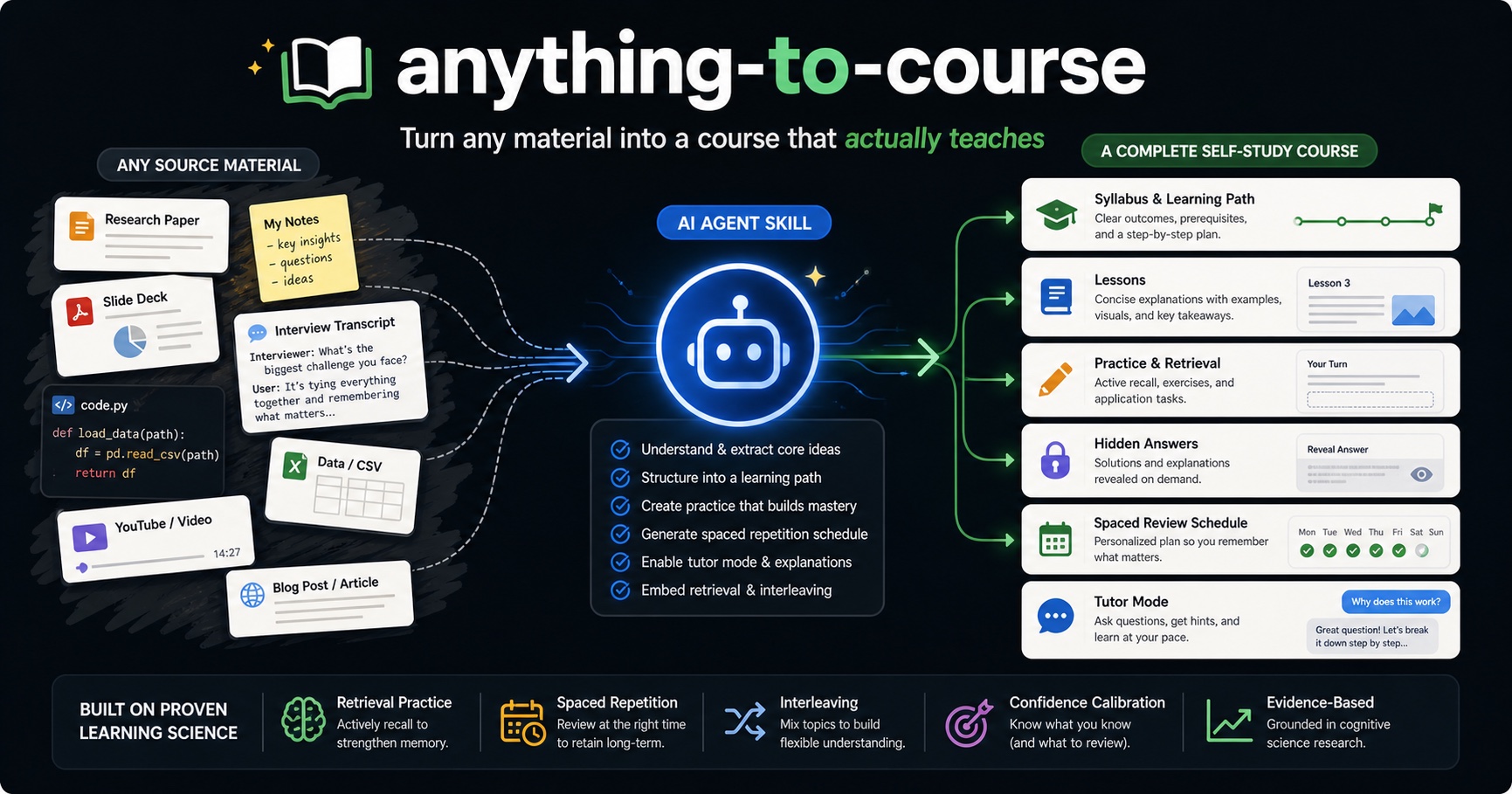
A universal AI agent skill that turns documents, notes, books, transcripts, slides, codebases — or just a topic — into a complete self-study course, then runs your study sessions as a tutor. Built and tested on Claude Code; designed for Claude.ai, OpenAI Codex, Gemini CLI, Cursor, and any agent that can read a SKILL.md folder.
What this is
anything-to-course is a portable course-design workflow for AI agents. It does not just summarize source material. It turns material into observable capabilities, lessons, practice, feedback, checkpoints, and a spaced review plan.
Source material       Capability map       Course build          Study mode
      |                    |                    |                    |
      v                    v                    v                    v
Docs, notes,  -->  outcomes, gaps  -->  lessons, tasks,  -->  retrieval,
slides, code       prerequisites        hidden answers        calibration,
or a topic          module order         review schedule       tutoring
Quick demo
Ask your agent:
Use the anything-to-course skill.
Turn ./docs/sql-handbook into a 3-week self-study course for analysts
who know Excel but have never written SQL.
Make learners practice before reading answers.
You get a course package with a syllabus, modules, lessons, hidden answer files, checkpoints, and a review schedule:
sql-for-analysts/
├── 00-syllabus.md
├── modules/
│   ├── 01-filtering-rows/
│   └── 02-aggregation/
├── answers/
└── review-schedule.md
See the generated example in examples/example-course/sql-for-analysts/.
The problem
Ask an AI to "make a course from this" and you get a content dump: well-formatted explanations, a cheerful summary, and a recognition quiz at the end. It reads smoothly. It feels clear. And it evaporates within a week — because feeling of understanding and ability to act are different outcomes, and rereading fluent text only produces the first one.
Decades of cognitive science are unambiguous about what produces durable capability: effortful retrieval, spaced re-encounters, interleaved discrimination practice, feedback after (never before) an attempt, and support that fades. Almost no AI-generated course uses any of it.
This skill hard-wires all of it into every course it builds.
What you get
Give it source material and an audience. It produces a structured course:
your-course/
├── 00-syllabus.md            # observable capabilities, module map, how to study
├── modules/
│   ├── 01-foundations/
│   │   ├── 00-overview.md    # outcomes, prerequisites, entry diagnostic
│   │   ├── 01-....md         # lessons: attempt → principle → worked example
│   │   │                     #   → contrast → practice with fading support
│   │   └── 99-checkpoint.md  # mixed practice, methods not named
│   └── ...
├── answers/                  # feedback & explanations — physically separate,
│                             #   so answers can't be seen before the attempt
└── review-schedule.md        # spaced repetition plan (+1d, +7d, +30d)
Every lesson follows an 11-step canonical flow where the learner attempts before reading the explanation, retrieves from memory before seeing options, rates confidence before checking, and gets feedback that explains the cause of the error and demands a retry.
See it before you run it
examples/example-course/sql-for-analysts/ is a complete, unedited course produced by this skill — syllabus, two modules, checkpoints, separated answer files, and a review schedule. Open any lesson and compare it with what "make me a course on SQL" gives you in a raw chat: the difference is the skill. A one-file taste: examples/sample-lesson.md.
The skill also shows you a sample lesson first on every run — one representative lesson in ~5 minutes for your sign-off on depth and tone — before building the full course.
Prerequisites
- An AI agent that can read local files: Claude Code, Claude.ai / Claude Desktop, OpenAI Codex, Gemini CLI, Cursor, or a similar tool.
- Git, if you want to clone the repository.
- Source material: docs, notes, PDFs, transcripts, slides, code, links you paste in, or just a topic brief.
No package manager, database, API key, or network access is required by the skill itself.
Install
Claude Code
git clone https://github.com/lowwwbank/anything-to-course.git ~/.claude/skills/anything-to-course
Then just ask:
Turn ~/docs/sql-handbook/ into a 3-week course for analysts who know Excel but not SQL.
Claude.ai / Claude Desktop
Zip this folder and upload it under Settings → Capabilities → Skills, then ask Claude to build a course from your material.
OpenAI Codex CLI
mkdir -p ~/.agents/skills
git clone https://github.com/lowwwbank/anything-to-course.git ~/.agents/skills/anything-to-course
Repo-scoped install
If you want a project-local skill, vendor it inside the current repo:
mkdir -p .agents/skills
git clone https://github.com/lowwwbank/anything-to-course.git .agents/skills/anything-to-course
Cursor, Gemini CLI, or any other agent
Place this folder wherever your agent can read it, then tell the agent to use SKILL.md. The skill is plain markdown: no scripts, no dependencies, no network access required.
Copy-paste only
If your agent does not support local skill folders, copy the contents of SKILL.md into the agent's custom instructions or prompt window, then attach or paste your source material.
Run your first course
Use the anything-to-course skill.
Turn <your source material> into a self-study course for <audience>.
Target outcome: learners should be able to <observable capability>.
Time budget: <duration>.
How it works
- Intake — audience, prior knowledge, target capabilities, time budget, stakes.
- Capabilities, not topics — the material becomes 3–8 observable outcomes ("given X, the learner can Y to standard Z"). Content that serves no capability is cut.
- Dependency mapping — modules ordered by what-builds-on-what, not by the source's table of contents. One lesson = one capability.
- Sample lesson first — one representative lesson for your sign-off before the full build; style mismatches cost one lesson to fix, not a course.
- Lessons via the canonical flow — real problem → learner attempt → principle → worked example (with the why of each step) → contrasting case → self-explanation → completion task → independent task → feedback → retry → exit ticket.
- Retention engineering — exit tickets reach back to earlier lessons, cumulative checkpoints interleave modules, and
review-schedule.mdschedules retrieval at +1 day, +7 days, +21–30 days. - Quality gate — the finished course is audited against a 40-item author checklist and an anti-pattern list before delivery.
- Study mode — afterwards, the same skill runs your sessions as a tutor: retrieval-first quizzing, confidence calibration, spaced reviews from the schedule, and a study log (
references/study-mode.md).
The science
Every design rule traces to published research — mostly meta-analyses:
| Design rule | Evidence |
|---|---|
| Practice by retrieval, not rereading | Rowland 2014 · Adesope et al. 2017 · Yang et al. 2021 |
| Attempt before explanation | Sinha & Kapur 2021 (productive failure) · Pan & Carpenter 2023 (pretesting) |
| Spaced reviews, relearning to criterion | Dunlosky et al. 2013 · Rawson & Dunlosky 2013 |
| Worked examples that fade with expertise | van Gog, Paas & Sweller 2010 · expertise reversal meta-analysis 2025 |
| Directed self-explanation prompts | Bisra et al. 2018 · Chi & Wylie 2014 (ICAP) |
| Interleaving for tool selection | Brunmair & Richter 2019 |
| Feedback after the attempt, cause-level, with retry | Wisniewski, Zierer & Hattie 2020 · Shute 2008 |
| Confidence calibration against the fluency illusion | Koriat & Bjork 2005 |
| Terms defined before first use | Mayer 2017 (pre-training) · Shatz 2023 (curse of knowledge) |
| Concrete example → abstract principle | Fyfe et al. 2014 (concreteness fading) |
| Goals ↔ practice ↔ assessment alignment | Biggs 1996 (constructive alignment) |
| Debriefed MCQ distractors | Roediger & Marsh 2005 |
| AI grading only with rubrics | Jukiewicz & Wyrwa 2026 |
The full principle set with conflict-resolution rules lives in references/learning-science.md.
What this skill refuses to do
Honest constraints, by design:
- ❌ No walls of explanation with a quiz bolted on the end
- ❌ No answers visible before the learner's attempt
- ❌ No recognition-only testing ("which of these is the definition of...")
- ❌ No new jargon used before it's defined for this audience
- ❌ No single example without a contrast or counterexample
- ❌ No topic ordering copied from the source's table of contents
- ❌ No "reread and highlight" as a study strategy
- ❌ No optimizing for completion speed and satisfaction over delayed performance
- ❌ No invented facts to pad thin source material — gaps get flagged instead
The full anti-pattern list is in references/quality-rubrics.md.
Repository structure
anything-to-course/
├── SKILL.md                        # the skill: workflow the agent follows
├── references/
│   ├── learning-science.md         # 18 principles + research citations
│   ├── course-blueprint.md         # canonical course/module/lesson templates
│   ├── practice-design.md          # practice matrix, question & feedback design
│   ├── quality-rubrics.md          # author checklist, case rubric, anti-patterns
│   └── study-mode.md               # tutor protocol: sessions, calibration log
├── examples/
│   ├── example-course/             # complete generated course (SQL for analysts)
│   └── sample-lesson.md            # one-file lesson excerpt
└── README.md
The skill uses progressive disclosure: agents load ~100 tokens of metadata at startup, the workflow when triggered, and reference files only when needed.
FAQ
What inputs work? Anything the agent can read: markdown/docs, PDFs, meeting or lecture transcripts, slide decks, blog post collections, codebases, or a plain topic description ("make me a course on X for Y"). Thin material gets flagged, not padded.
What about non-English source material? Fine. The skill's instructions are English; the generated course follows the language you ask for.
Can it run the course too, not just write it? Yes — say "run my study session" and the skill turns tutor: retrieval-first quizzing, confidence calibration, spaced reviews, and a study log, with hard rules like "no answers before an attempt" (protocol).
How long a course can it build? From a 1-hour primer to a multi-week program. Light requests keep the core invariants (attempt-first, retrieval practice, hidden answers) and drop the heavy apparatus (cumulative checkpoints, long review schedules).
License
MIT. Skills can direct an agent's behavior — always review a skill's contents before installing, including this one.
Yorumlar (0)
Yorum birakmak icin giris yap.
Yorum birakSonuc bulunamadi