perspectivegraph
Health Uyari
- License — License: Apache-2.0
- Description — Repository has a description
- Active repo — Last push 0 days ago
- Low visibility — Only 6 GitHub stars
Code Gecti
- Code scan — Scanned 12 files during light audit, no dangerous patterns found
Permissions Gecti
- Permissions — No dangerous permissions requested
Bu listing icin henuz AI raporu yok.
Finds the reachable paths from internet exposure, through excessive privilege, to a sensitive asset, by correlating the scanners you already run into one live graph of your environment. Flags them in the pull request that opens them and ships the fix as a PR. Open source, Apache-2.0.
 PerspectiveGraph





Catch the attack path in the pull request that opens it - then ship the fix as a PR.
On every pull request, PerspectiveGraph (open source, Apache 2.0) answers one question against a
graph of your real environment - built from the scanners you already run (Trivy, Semgrep, Cloud
Custodian, Falco):
Does this change open a path from the internet, through excessive privilege, to something valuable?
When it does, the PR check goes red - a required status you can block the merge on - and you get
the fix as its own one-click pull request. The reachable attack path is caught and closed in code
review, where it's cheapest, not months later in production. This is shift-left attack-path
analysis: not a scanner bolted onto CI, not a runtime CNAPP you log into after the fact - the
reachability question, answered in the developer's workflow.
That gate is powered by a full attack-path correlation engine, so the same graph also gives you the
rest: a queryable dashboard of your ~5 critical attack paths (not 10,000 flat findings), triage,
runtime confirmation, an AI summary, and always-current architecture maps. But the wedge is the
pull request.
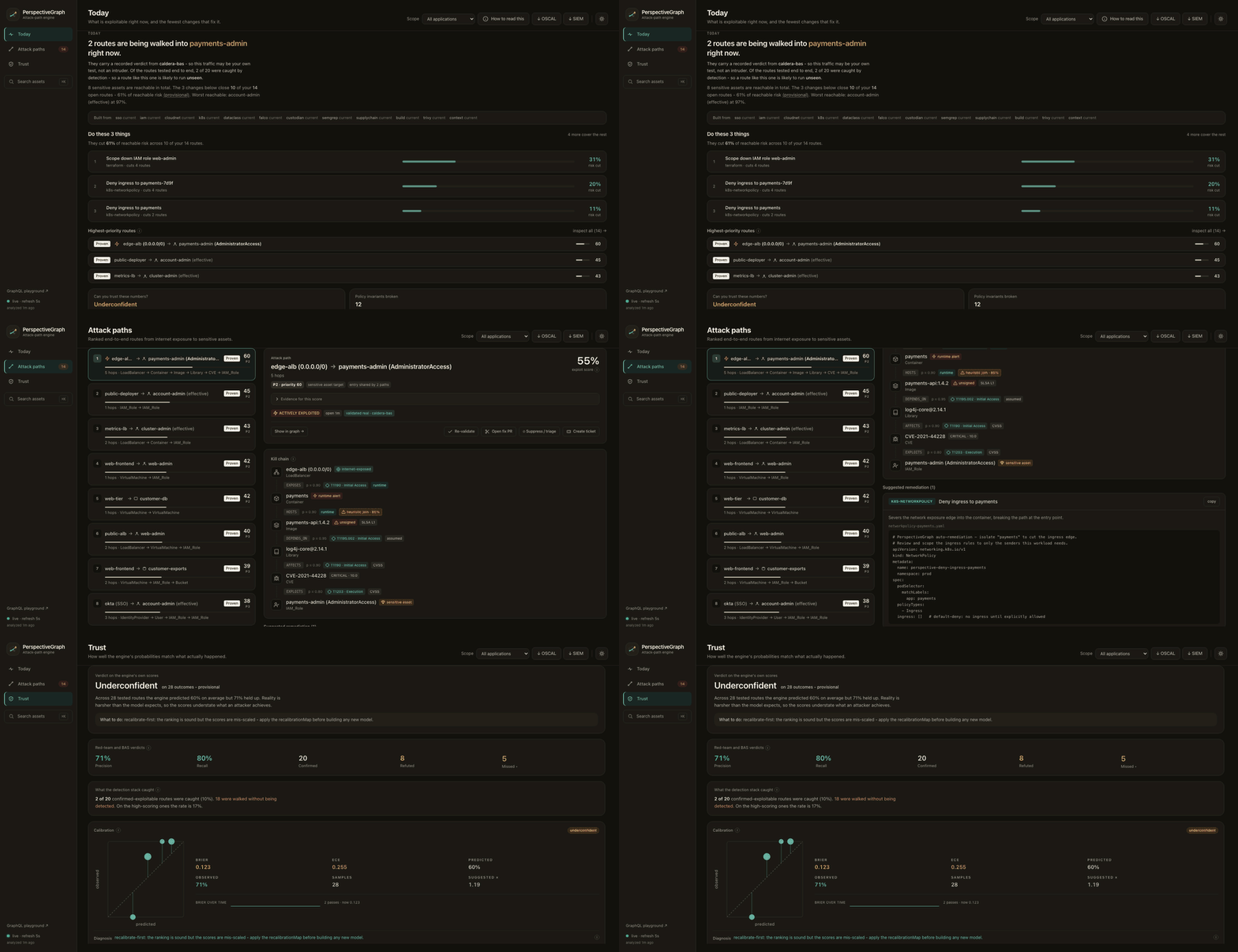
Twenty seconds of make demo: what is exploitable now → the ranked routes → one route's
kill chain and the fix it generates → whether the scores can be trusted. Sample scanner
output and seeded verdicts, not a real environment.
What this has not done yet
The engine reports probabilities, credible intervals and its own calibration - Brier
score, ECE, a reliability diagram. None of that has been calibrated against field
data. Nobody has yet run it over a real estate, tested the paths it surfaced, and fed
the verdicts back. The machinery for that closed loop is built and tested; the loop has
not been closed with real outcomes.So read a score as "what this model believes, and how sure it says it is", not as a
measured frequency. A path at 0.7 has not been shown to be exploited seven times in ten -
it has been shown to be what the model concludes from the evidence it was given, and
the interval beside it says how thin that evidence is.That is a statement about maturity, not about intent: the calibration harness exists
precisely so that number can be earned rather than asserted, and the
CloudGoat benchmark grades the path-finding itself on public,
reproducible scenarios today. If you run this on a real environment and record what you
find, that is the contribution that matters most.
Check your own account in 30 seconds
No deployment, no Docker, nothing ingested. One static binary asks AWS's own policy
evaluator which of your roles can reach administrator - applying the service control
policies, permission boundaries and condition keys that a policy reader on its own does
not see:
# macOS (Apple silicon); swap darwin_arm64 for linux_amd64, linux_arm64 or darwin_amd64
curl -sSL https://github.com/luiacuaniello/perspectivegraph/releases/latest/download/perspectivegraph_darwin_arm64.tar.gz | tar xz
./perspectivegraph redteam -roles -region eu-west-1
It is read-only and free: every check is one iam:SimulatePrincipalPolicy call, a
dry run that evaluates policy without performing anything, so it creates nothing and
costs nothing. It needs iam:SimulatePrincipalPolicy and iam:ListRoles - both insideSecurityAudit. Binaries for linux/macOS (amd64, arm64) and Windows are on the
releases page,
signed with cosign and carrying SLSA build provenance. The signature covers SHA256SUMS,
so one check covers every archive:
cosign verify-blob --bundle SHA256SUMS.bundle \
  --certificate-identity-regexp 'https://github.com/luiacuaniello/perspectivegraph/.*' \
  --certificate-oidc-issuer https://token.actions.githubusercontent.com \
  SHA256SUMS && sha256sum -c SHA256SUMS --ignore-missing
Add -compare and it also runs the engine over the same account and exits non-zero
where the two disagree - each disagreement is a false positive or a miss, in the
engine or in your assumptions. That check is how the permission-boundary bug described
in the manual was found, and how it stays closed.
That command is also stage 0 of a fuller trial: how to evaluate this
walks from here to a verdict in stages that each end in an answer - and says what the
trial will not tell you before you spend a fortnight finding out.
See the whole engine in 90 seconds
make demo
Pulls the published, cosign-signed images, feeds them sample Trivy / Semgrep /
Custodian / Falco / Kubernetes / IAM / SSO output, waits for the analyzer, and prints the
top attack path with its generated fix. Dashboard on http://localhost:3000. Needs
Docker, jq and curl - no Go or Node toolchain, and nothing is compiled: measured at
23 seconds from an empty image cache. Tear down with make down.
Building it yourself instead is make demo-build, which is the same demo from your
working tree. The images the fast path runs are the release artefacts, so you can check
what you are about to run before you run it - the cosign verify command is at the top ofdocker-compose.demo.yml.
Prefer not to build? The release images are published to GHCR (latest also tracks the
newest release; the pinned tag is the one to use if you care about reproducibility):
docker pull ghcr.io/luiacuaniello/perspectivegraph:v1.13.3 # x-release-please-version
docker pull ghcr.io/luiacuaniello/perspectivegraph-dashboard:v1.13.3 # x-release-please-version
docker pull ghcr.io/luiacuaniello/perspectivegraph-postgres:v1.13.3 # x-release-please-version
On Kubernetes, the Helm chart is published the same way - no clone needed, and a version
you can pin and verify. It is listed on
Artifact Hub as an
official package from a verified publisher, which is Artifact Hub's way of saying the
chart is published by the people who wrote the software rather than by a third party
repackaging it:
helm install perspectivegraph oci://ghcr.io/luiacuaniello/charts/perspectivegraph \
  --version 1.13.3 # x-release-please-version
They are signed with cosign keyless and carry an SPDX SBOM plus a SLSA build
provenance attestation - verify before you run, rather than taking the supply chain
on trust:
cosign verify \
  --certificate-identity-regexp 'https://github.com/luiacuaniello/perspectivegraph/.*' \
  --certificate-oidc-issuer https://token.actions.githubusercontent.com \
  ghcr.io/luiacuaniello/perspectivegraph:v1.13.3 # x-release-please-version
The dashboard opens on the decision, not the inventory: what is being exploited right
now, the fewest changes that remove the most risk, and how much the numbers can be
trusted.
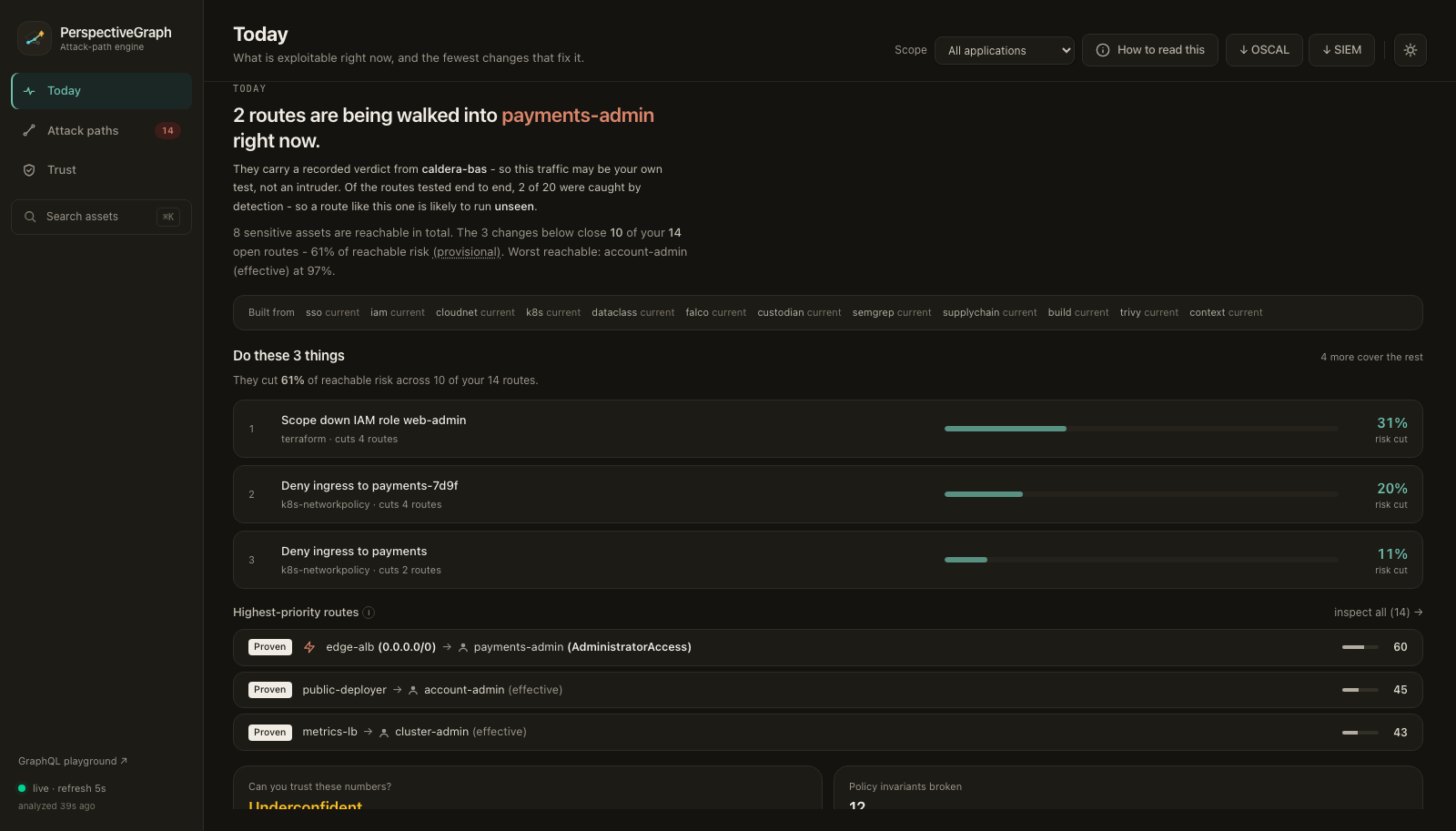
Routes are ranked by a composite triage priority - what the route reaches, whether
runtime confirmed it, how exposed the entry is - not by raw exploit score, so a
lower-scoring route can and does outrank a higher-scoring one.
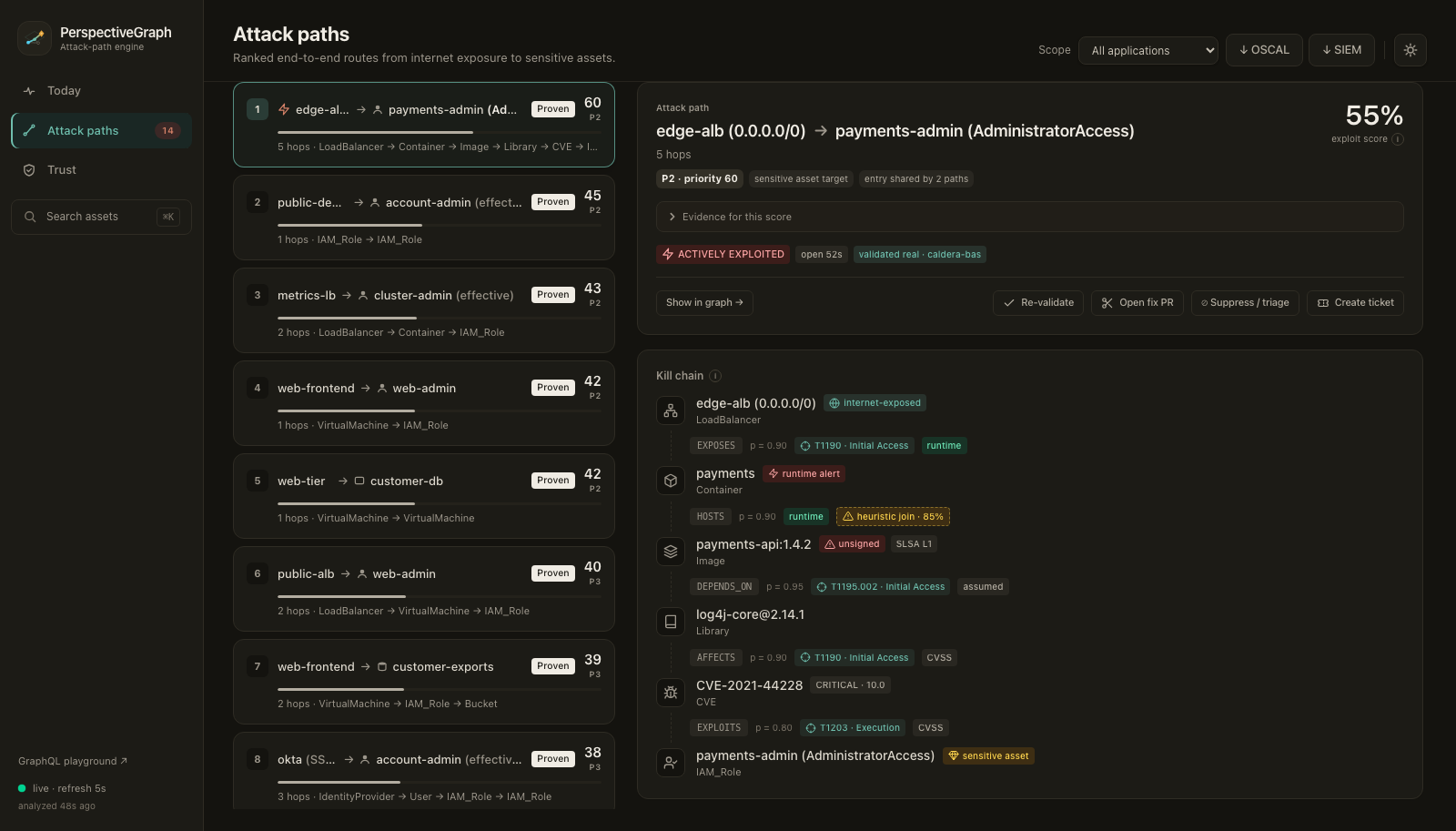 |
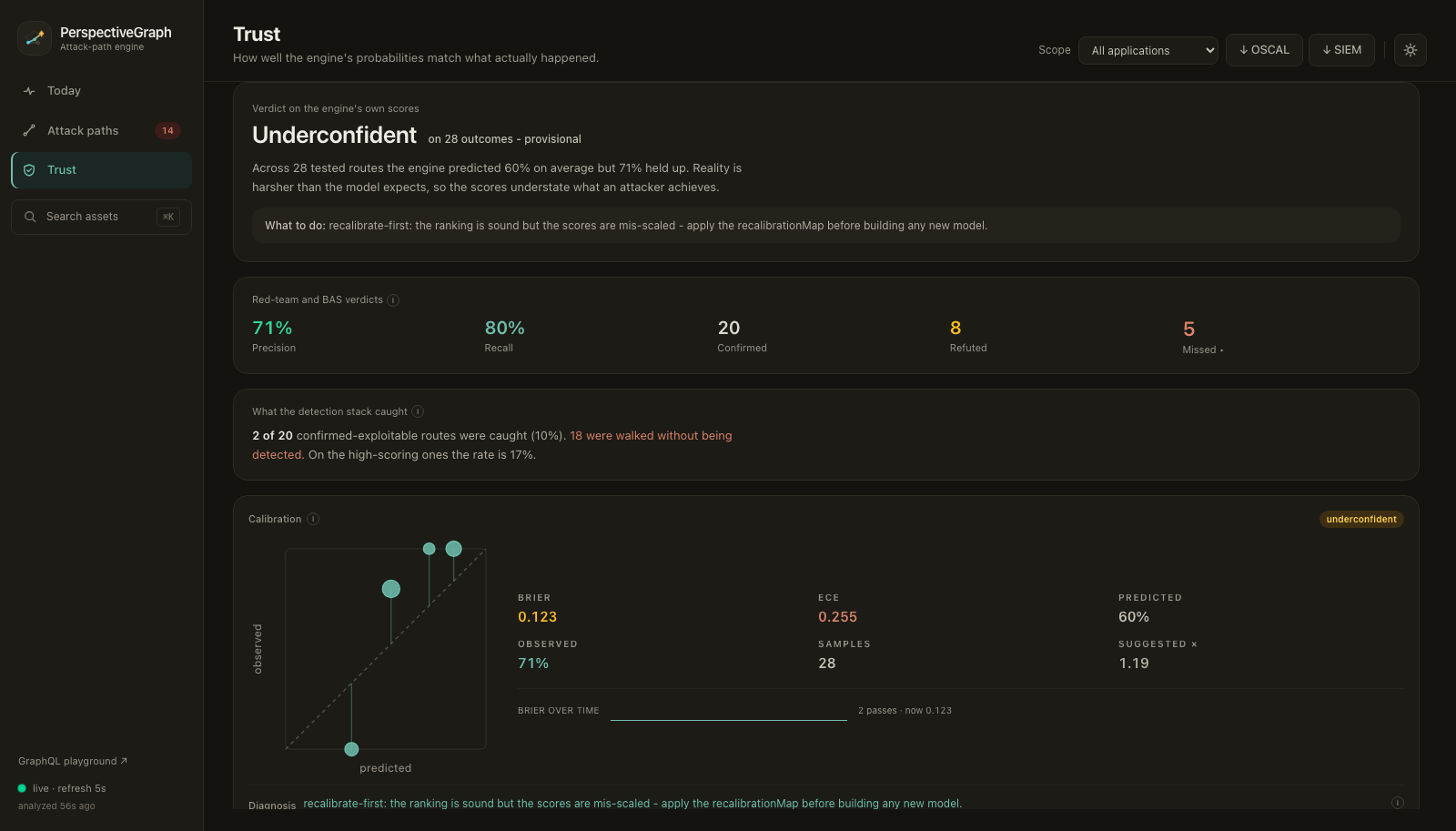 |
| Every hop, its probability, where that probability came from, and the ATT&CK technique. | Whether the engine's own scores held up against recorded outcomes. |
Every screenshot on this page is make demo: sample scanner output and seeded
verdicts, not a real environment. That is why the calibration panel returns a verdict of
"underconfident" - across 14 seeded outcomes the engine predicted 60% where 71% held up.
Those outcomes were generated to exercise the instrument, not to flatter it. On a fresh
install the same page reads "insufficient data" and withholds a verdict until real
outcomes exist, because a risk score you cannot check is worth less than an honest blank.
Why?
Modern security teams don't suffer from a lack of tools - they suffer from noise, fragmentation,
and missing context.
| Role | Pain today | What PerspectiveGraph gives them |
|---|---|---|
| Developer | CI/CD blocked by thousands of irrelevant CVEs | A PR check that goes red only when the change opens a real internet→sensitive-asset path - plus the fix as a one-click PR |
| Security | Triage on flat lists of 10,000 findings | A ranked list of ~5 critical attack paths, queryable like a database |
| Architect | No live view of how IaC becomes attack surface | Auto-generated, always-current architecture & data-flow maps + drift detection |
Block the pull request that opens the path
No deployment required. The runner reads your estate read-only, ingests this pull
request's scan, and answers in-process with the same engine:
- uses: luiacuaniello/perspectivegraph@v1
  with:
    mode: local
    aws-region: eu-west-1     # read-only; give the job an OIDC role with SecurityAudit
    report: trivy.json
An estate is not optional, and that is the point: without one there are no attack paths,
only a flat list of findings - the thing this replaces. If you collect your estate on its
own schedule, pass estate: estate.json (what perspectivegraph awscollect -json writes)
instead of aws-region.
Already running the engine? Point at it and it keeps the graph across pull requests, plus
triage, history and the dashboard:
- uses: luiacuaniello/perspectivegraph@v1
  with:
    api: https://perspectivegraph.internal
    ingest: https://perspectivegraph.internal:8081
    report: trivy.json
    hmac-secret: ${{ secrets.PG_INGEST_HMAC }}
Both modes run the same normalizer, the same pathfinder and the same triage priority, and
return the same verdict - a test asserts they agree path-for-path on identical input.
The check goes red when this commit puts a sensitive asset within reach. Not when it
adds a critical CVE - a critical on a host nothing routes to does not fail the build, and
a medium on a container that now reaches the production database does. That is a
different question from the one your other scanners answer, and answering it needs a live
estate, which is why the action talks to a running engine instead of scanning the runner.
It has three outcomes, and the third is the point. Every two-state gate ever written
gives a pipeline whose scanner output never arrived the same green tick as one that is
genuinely clean. Here that is unknown, and it fails the build by default:
| Verdict | Exit | Meaning |
|---|---|---|
clean |
0 | The engine analysed this commit and found no path through it |
blocked |
1 | Critical attack paths run through it - the check names them |
unknown |
2 | Nobody analysed it. The scan, the ingest or the SHA is wrong |
Set allow-unknown: true while you roll the gate out. Leaving it on afterwards turns a
broken ingest back into a green check, which is the one thing this gate is for.
The same thing without GitHub Actions - the action is a thin wrapper over one command:
perspectivegraph gate -local -aws-region eu-west-1 \
  -report trivy.json -slug owner/name -sha "$COMMIT_SHA"
Two things to settle before wiring it up.
Fork pull requests. The gate needs secrets, and GitHub gives a fork's
pull_request
run none - so a fork PR cannot be analysed and fails closed asunknown. Do not
reach forpull_request_targetto work around it: that event runs with your secrets
against the contributor's code, and in local mode your secrets are cloud credentials.
Run the gate onpushto your own branches instead, and let fork PRs go without it.Public repositories. When it blocks, the check prints the route - real asset names,
the CVE linking them, the sensitive asset at the end - into the job log and summary,
which on a public repository are public. Usesoft-failand post the detail somewhere
private, or keep the gate on a private repository.
Full input reference in action.yml; the underlying query is prVerdict
in the API schema.
Let an agent query it
A language model is weak at exactly what this engine is good at: it cannot enumerate
fourteen thousand edges reliably, it does not run Dijkstra, and asked for "the attack
paths in my account" it will produce plausible routes that do not exist. So the engine
speaks MCP - an agent calls it and reasons over
answers it could not have invented.
make mcp # or: perspectivegraph mcp --api http://localhost:8080
{"mcpServers": {"perspectivegraph": {
  "command": "perspectivegraph",
  "args": ["mcp", "--api", "http://localhost:8080"]}}}
Eight tools: get_posture, list_attack_paths, explain_attack_path,routes_to_target, list_fixes, simulate_fix, search_assets,get_score_trust. The one worth the integration is simulate_fix - it re-runs the
whole simulation with the given edges cut and reports what actually changes, settling
"would this help" with a deterministic counterfactual instead of an argument.
The surface is read-only: nothing suppresses a path, opens a PR or records a
verdict, because an agent that can silently accept a risk is a liability rather than a
feature. Every tool declares that on the wire (readOnlyHint), so a host can decide what
to run unattended without taking this paragraph's word for it - and a test fails if a
tool is ever added without that decision. The descriptions also tell the model the scores
are expert estimates, and to call get_score_trust before quoting one as a probability.
Every tool is also run against the real engine in the test suite, not only a stub, so a
query naming a field the schema lacks fails the build instead of an agent's call.search_assets asks the engine whether full-text search is on: without OpenSearch an agent
is told so, instead of receiving an empty result that reads as "no asset by that name".
Project status & maturity
The short version, if you read nothing else. The engine and its public API are
complete, documented and tested. The AWS connector is verified against a real account.
The path scores are not calibrated against real exploited outcomes yet, and the
order they produce has not been graded against them either - the instruments for both
exist, the field verdicts do not. What is measured today is whether a surfaced path is
real (the benchmark below). So: use it to find and cut routes, and don't put its risk
percentage in front of a board. What is and isn't claimed is spelled out in
positioning. It collects no telemetry: out of the box it opens
no outbound connection at all - GitHub, the AI assistant and the KEV/EPSS feeds each stay
dark until you set a key or flag (THREATINTEL is off by default).
The benchmark, as of v1.13.3. make bench-cloudgoat
runs four CloudGoat-shaped scenarios in CI and grades the engine on each:
| Scenario | Expects | Result |
|---|---|---|
ec2_ssrf |
a path | found it, invented none |
iam_privesc_by_attachment |
a path (leaked-credential origin) | found it, invented none |
ec2_private_subnet_no_path |
no path (open SG, private subnet) | produced none |
iam_privesc_denied_by_guardrail |
no path (explicit Deny wins) | produced none |
Precision and recall are 1.00 on all four. Read that for what it is: four scenarios, two
of them negative controls - a regression gate against known shapes, not a measurement of
field accuracy on your estate.
The long version follows. PerspectiveGraph is 1.x and in active development, built in
the open. The GraphQL schema is frozen and drift-guarded and the CLI/config surface is
documented, so a breaking change goes through a major version rather than arriving in a
patch - see the API stability policy. What's next is in the
roadmap; read this before you rely on it:
Engine: feature-complete. The correlation engine, agentless connectors, triage,
SSO, the PR merge-gate, the AI assistant, and the scale work are all implemented and
covered by tests. The public API contract (GraphQL, ingest events, config, CLI) is
documented and the GraphQL schema is frozen + drift-guarded - see the
API stability policy.Connector: validated against a real AWS account; scores: not yet field-calibrated.
The live connector, its read-only grant (SecurityAuditcovers every call), cross-accountAssumeRole, and the network↔identity join (instance --ASSUMES--> role) are verified
against a real account - that last edge was in fact a gap only real-account testing
exposed (the fixtures already contained edges AWS makes you derive). The
reachability-precision claim is verified there too:make reachability-lab-awsstands up
two instances behind the same wide-open security group, one in a subnet routed to an
internet gateway and one in a subnet with no default route, and the engine marks only the
first as exposed - suppressing the second with the reason, on real AWS rather than
fixtures. What is not yet
done is calibrating the path scores against real exploited outcomes: the self-calibration
flywheel has run end-to-end only on deliberately-vulnerable synthetic targets (a log4shell
app, akindRBAC scenario). Treat the scores as directionally honest, not
production-calibrated. One half of that gap is now closed against real AWS for free:make redteam-awsgrades the engine's privilege-escalation claims with AWS's own policy
evaluator - a read-only dry run that creates nothing and applies the SCPs and condition keys
the engine's policy reader skips. That grading has already paid for itself:make boundary-lab-awsstands up two roles with an identical privesc policy that differ only in a
permissions boundary, and it caught the engine calling both escalating where AWS allowed one
and denied the other. That false positive is now fixed - the connector carries the
boundary through and the evaluator intersects it - and the lab is the regression test,
running the engine and AWS side by side on a real account and failing if they disagree.
It deliberately does not rescale the path scores, and
the manual explains why it cannot:
those verdicts are one-sided, and a censored sample is not a measurement. Themake validate-aws,make validate-harness-aws, andmake validate-harness*harnesses are the path to closing that on your own environment.
For an offline, CI-gated check that the engine actually finds the right paths,make bench-cloudgoatgrades it against a battery of CloudGoat-shaped ground-truth
scenarios (precision/recall) - including the
reachability-precision case (an open SG on a private-subnet box must not form a path)
and the credential-origin case (a leaked-key privesc is invisible untilSEED_IAM_USERS
is on). It runs undermake test, so a regression that loses or invents a path fails the build.Deployment: demo-grade defaults, with a production switch. The backend is
hardened wherever it runs (distroless, non-root, read-only rootfs, all capabilities
dropped, digest-pinned 0-CVE images, opt-in TLS). Underdocker composethe bundled
dependencies - the dashboard's nginx, NATS, the demo Postgres - run as their images
ship, because the demo has to stay one command. Under Helm every workload, init
containers included, satisfies therestrictedPod Security Standard, asserted in CI
on both value sets, so a namespace that enforces it admits the chart unmodified. The
demo defaults are otherwise deliberately open. SetPG_ENV=productionand the backend refuses to start unless both the
API and ingest are authenticated - the permissive default cannot be reached by forgetting
to configure it. A production rollout still needs your own hardening beyond that: an
external PostgreSQL+AGE - managed only on Azure, self-managed on AWS and GCP, because
neither offers the AGE extension (the matrix) -
secrets in a manager (not env vars), TLS on by default,
backups, and HA for the leader-gated scheduler. If you terminate at a reverse proxy or
ingress, setTRUSTED_PROXY_CIDRSto it: per-IP controls (rate limit, brute-force
lockout, the address in the audit trail) otherwise key on the connecting peer - correct
and unspoofable, but behind a proxy that is one key for everybody, so one attacker's
failed logins lock out every user.X-Forwarded-Foris believed only from the proxies
named there, and only the hops they added. For people use OIDC, so revoking access is
your IdP's job rather than a token rotation - see the
operations & hardening runbook,SECURITY.md, and the
threat model.Support: the newest release, and nothing behind it. There are no backports and no LTS
branch - at six minor releases in the eight days after 1.0, a maintenance branch would be
a promise one maintainer breaks. What is promised instead is a clock on security fixes
(Critical 7 days, High 30, from confirmation) and an upgrade specified rather than hoped
for: semver over an enumerated stable surface, a drift-guarded schema, no migration step,
and rollback by redeploying the previous digest. SUPPORT.md is the policy,
including how to run this where change control applies.Scope. It answers the reachable attack-path question in the developer workflow. It is
not a scanner, a CNAPP, or a compliance product, and it does not replace them.How it is written. Developed by a human working with Claude (Anthropic): the design
decisions and what ships are the maintainer's, a large share of the implementation and its
tests came out of that collaboration. Said plainly for the same reason the engine reports its
own calibration - a claim you can check beats one you have to accept. Check it:make test,make bench-cloudgoat,govulncheck ./...,gosec ./.... See
CONTRIBUTING.
Issues and PRs are welcome. Nothing here is claimed beyond what the tests and the listed
validation cover.
Documentation
The manual is the full reference: the scoring model, every
integration, deployment, hardening and the runbook for pointing it at your own
environment.
- Evaluation - trying it on your own estate, in stages that each end in an answer
- Manual - architecture, scoring, quick start, deploy, operate
- Positioning - what is claimed, what is not, and how to check
- Support - which versions get fixes, how fast, and how to run this under change control
- Upgrading - the releases that need an action from you, and what it is
- Roadmap - what's next, and what it deliberately isn't becoming
- Threat model · Operations · API stability · Scale
- Governance · Maintainers · Adopters - who decides, who maintains, who runs it
- Attack-path benchmark - the CI-gated precision/recall battery
Verify the claims rather than taking them: make test, make bench-cloudgoat
(precision/recall against known-vulnerable scenarios), govulncheck ./....
License
Yorumlar (0)
Yorum birakmak icin giris yap.
Yorum birakSonuc bulunamadi