uxnan
Health Gecti
- License — License: MPL-2.0
- Description — Repository has a description
- Active repo — Last push 0 days ago
- Community trust — 21 GitHub stars
Code Uyari
- fs module — File system access in .github/workflows/release-desktop.yml
Permissions Gecti
- Permissions — No dangerous permissions requested
Bu listing icin henuz AI raporu yok.
Uxnan (pronounced /uʃ.nan/) is a suite of tools I built to solve a very specific problem I face as a developer: managing AI-powered coding agents from anywhere, without my hardware becoming a bottleneck.
Uxnan





Uxnan (pronounced /uʃ.nan/) is a toolkit I'm building to solve a very specific
problem I have as a developer: controlling AI coding agents from anywhere,
without my hardware becoming the bottleneck.
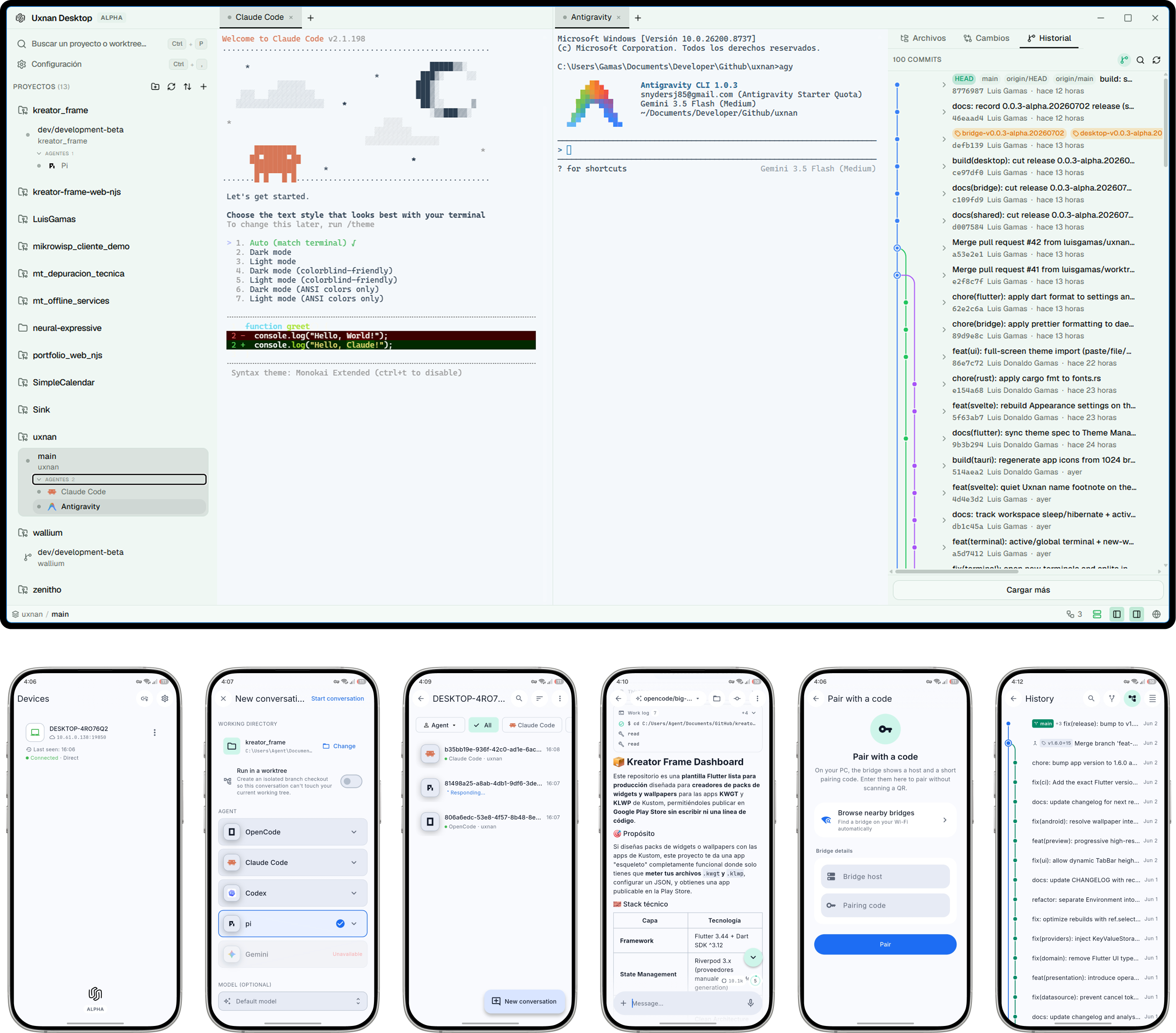
Why this project exists
I work with CLI coding agents (Claude Code, Codex CLI, OpenCode, Gemini CLI,
pi-agent) every day. They're extraordinary tools, but the current workflow has
real friction:
- When I step away from my PC, I lose all visibility into what the agent is
doing. I can't check its progress, approve changes, or send new instructions
from my phone. - Existing desktop solutions are excellent, but many assume high-end
hardware. On my current setup, running a heavy IDE + multiple agents + an
Electron environment consumes more resources than I can afford. - There's no provider-agnostic mobile tool that works with any agent, not
just one in particular.
Uxnan was born to solve exactly that. It's not an agent — it's the control
plane for the agents I already use.
How it fits together
The phone never talks to a cloud middleman in the clear. It pairs with the
bridge running on your PC and connects to it directly first — over your
LAN or your Tailscale network — and only falls back to an optional, self-hosted
relay when you're away from home. Whatever the path, every byte is
end-to-end encrypted; the relay only ever sees sealed envelopes.
   📱 uxnanmobile                  💻 your PC
   (Flutter app)                   ┌──────────────────────────────┐
        │                          │  bridge  ──▶  agent CLIs      │
        │   E2EE (X25519 +         │  (daemon)     claude · codex  │
        ├──── Ed25519 + ──────────▶│               opencode · pi   │
        │     AES-256-GCM)         │               gemini · zero   │
        │                          └──────────────────────────────┘
        │                                      ▲
        └──── relay (optional, ────────────────┘
              self-hosted, off-LAN only —
              forwards sealed envelopes, sees nothing)

   uxnandesktop — a separate, lightweight desktop app to run & review the same
   agents on the PC itself. shared — the contracts both ends speak.
What each component does
Uxnan is a single repository with five projects — plus the public website inweb/, which ships no artifact. Each one has its own README with
the full story; here's the short version and where to go next.
📱 Uxnanmobile — the mobile app




A Flutter app (Android + iOS) that turns your phone into a remote control for the
agents on your PC. Watch conversations stream in real time, send instructions,
attach images, dictate by voice, review diffs, commit and push, and get a
notification the moment an agent finishes — all over the encrypted, bridge-first
channel.

🖥️ Uxnandesktop — the desktop app





A lightweight Agent Development Environment built with Tauri 2, Rust and
Svelte 5. Unlike Electron-based alternatives that consume 200-500 MB of RAM just
by existing, this ADE uses the OS's native webview and targets 30-100 MB of RAM.
The core idea: each task lives in its own git worktree with its own agent running
in an independent pseudoterminal. I can have 5 agents working in parallel without
one blocking another, switch between them with a click (no git stash, no git checkout), and review each one's changes in an integrated diff viewer
(CodeMirror 6, unified + side-by-side, hunk-level staging) before committing.
It doesn't integrate any agent's SDK. It's terminal-centric: any CLI agent works
without modification.

macOS is an EXPERIMENTAL, unsigned build (separate Intel & Apple Silicon
DMGs) — macOS flags it as from an "unidentified developer", so you authorize it
by hand once (macOS install guide). You can
also build it on your own Mac; issues/PRs that
improve the macOS installers — or help non-technical users — are very welcome.
🌉 Bridge — the daemon on your PC



The heart of the product. A small Node.js daemon that runs on your PC, holds the
end-to-end-encrypted connection to your phone (E2EE protocol: X25519 + HKDF +
Ed25519 + AES-256-GCM), and drives the agents on your behalf by launching each
one's official local CLI exactly as you would in a terminal. No provider API,
no SDK, no keys: every agent runs under the account you already signed it in
with.
Real agents wired: OpenCode, Claude Code, Codex, pi, Gemini CLI, Antigravity, Zero, Grok.
🔁 Relay — the optional off-LAN hop

A tiny, stateless WebSocket relay you can self-host for when your phone and PC
aren't on the same network. It forwards sealed E2EE envelopes and nothing
else — it never sees your code, your diffs, your keys, or a line of plaintext.
Most of the time you won't need it at all.
📦 Shared — the common language


The single source of truth for the JSON-RPC + E2EE contracts that every part
of Uxnan speaks. The bridge and relay consume it directly; the mobile app keeps
hand-synced Dart equivalents. If two components ever need to agree on a message
shape, they agree here.
- JSON-RPC: envelope types + constructors, error codes (
-32000..-32008+
standard), typed method registry (build-time-locked toMETHOD_NAMES). - E2EE: handshake messages, transcript builder,
SecureEnvelope,PairingPayloadv2 (withhosts: string[]for direct addressing). - Domain models (thread/turn/message, git, workspace, project, auth, session,
approval) and agent contracts (IAgentAdapter,AgentCapabilities,AgentConfig). - Validation: Ajv-backed validators for requests, responses, E2EE envelopes,
pairing payloads and push payloads.
→ Read the shared contracts README
Security




Here privacy isn't a feature, it's the foundation. Everything that travels
between the phone and the PC goes through a real end-to-end encrypted channel:
session keys come from an X25519 ephemeral exchange, identities are authenticated
with Ed25519 signatures, and traffic is sealed with AES-256-GCM. The relay, when
it's even involved, is pure transport and never holds a key. Bridge responses are
sanitized too — sign-in status, for example, is reported per agent and never
returns a token.
If you find a vulnerability, please don't open a public issue — seeSECURITY.md.
Status
-orange?style=for-the-badge)
Uxnan is in alpha, and the core loop already works end to end. From the phone
I can pair with the bridge and hold a real, streaming conversation with eight
agents — OpenCode, Claude Code, Codex, pi, Gemini CLI, Antigravity, Zero and Grok — over the
encrypted channel. The desktop app is alpha-functional on its own. Push notifications are
live on Android (iOS depends on Apple assets).
Here's the quick snapshot; the detailed, always-current state for each project
lives in its own FOR-DEV.md:
| Project | Where it stands | Details |
|---|---|---|
uxnanmobile/ |
MVP wired, Android alpha-ready; iOS pending Apple assets | status |
uxnandesktop/ |
Alpha-functional as a standalone app | status |
bridge/ |
Implemented; 8 real agents wired | status |
relay/ |
Implemented; optional / self-hosted | status |
shared/ |
Implemented; contracts locked in CI | README |
This is early software, with no users and no production data yet, so things can
still change where a better idea justifies it.
Support the project
Uxnan is free and open source, built in the open in my own time. If it's useful
to you and you'd like to help it keep moving, a coffee goes a long way — and it's
genuinely appreciated. 🙏



For contributors & developers
If you want to build, run, or contribute to Uxnan, everything you need lives off
the README so the documentation above stays focused:
CONTRIBUTING.md— how to set up, the quality gates, and
how to open a good PR.AGENTS.md— the single source of truth for conventions,
architecture rules, and how the docs stay in sync. Read it before any
non-trivial change.- Per-project docs — each project keeps task-focused guides in its own
docs/and aCHANGELOG.md:bridge/docs/·relay/docs/·uxnanmobile/docs/·uxnandesktop/docs/·web/docs/. - The specification — the architecture documents are the source of truth for
cross-component behavior:architecture/(mobile,
bridge, relay, shared) anduxnandesktop/architecture/
(desktop). - Releases & versioning —
VERSIONS.md.
License
Uxnan is released under the Mozilla Public License 2.0.
Uxnan — a name with no relation to, or derivation from, any existing product.
Yorumlar (0)
Yorum birakmak icin giris yap.
Yorum birakSonuc bulunamadi