claude-mnemonic
Health Gecti
- License — License: MIT
- Description — Repository has a description
- Active repo — Last push 0 days ago
- Community trust — 10 GitHub stars
Code Basarisiz
- rm -rf — Recursive force deletion command in .goreleaser.yaml
Permissions Gecti
- Permissions — No dangerous permissions requested
This tool acts as a persistent memory module for the Claude Code CLI. It captures and recalls context, architecture decisions, and coding patterns across different sessions so the AI does not forget previous interactions.
Security Assessment
Overall risk: Medium. The application runs entirely locally and uses local embeddings, meaning it does not send your proprietary code or memory database to external APIs. However, there are a few security concerns to note. The primary issue is its installation method: the README heavily recommends piping a remote script directly into bash (`curl | bash`), which can be a vector for supply chain attacks if the repository is ever compromised. Additionally, the automated rule-based scan flagged a recursive force deletion command (`rm -rf`) inside the `.goreleaser.yaml` file. While this is a standard practice for cleaning up build directories during compilation, it still warrants a quick manual review of the script to ensure it strictly targets build artifacts. There are no hardcoded secrets or dangerous permission requests.
Quality Assessment
The project appears healthy and actively maintained, with repository activity as recent as today. It is licensed under the permissive and standard MIT license. Community trust is currently limited but present, represented by 10 GitHub stars. It is written in Go and recently shipped major updates, including a local knowledge graph and improved search relevance, indicating ongoing developer commitment.
Verdict
Use with caution: The local architecture is safe, but you should inspect the installation script and build files for safety before executing them.
Memory management and retrieval for Claude Code
Claude Mnemonic
Give Claude Code a memory that actually remembers.



Claude Code forgets everything when your session ends. Claude Mnemonic fixes that.
It captures what Claude learns during your coding sessions - bug fixes, architecture decisions, patterns that work - and brings that knowledge back in future conversations. No more re-explaining your codebase.
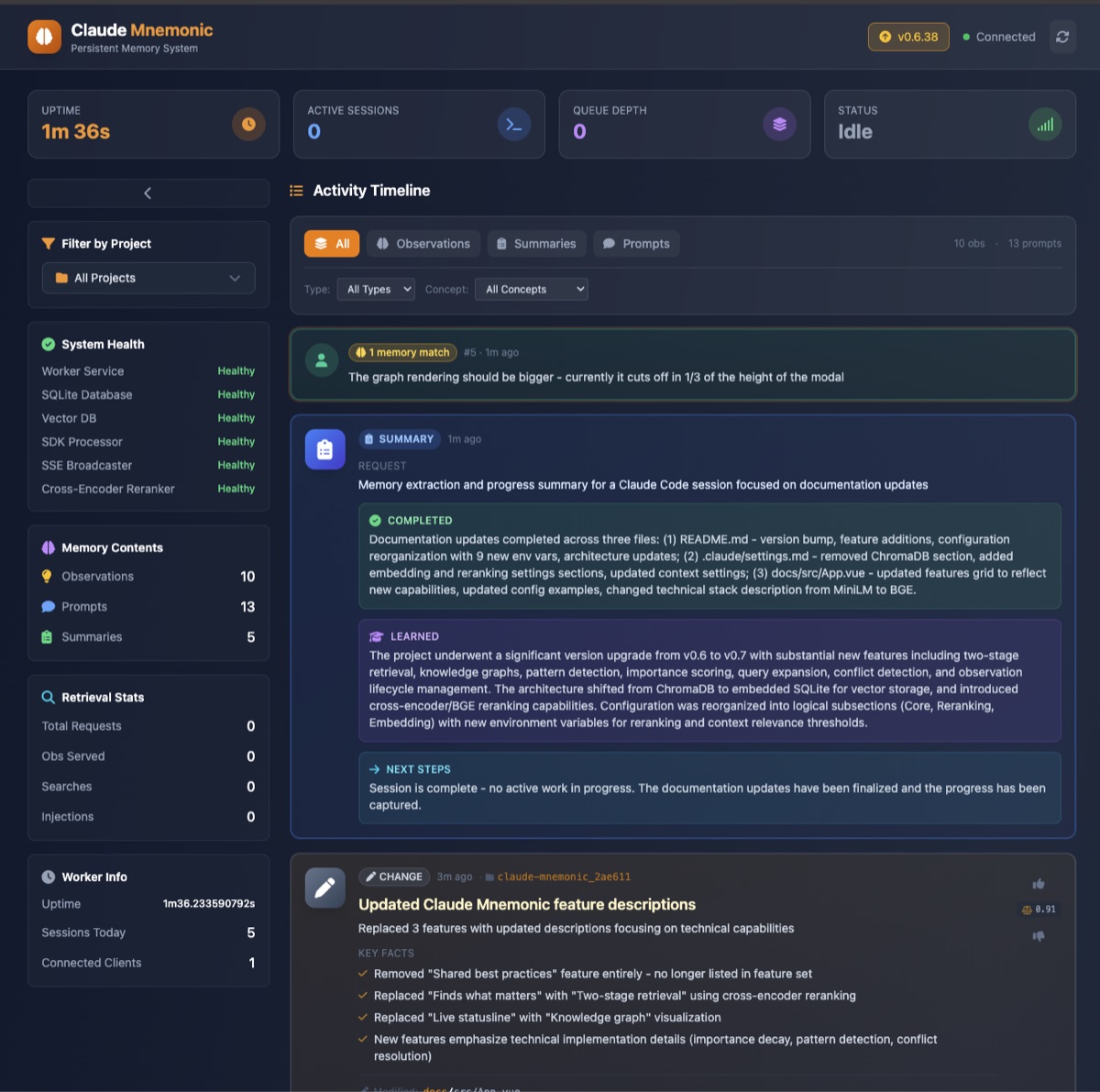
What's New in v0.7
- Two-Stage Retrieval - Cross-encoder reranking for dramatically improved search relevance
- Knowledge Graph - Automatic relationship detection between observations with visual graph in dashboard
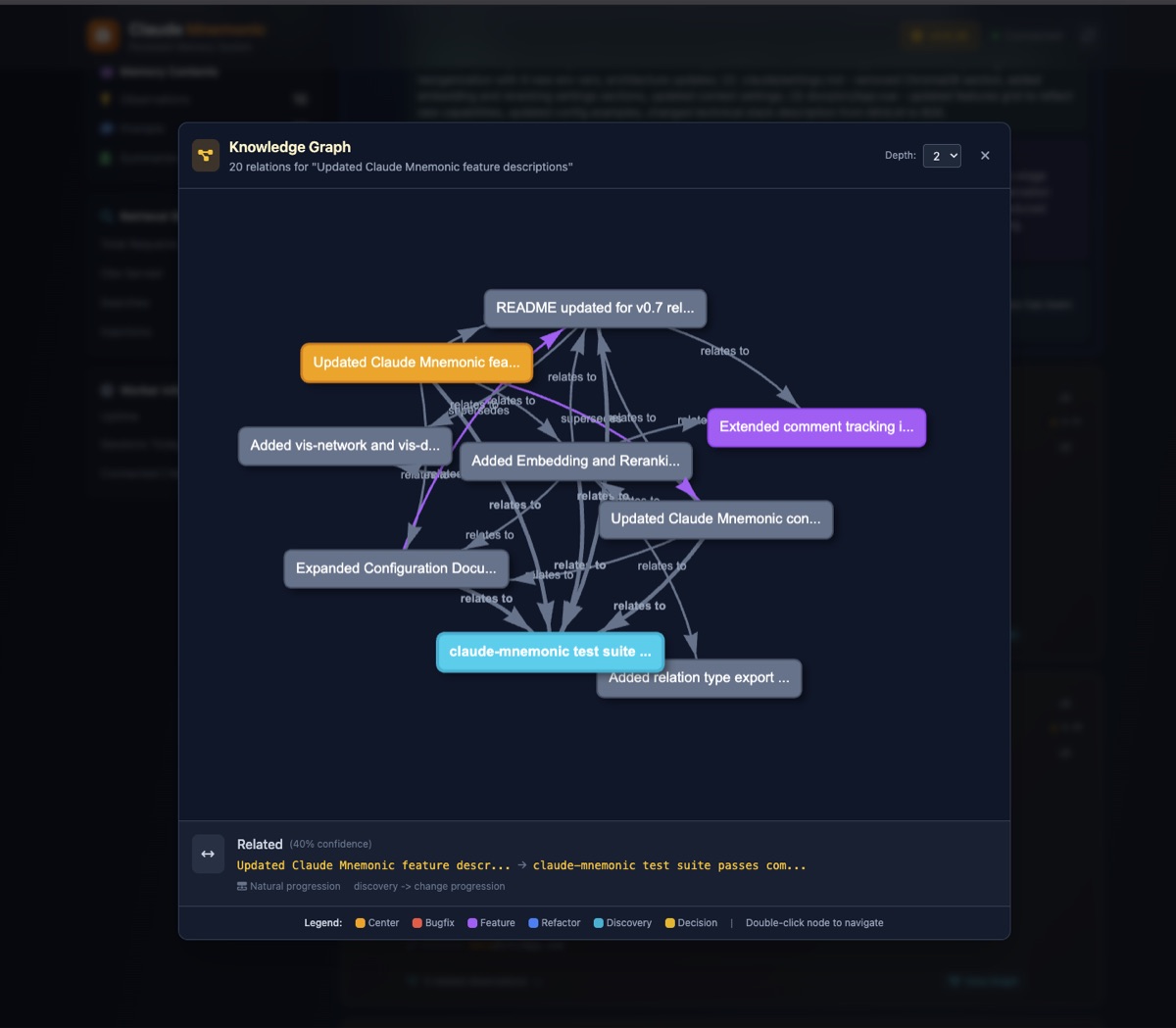
- Pattern Detection - Identifies recurring patterns across sessions and projects
- Importance Scoring - Time decay and voting system to surface the most valuable memories
- Query Expansion - Reformulates searches to find semantically related content
- Conflict Detection - Identifies and resolves contradictory observations
- Observation Lifecycle - Memories can be superseded when better information arrives
- Auto-Updates - Automatically stays up-to-date with the latest version
- Slash Command:
/restart- Restart the worker directly from Claude Code - Local Embeddings - All semantic search runs locally via ONNX Runtime (no external API calls)
- Async Queue Processing - Non-blocking observation capture for faster sessions
- Smarter Storage - Filters out system/agent summaries to keep knowledge relevant
- Improved Reliability - Better handling of connectivity issues and dead connections
Requirements
| Dependency | Required | Purpose |
|---|---|---|
| Claude Code CLI | Yes | Host application (this is a plugin) |
| jq | Yes | JSON processing during installation |
That's it. No Python. No external services. Everything runs locally.
No API keys needed! Claude Mnemonic uses Claude Code CLI, which works with your existing Claude Pro or Max subscription. No separate API costs.
Install
One command. That's it.
curl -sSL https://raw.githubusercontent.com/lukaszraczylo/claude-mnemonic/main/scripts/install.sh | bash
irm https://raw.githubusercontent.com/lukaszraczylo/claude-mnemonic/main/scripts/install.ps1 | iex
git clone https://github.com/lukaszraczylo/claude-mnemonic.git
cd claude-mnemonic
make build && make install
Requires: Go 1.24+, Node.js 18+, CGO-compatible compiler
After install, open http://localhost:37777 to see the dashboard. Start a new Claude Code session - memory is now active.
Verifying Release Signatures
All release checksums are signed with cosign using keyless signing. To verify:
# Download the checksum file and its sigstore bundle from the release
cosign verify-blob \
  --certificate-identity-regexp "https://github.com/lukaszraczylo/claude-mnemonic/.*" \
  --certificate-oidc-issuer "https://token.actions.githubusercontent.com" \
  --bundle "checksums.txt.sigstore.json" \
  checksums.txt
What it does
| Feature | Description |
|---|---|
| Persistent Memory | Observations survive across sessions and restarts |
| Project Isolation | Each project has its own knowledge base |
| Global Patterns | Best practices are shared across all projects |
| Semantic Search | Find relevant context with natural language (local embeddings) |
| Live Statusline | Real-time metrics in Claude Code: `[mnemonic] ● served:42 |
| Web Dashboard | Browse and manage memories at localhost:37777 |
| Auto-Updates | Automatically downloads and applies new versions |
| Slash Commands | Control the worker directly from Claude Code |
How knowledge flows
You code with Claude
        ↓
Claude learns something useful
        ↓
Mnemonic captures it automatically
        ↓
Next session: Claude remembers
Behind the scenes: hooks capture Claude's observations → SQLite stores with full-text search → sqlite-vec enables semantic search with local embeddings (all-MiniLM-L6-v2) → relevant context is injected at session start.
Configuration
Config file: ~/.claude-mnemonic/settings.json
{
  "CLAUDE_MNEMONIC_WORKER_PORT": 37777,
  "CLAUDE_MNEMONIC_CONTEXT_OBSERVATIONS": 100,
  "CLAUDE_MNEMONIC_CONTEXT_FULL_COUNT": 25,
  "CLAUDE_MNEMONIC_RERANKING_ENABLED": true
}
Core Settings
| Variable | Default | What it does |
|---|---|---|
WORKER_PORT |
37777 |
Dashboard & API port |
CONTEXT_OBSERVATIONS |
100 |
Max memories per session |
CONTEXT_FULL_COUNT |
25 |
Full detail memories (rest are condensed) |
CONTEXT_SESSION_COUNT |
10 |
Recent sessions to reference |
CONTEXT_RELEVANCE_THRESHOLD |
0.3 |
Minimum similarity score (0.0-1.0) for inclusion |
CONTEXT_MAX_PROMPT_RESULTS |
10 |
Max results per prompt search |
Reranking Settings (Two-Stage Retrieval)
| Variable | Default | What it does |
|---|---|---|
RERANKING_ENABLED |
true |
Enable cross-encoder reranking |
RERANKING_CANDIDATES |
100 |
Candidates to retrieve before reranking |
RERANKING_RESULTS |
10 |
Final results after reranking |
RERANKING_ALPHA |
0.7 |
Score blend: alpha×rerank + (1-alpha)×original |
RERANKING_PURE_MODE |
false |
Use pure cross-encoder scores only |
Embedding Settings
| Variable | Default | What it does |
|---|---|---|
EMBEDDING_MODEL |
bge-v1.5 |
Embedding model for semantic search |
All variables are prefixed with CLAUDE_MNEMONIC_ in the config file.
Project vs Global scope
Observations are automatically scoped:
- Project scope (default) - stays within the project directory
- Global scope - shared everywhere
Global scope triggers on tags like: best-practice, security, architecture, pattern, performance
Example: A bug fix in your auth module stays local. "Always validate JWT server-side" goes global.
MCP Tools
These search tools are available via MCP:
search- semantic search across all memoriestimeline- browse by timedecisions- find architecture decisionschanges- find code modificationshow_it_works- system understanding queries
Slash Commands
Available commands within Claude Code:
| Command | Description |
|---|---|
/restart |
Restart the worker process when experiencing issues |
Auto-Updates
Claude Mnemonic automatically checks for updates and applies them. Updates are downloaded in the background and applied on restart.
- Automatic update checks on startup
- Background downloads (up to 250MB)
- Seamless restart after update
- Manual trigger:
curl -X POST http://127.0.0.1:37777/api/update/apply
Check update status: curl http://127.0.0.1:37777/api/update/status
Troubleshooting
Worker won't start?
lsof -i :37777              # check if port is in use
cat /tmp/claude-mnemonic-worker.log  # view logs
Database locked?
rm -f ~/.claude-mnemonic/*.db-wal ~/.claude-mnemonic/*.db-shm
Worker unresponsive?
# Restart via API
curl -X POST http://127.0.0.1:37777/api/restart

# Or use the slash command in Claude Code
/restart
Check health status:
curl http://127.0.0.1:37777/api/selfcheck
Uninstall
# Remove everything
curl -sSL https://raw.githubusercontent.com/lukaszraczylo/claude-mnemonic/main/scripts/uninstall.sh | bash

# Keep your data
curl -sSL https://raw.githubusercontent.com/lukaszraczylo/claude-mnemonic/main/scripts/uninstall.sh | bash -s -- --keep-data
Architecture
- SQLite + FTS5 - Full-text search for exact matches
- sqlite-vec - Vector database embedded in SQLite
- Two-Stage Retrieval - Bi-encoder (embedding) + cross-encoder (reranking) for high accuracy
- Local Models - all-MiniLM-L6-v2 for embeddings, BGE reranker for relevance scoring
- Go - Single binary, no external dependencies
Everything runs locally. No Python. No external vector database. No API calls.
Platform support
| Platform | Status |
|---|---|
| macOS Intel | Supported |
| macOS Apple Silicon | Supported |
| Linux amd64 | Supported |
| Linux arm64 | Supported |
| Windows amd64 | Supported |
Development
make build          # build all
make test           # run tests
make dev            # dev mode with hot reload
make install        # install to Claude plugins
License
MIT
Yorumlar (0)
Yorum birakmak icin giris yap.
Yorum birakSonuc bulunamadi