skillnote
Health Pass
- License — License: MIT
- Description — Repository has a description
- Active repo — Last push 0 days ago
- Community trust — 30 GitHub stars
Code Pass
- Code scan — Scanned 12 files during light audit, no dangerous patterns found
Permissions Pass
- Permissions — No dangerous permissions requested
This open-source tool serves as a self-hosted registry for creating, managing, and distributing SKILL.md files to various AI coding agents via a web UI, CLI, or MCP server.
Security Assessment
Overall Risk: Low. The automated code scan of 12 files found no dangerous patterns, no hardcoded secrets, and the tool does not request any dangerous system permissions. As an agent designed to manage markdown files, it does not inherently require access to sensitive system data. However, because it is a self-hosted web application with a built-in MCP server, it does accept network requests. You should ensure you properly secure the deployment if you choose to expose it outside your local environment.
Quality Assessment
Quality is strong and actively maintained. The project uses the permissive MIT license and is highly active, with its most recent code push happening today. It has garnered 30 GitHub stars, showing a baseline of early community trust. The README is professional and clearly documents the features, indicating a well-structured project.
Verdict
Safe to use.
The open-source skill registry for AI coding agents. Create, manage, and distribute SKILL.md files across Openclaw, Claude Code, Cursor, Codex, OpenHands, Antigravity, and more.

SkillNote
The open-source skill registry for AI coding agents.
Create, manage, and distribute SKILL.md files, or connect any agent directly via MCP.





Quick Start · MCP Server · Features · Self-Hosting · Contributing
Why SkillNote?
AI coding agents like Claude Code, Cursor, and Codex use SKILL.md files to learn new capabilities. But managing these files is painful:
- They live scattered across
~/.claude/skills/,.cursor/skills/,.codex/skills/ - No versioning, no search, no way to share across projects or teams
- Writing them from scratch means guessing what works
SkillNote fixes this. It's a self-hosted registry with a clean web UI, a CLI for one-command installs, and an MCP server that lets any agent connect directly with no file installation needed.
Why self-hosted? Enterprise workflows, proprietary codebases, and compliance-sensitive prompts contain institutional knowledge that shouldn't leave your infrastructure. SkillNote runs entirely on your machines. Your skills stay private, versioned, and accessible only to your team.
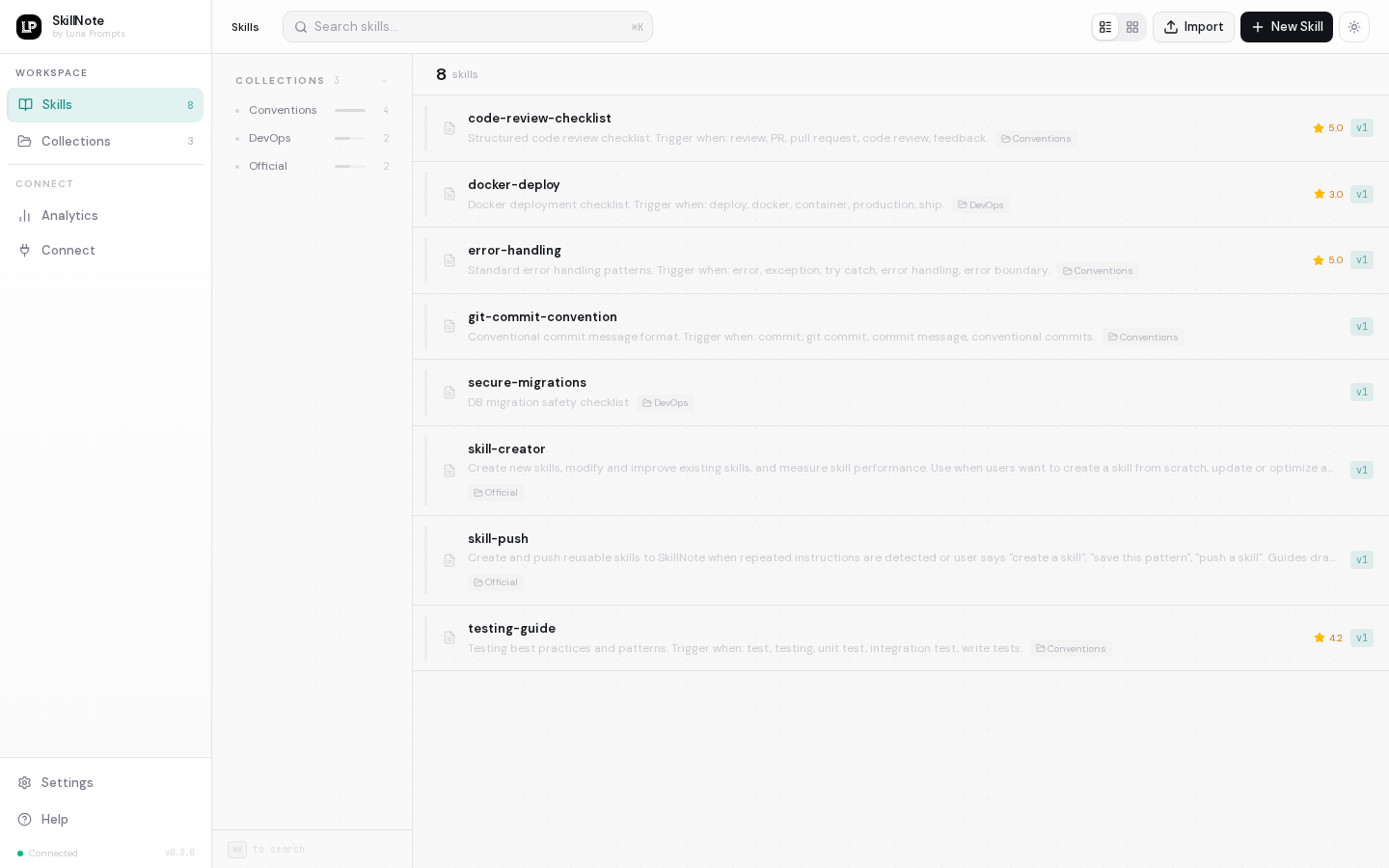
Skill Reviews & Ratings
SkillNote is the only skill registry with a built-in feedback loop. After an agent uses a skill, it rates it (1-5 stars) and optionally describes what it did — giving you real data on which skills actually work.
Agent uses skill → complete_skill(rating: 4, outcome: "built auth flow") → SkillNote
What you get:
- Per-version ratings — see how each version of a skill performs, right in the version history
- Agent reviews — read what agents actually did with the skill (outcome messages)
- Analytics dashboard — top skills, rating distribution, completion rates, and trends over time
- Settings control — toggle rating collection and outcome fields on/off from the Settings page
This creates a data-driven workflow: write a skill → agents use it → review the ratings → improve → repeat. Skills get better over time because you have real feedback, not guesswork.
Quick Start
Make sure you have Docker and Docker Compose v2+ installed.
git clone https://github.com/luna-prompts/skillnote.git
cd skillnote
docker compose up --build -d
Four containers spin up:
| Service | URL | What it does |
|---|---|---|
| Web | http://localhost:3000 | Next.js frontend |
| API | http://localhost:8082 | FastAPI backend (auto-migrates + seeds) |
| MCP | http://localhost:8083/mcp | MCP server, skills as tools |
| DB | localhost:5432 | PostgreSQL 16 |
Open http://localhost:3000 and start creating skills.
The backend auto-runs migrations and seeds a default skill (
skill-creator) on first boot. No manual setup needed.
Skills vs MCP: What's the Difference?
Most people building AI agents hear about both and assume they're the same thing. They're not. Understanding the difference is what makes SkillNote click.
Skills: reusable intelligence
A Skill is a reusable piece of knowledge injected into an agent's context: instructions, workflows, rules, examples. Think of it as a dynamic system prompt loaded on demand:
User message
    ↓
Agent picks the right Skill
    ↓
Injects SKILL.md content into the prompt
    ↓
LLM responds with that context
Skills improve reasoning. They teach the agent how to do something.
MCP: context transport
Model Context Protocol is a standard for delivering context to agents: tools, APIs, documents, prompts. It improves connectivity. It doesn't care what the content is; it's the pipe.
Skills = HTML    (the content)
MCP    = HTTP    (the transport)
HTTP delivers HTML. But HTML isn't part of HTTP. Same relationship.
How SkillNote combines both
Version 1: local files:
Agent reads skills/making-tea/SKILL.md from disk
Simple. Works offline. But skills go stale, drift across machines, and require manual installs.
Version 2: MCP delivery (what SkillNote does):
Agent → MCP → SkillNote → Skills DB
Every skill is exposed as an MCP tool. The agent discovers and calls them live: no files, no installs, always up to date. Update a skill in the Web UI and every connected agent gets the new version instantly.
Real-time push notifications. When a skill is created, updated, or deleted the MCP server immediately pushes a
notifications/tools/list_changedevent to every connected agent over their open SSE stream. Compliant clients (Claude Code, OpenClaw, Cursor, …) re-fetchtools/listautomatically — no reconnect, no polling, no restart required.
┌──────────┐     tools/list      ┌───────────────┐
│  Agent   │ ─────────────────▶  │  SkillNote    │
│          │ ◀─────────────────  │  MCP Server   │
│          │   [all your skills] │               │
│          │                     │  PostgreSQL   │
│          │  tools/call         │  LISTEN/      │
│          │ ─────────────────▶  │  NOTIFY       │
│          │ ◀─────────────────  │               │
│          │   skill content     │               │
│          │                     │               │
│          │ ◀─────────────────  │  push:        │
│          │  notifications/     │  tools/list   │
│          │  tools/list_changed │  _changed     │
└──────────┘  (SSE stream)       └───────────────┘
| Local Skills | MCP Skills (SkillNote) | |
|---|---|---|
| Updates | Manual (git pull / npx install) |
Automatic: edit in UI, live instantly |
| Fragmentation | Different versions per machine | One source of truth |
| Discovery | Agent must know the file path | Agent discovers via tools/list |
| Sharing | Send files or links | Connect to the same server |
| Offline | Yes | Needs network |
MCP Server
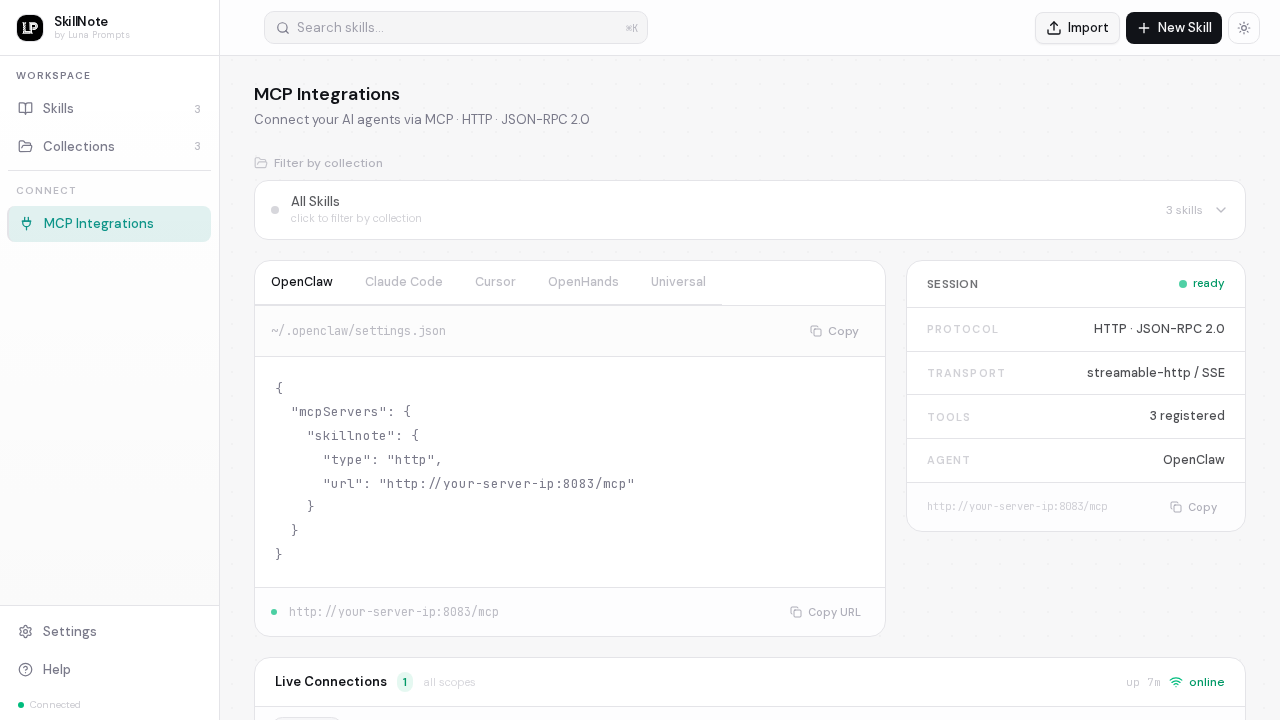
SkillNote exposes every skill as an MCP tool your agent can discover and call directly: no local files needed, no restart when skills change.
Every skill = one MCP tool. The tool name is the skill slug, the description is what the agent reads to decide when to invoke it, and calling the tool returns the full
SKILL.mdcontent. Filter by collection to control which skills (tools) each agent sees.
How it works:
- Each skill becomes a tool:
name = slug,description = skill description - The agent uses the description to decide when to invoke the skill
- Calling the tool returns the full
SKILL.mdcontent - Skills added, updated, or deleted in SkillNote trigger a
notifications/tools/list_changedpush to every connected agent — no reconnect needed
Claude Code
claude mcp add --transport http skillnote http://localhost:8083/mcp --scope user
Restart Claude Code, then run /mcp to confirm skillnote is listed.
openclaw mcp add --transport http skillnote http://localhost:8083/mcp --scope user
Or add to ~/.openclaw/settings.json:
{
  "mcpServers": {
    "skillnote": {
      "type": "http",
      "url": "http://localhost:8083/mcp"
    }
  }
}
In the OpenHands settings, add a new MCP server under MCP Servers:
{
  "mcpServers": {
    "skillnote": {
      "type": "http",
      "url": "http://localhost:8083/mcp"
    }
  }
}
Add to your codex.json config:
{
  "mcpServers": {
    "skillnote": {
      "type": "http",
      "url": "http://localhost:8083/mcp"
    }
  }
}
Add to your Antigravity MCP config:
{
  "mcpServers": {
    "skillnote": {
      "type": "http",
      "url": "http://localhost:8083/mcp"
    }
  }
}
Add to ~/.cursor/mcp.json or via Settings → MCP:
{
  "mcpServers": {
    "skillnote": {
      "type": "http",
      "url": "http://localhost:8083/mcp"
    }
  }
}
Any agent that supports the MCP HTTP transport can connect:
http://localhost:8083/mcp
Filter skills by collection
Use environment variables to serve only a subset of skills to a specific agent:
SKILLNOTE_MCP_FILTER_COLLECTIONS=devops,security docker compose up -d mcp
This is useful for scoping what different teams or agents can see.
MCP Integrations UI
The MCP Integrations page (sidebar → Connect → MCP Integrations) gives you ready-to-copy config snippets for every supported agent, a scope selector to generate collection-filtered URLs, and a live connection monitor that shows every connected agent — its name, version, IP, call count, and session duration — updating every 5 seconds.
Features
Skill Editor
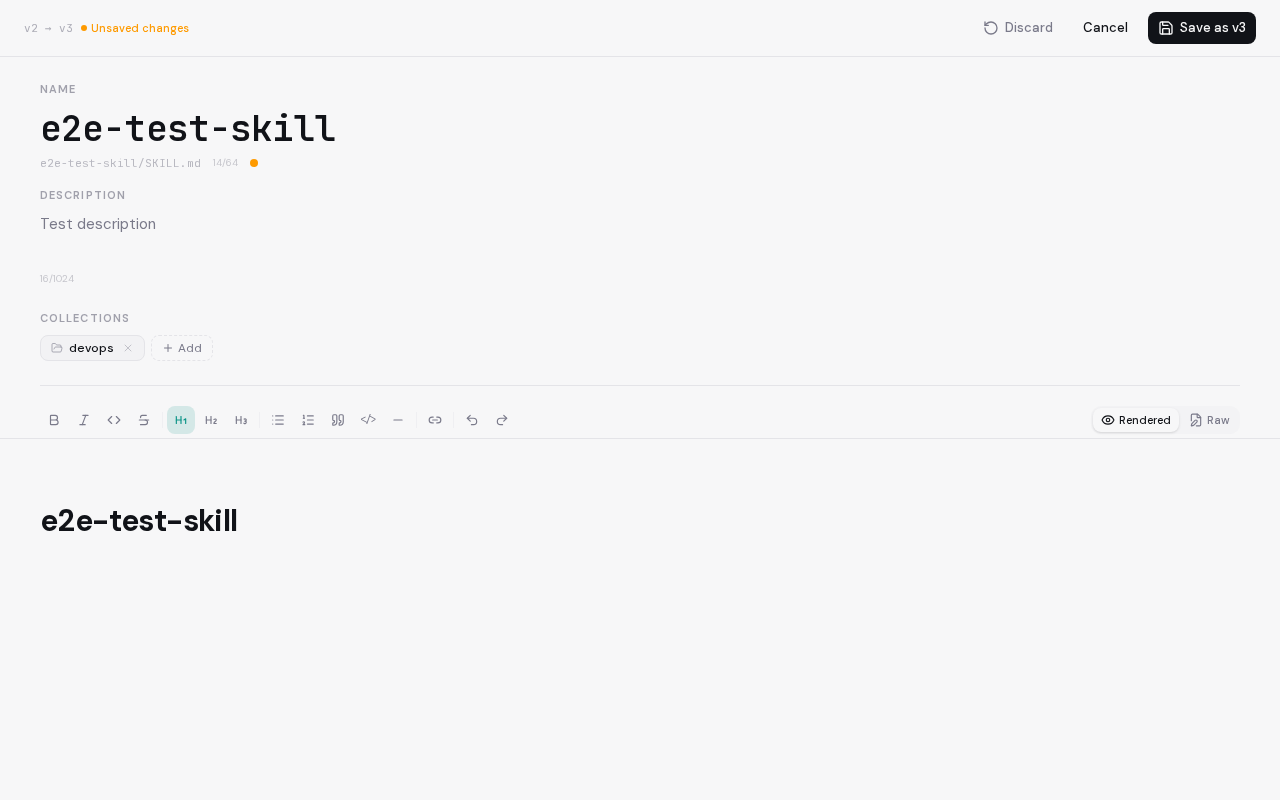
A Notion-style WYSIWYG editor powered by Tiptap. Write in rich text or switch to raw markdown. Paste a raw SKILL.md file and it auto-extracts the name, description, and body from the frontmatter.
Version History
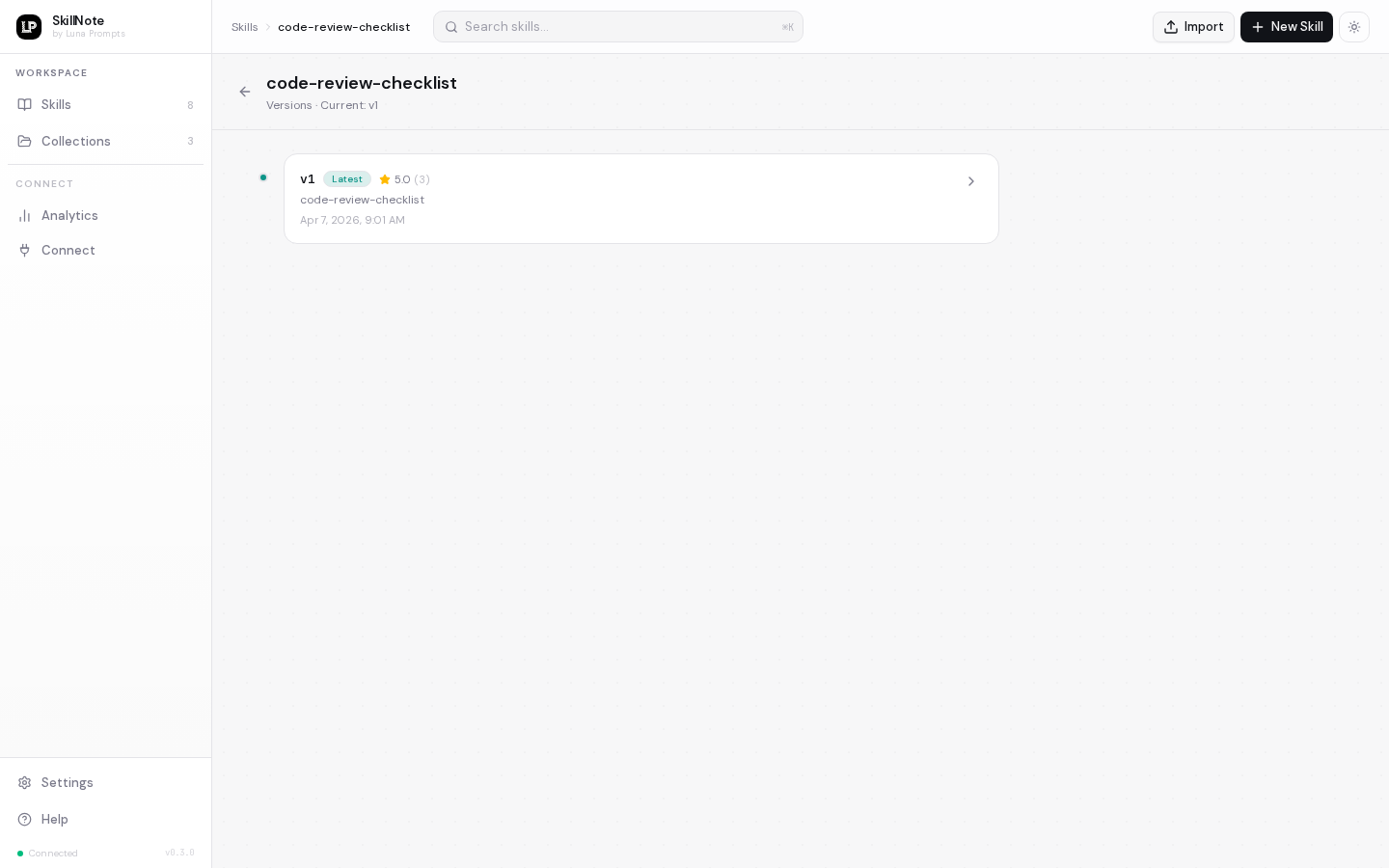
Every save creates a snapshot. Browse the full history, compare versions, and restore any previous state with one click. Each version shows its average rating and agent reviews inline, so you can see exactly how a version performed before deciding to restore or build on it.
Analytics
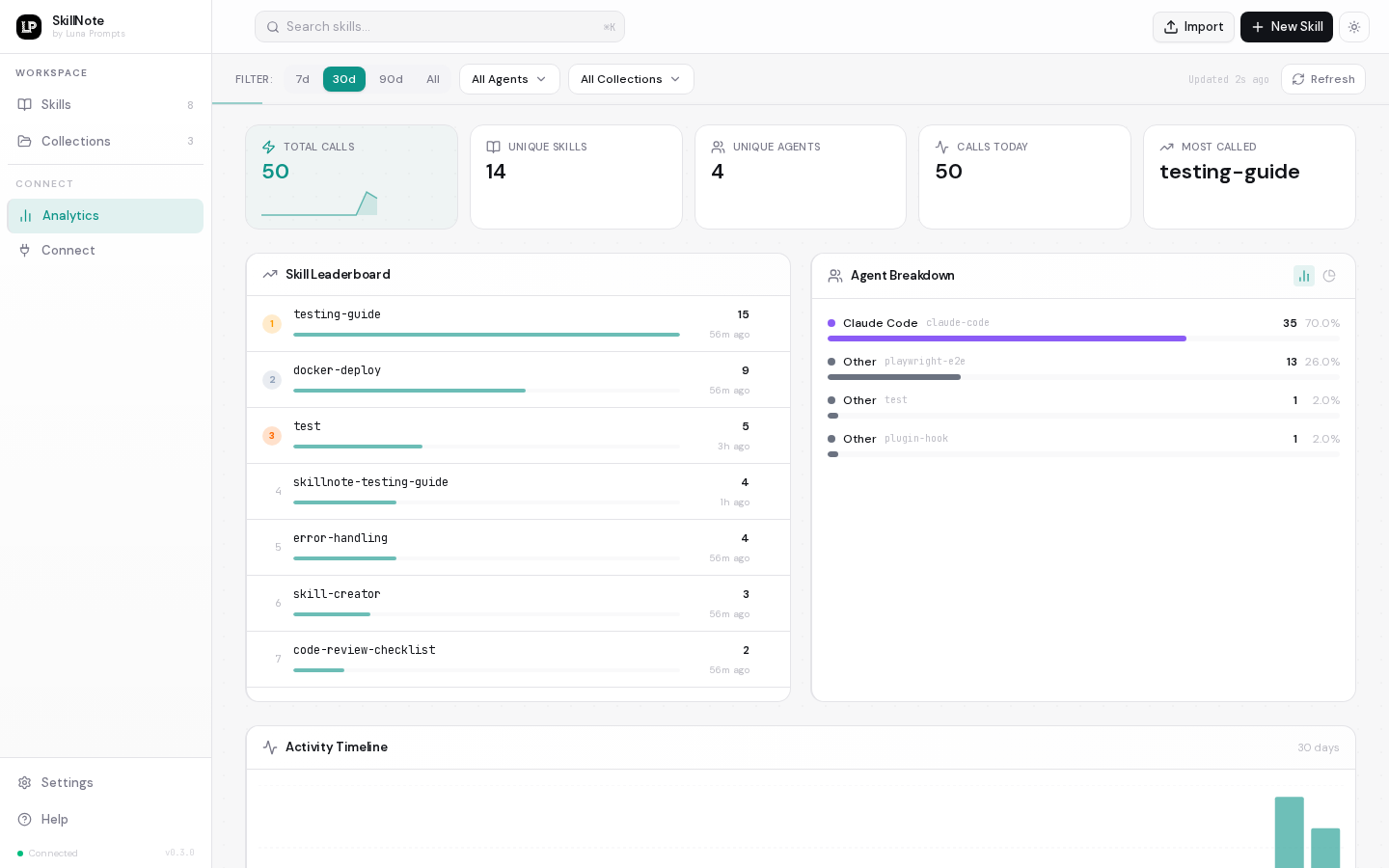
Track how your skills are used across every connected agent. The Analytics dashboard shows total calls, unique skills invoked, active agents, a skill leaderboard with ratings, agent breakdown by client, rating distribution and trends, an activity timeline, collection usage, and a live connections panel — all filterable by 7d / 30d / 90d / all-time.
Collections
Organise skills into collections. Filter, search, and browse by category. Add or remove skills from any collection with inline confirmation.
Multi-Agent Install
Install skills as local files to any AI coding agent from the web UI or CLI. Supported agents:
| Agent | Install Path |
|---|---|
| Claude Code | ~/.claude/skills/<skill>/SKILL.md |
| Cursor | .cursor/skills/<skill>/SKILL.md |
| Codex | .codex/skills/<skill>/SKILL.md |
| OpenClaw | ~/.openclaw/skills/<skill>/SKILL.md |
| OpenHands | ~/.openhands/skills/<skill>/SKILL.md |
| Windsurf | .windsurf/skills/<skill>/SKILL.md |
| Universal | .skills/<skill>/SKILL.md |
SKILL.md Format
Every skill is a Markdown file with YAML frontmatter:
---
name: pdf-extractor
description: Extract text and tables from PDF files. Use when the user mentions PDFs, scanned documents, or form extraction.
---

# PDF Extractor

When the user provides a PDF file:

1. Use `pdftotext` to extract raw text
2. Identify tables and format them as markdown
3. Preserve headings and document structure
Self-Hosting
System Requirements
SkillNote is lightweight. Here's what it uses on a typical machine at idle:
| Container | Image size | RAM (idle) | RAM (under load) |
|---|---|---|---|
| Web | ~302 MB | ~37 MB | ~60 MB |
| API | ~456 MB | ~71 MB | ~120 MB |
| MCP | ~456 MB | ~104 MB | ~160 MB |
| Postgres | ~663 MB | ~38 MB | ~80 MB |
| Total | ~1.9 GB | ~250 MB | ~420 MB |
The API and MCP images share base layers — the combined pull is ~600 MB, not 912 MB.
Minimum recommended specs:
- CPU: 1 core (2+ recommended for MCP-heavy workloads)
- RAM: 512 MB free
- Disk: 2 GB for images + space for skill bundles (5 MB each by default)
Disk usage over time:
- Each published skill version creates a ZIP bundle (≤ 5 MB by default)
- PostgreSQL data grows slowly — a typical install with 100 skills is < 10 MB
- Logs are written to stdout (captured by Docker); no files accumulate on disk
To check live resource usage at any time:
docker stats
Docker Compose (recommended)
git clone https://github.com/luna-prompts/skillnote.git
cd skillnote
docker compose up --build -d
Custom host or port
SKILLNOTE_HOST=192.168.1.100 SKILLNOTE_API_PORT=9000 docker compose up --build -d
Stop & reset
docker compose down          # Stop (keeps data)
docker compose down -v       # Stop + wipe database
Local Development
Run the backend in Docker, frontend with hot-reload:
# Terminal 1: Backend + MCP
docker compose up --build -d postgres api mcp
curl http://localhost:8082/health   # Wait for {"status":"ok"}

# Terminal 2: Frontend
npm install
npm run dev                         # http://localhost:3000
Environment Variables
| Variable | Default | Description |
|---|---|---|
SKILLNOTE_HOST |
localhost |
Host IP or domain (CORS + frontend URL) |
SKILLNOTE_API_PORT |
8082 |
Host port for the API |
SKILLNOTE_MCP_PORT |
8083 |
Host port for the MCP server |
SKILLNOTE_DATABASE_URL |
(set in compose) | PostgreSQL connection string |
SKILLNOTE_BUNDLE_STORAGE_DIR |
/app/data/bundles |
Where versioned ZIP bundles are stored |
SKILLNOTE_MAX_BUNDLE_SIZE_BYTES |
5242880 |
Max bundle upload size (5 MB) |
SKILLNOTE_CORS_ORIGINS |
(auto from host) | Comma-separated CORS origins |
NEXT_PUBLIC_API_BASE_URL |
http://localhost:8082 |
Frontend API endpoint |
SKILLNOTE_MCP_FILTER_COLLECTIONS |
(all) | Comma-separated collections to expose via MCP |
Tech Stack
| Layer | Technology |
|---|---|
| Frontend | Next.js 16, React 19, TypeScript, Tailwind CSS 4, Tiptap |
| Backend | Python 3.12, FastAPI, SQLAlchemy 2, Alembic, Pydantic 2 |
| MCP Server | Python 3.12, FastMCP |
| Database | PostgreSQL 16 |
| CLI | Node.js, TypeScript, Commander.js |
| Infra | Docker, Docker Compose |
References
- Claude Code Skills - Anthropic's official skills documentation
- Model Context Protocol - MCP specification
- AgentSkills.io - The skills ecosystem
- Codex Skills - OpenAI Codex skills reference
- Antigravity Skills - Google Antigravity skills documentation
- OpenHands Skills - OpenHands skills overview
Star Us
If you find SkillNote useful, please consider giving it a star on GitHub. It helps others discover the project and motivates us to keep improving it.

Contributing
Contributions are welcome! Here's how:
- Fork the repository
- Create a feature branch (
git checkout -b feat/my-feature) - Commit your changes (
git commit -m 'feat: add my feature') - Push to the branch (
git push origin feat/my-feature) - Open a Pull Request
Please follow Conventional Commits for commit messages.
Join us on Discord to discuss ideas, get help, or just hang out.
License
MIT © Luna Prompts
Made with ❤️ by Luna Prompts
Reviews (0)
Sign in to leave a review.
Leave a reviewNo results found