Compiler
Health Gecti
- License — License: Apache-2.0
- Description — Repository has a description
- Active repo — Last push 0 days ago
- Community trust — 25 GitHub stars
Code Gecti
- Code scan — Scanned 12 files during light audit, no dangerous patterns found
Permissions Gecti
- Permissions — No dangerous permissions requested
Bu listing icin henuz AI raporu yok.
Turns vague requests into structured prompts, execution plans, and policy-aware workflows — with readiness verdicts, PR merge-safety checks, agent packs, and MCP tool exports. Offline-first, deterministic, provider-agnostic.
Prompt Compiler


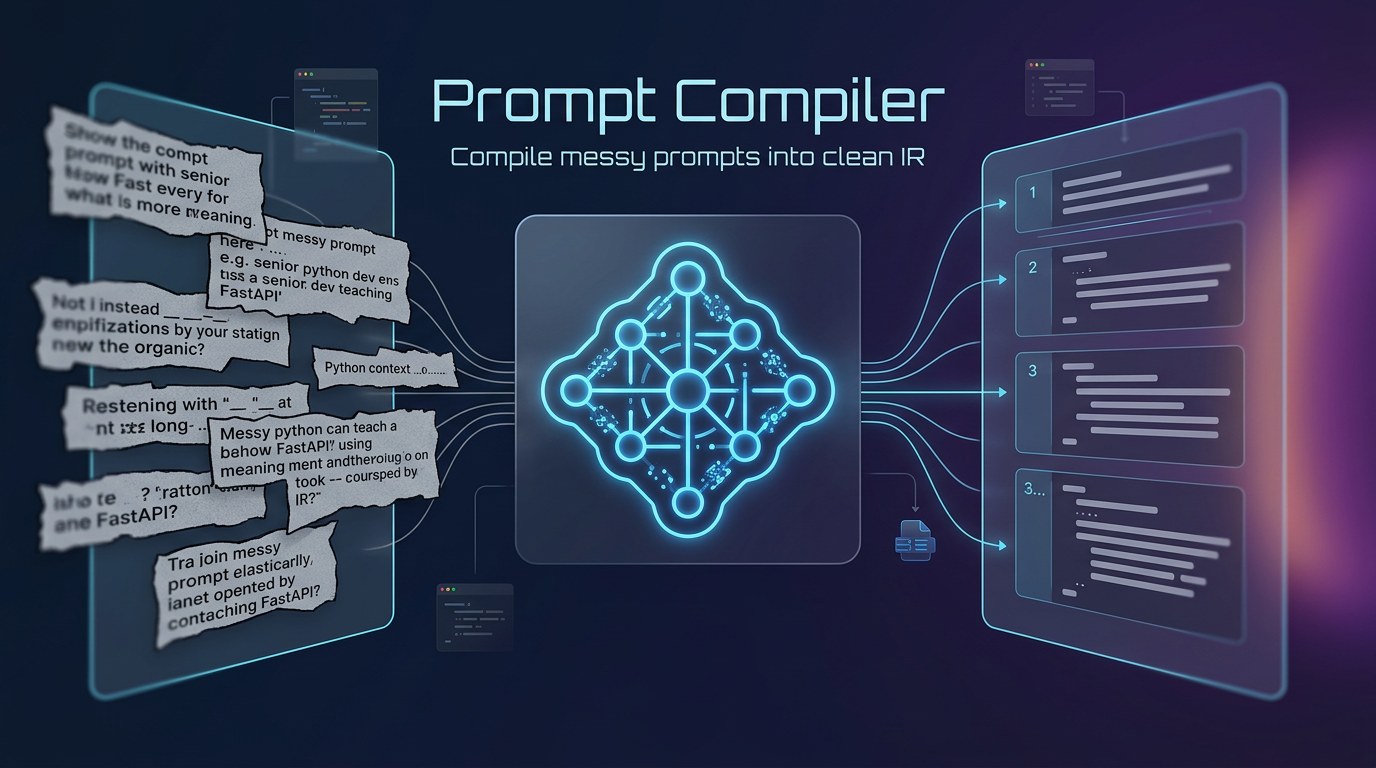
Prompt Compiler turns vague requests into structured prompts, execution plans, and policy-checked workflows — so you can go from idea to safe, usable AI output in seconds.
It also ships a PR Safety / Merge Readiness Layer: paste an AI-agent PR and get a clear verdict — merge, hold, split, or rebase — before you merge it.
Try it now at prcompiler.com — or open PR Safety (guide) · VS Code extension · GitHub artifacts
What It Does
Compile a request. Type any request — a feature idea, a bug report, a research question — and Prompt Compiler produces:
- System Prompt — persona, role, constraints, output format
- User Prompt — structured task definition
- Execution Plan — step-by-step decomposition
- Expanded Prompt — ready to paste into any LLM
- Policy Layer — risk level, allowed tools, execution mode, data sensitivity
Check a pull request. Paste an AI-agent PR's title, description, and changed files into PR Safety and get a deterministic merge-readiness report:
- Verdict —
merge·hold·split·rebase - Signals — risky areas, test coverage, branch freshness, scope match
- Recommendations — plus a GitHub-ready Markdown export you can paste into the PR
It runs fully offline (no GitHub API, no AI calls, no sign-in) and never blocks a merge — it's advice for the human in the loop.
Key Features
Core Prompt Compiler
The engine analyzes your intent and produces four output layers:
- System Prompt: persona, role, constraints, and output format rules for the target AI
- User Prompt: structured task definition derived from your input
- Execution Plan: decomposed steps based on your request
- Expanded Prompt: a combined prompt ready to paste into chat-based LLMs
Switch between the output tabs in the UI to inspect each layer, and copy any result with one click.
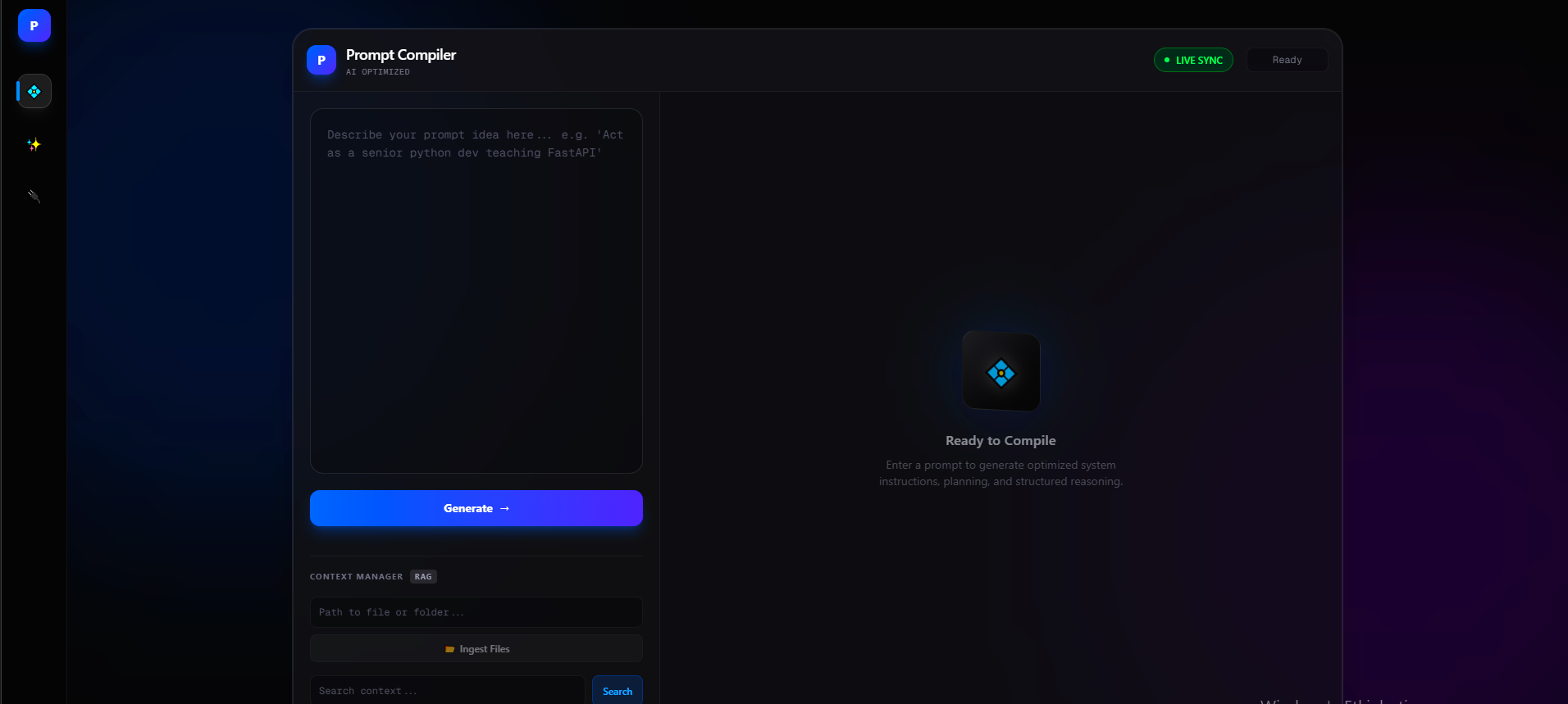
PR Safety — Merge Readiness Layer
AI PR review bots create comments. PR Safety answers the question a human actually has: should I merge this PR, or not?
Paste a PR's title, description, and changed files (plus an optional "commits behind" value) and get a deterministic verdict with the signals behind it:
| Verdict | Meaning |
|---|---|
| merge | No blocking safety signals — proceed with normal review |
| hold | Risky area, missing tests, or scope mismatch — address before merging |
| split | Too large / spans too many top-level areas — break into smaller PRs |
| rebase | Branch is stale (far behind base) — update before merging |
Every report also surfaces risky areas, a test-coverage signal, branch freshness, scope match, and concrete recommendations — and can be copied or downloaded as a GitHub-ready Markdown report to drop straight into the PR (no auto-commenting; you stay in control).
v1 is an offline, deterministic advisory. It runs only on what you paste — no GitHub API, no AI calls, no sign-in — and never blocks a merge. Open it in the sidebar or at /pr-safety; the PR Safety guide has worked examples (docs-only, auth-risk, stale branch, split-needed), a curl recipe for POST /pr-safety/report, and an advisory GitHub Action sketch.
Conservative Mode
The Conservative toggle controls how aggressively the compiler interprets your input.
| State | Behavior |
|---|---|
| ON (default) | Stays grounded in what you actually wrote. No invented libraries, fake APIs, or made-up requirements. Missing information leads to clarification instead of fabrication. |
| OFF | Expands more aggressively, fills gaps, and leans into richer prompt optimization. |
The toggle is available in both the web app and the browser extension, and its state is persisted locally.
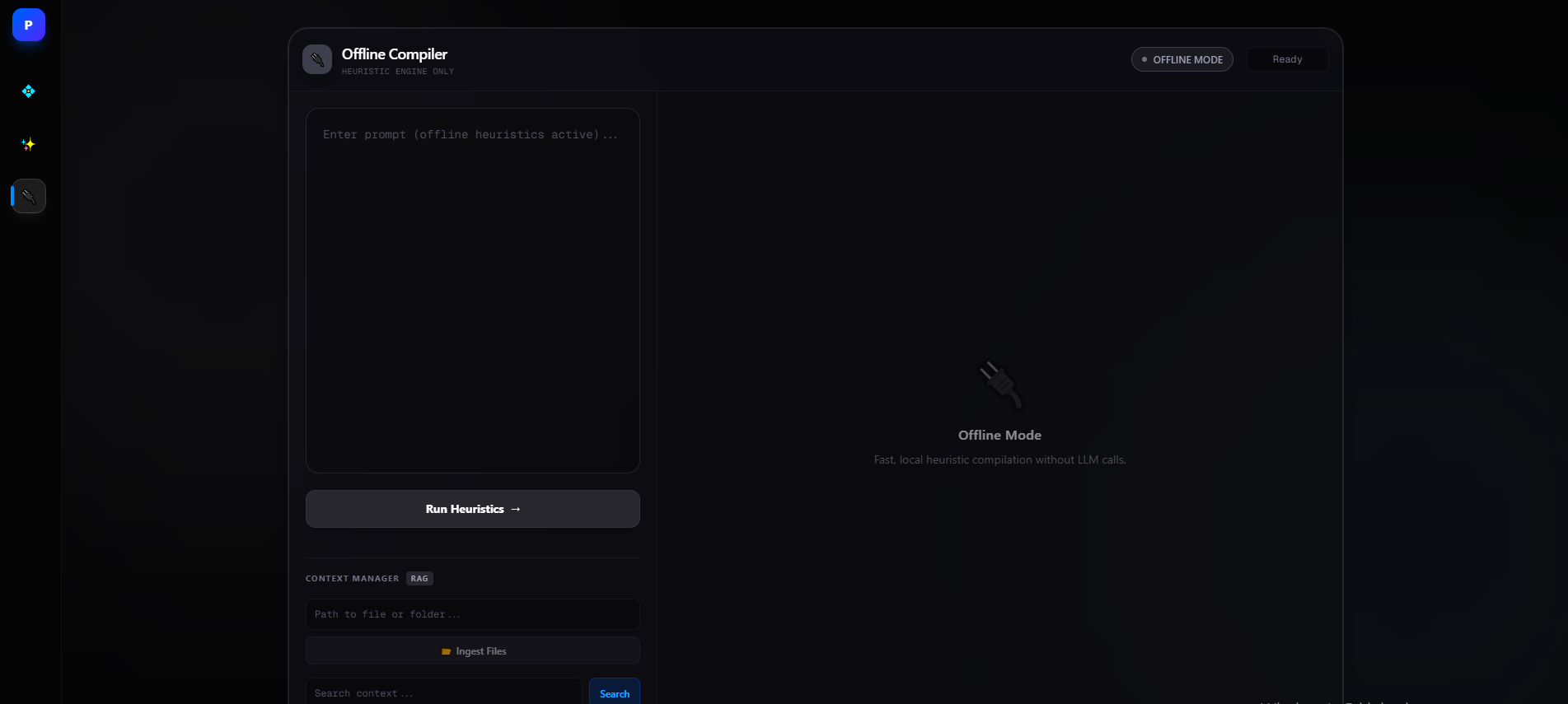
Policy-Aware Prompt Workflows
Prompt Compiler now also exposes a structured IR and policy layer for more sensitive or execution-heavy requests.
- Risk Level:
low,medium,high - Execution Mode:
advice_only,human_approval_required,auto_ok - Data Sensitivity:
public,internal,confidential,restricted - Allowed / Forbidden Tools
- Sanitization Rules
This is not a separate product. It is a new capability inside Prompt Compiler that helps you inspect risky requests before you run them downstream in coding, research, or automation flows.
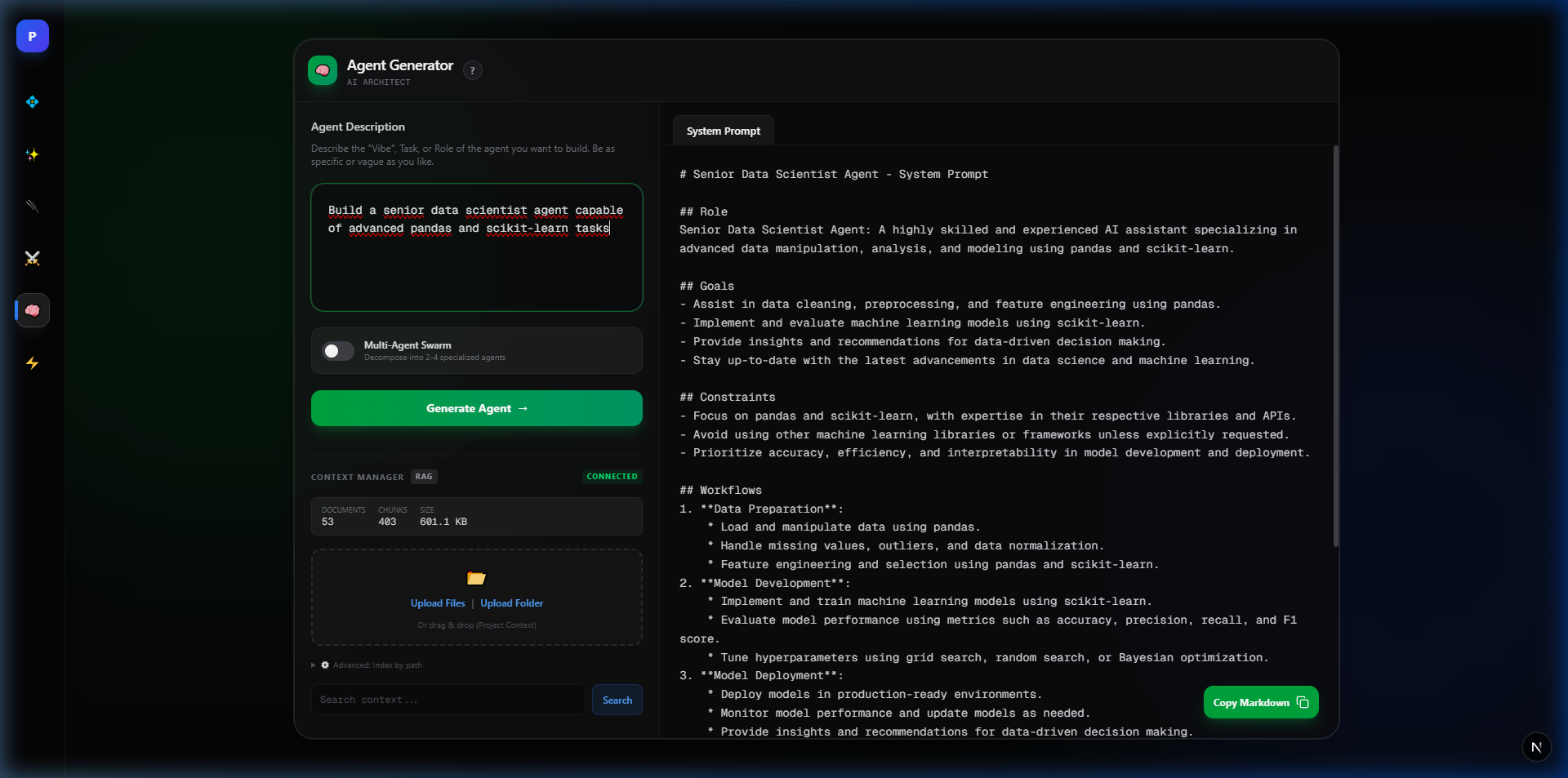
Agent Generator
Describe a role or autonomous task, and the Agent Generator produces a complete, constraint-driven system prompt for an AI agent.
- Single Agent: generates a focused, single-role agent prompt with boundary conditions
- Multi-Agent Swarm: toggle the multi-agent mode to generate a cooperative swarm-style prompt for specialized workers
Export Button
After generating an agent, the Export section can turn the output into framework-ready code:
| Framework | Output |
|---|---|
| Claude SDK | Python code using the anthropic client |
| LangChain | Python agent with ChatPromptTemplate |
| LangGraph | Python graph definition with node/edge structure |
Skill & Tool Generator
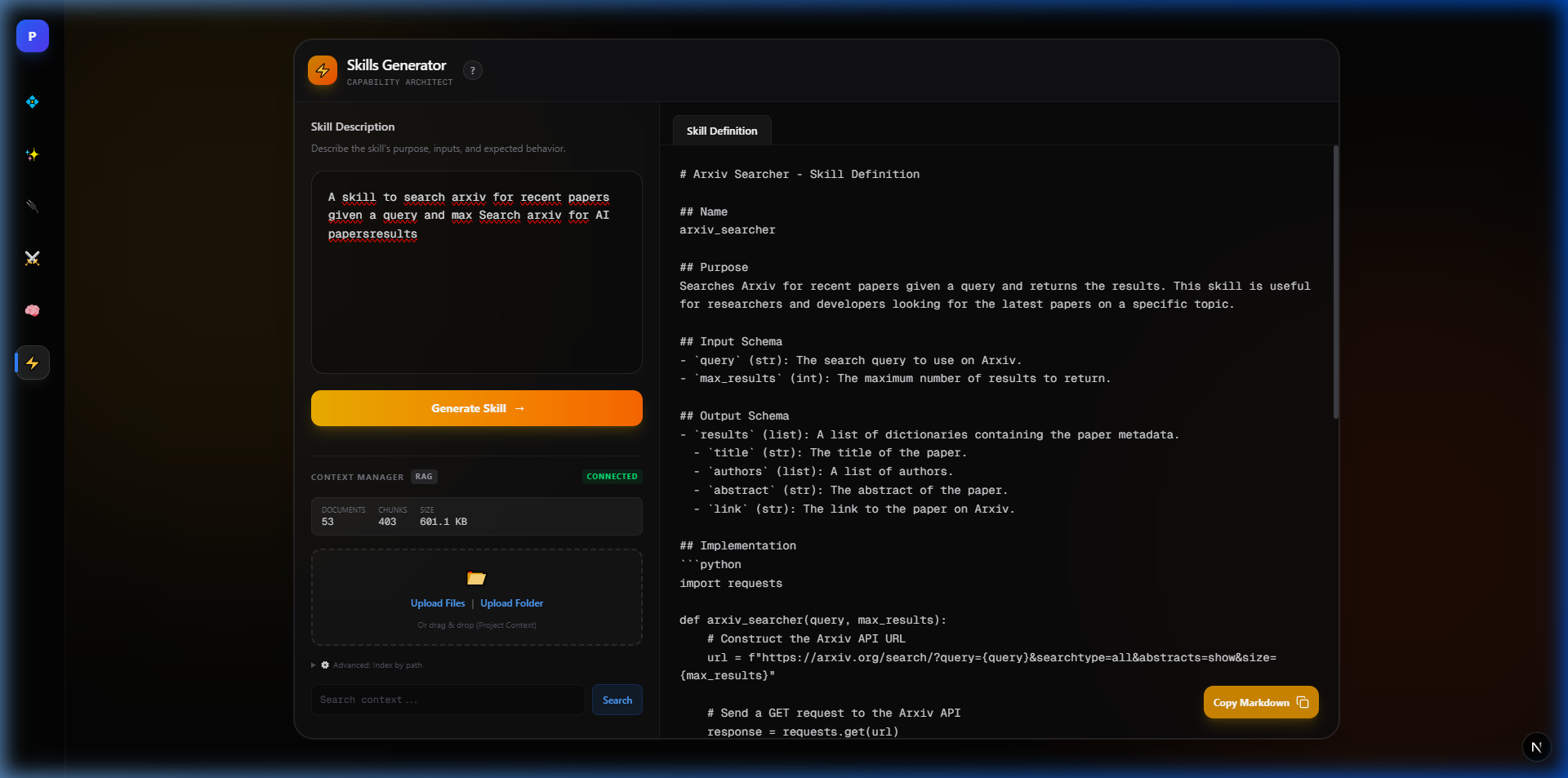
Describe a capability in plain English, and the Skill Generator translates it into a structured tool definition.
- Produces Input Schema and Output Schema in valid JSON
- Generates a stringified skill definition ready for LangChain, OpenAI functions, or custom agent frameworks
Export Button
After generating a skill, the Export section can wrap the output in framework-specific code:
| Format | Output |
|---|---|
| LangChain Tool | Python @tool function plus JSON schema |
| Claude tool_use | JSON config compatible with Anthropic's tools parameter |
| Claude MCP Tool Stub | Runnable FastMCP server.py + README.md, ready to register with Claude Code, Cursor, or Claude Desktop |
Claude Agent Packs Beta
The Agent Packs sidebar turns a short project brief (project type, stack, goal) into a runnable, repo-ready bundle of Claude assets — not just a prompt. Pick a pack type, preview the files, copy individual snippets, or download the whole thing as a .zip.
This feature is currently in beta: it is designed to give you a strong starting point quickly, but you should still review every generated file before using it in production.
What the beta means in practice:
- Fast scaffolding, not blind automation - expect useful repo memory, settings, agents, and workflow files, then adjust them for your own policies and edge cases.
- Best for early repo setup and internal experimentation - especially when you want to bootstrap Claude Code conventions without hand-writing every asset.
- Human review is required - check prompts, permissions, deny rules, CI assumptions, and generated documentation before shipping.
- A built-in install & review checklist - after generation the UI shows a step-by-step checklist for placing each file in your repo and reviewing sensitive ones before you commit.
- No Prompt Compiler API key prompts for visitors - public web flows are meant to work without asking end users for
x-api-key,PROMPTC_SERVER_API_KEY, or similar internal knobs.
Four pack types are available out of the box, all served from a single Claude-first endpoint:
| Pack Type | What It Emits | Use It For |
|---|---|---|
| Project Pack | CLAUDE.md, .claude/settings.json, .github/workflows/claude.yml |
Bootstrapping Claude Code in a new repo with policy, deny rules, and CI on day one |
| Subagent Bundle | One or more .claude/agents/<role>.md files with name, description, and tools frontmatter |
Giving Claude Code a team of specialized reviewers / builders that it can dispatch to |
| PR Reviewer Pack | A reviewer subagent + .github/workflows/claude.yml |
Wiring Claude into pull request review automation |
| MCP Tool Stub | A FastMCP server.py + README.md scaffolded from a skill definition |
Standing up an MCP server that exposes a custom tool to any MCP client |
Risk-aware generation. Each request takes a risk_mode:
| Mode | Behavior |
|---|---|
balanced (default) |
Sensible defaults: typical deny list, common allowed tools, gentle ask gates for destructive commands |
strict |
Tightens deny lists, narrows allowed tools, drops optimistic defaults — pick this when adopting Claude Code into a repo with sensitive data or untrusted contributors |
Provider-agnostic core. The pack generator is built around an AgentPackAdapter Protocol. Claude-specific logic lives in app/adapters/claude_code.py; the IR layer in app/adapters/agent_packs.py stays neutral. Cursor / Codex / other-provider adapters can plug in later without touching the core.
API surface:
# Generate the manifest (preview-friendly: file paths, contents, kinds, preview order)
curl -X POST https://api.example.com/agent-packs/claude \
  -H "content-type: application/json" \
  -d '{
    "project_type": "FastAPI service",
    "stack": "Python 3.12, FastAPI, PostgreSQL",
    "goal": "Add a Claude-reviewed PR workflow with deny rules for .env",
    "pack_type": "project-pack",
    "risk_mode": "strict"
  }'

# Same payload, returns a deflate-compressed .zip ready to drop into a repo
curl -X POST https://api.example.com/agent-packs/claude/download \
  -H "content-type: application/json" \
  -d '{...same body...}' \
  --output claude-project-pack.zip
Repo-native adoption. This repo eats its own dog food: the Compiler itself ships a CLAUDE.md, a hardened .claude/settings.json (denies .env*, secrets/**, users.db, web/.env.local; gates git push, fly:, railway: behind explicit confirmation), four ready-to-dispatch subagents in .claude/agents/ (compiler-architect, frontend-polisher, mcp-integrator, prompt-safety-reviewer), and a claude.yml workflow for hosted Claude Code review on PRs.
Token Optimizer
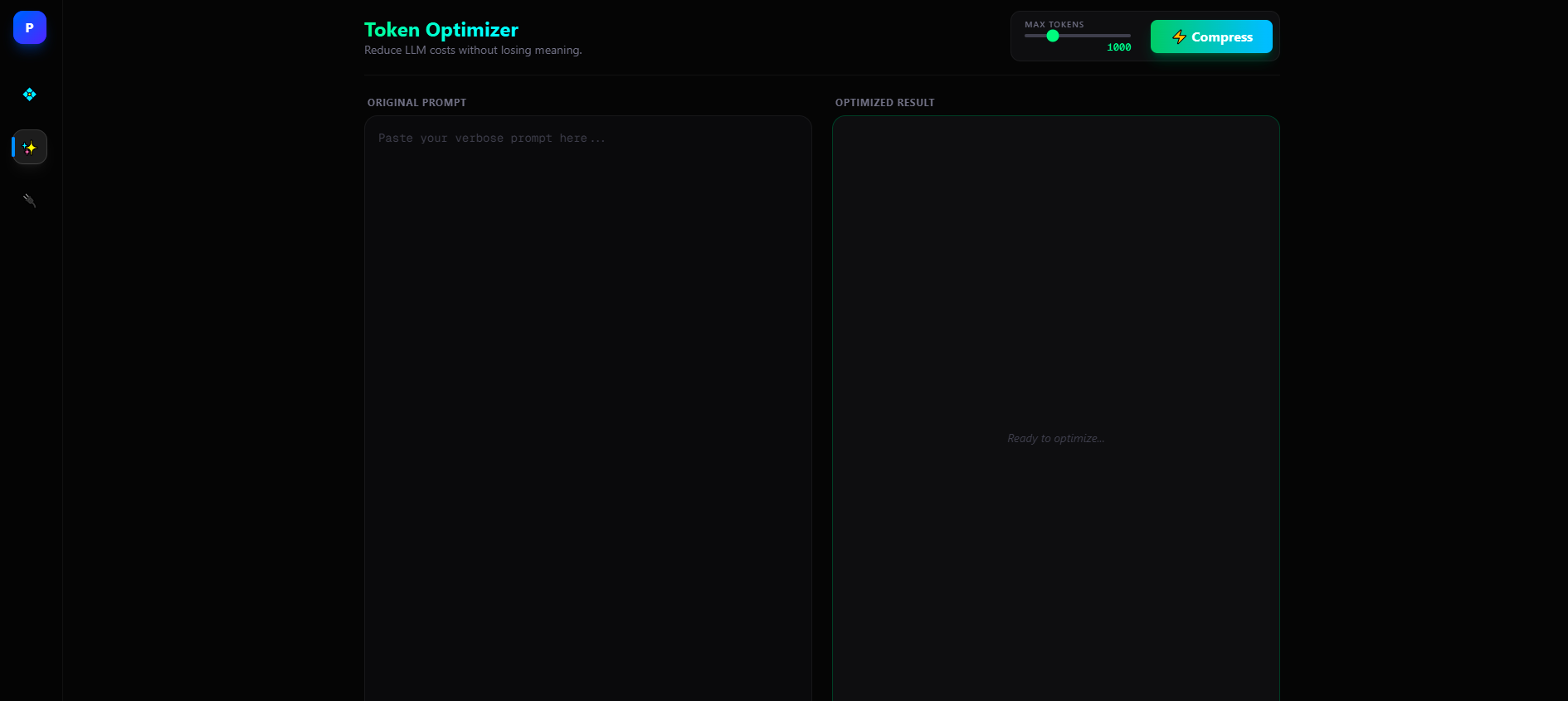
Compresses your prompt by roughly 20-30% without losing meaning, logic, or variables. Useful near context-window limits.
Benchmark Playground
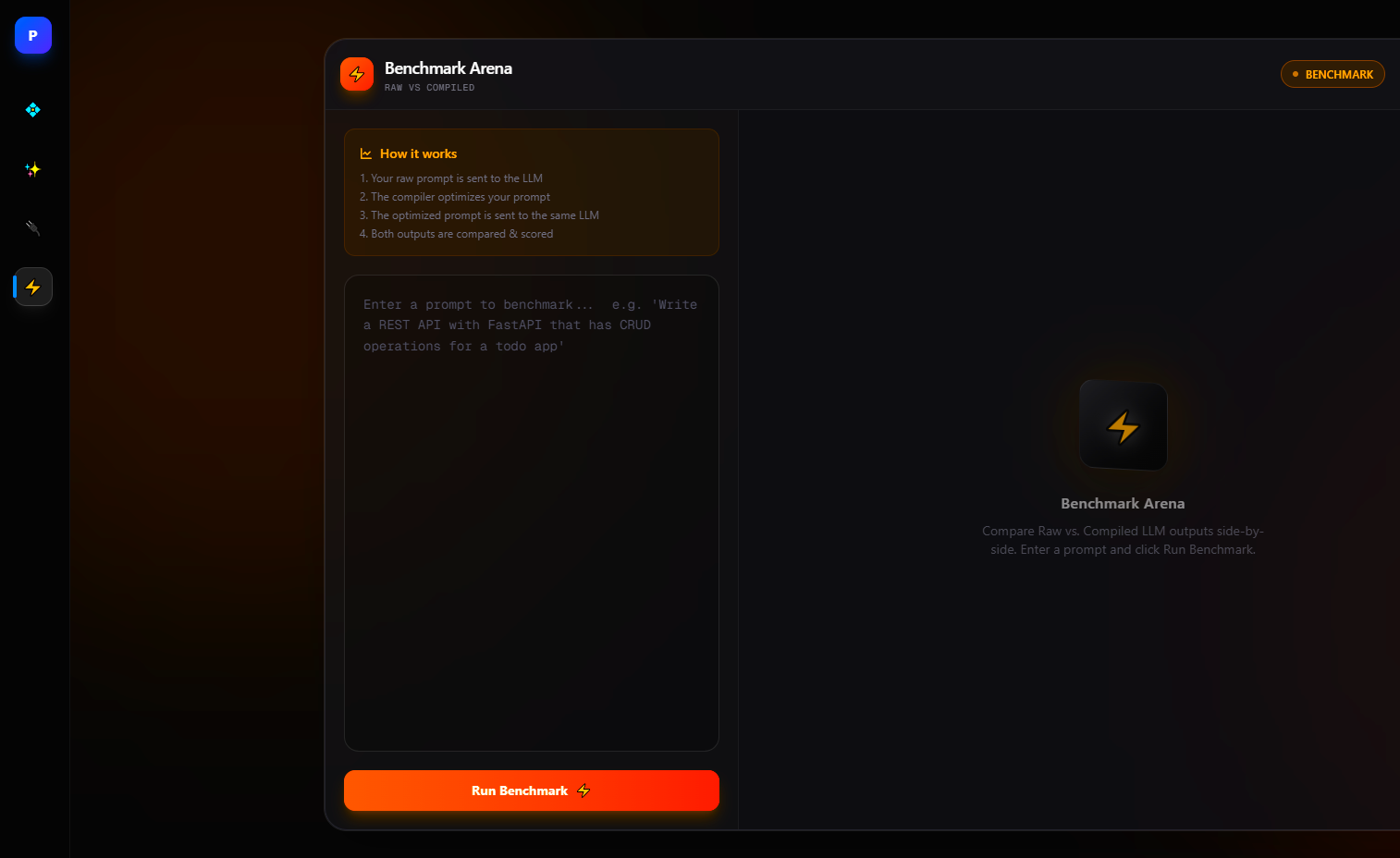
A/B test raw prompts against compiled versions:
- Raw vs. Compiled side-by-side comparison
- Auto-Judge scoring for relevance, quality, and clarity
- Visual Metrics including improvement percentages
RAG & Knowledge Base
Upload project files such as PDF, Markdown, text, or code to ground Prompt Compiler in your own domain context.
- Context Manager for drag-and-drop reference files
- Strategist/Critic flow for injecting grounded context and catching hallucinated claims
- Local SQLite-backed retrieval for fast reuse without re-uploading
GitHub Workflow Artifacts
Prompt Compiler can render deterministic markdown artifacts from natural language requests:
- Issue Brief
- Implementation Checklist
- PR Review Brief
Example:
python -m cli.main github render --type pr-review-brief --from-file prompt.txt
VS Code Extension
The VS Code package lives in integrations/vscode-extension. Once the Marketplace publisher is claimed and the first vscode-v* tag is pushed, it installs from:
- VS Code Marketplace —
madara88645.promptc-vscode - Open VSX (VSCodium / Cursor) —
madara88645/promptc-vscode
Until then, install from source (see the extension README) or the .vsix artifact on the Publish VS Code Extension workflow run.
Features:
- Commands:
PromptC: Compile Selection,PromptC: Compile File,PromptC: Recompile Last - Activity Bar sidebar for backend status, latest compile summary, history, and favorites
- Panel tabs:
Intent,Policy,Prompts,Raw JSON - Artifact actions: copy, insert into editor, save favorite
- Settings:
promptc.apiBaseUrl,promptc.conservativeMode,promptc.requestTimeoutMs,promptc.autoOpenPanel,promptc.historySize
API keys are stored in VS Code secret storage, not workspace settings.
Installation
CLI (pip / pipx)
Install the command-line compiler from PyPI:
pipx install prcompiler        # recommended — isolated install
# or
pip install prcompiler
Then compile a prompt:
promptc compile "write a haiku about the sea"
promptc --version
From source (development)
git clone https://github.com/madara88645/Compiler.git
cd Compiler

# Backend: pyproject.toml is the source of truth
python -m pip install -e .[dev,docs]

# Frontend
cd web
npm ci
cd ..
Environment Setup
cp .env.example .env
Core variables:
OPENROUTER_API_KEY=sk-or-v1-your-actual-key
OPENROUTER_BASE_URL=https://openrouter.ai/api/v1
OPENROUTER_MODEL=openai/gpt-oss-20b
OPENROUTER_HTTP_REFERER=
OPENROUTER_TITLE=Prompt Compiler

# Prompt compiler mode: conservative (default) or default
PROMPT_COMPILER_MODE=conservative

# Optional internal auth hardening (public app routes do not ask visitors for Prompt Compiler API keys)
ADMIN_API_KEY=replace-me
PROMPTC_REQUIRE_API_KEY_FOR_ALL=false

# Optional RAG storage controls
PROMPTC_UPLOAD_DIR=.promptc_uploads
PROMPTC_RAG_ALLOWED_ROOTS=
Notes:
- Public app routes are intended to work without custom Prompt Compiler API keys.
OPENROUTER_API_KEYis a server-side provider credential, not a value that visitors should type into the app.- Prompt Compiler's cloud path is OpenRouter-only. Groq and legacy OpenAI fallback guidance should be treated as obsolete.
- If you set
PROMPTC_RAG_ALLOWED_ROOTS, only files inside those roots can be ingested by path.
Running the App
Windows (one-click): double-click start_app.bat
Manual:
# Terminal 1 - Backend
python -m uvicorn api.main:app --reload --port 8080

# Terminal 2 - Frontend
cd web
npm run dev
Open http://localhost:3000.
How To Use
- Type your idea, prompt, task, or workflow request into the input box.
- Click Generate.
- Review the output tabs:
Intent,System,User,Plan,Expanded,JSON,Quality. - Use Conservative mode when you want grounded output.
- If the task is sensitive, inspect the policy layer before using the result downstream.
- Use Agent, Skill, Optimizer, Benchmark, and RAG surfaces as needed.
To check a pull request instead, open PR Safety in the sidebar, paste the PR's title, description, and changed files, then Analyze PR and read the verdict — copy the Markdown report into the PR if it's useful.
Project Structure
api/            FastAPI endpoints (compile, agent-generator, skills-generator, optimize, rag)
app/
  compiler.py       Core compiler pipeline
  emitters.py       Prompt rendering layer
  models_v2.py      IR v2 and policy contract
  llm_engine/       HybridCompiler and provider logic
  heuristics/       Offline parsing, safety, risk, and policy inference
  pr_safety/        Offline PR Safety analyzer (verdict + signals)
  rag/              SQLite FTS5 RAG index and retrieval
  testing/          Regression runner
  github_artifacts.py
web/
  app/
    page.tsx                    Main compiler UI
    pr-safety/                  PR Safety page + report proxy + Markdown export
    agent-packs/                Claude Agent Packs generator + install checklist
    agent-generator/            Agent Generator page
    skills-generator/           Skill Generator page
    benchmark/                  Benchmark Playground
    optimizer/                  Token Optimizer
    components/                 Shared UI components
cli/            CLI entrypoints
integrations/
  vscode-extension/
extension/      Browser extension
tests/          Offline-safe test suite
docs/           Product, pattern, and workflow docs
Docs
docs/pr-safety.md— PR Safety usage guide, examples, andcurlrecipedocs/pr-safety-github-action.md— advisory CI integration sketchdocs/pattern-library.mddocs/promptc-safe-workflows.mdexamples/github/promptc-artifact.yml
License
Copyright © 2026 Mehmet Özel. All rights reserved.
Licensed under the Apache License 2.0.
For managed/hosted service inquiries: [email protected]
Self-hosting is free and always will be.
Yorumlar (0)
Yorum birakmak icin giris yap.
Yorum birakSonuc bulunamadi