ai-site-cloner
Health Gecti
- License — License: MIT
- Description — Repository has a description
- Active repo — Last push 0 days ago
- Community trust — 24 GitHub stars
Code Uyari
- network request — Outbound network request in docker-compose.yml
Permissions Gecti
- Permissions — No dangerous permissions requested
Bu listing icin henuz AI raporu yok.
Clone any website into a pixel-accurate Next.js app with AI — Playwright-measured extraction (no eyeballing), spec-gated parallel builder agents, and scored pixel-diff QA at phone/tablet/desktop. Works with Claude Code, Cursor, Copilot + 9 more.
ai-site-cloner
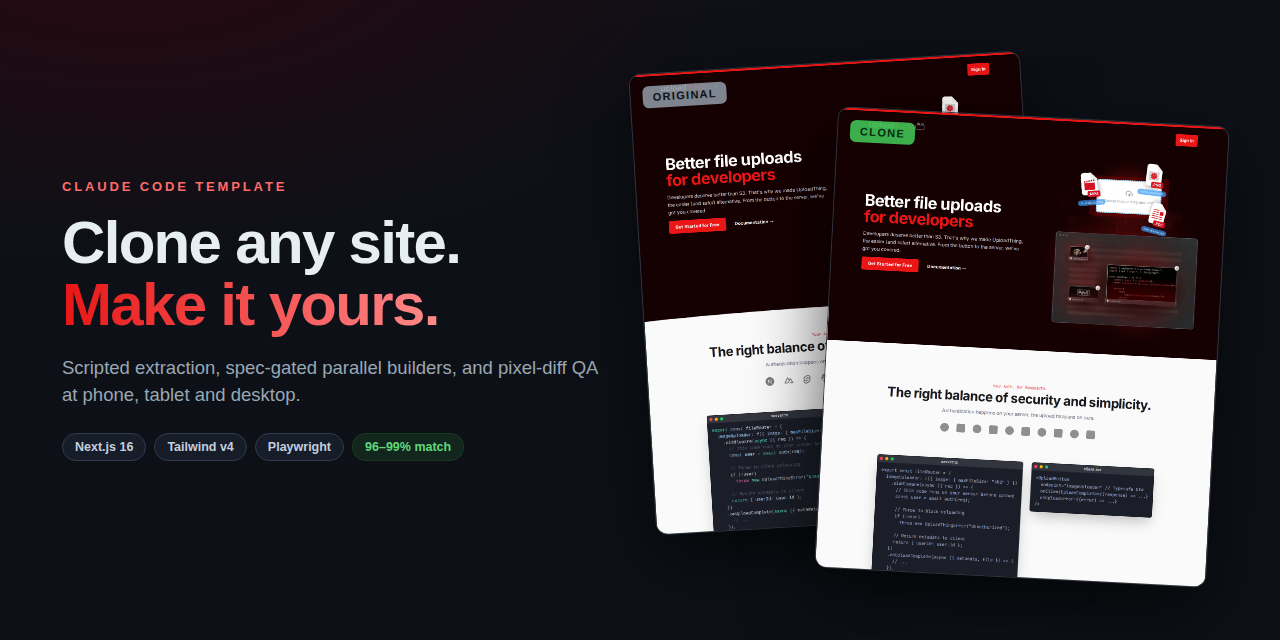
Point AI at any website. Get a pixel-accurate, working Next.js clone back — measured, not eyeballed.
One command. /clone-website turns Claude Code (or Cursor, Copilot, Gemini CLI — 12 tools supported) into a full cloning pipeline: it crawls the site, extracts every computed style with scripted Playwright measurement, generates auditable component specs, dispatches parallel builder agents in git worktrees, and loops a scored pixel-diff QA at phone/tablet/desktop widths until every section clears 95%. Then /restyle swaps in your own brand — colors, fonts, logo, copy — without touching the cloned layout.
Screenshot-to-code tools guess. This one measures.
Proof: plausible.io, cloned
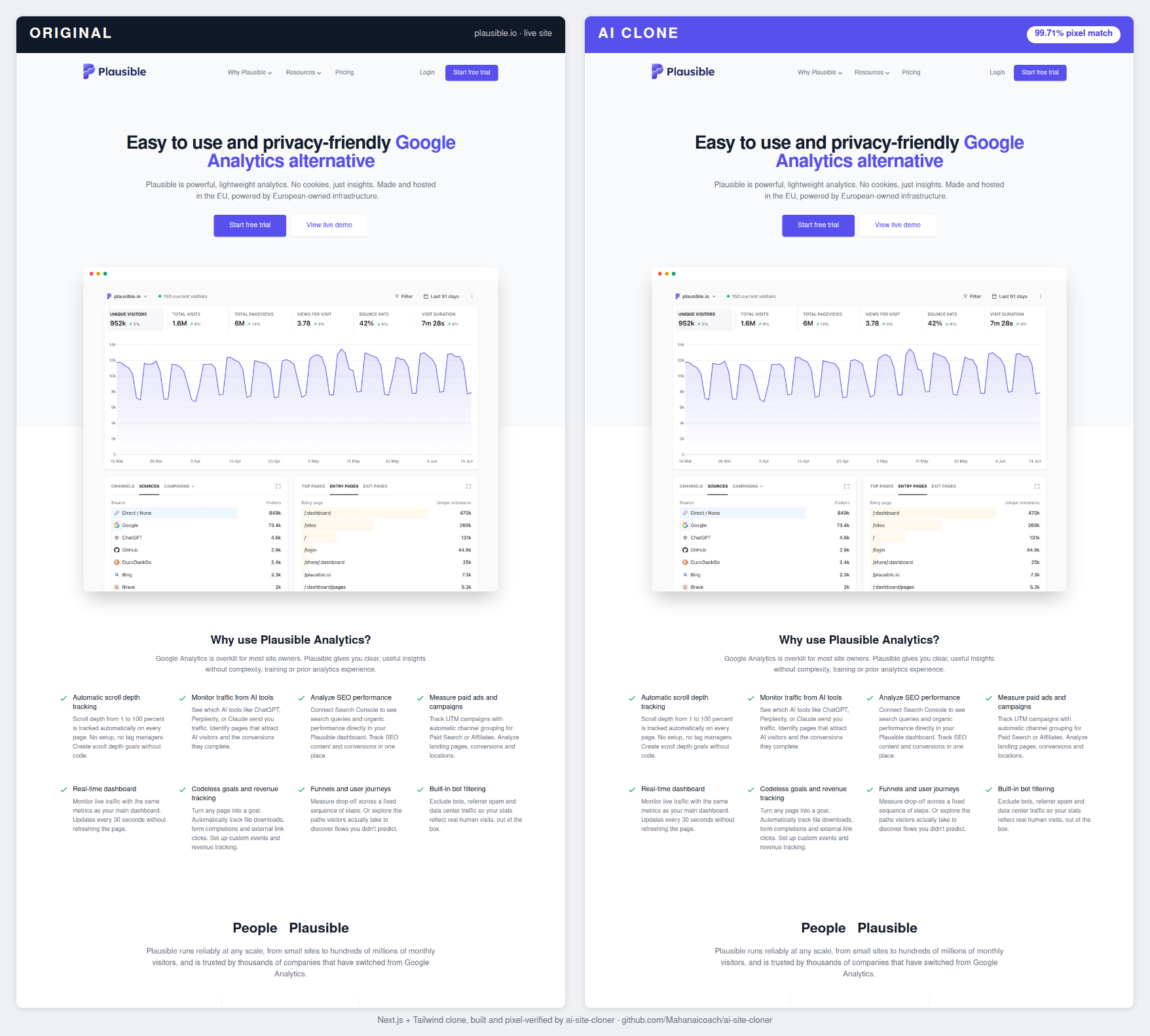
99.71% average pixel match across 9 sections × 3 viewports, scored by pixelmatch against the live site — 6 of 9 sections hit a perfect 100% on every viewport, nothing below 97.5%. And it's not a screenshot of a screenshot: the clone is a working app with the nav dropdowns, the mobile menu overlay, and the 9-tier pricing slider with its monthly/yearly toggle and recomputing prices — a clean, typed, componentized codebase you can actually maintain.
| Section | PC | iPad | Phone | Section | PC | iPad | Phone | |
|---|---|---|---|---|---|---|---|---|
| hero | 100% | 100% | 100% | story | 99.98% | 99.97% | 100% | |
| dashboard | 100% | 100% | 100% | nav | 99.2% | 98.8% | 100% | |
| features | 100% | 100% | 100% | cta | 99.6% | 99.3% | 100% | |
| testimonials | 100% | 100% | 100% | footer | 100% | 97.7% | 100% | |
| pricing | 100% | 100% | 97.5% |
Full-page and phone side-by-sides, the data file, and how the run went: examples/plausible/
Second example: examples/uploadthing/ — its hero artwork is painted on a <canvas>, normally unclonable since there's no DOM to copy. The pipeline records it via canvas.captureStream() and embeds a looping video, so the clone keeps the artwork and its motion.
Fast. Accurate. Cheap on tokens.
Fast. Recon of an entire page — design tokens, every asset downloaded, computed-style walks of every section, responsive measurements, and screenshots at all three viewports — is one command and three page loads (~15 seconds). Builders run in parallel git worktrees, so five sections build in the time of one. QA opens with one whole-page diff per viewport instead of dozens of per-section diffs — on a good clone the entire QA phase is a handful of page loads — and the original site's screenshots are cached, so fix iterations only re-render your clone. Interrupted? manifest.mjs resume prints exactly where you were and the next command to run.
Accurate. The AI never invents a value. Font sizes, padding, colors, real column counts, hover states, transition durations — everything a builder uses was measured from the live page by a script. A linter blocks incomplete specs from ever reaching a builder, and the pixelmatch score decides when a section is done: 95% per section per viewport, no exceptions, no "looks right to me." When a diff fails, compare.mjs walks both live DOMs and names the exact CSS properties that differ — so a fix is one targeted edit, not a guessing loop.
Cheap on tokens. Cloning with an agent is a token problem before it's anything else — the naive approach pastes screenshots and raw DOM into context and burns six figures of tokens guessing. Here the agent never reads a raw page. The scripts write compact artifacts, and the agent reads only the interface:
- Section walks ship in a compact format (style dictionary + inheritance pruning) — the plausible.io extraction dropped from 889KB to 445KB, and nobody reads the JSON anyway:
resolve-walk.mjsanswers questions about any single node - Interaction captures store only what changed: the pricing toggle's capture is 2.9KB, down from 368KB of before/after DOM dumps
- Specs are generated from the JSON — the agent writes ~10 judgment lines per section instead of transcribing hundreds of values, and each builder receives one 2–4KB spec, not the site
- Screenshots are judged at 640px review size (~half the bytes); full-res exists only for pixelmatch and builders
- On Tailwind-style sites the extraction stores the cleaned source markup — plausible's hero is 1.7KB of HTML that is the spec
- QA returns numbers, not images: match scores and a 10-band breakdown naming the failing y-range; an image gets opened only when something fails
Net effect: the agent-facing surface of a full plausible-sized run fits in about half a megabyte of artifacts, and specs + scores are the only parts an agent routinely reads.
Quick Start
- Create your own repository from this template (Use this template on GitHub), then clone it.
- Install:
npm install # Chromium auto-installs on the first extraction run (or: npm run setup) - Start Claude Code (Chrome integration recommended for interaction discovery):
claude --chrome - Clone a site:
/clone-website https://example.com - Make it yours: fill in
BRAND.md, then:/restyle
How it works
Six phases, one command, resumable at any point:
flowchart LR
    A(["🕸️ Crawl"]) --> B(["📐 Recon"])
    B --> C(["🎨 Foundation"])
    C --> D(["🧱 Sections"])
    D --> E(["🧩 Assembly"])
    E --> F{"✅ QA"}
    F -- "< 95%: fix what compare.mjs names" --> D
    F -- "≥ 95% × 3 viewports" --> G(["🚀 Clone done"])
    style G fill:#5850ec,color:#fff,stroke:#4c3fe0
| Phase | What happens | |
|---|---|---|
| 🕸️ | 0 · Crawl | Sitemap + nav discovery. You confirm the page list — that's the only question it asks. |
| 📐 | 1 · Recon | One command per page: design tokens, every asset downloaded, computed-style walks, responsive measurements at 390/768/1440px, screenshots, interaction sweep. Three page loads, ~15 seconds. |
| 🎨 | 2 · Foundation | Fonts, color tokens, TypeScript types, extracted SVG icons, shared header/footer. |
| 🧱 | 3 · Sections | Spec scaffolded from the extraction JSON → AI fills the judgment blocks → lint gate → parallel builder agents in git worktrees → merge. |
| 🧩 | 4 · Assembly | One route per page, content wired from src/data/*.ts to components. |
| ✅ | 5 · QA loop | Whole-page pixel triage first; only sections in failing bands get individual diffs. Every section must clear 95% × 3 viewports — the score decides, not vibes. |
The AI never invents a value. Every number a builder uses — font sizes, padding, colors, column counts, hover states, transition durations — comes from a script that measured the live page. Specs are generated from that JSON, a linter blocks incomplete ones, and the pixel score decides when a section is done.
Why this beats screenshot-to-code
| Problem with "look at a screenshot and code it" | What happens here instead |
|---|---|
| AI guesses CSS values from pixels | scripts/extract/section.mjs — full getComputedStyle() DOM walk, exact values (stored compact; resolve-walk.mjs reads any node) |
| Responsive behavior guessed from desktop | scripts/extract/responsive.mjs — real column counts and font steps measured at 390/768/1440px |
| Only the default state gets cloned | --state captures diff the DOM before/after every click/hover/scroll — dropdowns, toggles, tab panels, with the appeared nodes and their styles |
| "Looks close enough" QA | scripts/diff.mjs — pixel-diff score per section per viewport, 95% to pass; --triage diffs the whole page first and touches only sections in failing bands |
| QA says WHERE but not WHAT | scripts/compare.mjs — walks original + clone, prints the differing computed properties ordered by visual impact |
| AI mis-transcribes values into specs | scripts/spec-scaffold.mjs — mechanical spec sections generated straight from the extraction JSON (Tailwind sites quote the source markup itself) |
| Incomplete specs slip through | scripts/lint-spec.mjs — mechanical completeness gate before any builder runs |
| Long runs die and restart from zero | docs/research/manifest.json — scripts self-report their stage transitions; manifest.mjs resume prints the exact next commands |
| Single-page only | scripts/extract/crawl.mjs — sitemap + nav discovery, shared header/footer extracted once |
<canvas> artwork is unclonable |
scripts/extract/canvas.mjs — records it with captureStream(), embeds a looping video |
| Clone is a dead-end copy | Content lives in src/data/*.ts + the /restyle skill = rebrand without breaking layout |
Scripts
All plain Playwright — run standalone, no MCP needed:
node scripts/extract/page.mjs <url>                    # ONE-SHOT recon: tokens, css, assets, responsive,
                                                       #   section walks + every screenshot — 3 page loads, ~15s
node scripts/extract/crawl.mjs <url> [--max 25]        # discover pages
node scripts/extract/page.mjs --rename section-3=hero  # rename auto-detected sections in place (no browser)
node scripts/extract/section.mjs <url> --selector "x" --state hover:".card"   # hover/scroll/click state diffs
node scripts/extract/probe.mjs <url> --selector "x"    # per-viewport value table for specs
node scripts/spec-scaffold.mjs --route / --all         # generate the mechanical spec sections from the
                                                       #   extraction JSON; agent fills judgment blocks only
node scripts/resolve-walk.mjs <sections.json> --node 0.2.1   # resolved styles for any walk node (walks are
                                                       #   stored compact: style dict + inheritance pruning)
node scripts/extract/canvas.mjs <url>                  # capture <canvas> artwork as video/PNG
node scripts/extract/tokens.mjs / css.mjs / assets.mjs / responsive.mjs / screenshot.mjs   # single-purpose re-runs
node scripts/diff.mjs --original <url> --clone <url> --route / --triage --viewport all
                                                       # scored pixel diff QA: whole-page first, per-section
                                                       #   only where bands fail; 10-band breakdown names
                                                       #   WHERE it mismatches; scores land in the manifest
node scripts/compare.mjs --original <url> --clone <url> --selector "x"   # WHAT differs on a failing section:
                                                       #   computed-property table, geometry > typography > color
node scripts/lint-spec.mjs docs/research/components    # spec completeness gate
node scripts/manifest.mjs resume                       # one-screen digest: stage table + exact next commands
Supported agents
The two skills are written once in .claude/skills/ and synced to every other tool's native format (node scripts/sync-skills.mjs; CI fails if generated configs go stale):
Claude Code (native) · Cursor · Windsurf · GitHub Copilot · Gemini CLI · Amazon Q · Codex · Cline · Continue · opencode · Augment · Aider — plus a generic AGENTS.md that most other tools pick up automatically.
The extraction scripts are plain Node CLIs, so any agent can run them. Tools without subagent/worktree support build sections sequentially from the same lint-gated specs — every quality gate still applies.
Docker
docker compose up dev    # dev server on :3000, Playwright preinstalled (extraction works in-container)
docker compose up app    # production: slim standalone build of the finished clone
Stack
Next.js 16 (App Router, React 19, TS strict) · Tailwind CSS v4 · shadcn/ui · Playwright + pixelmatch (dev)
Requires Node 22+ (auto via .nvmrc).
Intended Use
Platform migration of sites you own · recovering lost source code · learning how production sites are built.
Not for phishing, impersonation, or passing off someone else's design as your own. Check a site's terms before cloning it. The example clones in this repo (plausible.io, uploadthing.com) are technical demonstrations — don't republish anyone's brand.
Updating
In a fork or a clone of this repo, pull the latest version with:
bash scripts/update.sh
It keeps your own commits and runs npm install when dependencies change.
Forked it on GitHub? Run git push afterwards, or click Sync fork on your fork's
page.
Made your repo with Use this template? It shares no history with this one, so git can't merge
updates into it. Read the CHANGELOG and copy over the files you want.
License
MIT
Yorumlar (0)
Yorum birakmak icin giris yap.
Yorum birakSonuc bulunamadi