vibeguard
Health Uyari
- License — License: MIT
- Description — Repository has a description
- Active repo — Last push 0 days ago
- Low visibility — Only 5 GitHub stars
Code Basarisiz
- rm -rf — Recursive force deletion command in docs/assets/demo-scenario.sh
- eval() — Dynamic code execution via eval() in eval/samples.py
- network request — Outbound network request in eval/samples.py
- Hardcoded secret — Potential hardcoded credential in eval/samples.py
Permissions Gecti
- Permissions — No dangerous permissions requested
Security Assessment: Overall risk is High. The codebase exhibits several alarming security anti-patterns. A scan found a hardcoded secret and uses `eval()` for dynamic code execution. Combined with outbound network requests in the same file, this creates a significant vulnerability vector. Furthermore, recursive force deletion commands (`rm -rf`) are present in the documentation assets. While the tool ironically markets itself as a defense against AI mistakes, these underlying scripts require aggressive sandboxing and a thorough manual audit before deployment.
Quality Assessment: Quality is currently Low. The project is very new and lacks community validation, evidenced by having only 5 GitHub stars. On a positive note, it is released under the permissive and standard MIT license, and the repository is highly active with pushes made as recently as today.
Verdict: Not recommended. Developers should avoid using this tool until the hardcoded secrets, eval execution, and unsafe deletion commands are removed or thoroughly explained by the maintainers.
Native rules, hooks, and guards that prevent Claude Code and Codex from hallucinating code, duplicating files, or shipping unverified changes.
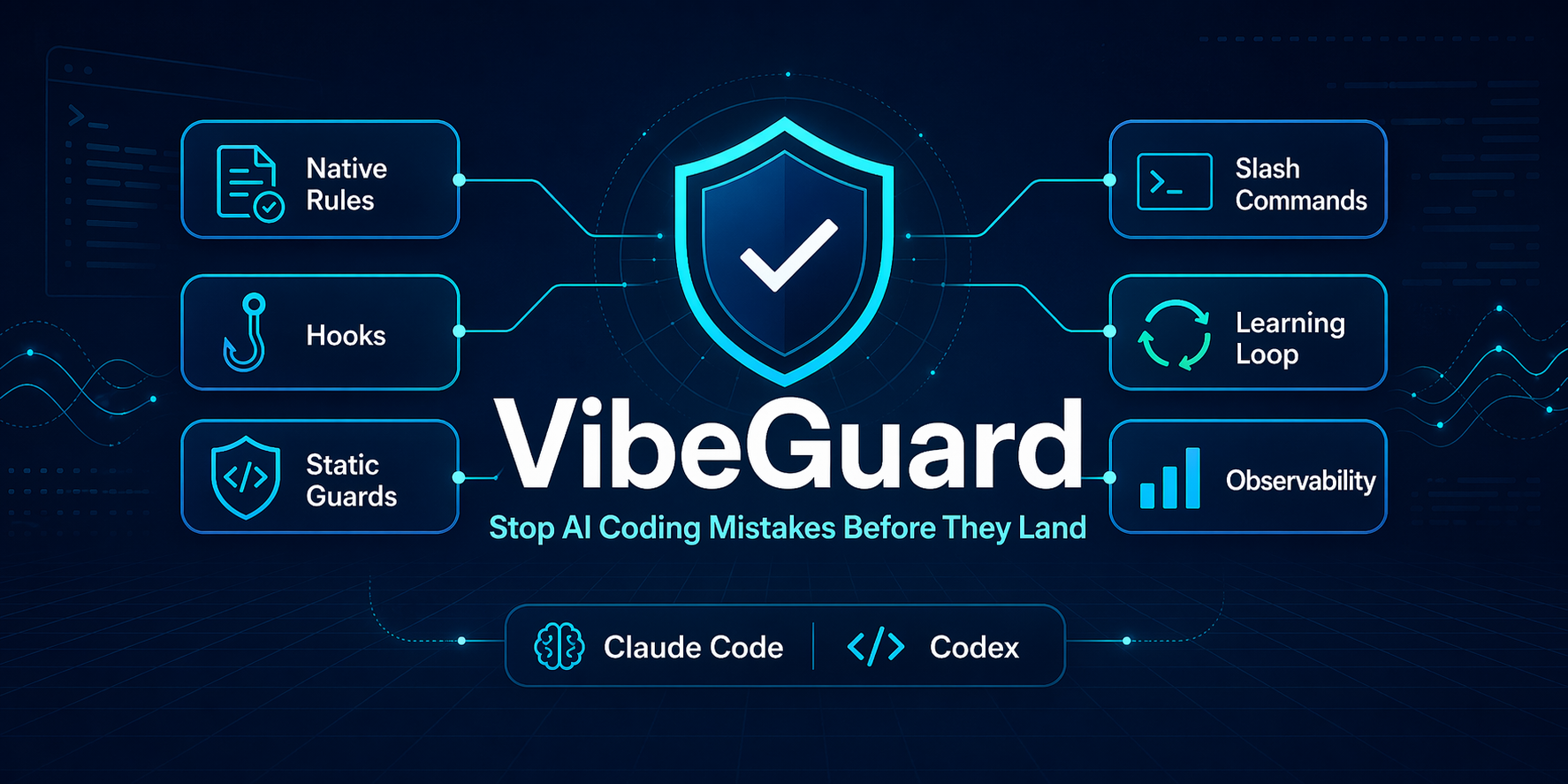
VibeGuard

Stop Claude Code and Codex from making the same expensive mistakes twice.
Chinese Docs · Rule Reference · Contributing
VibeGuard adds native rules + real-time hooks + static guards to catch what AI coding agents get wrong — before it reaches your codebase:
- Duplicate files and reinvented modules
- Invented APIs, fake libraries, and hardcoded placeholder values
- Dangerous shell/git commands (
rm -rf,push --force,reset --hard) - Analysis paralysis and unverified "I'm done" claims
- Silent exception swallowing and
Any-type abuse - AI-slop patterns flagged on every commit
Works with Claude Code and Codex CLI.
Install in 30 seconds
git clone https://github.com/majiayu000/vibeguard.git ~/vibeguard
bash ~/vibeguard/setup.sh
Open a new Claude Code or Codex session. Run bash ~/vibeguard/setup.sh --check to verify.
What you actually get
| Layer | What it does |
|---|---|
| Native Rules | Bias the model away from bad decisions before it acts |
| Hooks | Block dangerous or low-quality actions in real time |
| Static Guards | Scan projects for AI-slop, duplicates, and structural issues |
| Slash Commands | /vibeguard:* workflows for preflight / review / check / learn |
| Learning System | Turn repeated AI mistakes into reusable defenses |
| Observability | Metrics and health for every interception |
Product Boundaries
VibeGuard has two layers:
| Surface | Scope | Canonical Source |
|---|---|---|
| VibeGuard Core | Rules, hooks, static guards, install/runtime contract, observability | rules/claude-rules/, schemas/install-modules.json, hooks/, guards/ |
| VibeGuard Workflows | Slash commands, agent prompts, planning/execution presets | skills/, workflows/, agents/ |
If these surfaces disagree, treat the Core contract as authoritative first, then update workflow/docs surfaces to match it.
For repository layout ownership, see Directory Map.
What it looks like in practice
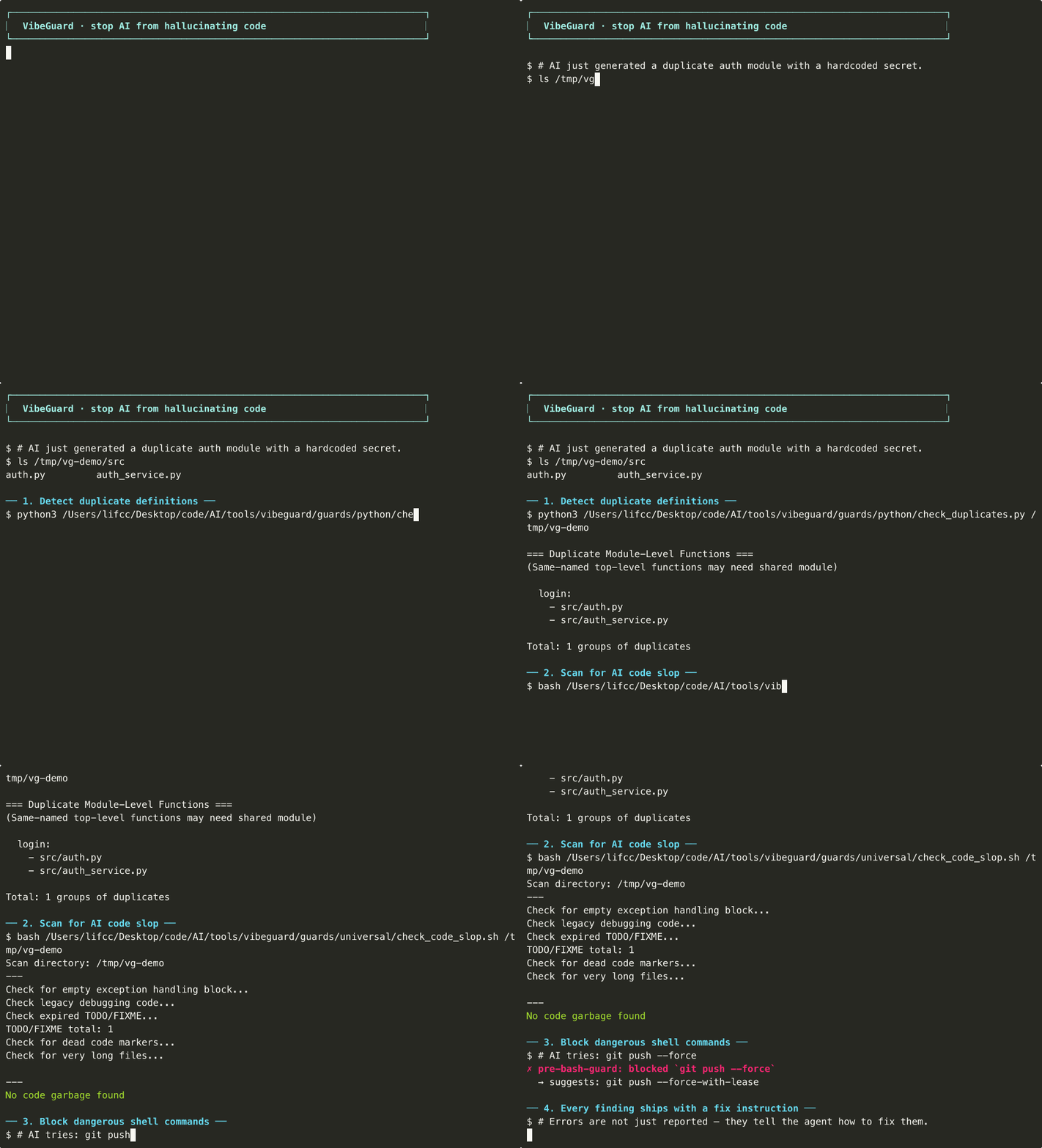
You:  "Add a login endpoint"

AI:   → tries to create auth_service.py
      ✗ VibeGuard blocks — duplicate of existing auth.py, search first

      → tries to import `flask-auth-magic`
      ✗ VibeGuard blocks — non-existent library, verify before adding

      → hardcodes JWT secret as "your-secret-key"
      ✗ VibeGuard flags — use env var or secret manager

      → runs `git push --force`
      ✗ VibeGuard denies — suggests `--force-with-lease`

      → keeps reading files without acting
      ⚠ VibeGuard escalates — force a concrete next step or report blocker

      → claims done without verifying
      ⚠ VibeGuard gates — run build/test before finishing
Every interception returns a fix instruction, not just a failure — so the agent can self-correct.
Re-record your own demo: see docs/assets/README.md (one command via asciinema + agg).
Who this is for
Use VibeGuard if you:
- Use Claude Code or Codex regularly
- Have seen duplicate files, fake APIs, over-engineering, or unverified "done" claims
- Want mechanical enforcement, not just prompt guidelines
It may be overkill if you only use AI occasionally or don't want hook-level interception.
Inspired by OpenAI Harness Engineering and Stripe Minions. Fully implements all 5 Harness Golden Principles.
How It Works
Rule Injection (active from session start)
The native rule set in rules/claude-rules/ is installed to Claude Code's native rules system (~/.claude/rules/vibeguard/), directly influencing AI reasoning. Plus a 7-layer constraint index injected into ~/.claude/CLAUDE.md:
| Layer | Constraint | Effect |
|---|---|---|
| L1 | Search before create | Must search for existing implementations before creating new files |
| L2 | Naming conventions | snake_case internally, camelCase at API boundaries, no aliases |
| L3 | Quality baseline | No silent exception swallowing, no Any types in public methods |
| L4 | Data integrity | No data = show blank, no hardcoding, no inventing APIs |
| L5 | Minimal changes | Only do what was asked, no unsolicited "improvements" |
| L6 | Process gates | Large changes require preflight, structured planning, and verification |
| L7 | Commit discipline | No AI markers, no force push, no secrets |
Rules use negative constraints ("X does not exist") to implicitly guide AI, which is often more effective than positive descriptions.
Canonical references for this contract:
- Install/runtime contract:
schemas/install-modules.json - Native rule source:
rules/claude-rules/ - Public summary of current rule surface:
docs/rule-reference.md
Hooks — Real-Time Interception
Most hooks trigger automatically during AI operations. skills-loader remains an optional manual hook, and Codex currently deploys only Bash/Stop hook events:
| Scenario | Hook | Result |
|---|---|---|
AI creates new .py/.ts/.rs/.go/.js file |
pre-write-guard |
Block — must search first |
AI runs git push --force, rm -rf, reset --hard |
pre-bash-guard |
Block — suggests safe alternatives |
| AI edits non-existent file | pre-edit-guard |
Block — must Read file first |
AI adds unwrap(), hardcoded paths |
post-edit-guard |
Warn — with fix instructions |
AI adds console.log / print() debug statements |
post-edit-guard |
Warn — use logger instead |
| AI creates duplicate definitions after a new file write | post-write-guard |
Warn — detect duplicate symbols and same-name files |
| AI keeps reading/searching without acting | analysis-paralysis-guard |
Escalate — force a concrete next step or blocker report |
AI edits code in full / strict profile |
post-build-check |
Warn — run language-appropriate build check |
git commit |
pre-commit-guard |
Block — quality + build checks (staged files only), 10s timeout |
| AI tries to finish with unverified changes | stop-guard |
Gate — complete verification first |
| Session ends | learn-evaluator |
Evaluate — collect metrics and detect correction signals |
Static Guards — Run Anytime
Representative standalone checks you can run on any project. The complete inventory lives in docs/rule-reference.md.
# Universal
bash ~/vibeguard/guards/universal/check_code_slop.sh /path/to/project     # AI code slop
python3 ~/vibeguard/guards/universal/check_dependency_layers.py /path      # dependency direction
python3 ~/vibeguard/guards/universal/check_circular_deps.py /path          # circular deps
bash ~/vibeguard/guards/universal/check_test_integrity.sh /path            # test shadowing / integrity issues

# Rust
bash ~/vibeguard/guards/rust/check_unwrap_in_prod.sh /path                 # unwrap/expect in prod
bash ~/vibeguard/guards/rust/check_nested_locks.sh /path                   # deadlock risk
bash ~/vibeguard/guards/rust/check_declaration_execution_gap.sh /path      # declared but not wired
bash ~/vibeguard/guards/rust/check_duplicate_types.sh /path                # duplicate type definitions
bash ~/vibeguard/guards/rust/check_semantic_effect.sh /path                # semantic side effects
bash ~/vibeguard/guards/rust/check_single_source_of_truth.sh /path         # single source of truth
bash ~/vibeguard/guards/rust/check_taste_invariants.sh /path               # taste/style invariants
bash ~/vibeguard/guards/rust/check_workspace_consistency.sh /path          # workspace dep consistency

# Go
bash ~/vibeguard/guards/go/check_error_handling.sh /path                   # unchecked errors
bash ~/vibeguard/guards/go/check_goroutine_leak.sh /path                   # goroutine leaks
bash ~/vibeguard/guards/go/check_defer_in_loop.sh /path                    # defer in loop

# TypeScript
bash ~/vibeguard/guards/typescript/check_any_abuse.sh /path                # any type abuse
bash ~/vibeguard/guards/typescript/check_console_residual.sh /path         # console.log residue
bash ~/vibeguard/guards/typescript/check_component_duplication.sh /path    # duplicated component files
bash ~/vibeguard/guards/typescript/check_duplicate_constants.sh /path      # repeated constant definitions

# Python
python3 ~/vibeguard/guards/python/check_duplicates.py /path                # duplicate functions/classes/protocols
python3 ~/vibeguard/guards/python/check_naming_convention.py /path         # camelCase mix
python3 ~/vibeguard/guards/python/check_dead_shims.py /path                # dead re-export shims
Slash Commands
10 custom commands covering the full development lifecycle. Shortcuts: /vg:pf /vg:gc /vg:ck /vg:lrn.
| Command | Purpose |
|---|---|
/vibeguard:preflight |
Generate constraint set before changes |
/vibeguard:check |
Full guard scan + compliance report |
/vibeguard:review |
Structured code review (security → logic → quality → perf) |
/vibeguard:cross-review |
Dual-model adversarial review (Claude + Codex) |
/vibeguard:build-fix |
Build error resolution |
/vibeguard:learn |
Generate guard rules from errors / extract Skills from discoveries |
/vibeguard:interview |
Deep requirements interview → SPEC.md |
/vibeguard:exec-plan |
Long-running task execution plan, cross-session resume |
/vibeguard:gc |
Garbage collection (log archival + worktree cleanup + code slop scan) |
/vibeguard:stats |
Hook trigger statistics |
Complexity Routing
| Scope | Flow |
|---|---|
| 1-2 files | Just implement |
| 3-5 files | /vibeguard:preflight → constraints → implement |
| 6+ files | /vibeguard:interview → SPEC → /vibeguard:preflight → implement |
Multi-Agent Dispatch
14 built-in agent prompts (13 specialists + 1 dispatcher) with automatic routing:
| Agent | Purpose |
|---|---|
dispatcher |
Auto-route — analyzes task type and routes to the best agent |
planner / architect |
Requirements analysis and system design |
tdd-guide |
RED → GREEN → IMPROVE test-driven development |
code-reviewer / security-reviewer |
Layered code review and OWASP Top 10 |
build-error-resolver |
Build error diagnosis and fix |
go-reviewer / python-reviewer / database-reviewer |
Language-specific review |
refactor-cleaner / doc-updater / e2e-runner |
Refactoring, docs, and E2E tests |
Observability
bash ~/vibeguard/scripts/quality-grader.sh              # Quality grade (A/B/C/D)
bash ~/vibeguard/scripts/stats.sh                       # Hook trigger stats (7 days)
bash ~/vibeguard/scripts/hook-health.sh 24              # Hook health snapshot
bash ~/vibeguard/scripts/metrics/metrics-exporter.sh    # Prometheus metrics export
bash ~/vibeguard/scripts/verify/doc-freshness-check.sh  # Rule-guard coverage check
Learning System
Closed-loop learning evolves defenses from mistakes:
Mode A — Defensive
/vibeguard:learn <error description>
Analyzes root cause (5-Why) → generates a new guard/hook/rule → verifies detection → the same class of error should not recur.
Mode B — Accumulative
/vibeguard:learn extract
Extracts non-obvious solutions as structured Skill files for future reuse.
Installation
Profiles and languages
# Profiles
bash ~/vibeguard/setup.sh                              # Install (default: core profile)
bash ~/vibeguard/setup.sh --profile minimal           # Minimal: pre-hooks only (lightweight)
bash ~/vibeguard/setup.sh --profile full              # Full: adds Stop Gate + Build Check + Pre-Commit
bash ~/vibeguard/setup.sh --profile strict            # Strict: same hook set as full, for stricter runtime policy

# Language selection (only install rules/guards for specified languages)
bash ~/vibeguard/setup.sh --languages rust,python
bash ~/vibeguard/setup.sh --profile full --languages rust,typescript

# Verify / Uninstall
bash ~/vibeguard/setup.sh --check                     # Verify installation
bash ~/vibeguard/setup.sh --clean                     # Uninstall
| Profile | Hooks Installed | Use Case |
|---|---|---|
minimal |
pre-write, pre-edit, pre-bash | Lightweight — only critical interception |
core (default) |
minimal + post-edit, post-write, analysis-paralysis | Standard development |
full |
core + stop-guard, learn-evaluator, post-build-check | Full defense + learning |
strict |
same hook set as full | Maximum enforcement |
Codex Integration
VibeGuard deploys hooks and skills to both Claude Code and Codex CLI.
Hooks live in ~/.codex/hooks.json (requires codex_hooks = true in config.toml):
| Event | Hook | Function |
|---|---|---|
PreToolUse(Bash) |
pre-bash-guard.sh |
Dangerous command interception + package manager correction |
PostToolUse(Bash) |
post-build-check.sh |
Build failure detection |
Stop |
stop-guard.sh |
Uncommitted changes gate |
Stop |
learn-evaluator.sh |
Session metrics collection |
Note: Codex PreToolUse/PostToolUse currently only supports the
Bashmatcher. Edit/Write guards (pre-edit,pre-write,post-edit,post-write) andanalysis-paralysisare not deployable on the native Codex CLI hook path.
Codex hook command names are namespaced as vibeguard-*.sh to avoid collisions with other toolchains sharing ~/.codex/hooks.json. Output format differences are handled by the run-hook-codex.sh wrapper (Claude Code decision:block → Codex permissionDecision:deny). When a hook suggests updatedInput, the Codex CLI wrapper cannot apply it automatically, so VibeGuard emits an explicit note with the suggested replacement command instead of silently dropping it.
App-server wrapper (Symphony-style orchestrators):
python3 ~/vibeguard/scripts/codex/app_server_wrapper.py --codex-command "codex app-server"
--strategy vibeguard(default): applies pre/stop/post gates externally--strategy noop: pure pass-through for debugging- App-server wrapper scope today: Bash approval interception + post-turn stop/build feedback with explicit
thread/session/turnpropagation - Still unsupported on app-server path:
pre-edit,pre-write,post-edit,post-write,analysis-paralysis
Use with any project
| Tool | How |
|---|---|
| OpenAI Codex | cp ~/vibeguard/templates/AGENTS.md ./AGENTS.md + bash ~/vibeguard/setup.sh (installs skills + Codex hooks) |
| Any project (rules only) | cp ~/vibeguard/docs/CLAUDE.md.example ./CLAUDE.md |
Project Bootstrap
Bootstrap another repository with project-specific guidance and the pre-commit wrapper:
bash ~/vibeguard/scripts/project-init.sh /path/to/project
Local Contract Gate (contributors)
Run stable contract checks locally before pushing, or wire them as a pre-commit hook:
bash scripts/local-contract-check.sh          # run the full local gate
bash scripts/install-pre-commit-hook.sh       # install as git pre-commit hook
See CONTRIBUTING.md for the local-vs-CI split and the --quick flag.
Custom Rules
Add your own rules to ~/.vibeguard/user-rules/. Any .md files placed there are automatically installed to ~/.claude/rules/vibeguard/custom/ on the next setup run. Format: standard Claude Code rule files with YAML frontmatter.
Design Principles
| Principle | From | Implementation |
|---|---|---|
| Automation over documentation | Harness #3 | Hooks + guard scripts enforce mechanically |
| Error messages = fix instructions | Harness #3 | Every interception tells AI how to fix, not just what's wrong |
| Maps not manuals | Harness #5 | 7-layer index + negative constraints + lazy loading |
| Failure → capability | Harness #2 | Mistake → learn → new guard → never again |
| If agent can't see it, it doesn't exist | Harness #1 | All decisions written to repo (CLAUDE.md / ExecPlan / logs) |
| Give agent eyes | Harness #4 | Observability stack (logs + metrics + alerts) |
Known Issues
Guard scripts rely heavily on pattern matching (grep/awk or lightweight AST helpers), which means false positives can still happen in some scenarios.
- Known False Positives — identified false positive scenarios, fixes, and lessons learned
Key lessons:
- grep is not an AST parser — nested scopes and multi-block structures need language-aware tools
- Guard fix messages are consumed by AI agents — an imprecise fix hint can itself trigger unnecessary edits
- Project type awareness matters — CLI/Web/MCP/Library codebases may need different acceptable patterns for the same language rule
Documentation
| Doc | Purpose |
|---|---|
| docs/README_CN.md | Chinese overview and setup guide |
| docs/rule-reference.md | Rule layers, guard coverage, and language-specific checks |
| docs/CLAUDE.md.example | Project-level CLAUDE template without installing hooks |
| docs/linux-setup.md | Linux-specific setup notes |
| docs/known-issues/false-positives.md | Known guard false positives and mitigation notes |
| docs/assets/README.md | Demo recording script and assets |
| CONTRIBUTING.md | Contributor workflow, validation commands, and commit protocol |
References
Yorumlar (0)
Yorum birakmak icin giris yap.
Yorum birakSonuc bulunamadi