design-extract
Health Pass
- License — License: MIT
- Description — Repository has a description
- Active repo — Last push 0 days ago
- Community trust — 995 GitHub stars
Code Pass
- Code scan — Scanned 12 files during light audit, no dangerous patterns found
Permissions Pass
- Permissions — No dangerous permissions requested
This tool crawls any public website using a headless browser (Playwright) to extract its complete design system. It automatically generates eight output files—including W3C design tokens, CSS variables, Tailwind configs, and Figma variables—allowing developers to easily replicate or analyze a site's styling.
Security Assessment
Overall Risk: Medium
The automated code scan passed with no dangerous patterns found, and the tool does not request any dangerous system permissions. However, it inherently makes external network requests to fetch and render live websites. Because it is designed to execute via `npx` and uses a headless browser to parse remote DOMs, you are relying on the tool's internal safety when fetching potentially malicious or compromised external sites. There is no indication of hardcoded secrets or unauthorized local data access.
Quality Assessment
The project is actively maintained (last pushed 0 days ago) and carries a highly permissive MIT license. It demonstrates strong community trust with nearly 1,000 GitHub stars. The straightforward documentation and clearly defined scope show a mature, developer-friendly utility.
Verdict
Safe to use, but exercise standard caution when running arbitrary `npx` commands and crawling unknown external websites.
Extract any website's complete design system with one command. DTCG tokens, semantic+primitive+composite, MCP server for Claude Code/Cursor/Windsurf, multi-platform emitters (iOS SwiftUI, Android Compose, Flutter, WordPress), Tailwind v4, Figma variables, shadcn/ui, CSS health audit, WCAG remediation, Chrome extension. MIT, Playwright, Node 20+.


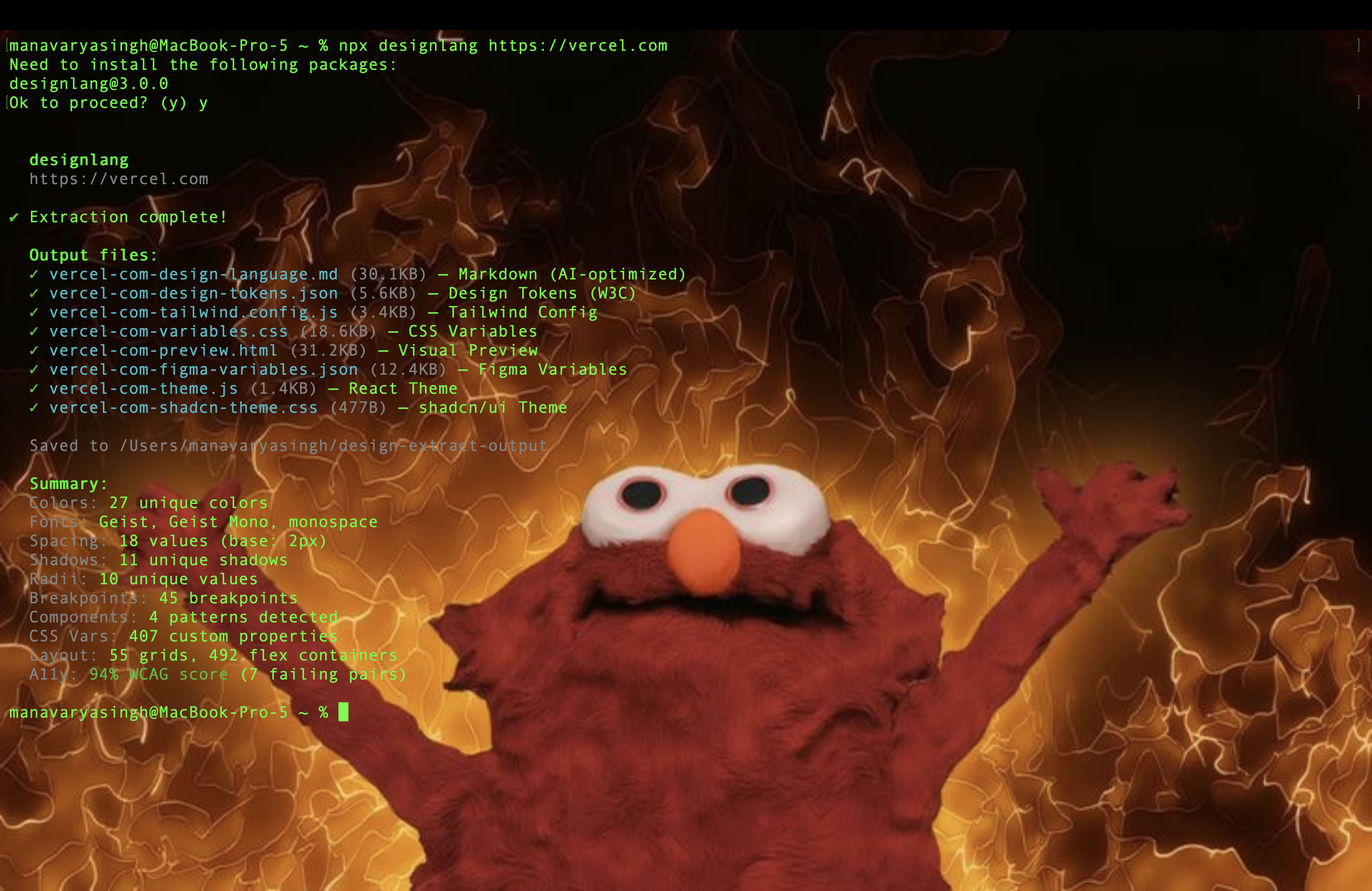
designlang crawls any website with a headless browser, extracts every computed style from the live DOM, and generates 8 output files — including an AI-optimized markdown file, visual HTML preview, Tailwind config, React theme, shadcn/ui theme, Figma variables, W3C design tokens, and CSS custom properties.
But unlike every other tool out there, it also extracts layout patterns (grids, flexbox, containers), captures responsive behavior across 4 breakpoints, records interaction states (hover, focus, active), scores WCAG accessibility, and lets you compare multiple brands or sync live sites to local tokens.
Quick Start
npx designlang https://stripe.com
Get everything at once:
npx designlang https://stripe.com --full
What You Get (8 Files)
| File | What it is |
|---|---|
*-design-language.md |
AI-optimized markdown — feed it to any LLM to recreate the design |
*-preview.html |
Visual report with swatches, type scale, shadows, a11y score |
*-design-tokens.json |
W3C Design Tokens format |
*-tailwind.config.js |
Drop-in Tailwind CSS theme |
*-variables.css |
CSS custom properties |
*-figma-variables.json |
Figma Variables import (with dark mode support) |
*-theme.js |
React/CSS-in-JS theme (Chakra, Stitches, Vanilla Extract) |
*-shadcn-theme.css |
shadcn/ui globals.css variables |
The markdown output has 19 sections: Color Palette, Typography, Spacing, Border Radii, Box Shadows, CSS Custom Properties, Breakpoints, Transitions & Animations, Component Patterns (with full CSS snippets), Layout System, Responsive Design, Interaction States, Accessibility (WCAG 2.1), Gradients, Z-Index Map, SVG Icons, Font Files, Image Style Patterns, and Quick Start.
In v7 a companion *-mcp.json file is also written alongside the 8 outputs so that designlang mcp can serve regions, components, and health data from disk on later invocations. Opting into --platforms <csv> additively emits ios/, android/, flutter/, and/or wordpress-theme/ directories in the output folder, and --emit-agent-rules adds a .cursor/, .claude/, CLAUDE.md.fragment, and agents.md set.
Install
# Use directly (no install needed)
npx designlang https://example.com

# Or install globally
npm install -g designlang

# As an agent skill (Claude Code, Cursor, Codex, 40+ agents)
npx skills add Manavarya09/design-extract
What Makes This Different
Most design extraction tools give you colors and fonts. That's it. designlang fills 5 market gaps that no other tool addresses:
1. Layout System Extraction
Extracts the structural skeleton — grid column patterns, flex direction usage, container widths, gap values, and justify/align patterns.
Layout: 55 grids, 492 flex containers
Every other tool gives you the paint. designlang gives you the architecture.
2. Responsive Multi-Breakpoint Capture
Crawls the site at 4 viewports (mobile, tablet, desktop, wide) and maps exactly what changes:
designlang https://vercel.com --responsive
Responsive: 4 viewports, 3 breakpoint changes
  375px → 768px: Nav visibility hidden → visible, Hamburger shown → hidden
  768px → 1280px: Max grid columns 1 → 3, H1 size 32px → 48px
No other tool captures how the design adapts, just how it looks at one size.
3. Interaction State Capture
Programmatically hovers and focuses interactive elements, capturing the actual style transitions:
designlang https://stripe.com --interactions
/* Button Hover */
background-color: rgb(83, 58, 253) → rgb(67, 47, 202);
box-shadow: none → 0 4px 12px rgba(83, 58, 253, 0.4);

/* Input Focus */
border-color: rgb(200, 200, 200) → rgb(83, 58, 253);
outline: none → 2px solid rgb(83, 58, 253);
4. Live Site Sync
Treat the deployed site as your source of truth, not Figma:
designlang sync https://stripe.com --out ./src/tokens
Detects design changes and auto-updates your local design-tokens.json, tailwind.config.js, and variables.css.
5. Multi-Brand Comparison
Compare N brands side-by-side:
designlang brands stripe.com vercel.com github.com linear.app
Generates a matrix with color overlap analysis, typography comparison, spacing systems, and accessibility scores. Outputs both brands.md and brands.html.
6. Clone Command
Generate a working Next.js app with the extracted design applied:
designlang clone https://stripe.com
cd cloned-design && npm install && npm run dev
One command → a running app with the site's colors, fonts, spacing, and component patterns.
7. Design System Scoring
Rate any site's design quality across 7 categories:
designlang score https://vercel.com
  68/100  Grade: D

  Color Discipline     ██████████░░░░░░░░░░ 50
  Typography           ██████████████░░░░░░ 70
  Spacing System       ████████████████░░░░ 80
  Shadows              ██████████░░░░░░░░░░ 50
  Border Radii         ████████░░░░░░░░░░░░ 40
  Accessibility        ███████████████████░ 94
  Tokenization         ████████████████████ 100
8. Watch Mode
Monitor a site for design changes:
designlang watch https://stripe.com --interval 60
Checks hourly and alerts when colors, fonts, or accessibility scores change.
9. Apply Command (NEW in v5)
Extract a site's design and write tokens directly into your project — auto-detects your framework:
designlang apply https://stripe.com --dir ./my-app
Detects Tailwind, shadcn/ui, or plain CSS and writes to the right config files automatically.
10. Auth Extraction (NEW in v5)
Extract from authenticated or protected pages with cookies and custom headers:
designlang https://internal-app.com --cookie "session=abc123" --header "Authorization:Bearer token"
11. Gradient Extraction (NEW in v5)
Detects all CSS gradients — type (linear/radial/conic), direction, color stops, and classifies them as subtle, brand, bold, or complex.
12. Z-Index Map (NEW in v5)
Builds a layer hierarchy from all z-index values, groups them into layers (base, sticky, dropdown, modal, etc.), and flags z-index wars or excessive values (>9999).
13. SVG Icon Extraction (NEW in v5)
Finds and deduplicates all inline SVGs, classifies them by size and style (outline/solid/duotone), and extracts the icon color palette.
14. Font File Detection (NEW in v5)
Identifies every font source — Google Fonts, self-hosted, CDN, or system — and generates ready-to-use @font-face CSS.
15. Image Style Patterns (NEW in v5)
Detects image aspect ratios, border treatments, filters, and classifies patterns like avatar, hero, thumbnail, and gallery.
16. Dark Mode Diffing (NEW in v5)
Compare light and dark mode side-by-side — see exactly which colors change and which CSS variables are overridden:
designlang https://vercel.com --dark
17. MCP Server (NEW in v7)
One-command integration with any MCP-aware AI agent (Cursor, Claude Code, Windsurf, and more):
designlang mcp --output-dir ./design-extract-output
Launches a stdio JSON-RPC server that exposes the extracted design as MCP resources and tools.
Resources:
designlang://tokens/primitive— primitive token layerdesignlang://tokens/semantic— semantic token layer (with DTCG alias references)designlang://regions— classified page regions (nav, hero, pricing, etc.)designlang://components— reusable component clusters with variantsdesignlang://health— CSS health audit
Tools:
search_tokens— query tokens by name, value, or typefind_nearest_color— snap any color to the nearest palette tokenget_region— fetch a classified region by nameget_component— fetch a component cluster by idlist_failing_contrast_pairs— list every WCAG-failing fg/bg pair with remediation suggestions
18. Multi-Platform Output (NEW in v7)
Emit iOS SwiftUI, Android Compose, Flutter, and WordPress block-theme files in a single run, in addition to the default web output:
designlang https://stripe.com --platforms all
Resulting tree:
design-extract-output/
├── stripe-com-*.{md,json,css,js,html}    (default web output)
├── ios/
│   └── DesignTokens.swift
├── android/
│   ├── Theme.kt
│   ├── colors.xml
│   └── dimens.xml
├── flutter/
│   └── design_tokens.dart               (+ buildDesignlangTheme())
└── wordpress-theme/
    ├── theme.json
    ├── style.css
    ├── functions.php
    ├── index.php
    └── templates/index.html
Values for --platforms are any comma-separated subset of web,ios,android,flutter,wordpress,all. The flag is additive — the default web output is always emitted.
19. Agent Rules Emitter (NEW in v7)
Write agent-facing rule files generated from the resolved semantic tokens:
designlang https://stripe.com --emit-agent-rules
Writes:
.cursor/rules/designlang.mdc— Cursor rule.claude/skills/designlang/SKILL.md— Claude Code skillCLAUDE.md.fragment— snippet you can paste into your project's CLAUDE.mdagents.md— generic, vendor-neutral agent guidance
Each file is templated from the semantic layer of the extracted token set, so the agent sees real token names and values — not placeholders.
20. Stack + Tailwind Fingerprint (NEW in v7)
Automatic framework, utility-class, and analytics detection surfaced on design.stack:
- Framework: Next.js, Nuxt, Gatsby, Remix, Astro, Shopify, WordPress, Framer, Webflow, and more.
- Tailwind: when Tailwind is in use, records utility-class frequency so you see which utilities drive the design.
- Analytics: inventory of analytics scripts — GA4, Plausible, PostHog, Segment, Mixpanel, Amplitude, and friends.
21. CSS Health Audit (NEW in v7)
A dedicated audit pass surfaced on design.cssHealth:
- Specificity graph (distribution, hotspots)
!importantcount- Duplicate declarations
- Unused CSS via the Playwright Coverage API
@keyframescatalog- Vendor-prefix audit
Also contributes a cssHealth dimension to the overall design score.
22. Chrome Extension (NEW in v7.1)
A Manifest-v3 popup lives in chrome-extension/. One click on any tab opens designlang.manavaryasingh.com with the URL prefilled — no copy-paste, no context switch. There is also a Copy CLI button that puts npx designlang <url> in your clipboard.
- Permissions:
activeTabonly, plus host access to the hosted extractor. - Install: toggle developer mode at
chrome://extensions, click Load unpacked, pick thechrome-extension/folder. - Firefox + Edge work with the same MV3 manifest.
23. Better Auth + Network Control (NEW in v7.1)
Extracting from authenticated, self-signed, or non-default environments now takes one flag:
--cookie-file <path>— loads cookies from JSON array, PlaywrightstorageState.json, or Netscapecookies.txt(browser extensions, curl exports). Merges cleanly with the existing--cookie name=valueflag.--insecure— ignore HTTPS/SSL certificate errors for self-signed dev servers, corporate staging, or MITM tools.--user-agent <ua>— override the browser User-Agent string.
designlang https://staging.internal --cookie-file ./session.json --insecure
All Features
| Feature | Flag / Command | Description |
|---|---|---|
| Base extraction | designlang <url> |
Colors, typography, spacing, shadows, radii, CSS vars, breakpoints, animations, components |
| Layout system | automatic | Grid patterns, flex usage, container widths, gap values |
| Accessibility | automatic | WCAG 2.1 contrast ratios for all fg/bg pairs |
| Design scoring | automatic | 7-category quality rating (A-F) with actionable issues |
| Gradients | automatic | Gradient type, direction, stops, classification |
| Z-index map | automatic | Layer hierarchy, z-index wars detection |
| SVG icons | automatic | Deduplicated icons, size/style classification, color palette |
| Font files | automatic | Source detection (Google/self-hosted/CDN/system), @font-face CSS |
| Image styles | automatic | Aspect ratios, shapes, filters, pattern classification |
| Dark mode | --dark |
Extracts dark color scheme + light/dark diff |
| Auth pages | --cookie, --cookie-file, --header |
Extract from authenticated/protected pages; cookie files in JSON / Playwright storageState / Netscape formats |
| Self-signed / dev TLS | --insecure |
Ignore HTTPS/SSL certificate errors |
| User-Agent override | --user-agent <ua> |
Set a custom User-Agent string |
| Chrome extension | chrome-extension/ |
One-click handoff from any tab, MV3, activeTab only |
| Multi-page | --depth <n> |
Crawl N internal pages for site-wide tokens |
| Screenshots | --screenshots |
Capture buttons, cards, inputs, nav, hero, full page |
| Responsive | --responsive |
Crawl at 4 viewports, map breakpoint changes |
| Interactions | --interactions |
Capture hover/focus/active state transitions |
| Everything | --full |
Enable screenshots + responsive + interactions |
| Apply | designlang apply <url> |
Auto-detect framework and write tokens to your project |
| Clone | designlang clone <url> |
Generate a working Next.js starter with extracted design |
| Score | designlang score <url> |
Rate design quality with visual bar chart breakdown |
| Watch | designlang watch <url> |
Monitor for design changes on interval |
| Diff | designlang diff <A> <B> |
Compare two sites (MD + HTML) |
| Multi-brand | designlang brands <urls...> |
N-site comparison matrix |
| Sync | designlang sync <url> |
Update local tokens from live site |
| History | designlang history <url> |
Track design changes over time |
| MCP server | designlang mcp |
Expose extraction as MCP resources + tools |
| Multi-platform | --platforms <csv> |
Emit iOS / Android / Flutter / WordPress outputs |
| Agent rules | --emit-agent-rules |
Cursor, Claude Code, generic agent rule files |
| Stack fingerprint | automatic | Framework + Tailwind + analytics detection |
| CSS health | automatic | Specificity, !important, unused CSS, keyframes |
| A11y remediation | automatic | Nearest palette color passing AA / AAA for every failing pair |
| Semantic regions | automatic | nav / hero / pricing / testimonials / cta / footer classification |
| Reusable components | automatic | DOM subtree + style-vector clustering with variants |
| DTCG tokens | default | W3C Design Tokens v1 with semantic + composite layers (--tokens-legacy for pre-v7) |
Full CLI Reference
designlang <url> [options]

Options:
  -o, --out <dir>         Output directory (default: ./design-extract-output)
  -n, --name <name>       Output file prefix (default: derived from URL)
  -w, --width <px>        Viewport width (default: 1280)
  --height <px>           Viewport height (default: 800)
  --wait <ms>             Wait after page load for SPAs (default: 0)
  --dark                  Also extract dark mode styles
  --depth <n>             Internal pages to crawl (default: 0)
  --screenshots           Capture component screenshots
  --responsive            Capture at multiple breakpoints
  --interactions          Capture hover/focus/active states
  --full                  Enable all captures
  --cookie <cookies...>   Cookies for authenticated pages (name=value)
  --cookie-file <path>    Load cookies from JSON / storageState / Netscape cookies.txt
  --header <headers...>   Custom headers (name:value)
  --user-agent <ua>       Override the browser User-Agent string
  --insecure              Ignore HTTPS/SSL certificate errors (self-signed, dev, proxies)
  --framework <type>      Only generate specific theme (react, shadcn)
  --platforms <csv>       Additional platforms: web,ios,android,flutter,wordpress,all (additive)
  --emit-agent-rules      Emit Cursor / Claude Code / CLAUDE.md / agents.md rule files
  --tokens-legacy         Emit pre-v7 flat design-tokens.json shape (backward compat)
  --no-history            Skip saving to history
  --verbose               Detailed progress output

Commands:
  apply <url>             Extract and apply design directly to your project
  clone <url>             Generate a working Next.js starter from extracted design
  score <url>             Rate design quality (7 categories, A-F, bar chart)
  watch <url>             Monitor for design changes on interval
  diff <urlA> <urlB>      Compare two sites' design languages
  brands <urls...>        Multi-brand comparison matrix
  sync <url>              Sync local tokens with live site
  history <url>           View design change history
  mcp                     Launch stdio MCP server (--output-dir <dir>)
Example Output
Running designlang https://vercel.com --full:
  designlang
  https://vercel.com

  Output files:
  ✓ vercel-com-design-language.md (32.6KB)
  ✓ vercel-com-design-tokens.json (5.6KB)
  ✓ vercel-com-tailwind.config.js (3.4KB)
  ✓ vercel-com-variables.css (18.6KB)
  ✓ vercel-com-preview.html (31.8KB)
  ✓ vercel-com-figma-variables.json (12.4KB)
  ✓ vercel-com-theme.js (1.4KB)
  ✓ vercel-com-shadcn-theme.css (477B)
  ✓ screenshots/button.png
  ✓ screenshots/card.png
  ✓ screenshots/nav.png
  ✓ screenshots/hero.png
  ✓ screenshots/full-page.png

  Summary:
  Colors: 27 unique colors
  Fonts: Geist, Geist Mono
  Spacing: 18 values (base: 2px)
  Shadows: 11 unique shadows
  Radii: 10 unique values
  Breakpoints: 45 breakpoints
  Components: 11 types detected (with CSS snippets)
  CSS Vars: 407 custom properties
  Layout: 55 grids, 492 flex containers
  Gradients: 4 unique gradients
  Z-Index: 8 layers mapped
  Icons: 23 unique SVGs
  Font Files: 4 font sources detected
  Images: 6 style patterns
  Responsive: 4 viewports, 3 breakpoint changes
  Interactions: 8 state changes captured
  A11y: 94% WCAG score (7 failing pairs)
  Design Score: 68/100 (D) — 4 issues
How It Works
- Crawl — Launches headless Chromium via Playwright, waits for network idle and fonts
- Extract — Single
page.evaluate()walks up to 5,000 DOM elements collecting 25+ computed style properties, layout data, inline SVGs, font sources, and image metadata - Process — 17 extractor modules parse, deduplicate, cluster, and classify the raw data (including gradients, z-index layers, icons, fonts, and image patterns)
- Format — 8 formatter modules generate output files
- Score — Accessibility extractor calculates WCAG contrast ratios for all color pairs
- Capture — Optional: screenshots, responsive viewport crawling, interaction state recording
Agent Skill
Works with Claude Code, Cursor, Codex, and 40+ AI coding agents via the skills ecosystem:
npx skills add Manavarya09/design-extract
In Claude Code, use /extract-design <url>.
Website
design-extract-beta.vercel.app — the brutalist product page.
Contributing
See CONTRIBUTING.md. PRs welcome!
License
MIT - Manav Arya Singh
Reviews (0)
Sign in to leave a review.
Leave a reviewNo results found