antialgorithm
Health Pass
- License — License: MIT
- Description — Repository has a description
- Active repo — Last push 0 days ago
- Community trust — 550 GitHub stars
Code Pass
- Code scan — Scanned 7 files during light audit, no dangerous patterns found
Permissions Pass
- Permissions — No dangerous permissions requested
No AI report is available for this listing yet.
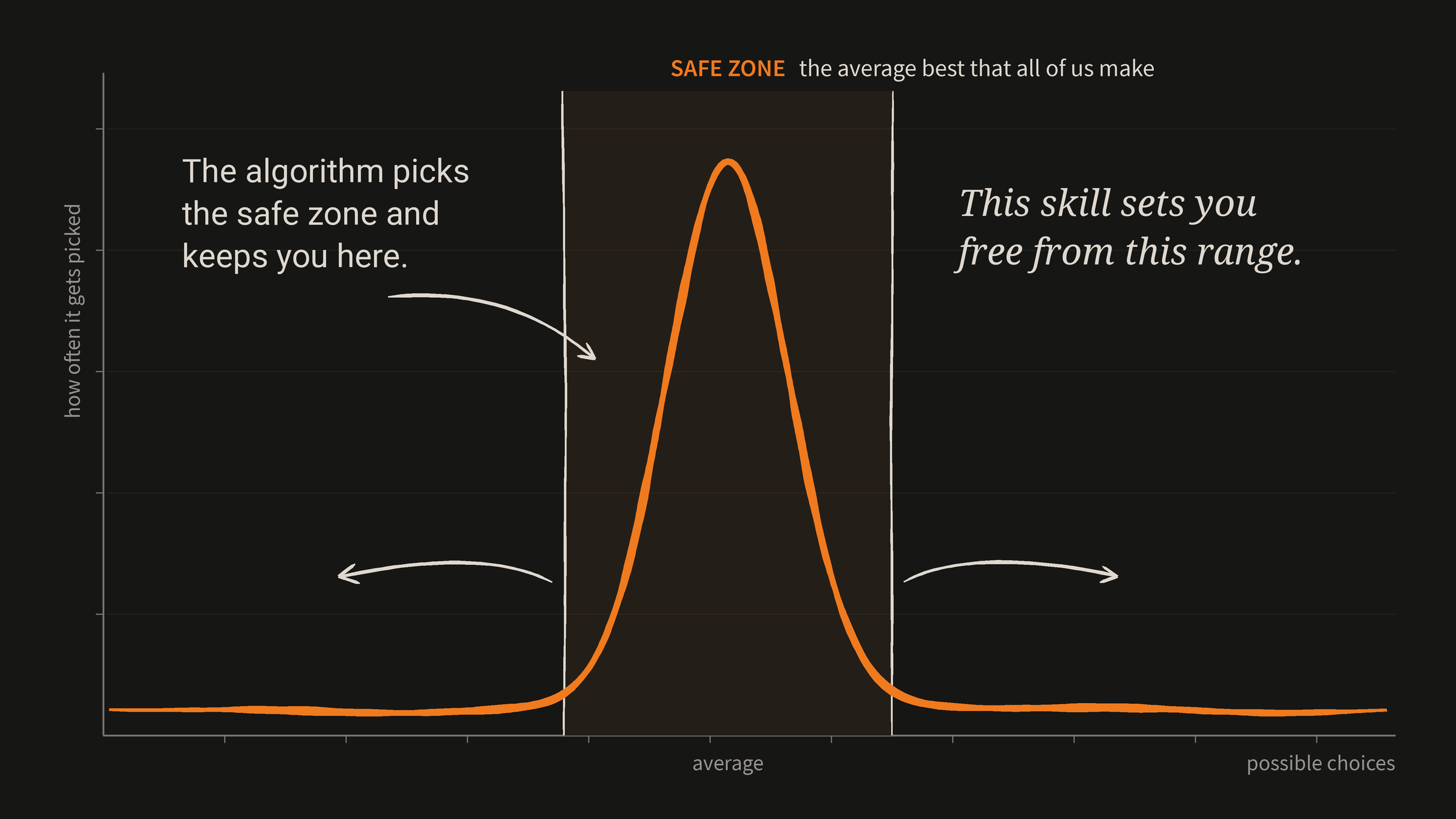
Claude Code skill that steers the model away from its first, most average pick in creative work: names, ideas, posters, UI.
antialgorithm
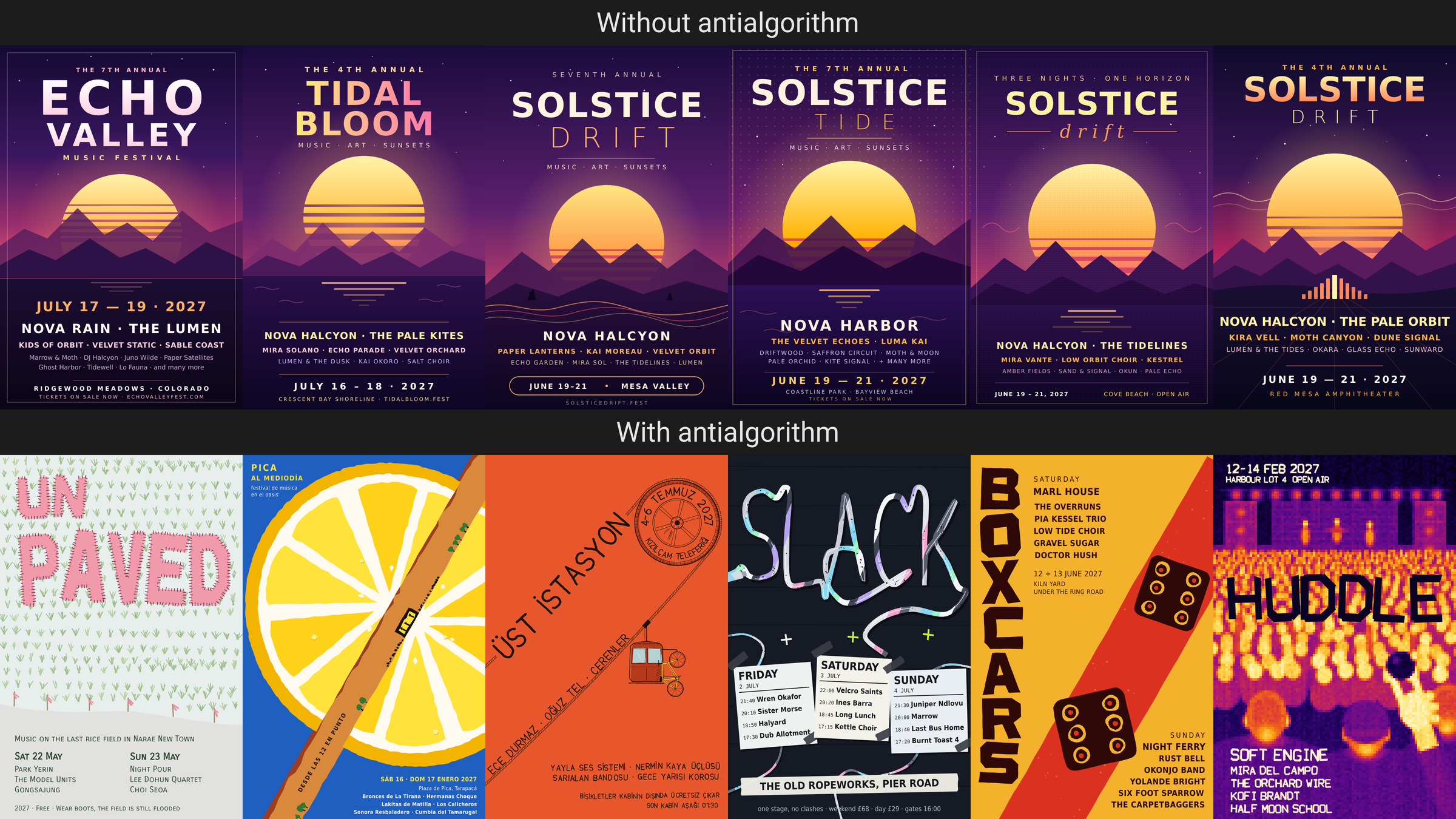
Claude Code skill for creative work: names, copy, story, game ideas, posters, UI. It makes the model name its first, most average pick, then move away from it for a reason taken from the project.
Both rows came from the same prompt: Design a poster for a music festival as a 400x600 SVG. Save the final SVG as final.svg in the current folder. The top row is one batch of six runs without the skill, none left out. The bottom row is picked from about a dozen runs made while the skill was still being written.
Install
In Claude Code:
/plugin install antialgorithm --marketplace mankidev/antialgorithm
Claude Code before 2.1.275 needs the marketplace added first:
/plugin marketplace add mankidev/antialgorithm
/plugin install antialgorithm@antialgorithm
Or clone it into your skills folder:
git clone https://github.com/mankidev/antialgorithm ~/.claude/skills/antialgorithm
For Codex, Cursor, OpenCode and other agents that read SKILL.md, the skills CLI puts it in the right folder:
npx skills add mankidev/antialgorithm
The scripts need Python 3. check.py also needs numpy, Pillow and rsvg-convert (or the cairosvg package).
Scripts
seed.py rolls a starting point when the request is thin. A visual seed gives a making method, colors, layout, type, a verb and a scale for the idea, a setting, a region and, half the time, an object. A text seed gives a voice, a way in and a register. An idea seed gives a verb, a constraint, a scale and a pressure. It draws from system randomness, so two people sending the same prompt start in different places. It also saves each seed to ~/.local/state/antialgorithm/history.jsonl (under $XDG_STATE_HOME when that is set) and skips values from the last few, so your own seeds don't repeat from one session to the next. Plugin updates leave that file alone. --keep "axis=value" holds an axis fixed, which lets you keep a subject and roll only the look.
moves.py keeps a short log of the main move behind each off-default answer, such as "neon tube wall, almost no type". The model reads it before showing new work, so it doesn't reuse a move that worked last time just because it worked.
rough.py takes an SVG and shakes its straight lines, shapes and letters, and breaks the even spacing of repeated marks, so a hand-made look drawn in code stops looking plotted. It is only for hand-made methods such as print, paint, stamps and ink; screen, camera and render looks keep their own marks.
check.py renders an SVG at full size and at icon size and lists text that runs off an edge, sits under a shape, has low contrast or is too small. The size limit fits posters; for an app screen use --min-text 0.6.
Visual rules live in visuals.md, which the model reads only for visual work, so a name or a slogan doesn't load them.
License
MIT
Reviews (0)
Sign in to leave a review.
Leave a reviewNo results found