mcpsec
Health Pass
- License — License: MIT
- Description — Repository has a description
- Active repo — Last push 0 days ago
- Community trust — 19 GitHub stars
Code Fail
- eval() — Dynamic code execution via eval() in mcpsec/ai/ai_taint_analyzer.py
- new Function() — Dynamic code execution via Function constructor in mcpsec/ai/ai_taint_analyzer.py
- exec() — Shell command execution in mcpsec/ai/ai_taint_analyzer.py
Permissions Pass
- Permissions — No dangerous permissions requested
No AI report is available for this listing yet.
An AI-driven dynamic protocol fuzzer for the Model Context Protocol (MCP). Prove runtime exploitability by discovering state violations, transport crashes, and application-layer logic flaws (SSRF, LFI) before your AI agents do.
mcpsec
Security scanner and protocol fuzzer for MCP servers





Why mcpsec?
MCP (Model Context Protocol) connects AI agents to external tools. Claude Desktop, Cursor, VS Code Copilot, and every major AI IDE uses it. Security is often an afterthought.
Most MCP security tools do static analysis. mcpsec connects to live servers and proves exploitation.
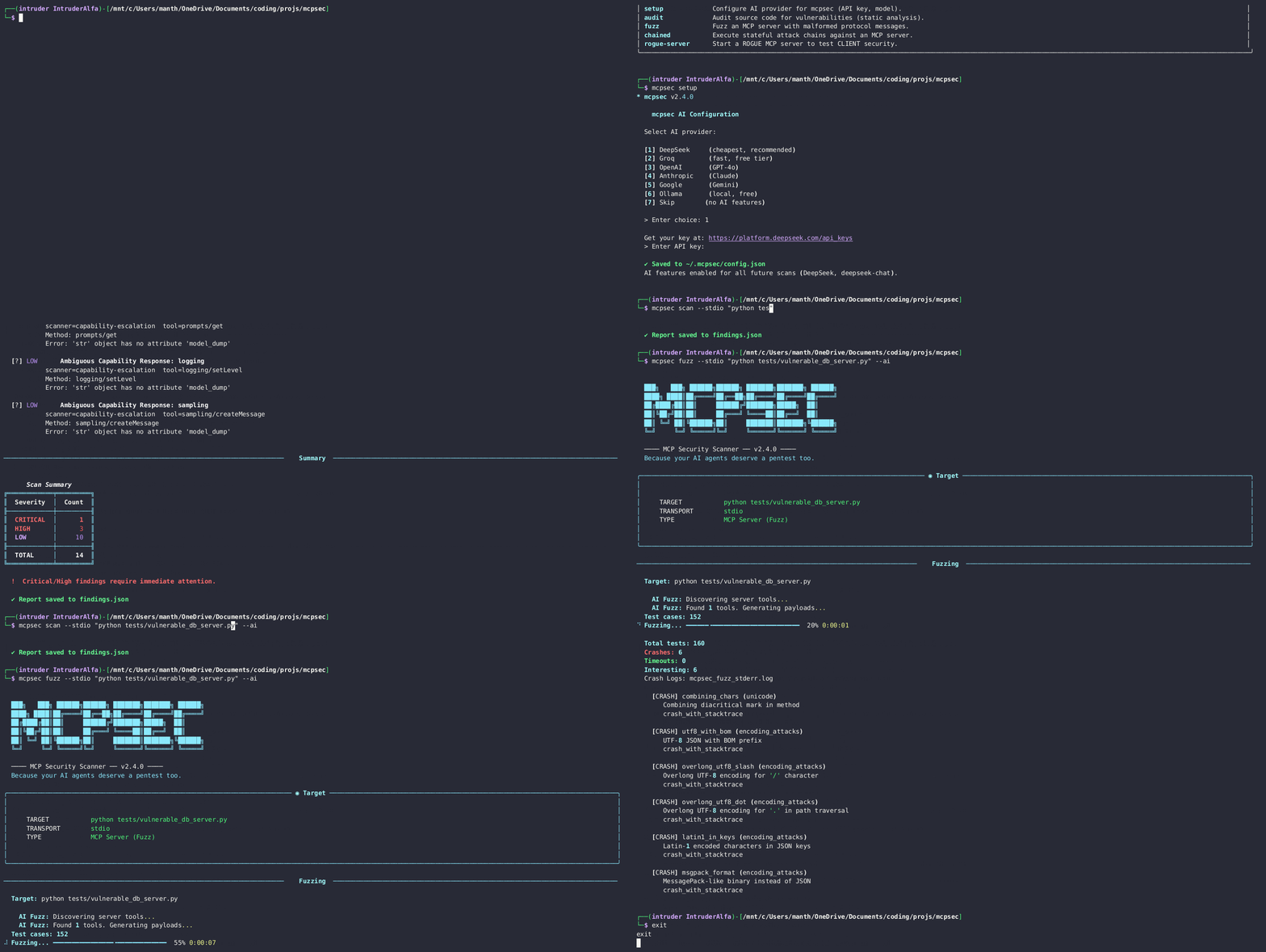
Real Bugs Found
| Target | Vulnerability | Status |
|---|---|---|
| MCP Python SDK | ClosedResourceError DoS (invalid UTF-8) | Issue #2328 - Fix in PR #2334 |
| radare2-mcp | Multiple SIGSEGV via params type confusion | Issue #42 |
| radare2-mcp | Arbitrary RCE via shell escape (!) in run_command/run_javascript | Issue #45 - Fixed in commit 482cde6 |
| radare2-mcp | SIGSEGV in initialize via params type confusion | Issue #52 |
| MCP Python SDK | UnicodeDecodeError DoS | Fixed - PR #2302 |
| mcp-server-fetch | 61 crash cases, exception handling DoS | Issue #3359 |
| mcp-server-git | 61 crash cases | Issue #3359 |
| MCP TypeScript SDK | EPIPE crash | Issue #1564 |
| MCP TypeScript SDK | Integer overflow DoS (MAX_SAFE_INTEGER+1) | Issue #1765 |
More findings under responsible disclosure.
Installation
pip install mcpsec
For AI-powered features:
pip install mcpsec[ai]
Nix
nix-shell   # basic
nix-shell --arg withAll true   # all optional deps
Quick Start
Runtime Scanning
# Scan via stdio
mcpsec scan --stdio "npx @modelcontextprotocol/server-filesystem /tmp"

# Scan via HTTP with auth
mcpsec scan --http http://localhost:8080/mcp -H "Authorization: Bearer TOKEN"

# Auto-discover and scan all local servers
mcpsec scan --auto

# Enumerate attack surface
mcpsec info --stdio "python my_server.py"
Protocol Fuzzing
# Standard fuzzing (~200 cases)
mcpsec fuzz --stdio "python my_server.py"

# High intensity (~800 cases)
mcpsec fuzz --stdio "python my_server.py" --intensity high

# AI-powered payload generation
mcpsec fuzz --stdio "python my_server.py" --ai
Static Analysis
# Local source
mcpsec audit --path ./my-mcp-server

# GitHub repository
mcpsec audit --github https://github.com/user/mcp-server

# With AI validation
mcpsec audit --github https://github.com/user/mcp-server --ai
Advanced
# SQL Injection scanner with DB fingerprinting
mcpsec sql --stdio "npx @benborla29/mcp-server-mysql" --fingerprint

# Dangerous tool chain detection
mcpsec chains --stdio "npx @example/complex-server"

# Interactive exploitation REPL
mcpsec exploit --stdio "npx vulnerable-server"

# Rogue server for client-side testing
mcpsec rogue-server --port 9999 --attack all
Scanners
| Scanner | Description |
|---|---|
prompt-injection |
Hidden instructions in tool descriptions |
command-injection |
OS command injection with 138 payloads |
path-traversal |
Directory traversal with 104 payloads |
ssrf |
Server-Side Request Forgery with 81 payloads |
sql |
SQL Injection (Error, Time, Boolean, Stacked) |
auth-audit |
Missing authentication, dangerous tool combos |
description-prompt-injection |
LLM manipulation via descriptions |
resource-ssrf |
SSRF via MCP resource URIs |
capability-escalation |
Undeclared capability abuse |
chains |
Dangerous tool combination detection |
code-execution |
Detects eval(), exec(), and compile() sinks |
template-injection |
Targets SSTI and string formatting vulnerabilities |
rag-poisoning |
Identifies dangerous Write→Read data flows |
idor |
Insecure Direct Object Reference detection |
info-leak |
Environment variable and credential disclosure |
deserialization |
Pickle, XXE, and unsafe YAML parsing |
Fuzz Generators
22 generators organized by intensity level:
Low (~65 cases): malformed_json, protocol_violation, type_confusion, boundary_testing, unicode_attacks
Medium (~200 cases): + session_attacks, encoding_attacks, integer_boundaries
High (~800 cases): + injection_payloads, method_mutations, param_mutations, timing_attacks, header_mutations, json_edge_cases, protocol_state, protocol_state_machine, id_confusion, concurrency_attacks, regex_dos, deserialization
Insane (~1500+ cases): + resource_exhaustion, memory_exhaustion_v2
Static Analysis (149 Semgrep Rules)
24 rule files covering:
- Injection: Command injection (JS, Go, Rust, .NET, Python, Python async), SQL injection (all drivers + ORM bypass), path traversal
- Network: SSRF patterns, resource URI issues
- Secrets: AWS keys, API tokens, JWT secrets, connection strings, private keys
- MCP-Specific: Dangerous tool names, empty schemas, input reflection, missing auth
- Code Quality: Security TODOs, empty catches, TLS disabled, CORS *, ReDoS patterns
How It Works
┌─────────┐     MCP Protocol      ┌────────────┐
│ mcpsec  │ ◄──── JSON-RPC ────►  │   Target   │
│         │    (stdio / HTTP)     │   Server   │
└────┬────┘                       └────────────┘
     │
     ├── Connect & enumerate attack surface
     ├── Run 10+ security scanners
     ├── Generate 800+ fuzz cases
     ├── Execute AI-powered payload mutations
     └── Report findings with PoC evidence
Configuration
AI Provider Setup
mcpsec setup
Supports: OpenAI, Anthropic, Google, Groq, DeepSeek, Ollama
Output Formats
# JSON
mcpsec scan --stdio "server" --output results.json

# SARIF 2.1.0 (GitHub/GitLab/Azure DevOps CI/CD)
mcpsec fuzz --stdio "server" --output results.sarif
Changelog
v2.6.1 (2026-03-20)
- CI/CD pipeline with GitHub Actions for automated testing and PyPI releases
- PR and Issue templates for better community contributions
- Nix package support via
shell.nixfor reproducible builds (@AbhiTheModder) - Environment variables now properly inherited in
mcp_client.py(@AbhiTheModder)
v2.6.0 (2026-03-13)
- Auto-Discovery Scanner: New
--autoflag to automatically find and scan MCP servers from Claude, Cursor, VS Code, Windsurf, etc. - Windows Unicode Fixes: Comprehensive fix for
UnicodeEncodeErroron Windows consoles. - Pydantic Compatibility: Resolved
AttributeErrorfor custom metadata in scan results.
v2.5.0 (2026-03-04)
- New Scanners:
code-execution,template-injection,rag-poisoning,idor,info-leak,deserialization - Confirmation Proofs: Added
mcpsec_cmd_successexecution anchor for command injection - SSRF Expansion: Support for
file://protocol and generic fetch success indicators - Robust Parameter Handling: Automatic dummy argument generation for complex tool schemas
- Enhanced Classification: Massive reduction in false positives for blocked/sandboxed tools
v2.4.0 (2026-02-28)
- SAST Rules Expansion: 87 new Semgrep rules → 149 total across 24 rule files
- Broad patterns for command injection, path traversal, SQL injection, SSRF, deserialization
- Secrets detection: AWS keys, AI API keys, GitHub/Slack tokens, JWT secrets
- MCP-specific rules: dangerous tool names, empty schemas, error leaks, input reflection
- Code smells: security TODOs, empty catches, TLS disabled, CORS *, ReDoS patterns
v2.3.0 (2026-02-28)
- Scanner Nuclear Expansion: Command injection (138), path traversal (104), SSRF (81) payloads
- Encoding bypasses, protocol smuggling, shell-specific evasion
- 5 new fuzz generators: integer boundaries, concurrency, memory exhaustion, regex DoS, deserialization
- SDK-specific Semgrep rules for Go, Rust, Python async, .NET
v2.2.0 (2026-02-28)
- SARIF 2.1.0 Output for CI/CD integration
- CWE mapping and severity scoring
- Audit report export with
--outputand--formatflags
v2.1.0 (2026-02-27)
- AI Exploitation Assistant:
select,run,next,verdict,autoREPL commands - Expert controls:
edit,aggressive,hintfor complex bypasses - AI learns from manual
callcommands and response history
v2.0.3 (2026-02-26)
- MCP Repeater: Interactive REPL for manual/semi-auto finding validation
- AI payload engine with context-aware recommendations
- Exploit playbooks for SQLi, RCE, SSRF, path traversal
- Automated evidence capture and PoC generation
v2.0.2 (2026-02-26)
- Tool chain analysis for dangerous combinations
- Cross-platform Windows support improvements
v2.0.1 (2026-02-25)
- Advanced SQL scanner with modular detection
- DB fingerprinting for MySQL, Postgres, MSSQL, SQLite
v2.0.0 (2026-02-24)
- Fuzzing engine v2 with chained state-machine exploration
- AI-powered validation of security findings
Contributing
See CONTRIBUTING.md for guidelines.
CI runs automatically on all PRs — linting with Ruff and cross-platform tests (Ubuntu, Windows, macOS).
Disclaimer
For authorized security testing only. Only scan servers you own or have explicit permission to test.
License
Built by Manthan Ghasadiya
Reviews (0)
Sign in to leave a review.
Leave a reviewNo results found