my-style-gen
Health Warn
- License — License: MIT
- Description — Repository has a description
- Active repo — Last push 0 days ago
- Low visibility — Only 6 GitHub stars
Code Pass
- Code scan — Scanned 12 files during light audit, no dangerous patterns found
Permissions Pass
- Permissions — No dangerous permissions requested
No AI report is available for this listing yet.
Builds a personal style skill from material you authored, so an agent works, writes and reports back in your idiom.






my-style-gen
Your agent writes well. It just doesn't write like you.
So the code it writes, the deck it drafts, the spec it fills in... all in a stranger's idiom: slower to read, deaf to the shorthand you actually
use, and not quite yours by the time it ships. This fixes all three, once.
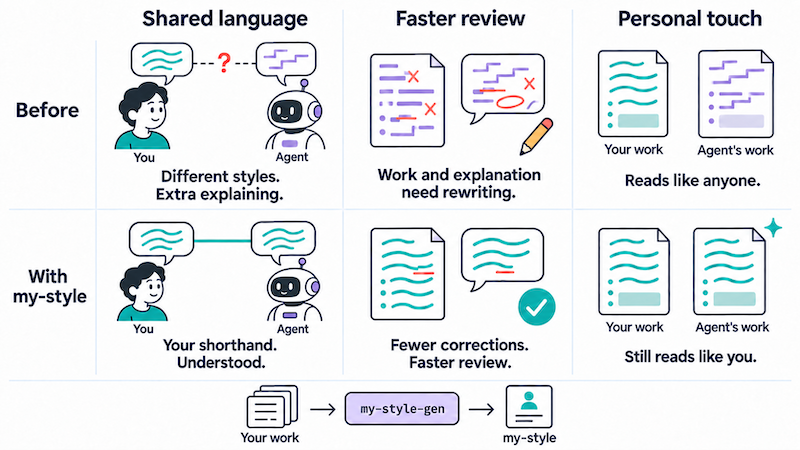
Point it at work you already produced: git repositories, specs, decks, spreadsheets,
contracts, notes. It reads each source, works out how you work and how you write, and
installs a skill called my-style that every future agent session follows.
- Faster review — the work and the prose explaining it read the way you write, and
need fewer corrections - Shared language — your vocabulary and shorthand travel with the skill, so a terse
request is decoded the way a long-time colleague would decode it - Personal touch — what you make with an agent still reads like your work
Works for any line of work, not just engineering (an engineer's sources are
repositories, a product manager's are specs and decks, a lawyer's are filings — same
method, same output). And it adopts the style, not the weakness: a modern model already
writes a cleaner first draft than most of us, so each analysis agent filters as it
reads. The goal is legibility, not forgery.
What it looks like
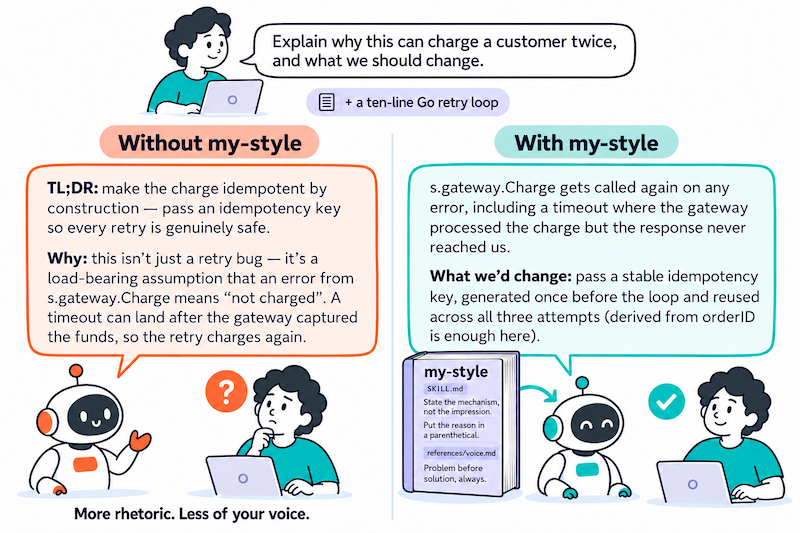
Prompt
Explain why this can charge a customer twice, and what we should change.
(followed by a ten-line Go retry loop)
Response
Without my-style |
With my-style |
|---|---|
TL;DR: make the charge idempotent by construction — pass an idempotency key so every retry is genuinely safe. Why: this isn't just a retry bug — it's a load-bearing assumption that an error from s.gateway.Charge means "not charged". A timeout can land after the gateway has already captured the funds, so the retry quietly charges again. |
s.gateway.Charge gets called again on any error, including a timeout where the gateway processed the charge but the response never reached us. What we'd change: pass a stable idempotency key, generated once before the loop and reused across all three attempts (derived from orderID is enough here) |
Generated my-style skill
<!-- SKILL.md -->
- **State the mechanism, not the impression.** Name the machinery that makes the claim
  checkable. "Bounded by the queue depth once the consumers saturate", not "it scales
  better".
- **Put the reason in a parenthetical, not in a sentence of its own.** He compresses
  justification rather than narrating it. "Moved the publisher outside the transaction
  (so a failed publish can't roll back a committed order)" - not a paragraph explaining
  transaction semantics.

<!-- references/voice.md -->
- Problem before solution, always. Open by stating what the alternatives fail at, then
  the goal - never with your own solution first.
Install
One command, any agent — Claude Code, Copilot, Codex, Cursor, Windsurf and 75 others:
npx skills add marcotrinelli/my-style-gen -g -a claude-code
That installs it for every project. Drop -g to install into the current project only.
Then ask for it in plain words:
build a style skill from my work
Other ways to install
Claude Code, as a plugin:
/plugin marketplace add marcotrinelli/my-style-gen
/plugin install my-style-gen@marcotrinelli
By hand: clone and copy skills/my-style-gen into ~/.claude/skills/,~/.agents/skills/, or wherever your agent keeps its skills.
Companion skills
my-style-gen works on its own, but hands off to and leans on a few skills that live
upstream in anthropics/skills. Install the
ones that match your sources:
| Skill | When you need it | Why |
|---|---|---|
skill-creator |
Recommended | my-style-gen hands off to it for iterating on a skill's description and triggering rather than its content |
docx |
Sources are Word documents | Reads .docx properly, tracked changes and comments included |
pptx |
Sources are decks | Reads .pptx properly, speaker notes included |
pdf |
Sources are PDFs | Extracts text and tables rather than guessing at layout |
xlsx |
Sources are spreadsheets | Reads formulas and structure, not just rendered values |
All five in one go:
npx skills add anthropics/skills -g -a claude-code --skill skill-creator docx pptx pdf xlsx
In Claude Code skill-creator is also carried by the official marketplace, so/plugin install skill-creator@claude-plugins-official works just as well.
Without the format skills the analysis still runs — it falls back to unzip,pdftotext, pandoc or markitdown — but the read is lossier, and tracked changes and
comments are where the best anti-pattern evidence lives. Plain text and git repositories
need none of them.
Use
Asking in plain words is enough. Or give it what it needs up front — what you do, and
where your material is:
/my-style-gen
/my-style-gen backend engineer ~/src/api ~/src/cli
/my-style-gen product manager ~/Documents/specs ~/Documents/decks
/my-style-gen patent attorney ~/matters/filings
/my-style-gen https://github.com/me/project
Whatever is missing, it asks for in one message — what you do, which sources to read,
how to tell your material from everyone else's, your name and pronouns — then goes.
[!IMPORTANT]
Point it at work you actually wrote. Material an agent produced end to end carries
the model's idiom, not yours, so feeding it back gives you a skill describing the
default you were trying to get away from.
Reading the sources is the expensive part (one agentic exploration per source), so
prefer two or three substantial sources over many thin ones. Sources from unrelated
contexts are worth more than two from the same team — agreement across them is what
separates your habits from the house style.
The result installs as my-style, under ~/.claude/skills/ by default. Ask for another
name where two people's skills have to sit side by side. If it lands inside a git
repository, its path is added to that repository's .gitignore, because it describes
you and not the project.
How it works
Three steps, one agent run per source. No tool to install, no state kept between runs.
| Step | What happens |
|---|---|
| Settle the inputs | What kind of work you do, which sources to read, how your material is identified in each |
| Read the sources | One agent per source, launched in parallel, each returning evidenced findings on voice, vocabulary, standards, craft and workflow |
| Write the skill | Merge the findings, keep what two or more sources agree on as firm rules, hedge the rest, install my-style alongside three A/B tasks written from the same findings |
Voice, vocabulary and standards carry the most weight. The first two serve legibility
and shared language directly; the third comes from what you push back on in other
people's work — review comments, tracked changes, redlines — the only source that yields
genuine anti-patterns. What someone sends back says more about their standards than
their own finished work does.
If a rule in the generated skill is wrong, edit the installed skill. A bad rule is
nearly always a wording problem, and re-reading the sources is the only expensive part.
Seeing what it bought you
A style skill is hard to judge by reading it — the rules all look reasonable on the
page. So the generator also writes three tasks, from the same findings as the rules: one
that produces the thing you make, one that asks for work to be explained back, and one
terse request leaning on your shorthand. They land in my-style/ab-test/tasks/, and the
harness runs each twice, once without the skill and once with it:
skills/my-style-gen/assets/ab-test/ab-test.sh \
  --skill ~/.claude/skills/my-style --compare
Each arm runs headless in a throwaway workspace created outside any project (an arm
sitting under a repository would inherit that repository's skills, which is exactly what
is being measured), so the skill is the only difference between them. --compare adds a
pass that sorts the rules that applied into applied, missed, no difference
and regressions. Applied is the demonstration; missed and no-difference are the edit
list — a rule the model would have followed anyway costs attention in every session and
buys nothing. Re-run it after editing a rule; it takes no arguments beyond the skill.
Layout
skills/my-style-gen/
  SKILL.md                                the three steps and how to drive them
  references/
    analysis.md       the per-source brief, ready to substitute and spawn
    output.md         generated skill layout, frontmatter rules, checklist
    ab-test.md        writing the three tasks and reading the comparison
  assets/
    generated-skill-template/             starting point for the rendered skill
    ab-test/                              the comparison script and example tasks
Contributing
Contributions are very welcome. Feature requests, bug reports and support all go through
GitHub issues — open one and
let's talk. Pull requests just as welcome.
License
MIT © Marco Trinelli
Reviews (0)
Sign in to leave a review.
Leave a reviewNo results found