atelier
Health Warn
- License — License: MIT
- Description — Repository has a description
- Active repo — Last push 0 days ago
- Low visibility — Only 5 GitHub stars
Code Pass
- Code scan — Scanned 12 files during light audit, no dangerous patterns found
Permissions Pass
- Permissions — No dangerous permissions requested
No AI report is available for this listing yet.
The pixel-art studio agents can see — layered, animated, game-ready art over MCP. One binary, no keys, fully deterministic.

The pixel-art studio agents can see — headless, over MCP.


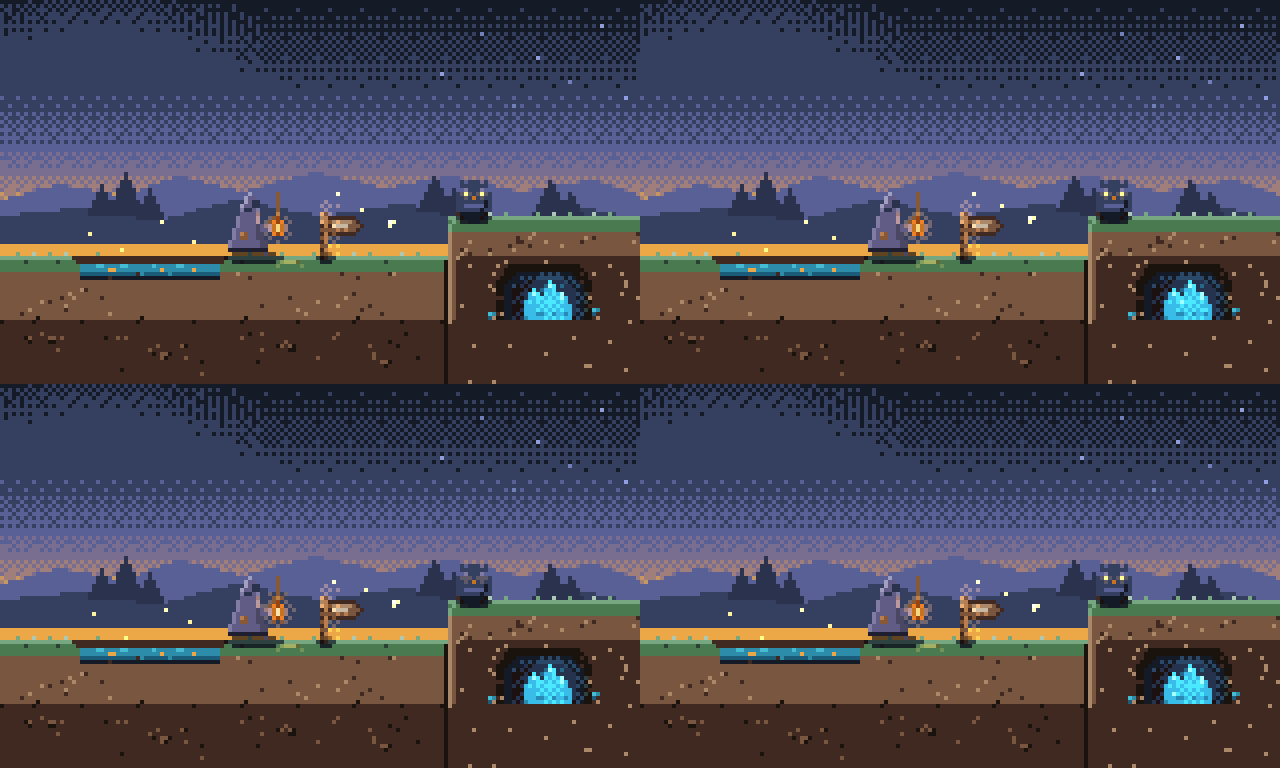
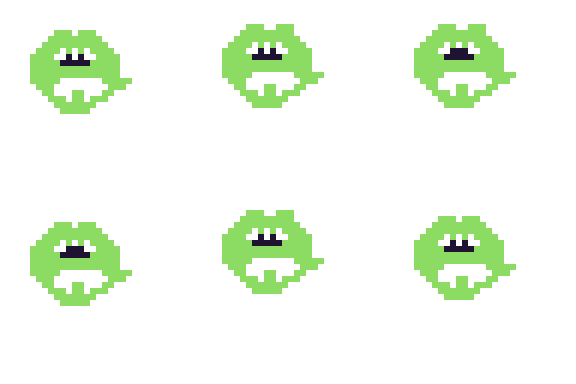



Alien by Haiku 4.5 · potion by Sonnet 5 · wizard cat by Opus 4.8 · ball by Fable 5 — same briefs, four models, zero hand-editing. Full benchmark with compare views: marmikshah.github.io/atelier.
What it is
Agents are good at describing art and bad at seeing it. atelier closes the
loop: every drawing op is a tool call, and doc_look hands back a PNG the
agent can actually look at, judge, and correct — the same look-and-fix loop a
human uses in an editor. One static Rust binary; no API keys, no network, fully
deterministic.
- A real editor, headless — layers, frames, tags, selections, locked
palettes; generators for figures, walk/pose cycles, autotile terrain,
9-slice panels and particle FX. - An eye, not just a hand — critique, palette, silhouette, animation and
colour-blindness audits turn "does it look right?" into numbers an agent
acts on;doc_set_auditjudges a whole asset set as one game. - Game-ready out of the box — spritesheets with pivots/hitboxes/tags,
GIF/APNG, texture atlases, Tiled tilesets, engine-standard JSON.
Quickstart
curl -fsSL https://marmikshah.github.io/atelier/install.sh | sh
The installer registers atelier with your MCP client (stdio or a background
HTTP daemon). Restart your session, then ask your agent for art — "draw me a
blinking cat sprite and export it as a GIF". Under the hood that becomes:
doc_create → paint → doc_look (look!) → fix → doc_export op=anim
| Prebuilt binaries | macOS (Apple Silicon), Linux x86_64, Windows — latest release |
| From source | cargo install --path . |
| Documents live in | ~/.atelier (override with ATELIER_HOME) |
| Tool profile | 30-tool core by default; ATELIER_PROFILE=full for all 75 |
Recipes
Every document is an ordered sequence of tool calls, so art is a recipe —
a JSON file that replays byte-identically and doubles as an integration test:
atelier replay docs/examples/invader-march.json --home /tmp/atelier-demo
The recipes under docs/examples are both the brand art and
the test suite — run make branding to watch all of them draw.
How it's built
A strict four-crate tower — functional core, imperative shell. atelier-core
(document model + raster math) knows nothing about MCP; atelier-studio is
the one-method-per-tool facade; atelier-mcp is the thin tool router over
stdio and HTTP; the atelier binary adds the installer and the replay runner.
Start with the illustrated tour — the smallest units (cel + op), the
composition ladder, and the life of a tool call:
marmikshah.github.io/atelier/architecture.html
Documentation
| Where | What |
|---|---|
| Benchmark gallery | Different models, identical briefs, the same studio in different hands |
| Architecture tour | The crate tower, the life of a tool call, onboarding paths |
| docs/TOOLS.md | Complete reference for all 75 tools |
| docs/ARCHITECTURE.md | Crate and module layout, in the repo |
| CHANGELOG.md | Release notes |
A personal note
atelier started as an experiment with one question behind it: can AI agents,
using only tool calls, build art that is genuinely good enough to ship in a
game?
Every line of code here was written by AI — Claude Opus 4.8 and Fable 5 did
the heavy lifting, with Kimi 2.6 and Minimax 2.7 pitching in. I didn't write a
single line myself. My part was direction: holding the project to the same
practices and standards I use in the projects where I do still write the
code.
This is an ongoing experiment. As time allows, I'll keep running the
benchmark against other model families — GPT, Gemini, and whatever else looks
promising — and trying different designs to see how each of them holds a
brush.
If atelier helps you in any way — as a tool, a reference, or just a kick-start
on your own game-design journey — that makes me genuinely happy. The tokens
are already spent; the least they can do is be useful to you too.
Notice — versions below 2.0.0
[!WARNING]
I intend to follow SemVer, but be realistic about what
this project is: AI-generated code. Diffs are large, and every release below
2.0.0 will likely contain breaking changes despite my best intentions.Once I'm confident the tool has proven itself, I will cut a 2.0.0
release — that is the point where I start reviewing the code in detail and
contributing to it directly. 2.0.0 will be tagged by me, by hand — it is the
one release an AI agent is not allowed to cut. Until then, assume that
anything below 2.0.0 has not been fully reviewed by me and may contain
bugs or security issues I haven't caught.Use at your own risk.
License
MIT.
Reviews (0)
Sign in to leave a review.
Leave a reviewNo results found