agentum
Health Uyari
- License — License: MIT
- Description — Repository has a description
- Active repo — Last push 0 days ago
- Low visibility — Only 8 GitHub stars
Code Uyari
- network request — Outbound network request in crates/agentum/public/sw.js
Permissions Gecti
- Permissions — No dangerous permissions requested
Bu listing icin henuz AI raporu yok.
Mail, calendar, notes and your coding agents in one self-hosted app. All Rust.
Agentum
Your mail, calendar and notes, and your coding agents, in one self-hosted app.
Agentum runs on a small server you own (a Raspberry Pi is enough) and puts two things side by
side: a private Personal space with an assistant that runs on your own model, and a Coding
space where Claude Code, Codex, OpenCode and Cursor work on your machines while you watch and steer.
It is all Rust: the server, the agent daemon, and the web app (Leptos compiled to WebAssembly).
What's inside
Personal
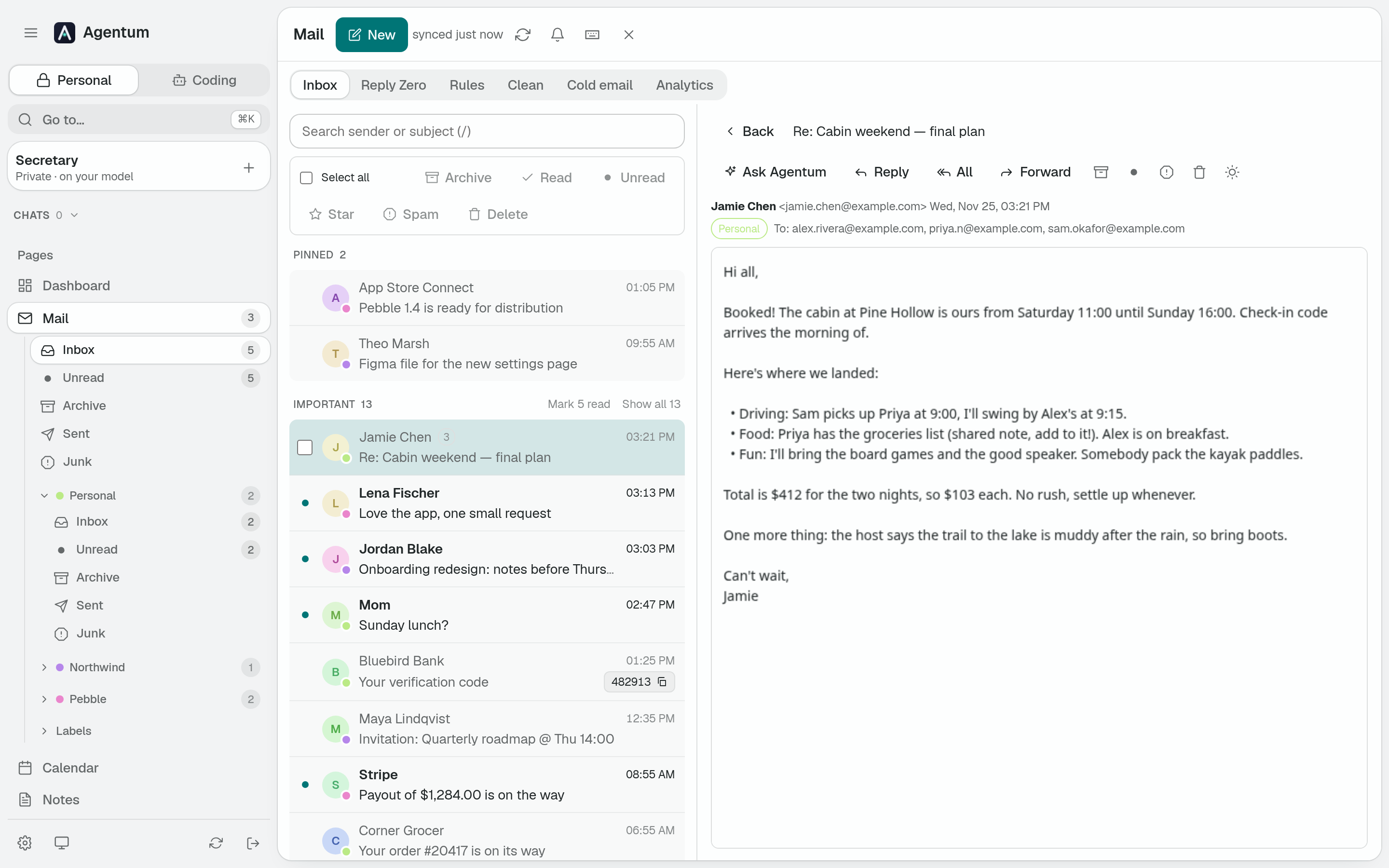
- Mail for several accounts (IMAP, Google and Microsoft sign-in): one inbox grouped into what
matters, the folders in the app's sidebar, a reading pane that follows light and dark, Reply Zero,
rules, bulk cleanup and push notifications. - Calendar over iCloud, Google and Outlook: month, week, day and list views, recurring events,
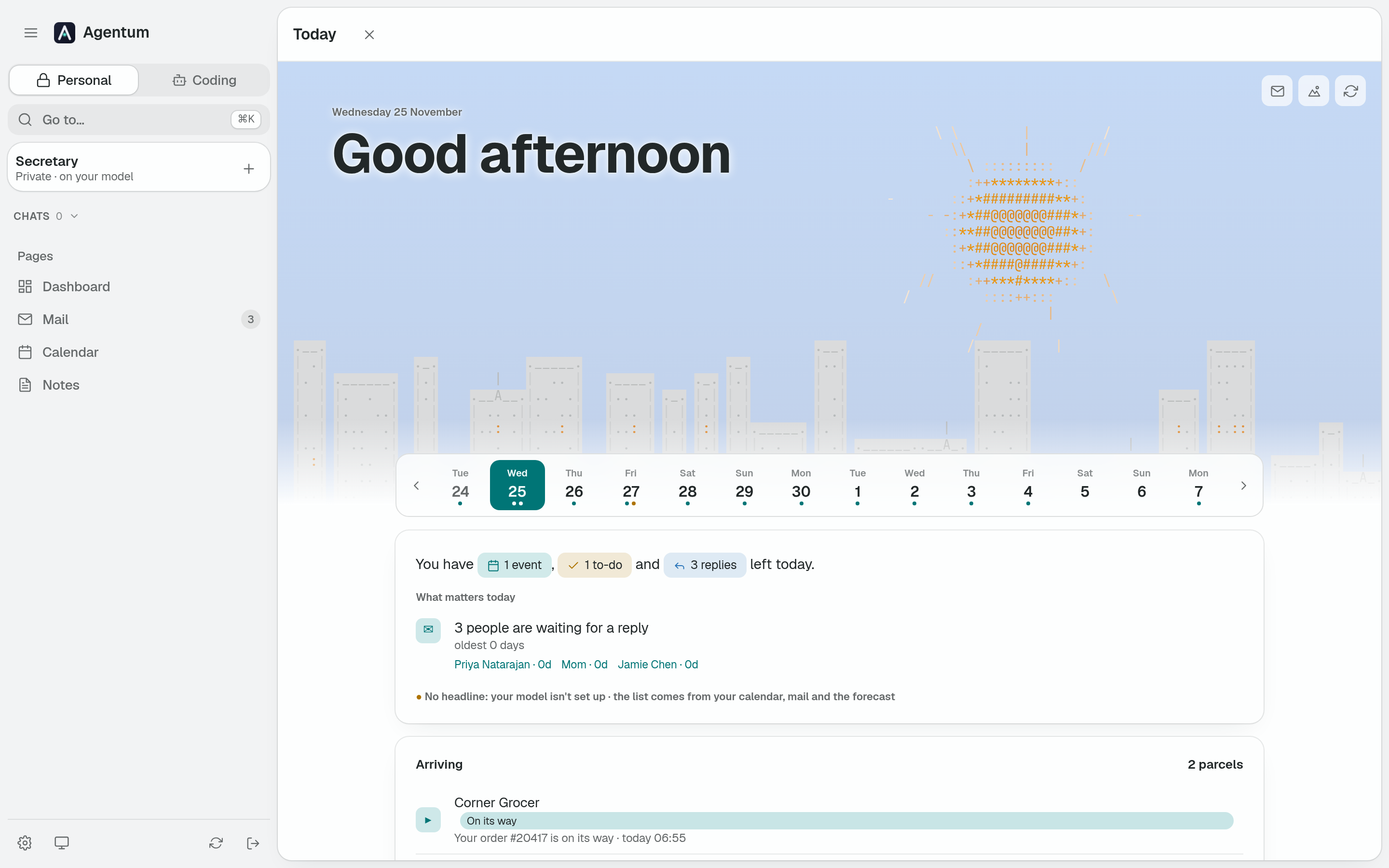
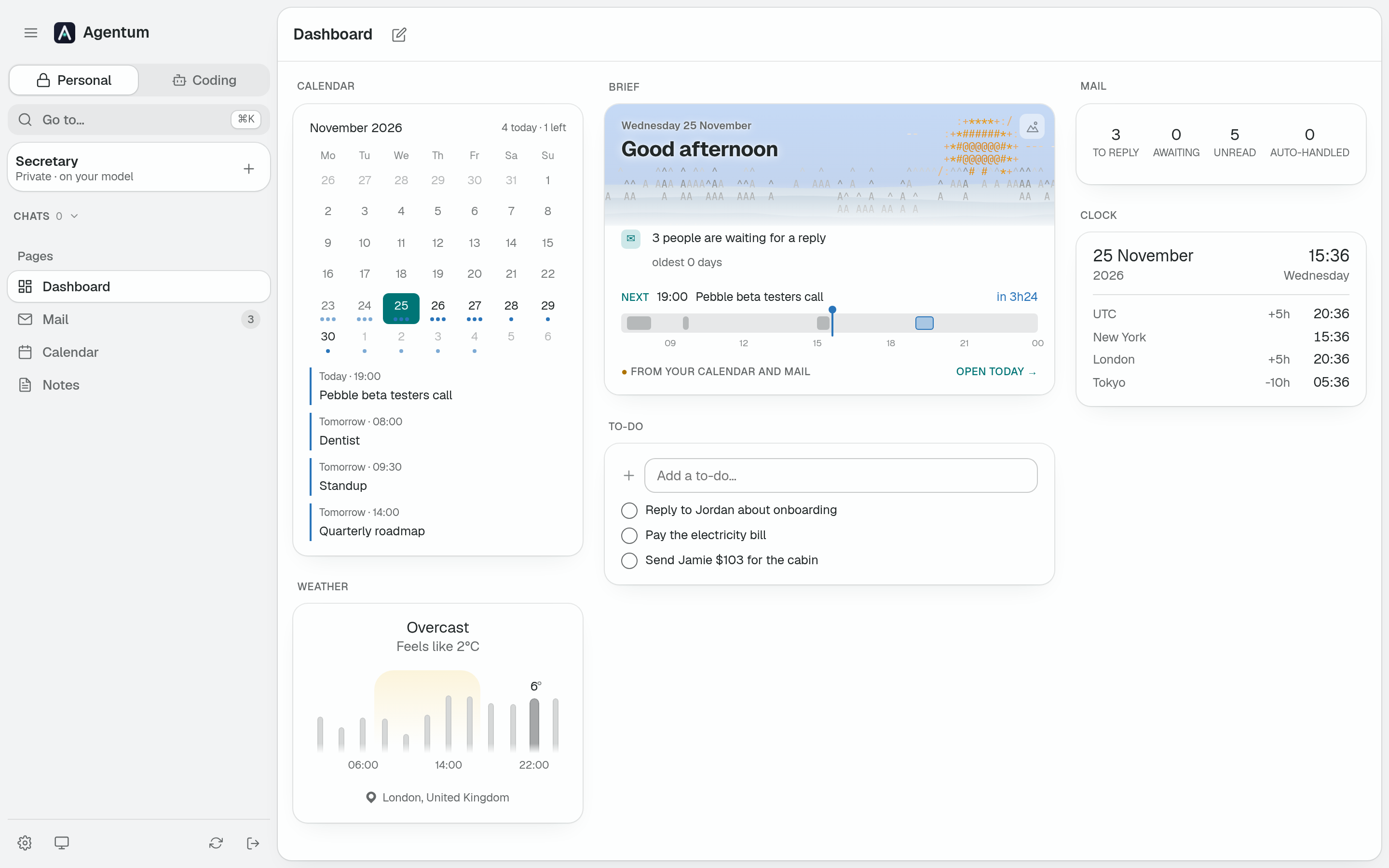
and to-dos beside the grid. - Notes and to-dos, a Today page that plans your day, and a Dashboard of widgets.
- The Secretary: a private chat on your own model (Ollama), with voice, that can look across
your mail, calendar and notes. Your private life never reaches a cloud provider.
Coding
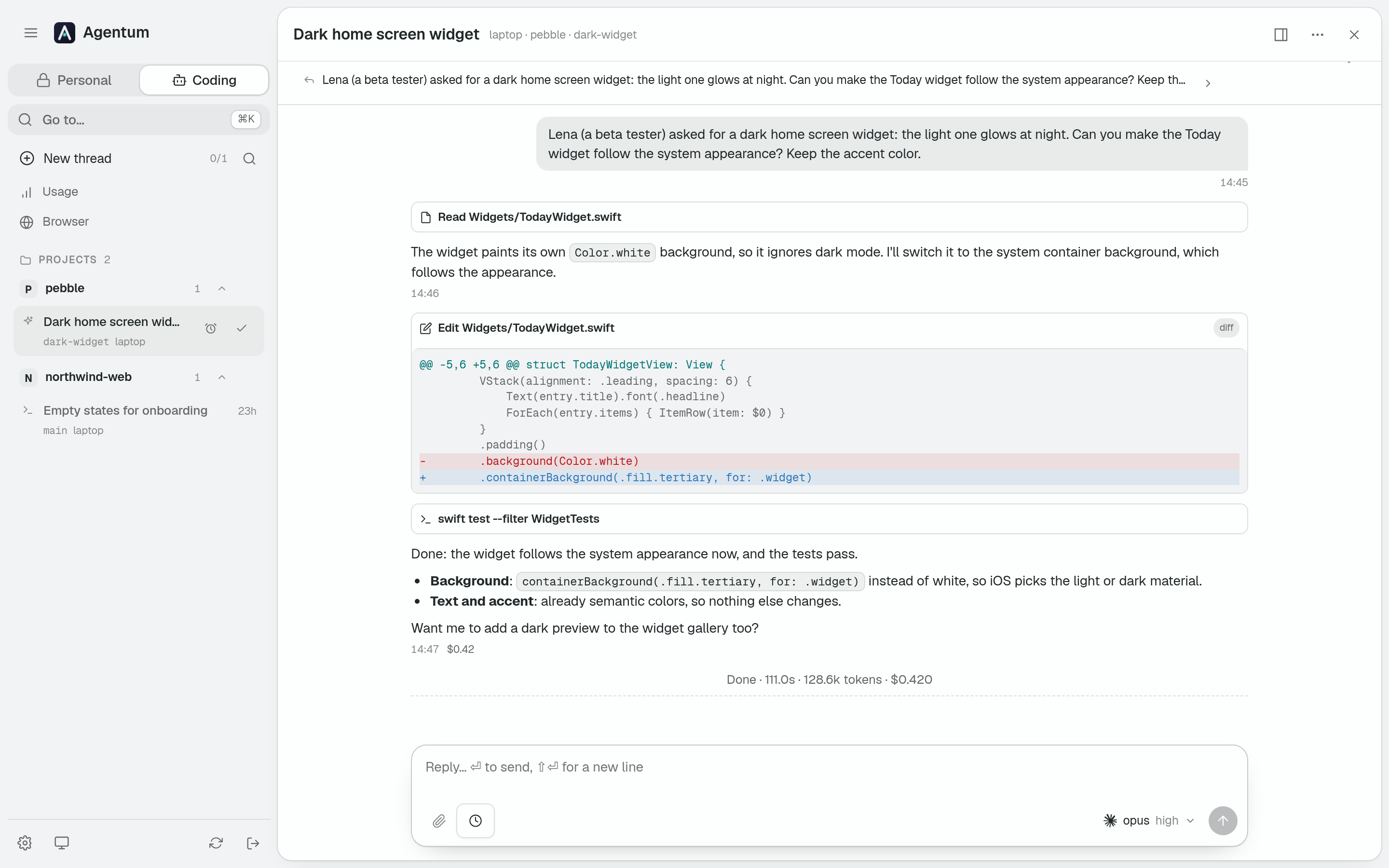
- Threads for Claude Code, Codex, OpenCode and Cursor on any machine running
agentd. Watch
them live, answer their questions and permissions, queue or steer messages, and stop a turn. - Each thread has diffs, git, pull requests, files, an editor, terminals, side chats, scheduled
messages, a per-project browser (Surf) and a Secrets tab for.envkeys. - New threads in the project checkout or a fresh worktree, a sidebar that sorts what needs you,
each agent's subscription usage, and ⌘K to search everything that was said.
All in one: any page opens in either half of the screen, so Mail can sit beside a coding
thread, with its folders in the sidebar.
Plugins: every tool around a thread is a plugin, a manifest plus a server part and a web part
mounted in slots. 23 ship in plugins/.
Screenshots
 |
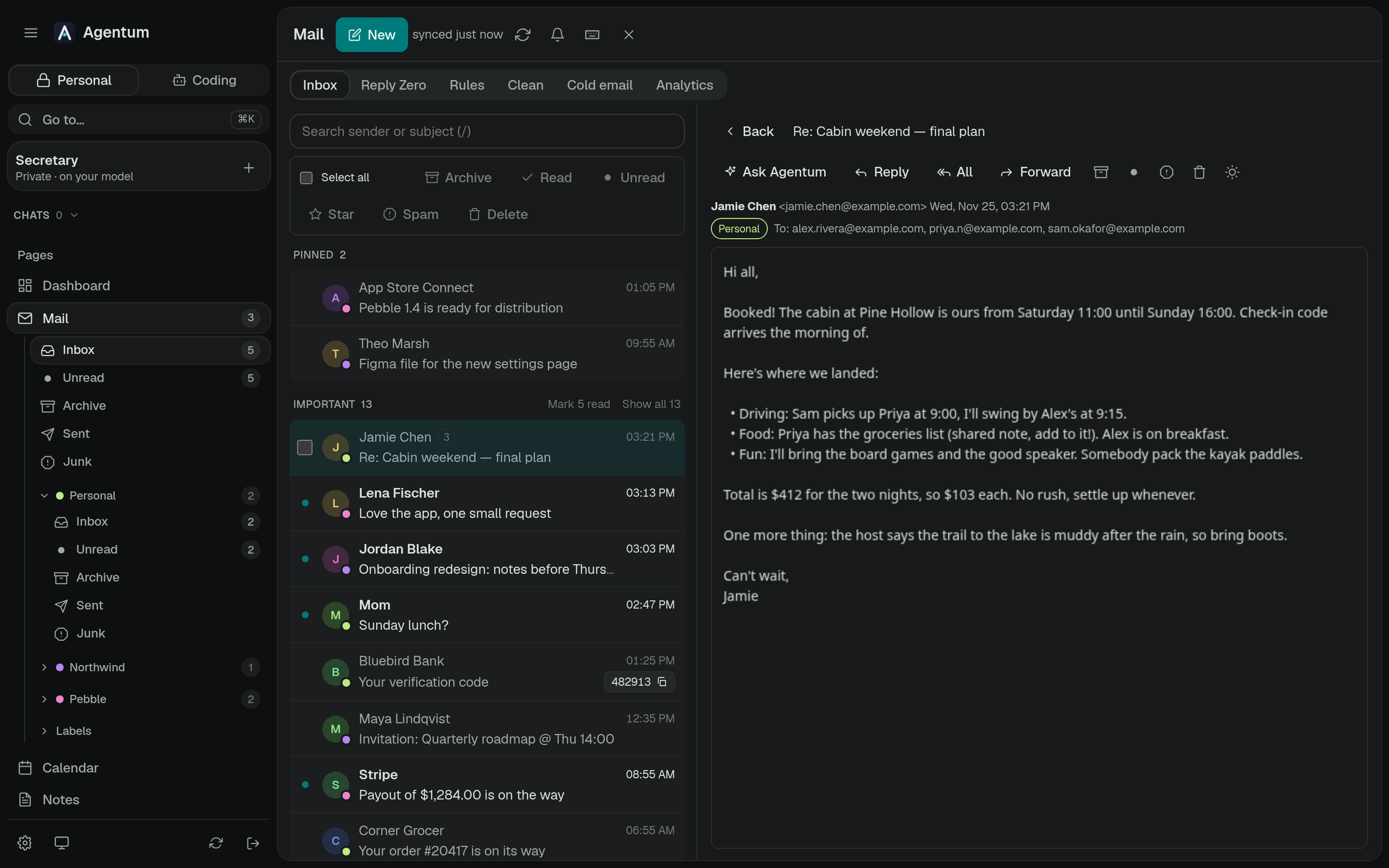 |
| Coding: a thread with its tool calls and diff | Mail, dark |
 |
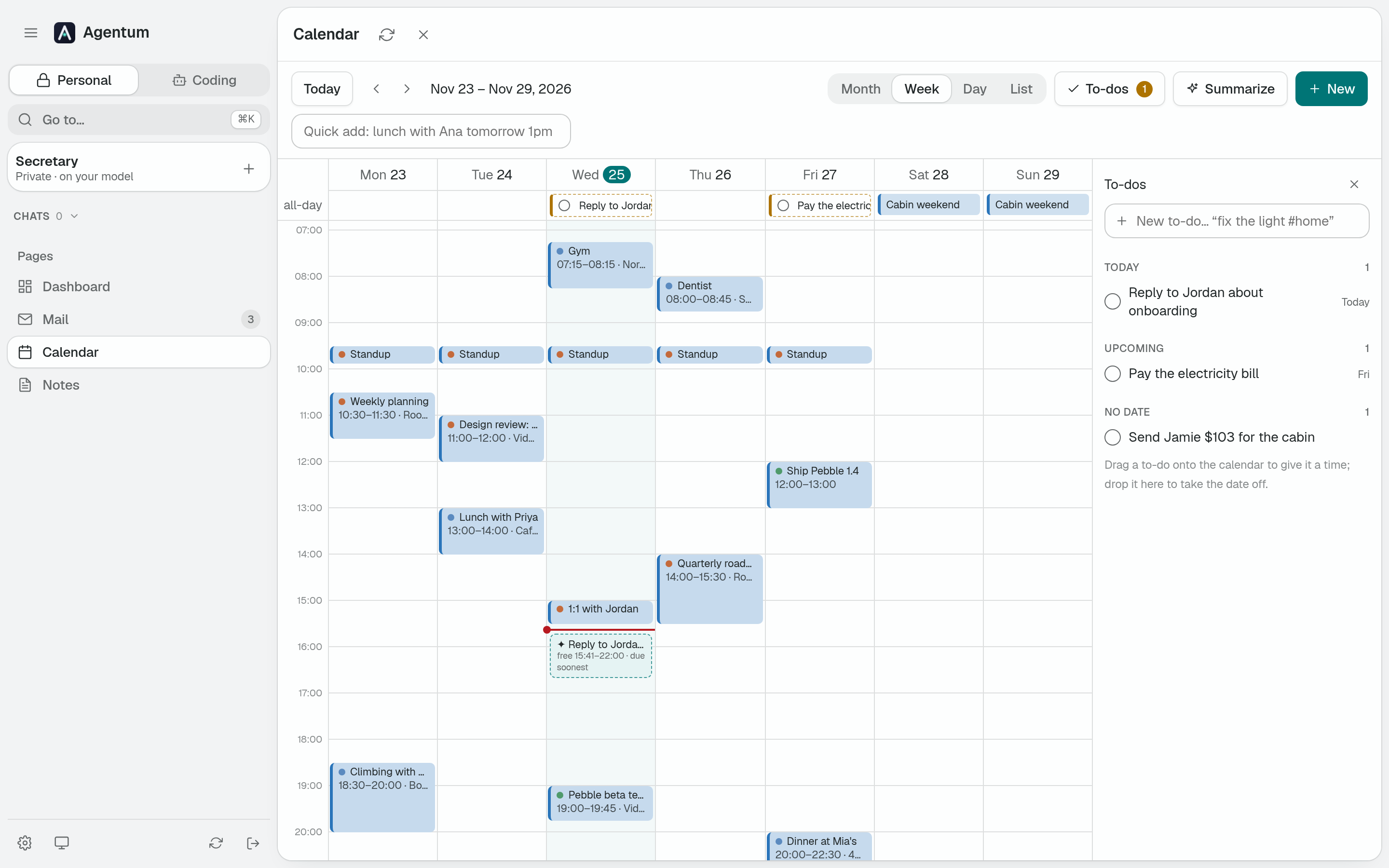 |
| Today: the day at a glance | Calendar: the week, with to-dos |
 |
|
| Dashboard |
Every screenshot uses made-up demo data; scripts/demo.sh runs the same demo.
How it works
browser ──HTTP + one WebSocket──▶ agentum   the hub: axum + SQLite; serves the web app,
                                     ▲       syncs mail and calendars, keeps every thread
                                     │ one WebSocket per machine
          agentd on each machine ────┘       runs the agents, files, git and terminals
agentum, the hub: one binary with the web app embedded. It keeps your data in SQLite.agentd, on every machine that should run agents: it connects out to the hub, so the
machines need no open ports.- The web app: Leptos in the browser (about 1.2 MB compressed), installable as a home-screen
app with push notifications.
More in docs/ARCHITECTURE.md (the crates, the protocol, the plugin API) and
docs/COMPARE-BB.md (how moving around threads compares with BB).
Try it
With the Rust toolchain, the wasm32-unknown-unknown target, wasm-bindgen-cli and wasm-opt
installed (see Build):
scripts/build-web.sh && cargo build -p agentum
scripts/demo.sh 7141      # a hub on made-up mail, calendar, notes and coding threads
It starts on a fresh temp directory, reaches no mail server, and prints the address. Sign in asdemo / demo, and stop it with kill "$(cat /tmp/agentum-demo-7141/pid)".
Build
rustup target add wasm32-unknown-unknown x86_64-unknown-linux-musl aarch64-unknown-linux-musl
cargo install wasm-bindgen-cli --version <the wasm-bindgen version in Cargo.lock>
# plus wasm-opt (binaryen), brotli, cargo-zigbuild and zig
deploy/build.sh        # dist/agentum-<arch>, dist/agentd-<arch>
Run
- The hub: install
deploy/agentum.service(or runagentumwithAGENTUM_DATAandAGENTUM_BIND) behind a TLS proxy. The two WebSocket locations the proxy needs are indeploy/nginx-locations.conf. - Each machine: Settings → Machines → Add machine shows a one-time command,
agentd install --hub wss://<hub>/agentd --token <token> --name <machine>. It installs a
systemd user service. The agents' CLIs must be installed and signed in on that machine.
Configuration
Both binaries read a dotenv file at start (KEY=value lines; export, # comments and quotes
allowed). A variable already set in the environment wins over the file.
- The hub reads
$AGENTUM_ENV_FILE, else/etc/agentum.envif it exists, else<data dir>/.env(AGENTUM_DATA, default./data). Its settings areAGENTUM_*and the olderCERQ_*. - agentd reads
$AGENTD_ENV_FILE, else~/.config/agentum/agentd.env:- These override
agentd.toml:AGENTD_HUB,AGENTD_TOKEN,AGENTD_NAME,AGENTD_CA,AGENTD_HUB_IP,AGENTD_ROOTSandAGENTD_PROJECTS. Lists are separated by:or,, andAGENTD_ROOTS=scans nothing. agentd installstill writesagentd.toml, but withAGENTD_HUBset it can be left out.- Other variables in the file (an API key,
PATH) reach the agents;AGENTD_TOKENdoesn't. - Keep the file
chmod 600.
- These override
# ~/.config/agentum/agentd.env
AGENTD_HUB=wss://hub.example.lan/agentd
AGENTD_TOKEN=agm_…
AGENTD_NAME=laptop
AGENTD_PROJECTS=~/src/app:~/src/site
Secrets
A thread's Secrets tab lists the keys in the .env of its working directory, by name only.
You add, change or delete a key through a masked field.
- Where a value goes: from the browser to the hub to agentd and into the file (written
atomically, mode 600). It never lands in a thread, a log or the hub's database. .gitignore: if git doesn't ignore.env, agentd adds it to.gitignoreand the tab says so.- Agents: they're told to ask for a key in that tab instead of asking for its value in chat.
Thanks
Agentum stands on other people's work, and borrows ideas from projects it is glad exist:
- Glance: the dashboard this started as. Its look lives on
as the Glance theme, and the Dashboard's widgets follow its lead. - Odysseus: the self-hosted AI workspace the first
version was built on. Its chat, calendar and notes shaped the Personal side, and Agentum still
accepts its sign-in sessions. - BB: how the Coding side moves around threads, the sidebar (Dockside), the
new-thread composer and plugins mounted in slots. - Steel: each project's browser (Surf).
- Speaches (Whisper and Kokoro) for voice, and
Ollama for the Secretary's local model. - Leptos, axum,
SQLite and wasm-bindgen; icons
drawn after Lucide; Geist and
JetBrains Mono; weather from
Open-Meteo.
License
Yorumlar (0)
Yorum birakmak icin giris yap.
Yorum birakSonuc bulunamadi