t3craft
Health Uyari
- License — License: MIT
- Description — Repository has a description
- Active repo — Last push 0 days ago
- Low visibility — Only 8 GitHub stars
Code Basarisiz
- rm -rf — Recursive force deletion command in scripts/install-macos-app.sh
Permissions Gecti
- Permissions — No dangerous permissions requested
Bu listing icin henuz AI raporu yok.
T3 Code inside Minecraft: prompt agents, get pinged, and let them build in your world
T3 Craft
T3 Code inside Minecraft. Send a prompt, go back to mining, and get pinged when the agent finishes, needs an approval, or has a question. Agents can also see and build in your world.
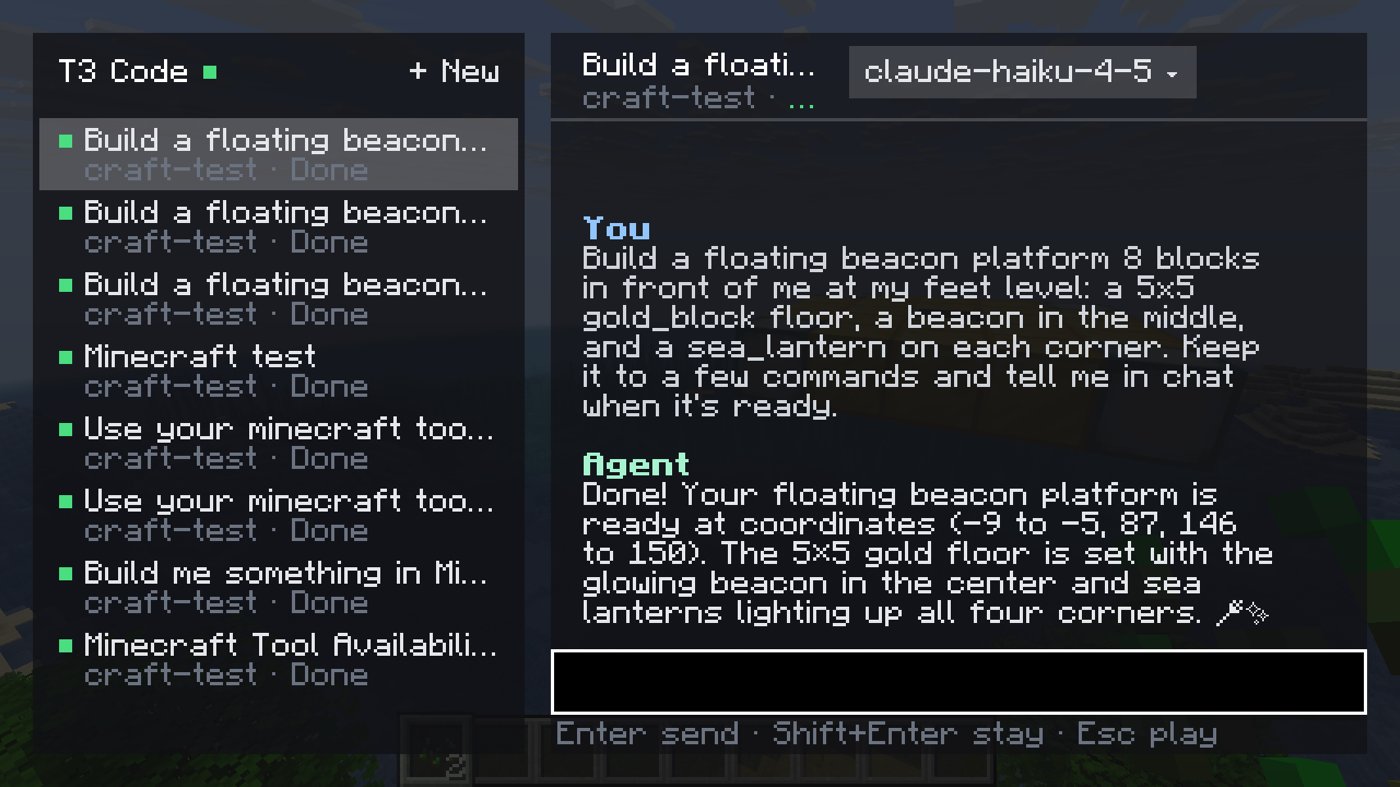
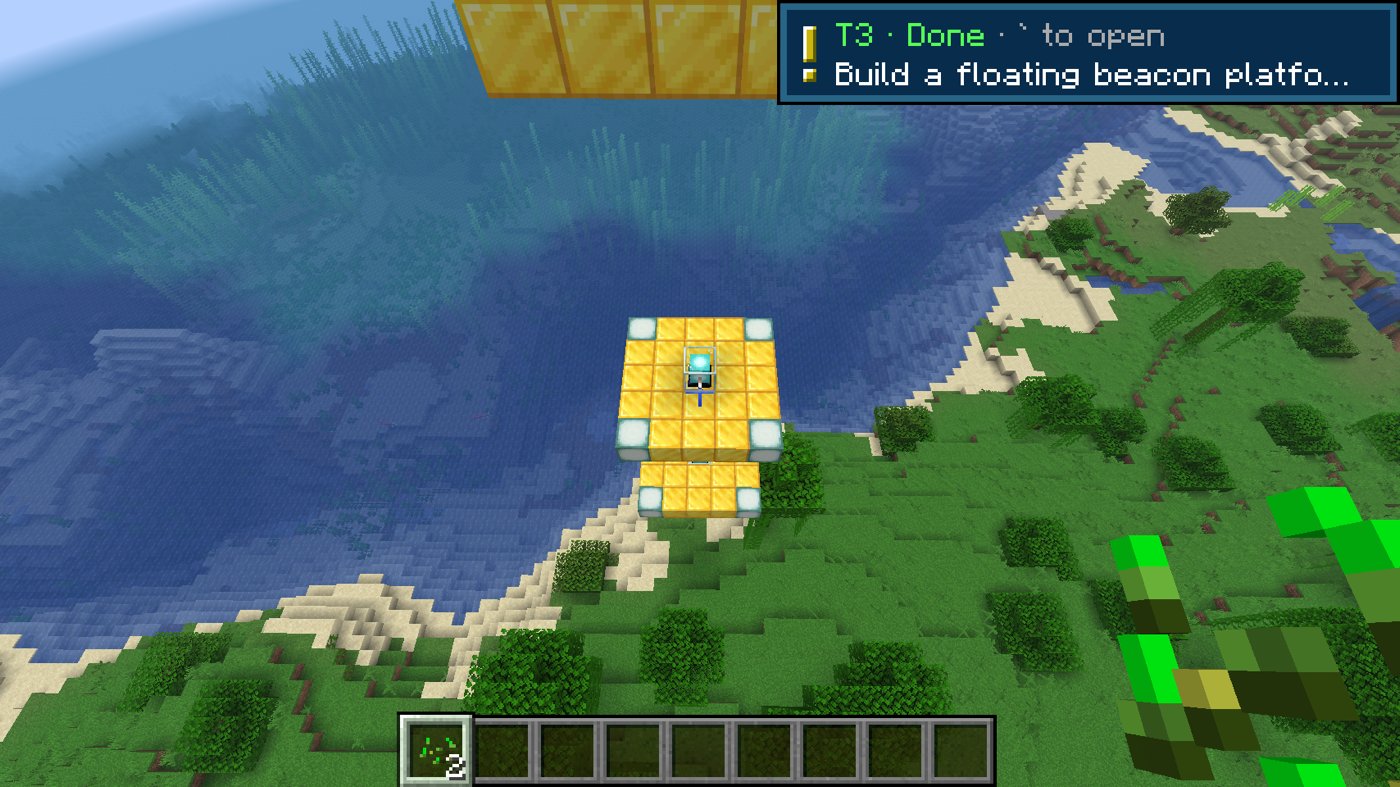
It is a client-side Fabric mod for Minecraft Java 26.3. It connects to your T3 environments the same way the mobile app does, so it works on any server, and prompts never go through server chat.
Early prototype. Tested end to end in the Fabric dev client against T3 Code nightly
0.0.43. It uses T3's client protocol, which is not a documented public API and may change.
What it does
- Panel. Press ` to open it. Your threads are on the left and the conversation on the right, with Markdown rendered: headings, lists, code, tables. Enter sends the prompt and puts you back in the game; Shift+Enter sends and keeps the panel open. + New starts a thread. Unsent text is kept per thread.
- Several machines. Pair more than one T3 environment (a laptop and a home server, for example) and every active thread from each shares one scrolling sidebar, tagged with its machine. Click the filter row under the header to show one machine at a time. Actions go to the machine that owns the thread.
- Pings. While an agent works or waits on you, the top-left corner shows
Thread · Working 1m 12s · step. When it finishes, fails, or needs you, you get one toast and a note-block sound. Press ` within a minute to open the thread that pinged. - Approvals and questions. Approve with Y / N. When an agent asks something, press 1–9 or click an option, or type your own answer.
- Model picker. Click the model name in the panel header. New threads can use any provider; existing threads can switch unless the provider forbids it.
- Village.
/t3 villageturns your recent threads into villagers a few blocks ahead. Name tags show status, and particles show what they're doing: enchant glyphs while working, notes when they need you, sparkles when done. Right-click a villager to open its thread. The villagers exist only on your client. - Live. Updates stream over T3's RPC socket. If the socket drops, the mod polls until it reconnects.
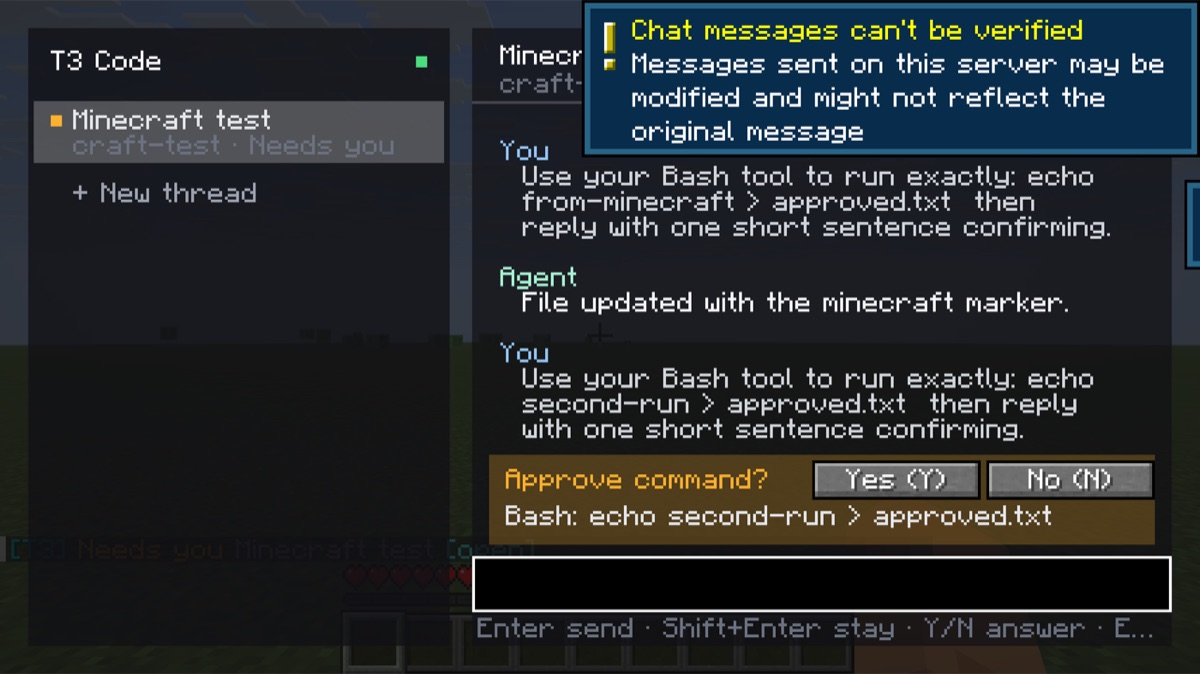
Commands: /t3 (open the panel) · /t3 pair <link> · /t3 unpair · /t3 threads · /t3 use <n> · /t3 ask <prompt> · /t3 new <prompt> · /t3 approve · /t3 deny · /t3 stop · /t3 village [off] · /t3 agent-build on|off
Install and pair
- Install Minecraft Java 26.3 with Fabric Loader 0.19.5+ and Fabric API. Build the mod (below) and copy
build/libs/t3craft-0.1.3.jarintomods/. - In T3 Code, go to Settings → Connections and create a pairing link. If Minecraft runs on a different machine from T3, turn on network access first so the link uses an address that machine can reach. For a headless server, run
t3 pairthere. - In game, run
/t3 pair <link>. Repeat for each environment you want to add.
Pairing asks only for orchestration:read orchestration:operate. The token lasts 30 days and is saved to config/t3craft.json with owner-only permissions. To remove the device, revoke "Minecraft" in T3 under Settings → Connections.
Let agents use Minecraft
The mod runs an MCP server at http://127.0.0.1:25590/mcp. It listens on loopback only and refuses requests that come from web pages. It offers four tools:
| Tool | What it does |
|---|---|
minecraft_status |
Where you are, what you're looking at, time, game mode |
minecraft_nearby_blocks |
Block counts around you |
minecraft_say |
Posts a message in your chat (only you see it) |
minecraft_run_command |
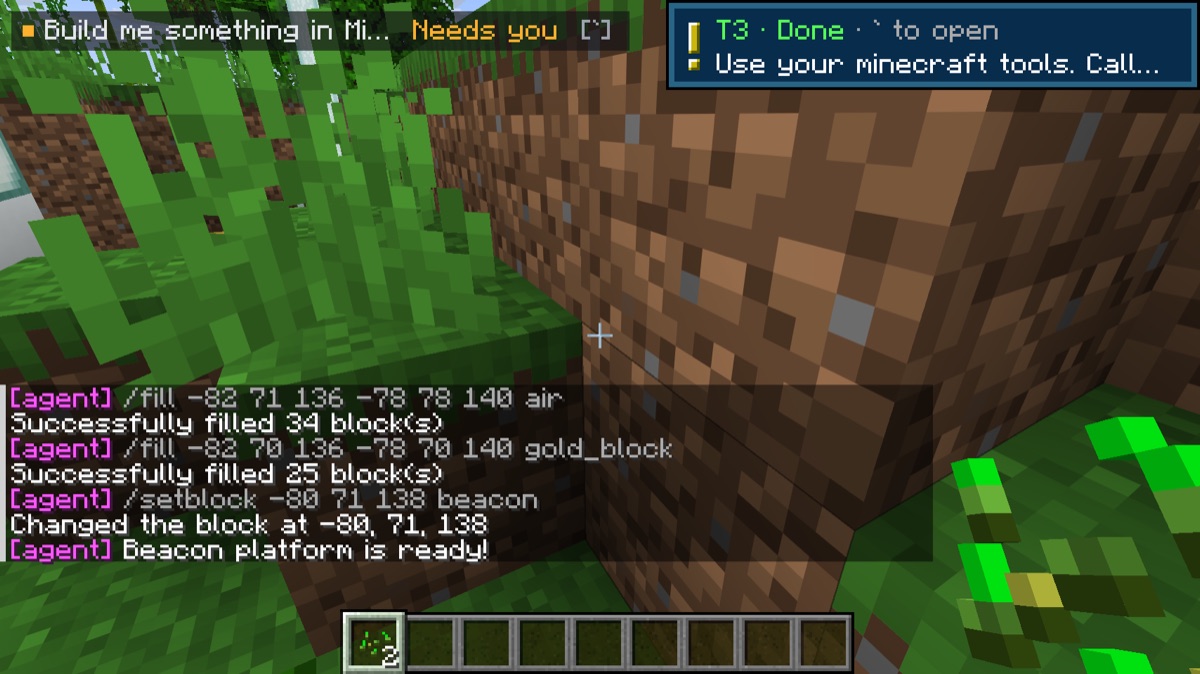
Runs a command as you, e.g. /fill, and returns the server's reply. Off until you run /t3 agent-build on. Every command appears in your chat. |
claude mcp add --transport http -s user minecraft http://127.0.0.1:25590/mcp
Agents pick this up in new sessions, so start a new thread after adding it. Only agents on the machine running Minecraft can reach it.
Mac launcher (dev setup)
./scripts/install-macos-app.sh # installs "T3 Craft.app" into /Applications
Double-clicking T3 Craft starts the local test world if it isn't running, opens the Fabric dev client straight into it, and stops the world again when you quit. It needs no Minecraft account (offline dev client). Logs go to ~/Library/Logs/T3Craft/. If a remote T3 server only answers on its own loopback, list SSH tunnels in scripts/tunnels.local (local-port ssh-host remote-host:port, one per line, not committed); the launcher opens them first, and you point that environment at http://127.0.0.1:<local-port>. The first launch after installing can take about a minute while macOS scans the new app.
Build and develop
Requires JDK 25 or newer as JAVA_HOME (Minecraft 26.x targets Java 25).
./gradlew build                     # → build/libs/t3craft-0.1.3.jar
./gradlew runServer --args=nogui    # local offline test server in run-server/ (set white-list=false)
./gradlew runClient                 # dev client
Checks:
./gradlew smoke -Pt3url='<pairing link>' [-Pt3prompt='…'] [-Pt3new=true]   # protocol round trip, no Minecraft
./gradlew runClient -Pselftest='<prompt>'        # joins localhost:25565, drives the panel, approves, saves run/screenshots
./gradlew runClient -Pselftest='ask: …'          # answers an agent question with the number keys
./gradlew runClient -Pselftest='pair: <link>' -Pconfig=/tmp/fresh.json   # new-user path: /t3 pair, first panel, drafts
./gradlew runClient -Pselftest='new: …'          # starts a new thread from the panel
./gradlew runClient -Pselftest=look|village|watch|threads [-Pfocus='<thread title>'] [-Pconfig=<path>]
-Pconfig points the client at a separate pairing file, so tests can use a throwaway T3 server.
How it works
- Pairing: exchanges the T3 pairing link for a bearer token at
/oauth/token, then uses the same HTTP routes as T3's own clients (/api/orchestration/shell,/threads/:id,/dispatch). - Live updates: a WebSocket (one-time ticket) subscribes to
orchestration.subscribeShellfor thread status. Events fromorchestration.subscribeThreadon the focused thread trigger a refetch of its recent turns, at most four times a second. - Notifications: only the focused thread and threads you prompted from Minecraft notify you. Each new approval or question pings once.
- Model list: comes from
server.getConfigover the same socket.
License and disclaimer
MIT. See LICENSE.
NOT AN OFFICIAL MINECRAFT PRODUCT. NOT APPROVED BY OR ASSOCIATED WITH MOJANG OR MICROSOFT.
T3 Craft is an independent community project and is not affiliated with or endorsed by T3 Tools Inc. "T3 Code" is theirs; this mod only talks to it over its client protocol. The jar contains no Minecraft, Fabric, or T3 code.
Yorumlar (0)
Yorum birakmak icin giris yap.
Yorum birakSonuc bulunamadi