neko-core
Health Uyari
- License — License: AGPL-3.0
- Description — Repository has a description
- Active repo — Last push 0 days ago
- Low visibility — Only 5 GitHub stars
Code Basarisiz
- spawnSync — Synchronous process spawning in bin/neko-source.cjs
- process.env — Environment variable access in bin/neko-source.cjs
- fs module — File system access in bin/neko-source.cjs
- spawnSync — Synchronous process spawning in bin/neko.ts
- process.env — Environment variable access in bin/neko.ts
Permissions Gecti
- Permissions — No dangerous permissions requested
Bu listing icin henuz AI raporu yok.
Stable local-first terminal coding agent with durable sessions, consequence-gated autonomy, any-model providers, skills, MCP, and ACP. TypeScript + Bun + Ink. By Meiiie / The Wiii Lab.
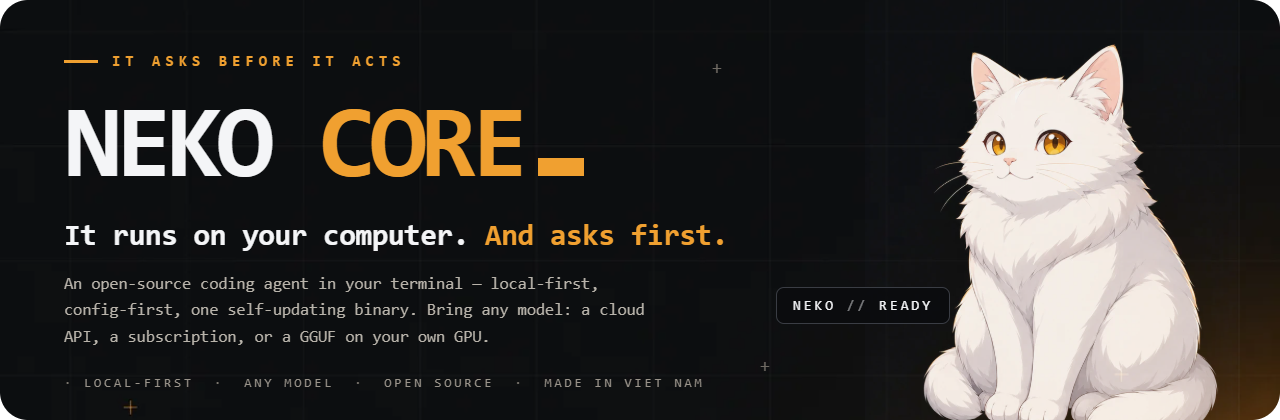
Neko Core
Một chú mèo trong terminal — chỉ muốn meo meo, và làm việc.
Neko Core is a local-first terminal agent for coding and computer work. It combines a provider-agnostic
agent loop, durable sessions, governed tools, skills, MCP, browser control, and an Ink terminal UI in one
standalone binary. The shipped CLI is written in TypeScript, compiled with Bun, and does not require Bun
on the user's machine.
By Meiiie / The Wiii Lab. Download in English or Vietnamese at
neko.holilihu.online.




Stable 1.x line. Public CLI, configuration, durable-session, SDK, ACP, authority, and rollback contracts
follow the stability and support policy. See the
current release for install and upgrade notes.
Why Neko
- A real agent harness. Streaming
complete -> tool calls -> observeloop, concurrent safe reads,
context relief, compaction, loop recovery, verification debt, and bounded closed-loop continuation. Explicit
closed loops fix an observable completion contract before implementation and use an independent validator. - Local-first and provider-agnostic. Use hosted APIs, supported subscription accounts, or an
OpenAI-compatible local server. Models and endpoints are config, not product forks. - Governed action. Read tools are safe; edits, shell, browser, Office, and host-computer actions pass
through one permission boundary. Catastrophic commands and credential targets remain hard refusals. - Durable work. Sessions checkpoint messages, tool calls, results, provider continuation data, model,
profile, and mode. Resume after an interrupt or process restart without silently replaying mutations. - Terminal-native UX. Fullscreen transcript, live Markdown, smooth scrolling, mouse selection, clickable
pickers, multiline input, image paste, completion alerts, and clean terminal restoration on exit. - Extensible everywhere. Built-in skills ship inside the binary and work from every folder;
~/.neko-core/skillsadds global overrides. MCP, recipes, memory, workflows, and ACP extend the same core. - Auditable delivery. Every release is built for five targets, smoke-tested, checksummed, and published
by GitHub Actions. Exact-version rollback is supported by both the updater and installers.
Install
One line; no Bun or Node.js required:
# macOS / Linux
curl -fsSL https://neko.holilihu.online/install.sh | sh
# Windows PowerShell
irm https://neko.holilihu.online/install.ps1 | iex
If the domain is unavailable, use the same scripts fromhttps://raw.githubusercontent.com/meiiie/neko-core/main/install.sh or install.ps1.
Direct binaries and their SHA-256 files are on the
latest release.
Start Neko:
neko
Then use /login, choose a provider and an authentication route, and use /model to select from the
catalog available to that account. neko doctor performs read-only setup diagnostics.
Provider routes
Neko keeps account subscriptions and pay-as-you-go API billing visibly separate.
| Provider | Supported route |
|---|---|
| OpenAI | ChatGPT subscription OAuth or OpenAI API key |
| Gemini API key or Code Assist Standard/Enterprise OAuth through isolated ACP | |
| Anthropic | Anthropic API key |
| xAI | Grok subscription OAuth or xAI API key |
| Kimi | Kimi Code account OAuth or Kimi Platform API key |
| DeepSeek | DeepSeek API key |
| Z.AI | GLM Coding Plan or paid General API |
| OpenRouter | API key with live tool-capable model discovery |
| OpenCode | Console account OAuth or Zen service-account API key |
| Cline | Cline Account device OAuth or Cline API key |
| Local/custom | Any configured OpenAI-compatible endpoint, including llama.cpp or Ollama |
Neko owns and refreshes its own OAuth state. It does not import another CLI's credential store, mix an
account token with API billing, or silently fall back across authentication routes. Credentials are stored
outside the transcript and removed from child-process environments.
Non-interactive examples:
neko login openai chatgpt
neko login openai api <key>
neko login google api <key>
neko login xai
neko login xai api <key>
neko login kimi
neko login deepseek <key>
neko login openrouter <key>
neko login opencode
neko login opencode zen <key>
neko login cline account
neko login cline api <key>
Everyday use
neko                         # interactive TUI
neko --yolo                  # no approval waits; hard seatbelts still apply
neko --resume                # resume the latest session in this folder
neko run "fix the failing tests"
neko run --loop "finish the migration and verify it"
neko bench contract hard --trials 3 --call-budget 24
neko bench campaign frontier --profiles zai,bai --trials 3 --call-budget 24
neko acp                     # ACP v1 server for Zed, JetBrains, and other clients
neko acp --host-profile nekocut # exclusive six-tool embedding profile for NekoCut
neko update                  # install latest and resume auto-updates
neko update <version>        # exact rollback/pin; pauses auto-updates
Inside the TUI:
Shift+Tabcyclesdefault,accept-edits,plan, andauto.Escinterrupts the active turn;Ctrl+Cclears a draft, then exits on the second press.Alt+Vpastes an image;Alt+Ccopies the full draft;Ctrl+Oexpands tool output./model,/login,/resume,/contract,/memory,/browser,/meeting,/support, and/helpexpose the
corresponding guided surfaces.
Neko plays its short Bubble completion sound after successful background work. Setcompletion_sound:false in ~/.neko-core/config.json or NEKO_COMPLETION_SOUND=0 for silence.
Permissions and sandboxing
The default auto mode is bounded autonomy: ordinary workspace work proceeds, while consequential host
boundaries remain explicit. --yolo grants those prompts for the current launch, but does not disable project
trust, credential/system path protection, catastrophic-shell refusal, or validation.
Shell and CLI work runs directly through the current host Bash by default; on Windows its child console stays
hidden. Neko never drives a terminal through Computer Use as a shell fallback. The permission gate, secret
environment scrubbing, project trust, and catastrophic-command seatbelt remain active, but direct-host Bash is
not filesystem containment. Set "sandbox": true to opt into the platform OS sandbox, which confines writes
and uses bounded network grants. If an explicitly configured sandbox is unhealthy, Neko fails closed instead
of silently widening to the host. Run neko policy to inspect the effective boundary. See
Sandbox and Architecture.
Browser, Office, meetings, and remote control
/browserconnects a capability-scoped loopback bridge to an explicitly visible Chrome tab. Signed-in
browser state remains local; relay clients never receive cookies or browser capabilities./support officeinstalls the optional checksummed Office engine. Typed operations stage, validate, and
atomically publish Word, Excel, and PowerPoint changes./meetingrecords consented local audio, keeps video out, and can install a verified local transcription
pack. Notes require timestamp evidence./relaypairs a phone through an outbound, end-to-end-encrypted session without opening a local port.
These surfaces are optional and progressively disclosed. Their contracts live under
docs/process.
ACP
neko acp exposes the same agent, tools, permissions, skills, and durable session store over ACP v1.
Clients can create, list, load, resume, and close sessions; replay and resume are deliberately distinct.
Permission requests map to Neko's named modes rather than bypassing the CLI safety boundary. See
Neko over ACP.
Embedding applications can opt into a launch-authorized host profile. The first profile,neko acp --host-profile nekocut, disables native/global tools and accepts only NekoCut's exact
MCP-over-ACP surface for that session. Ordinary ACP behavior is unchanged, and an ACP request cannot select
or widen the profile after launch.
Configuration
Configuration overlays, lowest to highest precedence:
built-ins < profile preset < ~/.neko-core/config.json < ./.neko-core/config.json < NEKO_* environment
Use neko config, neko profiles, neko doctor, and neko policy to inspect the resolved state.
Provider keys may come from their named environment variables or the gitignored user config. A new model or
endpoint belongs in a profile; it should not require changing the agent core.
Develop from source
Development requires Node.js and the stable Bun version pinned by CI:
git clone https://github.com/meiiie/neko-core
cd neko-core
bun install --frozen-lockfile
bun run typecheck
bun test
bun run build
The compiled dist/neko is the primary runtime. node bin/neko-source.cjs is the safe development launcher;
it disables project autoload before Bun starts. Do not invoke the internal TypeScript entry directly from an
untrusted folder.
The package root is also a side-effect-free Bun/TypeScript library. Hosts inject their own provider and
approval gate:
import { Agent, ToolRegistry, type ApprovalGate, type Provider } from "neko-core";

export function createAgent(provider: Provider, root: string, approve: ApprovalGate) {
  const tools = new ToolRegistry(root, "default", approve);
  return new Agent({ provider, tools });
}
Start with the documentation index, then read the
harness architecture, working rules, and
testing contract. The public compatibility commitment is in the
stability policy. Contributions are described in CONTRIBUTING.md.
Heritage and ownership
Neko Core began with the frozen HackAIthon 2026 Bảng C project atmeiiie/bang_c. That repository is historical input, not a runtime
dependency. The original Python port is retained under reference/python as a spec;
the shipping product is the TypeScript implementation.
The owner and publisher of Neko Core is Meiiie / The Wiii Lab.
License
The core and CLI are AGPL-3.0-only or available under a separate commercial agreement. Independently
implemented code under sdk/ is Apache-2.0. The Neko Core name and branding are proprietary and are not
granted by either code license. See LICENSING.md,
COMMERCIAL-LICENSE.md, and TRADEMARKS.md.
Yorumlar (0)
Yorum birakmak icin giris yap.
Yorum birakSonuc bulunamadi