memro
Health Pass
- License — License: NOASSERTION
- Description — Repository has a description
- Active repo — Last push 0 days ago
- Community trust — 15 GitHub stars
Code Warn
- fs module — File system access in .github/workflows/bench.yml
Permissions Pass
- Permissions — No dangerous permissions requested
No AI report is available for this listing yet.
Memro — the memory layer for AI context. Server, SDKs, MCP server and integrations.
Memro — Verified Memory Infrastructure for AI Agents
Give your AI agents persistent memory across sessions: agent identity, memory storage and hybrid retrieval through an API, SDKs and MCP.
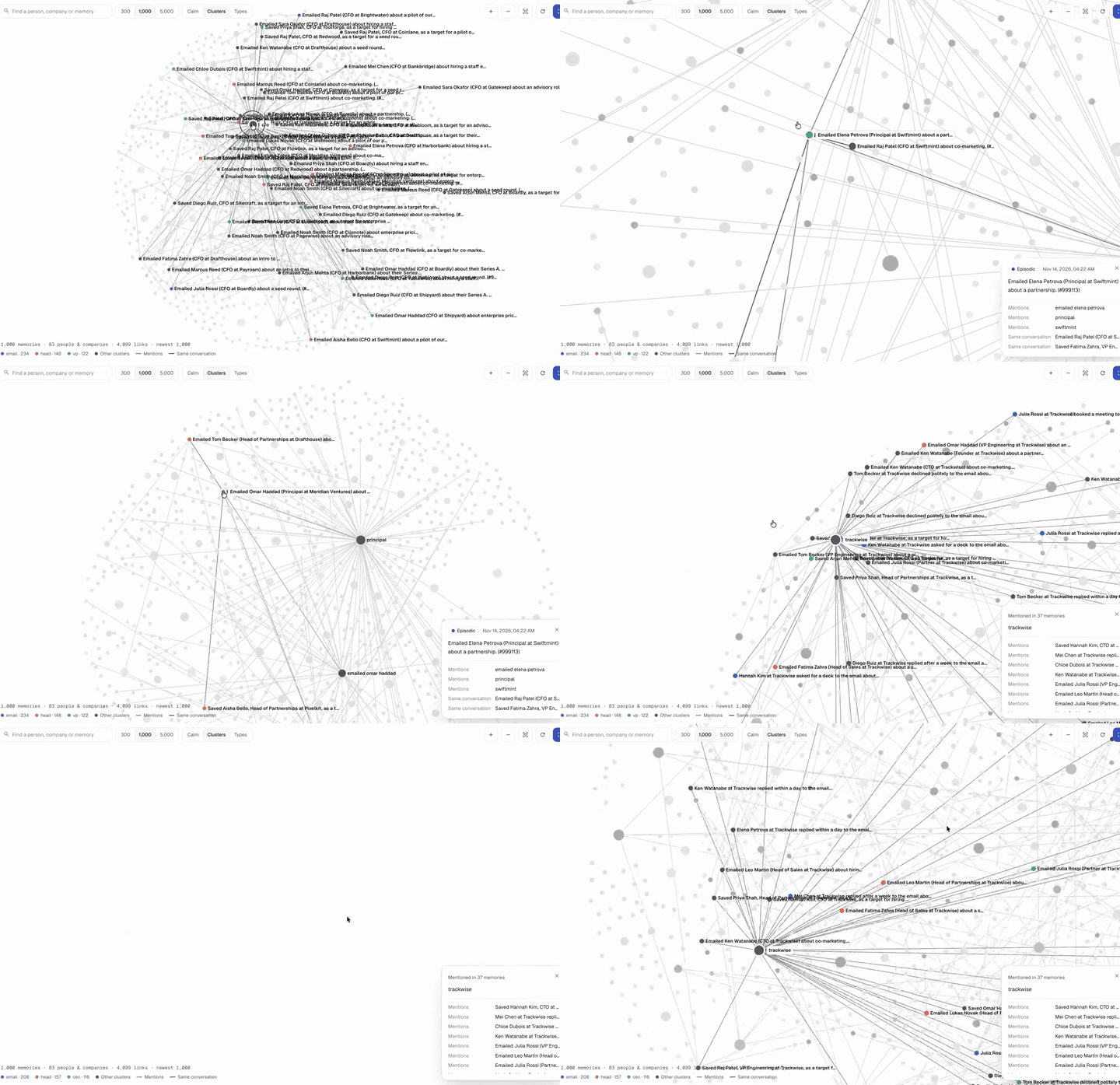
The dashboard's memory graph on an account with a million memories; it draws the newest 5,000 at most at a time. Watch the tour with sound.


License (Source Available)
Memro is licensed under the PolyForm Noncommercial License 1.0.0.
- Free for Non-Commercial Use: Personal study, experiments, hobby projects, research, and testing without commercial application.
- Commercial Use: Using Memro for commercial products or production services requires a managed subscription on Memro Cloud or an enterprise commercial license.
- How to Get a Commercial License: Visit memro.co/pricing or contact
[email protected].
Repository Notice:
github.com/memrohq/memrois the single public repository for Memro. It contains the Go server, official SDKs (Python, JavaScript/TypeScript, Go), Model Context Protocol (MCP) server, and the CLI.
Quickstart
Option A: Memro Cloud with Claude Code, Cursor, or Codex (< 10 lines)
# 1. Connect installed agent tools via device login:
npx memro-cli connect

# 2. Check connection status:
npx memro-cli status
In your assistant, say: "Remember that our primary database is PostgreSQL 16 with pgvector."
Restart your session and ask: "What database and extensions do we use?"
Option B: Self-Host with Docker Compose (Source Available)
Run the full Memro API server and PostgreSQL with pgvector on your own infrastructure:
Option 1: Clone the repository (works today)
git clone https://github.com/memrohq/memro && cd memro
cp .env.example .env              # add OPENAI_API_KEY for hybrid search; set METRICS_TOKEN
docker compose up -d              # API on :8081, dashboard on :5173, Postgres on 127.0.0.1:55432
curl http://localhost:8081/health
Option 2: Prebuilt images (no clone required, after v0.1.0 release)
curl -fsSL https://raw.githubusercontent.com/memrohq/memro/v0.1.0/docker-compose.release.yml -o docker-compose.yml && docker compose up -d
curl http://localhost:8081/health
(Note: The prebuilt image one-liner downloads docker-compose.release.yml with pinned ghcr.io/memrohq/memro:0.1.0 and ghcr.io/memrohq/memro-dashboard:0.1.0 images, available once v0.1.0 is published.)
- Backend API:
http://localhost:8081 - Dashboard:
http://localhost:5173 - Postgres Database: Port
55432on localhost (Option 1 clone) to avoid port 5432 collisions with existing local Postgres setups. - Metrics Token: Set
METRICS_TOKEN(min 32 characters) in.envto protectGET /metricsandGET /stats/cache; the server logs a warning if unset. - Verify Signatures: Verify published container images keylessly using Cosign:
cosign verify ghcr.io/memrohq/memro:0.1.0 \
  --certificate-identity-regexp 'https://github.com/memrohq/memro/' \
  --certificate-oidc-issuer https://token.actions.githubusercontent.com
For complete deployment options, production topologies, and configuration tables, see docs/self-hosting.md.
Architecture
┌──────────────────────────────────────┐
│         Clients & MCP Tools          │
│   Claude Code · Cursor · Codex · SDKs│
└──────────────────┬───────────────────┘
                   │  HTTP REST / Stdio MCP
┌──────────────────▼───────────────────┐
│            Memro API (Go)            │
│  Sovereign Ed25519 Identity · RRF    │
└──────────────────┬───────────────────┘
                   │  SQL & Embeddings
┌──────────────────▼───────────────────┐
│       PostgreSQL 16 + pgvector       │
│  pgvector Dense Search + tsvector FTS│
└──────────────────────────────────────┘
Memro runs a Go HTTP API backed by PostgreSQL and pgvector. Search queries combine vector cosine similarity and full-text keyword search using Reciprocal Rank Fusion (RRF, $k=60$). Agents authenticate using sovereign Ed25519 keypairs solved via local proof-of-work (private keys never leave the host) or standard Bearer API tokens.
Repository Layout
memrohq/memro holds all components in one mono-repository:
| Path | Description | Documentation |
|---|---|---|
server/ |
Go API server, PostgreSQL + pgvector engine | Self-Hosting Guide |
cli/ |
One-command connector (npx memro-cli connect) |
CLI Documentation |
mcp/ |
Model Context Protocol server (stdio & SSE HTTP) | MCP Guide |
sdk/python/ |
Official Python SDK (PyPI: memro) |
Python SDK Guide |
sdk/js/ |
Official JavaScript / TypeScript SDK (npm: @memro/sdk) |
JavaScript SDK Guide |
sdk/go/ |
Official Go SDK (github.com/memrohq/memro/sdk/[email protected]) |
Go SDK Guide |
examples/ |
Runnable integrations (Claude Code, Cursor, Codex) | Examples Index |
bench/ |
Reproducible benchmark harness and test suites | Benchmarks Index |
docs/ |
Architecture, concepts, API reference, decisions | Documentation Index |
Official SDKs & Runnable Examples
Python (sdk/python)
# PyPI (once published) or install from source: pip install ./sdk/python
pip install memro
from memro import Agent

agent = Agent.create()  # local sovereign Ed25519 identity
mem = agent.remember("The billing service was rewritten in Go", type="semantic")
results = agent.recall("billing service language")
print(results[0].content)
See runnable script at examples/python/register_remember_recall.py.
JavaScript / TypeScript (sdk/js)
# npm (once published) or install from local build: npm install ./sdk/js
npm install @memro/sdk
import { Agent } from '@memro/sdk';

const agent = await Agent.create(); // local sovereign Ed25519 identity
const mem = await agent.remember('The billing service was rewritten in Go', { type: 'semantic' });
const results = await agent.recall('billing service language');
console.log(results[0].content);
See runnable script at examples/typescript/index.js.
Go (sdk/go)
go get github.com/memrohq/memro/sdk/[email protected]
package main

import (
	"context"
	"fmt"
	memro "github.com/memrohq/memro/sdk/go"
)

func main() {
	ctx := context.Background()
	agent, _ := memro.CreateAgent(nil)
	mem, _ := agent.Remember(ctx, "The billing service was rewritten in Go", nil)
	results, _ := agent.Recall(ctx, "billing service language", nil)
	fmt.Println(results[0].Content)
}
See runnable script at examples/go/main.go.
Integration Guides
Step-by-step guides for connecting coding tools with full session-restart memory verification:
- Claude Code Integration (
examples/claude-code/) - Cursor Integration (
examples/cursor/) - OpenAI Codex Integration (
examples/codex/)
Advanced Memory Features
Memro includes structured primitives and cognitive graphs beyond basic vector search:
- Typed Memories: Categorize observations as
semantic(facts),episodic(events/conversations),procedural(runbooks/recipes), orprofile(agent guardrails). See Memory Concepts. - Temporal Search & Evolution: Query memories with timestamp weighting and trace how beliefs evolve over time. See API Reference.
- Conflict Analysis & Resolution: Identify contradictory facts across sessions and mark superseded memories using
resolve_conflict(). See Conflict Resolution. - Reasoning Graphs: Trace memory provenance, causal chains, and dependencies between stored observations. See Opinionated Guide.
Measurable Verification & Benchmarks
Memro publishes empirical evaluations and methodology:
- LongMemEval Benchmark: Evaluated across 500 questions testing multi-session recall and knowledge updates. See LongMemEval Report.
- Empirical Failure & Boundary Evaluations: Runnable test suite for identity boundaries, contradictory facts, stale facts, and distractor rejection. See Measurable Evaluations.
- Clean-Machine Verification: Full transcript verifying every quickstart command in a container without local caches. See Verification Transcript.
Contributing & Development
# 1. Start PostgreSQL with pgvector
docker compose up -d db

# 2. Run backend API server
cd server
DATABASE_URL=postgres://memro:memro@localhost:55432/memro go run ./cmd/memro-api

# 3. Run tests
MEMRO_TEST_DATABASE_URL=postgres://memro:memro@localhost:55432/memro go test -race ./...
Please review CONTRIBUTING.md and SECURITY.md before submitting pull requests.
Repository: github.com/memrohq/memro · Documentation: https://memro.co
License: Source available under PolyForm Noncommercial 1.0.0. Free for non-commercial use; commercial use requires Memro Cloud or a commercial license.
Reviews (0)
Sign in to leave a review.
Leave a reviewNo results found