har2sdk
Health Uyari
- License — License: MIT
- Description — Repository has a description
- Active repo — Last push 0 days ago
- Low visibility — Only 6 GitHub stars
Code Basarisiz
- network request — Outbound network request in examples/demo-shop/server.mjs
- Hardcoded secret — Potential hardcoded credential in examples/demo-shop/server.mjs
- fs module — File system access in package.json
- process.env — Environment variable access in src/cli.ts
- exec() — Shell command execution in src/har.ts
Permissions Gecti
- Permissions — No dangerous permissions requested
Bu listing icin henuz AI raporu yok.
Turn a browser HAR capture into a typed TypeScript client, an OpenAPI 3.1 spec and a mock server. Runs locally, no API key.
har2sdk
Record a web app's network traffic in your browser. Get a typed TypeScript client for its API.capture.har → client.ts + openapi.json + a mock server. Runs locally, deterministic, no API key.



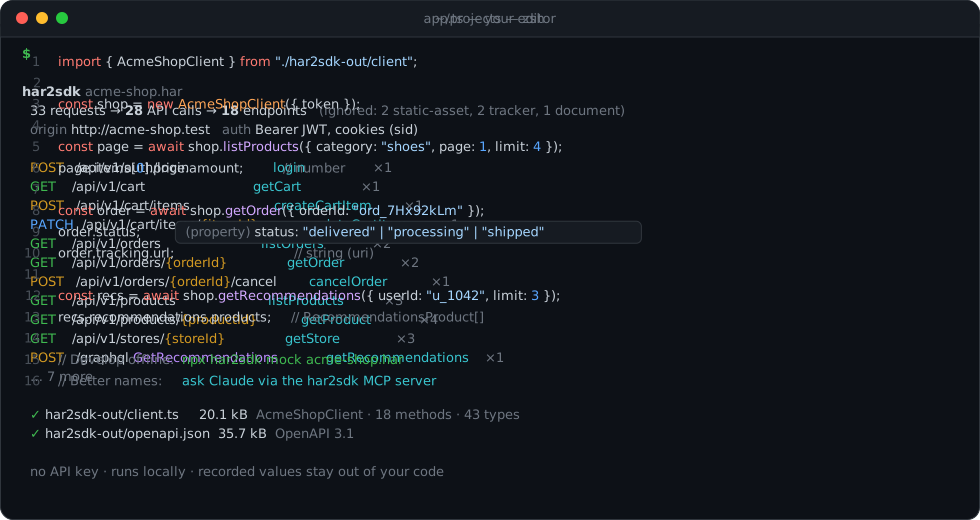
npx har2sdk capture.har
Figuring out an undocumented API in DevTools → Network takes an afternoon: which endpoints exist, what the ids look like, which fields are optional, what auth it wants. har2sdk does it in one command for JSON APIs — REST, GraphQL, JSON-RPC and tRPC — and gives you a client you can import:
import { AcmeShopClient } from "./har2sdk-out/client.js";

const shop = new AcmeShopClient({ token: process.env.TOKEN });

const page = await shop.listProducts({ category: "shoes", page: 1, limit: 4 });
page.items[0].price.amount;            // number

const orders = await shop.listOrders({ status: "delivered" });
orders.items[0].status;                // "delivered" | "processing" | "shipped" | (string & {})

const order = await shop.getOrder({ orderId: "ord_7Hx92kLm" });
order.shippingAddress.city;            // string
All of that was inferred from one recording of the demo shop — a small fake app clicked through by a real Chromium — with no spec and no config.
Quick start
- Record. Open the app, DevTools → Network, tick Preserve log, use the app, then click Export HAR (⤓) in the Network toolbar — or right-click a request → Save all as HAR.
- Generate.
npx har2sdk capture.har # → har2sdk-out/client.ts + openapi.json npx har2sdk inspect capture.har # only list what was found - Use it — or develop offline against a mock that answers like the real API, with fake data:
npx har2sdk mock capture.har # → http://localhost:4010
Needs Node 20+. Reads standard HAR 1.2: tested with Chrome-style exports and Playwright recordings by Chromium (fixtures). Firefox, Safari, mitmproxy, Charles and Proxyman write the same format but have no fixtures yet — if one trips it up, please open an issue with har2sdk inspect --json output (never the HAR itself).
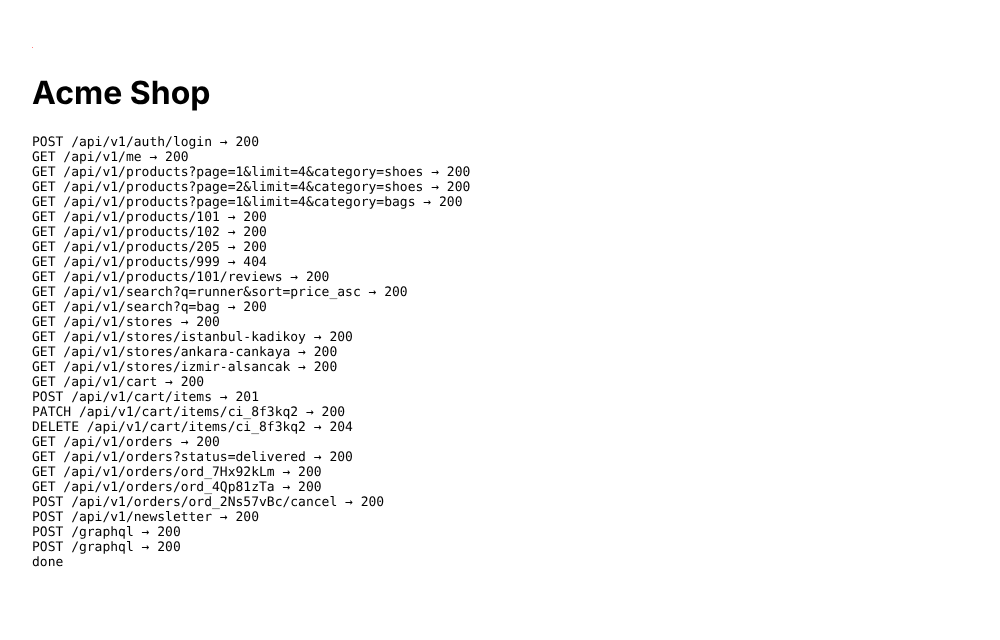 The fake demo shop in Chromium: 28 API calls (REST, GraphQL, a 404, a 204…) recorded into acme-shop.har. |
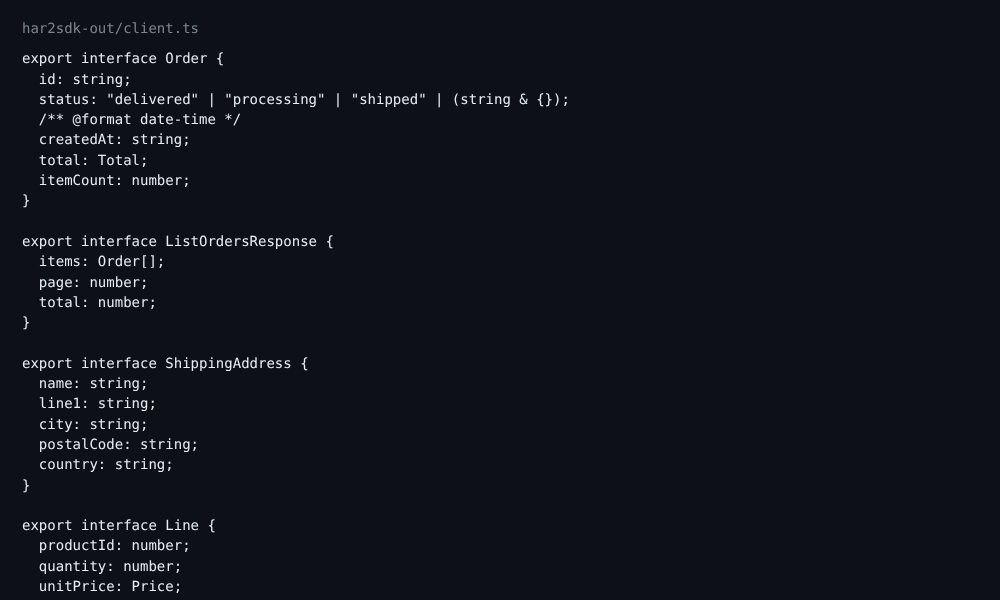 Part of the generated client.ts: named types, an open enum for status, formats. |
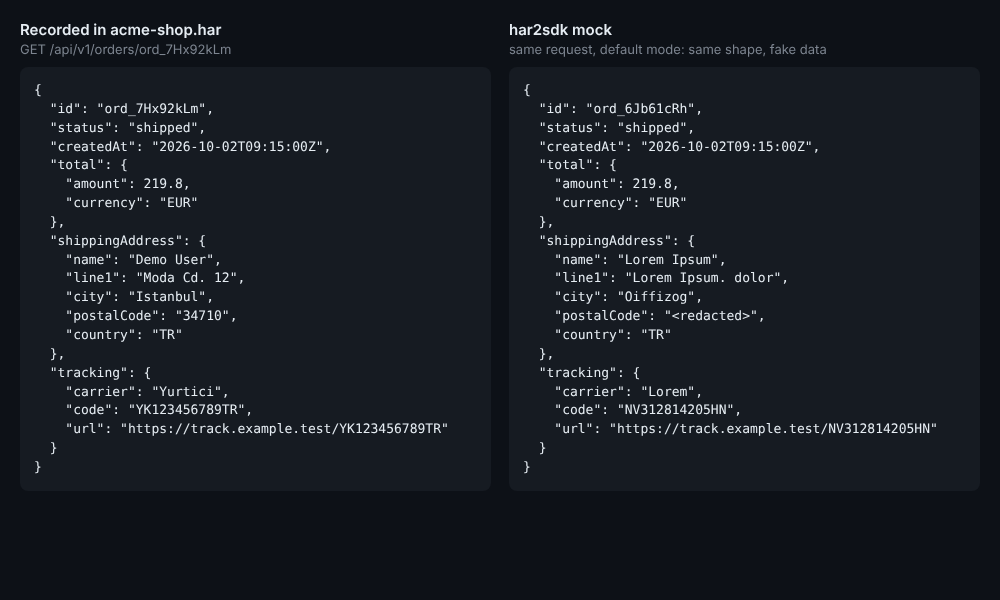 Left: what was recorded. Right: what har2sdk mock serves for the same request — same shape and vocabulary, fake ids, names and address. |
What it figures out
| Noise vs. API | Drops images, fonts, scripts, page loads, CORS preflights, failed requests, ~80 analytics/ads/consent hosts and common first-party telemetry (/g/collect, /_vercel/insights, Sentry tunnels, fire-and-forget POSTs to …/rum, …/beacon). First-party drops are listed in a warning; --include-path, --exclude-host and --exclude-path adjust it. |
| Path parameters | /users/42/orders/ord_9f8a → /users/{userId}/orders/{orderId}: numbers, UUIDs, ULIDs, prefixed ids, issue keys (PROJ-7), phone numbers, dates. Word-like segments become parameters on evidence from the capture: the response echoes the value as its own id (/users/alice → { "login": "alice" }), a list response names its items by it (/users/{u}/repos lists dotfiles → /repos/{owner}/{repo}), or it was recorded as a user or tenant name. /products/featured stays an endpoint. Also: {id}.json, file names, locales (/en-us/), tenants (/orgs/acme/), dated API versions (/api/2024-01/). Wrong guess? --param "/users/{login}". |
| Types | Merges every sample: optional vs. required, nullable, formats (date-time, uuid, email, uri), dictionaries keyed by ids or other data as Record<string, T>. Categorical fields (status, type, currency…) get open enums — "a" | "b" | (string & {}) — autocomplete without breaking on new values. Identical shapes are one type (type Total = Price). |
| Responses | Different 2xx shapes become a union; recorded error bodies get a type per status and a guard (if (isGetFileError(err)) err.body). Bodies the browser didn't record become unknown (a multipart upload FormData), with a warning — request and response bodies alike. |
| GraphQL & RPC | Every GraphQL operation (named, anonymous, batched, GET, persisted), JSON-RPC 1.0/2.0 method and tRPC procedure is its own typed method. Data-carrying inline values in recorded documents (user(id: 4815162342), login(username: "…")) become variables; small numbers and enum values stay. tRPC superjson: JSON values and the meta the app sent. |
| Auth & headers | Bearer/Token schemes, Basic, API-key headers or query params, session cookies (trackers ignored), CSRF headers. Version/platform headers (x-app-version: 3.4.1) become defaults; other custom headers are only listed by name. |
| Several captures | har2sdk a.har b.har merges them into one SDK. |
The generated client.ts has zero dependencies, uses the global fetch (Node 20+ and browsers), and compiles under strict, exactOptionalPropertyTypes and erasableSyntaxOnly. Non-2xx responses throw ApiError with the parsed body.
Auth
The capture tells har2sdk how the app authenticated, never with what. The token, cookie or key you recorded is not copied into client.ts (if it were, the leak guard would refuse to write the file). You pass your own:
new AcmeShopClient({ token: process.env.TOKEN });  // a string
new AcmeShopClient({ token: () => getToken() });   // or a function, sync or async
Which options you get depends on what the capture used:
token(sent inAuthorizationwith the scheme the app used, e.g.Bearer …orToken …, or bare if the app sent it bare;Bearerif no auth was seen),basicAuth,apiKey(in the header or query parameter the app used) andcookie. If no auth was seen, you gettoken.A token function is called before every request, so it can hand out a fresh token each time. For anything else computed per request (a CSRF header, a signature), pass
headers: async () => ({ … }).Refreshing is up to you. On a
401the client doesn't retry or refresh: it throwsApiErrorwithstatus, the parsedbodyand theoperationthat failed. One way to handle it:import { AcmeShopClient, ApiError } from "./har2sdk-out/client.js"; let token = await login(); const shop = new AcmeShopClient({ token: () => token }); async function withRefresh<T>(call: () => Promise<T>): Promise<T> { try { return await call(); } catch (err) { if (!(err instanceof ApiError) || err.status !== 401) throw err; token = await refresh(); return call(); } } const me = await withRefresh(() => shop.getMe());The mock doesn't check auth. Any token, or none, gets the same response.
Privacy
HAR files contain live session cookies, tokens and often other people's data. har2sdk:
- runs on your machine. The CLI makes no network requests.
- keeps recorded values out of the generated files. What is taken from the capture: the base URL, path segments and property names judged to be names of things, version/platform header values, vocabulary enum values (
"shipped"), and GraphQL documents with their data-carrying values lifted into variables. - has a leak guard. Before generating, it collects every recorded value that looks like data (ids, emails, phone numbers, free text, values under personal, secret or id keys in five languages) and every value the capture uses as a user or tenant name (under
login,owner,reviewer… or inx-userheaders —okilictoo, in any spelling). The generator consults that set for every path literal, enum member, property name and header default. Then every output is scanned: ifclient.tsoropenapi.jsoncontains a recorded value, nothing is written (exit status 2, masked previews;--allow-leaksoverrides). The chat prompt, MCP responses andinspect --jsonget such values replaced by<redacted>. - serves fake data from the mock (and
--examples): same shape, consistent fake ids, masked names, emails, addresses and free text — for JSON, XML, CSV and text bodies. The mock listens on127.0.0.1, rejects foreignHostheaders (DNS rebinding) and allows CORS only fromlocalhostand the recorded origins.--rawserves the recorded bodies unscrubbed.
The guard is a heuristic with evidence from the capture, not a proof: a value with no evidence anywhere (a word used once as a path segment that nothing else names) can't be recognised, and one-word names of things (a category "Books") are treated as vocabulary. Look over har2sdk inspect before publishing generated code. Details, and exactly what is and isn't collected: SECURITY.md.
It's tested with the inputs of nine review rounds (test/review*.test.ts) and a generated privacy test that builds a random person and hides them in 30 kinds of places in a random capture, then checks every output, including a real MCP session, the CLI's inspect --json and every mock response (30 seeds in CI; the long run of 1,000 seeds passes).
Treat .har files like passwords. Use it responsibly: reverse-engineering an API you don't own can break its terms of use. Good uses: your own apps, legacy internal systems, services you're allowed to integrate with. Please don't publish SDKs for other companies' services.
Better names with Claude — no API key
The engine is deterministic; naming is where a language model helps. What a model sees: endpoint paths (ids already {params}), parameter names, inferred types and GraphQL documents — checked against the leak guard's values first. Accepted names are saved to har2sdk.annotations.json, so later runs are reproducible.
MCP server (Claude Code, Claude Desktop, Cursor, any MCP client):
claude mcp add har2sdk -- npx -y har2sdk mcp
{
  "mcpServers": {
    "har2sdk": { "command": "npx", "args": ["-y", "har2sdk", "mcp"] }
  }
}
On Windows, if the server doesn't start, use "command": "cmd", "args": ["/c", "npx", "-y", "har2sdk", "mcp"].
Then ask: "Turn ~/Downloads/capture.har into an SDK with great names." Claude calls analyze_har, inspect_endpoint and generate_sdk. The server writes to har2sdk-out next to the HAR file; out_dir must stay inside the HAR's folder, the server's working directory (not / or your home folder) or the temp directory. It never writes through a symbolic link (a linked har2sdk-out or har2sdk.annotations.json is an error).
Any chat, copy & paste: npx har2sdk prompt capture.har --copy, paste the prompt, save the JSON reply as har2sdk-out/har2sdk.annotations.json, then run npx har2sdk capture.har again.
{
  "clientName": "AcmeShopClient",
  "endpoints": {
    "POST /api/v1/newsletter": {
      "name": "subscribeToNewsletter",
      "description": "Subscribe an email address to the newsletter.",
      "tag": "marketing"
    },
    "GET /api/v1/stores/{storeId}": { "params": { "storeId": "slug" } }
  },
  "types": { "Price": "Money" }
}
How it works
flowchart LR
  HAR[capture.har] --> F[Filter noise]
  F --> T[Template paths<br/>ids · echo · membership]
  T --> G[Group endpoints<br/>GraphQL · JSON-RPC · tRPC]
  G --> I[Infer & merge types]
  I --> L{Leak guard}
  L --> TS[client.ts]
  L --> OA[openapi.json]
  G --> M[mock server<br/>fake data]
  L -. paths, names, types .-> LLM[Claude via MCP<br/>or any chat]
  LLM -. names & docs .-> A[annotations.json] --> TS
CLI
har2sdk <capture.har…> [options]          Generate client.ts + openapi.json (several captures are merged)
har2sdk inspect <capture.har…> [--json]   List the endpoints that were found
har2sdk prompt <capture.har…> [--copy]    Prompt to paste into any AI chat for better names
har2sdk mock <capture.har…> [--port 4010] Replay the API locally with fake data
har2sdk mcp                               Start the MCP server

-o, --out <dir>          Output directory (default: ./har2sdk-out)
--host <host>            Only include this host (repeatable)
--exclude-host <host>    Drop this host (repeatable)
--exclude-path <glob>    Drop matching paths, e.g. "/telemetry/*" (repeatable)
--include-path <glob>    Keep matching paths even if they look like telemetry (repeatable)
--param <pattern>        Force a path parameter: "/users/*", "/users/{login}", or "users/*" anywhere (repeatable)
--base-url <url>         Base URL baked into the SDK
--name <ClientName>      Class name
--annotations <file>     Names/descriptions to apply
--examples               Embed examples in openapi.json (fake data with the recorded shape)
--allow-leaks            Write files even if the leak guard finds a recorded value in them (default: refuse)
--no-enums               Don't emit literal unions
--no-merge               Don't merge sibling paths into {params}
--bind <address>         (mock) Interface to listen on (default 127.0.0.1)
--raw                    (mock) Serve recorded bodies unscrubbed (default: fake data)
Programmatic API
import { generateFromHar, loadHarFile, analyzeExchanges, generateFromModel } from "har2sdk";

const { files, model, warnings, leaks } = generateFromHar(harText, { hosts: ["api.example.com"] });
files["client.ts"];      // string
files["openapi.json"];   // string
leaks;                   // recorded values found in the files (masked previews), normally []

// Large files: stream them.
const exchanges = await loadHarFile("capture.har");
const result = generateFromModel(analyzeExchanges(exchanges), exchanges);
How it compares
| Typed client | OpenAPI | GraphQL / RPC methods | Mock server | LLM / API key | Where it runs | |
|---|---|---|---|---|---|---|
| har2sdk | ✅ TypeScript | ✅ 3.1 | ✅ | ✅ | Not needed (optional naming) | Local |
| mitmproxy2swagger | via a generator | ✅ 3.0 | — | — | No | Local |
| har-to-openapi | via a generator | ✅ 3.0/3.1 | — | — | No | Local |
| OpenAPI DevTools | via a generator | ✅ 3.1 | — | — | No | Browser extension |
| Integuru | Python scripts | — | — | — | Yes (OpenAI) | Local + OpenAI |
| reverse-api-engineer | ✅ many languages, LLM-written | — | — | — | Yes | Local + model provider |
The OpenAPI tools pair well with a generator such as orval or hey-api; mitmproxy2swagger's explicit review step for path templates is a good idea when you want full control. Agent tools let a model read the traffic and write the client — flexible and multi-language, but they need a model and key, send the capture to it, and produce different code on each run. har2sdk is one deterministic step from recording to an importable client, with a model only for names if you want one.
Limitations
Types describe what was observed: fields that never showed up are missing, fields seen once may look required. Record more, or pass several HARs.
Heuristics can mis-template paths. Check
har2sdk inspect; fix with--paramor annotations.Not modelled yet: APIs multiplexed through a query parameter (
index.php?route=…), protobuf / gRPC-web, WebSockets, Server-Sent Events, request chains (fetch a CSRF token, then call — pass such headers withheaders: async () => ({ … })).The same method + path on two origins: the SDK has both,
openapi.jsonkeeps one (with a warning). JSON-RPC over one URL is one OpenAPI operation with a body variant per method.Large captures are read as a stream, but every request is kept in memory. Synthetic capture (API JSON, base64 images, JS bundles), Node 22, 4 vCPU,
har2sdk capture.har:capture 0.5.0 0.6.0 200 MB, 8,191 requests 11 s, 713 MB peak RSS 11 s, ~420 MB peak RSS 600 MB, 24,622 requests refused ("too large to load in one piece") 39 s, 979 MB peak RSS
Known issues: docs/KNOWN-ISSUES.md.
Development
npm install
npm test               # builds, then runs unit, review, browser-fixture, MCP and end-to-end tests
npm run demo:record    # re-record examples/demo-shop/acme-shop.har with Playwright (see examples/demo-shop)
HAR2SDK_FUZZ_SEEDS=1000 npx vitest run test/privacy-fuzz.test.ts   # the long privacy run
The suites type-check generated SDKs under --strict, run them against the mock server and stubbed fetch, validate openapi.json against the official OpenAPI 3.1 schema, and run the generated privacy test.
har2sdk is an independent open-source project and is not affiliated with Anthropic; "Claude" refers to the assistant you may use with it.
License
Yorumlar (0)
Yorum birakmak icin giris yap.
Yorum birakSonuc bulunamadi