architecture-intelligence-platform
Health Uyari
- License — License: Apache-2.0
- Description — Repository has a description
- Active repo — Last push 0 days ago
- Low visibility — Only 5 GitHub stars
Code Gecti
- Code scan — Scanned 12 files during light audit, no dangerous patterns found
Permissions Gecti
- Permissions — No dangerous permissions requested
Bu listing icin henuz AI raporu yok.
Trusted architecture context for AI agents: an evidence-backed architecture graph from OpenAPI, AsyncAPI and OpenTelemetry, served over MCP.
Architecture Intelligence Platform


Agents should reason about architecture — not reconstruct it.
AIP gives coding agents evidence-qualified architecture context.
It reconciles declared API contracts with observed runtime behavior so an agent can distinguish:
- dependencies that are declared and observed;
- dependencies seen in production but documented nowhere;
- declared relationships not observed in the selected runtime window;
- facts AIP cannot safely establish.
Every answer is snapshot-bound and traceable to evidence. The agent-facing tools are read-only.
Four real coding-agent clients were qualified end to end against v0.4.2 — see thev0.4.2 compatibility matrix. That
qualification has not been repeated since.
Run the 5-Minute Demo · Realistic Demo: Quarkus Super Heroes · MCP Tools · How It Works

LegacyPricingService was never declared. AIP observed the dependency at runtime asOBSERVED_ONLY and traces the claim back to its OpenTelemetry evidence.
⭐ Star AIP if evidence-qualified architecture context for coding agents is a problem you want
solved.
Video Walkthrough ·
Evaluation · Boundaries · Documentation ·
Research Landscape
See It in Five Minutes
Requires Docker (with Compose), curl and jq. No LLM API key — nothing on this path calls a
model:
git clone https://github.com/michaelegner/architecture-intelligence-platform.git
cd architecture-intelligence-platform
cp .env.example .env
examples/runtime-demo/mcp-demo.sh
The script starts AIP + Neo4j + an OTel Collector, imports the bundled example architecture, seeds
one timestamp-frozen batch of runtime telemetry, then drives tools/list →get_architecture_drift → get_evidence over plain HTTP/JSON-RPC — the same direct 2026-07-28
request path a compatible MCP client would take.
Asking get_architecture_drift about order-service returns two findings:
| Dependency | Qualification | What it means |
|---|---|---|
LegacyPricingService |
OBSERVED_ONLY |
A runtime dependency observed in the seeded telemetry that nothing declares |
unused-q |
NOT_OBSERVED_IN_WINDOW |
Declared in asyncapi.yaml, not seen in this window — deliberately not reported as "unused" or "dead" |
ProductService and PaymentService (via payment-q) are CONFIRMED — declared and
observed — and correctly don't appear at all: drift returns discrepancies, never matches.get_service_dependencies is the tool that lists all four. Alongside the two claims the answer
carries a limitations entry: AIP declining to name a consumer for unused-q that it cannot
evidence. Each claim's evidence_refs then resolve through get_evidence, at the samesnapshot_id, to the asyncapi.yaml that declared one and the OpenTelemetry window that observed
the other.
get_architecture_drift for order-service, exactly as the demo prints it — its jq flattenssnapshot.snapshot_id and keeps the fields that matter here, rather than showing the full envelope:
{
  "snapshot_id": "aip:snapshot:v1:685a34157b6842b00d7130b8490df63060c3d80871c2ed6f56cd9206e62342d8",
  "outcome": "PARTIAL",
  "limitations": [
    {
      "code": "UNRESOLVED_IDENTITY",
      "message": "queue:unused-q has no single evidenced consumer service; retained as the direct queue target rather than guessed.",
      "claim_ids": ["aip:claim:v1:ca0dd73ba391552edd6d2cc06cddd919a8af97f362cdb47392e78325219fd612"]
    }
  ],
  "claims": [
    {
      "dependency": "unused-q",
      "via": "unused-q",
      "qualification": "NOT_OBSERVED_IN_WINDOW",
      "evidence_refs": ["evidence:asyncapi:order-service"]
    },
    {
      "dependency": "LegacyPricingService",
      "via": "GET /pricing/{sku}",
      "qualification": "OBSERVED_ONLY",
      "evidence_refs": ["evidence:otel:demo:2026-08-26:bfae54276215"]
    }
  ]
}
Feeding those evidence_refs back into get_evidence at the same snapshot_id returns the
provenance behind each claim:
[
  {
    "id": "evidence:asyncapi:order-service",
    "evidence_type": "DECLARED",
    "source_type": "ASYNCAPI",
    "source_locator": "examples/order-service/asyncapi.yaml"
  },
  {
    "id": "evidence:otel:demo:2026-08-26:bfae54276215",
    "evidence_type": "OBSERVED",
    "source_type": "OPENTELEMETRY",
    "source_locator": "opentelemetry"
  }
]
Because every seeded span is frozen rather than clock-derived, two clean runs produce the same
qualifications and the same snapshot_id. Run examples/runtime-demo/mcp-demo.sh --down to tear it
back down. For the step-by-step version — every curl spelled out, with what each answer means —
see examples/runtime-demo/hero-demo.md.
Quarkus Super Heroes: understand the fight service before changing it
The five-minute demo uses a small synthetic landscape. This one uses a real multi-service system,
Quarkus Super Heroes, from AIP's v0.5.0
real-system qualification. The task: before changing image narration in rest-fights, what do I
need to know? One command replays the already-qualified evidence. It needs Docker and curl; no
Quarkus build, Kafka, cluster or model key:
examples/quarkus-super-heroes-demo/run.sh
The answer for rest-fights shows seven operation-level CALLS, three CONFIRMED at runtime and
four NOT_OBSERVED_IN_WINDOW, and a DEPLOYED_AS resolved through a configured mapping. It also
shows a PUBLISHES_TO Topic fights, declared by a disclosed operator-authored AsyncAPI overlay.
Its consumer stays an explicit UNRESOLVED_IDENTITY rather than a guess. The gRPC call AIP cannot
answer yet is labelled as outside the answer, not hidden.
Demo README ·
question-by-question walkthrough ·
recorded Claude Code conversation
What You Can Do With It
Find dependencies nobody wrote down. Real traffic reveals calls that exist in no spec, manifest
or diagram. AIP surfaces them as OBSERVED_ONLY, with the observation window that saw them —OrderService -> LegacyPricingService in the demo above.
Check whether the architecture you declared is the one that's running. Drift is reported per
dependency and in both directions — declared but not observed, observed but never declared — each
qualified rather than asserted.
Give a coding agent context it can cite. Three read-only MCP tools hand an agent direct
dependencies, drift and provenance bound to one graph snapshot, so it can tell a fact from a guess
— and so it can never write to the model it is reading from.
Connect AIP to Your Coding Agent
Prepare the deterministic demo without running the scripted MCP calls yourself:
examples/runtime-demo/mcp-demo.sh --serve
AIP is now available at http://localhost:8000/mcp. Configure a coding-agent client using the
examples below — configuration syntax is verified against each client's current official docs.
Qualified client/platform combinations are listed in the
v0.4.2 compatibility matrix. They were
qualified against v0.4.2 and have not been re-qualified since. Other combinations are
unverified unless listed.
Codex CLI
codex mcp add aip --url http://localhost:8000/mcp
Claude Code
claude mcp add --transport http --scope local aip http://localhost:8000/mcp
Cursor — .cursor/mcp.json:
{ "mcpServers": { "aip": { "url": "http://localhost:8000/mcp" } } }
VS Code — .vscode/mcp.json:
{ "servers": { "aip": { "type": "http", "url": "http://localhost:8000/mcp" } } }
Then ask:
Use AIP to find architecture drift for service:order-service in the demo environment between
2026-08-26T00:00:00Z and 2026-08-27T00:00:00Z. For every finding, explain its qualification and
resolve its evidence using the same snapshot. Do not infer facts AIP does not establish.
Expected AIP findings:
LegacyPricingService—OBSERVED_ONLY(observed at runtime, never declared)unused-q—NOT_OBSERVED_IN_WINDOW(declared, not seen in this window — never "unused" or "dead")

Here's Codex CLI doing exactly that, live:
These instructions target locally running clients — a hosted/cloud agent usually can't reach
your localhost. /mcp has no public-internet authentication; keep it local or on a
trusted network. AIP itself needs no LLM API key for this path; your client may still need its own.
Detailed per-client setup, verification sources, and cleanup instructions →
Why?
An agent changing a service needs to know what that service actually talks to. Today it often gets
that from two problematic sources: architecture documentation that may have drifted from reality,
and plausible inference from whatever code happened to fit in the context window. Both sound
equally confident, and neither lets the agent tell a fact from a guess.
AIP answers that question from evidence that already exists and is already maintained as part of
normal development — OpenAPI/AsyncAPI specs, a minimal manifest for the one thing they can't express
(who calls what), and, optionally, real OpenTelemetry traffic. Dependency and drift answers state
which evidence supports each claim, whether runtime observation agrees with what was declared, and
what AIP could not establish: a dependency that was never observed is reported as not observed,
never as absent, and an unresolved identity is never guessed. Evidence drill-down resolves those
evidence references at the same snapshot without creating new architecture claims.
AIP may help agents reason about architecture, but an agent must never become the source of
architectural truth. —ROADMAP.md's v0.4 principle
MCP Tools
AIP exposes the validated architecture model at /mcp — via either the direct 2026-07-28
envelope or standard negotiated MCP client initialization (see Boundaries) — as
exactly three read-only tools:
| Tool | Answers |
|---|---|
get_service_dependencies |
What does this service directly depend on, and is each dependency confirmed by runtime observation? |
get_architecture_drift |
Which of those direct dependencies disagree with what was declared — observed but undocumented, or declared but not observed in this window? |
get_evidence |
What is the actual provenance behind those claims — which spec file, manifest, or observation window? |
All three perform zero graph writes and need no LLM API key — the whole surface is deterministic —
and none of them will invent, guess, or upgrade an unresolved fact: insufficient evidence comes back
as a limitations entry, never as silence.
What each answer contains, what it is bound to, and what the surface deliberately does not do:
Boundaries below. Full reference, including the exact JSON-RPC call shape:docs/mcp.md.
Quick Start
To run the whole platform (REST API, Service Explorer, MCP endpoint) rather than just the demo:
cp .env.example .env
docker compose up
.env.example's NEO4J_PASSWORD is a fixed local-only default (change-me-local) — fine for
trying this out, never for anything reachable outside your machine.
Then open http://localhost:8000. config.yaml already points at this repo's examples/ fixture
services, so POST /api/import works immediately against them. Seedocs/development.md for running locally without Docker, the test suite, and
linting.
How AIP Works
Evidence in, qualified architecture facts out:
OpenAPI · AsyncAPI · architecture.yaml   (declared)
OpenTelemetry traces                     (observed)
        -> canonical model -> evidence-backed graph -> qualified claims -> MCP tools / REST / UI
Hand-maintained architecture documentation drifts because nothing forces it to agree with the
system. AIP never stores an architecture fact without the evidence that produced it, so declared and
observed signals stay distinguishable instead of collapsing into one undifferentiated "truth".
Declared vs observed
Every relation in the graph carries evidence, and its evidence can be DECLARED (from a spec/
manifest), OBSERVED (from real telemetry), or both. That's what turns into a status:
| Status | Meaning |
|---|---|
CONFIRMED |
Declared and observed |
OBSERVED_ONLY |
Observed, but never declared anywhere — an undocumented real dependency |
NOT_OBSERVED_IN_WINDOW |
Declared, but not seen in this window — never "obsolete"/"unused"/"dead", just not observed yet or here |
Removing a stale declaration never deletes a relation that still has observed evidence — it degradesCONFIRMED to OBSERVED_ONLY instead. See docs/graph-model.md for the
exact invariant this guarantees and why it matters. The dependency and drift MCP tools above return
exactly these qualifications; nothing is upgraded or smoothed over on the way out.
Ingestion
A modular Python monolith (a single FastAPI process); Neo4j is the only external persistent
dependency. Ingestion is a strictly staged pipeline — scan -> parse -> source-validate -> map to canonical model -> canonical-validate -> reconcile/diff -> transactional graph write — where a
service's import either fully succeeds or is entirely discarded, never left partial. Source adapters
never write to Neo4j directly; they all map into one shared Canonical Model first. Full details,
including the graph/evidence model and every API route: docs/architecture.md.
Deterministic analyses
Five fixed, parameterized Cypher analyses over declared architecture (queue senders/consumers,
orphan queues, mixed-architecture blast radius) plus five over declared-vs-observed runtime data
(what was actually observed, what's confirmed, what's observed-only, what's declared-only, and
per-service telemetry coverage). None of these involve the LLM — seedocs/analyses.md for the full list and what each one answers.
Core Capabilities
- Evidence-qualified service dependencies and architecture drift, via three read-only MCP tools
- OpenAPI, AsyncAPI and OpenTelemetry evidence, reconciled into one graph
- Queue and source-independent Pub/Sub semantics. Topic fan-out is expressed only through
explicitly declared Subscriptions, and a Kafka consumer group is never treated as a Subscription. - Snapshot-bound provenance — every claim traces back to the spec file, manifest, or observation
window that produced it - Deterministic declared-vs-observed reconciliation, with cross-batch OTel correlation
- Conservative handling of missing evidence and unresolved identity — never guessed, never silently
dropped - Neo4j-backed architecture model with an optional Service Explorer UI
See the architecture and capability documentation → ·
Correlation modes →
Example
The bundled examples/ fixture is a small, fully synthetic four-service landscape:
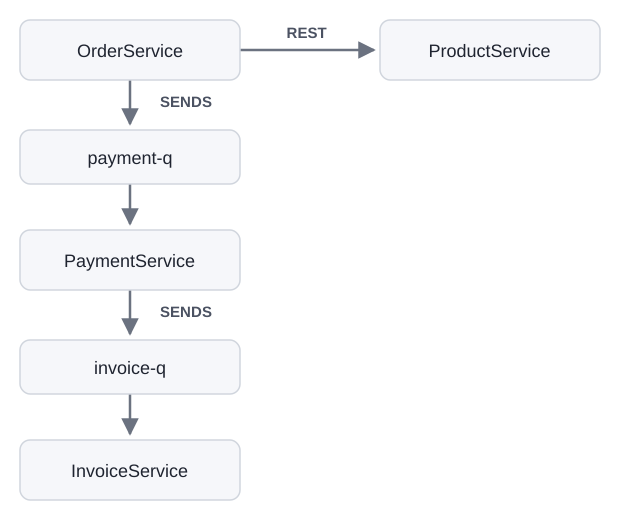
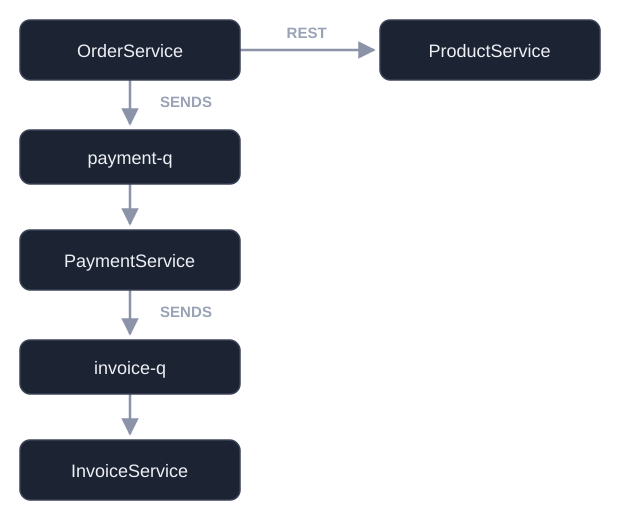
unused-q (a sender with no consumer) and unknown-producer-q (a consumer with no known sender) are
included specifically to exercise the orphan-queue analyses. POST /api/import loads all of it in
one call.
Evaluation
AIP is evaluated against independently authored ground truth — never against expectations
generated from AIP's own output — with deterministic PASS/FAIL:
- 10 deterministic scenarios over declared/observed relation facts
- 23
ArchitectureAnswerscenarios across all three MCP tools - Two clean
ArchitectureAnswerruns are semantically identical; the hero demo'sstructuredContentis byte-identical across repeated clean runs - Real-system validation against Quarkus Super Heroes and Apache Airflow
uv run python -m evaluation run       # ten relation-fact scenarios
uv run python -m evaluation answers   # 23 ArchitectureAnswer scenarios
No LLM provider key is required — neither suite touches the natural-language query layer. Seeevaluation/README.md for the full scenario lists, ground-truth formats,
and failure-report examples.
Tested against real systems
AIP's model was also challenged against two systems it wasn't designed for: Quarkus Super Heroes
and Apache Airflow. The important result wasn't that AIP "discovered everything" — it was that
unsupported and unresolved cases stayed explicit instead of being converted into plausible
architecture facts. Seedocs/real-world-validation/README.md for the
ground-truth independence rule, dossier structure, and per-system findings. To explore the Quarkus
system yourself, run the Quarkus Super Heroes demo.
answers compares the complete ArchitectureAnswer — claims, evidence references, snapshot and
observation-context identity, limitations — against literal frozen expectations across all three
tools (get_service_dependencies, get_architecture_drift, get_evidence) and emits a
machine-readable JSON result toevaluation/architecture_answers/results/architecture-answers-evaluation-result.json. The original
I1-only artifact, evaluation/architecture_answers/results/i1-evaluation-result.json, is kept as
the immutable historical record docs/specifications/0.4.0/i1-completion-record.md cites by
SHA-256 — it is no longer written by answers, only the generalized file is.
Runtime Evidence with OpenTelemetry
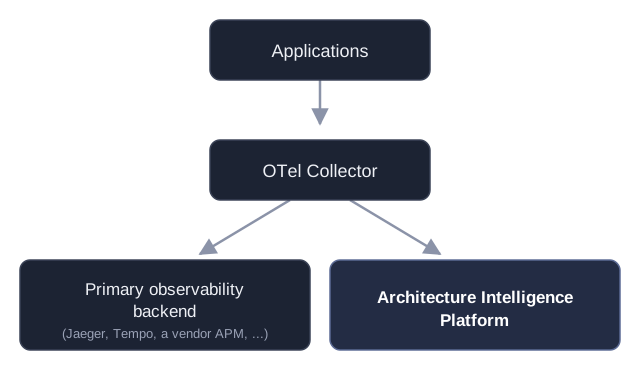
AIP consumes OTLP traces as an additional telemetry consumer, not a replacement for your
observability backend. It must never be the only thing an OTel Collector forwards to, and its own
availability must never affect an application's normal observability:
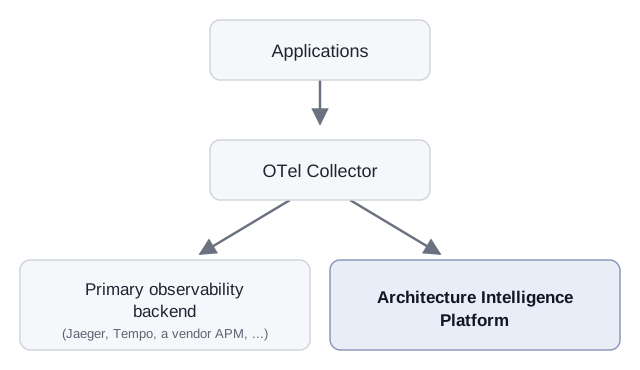
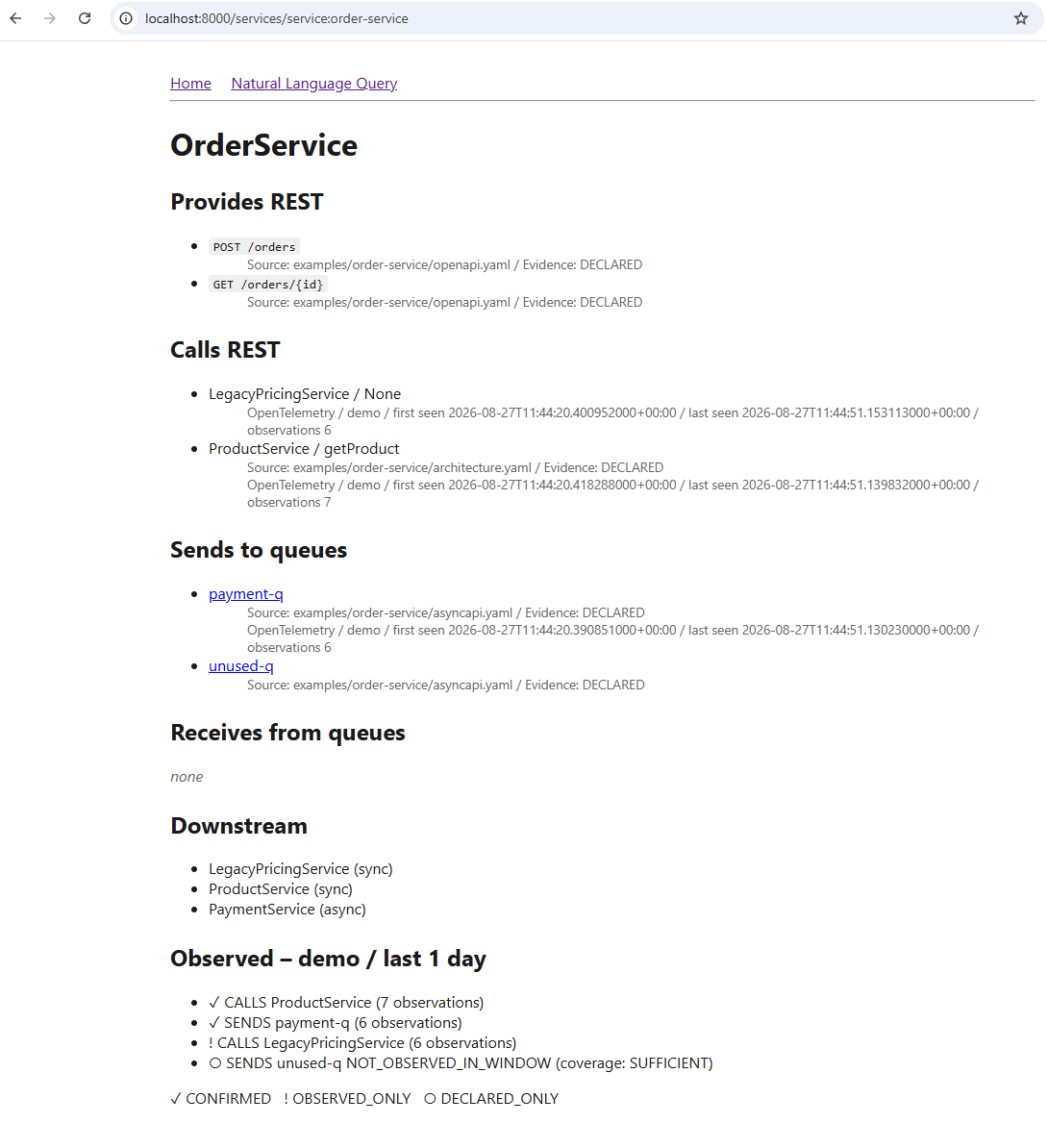
The bundled runtime demo generates continuous synthetic traffic and shows CONFIRMED,OBSERVED_ONLY and NOT_OBSERVED_IN_WINDOW relationships fill in live, in both the API and the
Service Explorer:
OpenTelemetry integration → ·
Runtime demo walkthrough →
Optional human query interface
POST /api/query also answers plain-language questions for interactive exploration — routed to an
existing deterministic analysis where possible, or otherwise answered with LLM-generated Cypher
that must pass a strict read-only allowlist validator before it ever touches Neo4j. The LLM never
holds write credentials and its Cypher is always shown back for traceability. Entirely optional —
the platform works with no LLM provider configured, and no MCP tool depends on it. Seedocs/semantic-validation.md.
Boundaries
What the three MCP tools return, and what they deliberately don't.
One envelope. Every tool returns the same ArchitectureAnswer (schema_version, producer,tool, outcome, snapshot, observation_context, data, claims, evidence_refs,limitations), validated against a closed, published JSON Schema. Dependency and drift answers
populate claims/evidence_refs, while get_evidence resolves evidence records into data and
intentionally leaves those top-level arrays empty.
Current state, not history. Every answer is bound to one stable graph snapshot identity — a
fingerprint of the current graph state, so two related answers can be proven to refer to the same
identified graph state. There is no historical or point-in-time query surface, and a snapshot_id
that is no longer the current one is refused with a SNAPSHOT_NOT_AVAILABLE limitation rather than
answered from stale data.
Explicit observation context. The runtime-sensitive dependency and drift tools carry an
environment and time window on every answer, while get_evidence is intentionally
observation-context-free and requires an explicit snapshot_id.
Direct dependencies only. One hop — no transitive traversal, and no generic Cypher or graph
query surface behind the tools.
Declared Pub/Sub only. Topics and Subscriptions come only from declared AsyncAPI (or configured
mappings). Runtime telemetry can confirm them but never invents them, and AIP has no live broker
discovery for Kafka, Azure Service Bus, Google Pub/Sub or RabbitMQ (seedocs/ingestion.md).
One path, two connection modes. /mcp speaks the strict 2026-07-28 per-request envelope as
before, and also accepts standard negotiated MCP client initialization on that same path — both
expose identical architecture semantics (see docs/mcp.md), and a request that is
neither a valid direct call nor valid negotiated traffic is rejected rather than silently downgraded
to whichever path is more permissive.
Local or trusted network. As with the rest of AIP, /mcp is built for a local or
trusted-network posture; it is not hardened for direct public-internet exposure — seedocs/security-model.md.
Documentation
docs/mcp.md— the three read-only MCP tools for AI agents, and a runnable
hero-demo walkthroughdocs/architecture.md— pipeline, API surfacedocs/canonical-model.md— entities and deterministic idsdocs/graph-model.md— relations, fact/evidence invariants, observedPROVIDESdocs/evidence.md— provenance, theEvidencenode, correlation modesdocs/ingestion.md— the three declared source adaptersdocs/analyses.md— A1-A5 and O1-O5docs/semantic-validation.md— the NL query pipelinedocs/opentelemetry.md— runtime observation, attribute allowlist, coverageevaluation/README.md— the deterministic evaluation suite: scenarios,
ground-truth format, running it, and reading a failure reportreal_world_validation/README.mdanddocs/real-world-validation/README.md— the v0.3
real-world validation contract: finding vocabulary,expected.yamlshape, dossier structuredocs/configuration.md— every setting and its defaultdocs/security-model.md— trust boundariesdocs/development.md— local dev, tests, lintingdocs/adapter-development.md— extending AIP with a new sourcedocs/architecture-review-0.4.0.md— post-v0.4.0
architecture review: what held up, four structural findings, measured read costdocs/product-doctrine-and-strategic-direction.md
— product doctrine, semantic boundaries, strategic direction, and roadmap rationaledocs/adr/— Architecture Decision Records: why Neo4j, why a Canonical Model, why
the LLM is read-only and never a source of truth, and moredocs/specifications/— the original design specifications, as a
traceable history of how the platform got heredocs/landscape.md— research landscape: formal foundations, adjacent
platforms, agent context, architectural intent, governance, and verificationROADMAP.md/CHANGELOG.md— where this is headed, and what's
shipped so far
Contributing
See CONTRIBUTING.md for development setup, test/lint/format commands, and the
adapter contribution guide. Questions and ideas go in Discussions; bugs and
feature requests use the issue templates. Security vulnerabilities should never be reported as
public issues — see SECURITY.md. This project follows the
Contributor Covenant.
Project Status
Latest release:v0.5.1
— Realistic Architecture Demo.
Pre-1.0: the REST/MCP surface, Graph Schema, Canonical Model, Adapter SPI and configuration format
may still change on a minor version bump. Every release ships a published-artifact verification —docs/release-validation/v0.5.1-release-record.md
is the most recent. See CHANGELOG.md for what shipped in each release andROADMAP.md for what's next — v0.6 (Locality-Aware Current State).
License
Licensed under the Apache License, Version 2.0.
See LICENSE. Third-party dependency licenses: THIRD_PARTY_LICENSES.md.
Yorumlar (0)
Yorum birakmak icin giris yap.
Yorum birakSonuc bulunamadi