bodhiorchard
Health Gecti
- License — License: Apache-2.0
- Description — Repository has a description
- Active repo — Last push 0 days ago
- Community trust — 17 GitHub stars
Code Gecti
- Code scan — Scanned 12 files during light audit, no dangerous patterns found
Permissions Gecti
- Permissions — No dangerous permissions requested
Bu listing icin henuz AI raporu yok.
Bodhiorchard is the open-source, self-hosted alternative to Jira and Linear for AI-native software teams. Specialised agents draft every spec, forecast cycle times, and reason over your real repositories, commits, and pull requests — replacing story points, standups, and stale tickets so engineers can focus on building.
Bodhiorchard™
From conversation to production, with twelve AI agents.
The open-source alternative to sprint, scrum & agile — self-hosted, AI-engine-agnostic, and built so your data never leaves your machine.




Website · Quick Start · Why Bodhiorchard · The Twelve Agents · Docs · FAQ
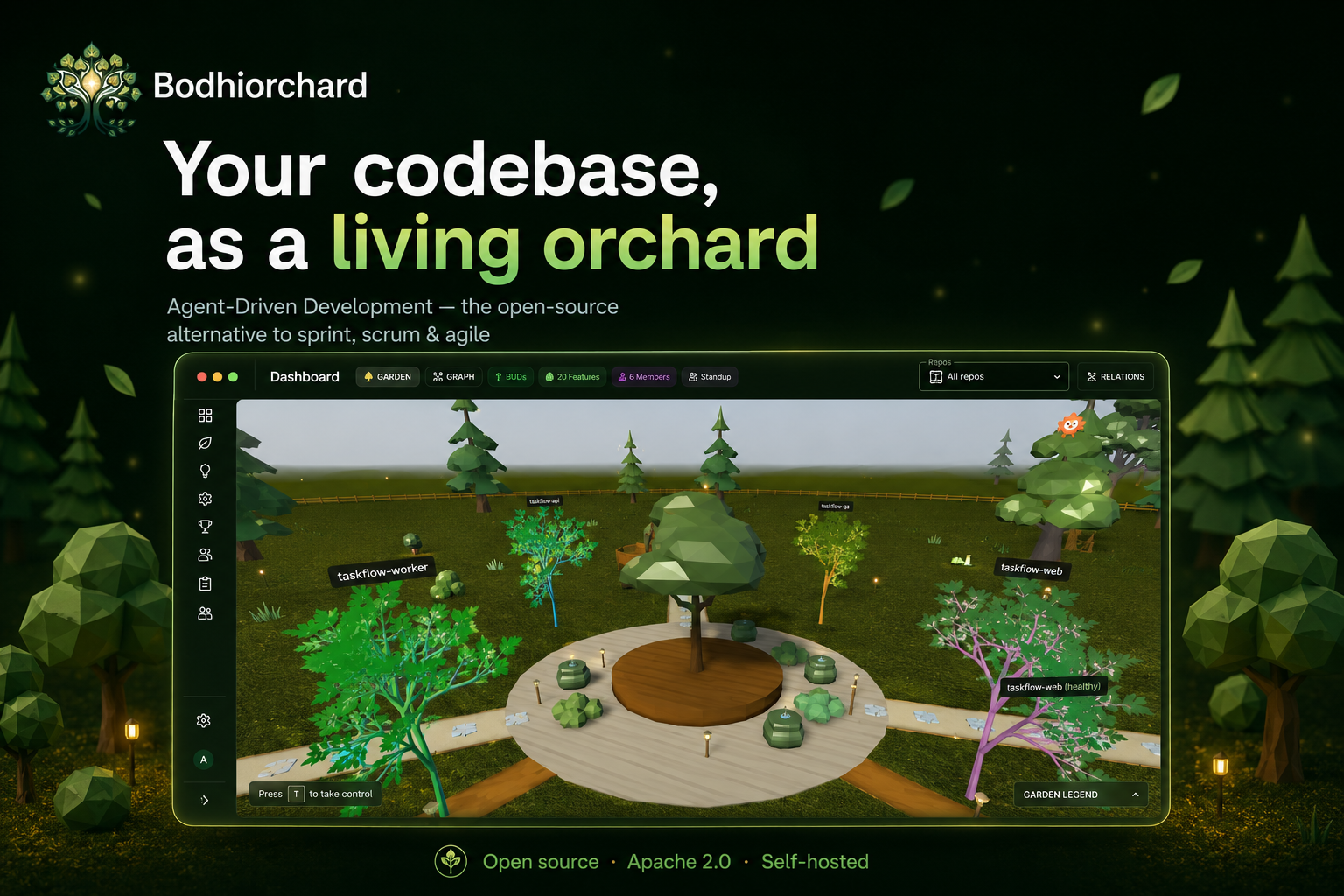
▶ Watch the demo — your organization as a living, tended orchard.
Bodhiorchard is the open-source reference implementation of Agent-Driven Development (ADD) — a software development methodology where twelve specialised AI agents handle the busywork (specs, estimates, test plans, triage, retrospectives) and humans keep the decisions that matter. It works as a self-hosted Jira alternative for the full lifecycle: intake → spec → design → development → testing → deploy → retrospective. The data plane stays on your hardware; inference runs on Claude Code today, with Ollama and OpenAI next.
Less process. More shipped. The full methodology lives at bodhiorchard.ai.
Quick Start
The fastest path — no clone, no build. Needs only Docker (running) and Node.js 18+:
npx bodhiorchard init     # detect ports, generate secrets, pull prebuilt images
cd bodhiorchard
npx bodhiorchard start    # start the stack and open the setup wizard
The wizard opens at http://localhost:3000/setup — finish there (organization, admin account, AI provider, repositories). bodhiorchard stop brings it down; your data volumes persist.
Prefer to build from source?
git clone https://github.com/mickyarun/bodhiorchard.git
cd bodhiorchard
docker compose up
Already running claude on your laptop? Hybrid mode reuses your Claude Pro/Max login instead of an API key:
npm install && npm run setup && npm run dev
→ All three paths, the full bodhiorchard CLI command list, prerequisites, mode-switching, and a ready-made demo dataset: Deployment Guide
Why Bodhiorchard
| 🤖 AI drafts, you decide | Agents write the specs, tech plans, and test cases. Humans review, edit, and approve at every phase — judgement stays human. |
| 🎯 Predictions, not poker | AI-PERT + 10,000 Monte Carlo simulations give P50/P70/P85 delivery dates per phase — factoring skill profiles, backlog, and workload. No story points. |
| 📄 One BUD per feature | A single living document (spec + tech spec + test plan + history) replaces tickets scattered across Jira, Confluence, Notion, and Slack. |
| 🌱 Knowledge that stays current | Auto-synced from code, vector-indexed, and fed into every agent prompt. No stale wiki pages. |
Old way vs Agent-Driven Development
| Phase | Scrum / Agile | Bodhiorchard |
|---|---|---|
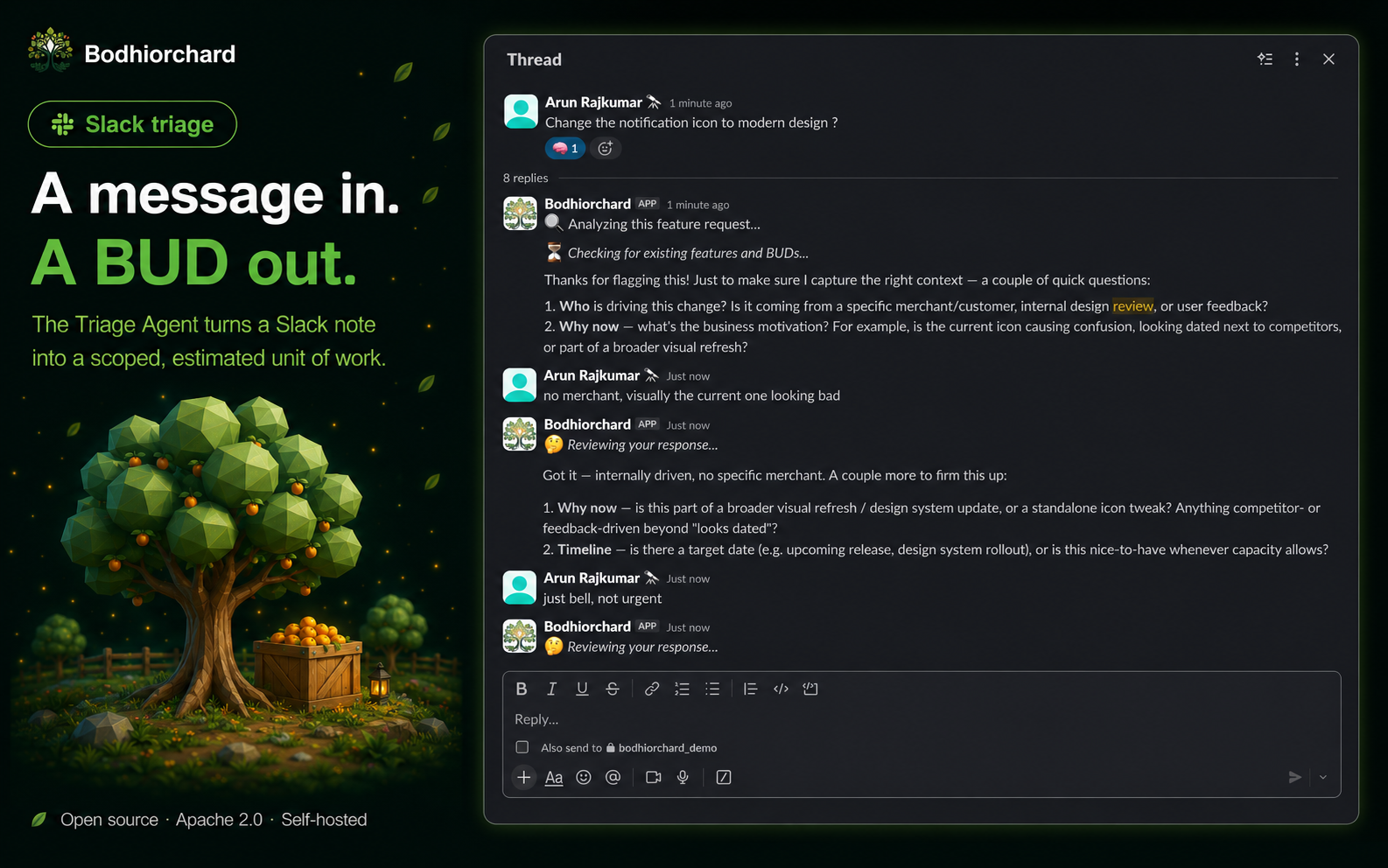
| Intake | Jira ticket, manual triage, sprint planning | Slack message → Triage Agent interviews, dedupes, estimates |
| Estimation | Story points, planning poker | Probabilistic per-phase dates with confidence intervals |
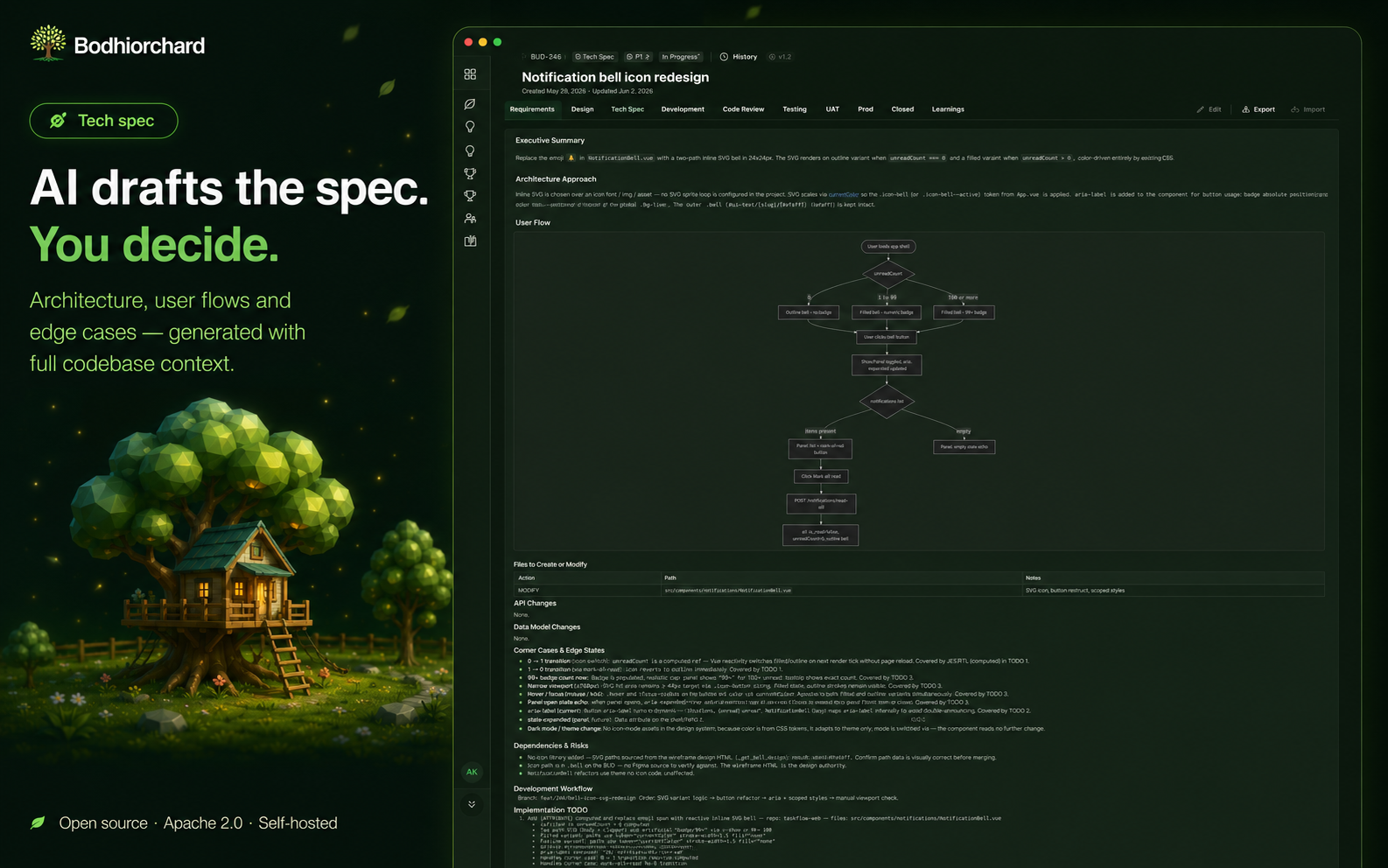
| Specification | PM writes docs, reviews in meetings | BUD Agent drafts with codebase context; PM approves |
| Development | Dev picks a ticket, starts from scratch | Best-fit dev auto-suggested from skill profiles; implements from a file-level tech plan |
| Testing | QA writes cases manually | Auto-generated unit / integration / e2e / security / UAT plans |
| Deployment | Release train, manual status updates | Status Agent detects PR merges; BUD becomes a shipped Feature |
| Retrospective | Biweekly meeting, action items forgotten | Learning Agent auto-generates one on every deployment |
Screenshots
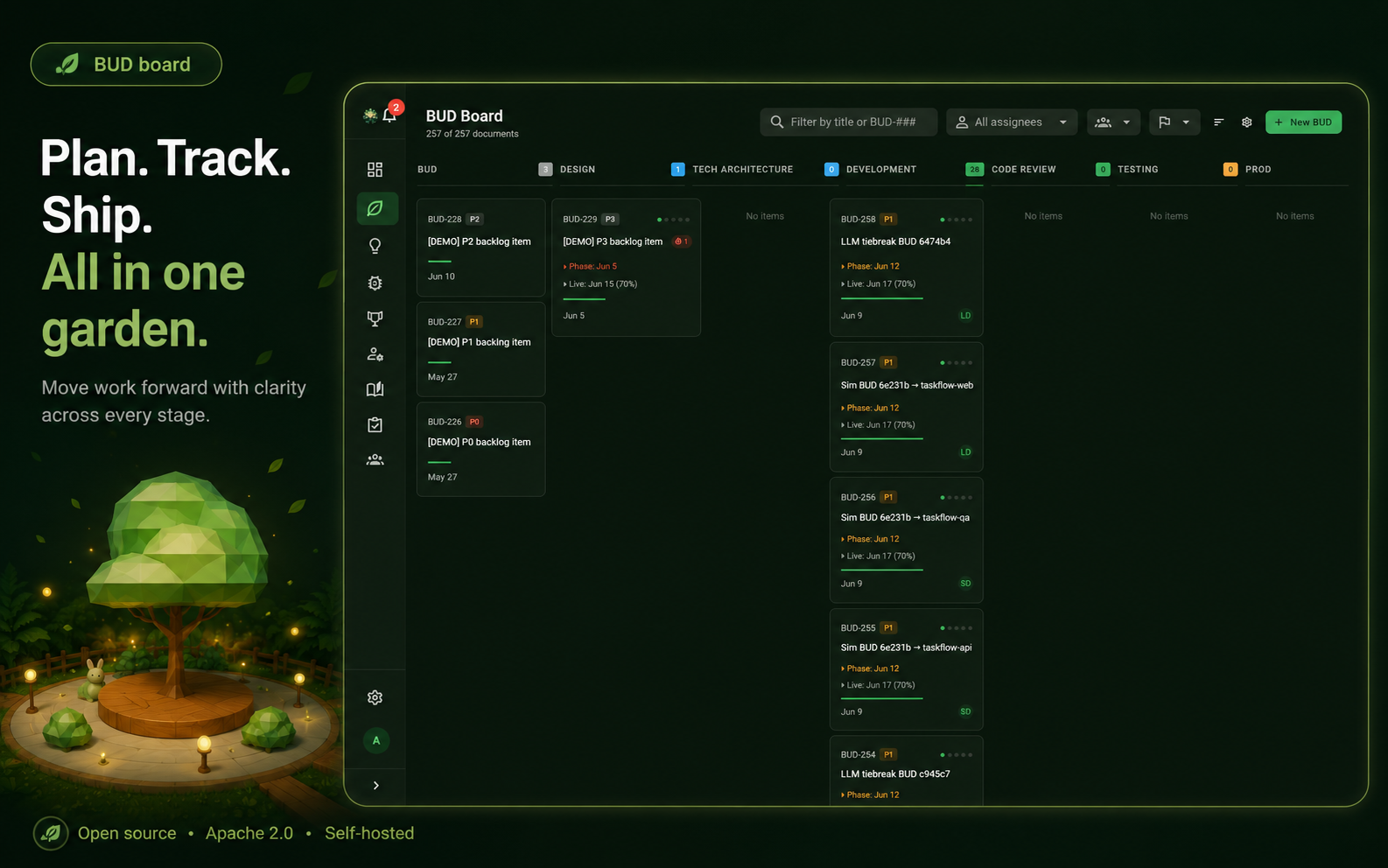 |
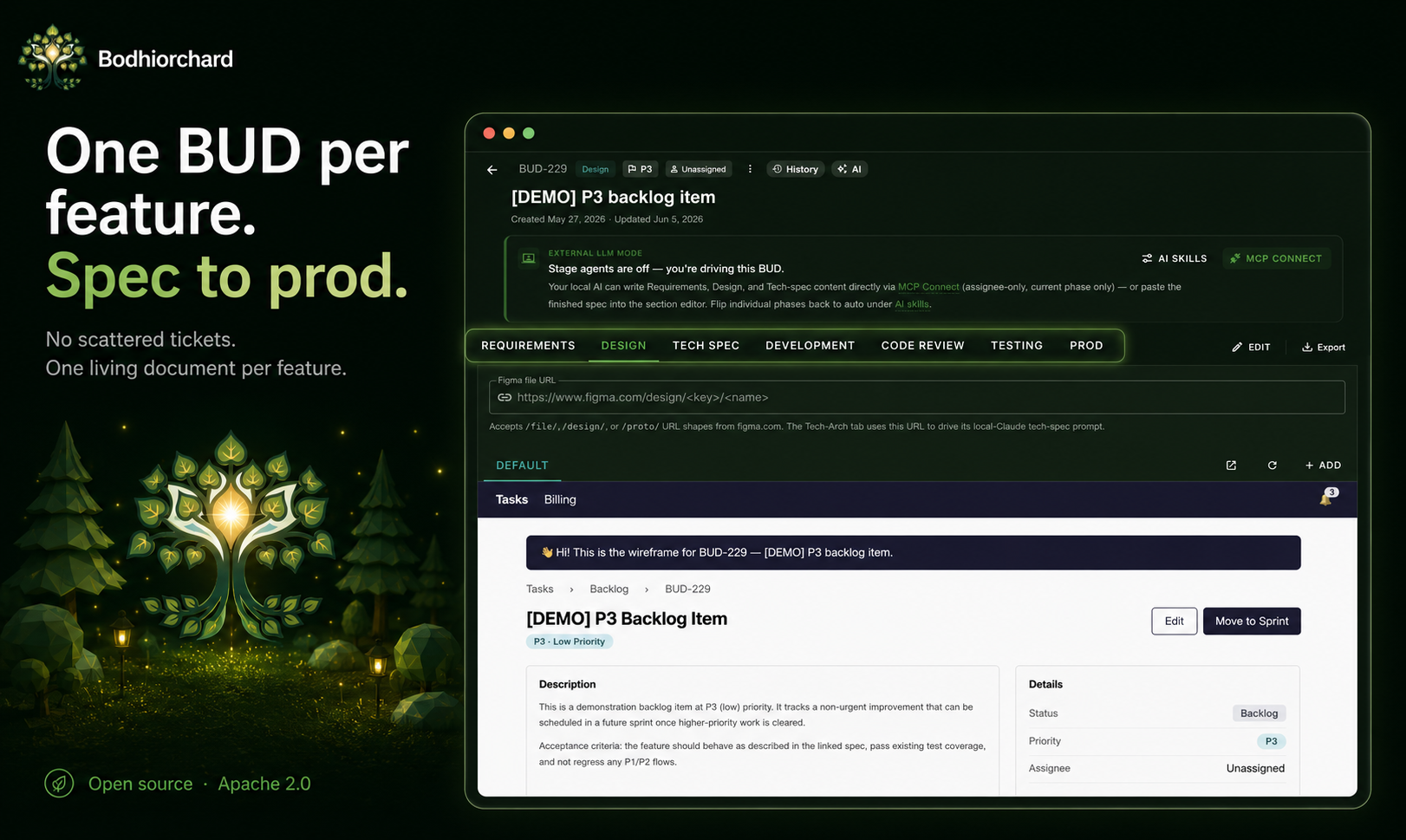 |
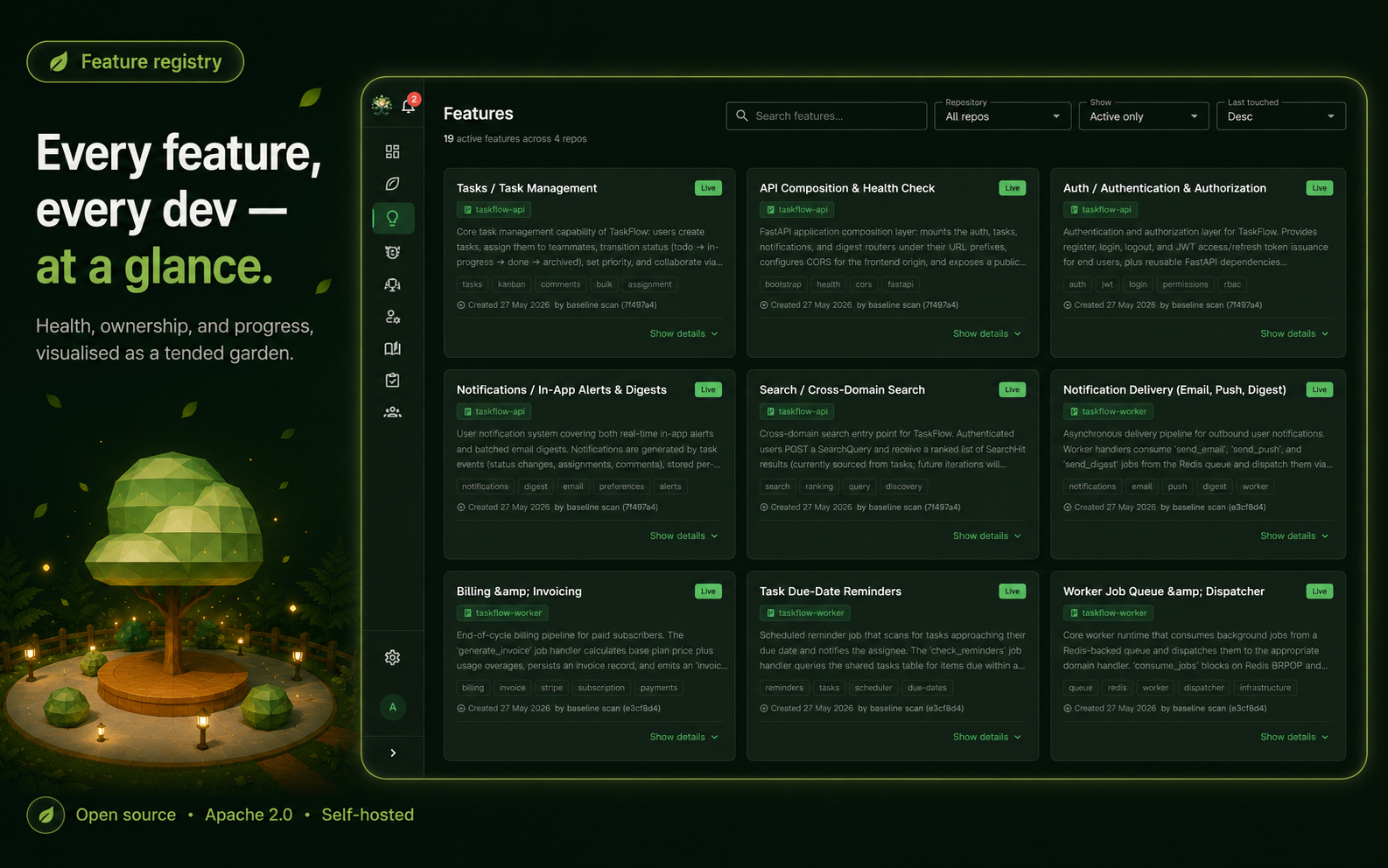 |
 |
 |
 |
 |
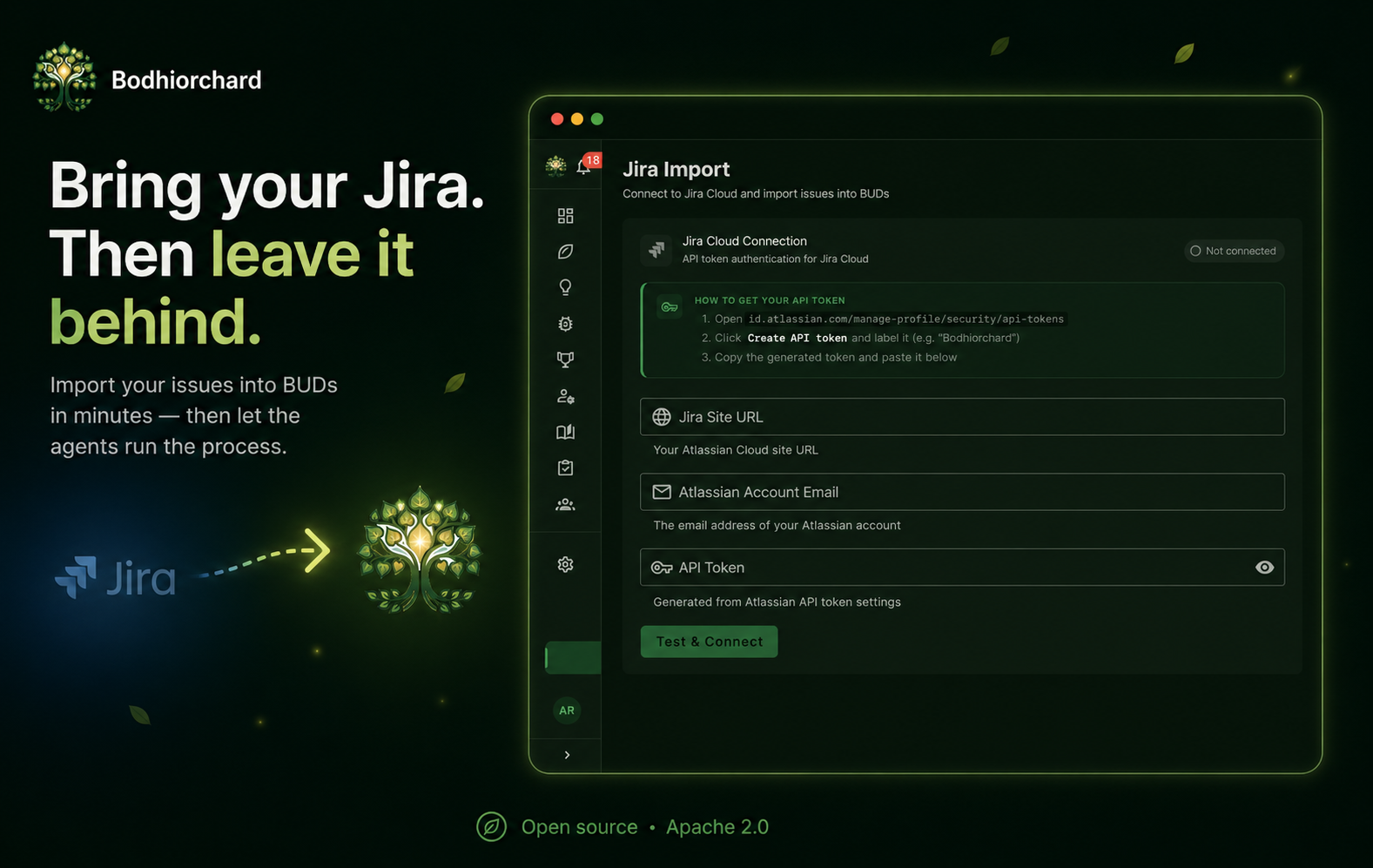 |
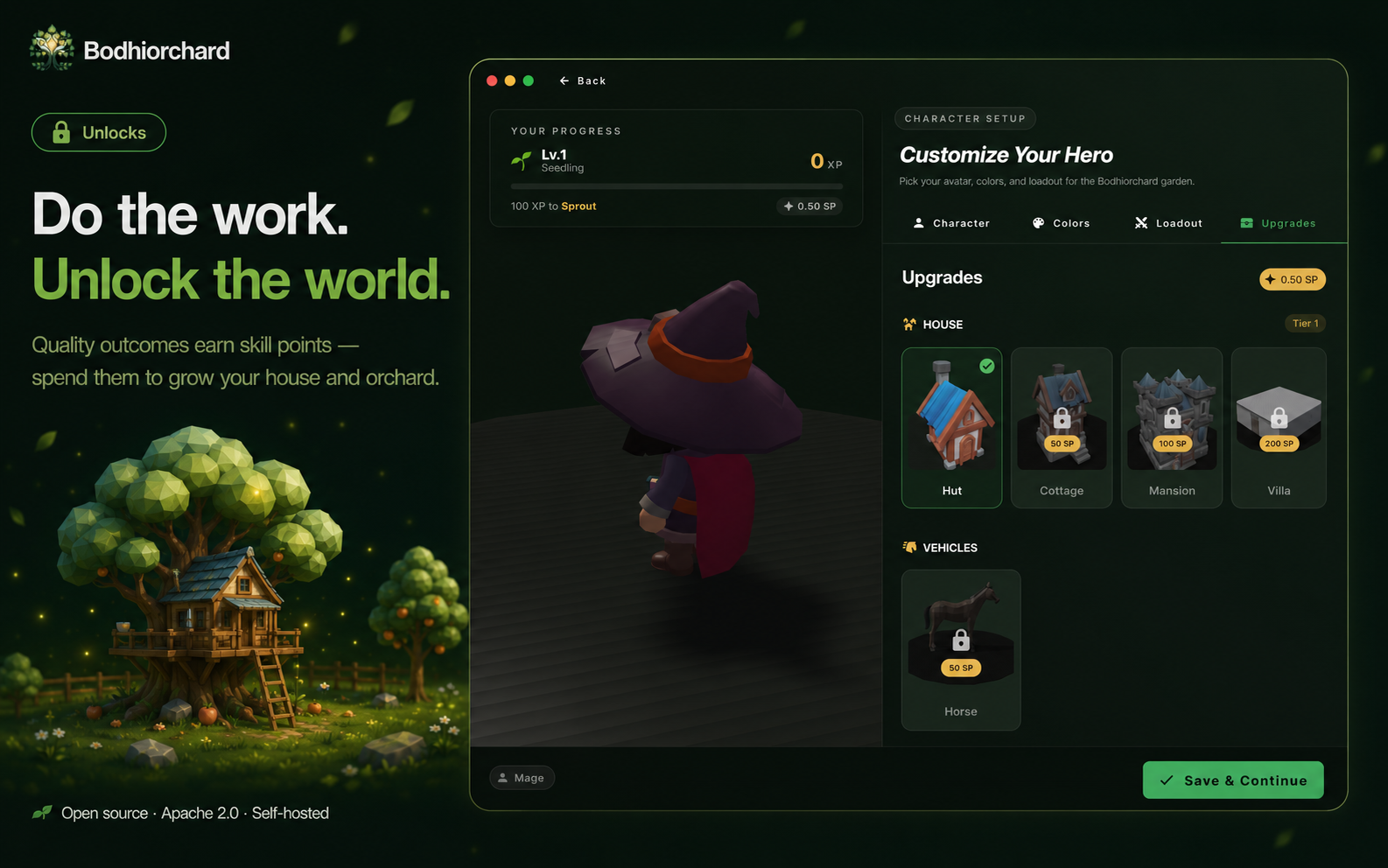
The gamification layer rebuilds developer skill profiles nightly — skills compound, badges unlock, and the leaderboard reflects shipped value, not ticket count:
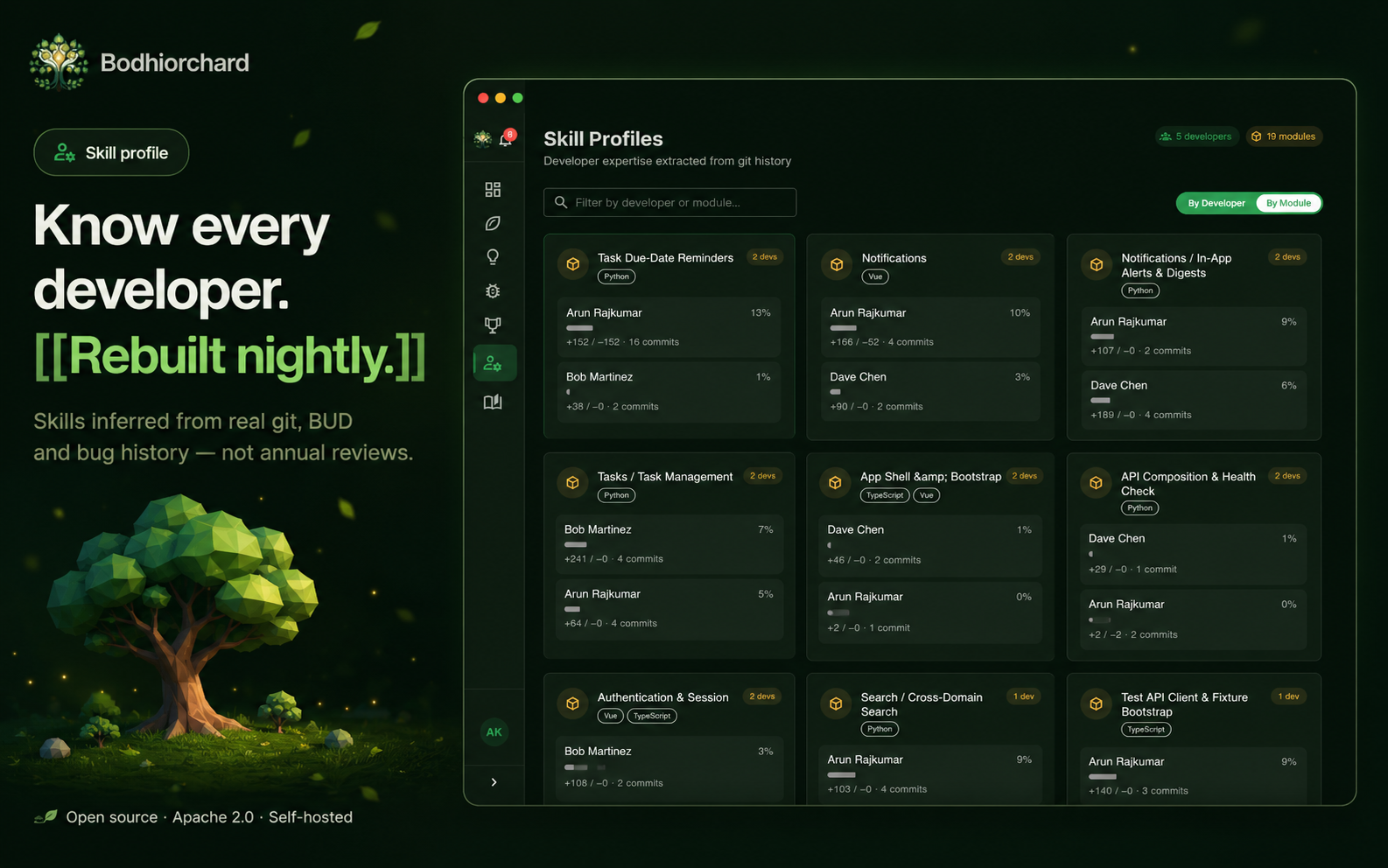 |
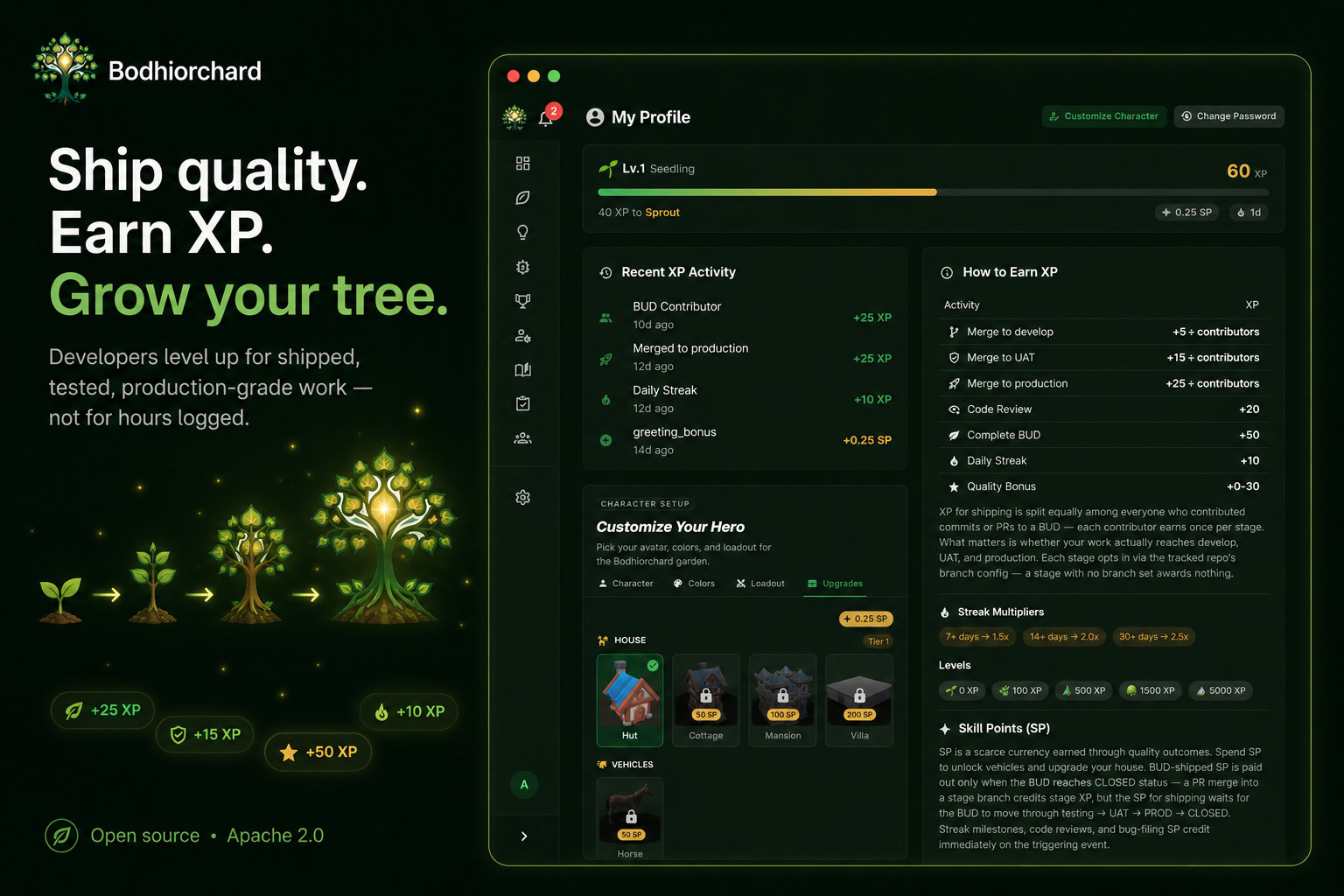 |
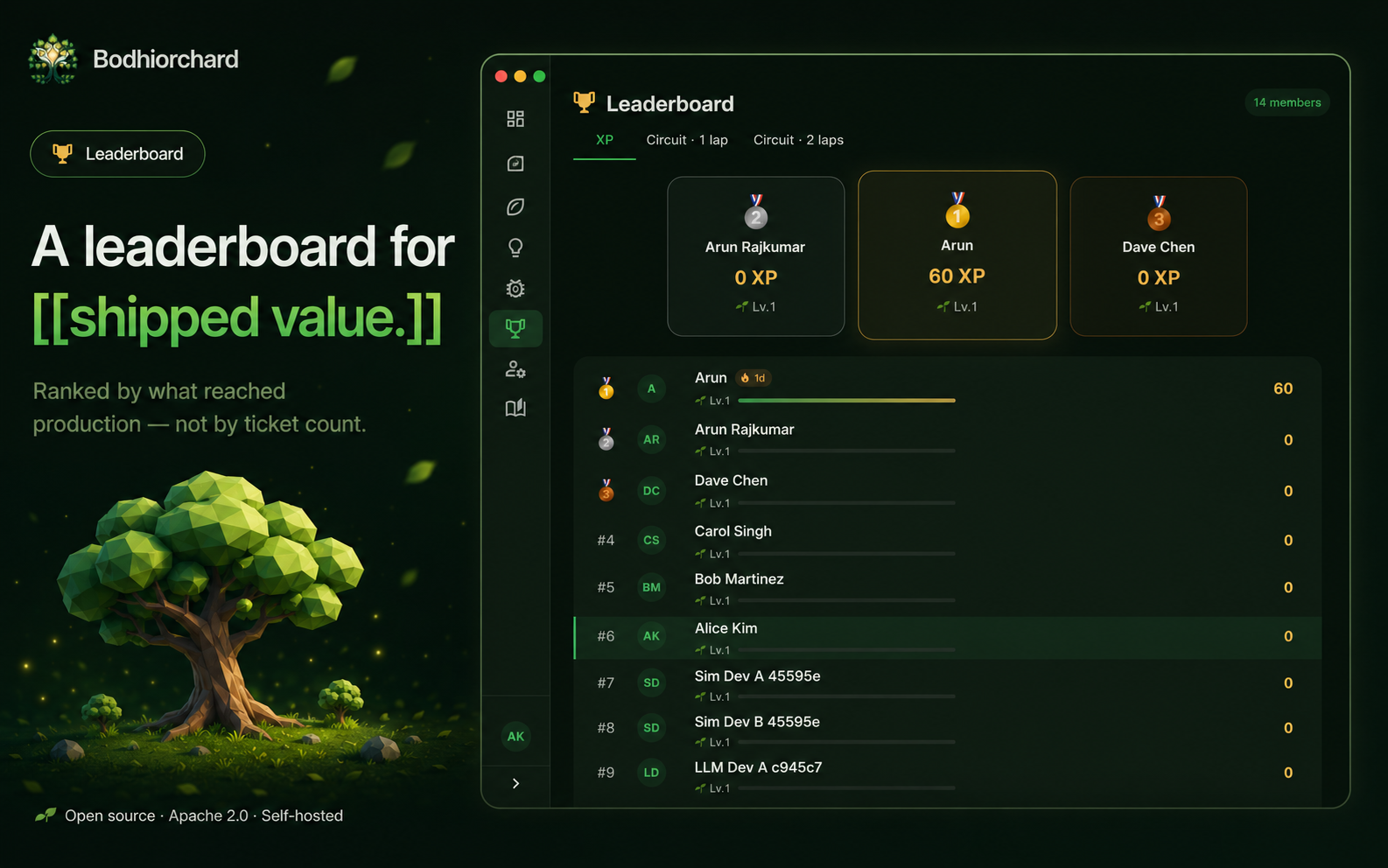 |
 |
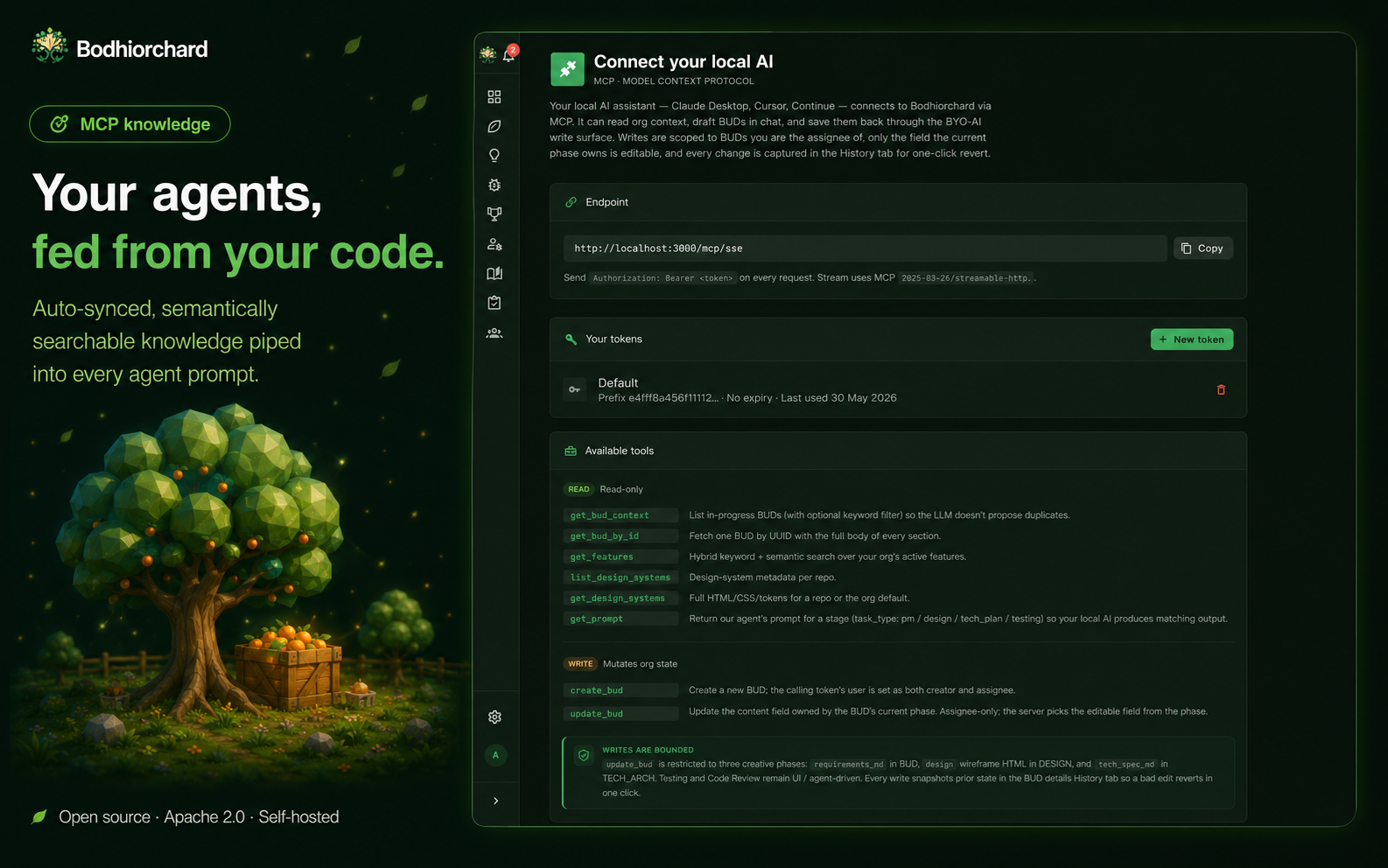
More walkthroughs: Setup · Slack triage & MCP tools · Requirements & estimation · Design phase · Development & retrospective
How it works
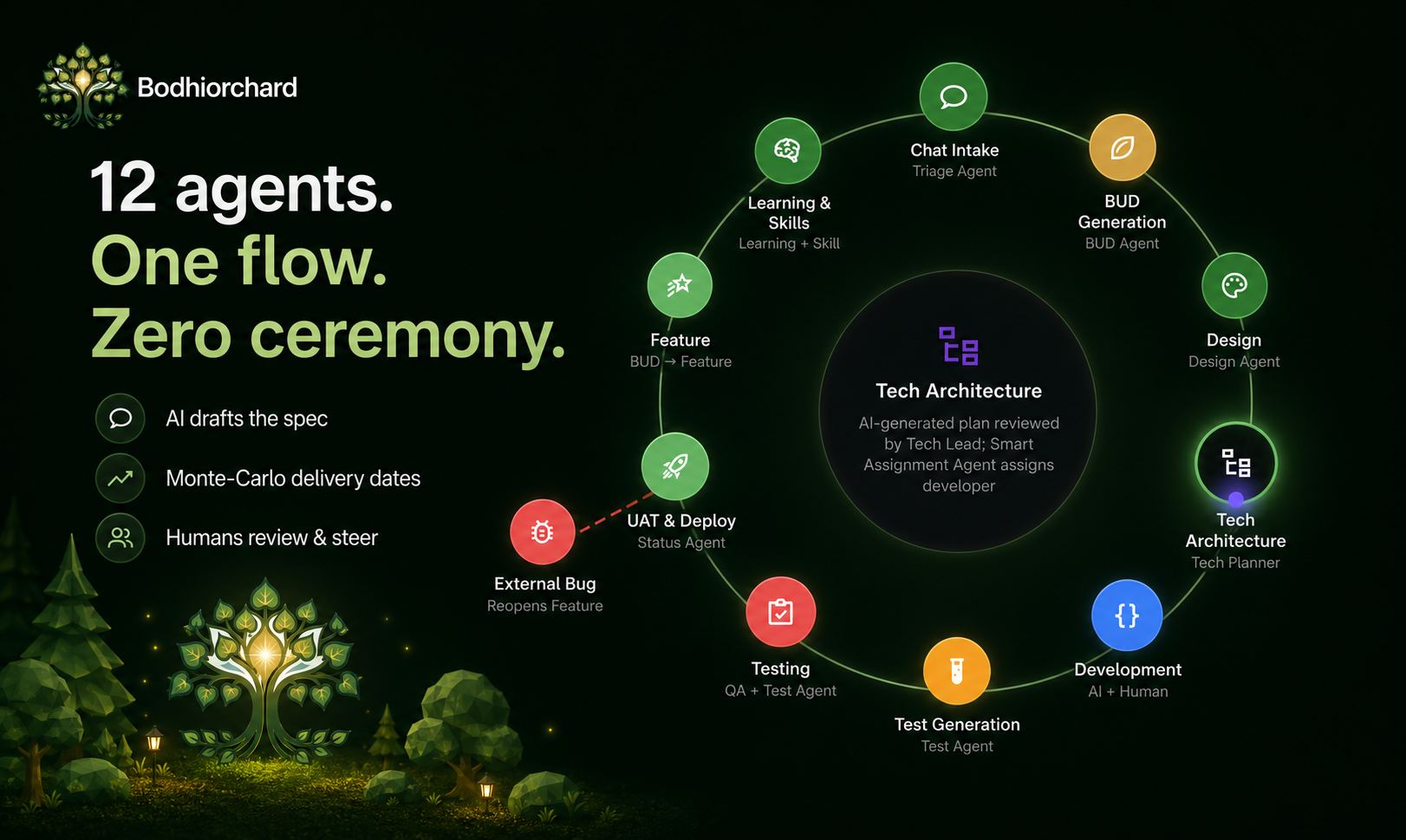
Every feature lives in one BUD (Business Understanding Document) that moves through the lifecycle, with an agent driving each phase and a human gate between phases:
bud → design → tech_arch → development → testing → uat → prod → closed
                                                              ↳ discarded (any time)
- Slack-native intake — post in
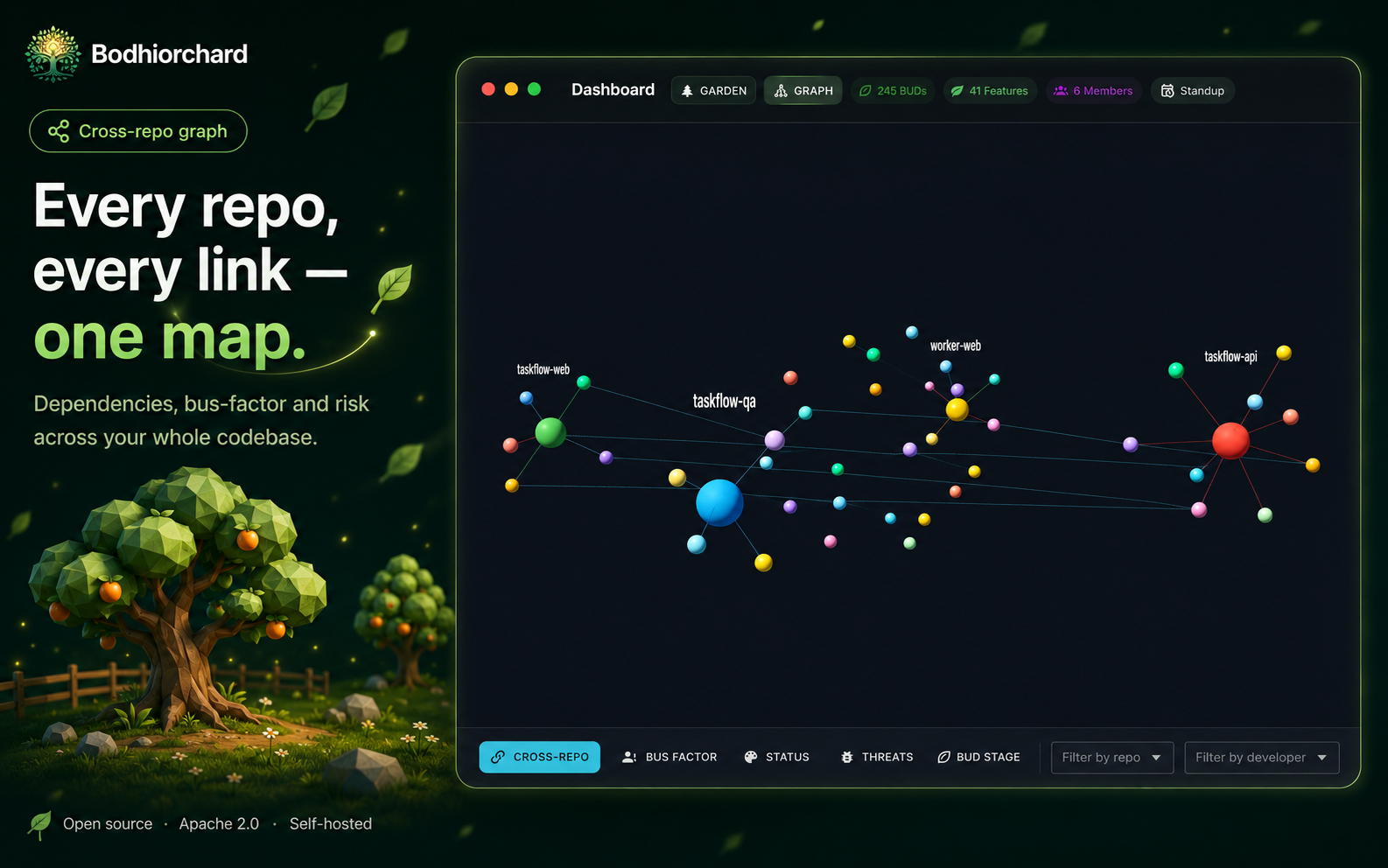
#feature-requests, the Triage Agent interviews you in-thread, checks duplicates via vector search, and queues for PM approval. - Multi-repo code intelligence — a tree-sitter code-graph indexer scans your repos, detects feature clusters across them, and answers blast-radius queries ("what breaks if I change this?").
- Smart quality loops — production bugs auto-link to the originating BUD; threshold breaches trigger reassignment; every fix feeds the knowledge base.
- Developer skill profiling — per-module expertise scores rebuilt nightly from git history, with bus-factor alerts and best-fit assignment.
- Living knowledge — git repos, agent skills, the central DB, and vector search stay auto-synced and feed every agent prompt.
- Enterprise-grade security — multi-tenant isolation, RBAC with 9 roles, AES encryption at rest, JWT auth, full audit trail.
The Twelve Agents
| Agent | What it does |
|---|---|
| Triage | Interviews requesters in Slack, checks capacity, finds duplicates, estimates complexity |
| BUD | Drafts the full spec with codebase context, enterprise rules, and prior art |
| Design | Scopes UI/UX requirements, generates component breakdowns and interaction specs |
| Tech Plan | Creates file-level implementation TODOs with architecture and dependency analysis |
| Smart Assignment | Suggests the best-fit developer from skill profiles and real-time capacity |
| Status | Detects PR merges via GitHub webhooks, advances BUD status, notifies stakeholders |
| Standup | Aggregates git/PR/bug/chat activity into daily summaries with risk flags |
| Test Plan | Auto-generates e2e, unit/integration, manual UAT, and security test cases |
| Bug Linker | Links incoming bugs to BUDs via vector search, monitors quality thresholds |
| Reassignment | Rotates developers to bug review when thresholds are exceeded |
| Learning | Analyses cycle time vs estimates and writes the retrospective on every deploy |
| Skill | Rebuilds developer skill profiles nightly from git, BUD, and bug history |
Every agent action is audited and reviewable in the UI. Triggers, hand-offs, and capabilities: AGENTS.md.
The Manifesto
Eight principles, deliberately echoing the Agile Manifesto's "X over Y" structure:
| We value… | …over |
|---|---|
| AI-generated first drafts | blank-page paralysis |
| Cycle time predictions | story points & planning poker |
| Continuous learning | post-mortems after the damage |
| Human decisions | human busywork |
| Living knowledge | stale wiki pages |
| BUD as single source of truth | scattered tickets & docs |
| Skills that grow with the team | static role assignments |
| Auto-healing quality loops | manual bug triage |
Architecture
Stack: FastAPI + SQLAlchemy 2.0 (async) on Python 3.12 · Vue 3 + Vuetify + PlayCanvas (3D) · Colyseus multiplayer · PostgreSQL 16 + pgvector · Redis · local ONNX embeddings (fastembed).
backend/     FastAPI — REST API, 12 agents, MCP server, code-graph indexer
frontend/    Vue 3 SPA — BUD board, Living Tree 3D dashboard, settings
multiplayer/ Colyseus server — shared 3D world state
shared/      World layout consumed by frontend + multiplayer
examples/    TaskFlow demo repos (cross-repo feature detection)
The agent layer is engine-independent: Claude Code runs the codebase-aware agents, the Anthropic direct API handles lightweight ones, and Ollama / OpenAI / Codex are next — adding an engine is API rewiring only. Bodhiorchard also runs its own MCP server so Claude Code (or any MCP client) can drive the BUD lifecycle, query the code graph, and read team context.
Documentation
| Doc | What's inside |
|---|---|
| Deployment Guide | npx installer, Full Docker vs Hybrid setup, system diagram, TaskFlow demo dataset |
| AI Engines & MCP Server | Engine roadmap, auth modes, full MCP tool reference, client registration |
| API Reference | REST endpoints, WebSocket jobs, environment variables |
| AGENTS.md | Per-agent capabilities and triggers |
| BODHIORCHARD-ARCHITECTURE.md | The full architecture spec |
| MCP-REMOTE.md | Bring-your-own-AI via the remote MCP endpoint |
FAQ
What is Agent-Driven Development?
A methodology where specialised AI agents — not humans running status meetings — drive every phase of the software lifecycle, while humans review, decide, and steer. It sits in the slot Agile occupied in 2001: a reorganisation of work around new capabilities. The methodology is free to adopt with or without Bodhiorchard — see bodhiorchard.ai.
Is Bodhiorchard a self-hosted Jira alternative?
Yes — for the full workflow layer (intake through retrospective). It's especially relevant for teams affected by Atlassian sunsetting self-hosted Jira licences (new licences end March 2026, full shutdown 2029).
Does my code leave my machine?
The data plane — Postgres, embeddings, BUDs, scanned repos, audit log — is always local. Only LLM prompts leave, and only when you choose cloud inference. Fully air-gapped operation arrives with the Ollama preset.
Do I need a Claude subscription?
No. Either paste an Anthropic API key (pay-per-token) or, if you do have Claude Pro/Max, run Hybrid mode and the agents inherit your flat-rate claude login session.
How is this different from Cursor, Tabby, or Continue?
Those are IDE-side coding assistants for an individual developer. Bodhiorchard is the orchestration and project-management layer above them — intake, specs, estimation, assignment, test plans, bug linking, retrospectives. Pair them freely.
How does it compare to GitHub Copilot Workspace?
Copilot Workspace is cloud-only and GitHub-bound. Bodhiorchard is self-hosted, repo-agnostic (GitHub, GitLab, self-hosted Git), and AI-engine-agnostic.
What does "BUD" mean?
Business Understanding Document — one markdown document per feature holding spec, tech spec, test plan, acceptance criteria, and full history.
Can I use it commercially?
Yes — Apache 2.0, including embedding in proprietary products. Contributions require DCO sign-off (git commit -s). Commercial licences with support are available separately from the maintainer.
Does it run on Windows?
Yes, via WSL2 in either deployment mode.
Roadmap
- Shipped — core platform (auth, multi-tenant, RBAC), BUD lifecycle, feature registry with vector search, repo scanning + code intelligence, skill profiling, 3D Living Tree, Slack-native triage and real-time Slack bot conversations, GitHub webhook pipeline (PR-merge → BUD status + repo re-scan), automated test-plan generation from BUDs (unit / integration / e2e / security / UAT), CI/CD integration (QA-automation repo wired via MCP; test commits flow back to the BUD), MCP server, 12 agent definitions,
npx bodhiorchardinstaller - Next — autonomous agent execution engine: small, low-risk BUDs run tech spec → code → review → test end to end, with a human approval gate before release (deliberately not lights-out)
- Future — multi-org marketplace, custom agent builder, analytics dashboards, mobile companion, plugin ecosystem
Contributing
Contributions welcome — fork, branch, lint (ruff / vue-tsc), and open a PR. All commits need DCO sign-off (git commit -s); see CONTRIBUTING.md.
Why "Bodhiorchard"?
Bodhi (Sanskrit: "awakening") is what the Buddha attained under the Bodhi tree. An orchard is a grove tended with intention so it can bear fruit. The software industry builds tools to make life better, yet the process of building them consumes our lives — ceremonies, status updates, and busywork that were meant to help but became the work itself.
Bodhiorchard exists because AI should give humans their time back. The agents are the orchardists: they water, prune, and tend the soil so the trees can grow and the humans who planted them can step back and enjoy the harvest.
Build well. Then go outside.
License
Apache License 2.0 — see LICENSE and NOTICE.
Built by Arun Rajkumar
If Bodhiorchard helps your team, give it a ⭐ and spread the word.
© 2025-2026 Arun Rajkumar. Bodhiorchard™ is a trademark of Arun Rajkumar.
Independent open-source project — not affiliated with any employer or client.
Yorumlar (0)
Yorum birakmak icin giris yap.
Yorum birakSonuc bulunamadi