mira
Health Pass
- License — License: Apache-2.0
- Description — Repository has a description
- Active repo — Last push 0 days ago
- Community trust — 104 GitHub stars
Code Pass
- Code scan — Scanned 12 files during light audit, no dangerous patterns found
Permissions Pass
- Permissions — No dangerous permissions requested
No AI report is available for this listing yet.
Self-hosted AI code reviewer with indexed PR reviews, walkthroughs, vulnerability scanning, dependency graphs, custom rules, and a learning loop.

Mira
Self-hosted AI code review. Your code, your dashboard, your LLM key.


Self-host every feature: full review engine, codebase indexing, vulnerability scanning, custom rules, org-wide package search, dashboard, learning loop. No paid tier, no license key, no SaaS upsell.
Mira reviews your pull requests using your choice of LLM (via OpenRouter, which fronts Anthropic, OpenAI, Google, DeepSeek, and more) and posts concise, actionable feedback. The noise filter, confidence clamping, and learning loop ensure you only see comments that matter. See FEATURES.md for the full surface.
Dashboard
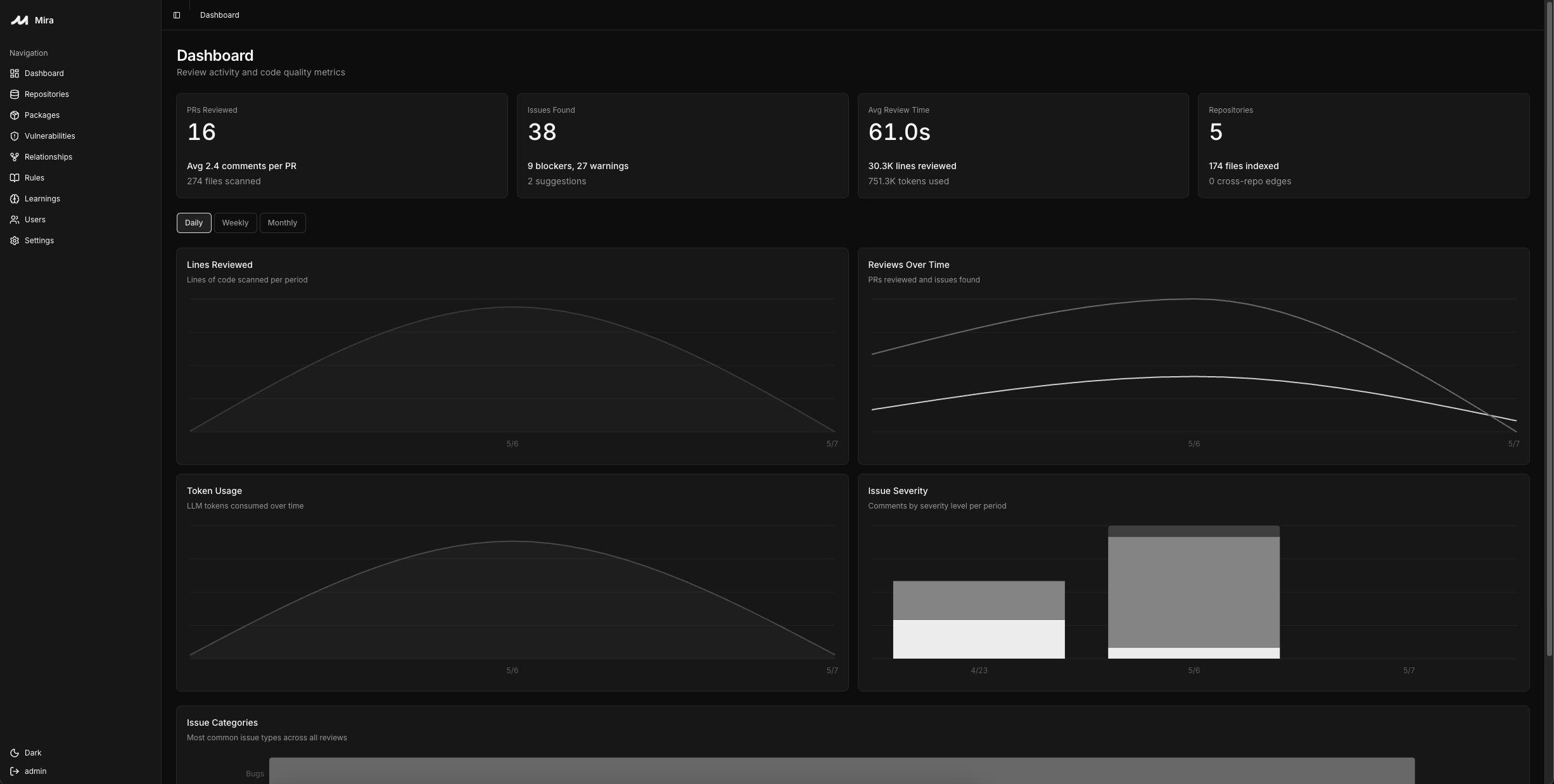
Your data, your dashboard
Most AI reviewers are SaaS: your diffs (and often the full surrounding code) leave for a third-party server, and the only "view" you get is the comments that come back on a PR. Mira flips both halves of that:
- Your code never leaves your infra. Diffs, embeddings, indexes, review history, vulnerability data, all stored in your SQLite or Postgres, on infrastructure you own. No phone-home, no required telemetry, no "is this used for training?" question.
- The dashboard you see above is yours. It's not a marketing screenshot of someone else's view of your code. CodeRabbit, Greptile, and similar SaaS reviewers don't expose anything like it. Mira's dashboard surfaces signals you don't get anywhere else:
- Org-wide package inventory: answer "which repos use
[email protected]?" in one query. Stack it next to your CVE feed for instant blast-radius checks. - CVE alerts on every dependency: hourly OSV.dev poll, severity + advisory link + fix version surfaced inline next to the package.
- Dependency + blast-radius graphs: see exactly which files and repos depend on a symbol before you change it.
- Per-repo review event stream: every webhook, every chunk, every cost figure, in one place for live troubleshooting.
- Cost & token telemetry: actual spend per repo and per model, not estimates, because you control the LLM key.
- Coming soon, change-frequency heatmaps: surface the files that bug fixes keep landing on so you can target review attention.
- Org-wide package inventory: answer "which repos use
If your engineering team needs answers like "which of our repos are exposed to this CVE?" or "what's the blast radius of changing this function?", those questions stop being multi-day investigations and start being one-click dashboard pages.
Highlights
- Any OpenAI-compatible endpoint: OpenRouter by default (Anthropic, OpenAI, Google Gemini, DeepSeek, …), or point
llm.base_urlat vLLM, Ollama, LiteLLM proxy, LocalAI, llama.cpp, Together, Fireworks, Groq, or Cerebras for self-hosted / data-resident reviews. See Custom endpoints. - Low noise: Confidence thresholds, dedupe, severity sorting, per-PR comment caps
- Indexed reviews: full-repo code index gives the LLM real context, not just the diff
- Learns your team: synthesizes rules from rejected comments and human review patterns on merged PRs
- Vulnerability scanning: hourly OSV.dev poll surfaces CVEs across every package in every repo
- Org-wide package search: answer "which repos use
[email protected]?" in seconds - Configurable:
.mira.yamlfor per-repo settings, custom + global rules in the dashboard - Self-host on day one: Docker image, Railway / Fly.io / Render configs, SQLite or Postgres
- GitHub today, more platforms coming: GitLab, Bitbucket, and Gitea support are on the roadmap. Same review engine, same dashboard, just a different provider adapter
Benchmark
Mira is the fastest tool measured on the public Code Review Bench, and the only one on the speed/quality Pareto frontier: every tool that scores higher on F1 takes 5–14× longer per PR.
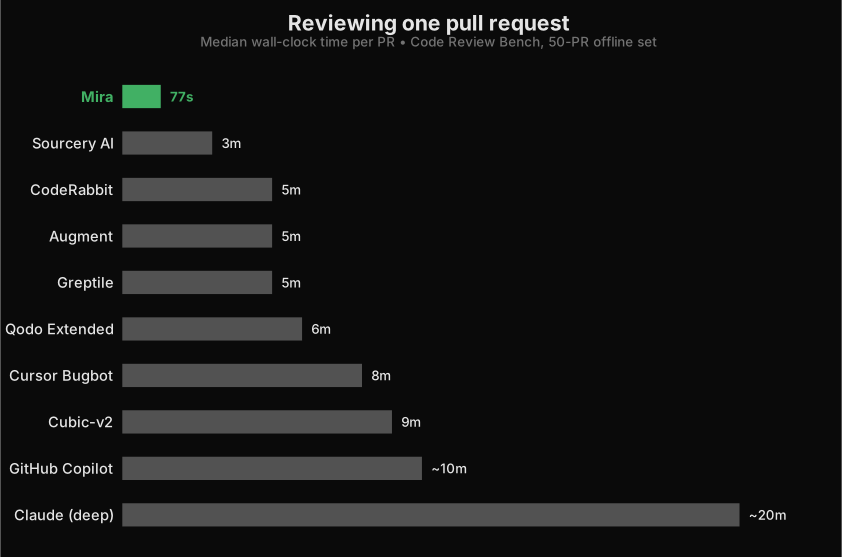
Plotted against every published competitor on the same subset, Mira sits in the upper-left corner: everything to the right is slower; everything above it pays 5–14× the wall time for the extra F1.
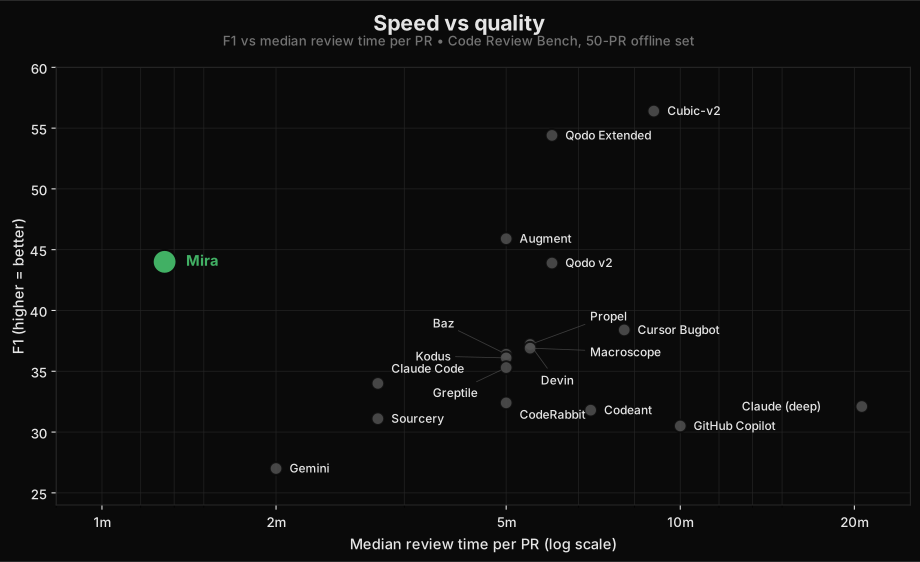
Measured on the same 50-PR offline benchmark, judged by Claude Sonnet 4.5.
| Mira | Cubic-v2 | Greptile | CodeRabbit | GitHub Copilot | |
|---|---|---|---|---|---|
| F1 | 44 | 56 | 35 | 32 | 31 |
| Precision | 43% | 50% | 32% | 24% | 24% |
| Recall | 46% | 65% | 40% | 50% | 43% |
| Median time / PR | ~77s | ~9m | ~5m | ~5m | ~10m |
Methodology: scores measured against the Martian Code Review Bench offline dataset with Claude Sonnet 4.5 as the judge.
Quick Start
GitHub App (self-hosted)
Run Mira as a GitHub App that auto-reviews every PR and responds to comments.
Note: GitHub is the only supported provider today. GitLab, Bitbucket, and Gitea adapters are on the roadmap. The review engine, indexer, and dashboard are provider-agnostic; only the webhook + comment-posting layer is GitHub-specific. Star the repo to follow along.
1. Create a GitHub App at github.com/settings/apps/new:
- Webhook URL:
https://your-server.com/github/webhook - Permissions: Pull Requests (read+write), Contents (read+write), Issues (read+write)
- Events: Pull requests, Issue comments
- Generate a private key (.pem)
2. Deploy:

Or with Docker:
Two files: mira.yaml for non-secret defaults, .env for secrets. Pass both into the container.
# mira.yaml: deployment-wide defaults. Every key is optional.
llm:
  model: "anthropic/claude-sonnet-4-6"
  fallback_model: "anthropic/claude-haiku-4-5"
  indexing_model: "anthropic/claude-haiku-4-5"

filter:
  confidence_threshold: 0.7
  max_comments: 5

review:
  walkthrough: true
  self_critique: true
  security_pass: true
# .env: secrets only. Don't commit this.
MIRA_GITHUB_APP_ID=123456
MIRA_GITHUB_PRIVATE_KEY="$(cat private-key.pem)"
MIRA_WEBHOOK_SECRET=your-secret
OPENROUTER_API_KEY=sk-or-...
docker run -p 8000:8000 \
  --env-file .env \
  -v "$(pwd)/mira.yaml:/app/mira.yaml" \
  ghcr.io/miracodeai/mira:latest \
  --config /app/mira.yaml
Mira talks to OpenRouter under the hood, so any model OpenRouter supports works. llm.model in mira.yaml is whatever the OpenRouter Models page lists. Examples:
| Provider | llm.model |
|---|---|
| Anthropic | anthropic/claude-sonnet-4-6 |
| Anthropic (cheap, indexing) | anthropic/claude-haiku-4-5 |
| OpenAI | openai/gpt-4o |
| OpenAI (cheap) | openai/gpt-4o-mini |
google/gemini-2.5-pro |
Set OPENROUTER_API_KEY once; one key works across every provider. See src/mira/llm/models.json for the full registry of models Mira recognises (with pricing and per-purpose recommendations).
Adding your own models. The dashboard's model dropdowns (and the validation behind them) come from that registry. To make a custom model selectable — e.g. DeepSeek or a local endpoint — point MIRA_MODELS_JSON_PATH at your own models.json (a volume mount works well). Its entries are merged over the bundled ones by model id, so you only list what you want to add or override:
MIRA_MODELS_JSON_PATH=/config/models.json
// /config/models.json — copy an entry from the bundled file as a template
{
  "deepseek/deepseek-chat": {
    "label": "DeepSeek Chat",
    "provider": "openai",
    "max_input_tokens": 64000,
    "max_output_tokens": 8000,
    "input_cost_per_1m": 0.27,
    "output_cost_per_1m": 1.10,
    "supports_json_mode": true,
    "purposes": ["indexing", "review"]
  }
}
The file is read at startup; a missing or invalid file falls back to the bundled registry with a warning.
Coming soon: direct adapters for Anthropic, OpenAI, Google Vertex, Ollama, and vLLM, for teams that already hold provider keys, run open-weights models in-house, or have data-residency rules that prevent traffic from flowing through OpenRouter.
AWS Bedrock
For teams with data-residency requirements or existing AWS Bedrock access, Mira can call Bedrock's Converse API directly — no OpenRouter, no intermediary:
# mira.yaml
llm:
  provider: "bedrock"
  model: "us.anthropic.claude-sonnet-4-6-v1:0"
  fallback_model: "us.anthropic.claude-haiku-4-5-v1:0"
  region: "us-east-1"
  # aws_profile: "my-profile"  # optional
Auth uses the standard AWS credential chain (env vars, instance profile, ECS task role, SSO). No API keys to manage.
Available Bedrock models:
| Model | llm.model |
Use case |
|---|---|---|
| Claude Sonnet 4.6 | us.anthropic.claude-sonnet-4-6-v1:0 |
Review |
| Claude Haiku 4.5 | us.anthropic.claude-haiku-4-5-v1:0 |
Indexing |
| Claude Opus 4.6 | us.anthropic.claude-opus-4-6-v1:0 |
Review (premium) |
Test locally without GitHub:
git diff HEAD~1 | mira review --stdin --dry-run --config mira.yaml
3. Install the app on your repos. Every PR gets auto-reviewed.
Chat with Mira: Comment @miracodeai <question> on any PR to ask about the code.
Configuration
mira.yaml (loaded via --config) holds deployment-wide defaults: model choices, filter thresholds, review behaviour. Most teams stop here.
If a single repo needs different review behaviour, drop a .mira.yaml at its root or edit that repo's settings from the dashboard. Both deep-merge over mira.yaml for that one repo only:
# .mira.yaml: optional per-repo override
filter:
  confidence_threshold: 0.5  # noisier repo → lower bar
  max_comments: 10
See the docs for the full schema.
Development
git clone https://github.com/mira-reviewer/mira.git
cd mira
pip install -e ".[dev,serve]"

# Run tests
pytest tests/ -v

# Run the regression suite (hits real GitHub + LLM, ~$1, ~3 min).
# Pinned PRs whose findings have flickered across iterations. Run before
# merging changes that touch prompts, the noise filter, or the engine.
OPENROUTER_API_KEY=... GITHUB_TOKEN=... pytest -m eval -v

# Lint
ruff check src/ tests/

# Type check
mypy src/mira/ --ignore-missing-imports
License
Apache 2.0. See LICENSE.
Reviews (0)
Sign in to leave a review.
Leave a reviewNo results found