arsenal
Health Uyari
- License — License: MIT
- Description — Repository has a description
- Active repo — Last push 0 days ago
- Low visibility — Only 9 GitHub stars
Code Uyari
- fs module — File system access in plugins/next/skills/next/scripts/scan.cjs
Permissions Gecti
- Permissions — No dangerous permissions requested
Bu listing icin henuz AI raporu yok.
Mirko Bozzetto's curated skills for AI coding agents (Claude Code, Codex, Cursor, ...)
arsenal



Mirko Bozzetto's curated skills for AI coding agents: a spec-driven build pipeline plus the tools around it.
Skills here are plain markdown, portable across providers (Claude Code, Codex, Cursor, ...). Native plugin install is wired for Claude Code; other agents can load the skill files directly. Every plugin installs on its own. Pick what you need.
What's in the arsenal
| Plugin | Category | What it does |
|---|---|---|
code-roadmap |
orientation | At task start, matches your intent against the skills you have installed and prints a recommended chain + execution mode + reflection level. Advisory, never forces a path. |
prd |
planning | Authors a product PRD by interview (the what and why), then derives a nested task list. Stops before code. |
rfc |
planning | The how. A 10-step design workflow: problem → alternatives → tradeoffs → design → risks → recommendation → impl plan. Forces reasoning before action. |
ship |
implementation | The build. Executes a finalized prd or an Accepted rfc (or a bare prompt via an inline contract) on agent-teams / subagents / solo, and hands back a verification bundle you run + a trace ledger. |
issue |
memory | GitHub issues as cross-session resolution memory. Self-contained, cold-readable, resumable after any context reset. |
next |
orientation | What's left and how to resume it. Derives an open-work board from prd/rfc frontmatter and recommends the next command; a SessionStart hook auto-surfaces it so context survives /clear. |
websearch |
research | Intent-routed web search via Exa MCP: 8 modes (quick / deep / code / docs / debug / news / compare / research). |
The build pipeline
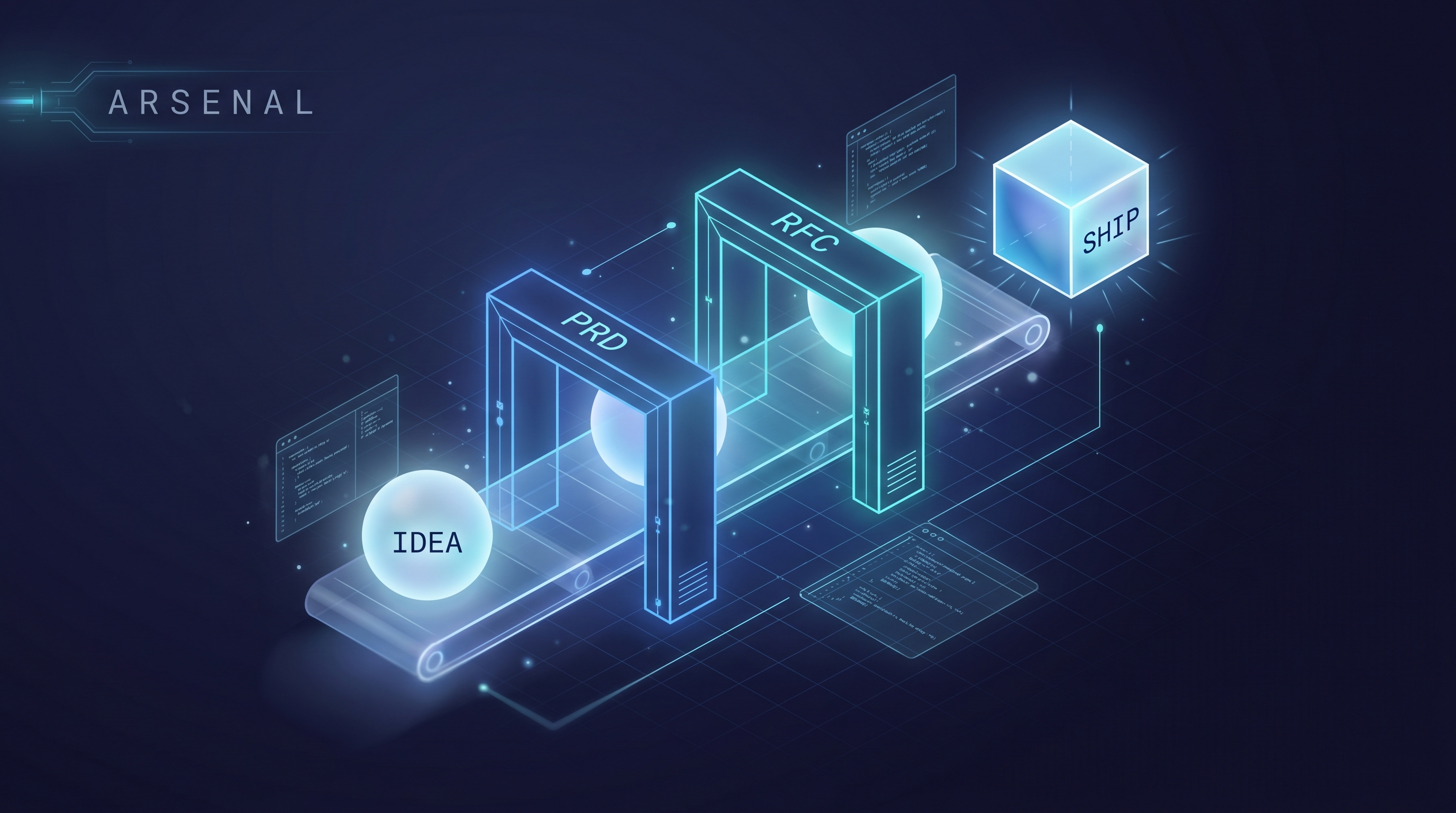
The four planning-to-build plugins form one chain. The picture at the top is the whole thing: an idea enters, passes the PRD gate (what/why) and the RFC gate (how), and comes out the other side as shipped code.
            code-roadmap                         issue
          (orient: which path?)            (memory: resume cold)
                  │                                 ▲
                  ▼                                 │  (log when work must
   idea ──▶ prd ──▶ rfc ──▶ ship ──▶ shipped code  │   survive a reset)
          what/why   how    build                  │
            │         │       │                     │
            └─────────┴───────┴─────────────────────┘
Suggested order, and what each step applies to:
code-roadmap: when you're unsure where to start. Applies to any task; it only orients, it never runs anything. Skip it once the path is obvious.prd: when the what/why isn't pinned down yet. Applies to a new feature or product change. Output:docs/prd/<slug>/{prd.md, tasks.md}.rfc: when the how crosses a boundary: architecture, migration, a new pattern, or several valid designs where the wrong one is expensive to undo. Applies to technical decisions worth reasoning about. Output:RFC.mdwith alternatives + tradeoffs + an impl plan.ship: to build. Applies to executing a finalizedprd(status: ready) or an Acceptedrfc(status: Accepted). Output: code + averification-bundle.mdyou run yourself + atrace.mdledger.issue: transversal. When a problem must survive a context reset, log it as a resumable GitHub issue and pick it up cold later.next: transversal. Asks "what is left and how do I resume it" - derives the board from eachprd/rfcstatus and points at the next/ship.shipcloses the loop (flipsready/Acceptedtoshippedon finish), and a SessionStart hook re-surfaces the board so a/clearnever loses the thread.
Not every task needs all four. A trivial change → ship directly (it derives a one-shot inline contract). A boundary-crossing feature → the full prd → rfc → ship. code-roadmap tells you which.
A bit of history: PRD and RFC
These two artifacts aren't invented here: they're decades-old engineering discipline. The plugins just turn them into repeatable workflows.
RFC: "Request for Comments" (1969)
The RFC series began in April 1969, when Steve Crocker, then a UCLA graduate student, wrote RFC 1, "Host Software" to organize the working notes of the ARPANET's Network Working Group. The name was deliberately humble: in Crocker's words, "the basic ground rules were that anyone could say anything and that nothing was official... and to emphasize the point, I labeled the notes 'Request for Comments'" (The Origins of RFCs). The goal was to start the conversation, not freeze a standard. The series went on to become the Internet's permanent record of design decisions, managed today through the IETF, and edited for 28 years by Jon Postel.
Engineering organizations later borrowed the form for internal design docs: the Rust RFC process, Oxide's Requests for Discussion, Google design docs, the Kubernetes and Go proposal processes. The throughline never changed: write the proposal down, weigh the alternatives and tradeoffs, reach consensus, all before you build. The rfc plugin is exactly that discipline, slowed down in the right place.
PRD: "Product Requirements Document"
The PRD comes from product management. The acronym standardized in the 1990s waterfall era; the artifact was rewritten for agile in the 2000s. Marty Cagan's ~2006 How to Write a Good PRD was the canonical guide of its generation and led to his 2008 book Inspired.
The enduring definition: a PRD states what a release will do, who it's for, and why it matters, and is deliberately silent on how. The "how" belongs to the engineering-owned design doc (the RFC). It's distinct from the MRD (Market Requirements Document, which argues should we build this at all). Modern practice keeps it short: 1-3 pages, a living document, not a 50-page frozen spec. Cagan himself later pushed teams toward discovery and prototypes over heavy documents: a reminder that the PRD is a means to clarity, not an end. The prd plugin runs it as an interview → a tight spec + a derived task list, and stops before code.
Why this ordering matters: the single most common failure is letting the what and the how bleed together. Keeping
prd(what/why) upstream ofrfc(how) upstream ofship(build), each a separate and checkable artifact, is the whole point of the chain.
Further reading
- PRD: How to Write a Good PRD (Marty Cagan / SVPG) · Discovery vs. Documentation (SVPG) · PRDs: A Modern Guide (Aakash Gupta)
- RFC: RFC Editor history · RFC 1: Host Software (1969) · RFC 2555: 30 Years of RFCs · The Rust RFC Book · Oxide RFD 1
Why I built this
Splitting a task into three checkable artifacts changed how I work.
prd pins down the what and the why.rfc decides the how.ship executes the plan.
When I run the full chain, each stage keeps the previous one honest: ship will not execute a PRD that is not marked ready or an RFC that is not Accepted. The spec has to be real before any code gets written.
That gate is what gave me a precision I had never reached before.
But the chain is never forced on me. When I just want to move, I hand ship a one-line prompt. It asks a couple of quick questions, builds a small contract on the spot, and ships.
The discipline is there when the stakes call for it, and out of the way when they do not. That balance is the whole point.
- Mirko
Quick install (Claude Code)
Add the marketplace once, then install whichever plugins you want:
# Inside Claude Code:
/plugin marketplace add mirkobozzetto/arsenal

# Install the whole pipeline:
/plugin install code-roadmap@arsenal
/plugin install prd@arsenal
/plugin install rfc@arsenal
/plugin install ship@arsenal
/plugin install issue@arsenal
/plugin install next@arsenal

# ...or just one:
/plugin install ship@arsenal
Then drive the pipeline:
/code-roadmap add OAuth login          # orient
/prd add OAuth login                   # what/why  -> docs/prd/oauth-login/
/rfc OAuth login                       # how       -> RFC.md
/ship docs/prd/oauth-login/            # build     -> code + verification bundle + trace
/next                                  # what's left -> the next /ship, after any /clear
Per-plugin setup, flags, and dependencies live in each plugin's README (linked in the table above).
Dependencies, per plugin
Plugins are published as I actually use them: adapt them to your own setup.
ship,prd: use Exa MCP for any web lookup (no native WebSearch/WebFetch).shipis toolchain-agnostic (detects pnpm/bun/yarn/npm, cargo, go, uv, ... from your lockfile) and never runs your tests/builds. It hands you a bundle to run.rfc: optionally integrates GitNexus for codebase context; degrades to grep/Read when it's absent. Uses Exa for prior-art research.code-roadmap: reads the skills you have installed this session; mentions index-gated code-intel tools and creator skills that you may or may not have. It only suggests, so adapt the chain to your toolbox.issue: needs theghCLI authenticated, inside a GitHub repo.websearch: needs the Exa MCP server connected.
Companion: espresso
espresso is the token-economy side of this setup: a hooks-based installer that wires up RTK, Caveman, GitNexus and Exa so these skills run lean. arsenal is the what you build with; espresso is how you keep it cheap.
Install on other agents (Codex, Cursor, ...)
The skills are plain markdown. To use them outside Claude Code:
- Copy
plugins/<name>/skills/<name>/into your agent's skill/prompt directory. - Wire the agent's MCP config to whatever the skill needs (Exa for
ship/prd/websearch, etc.). - Invoke per your agent's slash/skill mechanism.
Contributing
Open an issue or PR at github.com/mirkobozzetto/arsenal. One concern per PR. Bump the plugin's semver on any change that ships to users.
License
MIT: see LICENSE.
Yorumlar (0)
Yorum birakmak icin giris yap.
Yorum birakSonuc bulunamadi