grantex
Health Pass
- License — License: NOASSERTION
- Description — Repository has a description
- Active repo — Last push 0 days ago
- Community trust — 18 GitHub stars
Code Warn
- process.env — Environment variable access in .github/workflows/e2e-mpp.yml
- network request — Outbound network request in .github/workflows/e2e-mpp.yml
- fs module — File system access in apps/auth-service/package.json
- process.env — Environment variable access in apps/auth-service/src/config.ts
Permissions Pass
- Permissions — No dangerous permissions requested
No AI report is available for this listing yet.
grantex is the identity, authorization, and audit infrastructure for AI agents — the "OAuth moment" for the agentic internet. We provide a universal SDK and cloud service that lets any AI agent act on behalf of a human with scoped, revocable permissions, cryptographic identity, and an immutable audit trail. Developers integrate in minutes.
Grantex
Delegated Authorization Protocol for AI Agents
What OAuth 2.0 is to humans, Grantex is to agents.











Docs | Playground | Spec | Dashboard | IETF Draft
Try in 30 seconds
npm install @grantex/sdk
import { Grantex, verifyGrantToken } from '@grantex/sdk';
const gx = new Grantex({ apiKey: process.env.GRANTEX_API_KEY });

// 1. Authorize an agent for a user
const auth = await gx.authorize({ agentId: 'agent-123', userId: 'user-456', scopes: ['calendar:read', 'email:send'] });

// 2. Exchange code for a scoped, signed JWT
const { grantToken } = await gx.tokens.exchange({ code: auth.code, agentId: 'agent-123' });

// 3. Verify anywhere — offline, no callback needed
const grant = await verifyGrantToken(grantToken, { jwksUri: 'https://api.grantex.dev/.well-known/jwks.json' });
console.log(grant.scopes); // ['calendar:read', 'email:send']
pip install grantex             # Python
go get github.com/mishrasanjeev/grantex-go  # Go
npm install -g @grantex/cli     # CLI
30+ packages across TypeScript, Python, and Go. Integrations for Anthropic SDK, LangChain, OpenAI Agents SDK, Google ADK, CrewAI, Vercel AI, AutoGen, MCP, Express.js, FastAPI, and Terraform. 679+ tests. Fully self-hostable. Apache 2.0.
The Problem
AI agents are booking travel, sending emails, deploying code, and spending money — on behalf of real humans. But:
- No scoping — agents get the same access as the key owner
- No consent — users never approve what the agent can do
- No per-agent identity — you know the key was used, but not which agent or why
- No revocation granularity — one agent misbehaves, rotate the key, kill everything
- No delegation control — Agent A calls Agent B? Copy-paste credentials
- No spending limits — an agent with a cloud API key can provision unlimited resources
OAuth solved this for web apps. IAM solved it for cloud. AI agents have nothing. Until now.
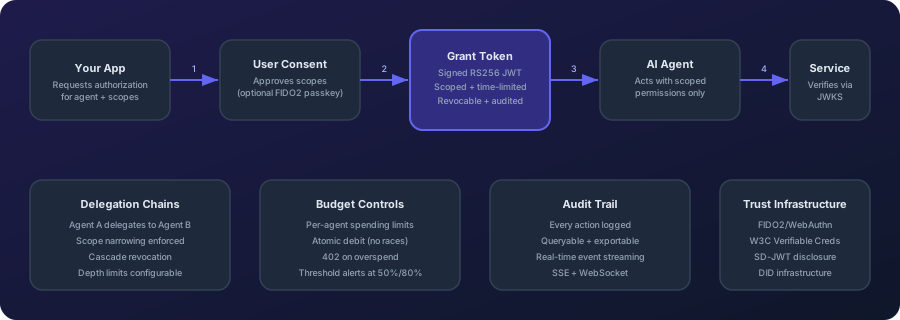
How It Works
Quickstart
1. Register your agent
import { Grantex } from '@grantex/sdk';

const grantex = new Grantex({ apiKey: process.env.GRANTEX_API_KEY });

const agent = await grantex.agents.register({
  name: 'travel-booker',
  description: 'Books flights and hotels on behalf of users',
  scopes: ['calendar:read', 'payments:initiate:max_500', 'email:send'],
});

console.log(agent.did);
// → did:grantex:ag_01HXYZ123abc...
2. Request authorization from a user
const authRequest = await grantex.authorize({
  agentId: agent.id,
  userId: 'user_abc123',       // your app's user identifier
  scopes: ['calendar:read', 'payments:initiate:max_500'],
  expiresIn: '24h',
  redirectUri: 'https://yourapp.com/auth/callback',
});

// Redirect user to authRequest.consentUrl
// Grantex handles the consent UI — plain language, mobile-first
console.log(authRequest.consentUrl);
// → https://consent.grantex.dev/authorize?req=eyJ...
3. Exchange the authorization code for a grant token
// After user approves, your redirectUri receives a `code`.
// Exchange it for a signed grant token (RS256 JWT):
const token = await grantex.tokens.exchange({
  code,                  // from the redirect callback
  agentId: agent.id,
});

console.log(token.grantToken);  // RS256 JWT — pass this to your agent
console.log(token.scopes);      // ['calendar:read', 'payments:initiate:max_500']
console.log(token.grantId);     // 'grnt_01HXYZ...'
4. Verify the token and use it
// Verify offline — no network call needed (uses published JWKS)
import { verifyGrantToken } from '@grantex/sdk';

const grant = await verifyGrantToken(token.grantToken, {
  jwksUri: 'https://api.grantex.dev/.well-known/jwks.json',
  requiredScopes: ['calendar:read'],
});
console.log(grant.principalId); // 'user_abc123'
console.log(grant.scopes);     // ['calendar:read', 'payments:initiate:max_500']

// Pass to your agent — it's now authorized
await travelAgent.run({ grantToken: token.grantToken, task: 'Book cheapest flight to Delhi on March 1' });
5. Log every action
// Inside your agent — one line, zero overhead
await grantex.audit.log({
  agentId: agent.id,
  grantId: token.grantId,
  action: 'payment.initiated',
  status: 'success',
  metadata: { amount: 420, currency: 'USD', merchant: 'Air India' },
});
6. Verify a token (service-side)
// In any service that receives agent requests — no Grantex account needed
import { verifyGrantToken } from '@grantex/sdk';

const grant = await verifyGrantToken(token, {
  jwksUri: 'https://grantex.dev/.well-known/jwks.json',  // or cache locally
  requiredScopes: ['payments:initiate'],
});
// Throws if token is expired, revoked, tampered, or missing required scopes
7. Give users control over their permissions
// Generate a short-lived link for the end-user to view & revoke agent access
const session = await grantex.principalSessions.create({
  principalId: 'user_abc123',
  expiresIn: '2h',
});
// Send session.dashboardUrl to the user via email, in-app notification, etc.
Python SDK
from grantex import Grantex, ExchangeTokenParams

client = Grantex(api_key=os.environ["GRANTEX_API_KEY"])

# Register agent
agent = client.agents.register(
    name="finance-agent",
    scopes=["transactions:read", "payments:initiate:max_100"],
)

# Authorize a user
auth = client.authorize(
    agent_id=agent.id,
    user_id="user_abc123",
    scopes=["transactions:read", "payments:initiate:max_100"],
)
# Redirect user to auth.consent_url — they approve in plain language

# Exchange the authorization code for a grant token
token = client.tokens.exchange(ExchangeTokenParams(code=code, agent_id=agent.id))

# Verify the token offline — no network call needed
from grantex import verify_grant_token, VerifyGrantTokenOptions

grant = verify_grant_token(token.grant_token, VerifyGrantTokenOptions(
    jwks_uri="https://api.grantex.dev/.well-known/jwks.json",
))
print(grant.scopes)  # ('transactions:read', 'payments:initiate:max_100')

# Log an action
client.audit.log(
    agent_id=agent.id,
    grant_id=token.grant_id,
    action="transaction.read",
    status="success",
    metadata={"account_last4": "4242"},
)
The Grant Token
Grantex tokens are standard JWTs (RS256) extended with agent-specific claims. Any service can verify them offline using the published JWKS — no dependency on Grantex at runtime:
{
  "iss": "https://grantex.dev",
  "sub": "user_abc123",
  "agt": "did:grantex:ag_01HXYZ123abc",
  "dev": "org_yourcompany",
  "scp": ["calendar:read", "payments:initiate:max_500"],
  "iat": 1709000000,
  "exp": 1709086400,
  "jti": "tok_01HXYZ987xyz",
  "grnt": "grnt_01HXYZ456def"
}
| Claim | Meaning |
|---|---|
sub |
The end-user who authorized this agent |
agt |
The agent's DID — cryptographically verifiable identity |
dev |
The developer org that built the agent |
scp |
Exact scopes granted — services should check these |
jti |
Unique token ID — used for real-time revocation |
grnt |
Grant record ID — links token to the persisted grant |
aud |
Intended audience (optional) — services should reject tokens with a mismatched aud |
Delegation claims (present on sub-agent tokens):
| Claim | Meaning |
|---|---|
parentAgt |
DID of the parent agent that spawned this sub-agent |
parentGrnt |
Grant ID of the parent grant — full delegation chain is traceable |
delegationDepth |
How many hops from the root grant (root = 0) |
Multi-Agent Delegation
Grantex supports multi-agent pipelines where a root agent spawns sub-agents with narrower scopes. Sub-agent tokens carry a full delegation chain that any service can inspect.
// Root agent has a grant for ['calendar:read', 'calendar:write', 'email:send']
// It spawns a sub-agent that only needs calendar read access

const delegated = await grantex.grants.delegate({
  parentGrantToken: rootGrantToken,   // root agent's token
  subAgentId: subAgent.id,            // sub-agent to authorize
  scopes: ['calendar:read'],          // must be ⊆ parent scopes
  expiresIn: '1h',                    // capped at parent token's expiry
});

// delegated.grantToken is a fully signed JWT with:
//   parentAgt, parentGrnt, delegationDepth = 1
# Python equivalent
delegated = grantex.grants.delegate(
    parent_grant_token=root_grant_token,
    sub_agent_id=sub_agent.id,
    scopes=["calendar:read"],
    expires_in="1h",
)
Constraints enforced by the protocol:
- Sub-agent scopes must be a strict subset of the parent's scopes — scope escalation is rejected with 400
- Sub-agent token expiry is
min(parent expiry, requested expiry)— sub-agents can never outlive their parent - Revoking a root grant cascades to all descendant grants atomically
Advanced Features
Enterprise SSO — OIDC + SAML 2.0 + LDAP with multi-IdP, JIT provisioning, and group mappingEnterprise SSO
Grantex provides full enterprise SSO support with OIDC, SAML 2.0, and LDAP protocols. Organizations can configure multiple identity provider connections, map email domains to specific IdPs, enforce SSO for all users, and automatically provision principals via JIT (Just-in-Time) provisioning.
Key capabilities:
- Multi-IdP connections — Configure multiple OIDC, SAML 2.0, and LDAP identity providers per organization
- OIDC Discovery + JWKS verification — Automatic endpoint discovery and cryptographic ID token verification
- SAML 2.0 — Full SAML response parsing with certificate-based signature verification
- LDAP / Active Directory — Direct bind authentication against LDAP directories (OpenLDAP, Active Directory, FreeIPA)
- Domain-based routing — Automatically route users to the correct IdP based on their email domain
- JIT provisioning — Auto-create or update principals on first SSO login
- Group-to-scope mapping — Map IdP groups/roles to Grantex scopes
- SSO enforcement — Require SSO authentication for all users in an organization
- Session management — Track, list, and revoke active SSO sessions
TypeScript
// Create an OIDC connection
const conn = await grantex.sso.createConnection({
  name: 'Okta Production',
  protocol: 'oidc',
  issuerUrl: 'https://mycompany.okta.com',
  clientId: 'your-client-id',
  clientSecret: 'your-client-secret',
  domains: ['mycompany.com'],
  jitProvisioning: true,
  groupAttribute: 'groups',
  groupMappings: { Engineering: ['read', 'write', 'deploy'], Admins: ['admin'] },
  defaultScopes: ['read'],
});

// Create a SAML 2.0 connection
await grantex.sso.createConnection({
  name: 'Azure AD SAML',
  protocol: 'saml',
  idpEntityId: 'https://sts.windows.net/tenant-id/',
  idpSsoUrl: 'https://login.microsoftonline.com/tenant-id/saml2',
  idpCertificate: '-----BEGIN CERTIFICATE-----\n...\n-----END CERTIFICATE-----',
  spEntityId: 'urn:grantex:mycompany',
  spAcsUrl: 'https://myapp.com/sso/callback/saml',
  domains: ['mycompany.com'],
});

// Enforce SSO for the organization
await grantex.sso.setEnforcement({ enforce: true });

// Handle OIDC callback with verified ID token
const result = await grantex.sso.handleOidcCallback({ code, state });
console.log(result.email, result.mappedScopes, result.sessionId);

// List and revoke sessions
const { sessions } = await grantex.sso.listSessions();
await grantex.sso.revokeSession(sessions[0].id);
Python
# Create an OIDC connection
conn = client.sso.create_connection(CreateSsoConnectionParams(
    name="Okta Production",
    protocol="oidc",
    issuer_url="https://mycompany.okta.com",
    client_id="your-client-id",
    client_secret="your-client-secret",
    domains=["mycompany.com"],
    jit_provisioning=True,
    group_attribute="groups",
    group_mappings={"Engineering": ["read", "write", "deploy"]},
))

# Handle OIDC callback
result = client.sso.handle_oidc_callback(SsoOidcCallbackParams(code=code, state=state))
print(result.email, result.mapped_scopes, result.session_id)
CLI
# Create a connection
grantex sso connections create --name "Okta" --protocol oidc \
  --issuer-url https://mycompany.okta.com \
  --client-id $CLIENT_ID --client-secret $CLIENT_SECRET \
  --domains mycompany.com --jit-provisioning

# List connections
grantex sso connections list

# Test connectivity
grantex sso connections test sso_01HXYZ...

# Enforce SSO
grantex sso enforce --enable
FIDO2 / WebAuthn
Grantex supports passkey-based human presence verification using the FIDO2/WebAuthn standard. When enabled, end-users prove they are physically present during the consent flow by authenticating with a passkey (biometric, security key, or platform authenticator). This raises the assurance level of every grant from "user clicked approve" to "user was cryptographically verified."
How It Works
- Developer enables FIDO — Set
fidoRequired: trueon your developer profile viaPATCH /v1/me - User registers a passkey — During the first consent flow, the user registers a FIDO2 credential (fingerprint, Face ID, YubiKey, etc.)
- User authenticates on consent — On subsequent authorization requests, the user completes a WebAuthn assertion challenge instead of a simple button click
- FIDO evidence embedded in grants — The assertion result is recorded in the grant and can be embedded in Verifiable Credentials as cryptographic proof of human presence
SDK Usage
// Enable FIDO for your developer account
await grantex.updateSettings({ fidoRequired: true, fidoRpName: 'My App' });

// Register a passkey for an end-user (called from the browser)
const options = await grantex.webauthn.registerOptions({ principalId: 'user_abc123' });
// Pass options to navigator.credentials.create() in the browser
const credential = await navigator.credentials.create({ publicKey: options });
await grantex.webauthn.registerVerify({ challengeId: options.challengeId, response: credential });

// List and manage credentials
const creds = await grantex.webauthn.listCredentials('user_abc123');
await grantex.webauthn.deleteCredential(credentialId);
# Enable FIDO for your developer account
client.update_settings(fido_required=True, fido_rp_name="My App")

# Register a passkey (server-side portion)
options = client.webauthn.register_options(principal_id="user_abc123")
# Browser performs navigator.credentials.create() and sends response back
result = client.webauthn.register_verify(challenge_id=options.challenge_id, response=credential_response)

# List and manage credentials
creds = client.webauthn.list_credentials("user_abc123")
client.webauthn.delete_credential(credential_id)
WebAuthn API Endpoints
| Method | Endpoint | Description |
|---|---|---|
POST |
/v1/webauthn/register/options |
Generate passkey registration options |
POST |
/v1/webauthn/register/verify |
Verify registration and store credential |
GET |
/v1/webauthn/credentials |
List WebAuthn credentials for a principal |
DELETE |
/v1/webauthn/credentials/:id |
Delete a credential |
POST |
/v1/webauthn/assert/options |
Generate assertion options for consent |
POST |
/v1/webauthn/assert/verify |
Verify assertion during consent |
PATCH |
/v1/me |
Update developer settings (FIDO config) |
Verifiable Credentials
Grantex can issue W3C Verifiable Credentials (VCs) alongside standard JWTs. While JWTs are optimized for real-time authorization, VCs provide a portable, tamper-proof, standards-compliant proof of authorization that can be presented to any verifier — including systems outside the Grantex ecosystem.
Why VCs Matter for Agents
In agentic commerce, an agent acting on your behalf needs to prove its authorization to third-party services that may not integrate with Grantex directly. A Verifiable Credential is a self-contained, cryptographically signed document that any party can verify using the issuer's published DID document — no API calls, no accounts, no trust relationships required.
How It Works
When exchanging an authorization code for a grant token, pass credentialFormat: "vc-jwt" to receive a Verifiable Credential alongside the standard grant token:
const result = await grantex.tokens.exchange({
  code,
  agentId: agent.id,
  credentialFormat: 'vc-jwt',   // opt-in to VC issuance
});

console.log(result.grantToken);         // standard RS256 JWT (unchanged)
console.log(result.verifiableCredential); // W3C VC-JWT
result = client.tokens.exchange(ExchangeTokenParams(
    code=code,
    agent_id=agent.id,
    credential_format="vc-jwt",
))

print(result.verifiable_credential)  # W3C VC-JWT
Credential Types
| Type | Description |
|---|---|
AgentGrantCredential |
Issued for direct grants — attests that a principal authorized an agent with specific scopes |
DelegatedGrantCredential |
Issued for delegated grants — includes the full delegation chain |
Verifying a VC
const verification = await grantex.credentials.verify(vcJwt);
console.log(verification.valid);
console.log(verification.credentialSubject);
console.log(verification.issuer); // "did:web:grantex.dev"
verification = client.credentials.verify(vc_jwt)
print(verification.valid)
print(verification.credential_subject)
Revocation via StatusList2021
Grantex implements the W3C StatusList2021 revocation mechanism. Each credential references a status list entry. When a grant is revoked, the corresponding bit in the status list is flipped, and any verifier checking the credential sees it as revoked.
// Check a specific credential's status
const cred = await grantex.credentials.get(credentialId);
console.log(cred.status); // "active" or "revoked"

// List credentials with filters
const { credentials } = await grantex.credentials.list({
  grantId: 'grnt_01HXYZ...',
  status: 'active',
});
FIDO Evidence in VCs
When FIDO is enabled and the user completes a WebAuthn assertion during consent, the VC includes a fidoEvidence field that cryptographically proves human presence at the time of authorization. This is compatible with the Mastercard Verifiable Intent specification for agentic commerce.
DID Infrastructure
Grantex publishes a W3C DID document at /.well-known/did.json (did:web:grantex.dev). This document contains the public keys used to sign Verifiable Credentials, enabling any party to verify credentials without contacting Grantex:
curl https://api.grantex.dev/.well-known/did.json
Verifiable Credentials API Endpoints
| Method | Endpoint | Description |
|---|---|---|
GET |
/v1/credentials/:id |
Retrieve a Verifiable Credential |
GET |
/v1/credentials |
List Verifiable Credentials |
POST |
/v1/credentials/verify |
Verify a VC-JWT |
GET |
/v1/credentials/status/:id |
StatusList2021 credential |
GET |
/.well-known/did.json |
W3C DID document |
MPP Agent Identity
MPP (Machine Payments Protocol) defines how AI agents pay for services via HTTP 402 flows. Grantex adds the missing identity layer: an AgentPassportCredential (W3C VC 2.0) that lets any merchant verify who authorized a payment, what the agent is allowed to buy, and how much it can spend — all in <50ms, offline-capable.
Why Agent Passports?
When an agent makes an MPP payment today, the source field is a wallet address — no human name, no organization, no authorization chain. For $0.10 API calls, nobody cares. For $500 B2B procurement, this is a compliance blocker. Visa and Mastercard are building proprietary agent identity networks (Trusted Agent Protocol, AgentPay), but these are closed and non-interoperable.
Grantex passports are the open, standards-based answer: a W3C VC 2.0 credential signed with Ed25519, carrying the full delegation chain from human to agent, with StatusList2021 revocation and a public trust registry.
How It Works
| Step | Who | What |
|---|---|---|
| 1. Issue | Human | Issues AgentPassportCredential via Grantex — W3C VC 2.0, Ed25519 signed, with categories (inference, compute), spending limit (50 USDC), and expiry (24h) |
| 2. Store | Agent | Receives and stores the passport credential |
| 3. Pay | Agent | Makes MPP payment request with Authorization: Payment header + X-Grantex-Passport: <base64url-credential> header |
| 4. Verify | Merchant | Calls verifyPassport() — checks Ed25519 signature, expiry, categories, and amount limit in <50ms using cached JWKS (no API roundtrip) |
| 5. Deliver | Merchant | Returns the resource — knows the human principal, org, and full delegation chain |
| 6. Audit | System | Every issuance, verification, and revocation is logged. Revoke anytime via StatusList2021 bit-flip |
Key insight: The passport is a self-contained W3C VC — merchants verify it offline using cached JWKS. No API call to Grantex needed after the initial key fetch.
Credential Structure
| Field | Description |
|---|---|
id |
urn:grantex:passport:<ulid> |
issuer |
did:web:grantex.dev |
credentialSubject.id |
Agent DID (did:grantex:ag_...) |
credentialSubject.humanPrincipal |
DID of the authorizing human |
credentialSubject.organizationDID |
Org DID (did:web:<domain>) |
credentialSubject.grantId |
Links to underlying Grantex grant |
credentialSubject.allowedMPPCategories |
inference, compute, data, storage, search, media, delivery, browser, general |
credentialSubject.maxTransactionAmount |
{ amount, currency } ceiling per transaction |
credentialSubject.delegationDepth |
Inherited from grant delegation chain |
credentialStatus |
StatusList2021 revocation entry |
proof |
Ed25519Signature2020 |
Issue a Passport
TypeScript:
import { Grantex } from '@grantex/sdk';

const grantex = new Grantex({ apiKey: process.env.GRANTEX_API_KEY });

const passport = await grantex.passports.issue({
  agentId: 'ag_01HXYZ...',
  grantId: 'grnt_01HXYZ...',
  allowedMPPCategories: ['inference', 'compute'],
  maxTransactionAmount: { amount: 50, currency: 'USDC' },
  paymentRails: ['tempo'],
  expiresIn: '24h',
});
// passport.passportId   → "urn:grantex:passport:01HXYZ..."
// passport.encodedCredential → base64url for X-Grantex-Passport header
cURL:
curl -X POST https://api.grantex.dev/v1/passport/issue \
  -H "Authorization: Bearer $GRANTEX_API_KEY" \
  -H "Content-Type: application/json" \
  -d '{
    "agentId": "ag_01HXYZ...",
    "grantId": "grnt_01HXYZ...",
    "allowedMPPCategories": ["inference", "compute"],
    "maxTransactionAmount": { "amount": 50, "currency": "USDC" },
    "expiresIn": "24h"
  }'
Attach to MPP Requests
import { createMppPassportMiddleware } from '@grantex/mpp';

const middleware = createMppPassportMiddleware({ passport });
const enrichedRequest = await middleware(new Request(url, init));
// enrichedRequest now has X-Grantex-Passport header
const response = await fetch(enrichedRequest);
Verify on the Merchant Side
Standalone verification:
import { verifyPassport } from '@grantex/mpp';

const verified = await verifyPassport(encodedCredential, {
  requiredCategories: ['inference'],
  maxAmount: 10,
});
// verified.humanDID        → "did:grantex:user_alice"
// verified.organizationDID → "did:web:acme.com"
// verified.allowedCategories → ["inference", "compute"]
// verified.maxTransactionAmount → { amount: 50, currency: "USDC" }
Express middleware (one-liner):
import { requireAgentPassport } from '@grantex/mpp';

app.use('/api/inference', requireAgentPassport({
  requiredCategories: ['inference'],
  maxAmount: 10,
}));
// req.agentPassport is populated on valid requests
// 403 with typed error code on invalid requests
Trust Registry
Query any organization's verified trust level — no authentication required:
curl https://api.grantex.dev/v1/trust-registry/did:web:grantex.dev
# {"organizationDID":"did:web:grantex.dev","trustLevel":"soc2","domains":["grantex.dev"]}
import { lookupOrgTrust } from '@grantex/mpp';

const record = await lookupOrgTrust('did:web:acme.com');
// record.trustLevel → "verified" | "soc2" | "basic"
// record.verificationMethod → "dns-txt" | "manual" | "soc2"
Revocation
Revoking a passport flips a StatusList2021 bit — propagates instantly:
await grantex.passports.revoke('urn:grantex:passport:01HXYZ...');
// Subsequent verifyPassport() calls return PASSPORT_REVOKED
Error Codes
| Code | HTTP | Description |
|---|---|---|
PASSPORT_EXPIRED |
403 | Credential validUntil has passed |
PASSPORT_REVOKED |
403 | StatusList2021 bit is set |
INVALID_SIGNATURE |
403 | Signature verification failed |
UNTRUSTED_ISSUER |
403 | Issuer DID not in trusted list |
CATEGORY_MISMATCH |
403 | Categories don't cover required service |
AMOUNT_EXCEEDED |
403 | Max amount below required threshold |
MISSING_PASSPORT |
403 | No X-Grantex-Passport header |
MALFORMED_CREDENTIAL |
403 | Invalid base64url or missing VC fields |
MPP Agent Identity API Endpoints
| Method | Endpoint | Auth | Description |
|---|---|---|---|
POST |
/v1/passport/issue |
API key | Issue AgentPassportCredential |
GET |
/v1/passports |
API key | List passports (filter by agentId, grantId, status) |
GET |
/v1/passport/:id |
API key | Retrieve passport by ID |
POST |
/v1/passport/:id/revoke |
API key | Revoke passport (StatusList2021) |
GET |
/v1/trust-registry/:orgDID |
None | Look up org trust record (public) |
GET |
/v1/trust-registry |
API key | List all trust records (admin) |
See packages/mpp/ for full package docs. Demo: grantex.dev/mpp-demo.
SD-JWT Selective Disclosure
Grantex supports SD-JWT (Selective Disclosure JWT) for privacy-preserving credential presentation. While a standard VC-JWT reveals all claims to every verifier, SD-JWT lets the holder choose exactly which fields to disclose — keeping everything else hidden.
Why SD-JWT?
In agentic commerce, different verifiers need different levels of information. A payment processor needs to know the agent's scopes and budget, but not the principal's identity. A compliance auditor needs the principal and timestamps, but not the scopes. SD-JWT enables minimum-disclosure presentations that satisfy each verifier's requirements without over-sharing.
How It Works
When exchanging an authorization code, pass credentialFormat: "sd-jwt" to receive an SD-JWT credential:
const result = await grantex.tokens.exchange({
  code,
  agentId: agent.id,
  credentialFormat: 'sd-jwt',   // opt-in to SD-JWT issuance
});

console.log(result.grantToken);         // standard RS256 JWT (unchanged)
console.log(result.sdJwt);              // SD-JWT with selective disclosure
result = client.tokens.exchange(ExchangeTokenParams(
    code=code,
    agent_id=agent.id,
    credential_format="sd-jwt",
))

print(result.sd_jwt)  # SD-JWT with selective disclosure
Creating a Presentation
The holder selects which claims to disclose when presenting to a verifier:
const presentation = await grantex.credentials.present({
  sdJwt: result.sdJwt,
  disclosedClaims: ['scopes', 'agentId'],   // only reveal these fields
});

// Send presentation to the verifier — they see scopes and agentId,
// but principalId, developerId, grantId, etc. remain hidden
presentation = client.credentials.present(
    sd_jwt=result.sd_jwt,
    disclosed_claims=["scopes", "agent_id"],
)
SD-JWT Format
An SD-JWT consists of: <issuer-jwt>~<disclosure1>~<disclosure2>~...~
Each disclosure is a base64url-encoded JSON array [salt, claim-name, claim-value]. The verifier can only see claims for which a disclosure is provided.
Disclosable Claims
| Claim | Description |
|---|---|
principalId |
The end-user who authorized the grant |
developerId |
The developer who owns the agent |
scopes |
The authorized scopes |
agentId |
The agent's DID |
grantId |
The grant record identifier |
issuedAt |
When the credential was issued |
expiresAt |
When the credential expires |
SD-JWT API Endpoints
| Method | Endpoint | Description |
|---|---|---|
POST |
/v1/token |
Exchange code for grant token + SD-JWT (with credentialFormat: "sd-jwt") |
POST |
/v1/credentials/verify |
Verify an SD-JWT presentation |
Budget Controls
Grantex provides per-grant budget controls that let developers cap how much an agent can spend. Budget allocations are enforced atomically — if a debit would exceed the remaining balance, it fails with a 402 INSUFFICIENT_BUDGET error. Threshold alerts fire at 50% and 80% consumption, and the remaining budget is embedded in grant tokens via the bdg JWT claim.
// Allocate a budget to a grant
const budget = await grantex.budgets.allocate({
  grantId: 'grnt_01HXYZ...',
  amount: 1000,
  currency: 'USD',
});

// Debit against the budget
const debit = await grantex.budgets.debit({
  grantId: 'grnt_01HXYZ...',
  amount: 42.50,
  description: 'Flight booking',
});
console.log(debit.remaining); // 957.50

// Check the current balance
const balance = await grantex.budgets.balance('grnt_01HXYZ...');
console.log(balance.remainingBudget);

// List all budget transactions for a grant
const { transactions } = await grantex.budgets.transactions('grnt_01HXYZ...');
# Allocate a budget to a grant
budget = client.budgets.allocate(
    grant_id="grnt_01HXYZ...",
    amount=1000,
    currency="USD",
)

# Debit against the budget
debit = client.budgets.debit(
    grant_id="grnt_01HXYZ...",
    amount=42.50,
    description="Flight booking",
)
print(debit.remaining)  # 957.50

# Check the current balance
balance = client.budgets.balance("grnt_01HXYZ...")

# List all budget transactions
transactions = client.budgets.transactions("grnt_01HXYZ...")
Budget API Endpoints
| Method | Endpoint | Description |
|---|---|---|
POST |
/v1/budget/allocate |
Create a budget allocation for a grant |
POST |
/v1/budget/debit |
Debit against a grant's budget (402 if insufficient) |
GET |
/v1/budget/balance/:grantId |
Get remaining balance for a grant |
GET |
/v1/budget/allocations |
List all budget allocations |
GET |
/v1/budget/transactions/:grantId |
List transactions and total spend for a grant |
Event Streaming
Grantex provides real-time event streaming via Server-Sent Events (SSE) and WebSocket. Subscribe to authorization lifecycle events as they happen — grant creation, revocation, token issuance, and budget threshold alerts. Events are published to both webhooks and streaming endpoints, so you can choose push or pull.
// SSE — async generator, automatically reconnects
for await (const event of grantex.events.stream()) {
  console.log(event.type);   // 'grant.created', 'token.issued', etc.
  console.log(event.data);
}

// Convenience wrapper with a callback
grantex.events.subscribe((event) => {
  if (event.type === 'budget.threshold') {
    alert(`Grant ${event.data.grantId} is at ${event.data.percentage}% budget`);
  }
});
# SSE — async generator
async for event in client.events.stream():
    print(event.type)   # 'grant.created', 'grant.revoked', etc.
    print(event.data)

# Convenience wrapper
async def handler(event):
    if event.type == "budget.exhausted":
        await revoke_grant(event.data["grant_id"])

await client.events.subscribe(handler)
Event Types
| Event | Description |
|---|---|
grant.created |
A new grant was approved by an end-user |
grant.revoked |
A grant was revoked (by user, developer, or cascade) |
token.issued |
A grant token was exchanged or refreshed |
budget.threshold |
A budget allocation crossed 50% or 80% usage |
budget.exhausted |
A budget allocation reached 0 remaining |
Event Streaming API Endpoints
| Method | Endpoint | Description |
|---|---|---|
GET |
/v1/events/stream |
SSE event stream (Bearer auth) |
GET |
/v1/events/ws |
WebSocket event stream |
Usage Metering
Grantex tracks API usage per developer — token exchanges, authorization requests, and verification calls. Use the metering API to monitor consumption, enforce plan limits, and export usage data for billing.
// Get current period usage
const usage = await grantex.usage.current();
console.log(usage.tokenExchanges);
console.log(usage.authorizations);
console.log(usage.totalRequests);

// Get usage history over the last 30 days
const { entries } = await grantex.usage.history({ days: 30 });
entries.forEach((e) => console.log(`${e.date}: ${e.totalRequests} requests`));
# Get current period usage
usage = client.usage.current()
print(usage.token_exchanges)
print(usage.total_requests)

# Get usage history over the last 30 days
history = client.usage.history(days=30)
for entry in history.entries:
    print(f"{entry.date}: {entry.total_requests} requests")
Usage Metering API Endpoints
| Method | Endpoint | Description |
|---|---|---|
GET |
/v1/usage |
Current period usage for the authenticated developer |
GET |
/v1/usage/history?days=N |
Daily usage history for the last N days |
Custom Domains
Grantex supports custom domains for white-labeling the consent UI and API endpoints. Register your domain, verify ownership via DNS TXT record, and all Grantex-hosted consent pages will be served under your brand.
// Register a custom domain
const domain = await grantex.domains.create({ domain: 'auth.yourapp.com' });
console.log(domain.verificationToken);
// → Add a DNS TXT record: _grantex-verify.auth.yourapp.com = <token>

// Verify the domain after adding the DNS record
const verified = await grantex.domains.verify(domain.id);
console.log(verified.verified); // true

// List all registered domains
const { domains } = await grantex.domains.list();

// Delete a domain
await grantex.domains.delete(domain.id);
# Register a custom domain
domain = client.domains.create(domain="auth.yourapp.com")
print(domain.verification_token)

# Verify after adding DNS TXT record
verified = client.domains.verify(domain.id)
print(verified.verified)  # True

# List all domains
domains = client.domains.list()

# Delete a domain
client.domains.delete(domain.id)
Custom Domains API Endpoints
| Method | Endpoint | Description |
|---|---|---|
POST |
/v1/domains |
Register a new custom domain |
GET |
/v1/domains |
List all registered domains |
POST |
/v1/domains/:id/verify |
Verify domain ownership via DNS TXT |
DELETE |
/v1/domains/:id |
Remove a custom domain |
Policy-as-Code
Grantex supports pluggable policy backends for fine-grained authorization decisions. In addition to the built-in policy engine, you can connect OPA (Open Policy Agent) or Cedar to evaluate authorization requests against externally managed policy bundles. Policy bundles can be synced via direct upload or triggered automatically from a git repository webhook.
// Upload a policy bundle
await grantex.policies.sync({
  format: 'opa',           // 'opa' or 'cedar'
  bundle: bundleBuffer,    // policy bundle as Buffer
});

// List policy bundles
const { bundles } = await grantex.policies.bundles();
# Upload a policy bundle
client.policies.sync(
    format="opa",
    bundle=bundle_bytes,
)

# List policy bundles
bundles = client.policies.bundles()
Supported Policy Backends
| Backend | Description | Config |
|---|---|---|
| Builtin | Default rule engine — scope matching + delegation constraints | No config needed |
| OPA | Open Policy Agent — Rego policies evaluated at POST /v1/data/grantex/authz |
POLICY_BACKEND=opa, OPA_URL=... |
| Cedar | AWS Cedar — Cedar policies evaluated at POST /v1/is_authorized |
POLICY_BACKEND=cedar, CEDAR_URL=... |
Policy-as-Code API Endpoints
| Method | Endpoint | Description |
|---|---|---|
POST |
/v1/policies/sync |
Upload a policy bundle (OPA or Cedar) |
POST |
/v1/policies/sync/webhook |
Git webhook trigger for policy sync |
GET |
/v1/policies/bundles |
List uploaded policy bundles |
Local Development
Start the full stack with one command:
git clone https://github.com/mishrasanjeev/grantex.git
cd grantex
docker compose up --build
Two API keys are seeded automatically:
| Key | Mode | Use for |
|---|---|---|
dev-api-key-local |
live | full consent flow with redirect |
sandbox-api-key-local |
sandbox | skip consent UI — get a code immediately |
Sandbox mode is designed for testing. With a sandbox key, POST /v1/authorize returns a code in the response body — no redirect required:
# Authorize + get code in one step
curl -s -X POST http://localhost:3001/v1/authorize \
  -H "Authorization: Bearer sandbox-api-key-local" \
  -H "Content-Type: application/json" \
  -d '{"agentId":"<id>","principalId":"test-user","scopes":["calendar:read"]}'
# → { ..., "sandbox": true, "code": "01J..." }

# Exchange immediately for a grant token
curl -s -X POST http://localhost:3001/v1/token \
  -H "Authorization: Bearer sandbox-api-key-local" \
  -H "Content-Type: application/json" \
  -d '{"code":"<code>","agentId":"<id>"}'
Developer portal is available at grantex.dev/dashboard — sign up or enter an API key to manage agents, grants, policies, anomalies, compliance exports, and billing from the browser.
For local development, the auth service also serves a lightweight dashboard at http://localhost:3001/dashboard.
See the self-hosting guide for production deployment guidance.
Why an Open Standard?
Grantex is built as an open protocol, not a closed SaaS product. Here's why that matters:
Model-neutral. Works with OpenAI, Anthropic, Google, Llama, Mistral — any model, any framework. No single AI provider can credibly own the authorization layer for their competitors' agents.
Framework-native. First-class integrations for LangChain, AutoGen, CrewAI, and plain code. Install one package, get Grantex in your existing stack.
Offline-verifiable. Services verify tokens using published JWKS — zero runtime dependency on Grantex infrastructure. Your agent works even if our servers are down.
Compliance-ready. The EU AI Act, GDPR, and emerging US AI regulations will mandate auditable agent actions. Grantex gives you that on day one.
Scope Naming Convention
Grantex defines a standard scope format: resource:action[:constraint]
| Scope | Meaning |
|---|---|
calendar:read |
Read calendar events |
calendar:write |
Create and modify events |
email:send |
Send emails on user's behalf |
payments:initiate:max_500 |
Initiate payments up to $500 |
files:read |
Read user files |
profile:read |
Read user profile |
Service providers implement scope definitions for their APIs. Agents declare which scopes they need. Users see plain-language descriptions, never raw scope strings.
Integrations
| Framework | Package | Install | Status |
|---|---|---|---|
| Adapters | @grantex/adapters |
npm install @grantex/adapters |
✅ Shipped |
| MCP Auth Server | @grantex/mcp-auth |
npm install @grantex/mcp-auth |
✅ Shipped |
| Gateway | @grantex/gateway |
npm install @grantex/gateway |
✅ Shipped |
| Express.js | @grantex/express |
npm install @grantex/express |
✅ Shipped |
| FastAPI | grantex-fastapi |
pip install grantex-fastapi |
✅ Shipped |
| LangChain | @grantex/langchain |
npm install @grantex/langchain |
✅ Shipped |
| AutoGen / OpenAI | @grantex/autogen |
npm install @grantex/autogen |
✅ Shipped |
| CrewAI | grantex-crewai |
pip install grantex-crewai |
✅ Shipped |
| OpenAI Agents SDK | grantex-openai-agents |
pip install grantex-openai-agents |
✅ Shipped |
| Google ADK | grantex-adk |
pip install grantex-adk |
✅ Shipped |
| Anthropic SDK | @grantex/anthropic |
npm install @grantex/anthropic |
✅ Shipped |
| Vercel AI SDK | @grantex/vercel-ai |
npm install @grantex/vercel-ai |
✅ Shipped |
| TypeScript SDK | @grantex/sdk |
npm install @grantex/sdk |
✅ Shipped |
| Python SDK | grantex |
pip install grantex |
✅ Shipped |
| Go SDK | grantex-go |
go get github.com/mishrasanjeev/grantex-go |
✅ Shipped |
| CLI | @grantex/cli |
npm install -g @grantex/cli |
✅ Shipped |
| Conformance Suite | @grantex/conformance |
npm install -g @grantex/conformance |
✅ Shipped |
| A2A Bridge (TS) | @grantex/a2a |
npm install @grantex/a2a |
✅ Shipped |
| A2A Bridge (Py) | grantex-a2a |
pip install grantex-a2a |
✅ Shipped |
| Event Destinations | @grantex/destinations |
npm install @grantex/destinations |
✅ Shipped |
| Terraform Provider | terraform-provider-grantex |
terraform { required_providers { grantex = { source = "mishrasanjeev/grantex" } } } |
✅ Shipped |
| x402 Payment Protocol | @grantex/x402 |
npm install @grantex/x402 |
✅ Shipped |
Framework Quick Examples
Express.js — grant token verification + scope-based authorization:
import express from 'express';
import { requireGrantToken, requireScopes } from '@grantex/express';

const JWKS_URI = 'https://grantex-auth-dd4mtrt2gq-uc.a.run.app/.well-known/jwks.json';

app.use('/api', requireGrantToken({ jwksUri: JWKS_URI }));
app.get('/api/calendar', requireScopes('calendar:read'), (req, res) => {
  res.json({ principalId: req.grant.principalId, scopes: req.grant.scopes });
});
FastAPI — dependency injection with scope enforcement:
from fastapi import Depends, FastAPI
from grantex import VerifiedGrant
from grantex_fastapi import GrantexAuth, GrantexFastAPIError, grantex_exception_handler

app = FastAPI()
app.add_exception_handler(GrantexFastAPIError, grantex_exception_handler)
grantex = GrantexAuth(jwks_uri="https://grantex-auth-dd4mtrt2gq-uc.a.run.app/.well-known/jwks.json")

@app.get("/api/calendar")
async def calendar(grant: VerifiedGrant = Depends(grantex.scopes("calendar:read"))):
    return {"principalId": grant.principal_id}
LangChain — scope-enforced tools + audit callbacks:
import { createGrantexTool } from '@grantex/langchain';

const tool = createGrantexTool({
  name: 'read_calendar',
  description: 'Read upcoming calendar events',
  grantToken,
  requiredScope: 'calendar:read',
  func: async (input) => JSON.stringify(await getCalendarEvents(input)),
});
// Use with any LangChain agent — scope checked offline from JWT
Vercel AI SDK — scope checked at construction time:
import { createGrantexTool } from '@grantex/vercel-ai';
import { z } from 'zod';

const tool = createGrantexTool({
  name: 'read_calendar',
  description: 'Read upcoming calendar events',
  parameters: z.object({ date: z.string() }),
  grantToken,
  requiredScope: 'calendar:read',
  execute: async (args) => await getCalendarEvents(args.date),
});
// Use with generateText, streamText, etc.
AutoGen / OpenAI function calling:
import { createGrantexFunction, GrantexFunctionRegistry } from '@grantex/autogen';

const fn = createGrantexFunction({
  name: 'read_calendar',
  description: 'Read upcoming calendar events',
  parameters: { type: 'object', properties: { date: { type: 'string' } }, required: ['date'] },
  grantToken,
  requiredScope: 'calendar:read',
  func: async (args) => await getCalendarEvents(args.date),
});

// Pass fn.definition to OpenAI, call fn.execute() when selected
CrewAI (Python):
from grantex_crewai import GrantexTool

tool = GrantexTool(
    name="read_calendar",
    description="Read upcoming calendar events",
    grant_token=grant_token,
    required_scope="calendar:read",
    func=get_calendar_events,
)
# Use with any CrewAI agent
OpenAI Agents SDK (Python):
from grantex_openai_agents import create_grantex_tool

tool = create_grantex_tool(
    name="read_calendar",
    description="Read upcoming calendar events",
    grant_token=grant_token,
    required_scope="calendar:read",
    func=get_calendar_events,
)
# Returns a FunctionTool — use with any OpenAI Agents SDK agent
Google ADK (Python):
from grantex_adk import create_grantex_tool

read_calendar = create_grantex_tool(
    name="read_calendar",
    description="Read upcoming calendar events",
    grant_token=grant_token,
    required_scope="calendar:read",
    func=get_calendar_events,
)
# Returns a plain function — pass directly to google.adk.Agent(tools=[...])
CLI (83 commands, all support --json for AI agent / scripting use):
grantex config set --url https://grantex-auth-dd4mtrt2gq-uc.a.run.app --key YOUR_API_KEY
grantex me                                            # check identity
grantex agents register --name "Bot" --description "..." --scopes email:read
grantex authorize --agent ag_... --principal [email protected] --scopes email:read
grantex tokens exchange --code <code> --agent-id ag_...
grantex tokens verify <jwt>
grantex tokens refresh --refresh-token <token> --agent-id ag_...
grantex grants delegate --grant-token <jwt> --agent-id ag_child... --scopes email:read
grantex budgets allocate --grant-id grnt_... --amount 100
grantex audit list --agent ag_...
grantex grants revoke grnt_...

# Machine-readable output for scripts and AI coding assistants
grantex --json agents list | jq '.[0].agentId'
Interactive Playground
Try the full Grantex authorization flow live in your browser — no signup required:
Walk through all 7 steps of the protocol: register an agent, authorize, exchange tokens, verify, refresh, revoke, and verify revocation. Uses sandbox mode with your API key.
Examples
| Example | Description | Run |
|---|---|---|
quickstart-ts |
Core authorization flow — register, authorize, exchange, verify, audit, revoke | npm start |
quickstart-py |
Same flow in Python | python main.py |
nextjs-starter |
Interactive Next.js app — full consent UI flow in the browser | npm run dev |
langchain-agent |
LangChain agent with scope-enforced tools | npm start |
anthropic-tool-use |
Anthropic SDK tool use with scope enforcement | npm start |
vercel-ai-chatbot |
Vercel AI SDK chatbot with Grantex tools | npm start |
crewai-agent |
CrewAI agent with Grantex authorization | python main.py |
openai-agents |
OpenAI Agents SDK integration | python main.py |
google-adk |
Google ADK agent with Grantex tools | python main.py |
gateway-proxy |
Gateway reverse proxy with YAML config and scope enforcement | npm start |
adapter-google-calendar |
GoogleCalendarAdapter with grant token verification | npm start |
multi-agent-delegation |
Parent/child delegation with cascade revocation | npm start |
Architecture
┌──────────────────────────────────────────────────────────────────────┐
│                         YOUR APPLICATION                             │
│                                                                      │
│   ┌──────────────┐    ┌──────────────┐    ┌───────────────────────┐ │
│   │  AI Agent    │    │  Grantex SDK │    │  End User Dashboard   │ │
│   │  (any model) │◄──►│  (2 lines)   │    │  (view / revoke)      │ │
│   └──────────────┘    └──────┬───────┘    └───────────────────────┘ │
└──────────────────────────────┼───────────────────────────────────────┘
                               │ HTTPS
                               ▼
┌──────────────────────────────────────────────────────────────────────┐
│                         GRANTEX PROTOCOL                             │
│                                                                      │
│  ┌─────────────┐  ┌──────────────┐  ┌─────────────┐  ┌──────────┐  │
│  │  Identity   │  │     Auth     │  │   Consent   │  │  Audit   │  │
│  │  Service    │  │   Service    │  │     UI      │  │  Chain   │  │
│  │  (DID/JWKS) │  │ (token i/o)  │  │  (hosted)   │  │ (append) │  │
│  └─────────────┘  └──────────────┘  └─────────────┘  └──────────┘  │
└──────────────────────────────────────────────────────────────────────┘
                               │
                               ▼
                ┌──────────────────────────┐
                │  Any Service / API       │
                │  Verifies via JWKS       │
                │  No Grantex dep needed   │
                └──────────────────────────┘
Roadmap
All milestones through v1.0 are complete. See ROADMAP.md for full details.
| Milestone | Highlights | Status |
|---|---|---|
| v0.1 — Foundation | Protocol spec, TypeScript & Python SDKs, auth service, consent UI, audit trail, multi-agent delegation, sandbox mode | ✅ Complete |
| v0.2 — Integrations | LangChain, AutoGen, webhooks, Stripe billing, CLI | ✅ Complete |
| v0.3 — Enterprise | CrewAI, Vercel AI, compliance exports, policy engine, SCIM/SSO, anomaly detection | ✅ Complete |
| v1.0 — Stable Protocol | Protocol spec finalized (v1.0), security audit, SOC2, standards submission | ✅ Complete |
| v2.0 — Platform | MCP Auth Server, Credential Vault, 7 new adapters, webhook delivery log, examples | ✅ Complete |
| v2.1 — Enterprise Scale | Event streaming, budget controls, observability, Terraform provider, gateway, conformance | ✅ Complete |
| v2.2 — Ecosystem | OPA/Cedar policy backends, A2A protocol bridge, usage metering, custom domains, policy-as-code | ✅ Complete |
| v2.3 — Trust & Identity | FIDO2/WebAuthn passkeys, W3C Verifiable Credentials, SD-JWT selective disclosure, DID infrastructure, StatusList2021 revocation, Mastercard Verifiable Intent | ✅ Complete |
| v2.4 — Enterprise SSO | OIDC + SAML 2.0 + LDAP multi-IdP connections, OIDC Discovery + JWKS verification, LDAP directory authentication, domain-based routing, JIT provisioning, group-to-scope mapping, SSO enforcement, session management | ✅ Complete |
Contributing
Grantex is open-source and welcomes contributions:
- Report bugs — open a GitHub Issue with reproduction steps
- Propose features — open a GitHub Discussion with your use case
- Build new integrations — add Grantex support to your favorite framework
- Improve docs — better examples, tutorials, and translations
Read CONTRIBUTING.md before submitting a PR.
Standards & Compliance
| OWASP | Covers ASI-01, ASI-03, ASI-05, ASI-10 from the Agentic Security Top 10 (Dec 2025) |
| EU AI Act | Art. 9 (risk management), Art. 13 (transparency), Art. 14 (human oversight) — binding Aug 2026 |
| NIST AI RMF | Govern 1.1, Map 5.1, Measure 2.5 — NCCoE public comment filed |
| IETF | Internet-Draft submitted to OAuth Working Group (draft-mishra-oauth-agent-grants-01) |
| AuthZEN | Conformance mapped |
| SOC 2 | Type I certification completed |
| Protocol Spec | v1.0 Final — frozen, open, Apache 2.0 |
Full compliance matrix: docs.grantex.dev/guides/compliance-matrix
Trusted By
Using Grantex in production? Open a PR to add your company here.
FAQ
Is this just another auth library?
No. Existing auth systems (Auth0, Okta, Supabase) are built for humans logging in. Grantex is built for autonomous agents acting on behalf of humans — a fundamentally different trust model with different primitives (delegation, scope chains, agent identity, real-time revocation, action audit trails).
Why not just use OAuth 2.0?
OAuth 2.0 was designed for "user grants app permission to access their data." Agents introduce new requirements: the agent needs a verifiable identity separate from its creator, grants need to be chainable across multi-agent pipelines, and every autonomous action must be attributable and auditable. We extend OAuth 2.0 concepts but add the agent-specific primitives it lacks.
What about MCP (Model Context Protocol)?
MCP solves tool connectivity — how agents access data and call functions. Grantex solves trust — proving that an agent is authorized to use those tools on behalf of a specific human. They're complementary. A Grantex-authorized agent uses MCP tools.
Who owns the standard?
The protocol spec is open (Apache 2.0). Grantex Inc. maintains a hosted reference implementation. Our goal is to contribute the spec to a neutral standards body (W3C, IETF, or CNCF) once it stabilizes.
Can I self-host?
Yes. The reference implementation is fully open-source. Docker Compose deploy in one command. See the self-hosting guide.
License
Protocol specification and SDKs: Apache 2.0
Docs · Spec · Dashboard · Self-Hosting · Roadmap · Contributing · GitHub
Building the trust layer for the agentic internet.
Reviews (0)
Sign in to leave a review.
Leave a reviewNo results found