vividoc
Health Warn
- License — License: MIT
- Description — Repository has a description
- Active repo — Last push 0 days ago
- Low visibility — Only 6 GitHub stars
Code Pass
- Code scan — Scanned 12 files during light audit, no dangerous patterns found
Permissions Pass
- Permissions — No dangerous permissions requested
No AI report is available for this listing yet.
Generate interactive educational documents from any topic — KaTeX math, custom interactions, single HTML file.
ViviDoc
Turn any topic into an explorable explanation.





Live Demo · Paper (arXiv) · PDF · Quick Start
What is ViviDoc?
ViviDoc is an LLM-powered pipeline that generates self-contained interactive HTML documents — explorable explanations — from a single topic input. Given a topic, ViviDoc designs a purpose-built visual style, plans a structured document using the SRTC Interaction Spec, and writes a single HTML file with explanatory text, KaTeX math, and interactive Canvas visualizations that open in any browser with no server.
The key insight is the SRTC specification — a four-field interaction design language (State · Render · Transition · Constraint) that separates what the learner should discover from how it's rendered. This allows an LLM to reason about pedagogy before touching code.
Accepted at ACL 2026 System Demonstrations — arXiv:2603.27991
✨ Features
- Zero-dependency output — Each document is a single
.htmlfile with embedded CSS and JS. No build step, no server. Open it in a browser. - Purpose-built visual style — ViviDoc reasons about the topic's emotional register and domain conventions (physics → monospace + dark; biology → organic + warm) to synthesize a custom visual identity per document.
- Structured interaction design — The SRTC spec (State · Render · Transition · Constraint) grounds every visualization in a pedagogical invariant — the one thing the learner must discover.
- 8 interaction categories — Grounded in empirical analysis of 482 interaction instances across 101 real-world explorable explanations (ViviBench).
- Two usage modes — Interactive Claude Code skill (
/vividoc) for zero-setup generation, or CLI pipeline for batch generation and benchmarking. - Extensible template library — Add reference cases with
/vividoc-learn <url>to distill real explorable explanations into reusable SRTC templates.
🚀 Quick Start
Option A: Claude Code skill (recommended — zero setup)
Open this repository in Claude Code. No API key needed — Claude Code is the model.
/vividoc Fourier Transform
Claude Code reasons about the topic, proposes a visual style, designs SRTC interactions, and writes the document directly. Output: outputs/fourier_transform/document.html
/vividoc-learn https://ncase.me/trust/
Fetches the page, extracts its interaction patterns and visual style into SRTC format, and saves a reusable template to benchmark/datasets/interaction_examples/.
Option B: CLI pipeline
# Install
pip install uv && uv sync

# Set API key (OpenRouter covers most models)
export OPENROUTER_API_KEY="sk-or-..."

# Generate a document
vividoc run "Fourier Transform" openrouter/google/gemini-2.5-pro
# → outputs/fourier_transform/vividoc_gemini-2.5-pro/document.html

# Stage-by-stage
vividoc plan "Fourier Transform" openrouter/google/gemini-2.5-pro -o spec.json
vividoc exec spec.json openrouter/google/gemini-2.5-pro

# With style guidance
vividoc run "Fourier Transform" openrouter/google/gemini-2.5-pro \
  --text-style "Conversational, concrete analogies" \
  --interaction-style "Dark background, neon accents, physics aesthetic"
Supported models: any openrouter/<provider>/<model> string, or anthropic/claude-* with ANTHROPIC_API_KEY.
🧠 How It Works
ViviDoc decomposes document generation into three stages:
Topic (string)
    │
    ▼  Plan
┌─────────────────────────────┐
│  Planner                    │
│  LLM → DocumentSpec         │  spec.json
│  (SRTC per knowledge unit)  │
└─────────────┬───────────────┘
              │
    ▼  Execute (per section)
┌─────────────────────────────┐
│  Executor                   │
│  Stage 1: text + KaTeX      │  HTML fragments
│  Stage 2: JS + Canvas viz   │
└─────────────┬───────────────┘
              │
    ▼  Evaluate
┌─────────────────────────────┐
│  Evaluator                  │
│  Coherence + render check   │  document.html
└─────────────────────────────┘
The SRTC Interaction Spec
Every knowledge unit has an interaction_spec with four fields:
| Field | Role |
|---|---|
| S (State) | Variables the user controls or that are derived |
| R (Render) | List of visual elements to display |
| T (Transition) | Cause → effect rules ([] = static, no interaction needed) |
| C (Constraint) | The pedagogical invariant the learner must discover |
The constraint is the design target: every visual element should be built to make it unmissable.
Interaction is not mandatory. If T = [], the executor creates a beautiful static or auto-animated visualization — static is sometimes the right answer.
🎛️ Interaction Taxonomy
ViviDoc's interaction design is grounded in 482 interaction instances across 101 real-world explorable explanations from 63 websites and 11 domains (ViviBench dataset):
| # | Category | When to use | Example |
|---|---|---|---|
| 1 | Parameter Exploration | Continuous variable has a nonlinear effect | Lorenz Attractor — σ, ρ sliders |
| 2 | State Switching | Discrete modes produce qualitatively different results | Quantum Orbitals — 1s / 2p / 3d |
| 3 | Direct Manipulation | Dragging objects; spatial relationships are the concept | Geometric Optics — drag lens/object |
| 4 | Freeform Construction | Build structure to observe emergent behavior | Neural Network — click-to-place neurons |
| 5 | Temporal Control | Concept has a time dimension; play/pause/scrub | Fourier Epicycles — play + harmonic slider |
| 6 | Inspection | Spatial structure revealed by hovering | Voronoi — hover highlights cell |
| 7 | Spatial Navigation | Inherently 3D; rotate/pan/zoom | Möbius Strip — drag to rotate 3D mesh |
| 8 | Scroll-driven Narrative | Linear progression reveals the concept | Entropy — scroll removes wall, particles mix |
Reference implementations (self-contained HTML + SRTC spec + style guide) for all 8 categories: benchmark/datasets/interaction_examples/
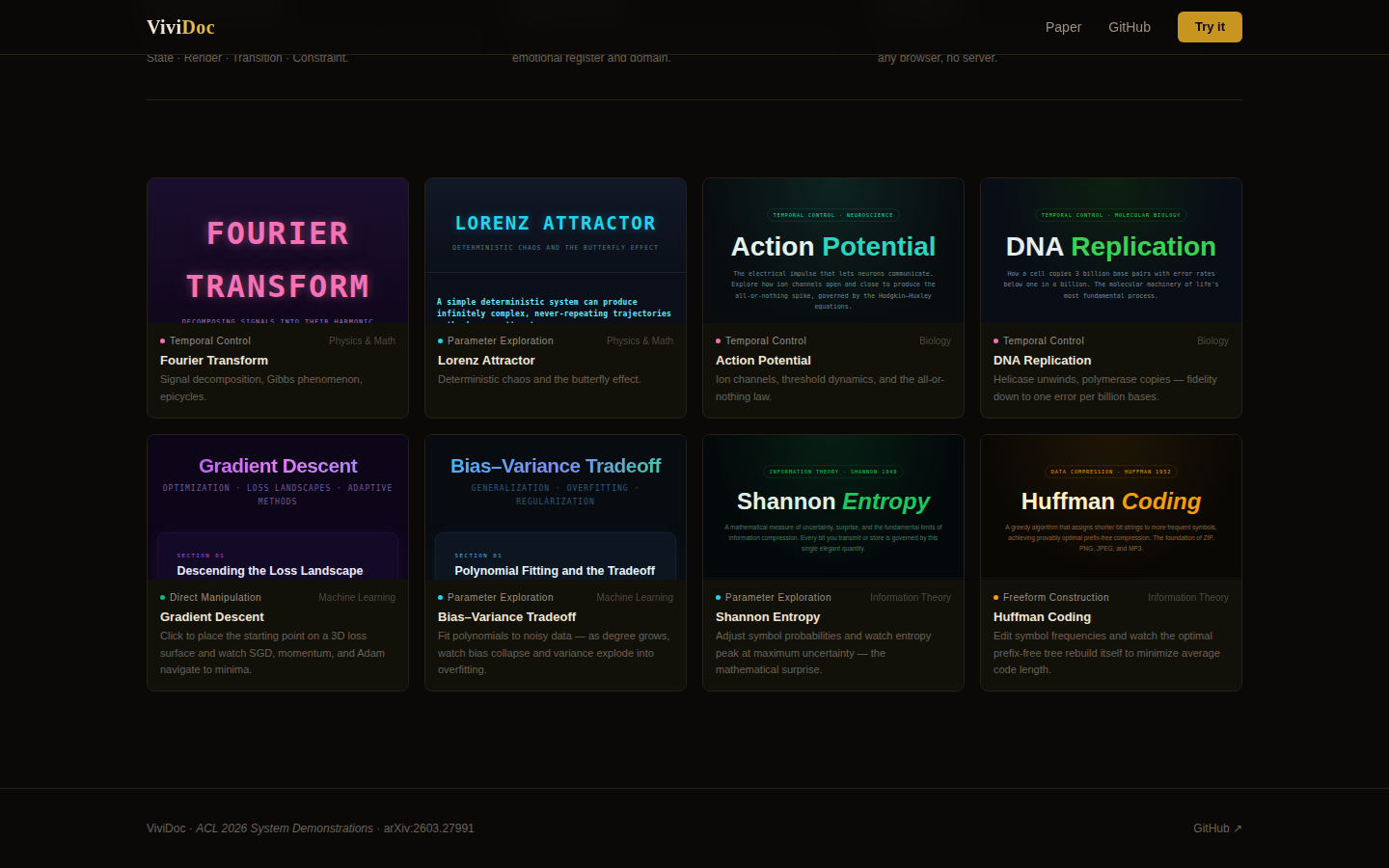
📚 Showcase
→ Browse all documents at vividoc.vercel.app
26 hand-verified documents across 10 domains, each generated by ViviDoc and reviewed for pedagogical accuracy:
Physics & Mathematics (3 documents)| Document | Interaction | Key Concept |
|---|---|---|
| Fourier Transform | Temporal Control | Epicycles, Gibbs phenomenon, signal decomposition |
| Lorenz Attractor | Parameter Exploration | Sensitive dependence, strange attractor, butterfly effect |
| Bézier Curves | Direct Manipulation | De Casteljau construction, convex hull property |
| Document | Interaction | Key Concept |
|---|---|---|
| Merge Sort | Temporal Control | Divide-and-conquer, O(n log n) guarantee |
| Neural Network | Freeform Construction | Forward propagation, activation functions |
| Voronoi Tessellation | Inspection | Nearest-neighbor partitioning, Delaunay duality |
| Document | Interaction | Key Concept |
|---|---|---|
| Action Potential | Temporal Control | Hodgkin-Huxley ion channels, all-or-nothing threshold |
| DNA Replication | Temporal Control | Helicase, polymerase fidelity, Okazaki fragments |
| Geometric Optics | Direct Manipulation | Thin lens equation, real/virtual images |
| Document | Interaction | Key Concept |
|---|---|---|
| Central Limit Theorem | Parameter Exploration | Convergence to normal, sample size effect |
| Quantum Orbitals | State Switching | Wave functions, electron probability clouds |
| Entropy | Scroll-driven Narrative | Thermodynamic irreversibility, Maxwell's demon |
| Document | Interaction | Key Concept |
|---|---|---|
| Supply & Demand | Direct Manipulation | Equilibrium, elasticity, deadweight loss |
| Black–Scholes | Parameter Exploration | Option pricing, the Greeks, IV smile |
| Prisoner's Dilemma | State Switching | Dominant strategy, iterated games, replicator dynamics |
| Document | Interaction | Key Concept |
|---|---|---|
| Double Pendulum | Direct Manipulation | Chaos, Lyapunov exponent, Poincaré section |
| Wave Interference | Parameter Exploration | Superposition, beats, standing waves |
| Spring–Mass System | Parameter Exploration | Damping regimes, resonance, phase lag |
| Document | Interaction | Key Concept |
|---|---|---|
| Reaction Kinetics | Parameter Exploration | Rate laws, Arrhenius equation, enzyme saturation |
| Molecular Orbitals | State Switching | Bonding vs antibonding, MO diagrams, HOMO-LUMO gap |
| Acid–Base Chemistry | Parameter Exploration | Henderson-Hasselbalch, titration curves, buffer capacity |
| Document | Interaction | Key Concept |
|---|---|---|
| Shannon Entropy | Parameter Exploration | Information content, source coding theorem |
| Huffman Coding | Freeform Construction | Prefix-free codes, optimal compression, entropy bound |
| Channel Capacity | Parameter Exploration | Shannon-Hartley theorem, AWGN channel, BSC |
| Document | Interaction | Key Concept |
|---|---|---|
| Gradient Descent | Direct Manipulation | Loss landscapes, optimizers (SGD/Adam), learning rate schedules |
| Bias–Variance Tradeoff | Parameter Exploration | Overfitting, regularization, model complexity |
| Document | Interaction | Key Concept |
|---|---|---|
| Time Dilation | Parameter Exploration | Lorentz factor, twin paradox, GPS corrections |
| Lorentz Transformation | Direct Manipulation | Minkowski diagram, simultaneity, length contraction |
🗂️ Repository Structure
.claude/commands/        # Claude Code skills: /vividoc and /vividoc-learn
prompts/                 # LLM prompt templates (planner, executor, evaluator, styler, video)
vividoc/
├── core/                # Pipeline stages: planner, executor, evaluator, runner, styler
│   ├── video_codegen.py # Video generation: DocumentSpec → Manim scenes
│   └── narration_gen.py # Narration synthesis from SRTC T-field keyframes
├── utils/llm/           # LLM client + provider adapters (OpenRouter, Anthropic)
└── cli.py               # CLI entry points (run, plan, exec, eval, video)
benchmark/
├── datasets/
│   ├── interaction_examples/   # 8 reference cases (HTML + SRTC spec + style guide)
│   └── prepped/                # ViviBench — 101-topic evaluation dataset
├── baselines/                  # AutoGen, CAMEL, MetaGPT, naive baselines
└── evals/                      # Automated evaluation scripts
frontend/                # React showcase (vividoc.vercel.app)
docs/                    # Design docs, video generation roadmap
examples/                # Standalone demos (Manim video generation)
🔬 Development
uv sync --dev

# Run tests
uv run pytest

# Lint
uv run ruff check . && uv run ruff format .

# Run benchmark evaluation
uv run python benchmark/run.py

# Serve showcase locally
cd frontend && npm install && npm run dev
Adding a new LLM provider
- Create
vividoc/utils/llm/callers/<provider>_caller.pyimplementingLLMCaller - Register it in
vividoc/utils/llm/caller_registry.py
Adding a reference case
/vividoc-learn https://example.com/interactive-page my-case-name
Saves to benchmark/datasets/interaction_examples/my-case-name/ with SRTC spec, HTML, and style notes. Immediately available as a template for future /vividoc runs.
📄 Citation
If you use ViviDoc in your research, please cite:
@inproceedings{tang2026vividoc,
  title     = {{ViviDoc}: Generating Interactive Documents through Human-Agent Collaboration},
  author    = {Tang, Yinghao and Xie, Yupeng and Feng, Yingchaojie and Lan, Tingfeng and Lao, Jiale and Cheng, Yue and Chen, Wei},
  booktitle = {Proceedings of the 64th Annual Meeting of the Association for Computational Linguistics: System Demonstrations},
  year      = {2026},
  url       = {https://arxiv.org/abs/2603.27991}
}
MIT License · ACL 2026 System Demonstrations · arXiv:2603.27991
Reviews (0)
Sign in to leave a review.
Leave a reviewNo results found