moo
Health Uyari
- License — License: MIT
- Description — Repository has a description
- Active repo — Last push 0 days ago
- Low visibility — Only 5 GitHub stars
Code Basarisiz
- rm -rf — Recursive force deletion command in package.json
- rm -rf — Recursive force deletion command in scripts/container-setup.sh
Permissions Gecti
- Permissions — No dangerous permissions requested
Bu listing icin henuz AI raporu yok.
An AI agent runtime, written in C.

An AI agent, written in C.
moo is a small, self-contained AI agent runtime written in C — plus the
foundation libraries it rides on. It ships as a terminal app you build from
source and run against any OpenAI-compatible endpoint (Kimi, GLM, DeepSeek,
OpenAI itself, …), with a streaming REPL, tool calls, token budgeting,
sidecar queries, and a layered memory design. An Anthropic-compatible backend
is on the roadmap — the provider layer is a vtable, adding one is a contained
change.
- Designed and reviewed by @mivinci
- Coded by CodeBuddy (VSCode plugin) with claude-opus-4.7 and GLM-5.1
Status. Active development. macOS and Linux are first-class; Windows is
on the roadmap but not a near-term priority.
Highlights
- Agent core in C —
xAgent+xAgentSession+xAgentQuery+xAgentBudgetwired together into a non-blocking, single-loop runtime.
No GC, no green threads, no hidden allocations on the hot path. - Streaming-first — SSE is decoded incrementally; every token reaches
on_textthe moment it leaves the wire. - Tool calls with confirmation — ships with a
shelltool out of the
box; the REPL prompts for confirmation before anything is executed, and
a sidecar query watches long-running commands and can talk to them
(stdin injection) if they stall. - Token budget that self-calibrates —
xAgentBudgetestimates prompt
size before each round, trims old turns underTruncateOldest, and
learns a correction factor from the provider's real usage reports. - Multi-model registry — one
models.jsondeclares every backend;/model <id>flips the active backend mid-conversation without tearing
the agent down. Today every entry is"provider": "openai"(covers any
OpenAI-compatible API);"provider": "anthropic"is planned. - Layered memory (in design) — conversation · session · agent tiers,
with JSONL persistence wired into each session. See
docs/design/layered-memory.md.
Quick Start
# 1. Configure + build the app (cli/ is off by default)
cmake -S . -B build -DCMAKE_BUILD_TYPE=Release \
      -DMOO_BUILD_APPS=ON -DX_BUILD_TESTS=OFF -DX_BUILD_BENCHMARKS=OFF
cmake --build build --parallel

# 2. First run scaffolds a models.json template into the data dir
#    (defaults to the current working directory; pass --data-dir to
#    point somewhere else, e.g. ~/.moo)
./build/cli/moo --data-dir ~/.moo
# moo will write ~/.moo/models.json on first launch, then exit with a
# "please configure me" hint. Edit the file in place.
The scaffolded models.json looks like this — fill in the angle-bracket
placeholders to enable chat:
{
  "default": "kimi",
  "max_turns": 64,
  "budget": { "context_window": 8192 },
  "models": [
    { "id": "kimi", "provider": "openai",
      "model": "kimi-k2.6",
      "api_key": "<your-api-key>",
      "base_url": "https://api.moonshot.cn/v1",
      "budget": { "context_window": 131072 } },
    { "id": "glm",  "provider": "openai",
      "model": "glm-4.5",
      "api_key": "<your-api-key>",
      "base_url": "https://open.bigmodel.cn/api/paas/v4",
      "budget": { "context_window": 131072 } }
  ]
}
Run again once models.json is filled in:
./build/cli/moo --data-dir ~/.moo
Inside the REPL, slash commands are available:
| Command | What it does |
|---|---|
/help |
Show all commands |
/model / /model <id> |
Show or switch the active model |
/tokens |
Cumulative token usage for the session |
/cancel |
Interrupt the active AI run |
/history |
Dump input history |
/clear |
Clear the terminal |
/bypass on --yes | off |
Skip tool-call confirmation for the session (--yes is mandatory to enable) |
/renderer md | raw |
Switch between markdown→ANSI and raw output |
/verbose on | off |
Toggle full vs truncated tool-output display |
/version |
Build version |
/exit |
Quit |
Tab completes slash commands. Ctrl-R is a reverse-search over history.Ctrl-C cancels an in-flight run without killing the REPL.
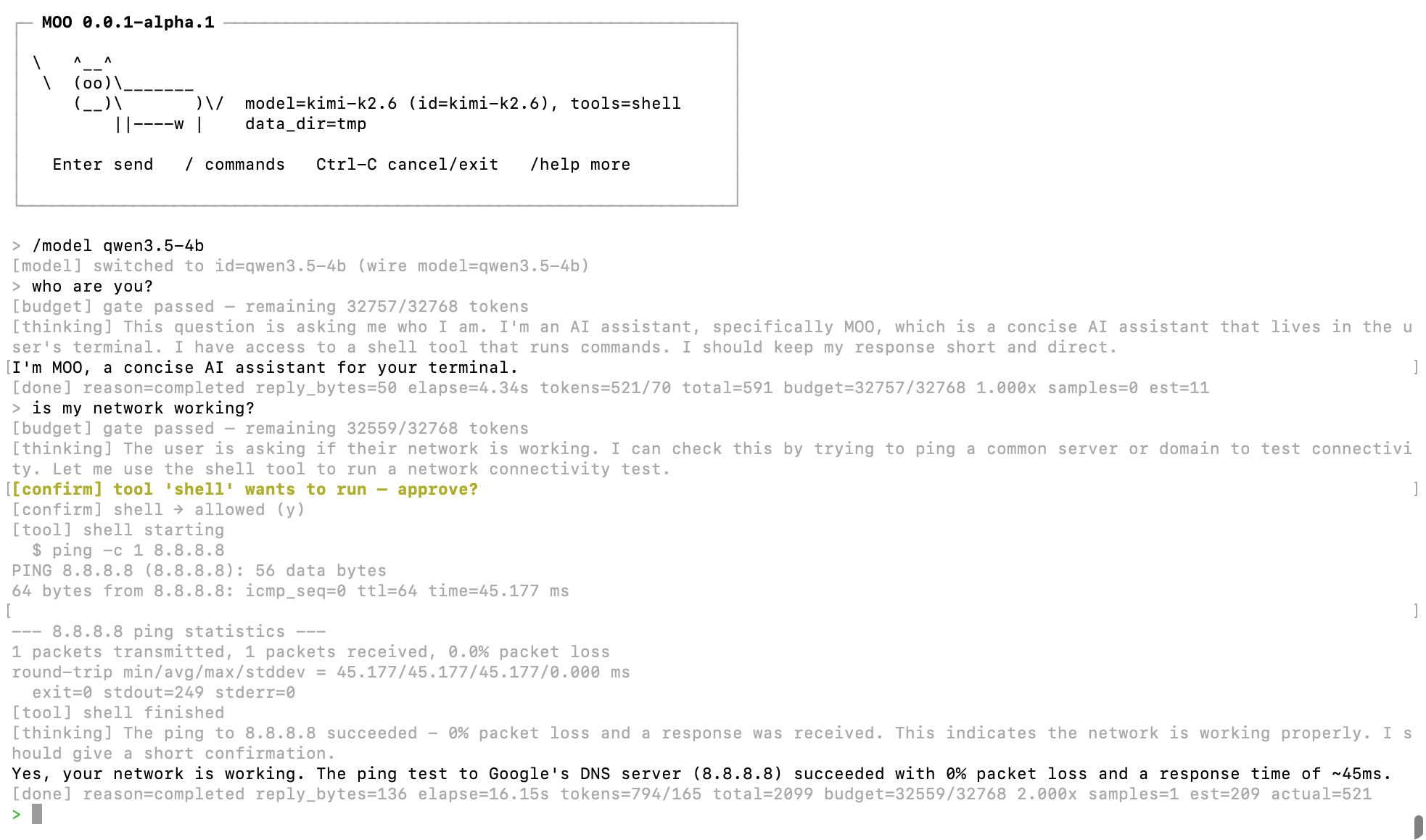
Here's what a session looks like:
Architecture
                     ┌─────────────────────────┐
                     │   cli  (the `moo`      │
                     │         REPL)           │
                     └────────────┬────────────┘
                                  │
                     ┌────────────▼────────────┐
                     │   xagent — the agent    │ ← the core
                     │  agent / session /      │
                     │  query / tool / budget  │
                     │  provider(openai)       │
                     └────────────┬────────────┘
                                  │
  ┌─────────┬─────────┬───────────┴────────┬─────────┬─────────┬─────────┐
  │ xbase   │ xbuf    │ xnet / xhttp       │ xline   │ xlog    │ xtui    │
  │ loop,   │ linear, │ DNS, TCP, TLS,     │ CJK-    │ async   │ stream  │
  │ timer,  │ ring,   │ HTTP/1.1, HTTP/2,  │ aware   │ MPSC    │ md →    │
  │ task,   │ chain   │ SSE, WebSocket     │ line    │ logger  │ ANSI    │
  │ atomic… │ bufs    │                    │ editor  │         │         │
  └─────────┴─────────┴────────────────────┴─────────┴─────────┴─────────┘

   plus xcrypto (hashes/HMAC), xjs (QuickJS-ng), xp2p / xfer
   (WebRTC + DataChannel file transfer) — supporting infra.
The agent (libx/x/agent)
| Module | Role |
|---|---|
agent.{h,c} |
Long-lived persona: provider/model, system prompt, tool set, limits. Mints sessions. |
session.{h,c} |
Stateful conversation. Owns history, runs the tool-call loop, emits on_text / on_thinking / on_tool / on_done. |
query.{h,c} |
One round-trip to the model, including streaming decode and sidecar supervision. |
message.{h,c} |
Chat-message value type with tool-call envelopes. |
model.{h,c} |
Model registry — map {id → provider + wire-model + limits}; powers runtime model switching. |
provider.{h,c} · provider_openai.c |
Backend vtable + OpenAI-compatible implementation (chat/completions, SSE). Anthropic-compatible provider planned. |
tool.{h,c} · tool_shell.{h,c} |
Tool definition ABI + a built-in shell tool with confirmation hooks. |
budget.{h,c} |
Prompt-size estimator, rolling trimmer, auto-calibrator. |
See libx/x/agent/agent.h for the entry point, anddocs/design/ for the design notes
(context budget, layered memory, three-layer conversation model).
The foundation libraries
Everything in libx/x/ outside agent/ is shared, reusable, and independently
testable — you can link any of them into your own C project without
pulling in the agent.
| Library | What you get |
|---|---|
| xbase | Event loop, timers, tasks, async sockets, lock-free structures |
| xbuf | Linear, ring, and block-chain I/O buffers |
| xnet | URL parser, async DNS, TCP, shared TLS config |
| xhttp | libcurl multi-socket client with SSE; HTTP/1.1 + HTTP/2 server; WebSocket |
| xline | CJK-aware line editor with persistent history and reverse search |
| xlog | Async MPSC logger with rotation |
| xjs | Embeddable JavaScript engine — QuickJS-ng backend, JSC-shaped API |
| xcrypto | SHA-1 / SHA-256 / MD5 / CRC-32 / HMAC |
| xp2p | ICE · STUN/TURN · SDP · DTLS · SCTP · DataChannel |
| xfer | Zero-config P2P file transfer over WebRTC DataChannel |
| xtui | Streaming markdown → ANSI transformer for terminal output |
libx++/xpp/ is an optional C++14 RAII layer over libx — Own<T>,NonNull<T>, Option<T>, Result<T, E>, and a few thin wrappers around
the C event/timer/task primitives. The C side stands on its own; pull in
libx++ only if you want the C++ ergonomics. See
libx++/xpp/.
Prerequisites
| Dependency | Required | Notes |
|---|---|---|
| CMake ≥ 3.14 | ✅ | Build system |
| C99 compiler | ✅ | GCC or Clang |
| OpenSSL or MbedTLS | ✅ (pick one) | TLS backend for xhttp and xp2p DTLS |
| libunwind | optional | Better backtraces on Linux |
Transitive deps (libcurl, llhttp, nghttp2, cJSON, usrsctp, QuickJS-ng,
libuv for benches, GoogleTest, Google Benchmark) are fetched via CMakeFetchContent when not found on the system — no manual setup required
for a first build.
Build
# Everything, Debug, with tests
cmake -S . -B build -DCMAKE_BUILD_TYPE=Debug
cmake --build build --parallel

# App only, Release
cmake -S . -B build -DCMAKE_BUILD_TYPE=Release \
      -DMOO_BUILD_APPS=ON -DX_BUILD_TESTS=OFF -DX_BUILD_BENCHMARKS=OFF
cmake --build build --parallel
Useful options:
| Option | Default | Purpose |
|---|---|---|
MOO_BUILD_APPS |
OFF |
Build cli/ (the moo CLI lives here) |
X_BUILD_TESTS |
ON |
Build unit tests |
X_BUILD_BENCHMARKS |
ON |
Build micro- and end-to-end benchmarks |
X_BUILD_EXAMPLES |
OFF |
Build example programs |
X_BUILD_STATIC |
OFF |
Build libraries as static archives |
X_TLS_BACKEND |
openssl |
TLS backend: openssl or mbedtls |
MOO_ENABLE_ASAN |
OFF |
AddressSanitizer |
X_DEBUG_LEVEL |
0 |
Debug-log verbosity (0–3) |
Test
Local (macOS / Linux)
ctest --test-dir build --output-on-failure --parallel 4
To test both TLS backends in one session, configure two build dirs and
run ctest in each:
cmake -S . -B build-openssl -DX_TLS_BACKEND=openssl && \
  cmake --build build-openssl --parallel && \
  ctest --test-dir build-openssl --output-on-failure --parallel 4

cmake -S . -B build-mbedtls -DX_TLS_BACKEND=mbedtls && \
  cmake --build build-mbedtls --parallel && \
  ctest --test-dir build-mbedtls --output-on-failure --parallel 4
Affected-modules workflow
For a faster local iteration loop, the test scripts diff against a base
ref (default origin/main) and run only the tests for changed libx
modules and their dependents:
./scripts/test-mac.sh                    # macOS, openssl, vs origin/main
./scripts/test-mac.sh -t mbedtls --all   # force-test every module, mbedTLS
./scripts/test-linux.sh --ci --base-sha <SHA>   # CI mode, native Linux
Pass --detect-only to print just the affected module names without
building or running anything.
Linux via container (macOS host)
Requires macOS 26+ with
Apple Containerization:
brew install container
container system start
./scripts/test-linux.sh            # default: gcc:14, Debug, -j2
./scripts/test-linux.sh -j4 -m 4G  # custom parallelism / memory
Benchmark
See the benchmark pages for micro-benchmarks of the
foundation libraries and end-to-end HTTP server numbers.
License
Yorumlar (0)
Yorum birakmak icin giris yap.
Yorum birakSonuc bulunamadi